Direct Answer (August 2026): Choose Microsoft Copilot ($30/user/mo) for native Office 365 app integration (Word, Excel, Outlook, Teams, SharePoint). Choose Claude ($20/mo Pro / $20–$100 Team) for superior code architecture, long-context document analysis (200k tokens), artifact creation, and custom MCP integrations.
Claude AI · Fitted Claude
Claude and Microsoft Copilot are both used for professional AI assistance, but they’re fundamentally different products solving different problems. Copilot is an AI layer built into the Microsoft 365 ecosystem — Word, Excel, PowerPoint, Teams, Outlook. Claude is a standalone AI model built for reasoning, analysis, and flexible integration. Choosing between them depends almost entirely on what you’re trying to do and where you work.
Short version: If you’re deeply embedded in Microsoft 365 and want AI assistance inside Word, Excel, and Teams — Copilot is the right tool. If you need advanced reasoning, long-document analysis, custom integrations, or you’re not primarily a Microsoft shop — Claude is stronger.
Claude vs Microsoft Copilot: Head-to-Head
Capability
Claude
Microsoft Copilot
Edge
Microsoft 365 integration
Via MCP connectors
✅ Native (Word, Excel, Teams)
Copilot
Context window
1M tokens (Sonnet/Opus)
128K tokens
Claude
Reasoning quality
✅ Stronger
Good (GPT-4o backend)
Claude
Writing quality
✅ Stronger
Good
Claude
Image generation
❌ Not included
✅ DALL-E 3 (Copilot Pro)
Copilot
Email access (Outlook)
Via Gmail MCP connector
✅ Native Outlook access
Copilot (for Outlook users)
Custom integrations
✅ Any API via MCP
Primarily M365 ecosystem
Claude
Non-Microsoft tools
✅ Flexible
Limited
Claude
Enterprise compliance (SSO, audit)
✅ Via Claude Enterprise
✅ Via Microsoft 365 governance
Tie — different ecosystems
Consumer pricing
Free tier + $20/mo Pro
Free tier + $20/mo Copilot Pro
Roughly equal
Agentic coding
✅ Claude Code
✅ GitHub Copilot (separate product)
Both — different tools
Not sure which to use?
We’ll help you pick the right stack — and set it up.
Tygart Media evaluates your workflow and configures the right AI tools for your team. No guesswork, no wasted subscriptions.
Microsoft 365 native integration. This is Copilot’s core advantage and it’s meaningful. Copilot lives inside Word, Excel, PowerPoint, Teams, and Outlook. It has native access to your Microsoft Graph data — emails, calendar, documents, meetings — and can surface relevant context from your organization’s data without you needing to copy and paste anything. If you’re working inside these applications all day, Copilot is frictionless.
Image generation. Copilot Pro includes DALL-E 3 image generation. Claude doesn’t generate images in its web interface. For workflows that combine writing and visual creation, Copilot Pro has a functional advantage.
Existing Microsoft governance. For organizations already using Microsoft Purview, Intune, and Entra ID for compliance, Copilot inherits that existing governance framework — no new vendor relationship or separate compliance work required.
What Claude Does Better
Context window. Claude’s 1M token context window is roughly 8x Copilot’s 128K. For analyzing large document stacks, lengthy contract portfolios, or extended research contexts, Claude processes significantly more at once.
Reasoning and writing quality. Copilot uses GPT-4o as its backend — capable, but Claude’s reasoning on complex tasks and writing quality on professional documents consistently rate higher in head-to-head comparisons. For strategic analysis, contract review, complex report generation, and nuanced writing — Claude is the stronger tool.
Ecosystem independence. Copilot’s value is maximized inside Microsoft’s ecosystem — and reduced significantly outside it. Claude works with any system: via the API, MCP connectors across dozens of services, or direct file upload. If your team uses Google Workspace, Notion, Slack, or a mix of tools, Claude integrates without friction. Copilot requires significant custom development to connect to non-Microsoft systems.
Flexibility for builders. Claude’s API and MCP architecture lets developers connect it to any data source or system. Copilot is primarily a user-facing product; building custom applications with it requires Microsoft’s more constrained extension model.
The Typical Enterprise Decision
Many organizations end up using both: Copilot for daily productivity tasks inside Office — drafting emails, summarizing meetings, building Excel formulas — and Claude for higher-stakes analytical work, long-document processing, and custom integrations. The tools are complementary rather than mutually exclusive.
Organizations considering switching from a full Microsoft shop to Claude should evaluate switching costs carefully. If your email, calendar, documents, and collaboration are all in Microsoft 365, Copilot’s access to that unified data graph has genuine value that Claude would need custom MCP work to replicate.
For reasoning, long-document analysis, writing quality, and flexible integrations — yes. For daily productivity inside Microsoft 365 (Word, Excel, Teams, Outlook) — Copilot is purpose-built and more frictionless. The right choice depends on where you spend most of your workday.
What’s the difference between Claude and Microsoft Copilot?
Claude is a standalone AI model from Anthropic — accessible via web, desktop, mobile, and API, with a 1M token context window and strong reasoning. Microsoft Copilot is an AI layer built into Microsoft 365, using GPT-4o as its backend, with native access to your Outlook, Teams, Word, and Excel data. Fundamentally different designs for different workflows.
Can I use both Claude and Microsoft Copilot?
Yes, and many organizations do. The common approach: Copilot for daily Office tasks (email, meetings, documents), Claude for analytical work, complex reasoning, and building custom integrations. At $20/month each, running both is $40/month — a common setup for knowledge workers.
Current flagship: Claude Opus 4.7 (claude-opus-4-7). Current models: Opus 4.7 · Sonnet 4.6 · Haiku 4.5. Claude Opus 4.7 (claude-opus-4-7) is the current flagship as of April 16, 2026. Where this article references Opus 4.6 or earlier models, those references are historical. See current model tracker →. See current model tracker →
Claude AI · Fitted Claude
Grok is xAI’s AI assistant, built by Elon Musk’s company and deeply integrated with the X (formerly Twitter) platform. Claude is Anthropic’s AI, built with a focus on safety and reasoning. They’re both frontier models — but they come from fundamentally different companies with different philosophies and different strengths. Here’s where each one wins.
Current models (April 2026): Claude Sonnet 4.6 and Opus 4.6 (Anthropic) vs Grok 4 and Grok 4.1 (xAI). Grok 4.20 — a new multi-agent architecture — was reportedly in development as of Q1 2026 but not yet publicly released.
Grok vs Claude: Direct Comparison
Grok vs Claude — direct comparison.
Capability
Grok 4 / 4.1
Claude Sonnet 4.6 / Opus 4.6
Edge
Real-time X/Twitter data
✅ Native
Via web search
Grok
Writing quality
Good
✅ Stronger
Claude
SWE-bench (coding)
~75% (Grok 4 Fast)
80.8% (Opus 4.6)
Claude Opus 4.7
Context window
~128K tokens
1M tokens (Sonnet/Opus)
Claude
API pricing (input)
~$2/M (Grok 4.1 Fast)
$3/M (Sonnet), $5/M (Opus)
Grok (cheaper)
Consumer subscription
$22/mo (X Premium+)
$20/mo (Claude Pro)
Claude (slightly cheaper)
Safety / refusal calibration
Less restrictive
✅ Constitutional AI
Depends on use case
Enterprise / compliance
Limited
✅ SSO, audit logs, BAA
Claude
Agentic coding tool
Limited
✅ Claude Code
Claude
Not sure which to use?
We’ll help you pick the right stack — and set it up.
Tygart Media evaluates your workflow and configures the right AI tools for your team. No guesswork, no wasted subscriptions.
Real-time X data. Grok’s native integration with X (Twitter) is a genuine differentiator — it can surface trending discussions, current sentiment, and breaking information from the platform in real time. If your work involves monitoring X, tracking social trends, or understanding current public discourse, this is an advantage no other model matches natively.
Cost at the API level. Grok 4.1 Fast’s API pricing runs below Claude Sonnet 4.6 on input tokens, making it attractive for high-volume workloads where cost per call is the primary consideration and you’re comfortable with the tradeoffs.
Less restrictive outputs. Grok is designed to be less filtered than Claude. For users who find Claude’s safety calibration frustrating on specific use cases, Grok may produce responses Claude declines. Whether this is an advantage depends entirely on what you’re trying to do.
What Claude Does Better
What Claude does better.
Context window. Claude Sonnet 4.6 and Opus 4.6 both have 1 million token context windows — roughly 8x Grok’s current context capacity. For long-document analysis, extended coding sessions, or large codebase comprehension, this is a meaningful operational difference.
Writing quality and instruction-following. On professional writing tasks — analysis, strategy documents, legal review, editorial content — Claude consistently produces more natural, constraint-adherent output. This is where Claude’s reputation was built and it remains a genuine advantage.
Coding benchmarks. Claude Opus 4.7 scores 80.8% on SWE-bench Verified (real-world software engineering tasks), with Sonnet 4.6 close behind at 79.6%. Grok 4 is competitive but Claude’s overall coding ecosystem — especially Claude Code — gives it a practical advantage for development workflows.
Enterprise features. Claude Enterprise offers SSO, audit logs, HIPAA BAA, configurable usage policies, and data processing agreements. Grok’s enterprise offering is less mature — meaningful for organizations with compliance requirements.
The User Base Difference
Grok’s primary audience is X users — people already on the platform who get Grok access as part of X Premium+. Claude’s primary audience is knowledge workers, developers, and enterprises who seek out a capable AI model. These different starting points shape each model’s design priorities and where each company invests in improvements.
For real-time X/Twitter data and less filtered outputs — yes. For writing quality, long-context work, coding (via Claude Code), and enterprise compliance — Claude is stronger. Neither is definitively better; they have different strengths for different workflows.
What is Grok’s advantage over Claude?
Grok’s clearest advantage is real-time X/Twitter data integration — it can access and analyze current X activity natively. Grok 4.1 Fast also runs cheaper per token than Claude Sonnet 4.6 at the API level, making it attractive for cost-sensitive high-volume workloads.
Is Grok free to use?
Grok has a free tier with limited access. Full Grok access requires X Premium+ ($22/month). Claude has a free tier with daily limits; Claude Pro is $20/month. Both have similar consumer price points with different bundling — Grok is tied to X, Claude is a standalone subscription.
Claude for Education is Anthropic’s official program for higher education institutions — a university-wide plan that gives enrolled students, faculty, and staff access to Claude’s premium features, including advanced models, learning mode, and API credits for research. It’s institution-facing, not student-facing: your university signs up, and access flows through your .edu email.
Access:claude.com/solutions/education — for institutions. If your university is already a partner, sign in to claude.ai with your .edu email and your account will be upgraded automatically.
What Claude for Education Includes
What Claude for Education includes.
Feature
What it means for your institution
Campus-wide access
Students, faculty, and staff all covered under one institutional agreement
Learning mode
Claude guides students through problems rather than just giving answers — designed to build understanding, not bypass it
API credits for research
Faculty can access the Claude API to accelerate research — dataset analysis, text processing, building learning tools
Submit your institution’s information and intended use case
Anthropic reviews and negotiates the institutional agreement
Once enrolled, students and staff access Claude by signing in with their .edu email
If you’re a student or faculty member who wants your institution to join, raise it with your IT department, library services, or educational technology office. Anthropic’s first confirmed design partner is Northeastern University (50,000 students and staff across 13 campuses worldwide), and the partner list has been expanding through 2025 and 2026.
Learning Mode: What Makes the Education Program Different
Learning Mode — what makes the education program different.
The distinctive feature of Claude for Education is learning mode — Claude’s approach shifts from answering questions to guiding students toward answers. Rather than writing the essay or solving the problem directly, Claude asks clarifying questions, prompts reflection, and helps students develop their own reasoning. Anthropic designed this explicitly to strengthen critical thinking rather than bypass it.
This is a meaningful distinction from standard Claude Pro: the same powerful model, but oriented toward building understanding rather than delivering outputs. For educators concerned about AI undermining the learning process, learning mode is Anthropic’s answer.
Claude for Education vs Claude for Research
Faculty and researchers at accredited institutions who need API access for research projects can also apply for Anthropic’s grant programs independently of the campus-wide Education plan. These grants typically provide API credits for research workloads — analyzing datasets, processing large text corpora, building research tools — rather than subscription discounts. Contact Anthropic through their research or social impact team for grant program information.
Student Programs Within the Education Ecosystem
Alongside the institutional program, Anthropic runs student-facing programs that provide individual access:
Campus Ambassadors — Selected students receive Pro access and API credits in exchange for leading AI education initiatives on campus. Applications open periodically; watch claude.com/solutions/education for current status.
Builder Clubs — Student clubs that organize hackathons and demos receive Pro access and monthly API credits. Open to all majors.
Claude for Education is Anthropic’s institutional program for universities — a campus-wide plan covering students, faculty, and staff with premium Claude access including learning mode, API credits for research, and Claude Code. It’s applied for by institutions through Anthropic’s sales team, not individual students.
How do I access Claude for Education as a student?
Sign in to claude.ai with your .edu email. If your institution is an Anthropic education partner, your account will be upgraded automatically. If not, ask your IT department or library about joining the program. Alternatively, apply for the Campus Ambassador program or join a Builder Club if available at your school.
Is Claude for Education free for students?
For students at partner institutions, yes — access is free through the institutional agreement. Anthropic and the university negotiate the pricing; it’s not passed on to individual students. For students at non-partner schools, there is no individual student pricing — the standard free and paid plans apply.
Confirmed Claude for Education Partners
The Claude for Education program has expanded significantly since launch. Confirmed institutional partners and program collaborations include:
University-Wide Campus Agreements
Northeastern University — Anthropic’s first university design partner, providing access to 50,000 students, faculty, and staff across 13 global campuses. Northeastern is collaborating directly with Anthropic on best practices for AI integration in higher education and frameworks for responsible AI adoption.
London School of Economics and Political Science (LSE) — Campus-wide rollout focused on equity of access, ethics, and skills development for students entering an AI-transformed workforce.
Champlain College — Vermont-based institution with full campus access for students, faculty, and administrators.
Multi-Institution Programs
CodePath Partnership — Anthropic partnered with CodePath, the nation’s largest provider of collegiate computer science education, to put Claude and Claude Code at the center of CodePath’s curriculum. The partnership reaches more than 20,000 students at community colleges, state schools, and HBCUs. Over 40% of CodePath students come from families earning under $50,000 a year, making this program a meaningful equity initiative. Courses include Foundations of AI Engineering, Applications of AI Engineering, and AI Open-Source Capstone.
American Federation of Teachers (AFT) — Anthropic is partnering with AFT to offer free AI training to AFT’s 1.8 million members across the United States.
Internet2 — Anthropic joined the Internet2 community and is participating in a NET+ service evaluation, working toward broader integration with research and education networks.
Instructure — Partnership to embed Claude into Canvas LMS, Instructure’s learning management system used by thousands of institutions.
International Education Initiatives
Iceland — One of the world’s first national AI education pilots, launched with the Icelandic Ministry of Education and Children, providing teachers across the country access to Claude.
Rwanda — Partnership with the Rwandan government and ALX bringing a Claude-powered learning companion to hundreds of thousands of students and young professionals across Africa.
U.S. Federal Commitment
Anthropic signed the White House’s “Pledge to America’s Youth: Investing in AI Education,” committing to expand AI education nationwide through investments in cybersecurity education, the Presidential AI Challenge, and a free AI curriculum for educators.
If your institution isn’t on this list, the program is actively expanding — application is through Anthropic’s education team at claude.com/contact-sales/education-plan.
Claude for Education vs ChatGPT Edu
Claude for Education vs ChatGPT Edu.
Anthropic’s Claude for Education and OpenAI’s ChatGPT Edu are the two major institutional AI offerings competing for higher education partnerships. Both provide campus-wide access at negotiated institutional rates rather than individual student pricing. Here’s how they compare:
Feature
Claude for Education
ChatGPT Edu
Launched
April 2025
May 2024
Pedagogical approach
Learning Mode — guides reasoning rather than providing answers directly
Columbia, Wharton, Oxford, California State University system
Data privacy default
Conversations not used for model training without explicit permission
Enterprise-grade privacy with admin controls
LMS integration
Canvas (via Instructure partnership)
Multiple LMS integrations available
Pricing
Negotiated per institution; not publicly disclosed
Negotiated per institution; not publicly disclosed
The most distinctive difference is pedagogical philosophy. Claude’s Learning Mode is purpose-built around guided reasoning — Claude is designed to ask questions, prompt students to think through problems, and develop critical thinking rather than provide direct answers. ChatGPT Edu provides the standard ChatGPT experience with administrative controls layered on top.
For institutions deciding between the two, the real evaluation criteria are usually: which model performs best for your dominant use cases (Claude tends to lead on writing, analysis, and reasoning; ChatGPT often leads on multimodal generation), which integrates better with your existing LMS, and which vendor’s pricing and contract terms work for your procurement process.
What Claude for Education Actually Costs
Anthropic does not publish standard pricing for Claude for Education. The program is sold as institutional agreements negotiated between Anthropic’s education team and the school. The factors that drive pricing typically include:
Number of users — students, faculty, and staff who will receive access
Scope of access — which Claude features, models, and tools are included
API credit allocation — for faculty research and student builder projects
Contract length — multi-year commitments often produce better per-user economics
Compliance and integration requirements — SSO, SCIM, Canvas integration, and other institutional infrastructure
For institutions sizing their budget before formal conversations, the practical reference point is what Anthropic charges enterprise customers. Anthropic’s Enterprise plan provides per-seat pricing in a similar institutional structure — though education program pricing is typically more favorable than commercial Enterprise rates given Anthropic’s strategic interest in academic adoption.
The fastest way to get accurate pricing for your institution is to contact Anthropic’s education team at claude.com/contact-sales/education-plan with your user count and use case priorities.
Building the Case for Your University to Adopt Claude for Education
If you’re a faculty member, IT administrator, or student trying to get your institution to adopt Claude for Education, the following points have been most effective in conversations with academic procurement teams:
Pedagogical Alignment
Claude’s Learning Mode is purpose-built around guided reasoning rather than answer-delivery. This addresses one of the most common faculty objections to AI in education: that students will use AI to bypass learning rather than enhance it. Learning Mode is the structural answer — Claude is designed to prompt students to think rather than think for them.
Privacy and Compliance
Anthropic provides explicit assurance that student and faculty conversations are not used for model training without permission. Security standards meet the compliance requirements typical of higher education procurement, including data residency considerations and audit controls. For institutions with FERPA requirements, the Education program is structured to support compliant deployment.
Equity of Access
Campus-wide access through institutional agreement removes the financial barrier that exists when AI tools are accessed by individual paid subscriptions. Students from lower-income backgrounds get the same access as students who could otherwise afford a $20/month Pro plan — eliminating an emerging form of academic inequality.
Research Capability
Faculty and graduate researchers gain access to API credits and the 1M token context window for processing large datasets, conducting literature reviews, analyzing research corpora, and building research tools. This is meaningful capability that would otherwise require individual API budgets.
Integration with Existing Infrastructure
The Instructure partnership for Canvas LMS integration and the Internet2 NET+ service evaluation reduce the integration burden on institutional IT teams. Claude for Education is designed to plug into the existing edtech stack rather than require a parallel system.
Practical Next Steps for Internal Advocates
Document specific use cases at your institution — what would students, faculty, and administrators actually do with Claude
Identify a faculty champion or department head willing to sponsor a pilot
Connect with your institution’s IT or educational technology office to understand procurement requirements
While Claude for Education is primarily focused on higher education institutions, Anthropic has expanded into K-12 and teacher development through several pathways:
American Federation of Teachers partnership — Free AI training for AFT’s 1.8 million teacher members. This is one of the largest teacher AI training initiatives in the U.S.
Iceland national pilot — National-scale AI education pilot with the Icelandic Ministry of Education and Children, providing classroom teachers across the country access to Claude. This is one of the world’s first national-scale AI education programs.
White House Pledge to America’s Youth — Anthropic’s commitment to expand AI education through cybersecurity education investments, the Presidential AI Challenge, and free AI curriculum for educators.
For K-12 schools and individual teachers wanting to bring Claude into the classroom, the formal Education program is currently structured around higher education. K-12 institutions interested in formal partnerships should still reach out via the Education contact channel — Anthropic has been expanding into K-12 through targeted pilots and may have programs available depending on the school’s profile.
Additional Frequently Asked Questions
Which universities have Claude for Education access?
Confirmed campus-wide partners include Northeastern University, the London School of Economics and Political Science, and Champlain College. The CodePath partnership extends Claude access to more than 20,000 students at community colleges, state schools, and HBCUs across the U.S. Internationally, Iceland and Rwanda have national-scale education partnerships. The partner list is actively expanding.
How is Claude for Education different from Claude Pro?
Claude Pro is an individual paid subscription at $20/month. Claude for Education is an institutional agreement that provides equivalent access (and often more, including API credits and Learning Mode) to all students, faculty, and staff at participating institutions. Education access is funded by the institution rather than the individual student.
Does Claude for Education include Claude Code?
Claude Code access depends on the specific institutional agreement. The CodePath partnership specifically integrates Claude Code into the curriculum, indicating that Claude Code is available within Education program agreements when negotiated. Institutions should confirm Claude Code inclusion as part of their procurement conversation.
How long does the Claude for Education evaluation process take?
The timeline varies by institution. Initial conversation through formal contract typically takes weeks to months depending on the institution’s procurement process, security review requirements, and contract complexity. Anthropic’s education team can provide a more specific timeline based on your institutional requirements.
Can community colleges and smaller institutions join Claude for Education?
Yes. The CodePath partnership specifically reaches community colleges and HBCUs, and the program is not limited to large research universities. Smaller institutions interested in the program should reach out through the same education contact channel — Anthropic’s expansion strategy is actively focused on reaching institutions that have historically been overlooked in technology partnerships.
What happens to my Claude for Education access when I graduate or leave the institution?
Access is tied to your institutional affiliation. When you’re no longer enrolled or employed at the partner institution, your account reverts to the standard Free or Pro tier (depending on whether you choose to subscribe individually). Conversations and Projects you created during your education access typically remain in your account, but premium features will require an individual subscription to continue using.
Is there a Claude for Education program for graduate students and postdocs specifically?
Graduate students and postdoctoral researchers at partner institutions are covered under the same campus-wide agreement as undergraduate students. For research-specific API credits at scale, faculty and researchers can also apply for Anthropic’s research grant programs independently of the campus-wide Education plan — these typically provide API credits for research workloads rather than subscription discounts.
How does Learning Mode actually work?
Learning Mode shifts Claude’s default response pattern from answer-delivery to guided reasoning. Instead of producing a complete solution to a problem, Claude asks clarifying questions, prompts the student to identify the next step, validates correct reasoning, and surfaces gaps in understanding. The mode is designed to support the educational goal of building student capability rather than completing assignments. Faculty can configure Learning Mode behavior at the institutional level.
Can faculty use Claude for Education for research that isn’t tied to teaching?
Yes. The program is designed to support faculty research activity in addition to classroom teaching. API credits within the institutional agreement can be allocated to faculty research projects, including data analysis, literature synthesis, research tool development, and large-scale text processing. The 1M token context window on Fable 5, Opus 4.8, and Sonnet 5 makes the program particularly useful for research workflows requiring large context.
Current flagship: Claude Opus 4.7 (claude-opus-4-7). Current models: Opus 4.7 · Sonnet 4.6 · Haiku 4.5. Claude Opus 4.7 (claude-opus-4-7) is the current flagship as of April 16, 2026. Where this article references Opus 4.6 or earlier models, those references are historical. See current model tracker →. See current model tracker →
Claude AI · Fitted Claude
The short answer is: it depends on what you mean by “smarter.” Claude and ChatGPT are both frontier AI models that perform at similar capability levels on most tasks. Where they differ is in specific strengths, how they handle uncertainty, and the kind of outputs they produce. Here’s the honest breakdown.
Bottom line: Claude and ChatGPT (GPT-4o) are competitive on most benchmarks. Claude tends to win on writing quality, instruction-following, and honesty calibration. ChatGPT tends to win on ecosystem breadth and image generation. Neither is definitively “smarter” — they have different strengths for different tasks.
Benchmark Comparison
Benchmark comparison.
Capability
Claude Sonnet 4.6
GPT-4o (ChatGPT)
Edge
Writing quality
✅ Stronger
Good
Claude
Instruction-following
✅ Stronger
Good
Claude
Coding (SWE-bench)
✅ Competitive
✅ Competitive
Roughly tied
Math reasoning
✅ Strong
✅ Strong
Roughly tied
Expressing uncertainty honestly
✅ Stronger
More confident
Claude
Context window
1M tokens
128K tokens
Claude
Image generation
❌ Not included
✅ DALL-E built in
ChatGPT
Data analysis (code interpreter)
Limited
✅ Advanced Data Analysis
ChatGPT
Hallucination rate
✅ Lower
Higher
Claude
Where Claude Is Genuinely Stronger
Where Claude is genuinely stronger.
Writing quality. Claude produces prose that reads more naturally and holds style constraints more consistently. ChatGPT has recognizable output patterns — a cadence and structure that appears even when you try to tune it away. Claude’s writing is harder to fingerprint as AI-generated.
Following complex instructions. Give both models a detailed, multi-constraint brief and Claude holds all the constraints through a long response more reliably. ChatGPT tends to gradually drift from earlier constraints as output length increases.
Honesty about uncertainty. Claude is more likely to say “I’m not sure about this” or “you should verify this” rather than confidently asserting something it doesn’t actually know. This is a calibration advantage — confident wrong answers from ChatGPT have frustrated many users who then don’t catch the error.
Long-context work. At 1M tokens vs ChatGPT’s 128K, Claude can process significantly more content in a single session — entire codebases, large document stacks, extended research contexts.
Where ChatGPT Is Genuinely Stronger
Image generation. DALL-E 3 is built into ChatGPT. Claude doesn’t generate images natively in the web interface. For visual workflows this is a real functional gap.
Code interpreter. ChatGPT’s Advanced Data Analysis runs Python in the conversation — upload a spreadsheet and get charts, analysis, and interactive data work in the same window. Claude can write code but doesn’t execute it in-chat.
Ecosystem breadth. OpenAI’s longer history means more third-party integrations, a larger community of people sharing GPT prompts, and more specialized GPTs in the store.
The Practical Answer
The practical answer.
For text-based professional work — writing, analysis, research, coding, strategy — most users find Claude to be the stronger daily driver. For visual content creation, data analysis in-chat, or workflows built around the OpenAI ecosystem, ChatGPT holds meaningful advantages. Many professionals run both and reach for whichever fits the specific task.
On writing quality, instruction-following, and honesty calibration — yes. On image generation and interactive data analysis — no. Both are competitive on reasoning and coding benchmarks. Neither is definitively smarter overall; they have different strengths for different task types.
Is Claude better than GPT-4?
Claude Sonnet 4.6 and Opus 4.6 compare to GPT-4o (the current GPT-4 model) — not the older GPT-4 Turbo. On most head-to-head comparisons, they’re competitive with Claude holding edges in writing quality and context length, and ChatGPT holding edges in image generation and data analysis tools.
Should I use Claude or ChatGPT?
Use Claude as your primary tool if your work is primarily text-based — writing, analysis, coding, research. Use ChatGPT if image generation or in-chat Python execution is central to your workflow. Many professionals use both, with Claude as the daily driver and ChatGPT for its specific capabilities.
Current flagship: Claude Opus 4.8 (claude-opus-4-8). Current models: Fable 5 · Opus 4.8 · Sonnet 5 · Haiku 4.5. Claude Fable 5 (claude-fable-5) is the current flagship, and Claude Opus 4.8 (claude-opus-4-8) is the current Opus tier, as of June 2026. Where this article references Opus 4.6 or earlier models, those references are historical. See current model tracker →. See current model tracker →
Direct Answer (August 2026): Claude.ai supports uploads up to 30MB per file and up to 5 files per message (PDFs, DOCX, CSV, TXT, images). Text documents are parsed and converted to tokens within Claude’s 200,000-token context window. For larger datasets exceeding 30MB, developers use the Anthropic API with prompt caching or local embeddings to query multi-gigabyte document repositories.
Claude AI · Fitted Claude
Claude supports file uploads in claude.ai and via the API, with specific limits on file size, page count, and number of files. Here are the exact limits for PDFs, images, and other document types, plus what to do when your file is too large.
Claude File Upload Limits (April 2026)
File type
Max file size
Page / length limit
Notes
PDF
32 MB
100 pages
Text layer required for reading. Image-only scans need OCR first.
Images (JPG, PNG, GIF, WebP)
5 MB per image
Up to 20 images per request
All current Claude models support image input.
Text files (TXT, MD, CSV)
~10 MB
Context window limit
Limited by context window, not file size.
Word / DOCX
~10 MB
Context window limit
Claude extracts text content.
Code files
Context window limit
—
No special limit beyond context window.
What Happens When a File Is Too Large
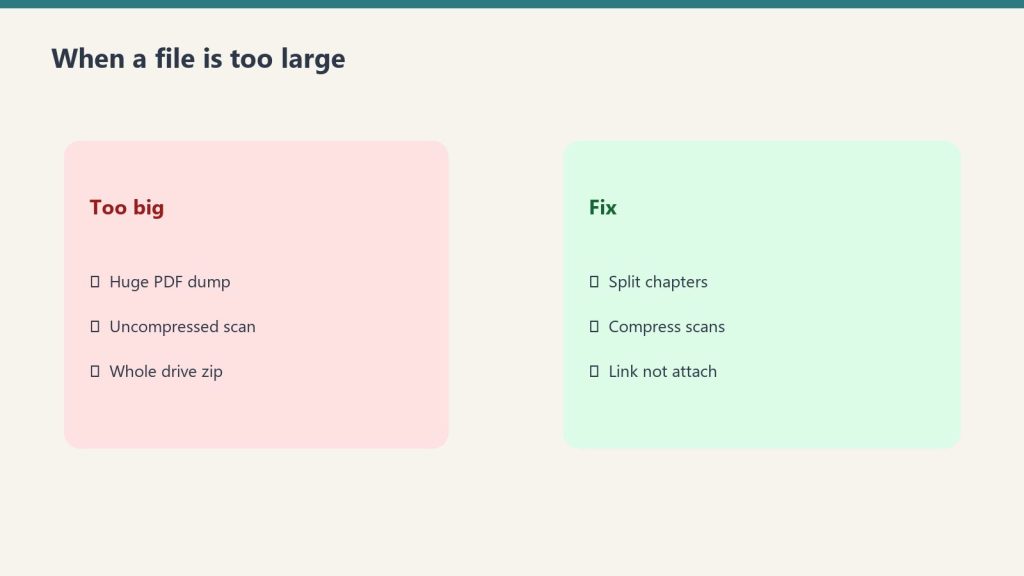
Too big? Split, compress, or link — don’t force the upload.
If a PDF exceeds 32 MB or 100 pages, Claude.ai will reject the upload with an error. The file won’t be processed. The practical workarounds:
Split the PDF. Most PDF readers and tools (Preview on Mac, Adobe, Smallpdf) can split a document into smaller sections. Upload the relevant section rather than the full document.
Compress the file. Large PDFs are often oversized due to embedded images. Use a PDF compressor to reduce file size while preserving text quality.
Copy and paste the text. For text-heavy documents, copying relevant sections directly into the chat removes the file size constraint entirely — the only limit is the context window (1M tokens for Sonnet and Opus).
Use multiple conversations. Process different sections in separate conversations and synthesize results yourself.
Context Window as the True Limit
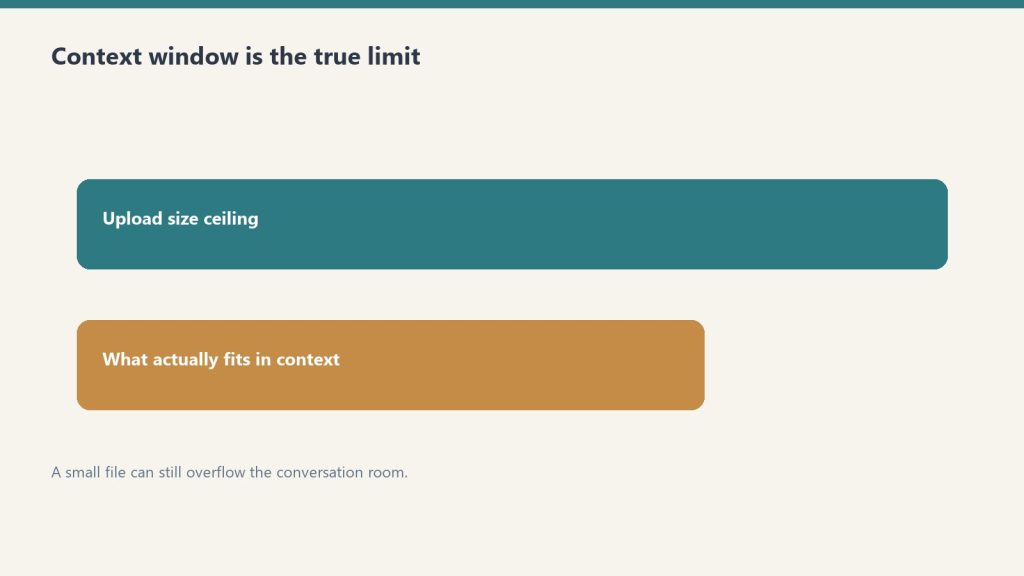
Context window is the true limit — not just the upload meter.
Even within the file size limits, the real constraint is the context window — how much text Claude can process at once. A 100-page PDF that’s text-heavy may contain 60,000–80,000 tokens. Claude Sonnet 4.6 and Opus 4.6 have a 1 million token context window, so most documents fit comfortably. Claude Haiku 4.5’s 200,000 token window is still large enough for most individual documents.
Where the context window becomes the binding constraint is when you’re uploading multiple large files simultaneously — several hundred pages of documents combined may approach context limits on Haiku.
Scanned PDFs: The Hidden Limit
Tokens still assemble the doc you uploaded — count before you paste.
File size and page count are the official limits, but there’s a functional limit that catches many users: scanned PDFs that are image-only have no text layer, so Claude can’t read their content regardless of size. A 5-page scanned document may be effectively unreadable while a 100-page digital PDF works fine. Run scanned documents through OCR software to create a text layer before uploading. See Can Claude Read PDFs? for the full breakdown.
Image Limits in Detail
Each image can be up to 5 MB, with a maximum of 20 images per API request. In Claude.ai conversations, you can upload multiple images in a single message. Claude processes images using its vision capability — all current models (Haiku 4.5, Sonnet 4.6, Opus 4.6) support image input including JPG, PNG, GIF, and WebP formats.
Frequently Asked Questions
What is the Claude file size limit?
PDFs: 32 MB and 100 pages maximum. Images: 5 MB per image, up to 20 images per request. Text files and documents: effectively limited by the context window rather than file size. These limits apply to claude.ai and the API.
What do I do if my PDF is too large for Claude?
Split the PDF into smaller sections, compress it to reduce file size, or copy and paste the relevant text directly into the conversation. Text pasted directly is only limited by the context window (1M tokens for Sonnet and Opus), not file size limits.
How many files can I upload to Claude at once?
Multiple files can be uploaded in a single conversation. The practical limit is the combined text content fitting within Claude’s context window — 1M tokens for Sonnet 4.6 and Opus 4.6, or 200K tokens for Haiku 4.5. For images, the API supports up to 20 per request.
Current models (June 2026): Fable 5 · Opus 4.8 · Sonnet 5 · Haiku 4.5. Current model tracker →
Direct Answer (August 2026): Claude features a standard 200,000-token context window (~150,000 words or 500 pages) across all tiers, with enterprise configurations extending up to 1,000,000+ tokens on select models. Maximum single-response output token limits are 8,192 tokens for Sonnet 4.6 and Opus 4.8.
Claude AI · Fitted Claude
Claude’s token limits depend on which model you’re using and whether you’re on the web interface or the API. Here are the exact numbers — context window, output limits, and what they mean in practice.
Key distinction: The context window is the total tokens Claude can process in one conversation (input + output combined). The output limit is the maximum tokens in a single response. These are different limits and both matter depending on your use case.
Claude Token Limits by Model (June 2026)
Model
Context Window
Max Output
Claude Fable 5
1,000,000 tokens
128,000 tokens
Claude Opus 4.8
1,000,000 tokens
128,000 tokens
Claude Sonnet 4.6
1,000,000 tokens
64,000 tokens
Claude Haiku 4.5
200,000 tokens
64,000 tokens
Context windows are at standard API pricing (no long-context premium). Claude Opus 4.7 and 4.6 are legacy models that match the 4.8 context limits (1M / 128K) but are no longer the recommended Opus tier — use Opus 4.8 for new projects. Outputs above ~16,000 tokens should be streamed to avoid request timeouts. The original Opus 4 and Sonnet 4 were retired on June 15, 2026 — see the deprecation guide. The asynchronous Message Batches API runs at 50% cost and supports larger per-request outputs for document-generation workloads.
What a Token Is
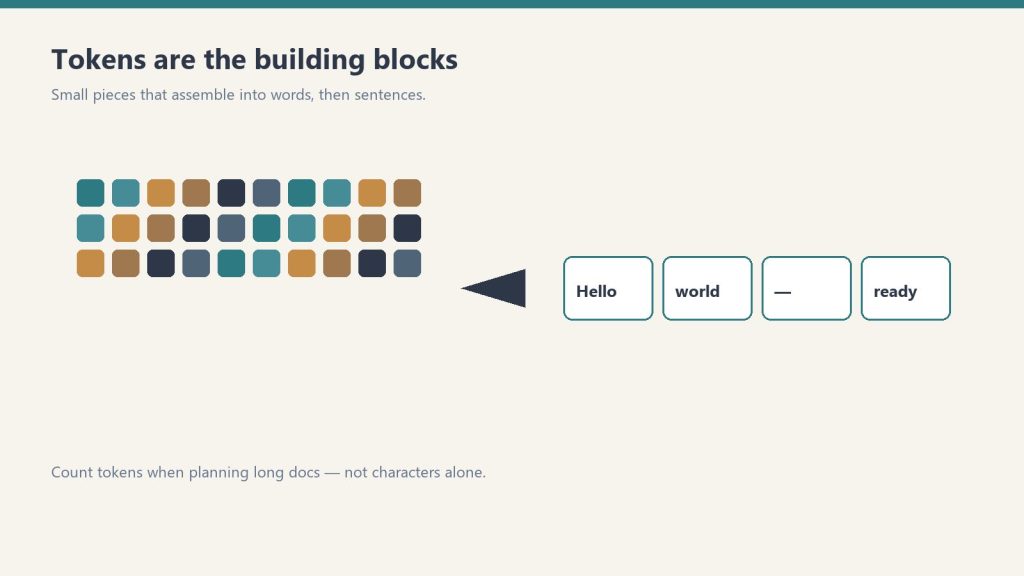
Count tokens when planning long docs — not characters alone.
A token is roughly 3–4 characters of English text — about 0.75 words. One page of text is approximately 500–700 tokens. A 200-page book is roughly 100,000–140,000 tokens.
Content
Approx. tokens
1 word
~1.3 tokens
1 page of text (~500 words)
~650 tokens
Short novel (80,000 words)
~104,000 tokens
Full codebase (10,000 lines)
~100,000–200,000 tokens
1M token context (Sonnet/Opus)
~750,000 words / ~1,500 pages
Context Window vs. Output Limit
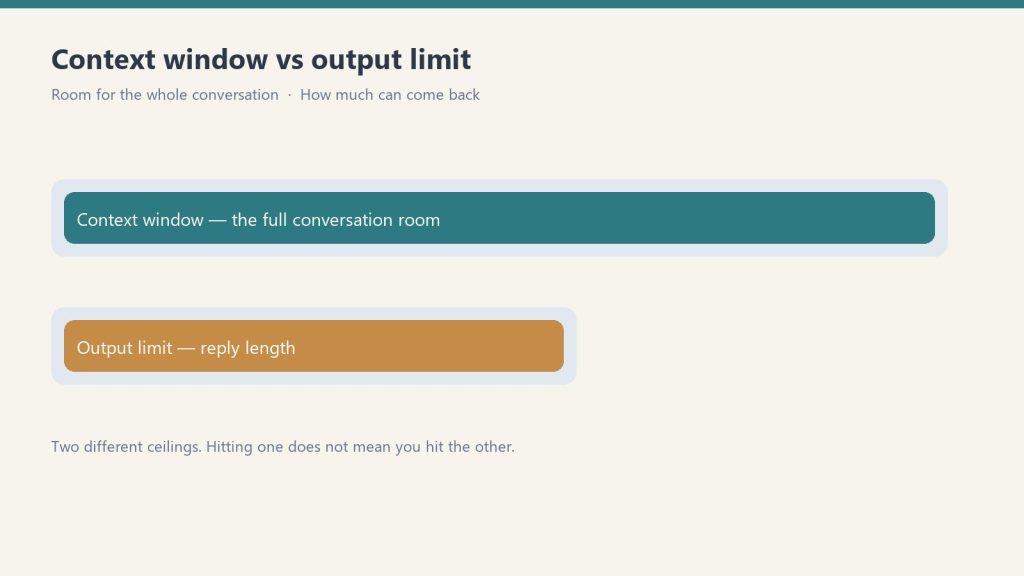
Two different ceilings. Hitting one does not mean you hit the other.
The context window is the total working memory for a session — everything Claude can “see” at once, including the system prompt, all previous messages in the conversation, uploaded files, and Claude’s own prior responses. At 1M tokens, the current models (Fable 5, Opus 4.8, Sonnet 4.6) can hold roughly 1,500 pages of text in context simultaneously.
The output limit is how long Claude’s individual response can be, and it is model-dependent: up to 128,000 tokens on Claude Opus 4.8 and Fable 5, and 64,000 tokens on Sonnet 4.6 and Haiku 4.5. Outputs above roughly 16,000 tokens should be streamed to avoid request timeouts.
Rate Limits: Separate From Token Limits
Token limits are per-conversation. Rate limits are per-time-period — how many tokens (and requests) you can send across multiple conversations in a given minute or day. Rate limits scale with your API usage tier. If you’re hitting errors in production that look like limits, check whether you’re hitting the context window, the output limit, or a rate limit — they produce different error codes. For the full rate limit breakdown, see Claude Rate Limits: What They Are and How to Work Around Them.
What Happens When You Hit the Context Limit
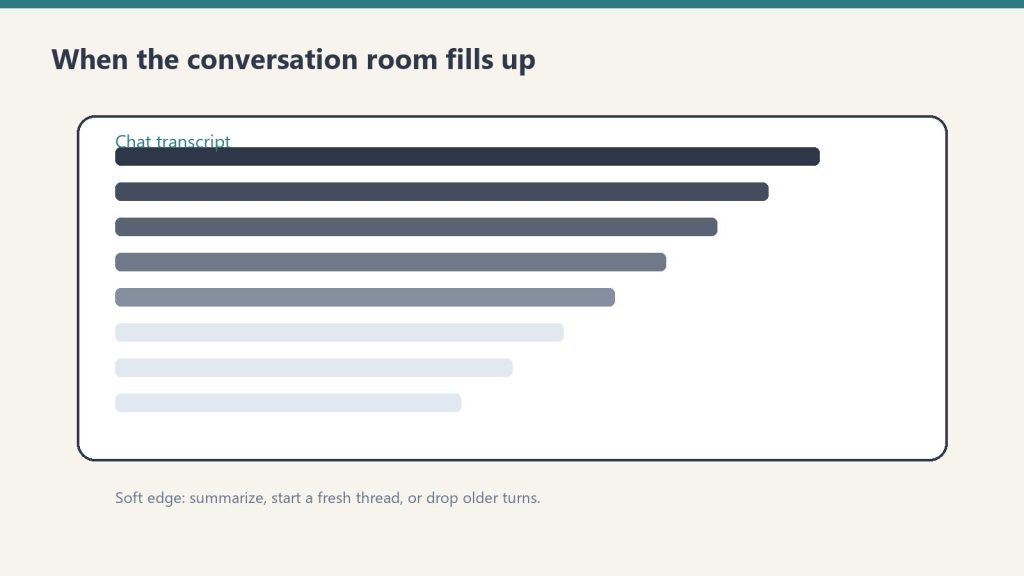
Soft edge: summarize, start a fresh thread, or drop older turns.
In claude.ai conversations, you’ll see a warning when the conversation is approaching the context window. Claude may summarize earlier parts of the conversation to stay within limits. In the API, sending more tokens than the context window allows returns an error. For very long sessions, breaking work into multiple conversations or using prompt caching (which stores static context at a discount) are the standard approaches.
Frequently Asked Questions
What is Claude’s token limit?
Claude Fable 5, Opus 4.8, and Sonnet 4.6 have a 1 million token context window. Claude Haiku 4.5 has a 200,000 token context window. Maximum output per response is model-dependent — 128,000 tokens on Opus 4.8 and Fable 5, 64,000 on Sonnet 4.6 and Haiku 4.5. These are different limits — context window is total working memory, output limit is maximum response length.
How long can Claude’s responses be?
The maximum output is model-dependent — up to 128,000 tokens on Claude Opus 4.8 and Fable 5, and 64,000 tokens on Sonnet 4.6 and Haiku 4.5 (roughly 48,000–96,000 words). Outputs above ~16,000 tokens should be streamed. In practice, claude.ai conversations have shorter limits than the raw API.
How many tokens is a page of text?
Approximately 650 tokens per page (roughly 500 words). A 200-page document is around 130,000 tokens — well within Claude’s 1M context window for Sonnet and Opus, and within Haiku’s 200K window as well.
How many tokens can Claude Opus 4.8 handle?
Claude Opus 4.8 supports a 1 million token context window for input and up to 128,000 tokens for output. This means you can feed in very large documents, entire codebases, or long conversation histories in a single request.
What happens when you hit Claude’s context window limit?
When your input exceeds Claude’s context window, the API returns an error and the request fails. In claude.ai, the interface warns you before sending. The fix is to summarize earlier conversation turns, split the input into chunks, or use a model with a larger context window.
Is Claude Haiku 4.5 context window smaller than Opus?
Yes. Claude Haiku 4.5 has a 200,000 token context window, compared to 1 million tokens for Opus 4.8 and Sonnet 4.6. For most tasks Haiku’s 200K window is sufficient, but for very long documents or large codebases, Sonnet 4.6 or Opus 4.8 is required.
Yes — Claude hallucinates. Every large language model does. The more useful question is: how often, on what types of tasks, and how does it compare to alternatives? Here’s an honest assessment of where Claude’s hallucination problem is real, where it’s overblown, and how to work with Claude in ways that minimize inaccurate outputs.
Bottom line: Claude hallucinates less than most alternatives on most benchmarks, and is more likely to express uncertainty rather than confabulate confidently. But hallucination is not eliminated — and Claude is not a reliable source for specific facts, citations, statistics, or recent events without verification.
Claude Hallucination Risk by Task Type (2026 Assessment)
Task Type
Hallucination Risk
Notes
Factual Q&A (well-known facts)
Low
High accuracy on stable, widely-documented facts
Recent events (post-training cutoff)
High
Claude’s knowledge has a cutoff — it will guess if not told
Citations & references
High
Claude may generate plausible-sounding but wrong citations
Code generation
Medium
Logic errors more common than syntax errors; always test
When source material is in context, accuracy is much higher
Legal / medical specifics
Medium-High
Use as a starting point only; verify with professionals
What Hallucination Actually Means
What hallucination actually means.
Hallucination in AI models means generating plausible-sounding but factually incorrect content. This ranges from subtle errors — slightly wrong dates, invented quotes attributed to real people — to confident fabrications of sources, studies, or events that don’t exist. The model isn’t lying; it’s producing statistically probable text that happens to be wrong.
Where Claude Hallucinates Most
Where Claude hallucinates most.
Specific citations and sources. Ask Claude to cite a paper, book, or article and it may generate a plausible-looking citation that doesn’t exist — correct author names, plausible journal, wrong or invented title. This is one of the most reliable hallucination triggers across all LLMs, Claude included.
Statistics and precise numbers. “What percentage of…” questions invite fabrication. Claude will often produce a number that sounds reasonable but has no verified source. When Claude says “studies show X%,” that number may be invented.
Recent events. Claude’s knowledge has a cutoff date. For events after that date it either refuses to answer, hedges appropriately, or — in the worst case — confabulates based on patterns from its training data.
Obscure specifics. The more niche the subject, the thinner the training data, and the higher the risk of plausible but wrong outputs. Popular topics have more training data reinforcing correct facts; obscure topics have less.
Where Claude Is More Reliable
Reasoning and logic. Claude is significantly better at catching its own errors in structured reasoning than it is at factual recall. Chain-of-thought tasks, mathematical reasoning, and logical analysis are areas where hallucination is less common.
Expressing uncertainty. One of Claude’s distinctive characteristics is that it’s more likely to say “I’m not certain about this” or “you should verify this” than to confidently assert something it’s unsure about. This calibration is better than most alternatives — though not perfect.
Well-documented topics. For widely-covered subjects with extensive training data, Claude’s factual accuracy is significantly better than for obscure ones. General knowledge, established science, and well-documented history have lower hallucination rates.
Claude vs ChatGPT on Hallucination
On most independent benchmarks, Claude hallucinates at a lower rate than GPT-4o and earlier ChatGPT models. The gap is most noticeable on citation accuracy and on resisting confident confabulation — Claude is more likely to hedge, while ChatGPT has historically been more likely to produce confident wrong answers. The practical difference in everyday use is meaningful but not night-and-day: both models hallucinate on the same types of tasks.
How to Minimize Hallucination When Using Claude
How to minimize hallucination when using Claude.
Always verify facts independently. Never trust a specific statistic, citation, date, or proper noun from Claude without checking a primary source.
Ask Claude to flag uncertainty. Add to your prompt: “If you’re not certain about something, say so.” Claude is more reliable when explicitly asked to express uncertainty.
Don’t ask for citations from memory. Instead, give Claude the source and ask it to work with what you’ve provided. Or use Claude with web search enabled to pull live information.
Use Claude for reasoning, not recall. The strongest use of Claude is reasoning about information you’ve provided, not retrieving facts from its training data.
Enable web search for current facts. Claude.ai’s web search integration significantly reduces hallucination on current events and recent data by grounding responses in retrieved content.
Frequently Asked Questions
Does Claude hallucinate?
Yes. Like all large language models, Claude produces factually incorrect content on some portion of responses. It hallucinates most on citations, specific statistics, and obscure topics. It hallucinates less on well-documented subjects and is more likely to express uncertainty than to confabulate confidently.
Is Claude more accurate than ChatGPT?
On most benchmarks, yes — Claude hallucinates at a lower rate and is better calibrated to express uncertainty when it doesn’t know something. The practical difference is meaningful but both models have significant hallucination rates on citations and specific facts. Neither should be trusted as a sole source for factual claims.
How do I stop Claude from hallucinating?
You can’t eliminate hallucination entirely, but you can minimize it. Provide your own sources rather than asking Claude to recall them. Enable web search for current facts. Ask Claude to flag uncertainty in its responses. Use Claude for reasoning about information you’ve provided rather than as a fact database. Always verify specific claims independently before using them.
⬡
Deploying Claude for your organization?
We configure Claude correctly — right plan tier, right data handling, right system prompts, real team onboarding. Done for you, not described for you.
How do I reduce Claude hallucinations in my prompts?
The most effective techniques: (1) Provide source documents in context rather than asking Claude to recall facts from memory. (2) Ask Claude to cite specific passages from the documents you provide. (3) Instruct Claude to say I don’t know rather than guess. (4) For critical outputs, prompt Claude to review its own answer for factual errors before finalizing.
Does Claude hallucinate less than GPT or Gemini?
Benchmark results vary by task and version. Claude generally scores well on factual consistency benchmarks, particularly when source documents are provided in context. However, no current LLM is hallucination-free. Independent evaluations show all frontier models hallucinate on a meaningful percentage of questions, especially on recent or obscure topics.
Can I trust Claude for medical or legal advice?
No. Claude is not a licensed medical professional or attorney. It can provide general information, but should not replace professional advice for any medical diagnosis, treatment decision, or legal strategy. Always verify with a qualified professional.
Current flagship: Claude Opus 4.7 (claude-opus-4-7). Current models: Opus 4.7 · Sonnet 4.6 · Haiku 4.5. Claude Opus 4.7 (claude-opus-4-7) is the current flagship as of April 16, 2026. Where this article references Opus 4.6 or earlier models, those references are historical. See current model tracker →. See current model tracker →
Claude AI · Fitted Claude
A Claude jailbreak is any technique designed to bypass Claude’s safety training and get it to produce content it would otherwise refuse. People search for this for different reasons — curiosity about how AI safety works, security research, or genuine attempts to exploit the model. Here’s what jailbreaking Claude actually looks like, why it’s harder than most people expect, and what happens when it does work.
The honest framing: Claude is the most safety-hardened commercial AI model available in 2026. Standard jailbreak techniques have low single-digit success rates against it. That said, no model is unbreakable — persistent, multi-turn adversarial prompting has demonstrated real-world success. Anthropic publishes its research on this openly and updates defenses continuously.
How Claude’s Safety System Works
How Claude’s safety system works.
Claude’s safety isn’t a single content filter — it’s a layered defense built into the model at training time. Anthropic uses Constitutional AI, a technique where Claude is trained against a set of principles and learns to evaluate its own outputs. The model doesn’t just pattern-match on blocked keywords; it reasons about whether a response would cause harm given the full context of the request.
On top of the trained model, Anthropic adds Constitutional Classifiers — a second layer that monitors inputs and outputs independently, trained on synthetic adversarial prompts across thousands of variations. Compared to an unguarded model, Constitutional Classifiers reduced the jailbreak success rate from 86% to 4.4% — blocking 95% of attacks that would otherwise bypass Claude’s built-in safety training.
Common Jailbreak Techniques and Why They Don’t Work Well on Claude
Persona injection (“DAN” / “do anything now”). Asking Claude to adopt an unrestricted persona — an “unfiltered AI,” a fictional character not bound by guidelines. Claude’s Constitutional AI training is robust against most direct persona injection attempts: the model declines the underlying request rather than complying through the fictional wrapper.
Roleplay framing. Wrapping harmful requests in fictional or hypothetical scenarios — “write a story where a character explains how to…” Claude evaluates the real-world impact of its outputs, not just the fictional framing. A response that would cause harm outside fiction causes the same harm inside it.
Token manipulation. Base64 encoding, unusual capitalization, Unicode substitution, and other character-level tricks to route requests past classifiers. Constitutional Classifiers are trained on these variations and handle most of them.
Reasoning framing. Presenting harmful requests as academic, research, or security-related. Claude considers whether a request is plausibly legitimate given context — a genuine security research context differs from a claim of being a researcher with no supporting context.
Where Jailbreaks Do Work
Where jailbreaks do work.
The Mexico breach in early 2026 — where an attacker used over 1,000 Spanish-language prompts, role-playing Claude as an “elite hacker” in a fictional bug bounty program, eventually causing Claude to abandon its alignment context — demonstrated that persistent multi-turn escalation can work against even hardened models. The attack succeeded not through a clever single prompt but through sustained pressure, context manipulation, and gradual escalation across a long session.
Multi-turn escalation still works at a non-trivial rate. Single-prompt jailbreaks are mostly defeated. Long sessions with gradual escalation remain a real vulnerability. Anthropic updated Claude Opus 4.6 with real-time misuse detection following the incident.
Anthropic’s Public Red-Teaming Program
Anthropic doesn’t just build defenses — it tests them publicly. Over 180 security researchers spent more than 3,000 hours over two months trying to jailbreak Claude using Constitutional Classifiers, offering a $15,000 bounty for a successful universal jailbreak. They weren’t able to find one during that period, though subsequent research has found partial techniques.
This transparency is part of Anthropic’s approach: publish the research, run public bug bounties, and update defenses based on what adversaries discover. The Constitutional Classifiers paper is publicly available and describes the methodology in full.
What Happens When Claude Gets Jailbroken
The consequences range from producing harmful content (the worst case) to simply generating off-policy responses that violate Anthropic’s usage terms. Accounts used to jailbreak Claude are banned. In the Mexico case, Anthropic banned the implicated accounts and shipped defensive updates to the model within weeks of discovery.
Using jailbreaks to extract harmful content violates Anthropic’s terms of service regardless of intent. Using jailbroken Claude to cause real-world harm — as in the Mexico case — is a criminal matter.
The Practical Alternative to Jailbreaking
The practical alternative to jailbreaking.
Most people searching for jailbreaks actually want Claude to do something specific it’s currently refusing. Claude’s refusals are mostly a context problem, not a censorship problem. Providing more context about your role, purpose, and authorization frequently resolves apparent refusals that feel like hard limits. If you’re building a product that needs capabilities beyond what the consumer interface allows, the Claude API with appropriate operator system prompts is the legitimate path — not jailbreaking.
Yes, but with difficulty. Standard single-prompt jailbreak techniques have very low success rates against Claude’s Constitutional AI training and Constitutional Classifiers. Persistent multi-turn escalation over long sessions has demonstrated real-world success. Anthropic continuously updates defenses and bans accounts used for jailbreaking.
Is jailbreaking Claude illegal?
Jailbreaking violates Anthropic’s terms of service. Using jailbreak techniques to cause real-world harm — breaching systems, generating CSAM, synthesizing weapons — is illegal regardless of the AI tool involved. Anthropic bans accounts and cooperates with law enforcement when illegal activity is discovered.
Why does Claude refuse some requests that seem harmless?
Claude evaluates requests as policies — imagining many different people making the same request and calibrating its response to the realistic distribution of intent. Some requests that are genuinely harmless get caught by this calibration. Providing more context about your specific purpose and role usually resolves these cases without needing to “jailbreak” anything.
⬡
Deploying Claude for your organization?
We configure Claude correctly — right plan tier, right data handling, right system prompts, real team onboarding. Done for you, not described for you.
Direct Answer (8 September 2026): The Anthropic Console at console.anthropic.com is where you create the API key, add prepaid credits, set spend caps, and read burn by model. claude.ai chat seats do not include API credits. Sign-in is email code or Google — same account family as platform.claude.com. There is no Microsoft or Apple login on the console. Chat lives at claude.ai; keys live here.
After the key exists, rates and current model names are on the pricing hub and the model tracker.
Also searched as anthopic / anthropic concole — same console, same API keys.
What the console is for
Section
Job
API Keys
Create, name, revoke. Optional per-key spend cap.
Billing / Credits
Add a card, buy prepaid credits, read invoices.
Usage
Tokens by model, cache hits, batch jobs.
Workbench
Test a prompt before you put it in code.
Limits
Tier (deposit-linked), requests and tokens per minute / day.
Use the live alias from the console Models page. Do not hardcode retired date-stamped IDs (the June 15, 2026 Claude 4 / 4.0 class).
Billing pitfalls that burn credits
Seat ≠ credit. Paying for Pro, Max, or Team does not add console credits.
Empty prepaid balance looks like an API outage. Check Billing first.
No spend cap on a shared key is how a loop empties the workspace overnight.
Wrong model string — Sonnet 4.6 is still billed at $3 / $15. Sonnet 5 is $2 / $10. Opus 5 is the current Opus at $5 / $25. Fable 5.1 is $10 / $50.
Prompt cache is not free by default. You set cache_control. 5-minute writes are 1.25× input; 1-hour writes are 2×; reads are 0.1× (0.025× on Fable 5.1).
Batch is 50% off and can take up to 24 hours. Do not use it for interactive chat.
Rate-limit tier follows deposited spend, not the chat plan. A new workspace starts tight. Raising the prepaid total is what moves the tier.
Workspaces are not interchangeable with claude.ai orgs. Admin on one is not admin on the other.
Claude Code and Cursor are both AI coding tools with serious developer followings — but they’re built on fundamentally different models. Cursor is an AI-powered IDE fork. Claude Code is a terminal-native agent. The right choice depends on how you work.
Short answer: Cursor wins for in-editor experience — autocomplete, inline suggestions, and staying inside VS Code’s familiar interface. Claude Code wins for autonomous multi-step tasks — it operates at the system level, can run commands, manage files across the whole project, and doesn’t require you to be watching. Most serious developers end up using both.
Claude Code vs Cursor: Head-to-Head
Claude Code vs Cursor — head-to-head.
Capability
Claude Code
Cursor
Edge
In-editor autocomplete
Limited
✅ Native
Cursor
Autonomous multi-file tasks
✅ Strong
✅ Good
Claude Code
Terminal / shell command execution
✅ Yes
Limited
Claude Code
Remote / cloud sessions
✅ Yes
—
Claude Code
VS Code compatibility
Via MCP
✅ Built on VS Code
Cursor
Model choice
Claude only
Multi-model
Cursor (flexibility)
Instruction-following precision
✅ Strong
Good
Claude Code
Price
Included in Pro ($20/mo)+
~$20/mo (Pro)
Tie
Setup complexity
Moderate
Easy
Cursor
Not sure which to use?
We’ll help you pick the right stack — and set it up.
Tygart Media evaluates your workflow and configures the right AI tools for your team. No guesswork, no wasted subscriptions.
In-editor experience. Cursor is a fork of VS Code with AI baked in — autocomplete, inline suggestions, cmd+K to edit code in place, and the full VS Code extension ecosystem. If you live in an editor and want AI suggestions as you type, Cursor is the more polished experience.
Familiar interface. If your team already uses VS Code, Cursor requires almost no adjustment. Claude Code requires getting comfortable with an agentic workflow that’s fundamentally different from autocomplete.
Multi-model flexibility. Cursor lets you choose between Claude, GPT-4o, and other models depending on the task. Claude Code is Claude-only.
What Claude Code Does Better
What Claude Code does better.
System-level autonomy. Claude Code runs commands, manages files across the entire project, executes tests, and operates at the OS level — not just inside an editor window. It can do things Cursor can’t, like run a test suite, see the results, fix the failures, and re-run without you touching anything.
Remote and background sessions. Claude Code supports remote sessions that continue on Anthropic’s infrastructure even after you close the app. Cursor requires you to be present.
Complex multi-step tasks. Agentic tasks that span many files, require running code, and iterate based on output are where Claude Code’s architecture shines. Cursor handles this through its Composer feature, but Claude Code’s terminal-native approach gives it more flexibility.
Instruction precision. On multi-constraint tasks — “refactor this to match our conventions, add error handling, keep it backward compatible, and don’t use async” — Claude Code holds all the constraints more reliably through a long operation.
Price Comparison
Claude Code is included (at limited levels) with a Claude Pro subscription at $20/month. Claude Code Pro at $100/month gives full access for developers using it as a primary tool. Cursor Pro is approximately $20/month. Both are in the same price tier for comparable usage levels.
The Practical Setup
Most developers using both tools run Cursor for in-editor work — autocomplete, inline edits, quick questions about code — and Claude Code for larger autonomous tasks: refactors, test generation across a codebase, debugging sessions that require running code. They’re complementary, not mutually exclusive.
They’re different tools. Claude Code is better for autonomous multi-step tasks, system-level operations, and complex refactors that require running code and iterating. Cursor is better for in-editor autocomplete and inline suggestions within the VS Code interface. Most serious developers use both.
Can I use Claude Code inside VS Code or Cursor?
Claude Code primarily runs as a terminal agent or through Claude Desktop’s Code tab. You can connect it to VS Code via MCP integration. Cursor has its own Claude integration built in — you can use Claude models inside Cursor without Claude Code.
How much does Cursor cost vs Claude Code?
Cursor Pro is approximately $20/month. Claude Code is included at limited levels with Claude Pro ($20/month) or at full access with Claude Code Pro ($100/month). For occasional use, Claude Pro gives you both a full Claude subscription and limited Claude Code access for the same $20.