By Will Tygart • Long-form Position • Practitioner-grade
Everything people actually ask about Claude Managed Agents, answered straight. No preamble about “the exciting world of AI agents.” If you’re here, you already know why this matters — you just need answers.
This page covers pricing, setup, capabilities, limits, comparisons, and the specific questions that don’t have obvious homes in Anthropic’s documentation. It updates as the beta evolves.
Context
Claude Managed Agents launched April 8, 2026 as a public beta. All answers reflect current documentation as of April 2026. Beta details change — verify specifics at platform.claude.com/docs.
Pricing Questions
What does Claude Managed Agents cost?
Two charges: standard Claude API token rates (same as calling the Messages API directly) plus $0.08 per session-hour of active runtime. That’s the complete formula. See the complete pricing reference for worked examples by workload type.
What exactly is a “session-hour” and when does it start billing?
A session-hour is one hour of active session runtime — time when your session’s status is running. Billing is metered to the millisecond. It does not accrue during idle time, time waiting for your input, time waiting for tool confirmations, or after session termination.
What’s included in the $0.08/session-hour charge?
The session runtime charge covers Anthropic’s managed infrastructure: sandboxed code execution containers, state management, checkpointing, tool orchestration, error recovery, and scaling. You are not separately billed for container hours on top of session runtime.
Does the $0.08/hr apply even if my agent is just waiting?
No. Time spent waiting for your message, waiting for tool confirmations, or sitting idle does not accumulate runtime charges. Only active execution time counts.
What does web search cost inside a Managed Agents session?
$10 per 1,000 searches ($0.01 per search), billed separately from session runtime and token costs. This is the same rate as web search through the standard API.
Are there volume discounts?
Yes, negotiated case-by-case for high-volume users. Contact [email protected] or through the Claude Console.
How does Managed Agents pricing compare to running my own agent infrastructure?
The $0.08/session-hour is almost always cheaper than equivalent provisioned compute — but you trade infrastructure control and data locality for that simplicity. For a full comparison: Build vs. Buy: The Real Infrastructure Cost.
What’s the real monthly cost if I run an agent 24/7?
Maximum theoretical session runtime: 24 hrs × $0.08 × 30 days = $57.60/month. In practice, no production agent has zero idle time. Token costs become the dominant cost driver long before you hit the runtime ceiling. Detailed breakdown: The Real Monthly Cost of Running Claude Managed Agents 24/7.
Setup and Access Questions
How do I get access to Claude Managed Agents?
Available to all Anthropic API accounts in public beta — no separate signup. You need the managed-agents-2026-04-01 beta header in your API requests. The Claude SDK adds this header automatically.
Does it work with my existing API key?
Yes. Same API key you’re already using for the Messages API. Same authentication. The beta header is the only new requirement.
What three ways can I access Managed Agents?
Via the Claude SDK (recommended — handles the beta header automatically), via direct API calls with the beta header, or via the Claude Console’s new Managed Agents section for no-code agent configuration and session tracing.
Can I use Managed Agents through AWS Bedrock or Google Vertex AI?
Managed Agents runs on Anthropic-managed infrastructure. This is distinct from Bedrock and Vertex AI deployments. Check Anthropic’s current documentation for multi-cloud availability status — this is an area of active development.
Capability Questions
What can Claude Managed Agents actually do?
Run long autonomous sessions with persistent state, execute code in sandboxed Linux containers, use tools including web search and MCP servers, coordinate multiple Claude instances via Agent Teams, and maintain checkpoints for crash recovery. The session can last minutes or hours without you staying in the loop.
What’s the difference between Agent Teams and subagents?
Agent Teams coordinate multiple Claude instances with independent contexts, direct agent-to-agent communication, and a shared task list — suited for complex parallel tasks. Subagents operate within the same session as the main agent and only report results upward — more economical for sequential targeted tasks but less capable of true parallelism.
Does it support MCP servers?
Yes. MCP servers can be integrated as tool sources in Managed Agents sessions, extending what the agent can access and act on.
How long can a session run?
Anthropic’s documentation currently references session durations of minutes to hours. Claude Code’s longest autonomous sessions have reached 45 minutes. Managed Agents is architected for longer-running work. Check current documentation for specific session duration limits as the beta matures.
What happened to Claude Code — is it the same as Managed Agents?
No. Claude Code is a separate local coding workflow product. Anthropic’s docs explicitly note partners should not conflate the two. Managed Agents is a hosted API runtime service. Claude Code is a developer tool. Different products, different use cases, different billing.
Rate Limit Questions
What are the rate limits for Managed Agents?
60 requests per minute for create endpoints; 600 requests per minute for read endpoints. Organization-level API limits still apply on top of these. For higher limits, contact Anthropic enterprise sales. Detailed breakdown: Claude Managed Agents Rate Limits Explained.
Do standard Claude API rate limits still apply inside a session?
Organization-level limits apply. The session runtime and create/read endpoint limits are Managed Agents-specific. If you’re running many parallel Agent Teams, model token throughput limits will become relevant.
Comparison Questions
How does Managed Agents compare to OpenAI’s Agents API?
Both offer hosted agent infrastructure. Key differences: Managed Agents is Claude-native (no multi-model flexibility), sessions bill on runtime + tokens vs. OpenAI’s different pricing model, and lock-in dynamics differ. Full comparison: Claude Managed Agents vs. OpenAI Agents API.
Should I use Managed Agents or the Claude Agent SDK?
Use Managed Agents when you want Anthropic to host the runtime — less infrastructure work, faster to production. Use the SDK when you need tighter loop control, on-premise execution, or multi-cloud flexibility. Anthropic’s own migration docs draw this line clearly: SDK runs in your environment; Managed Agents runs in theirs.
What companies are already using Managed Agents in production?
Notion, Asana, Rakuten, Sentry, and Vibecode were launch partners. Rakuten deployed five enterprise agents within a week. Allianz is using Claude for insurance agent workflows. Anthropic’s run-rate from the agent developer segment exceeds $2.5 billion. How Rakuten did it in a week →
Data and Security Questions
Where does my data go when running in Managed Agents?
Execution runs on Anthropic’s infrastructure. This is the explicit trade-off: you get managed infrastructure; they manage the compute. For companies with strict data sovereignty requirements, this is the key constraint to evaluate. On-premise or native multi-cloud deployment is not currently available.
What are the sandboxing guarantees?
Anthropic uses disposable Linux containers — “decoupled hands” in their terminology. Each container is a fresh sandboxed environment for code execution. State persistence is managed separately from the execution environment.
Strategic Questions
Is this a bet worth making?
That depends on your switching cost tolerance. Lock-in is real: once your agents run on Anthropic’s infrastructure with their tools, session format, and sandboxing, switching providers isn’t trivial. The counter-argument: the infrastructure you’d otherwise build to match this is months of engineering. One developer’s reaction at launch was blunt: “there goes a whole YC batch.” That captures both the opportunity and the risk. Our take on why we’re staying our course →
What does this mean for AI citation and visibility?
Agents running on Anthropic’s infrastructure make decisions about what content to surface, cite, and synthesize. As agent workloads grow, being present in the knowledge sources agents draw from becomes a search strategy question in itself. What AI citation monitoring looks like →
Anthropic introduced Dreaming at Code w/ Claude (May 6, 2026) — a new Managed Agents capability where agents review their own session history overnight to improve future performance. Harvey (legal AI) reported a roughly 6× task completion rate increase after implementing it. Dreaming is developer-access preview only. Multiagent Orchestration and Outcomes are now in public beta. See the new Dreaming section below.
What Is Claude Managed Agents? (Current Status, May 2026)
Claude Managed Agents is Anthropic’s framework for long-running, stateful AI agents — agents that can maintain context across sessions, hand off between sub-agents, and now, improve themselves by reviewing their own work history. Here’s the current status of each component:
Component
Status
Who Has Access
Multiagent Orchestration
Public Beta
All API developers
Outcomes
Public Beta
All API developers
Dreaming
Developer Preview
Selected developers only
Dreaming: The Feature the Press Mostly Missed
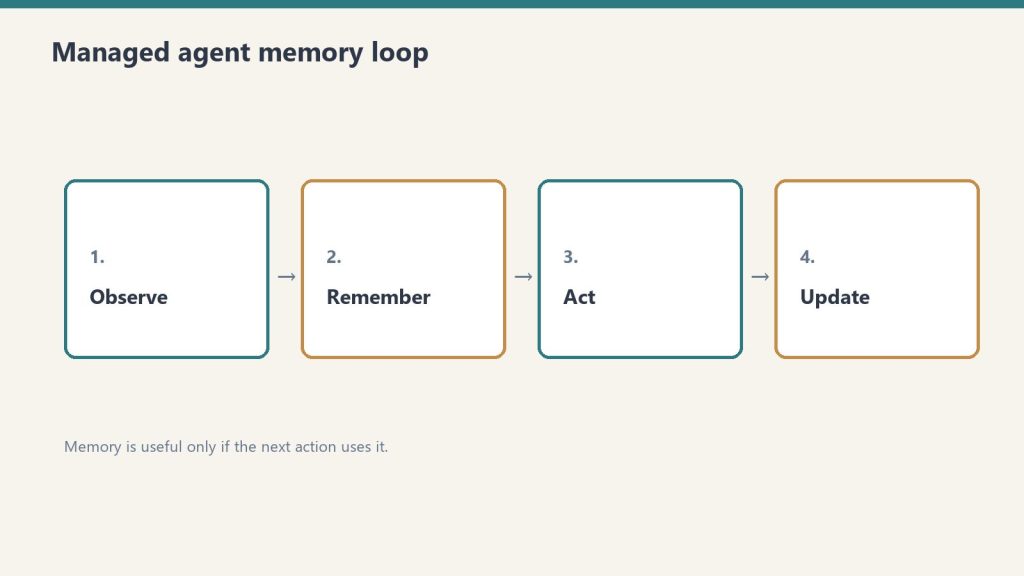
Announced at Code w/ Claude on May 6, 2026, Dreaming is a Managed Agents capability that lets agents review and reorganize their own memory between sessions. The mechanism:
After a session ends, the agent reads its existing memory store alongside the session transcripts
It produces a new, reorganized memory store: duplicates merged, stale entries replaced, new patterns surfaced
The next session starts with a higher-quality knowledge base — capturing insights no single session could hold
This is meaningfully different from simply persisting conversation history. The agent isn’t just remembering what happened — it’s synthesizing what it learned. Think of it as the difference between taking notes and actually reviewing and reorganizing your notes the next morning.
The Harvey Result
Harvey, the legal AI company, reported approximately a 6× task completion rate increase after implementing Dreaming in their Managed Agents workflow. Harvey’s use case — complex legal research that spans multiple sessions with evolving context — is exactly the kind of work Dreaming was designed for. Sessions build on each other rather than starting fresh each time.
Dreaming is not available to end users — it’s a developer-layer capability requiring implementation
It’s not persistent memory in the claude.ai chat interface
It’s not available to free or standard Pro subscribers through any interface
It’s a developer preview, not GA — expect it to evolve before full release
Our Take: Why This Architecture Matters
We run Managed Agents in our own Cowork workflows. The Dreaming announcement is the first time Anthropic has shipped something that resembles how expert human knowledge actually compounds over time — not by accumulating raw notes, but by periodically synthesizing and reorganizing what’s been learned into a cleaner structure.
The Harvey 6× result is a real-world data point from a production legal AI workflow. That’s not a benchmark number — it’s a deployed system showing measurable improvement from session-to-session memory refinement. Whether that 6× figure holds across different use cases is unknown, but the direction of the effect is the signal: agents that learn from their own history outperform agents that don’t.
For non-developer users watching this space: Dreaming is the preview of what agentic AI will look like when it becomes mainstream. The groundwork being laid now in developer preview will eventually surface in subscription-tier products.
Model Accuracy Note — Updated May 2026
Current flagship: Claude Opus 4.7 (claude-opus-4-7). Current models: Opus 4.7 · Sonnet 4.6 · Haiku 4.5. Claude Opus 4.7 (claude-opus-4-7) is the current flagship as of April 16, 2026. Where this article references Opus 4.6 or earlier models, those references are historical. See current model tracker →. See current model tracker →
Tygart Media Strategy
Volume Ⅰ · Issue 04Quarterly Position
By Will Tygart • Long-form Position • Practitioner-grade
You opened this tab because you need a number you can actually use. Not a vibe, not “it depends.” A real pricing breakdown you can put in a spreadsheet, a budget request, or a Slack message to your CTO.
This is that page. Every pricing variable for Claude Managed Agents in one place, verified against Anthropic’s current documentation as of April 2026. Bookmark it. The beta will update; so will this.
Quick Reference: The Formula
Total Cost = Token Costs + Session Runtime ($0.08/hr) + Optional Tools
Session runtime only accrues while status = running. Idle time is free.
The Two Cost Dimensions
Claude Managed Agents bills on exactly two dimensions: tokens and session runtime. Every pricing question you have collapses into one of these two buckets.
Dimension 1: Token Costs
These are identical to standard Claude API pricing. You pay the same rates you’d pay calling the Messages API directly. No Managed Agents markup on tokens. Current rates for the models most commonly used in agent work:
Claude Sonnet 4.6: ~$3/million input tokens, ~$15/million output tokens
Prompt caching: same multipliers as standard API — cache hits dramatically reduce input token costs on long sessions with stable system prompts
The implication: a token-heavy agent with a large system prompt that runs the same context repeatedly benefits significantly from prompt caching, and that benefit carries over unchanged into Managed Agents.
Dimension 2: Session Runtime — $0.08/Session-Hour
This is the Managed Agents-specific charge. You pay $0.08 per hour of active session runtime, metered to the millisecond.
The critical word is active. Runtime only accrues while your session’s status is running. The following do not count toward your bill:
Time spent waiting for your next message
Time waiting for a tool confirmation
Idle time between tasks
Rescheduling delays
Terminated session time
This is not how you’d bill a virtual machine. It’s closer to how AWS Lambda bills — you pay for execution, not reservation. An agent that “runs” for 8 hours but spends 6 of those hours waiting on human input has a very different bill than one running continuous autonomous loops.
Optional Tool Costs
Web Search: $10 per 1,000 Searches
If your agent uses web search, each search costs $10/1,000 — that’s $0.01 per search. For most agents, this is negligible. For a research agent running hundreds of searches per session, it becomes a line item worth modeling separately.
Code Execution: Included in Session Runtime
Code execution containers are included in your $0.08/session-hour charge. You’re not separately billed for container hours on top of session runtime. This is explicitly stated in Anthropic’s docs and represents meaningful savings versus provisioning your own compute.
Worked Cost Examples
Example 1: Daily Research Agent
Runs once per day. 30 minutes of active execution. Processes 10 documents, outputs a summary report. Moderate token volume.
In practice, no agent has zero idle time — real cost will be lower
Token costs at this scale become the dominant factor by a wide margin
Anthropic’s Official Example (from their docs)
A one-hour coding session using Claude Opus 4.7 consuming 50,000 input tokens and 15,000 output tokens: session runtime = $0.08. With prompt caching active and 40,000 of those tokens as cache reads, the token costs drop significantly. The runtime charge stays flat at $0.08 regardless of caching.
What’s Not Billed in Managed Agents
A few things that might seem like costs but aren’t:
Infrastructure provisioning: Anthropic handles hosting, scaling, and monitoring at no additional charge
Container hours: Explicitly not separately billed on top of session runtime
State management and checkpointing: Included in the session runtime charge
Error recovery and retry logic: Anthropic’s infrastructure problem, not yours
Rate Limits
Managed Agents has specific rate limits separate from standard API limits:
Create endpoints: 60 requests/minute
Read endpoints: 600 requests/minute
Organization-level limits still apply
For higher limits, contact Anthropic enterprise sales
How to Access Managed Agents Pricing
Managed Agents is available to all Anthropic API accounts in public beta. No separate signup, no premium tier gate. You need the managed-agents-2026-04-01 beta header in your API requests — the Claude SDK adds this automatically.
For high-volume agent applications, Anthropic’s enterprise sales team negotiates custom pricing arrangements. Contact them at [email protected] or through the Claude Console.
The Pricing Signals Worth Noting
Anthropic recently ended Claude subscription access (Pro/Max) for third-party agent frameworks, requiring those users to switch to pay-as-you-go API pricing. This signals a deliberate strategy: consumer subscriptions are for human-paced interactions; agent workloads route through the API. The $0.08/session-hour rate exists in that context — it’s infrastructure pricing for compute that runs beyond human attention spans.
The session-hour model also signals something about Anthropic’s infrastructure cost structure. They’re pricing on active execution time because that’s what actually taxes their systems. Idle sessions don’t cost them much; active agents do. The billing model follows the actual resource consumption pattern.
Frequently Asked Questions
Is the $0.08/session-hour charge in addition to token costs, or does it replace them?
In addition to. You pay both: standard token rates for all input and output tokens, plus $0.08 per hour of active session runtime. They’re separate line items.
Does prompt caching work in Managed Agents sessions?
Yes. Prompt caching multipliers apply identically to Managed Agents sessions as they do to standard API calls. If your agent has a large, stable system prompt, caching it can significantly reduce input token costs.
What happens if my session crashes? Am I billed for the crashed time?
Runtime accrues only while status is running. Terminated sessions stop accruing. Anthropic’s infrastructure handles checkpointing and crash recovery — the session state is preserved even if the session terminates unexpectedly.
Can I use Managed Agents on the free API tier?
Managed Agents is available to all Anthropic API accounts in public beta, but standard tier access and rate limits apply. Free API tier users receive a small credit for testing.
How does this compare to running agents on my own infrastructure?
An experiment in whether rhythm can do the heavy lifting of retention — and the full prompt library so you can run it yourself.
The Manifesto: Can Music Teach Faster Than Prose?
We memorize song lyrics we heard once in 1998 but forget the contents of a meeting from Tuesday. That’s not a bug in the brain — it’s a feature of how rhythm, melody, and cadence bypass the part of the mind that resists rote information and deliver payloads directly into long-term memory.
This project is a controlled test of that feature. The working hypothesis: a well-constructed song can transmit a complex, multi-step body of knowledge more densely and more durably than an equivalent written explanation. Not as a novelty. As a real transmission format.
Instead of producing ten finished tracks, I’m shipping one playable proof-of-concept and nine fully-formed prompts you can paste directly into Producer.ai (or any AI music generator) to build the rest yourself. The prompts are the real artifact. The song is the proof that the format works.
The Method
Every track in this series takes a dense subject — biology, economics, physics, logic, history — and encodes the mechanics into a single song. The genre for each track is chosen to match the shape of the information. Boom-bap for linear processes. Drum & bass for cyclical systems. Gospel for immutable laws. Dub for slow geological time. Bossa nova for elegant deception. The genre isn’t decoration. It’s the carrier wave.
Parenthetical ad-libs — (like this) for emphasis hooks
One knowledge stage per bar — no filler lines, no padding
That skeleton is what Producer.ai parses cleanly. Deviate from it and the output degrades.
Track 01: Internal Transit Authority (The Proof of Concept)
The inaugural track walks through the complete human digestive process — from the oral gateway and enamel contact all the way through peristalsis, the pyloric valve, villi absorption, the liver as master filter, and the final water reclamation in the large intestine. Every physiological stage gets a bar. The cadence is engineered to act as a mnemonic anchor so the steps lock in sequence the way a chorus does.
Listen:
The Prompt That Made It
Conscious Hip-Hop, Boom-Bap, Jazz-Rap, dusty MPC drum breaks, walking upright bass, warm Rhodes piano chords, soulful saxophone loops, mid-tempo groove, male narrator, gritty yet clear vocal tone, intellectual authoritative delivery, 92 BPM, key of D minor, earthy textures, rhythmic education, organic street philosopher vibe.
[Intro]
[Dusty vinyl crackle, a smooth upright bassline enters with a steady boom-bap drum loop]
(Check the rhythm)
(Internal mechanics)
Knowledge of the vessel is the first step to power
Pay attention to the transit system within
[Verse 1]
Entry point at the oral gateway where enamel strikes
Mechanical grinding begins the structural breakdown
Salivary glands release the first chemical catalyst
Softening the mass into a bolus for the descent
The pharynx directs the traffic down the narrow pipe
Esophagus muscles ripple in a rhythmic wave
Peristalsis pushing the cargo toward the central vat
Gravity is secondary to the muscular contraction
Arrival at the cardiac sphincter, the heavy door
Opening into the churning chamber of liquid fire
Hydrochloric acid dissolves the complex architecture
Turning the harvest into a slurry called chyme
Pyloric valve monitors the pressure of the flow
Releasing the mixture into the winding corridor
Small but vast, the labyrinth of the interior
(The transit continues)
[Chorus]
Break the heavy down to the molecular
Extract the power from the physical plane
Ingest the wisdom, process the essence
Discard the residue to remain light
(Keep the system moving)
(From the root to the crown)
[Verse 2]
The duodenum meets the bile from the emerald organ
Breaking the lipids into manageable fragments
Pancreatic juices neutralize the acidic surge
Preparation for the grand absorption of the spirit
Look at the walls lined with millions of tiny fingers
Villi reaching out to grasp the passing nutrients
Capillaries waiting to ferry the fuel to the stream
Glucose and amino acids entering the bloodline
The liver stands as the master filter at the station
Processing the wealth, storing the vital reserves
What remains travels further into the wider tunnel
The large intestine, where the moisture is reclaimed
Balance is restored as the fluid returns to the system
Compacting the remnants for the final departure
(The cycle completes)
(Nothing is wasted)
[Verse 3]
Understand the blueprints of your own biological city
Every cell waiting for the delivery of the cargo
ATP production is the currency of your motion
Transmuting the external world into internal force
Maintain the temple, respect the intricate valves
From the first bite to the ultimate release
The journey of the sustenance is the journey of life
Master the transit, manifest the clarity
(Internal rhythm)
(The body is a map)
[Outro]
[Bassline fades out as the saxophone takes a solo]
(Digest the truth)
(The spirit is fed)
Stay tuned to the frequency of the self
System check complete
[Drums stop abruptly]
[Vinyl scratch]
Paste that into Producer.ai and you get something in the neighborhood of what you just heard. Variance in the output is part of the experiment — two generations of the same prompt are never identical, which is useful data in itself.
The Remaining Nine Prompts
Each of these is ready to paste into Producer.ai. The production brief is the first paragraph. The structured lyrics are the body. Don’t modify the bracketed tags — they’re what the model parses for song structure.
Track 02 — The Invisible Hand
Subject: Supply & demand, price elasticity, market equilibrium Genre: Funk-Soul / Neo-Soul Why this genre: Call-and-response is literally how supply talks to demand. The groove of a funk bassline mirrors the oscillation of price discovery. Horns for emphasis on equilibrium points.
Funk-Soul, Neo-Soul, vintage Clavinet, slap bass, tight pocket drums with crisp hi-hats, Hammond B3 organ swells, brass stabs on the downbeat, female lead vocal with a soulful conversational tone, backup call-and-response vocals, 98 BPM, key of E minor, warm analog textures, economic street sermon, intellectual groove, Curtis Mayfield meets Erykah Badu energy.
[Intro]
[Clavinet riff locks in over a fat slap bassline, drums kick in on the two]
(The market speaks)
(Listen to the price)
Every number tells a story if you know how to read it
[Verse 1]
Supply is the stack of what the makers can produce
Demand is the hunger of the people on the street
When the hunger outpaces what the factory can release
Price climbs the ladder like a dollar chasing heat
(Scarcity)
When the shelves are overflowing and the buyers walk away
Price slides down the pole 'til it finds a place to stay
(Surplus)
Equilibrium is the handshake in the middle of the trade
Where the quantity they want meets the quantity they made
[Chorus]
No one at the wheel but the wheel still turns
(The invisible hand)
Every selfish motive is a signal that returns
(The invisible hand)
Price is the language of a million silent minds
(Supply meets demand)
Information coded in a number you can find
[Verse 2]
Elastic is the product you can easily replace
Butter swaps for margarine, the demand shifts with grace
Inelastic is the thing you cannot live without
Insulin and gasoline, the price can climb and shout
Shift the whole curve with a change in the income
Tastes and expectations move the baseline where we come from
Substitutes and complements, the dance is interlinked
Coffee needs the sugar and the tea needs what you think
[Verse 3]
Ceiling on the price creates a shortage underneath
Rent control is kindness with a hidden set of teeth
Floor below the price creates a surplus on the shelf
Minimum wage arguments depend on who you tell
Subsidies and taxes are the fingers on the scale
Every intervention leaves a signal or a trail
Read the curve, respect the slope, understand the game
The market is a mirror of the people and their aim
[Outro]
[Bass solo fades under the final vocal phrase]
(The invisible hand)
(It's just us)
No magic in the market, just a mirror of our want
[Horn stab]
Track 03 — Eight Stages of Fire (The Krebs Cycle)
Subject: Citric acid cycle / cellular respiration Genre: Liquid Drum & Bass Why this genre: The Krebs cycle IS a loop. D&B at 170 BPM has a natural eight-bar cyclical structure that maps onto the eight enzymatic steps. Each loop of the drum pattern equals one turn of the cycle.
Liquid Drum and Bass, atmospheric D&B, rolling amen-break drums, deep reese bassline, ethereal female vocal samples, jazzy Rhodes pads, subtle vinyl crackle, male spoken-word delivery over the groove, intellectual science-teacher tone with urgency, 170 BPM, key of F minor, London Elektricity meets Calibre energy, biochemistry as dancefloor science.
[Intro]
[Atmospheric pad swells, amen break rolls in at half-time, bass drops at 16]
(Eight stages)
(One loop)
The powerhouse of the cell runs on a rhythm you can feel
[Verse 1]
Acetyl-CoA meets the oxaloacetate partner
Citrate is the child of the very first encounter
Stage one complete and the cycle starts to spin
Isomerization turns the citrate into isocitrate, here we begin
Alpha-ketoglutarate is the third stop on the train
First carbon released as carbon dioxide in the rain
NADH is the currency the stage begins to mint
Every electron captured is a future ATP hint
[Chorus]
Eight stages of fire in the mitochondrial core
(Round and round)
Every turn of the wheel is a molecule of power
(Round and round)
Carbon in, carbon out, electrons for the chain
(The loop never breaks)
The citric acid cycle is the engine of the frame
[Verse 2]
Succinyl-CoA is the fourth stop on the line
Second carbon leaves as CO2 this time
GTP is minted here, the cycle pays the bill
Succinate takes the baton and it climbs the hill
FADH2 is captured at the sixth enzymatic gate
Fumarate is the next shape in the metabolic fate
Malate comes behind with a water molecule attached
Oxaloacetate returns, the circle has been latched
[Verse 3]
One glucose feeds two turns of the eternal loop
Thirty-something ATP from the cellular soup
Carbon dioxide exits through the breath you just released
Every exhale is a Krebs cycle receipt
The oxygen you breathe becomes the water that you drink
Electron transport chain is the final missing link
NADH and FADH2 deliver to the crew
Complexes one through four build the gradient that's true
[Outro]
[Drums cut to half-time, Rhodes takes the final chord]
(Eight stages)
(One breath)
Every turn is a heartbeat at the molecular level
[Bass fades]
Track 04 — Three Laws of Motion
Subject: Newton’s three laws of motion Genre: Gospel-Soul with a live band feel Why this genre: Gospel is the music of laws — immutable, declarative, celebratory. One law per verse, each verse building like a sermon. The B3 organ and full choir give each law the weight of doctrine.
Gospel-Soul, live band feel, Hammond B3 organ, upright piano, tight drum kit with cross-stick snare, walking bass, full gospel choir backing vocals, male lead with a preacher's cadence building from calm exposition to triumphant declaration, 84 BPM, key of G major with a relative minor bridge, warm analog, church basement science class energy, Ray Charles meets Neil deGrasse Tyson.
[Intro]
[Solo organ progression, choir hums underneath, bass and drums enter on the turnaround]
(Three laws)
(One universe)
Isaac Newton wrote the rules and the cosmos said amen
[Verse 1 — The First Law]
An object at rest will remain at rest, brother
(Unless a force comes knocking at the door)
An object in motion will stay in that motion forever
(Unless a friction or a gravity steps on the floor)
Inertia is the memory of the mass
It remembers where it was and it wants to stay
The universe is lazy, that's the truth of it
You gotta push if you want something to sway
(The first law)
(The law of rest)
[Chorus]
Three laws, one universe, every motion is a sermon
(Hallelujah in the physics)
Three laws, one universe, every push is a confession
(Hallelujah in the mechanics)
Every falling apple is a prayer to the equation
(F equals m-a)
The whole creation singing in the language of equation
[Verse 2 — The Second Law]
Force is the product of the mass and acceleration
(F equals m-a)
The heavier the object, the harder the negotiation
(F equals m-a)
Push a shopping cart, push a freight train, feel the difference
The mass is the resistance and the force is the insistence
A equals F divided by the weight you're trying to move
That's the second law, and the second law is proof
Double the force and you double the acceleration
Same mass, twice the push, twice the celebration
[Verse 3 — The Third Law]
For every action there's an equal and opposite reaction
(Say it back to me)
Every push against the world is a push the world pushes back
(Say it back to me)
A rocket burns its fuel and the exhaust goes down
The rocket goes up 'cause the universe is round
Walk across the floor and the floor walks back at you
Jump into the air and the earth moves a little too
Infinitesimal but real, the law is never bent
Every action has its answer, every force has its rent
[Outro]
[Choir sustains on the final chord, organ rolls, drums drop]
(Three laws)
(One universe)
Isaac wrote the scripture and the cosmos is the congregation
[Organ holds the final note]
Track 05 — The Method (The Scientific Method)
Subject: The scientific method as a cognitive discipline Genre: Lo-fi Hip-Hop / Jazzhop Why this genre: Lo-fi is the music of studying. The relaxed tempo and bedroom-producer aesthetic mirrors the patient, iterative nature of actual science. A jazzhop chorus loops the method so the structure of the song IS the structure of the method.
Lo-fi Hip-Hop, Jazzhop, dusty sampled drums with the kick slightly off the grid, muted trumpet loop, warm tape-saturated Rhodes, upright bass, vinyl crackle throughout, gentle brush snares, male vocal with a calm, curious, late-night-library delivery, 78 BPM, key of C minor, Nujabes meets a PBS documentary, study-group philosophy.
[Intro]
[Vinyl crackle, Rhodes chord holds, drums slide in off the kick]
(Observe)
(Ask)
The method is older than the labs it built
[Verse 1]
Step one is the noticing, the pause before the claim
A curiosity that fires when the pattern doesn't frame
Observe without the filter of the answer in your head
Write down what you saw, not what the expectation said
Step two is the question, the specific thing you ask
Vague inquiries die on the vine, precision is the task
What causes this, how often, under what conditions
Narrow the aperture and ask with clean definitions
(The method begins)
[Chorus]
Observe, ask, hypothesize, test
(Refine what you thought)
Observe, ask, hypothesize, test
(Keep only what survived)
The method is a filter, not a faith
(Evidence is the ground)
Every belief you hold should earn the space it's allowed
[Verse 2]
Step three is the hypothesis, the educated guess
A statement that predicts what the test will confess
It has to be falsifiable, that's the crucial trick
If nothing could disprove it, the claim is just a stick
Step four is the experiment, the reality check
Design it so the variable can actually connect
Control groups, isolation, repeat the thing again
One result is nothing, statistics is the friend
(The data comes in)
[Verse 3]
Step five is the analysis, the honest eye on the sheet
Does the hypothesis stand or did it die in the street
Confirmation bias wants to save the prior belief
The method is the discipline that gives the mind relief
Step six is the conclusion, but hold it lightly still
Peer review is the hammer that the community will
Publish, challenge, replicate, let the world test the claim
If it holds across the hands, that's when it earns its name
(The loop starts again)
[Outro]
[Trumpet takes the outro, drums fade]
(Observe)
(The method is alive)
Every question you ask is a vote for reality
[Rhodes holds the final chord]
Track 06 — Broken Reasoning (Logical Fallacies)
Subject: Common logical fallacies — ad hominem, straw man, false dichotomy, appeal to authority, slippery slope, circular reasoning, post hoc, bandwagon, appeal to nature, tu quoque Genre: Bossa Nova / Latin Jazz Why this genre: Fallacies are elegant mistakes — seductive, smooth, and dangerous. Bossa nova is the music of smooth seduction. The ironic pairing lets each fallacy get named, demonstrated, and unmasked in the same breath.
Bossa Nova, Latin Jazz, nylon-string guitar, brushed drums, upright bass walking in a samba pattern, flute lead, subtle vibraphone, female vocal with a sly, knowing, cocktail-party delivery, 102 BPM, key of A minor, Astrud Gilberto meets a philosophy lecture, elegant deception unmasked.
[Intro]
[Nylon guitar plays the samba turnaround, flute enters on the second bar]
(Every mistake sounds convincing)
(That's the whole problem)
The most dangerous arguments are the ones that feel correct
[Verse 1]
Ad hominem attacks the person instead of the claim
You're wrong because you're ugly is an ancient kind of game
The argument still stands or falls on evidence alone
The messenger is never what determines what is known
Straw man builds a weaker version of the thing you said
Then knocks it down in public like it was the real head
If you have to misrepresent the view to win the round
You already lost the argument the moment it was found
[Chorus]
Every fallacy is elegant, every fallacy is smooth
(That's why they work)
Every fallacy is a shortcut around the thing you have to prove
(That's why they work)
Learn to name them, learn to spot them in the wild
(Broken reasoning)
A mind that knows the tricks is a mind that can't be styled
[Verse 2]
False dichotomy gives you only two ways to turn
Love it or leave it, when a dozen options burn
Appeal to authority says the expert says it's true
But experts can be wrong and the evidence is due
Slippery slope predicts a cascade with no proof
One step leads to ruin in the argument's aloof
Circular reasoning is the snake that eats its tail
The premise is the conclusion wearing a different veil
[Verse 3]
Post hoc ergo propter hoc, it happened after, so it caused
Correlation is not causation, let the reasoning be paused
Bandwagon says everyone believes it, so it's right
Popularity is not a substitute for sight
Appeal to nature says if it's natural it's good
Arsenic is natural, and arsenic never should
Tu quoque says you do it too, so your point does not count
The hypocrisy of the speaker doesn't change the amount
[Outro]
[Flute takes the final melodic phrase over guitar and brushes]
(Name them)
(Spot them)
The mind that knows the tricks walks free from the trap
[Guitar holds the final chord]
Track 07 — Slow Collision (Plate Tectonics)
Subject: Plate tectonics, continental drift, fault types, geological timescales Genre: Dub Reggae Why this genre: Plates move at 2–5 cm per year. Dub is the slowest, most patient genre in popular music. The massive reverb tails mimic geological time. The bass is literally the weight of the continents.
Dub Reggae, classic 1970s Jamaica sound, massive spring reverb tails, tape delay throws, deep sub bass, clavinet skanks on the off-beat, horns with heavy echo, minimal drums with a steppers kick pattern, male vocal with a patient, oracular Jamaican-inflected delivery, 72 BPM, key of G minor, King Tubby meets a geology textbook, continental time.
[Intro]
[Deep bass pulse, drums enter with a steppers kick, echo chamber opens on the first word]
(Slow)
(The earth moves slow)
Two centimeters a year and the mountains rise
[Verse 1]
The crust is broken into seven major plates
Floating on the mantle where the molten rock creates
Convection currents moving at the pace of stone
The continents are passengers that cannot stand alone
Pangaea was the supercontinent, a single land
Two hundred million years ago it broke into the sand
Africa and South America were once a single coast
You can see the puzzle pieces where the plates embossed
[Chorus]
(Slow collision)
Every earthquake is a story of the plates at war
(Slow collision)
Every mountain is a handshake at the continental door
(Slow collision)
Every ocean is a gap that opened long ago
(Slow collision)
The earth is always moving even when it seems to slow
[Verse 2]
Divergent boundaries are the rifts where plates pull apart
Mid-ocean ridges where the lava starts the heart
New crust is born where the magma meets the sea
The Atlantic is still growing an inch or so for free
Convergent boundaries are the crashes in the dark
Oceanic under continental, a subduction mark
The Andes rose from Nazca diving under South American stone
Every volcano is a signal of the subduction zone
Continental on continental is the Himalayan way
India crashed into Asia and the Everest came to stay
[Verse 3]
Transform boundaries are the plates that slide past sideways
San Andreas is the famous one, it runs through L.A.
No new crust created and no old crust destroyed
Just friction locking up until the stress can't be avoided
Then the earthquake releases what the patience stored
Seconds of violence for decades of the building toward
The ring of fire is the circle of the Pacific rim
Seventy-five percent of volcanoes living in the hymn
[Outro]
[Horns fade into the reverb tail, bass sustains under the echo]
(Slow)
(The earth moves slow)
But the moving never stops
[Echo trails into silence]
Track 08 — Seventeen Eighty-Nine (The French Revolution)
Subject: French Revolution timeline — Estates General, Bastille, Declaration of Rights, Terror, Napoleon Genre: Protest Folk-Rap hybrid Why this genre: Revolutions need anthems. Folk is the music of the people’s history; rap is the music of compressed narrative. The hybrid mirrors the revolution itself — old forms broken open by new urgency.
Protest Folk-Rap hybrid, acoustic guitar with fingerpicked arpeggios, upright bass, cajón, hand-clap percussion, fiddle interjections, male vocal switching between sung folk chorus and tight rap verses, urgent, historically grounded delivery, 108 BPM, key of D minor, Woody Guthrie meets Lin-Manuel Miranda meets Talib Kweli, history as an urgent dispatch.
[Intro]
[Acoustic guitar arpeggio, cajón enters on the backbeat, fiddle line introduces the melody]
(Seventeen eighty-nine)
(The year the old world cracked)
The people of France picked up the pen and the pitchfork
[Verse 1]
France was broke, the king was Louis the sixteenth
The debt from wars had drained the treasury clean
Three estates divided up the social frame
Clergy, nobles, everybody else, the game was rigged the same
The third estate was ninety-six percent of all the population
But they paid the taxes and they had no representation
Estates General met in May of eighty-nine
The third estate broke away and drew a different line
(National Assembly)
[Chorus]
Liberty, equality, fraternity, or death
(The tricolor rising)
The people of the street had a fire in the chest
(The old regime was dying)
Every revolution ever since that day
(Borrows from the moment)
When the third estate stood up and would not walk away
[Verse 2]
July fourteenth, the Bastille fortress fell
The prison of the king became the people's bell
Women marched to Versailles in October, grain was scarce
Dragged the royal family back to Paris in a hearse of a carriage
Declaration of the Rights of Man was signed in August
All men are born free and equal, the promise had to be discussed
Constitution of ninety-one made a limited king
But the king tried to flee, and the trust could not stand a thing
(Varennes, he was caught)
[Verse 3]
September ninety-two, the Republic was declared
January ninety-three, Louis the sixteenth was bared
To the guillotine at the Place de la Revolution
The head of the king fell and the monarchy's dissolution
Then the Terror came, Robespierre at the wheel
Committee of Public Safety made the guillotine a meal
Thousands of executions in about ten months
Thermidor ended Robespierre with the same kind of stunts
Directory, then the Consulate, then Napoleon's throne
Seventeen ninety-nine the revolution had grown
Into an empire, ironically, a single man
But the ideas never died, they kept crossing every land
[Outro]
[Fiddle takes the final melodic phrase, guitar sustains]
(Liberty)
(Equality)
(Fraternity)
The echoes never stopped, they just changed the tongue
[Guitar holds the final chord]
Track 09 — The Doubling (Compound Interest)
Subject: Compound interest, the rule of 72, exponential growth Genre: Neo-Soul / Future Soul Why this genre: Compound interest is about patience and time — the same qualities neo-soul rewards. The arrangement models the math: each chorus adds a layer so by the final chorus the song has “compounded” into something denser than the first.
Neo-Soul, Future Soul, vintage Fender Rhodes, syncopated drum programming with live feel, melodic bass played on a Moog, layered vocal harmonies that build each chorus, subtle string pads, female lead with a wise, patient, financially literate delivery, 88 BPM, key of B-flat major, Hiatus Kaiyote meets a Vanguard index fund prospectus, exponential growth as a love letter.
[Intro]
[Rhodes chord progression, bass enters, drums slide in on the second bar]
(Time)
(The quiet multiplier)
Money makes a baby and the baby makes a baby
[Verse 1]
Simple interest pays you on the principal alone
Ten percent on a thousand is a hundred every year
Compound interest pays you on the principal and the gain
The hundred from year one starts earning its own name
Year one the thousand turns into eleven hundred clean
Year two the eleven hundred makes a hundred ten, it's seen
Year three the twelve ten makes a hundred twenty-one
The baby has a baby and the babies never done
(The doubling begins)
[Chorus — first time, thin]
Exponential growth is the quietest power in the world
(Patience is the weapon)
The math does the work while you sleep through the night
(Time is the weapon)
[Verse 2]
Rule of seventy-two is the shortcut in your head
Divide the seventy-two by the rate and you have the thread
Seven percent return will double every ten years
Ten percent return will double in about seven clear
A hundred dollars at ten percent for forty years of time
Becomes forty-five hundred without a single extra dime
The first ten years it only doubles to two hundred
But the last ten years it doubles from twenty-two hundred, stunned
(The curve goes vertical)
[Chorus — second time, thicker, strings added]
Exponential growth is the quietest power in the world
(Patience is the weapon)
The math does the work while you sleep through the night
(Time is the weapon)
Every year you wait is a year you cannot buy
(Start now, start small)
The compound wants decades, not a single lucky try
[Verse 3]
Einstein called it the eighth wonder of the world
The ones who understand it earn it, the rest pay it curled
Credit card debt at twenty-two percent will double in three
The compound cuts both ways, it's a mirror you should see
Start at twenty-five with a hundred every month
At seven percent you have a quarter million in the hunt
Start at thirty-five with double, two hundred every month
You end up with less, because the ten years were the front
(Time is the asset)
[Chorus — final time, full harmonies, everything in]
Exponential growth is the quietest power in the world
(Patience is the weapon)
The math does the work while you sleep through the night
(Time is the weapon)
Every year you wait is a year you cannot buy
(Start now, start small)
The compound wants decades, not a single lucky try
Money makes a baby and the baby makes a baby
(The doubling never stops)
The quiet multiplier is the one that makes you free
[Outro]
[Rhodes solo over sustained strings, drums drop to half-time]
(Time)
(Start today)
The best year to plant the tree was twenty years ago
The second best year is now
[Rhodes holds the final chord]
Track 10 — Condensation Dream (The Water Cycle)
Subject: The water cycle — evaporation, transpiration, condensation, precipitation, collection, infiltration Genre: Trip-Hop Why this genre: Trip-hop is atmospheric, watery, circular. Massive Attack and Portishead built whole records on the feeling of things rising and falling in slow motion. Every stage of the cycle can be represented by a different sonic texture that appears and disappears like water changing state.
Trip-Hop, atmospheric and cinematic, big downtempo drum breaks, heavy filtered bass, swirling ambient pads, distant theremin-like lead, occasional vinyl crackle and rain samples, female lead vocal with a haunted, ethereal, meteorological delivery, 82 BPM, key of E-flat minor, Portishead meets Massive Attack meets a nature documentary, water as atmosphere.
[Intro]
[Rain sample, ambient pad swells, drum break drops on the third bar, bass slides underneath]
(The cycle never ended)
(It just changed its shape)
Every drop of water you have ever seen has done this before
[Verse 1]
Evaporation lifts the water from the surface of the sea
The sun is the engine and the heat sets it free
Molecules break the bond that held them in the liquid state
Rising invisible into the atmospheric gate
Transpiration does the same from the leaves of every plant
A forest is a river that forgot it had to slant
Upward through the stomata, through the xylem, through the bark
Every tree is evaporating slowly in the dark
(The rising)
[Chorus]
Every drop has done this a thousand thousand times
(Rising and falling)
Every drop has been a cloud and a river and the brine
(Rising and falling)
The water in your glass was once inside a dinosaur
(The cycle never ends)
Condensation dream is the atmosphere in store
[Verse 2]
Condensation is the moment when the vapor meets the cold
The water has to choose a form, the cloud begins to fold
Around the tiny particles of dust and ash and salt
Nucleation gives the droplet something to exalt
Billions of droplets suspended in the sky
A cloud is just a river that forgot how to lie
Down on the surface where the gravity demands
The droplets grow by merging until the weight expands
(The falling)
[Verse 3]
Precipitation is the gravity reclaiming what was lent
Rain when it's warm enough, snow when the cold is spent
Sleet, hail, graupel, freezing rain, the forms are many
The water chooses based on the layers of the canopy
Collection is the rivers and the lakes and the sea
The aquifers underneath, the glaciers slowly
Infiltration soaks the ground where the roots will drink
Runoff carries sediment to the river's brink
And somewhere the sun is heating up a different surface
Lifting another molecule for another verse
(The cycle restarts)
[Outro]
[Rain samples return, drums drop out, theremin lead takes the final phrase over pads]
(Rising)
(Falling)
The water remembers everything it has ever been
Every drop is ancient and every drop is new
[Pads hold the final chord, rain continues into silence]
Run the Experiment
If you build any of these, I want to know how they land. The real question this project is trying to answer isn’t whether AI can generate a listenable track — it obviously can. The question is whether the format works. Does the song actually teach? Does a listener who hears “Eight Stages of Fire” once remember the Krebs cycle a week later better than someone who read a textbook passage of equivalent length? I don’t know yet. That’s why the prompts are public.
Paste one in. Generate the track. Play it for someone who doesn’t know the subject. Ask them a week later what they remember. Tell me what happened.
This is a working node in an ongoing experiment at Tygart Media about whether the boundaries between content, teaching, and entertainment are real or just inherited assumptions about how knowledge has to move.
Pricing updated to reflect current Opus 4.7 launch ($5/$25 per MTok) and the retirement of Claude Sonnet 4 and Opus 4 on April 20, 2026. Managed Agents moved to public beta — see the complete pricing guide for current rate details.
Tygart Media Strategy
Volume Ⅰ · Issue 04Quarterly Position
By Will Tygart • Long-form Position • Practitioner-grade
$0.08 Per Session Hour: Is Claude Managed Agents Actually Cheap?
Claude Managed Agents Pricing: $0.08 per session-hour of active runtime (measured in milliseconds, billed only while the agent is actively running) plus standard Anthropic API token costs. Idle time — while waiting for input or tool confirmations — does not count toward runtime billing.
When Anthropic launched Claude Managed Agents on April 9, 2026, the pricing structure was clean and simple: standard token costs plus $0.08 per session-hour. That’s the entire formula.
Whether $0.08/session-hour is cheap, expensive, or irrelevant depends entirely on what you’re comparing it to and how you model your workloads. Let’s work through the actual math.
What You’re Paying For
The session-hour charge covers the managed infrastructure — the sandboxed execution environment, state management, checkpointing, tool orchestration, and error recovery that Anthropic provides. You’re not paying for a virtual machine that sits running whether or not your agent is active. Runtime is measured to the millisecond and accrues only while the session’s status is running.
This is a meaningful distinction. An agent that’s waiting for a user to respond, waiting for a tool confirmation, or sitting idle between tasks does not accumulate runtime charges during those gaps. You pay for active execution time, not wall-clock time.
The token costs — what you pay for the model’s input and output — are separate and follow Anthropic’s standard API pricing. For most Claude models, input tokens run roughly $3 per million and output tokens roughly $15 per million, though current pricing is available at platform.claude.com/docs/en/about-claude/pricing.
Modeling Real Workloads
The clearest way to evaluate the $0.08/session-hour cost is to model specific workloads.
A research and summary agent that runs once per day, takes 30 minutes of active execution, and processes moderate token volumes: runtime cost is roughly $0.04/day ($1.20/month). Token costs depend on document size and frequency — likely $5-20/month for typical knowledge work. Total cost is in the range of $6-21/month.
A batch content pipeline running several times weekly, with 2-hour active sessions processing multiple documents: runtime is $0.16/session, roughly $2-3/month. Token costs for content generation are more substantial — a 15-article batch with research could run $15-40 in tokens. Total: $17-43/month per pipeline run frequency.
A continuous monitoring agent checking systems and data sources throughout the business day: if the agent is actively running 4 hours/day, that’s $0.32/day, $9.60/month in runtime alone. Token costs for monitoring-style queries are typically low. Total: $15-25/month.
An agent running 24/7 — continuously active — costs $0.08 × 24 = $1.92/day, or roughly $58/month in runtime. That number sounds significant until you compare it to what 24/7 human monitoring or processing would cost.
The Comparison That Actually Matters
The runtime cost is almost never the relevant comparison. The relevant comparison is: what does the agent replace, and what does that replacement cost?
If an agent handles work that would otherwise require two hours of an employee’s time per day — research compilation, report drafting, data processing, monitoring and alerting — the calculation isn’t “$58/month runtime versus zero.” It’s “$58/month runtime plus token costs versus the fully-loaded cost of two hours of labor daily.”
At a fully-loaded cost of $30/hour for an entry-level knowledge worker, two hours/day is $1,500/month. An agent handling the same work at $50-100/month in total AI costs is a 15-30x cost difference before accounting for the agent’s availability advantages (24/7, no PTO, instant scale).
The math inverts entirely for edge cases where agents are less efficient than humans — tasks requiring judgment, relationship context, or creative direction. Those aren’t good agent candidates regardless of cost.
Where the Pricing Gets Complicated
Token costs dominate runtime costs for most workloads. A two-hour agent session running intensive language tasks could easily generate $20-50 in token costs while only generating $0.16 in runtime charges. Teams optimizing AI agent costs should spend most of their attention on token efficiency — prompt engineering, context window management, model selection — rather than on the session-hour rate.
For very high-volume, long-running workloads — continuous agents processing large document sets at scale — the economics may eventually favor building custom infrastructure over managed hosting. But that threshold is well above what most teams will encounter until they’re running AI agents as a core part of their production infrastructure at significant scale.
The honest summary: $0.08/session-hour is not a meaningful cost for most workloads. It becomes material only when you’re running many parallel, long-duration sessions continuously. For the overwhelming majority of business use cases, token efficiency is the variable that matters, and the infrastructure cost is noise.
How This Compares to Building Your Own
The alternative to paying $0.08/session-hour is building and operating your own agent infrastructure. That means engineering time (months, initially), ongoing maintenance, cloud compute costs for your own execution environment, and the operational overhead of managing the system.
For teams that haven’t built this yet, the managed pricing is almost certainly cheaper than the build cost for the first year — even accounting for the runtime premium. The crossover point where self-managed becomes cheaper depends on engineering cost assumptions and workload volume, but for most teams it’s well beyond where they’re operating today.
Frequently Asked Questions
Is idle time charged in Claude Managed Agents?
No. Runtime billing only accrues when the session status is actively running. Time spent waiting for user input, tool confirmations, or between tasks does not count toward the $0.08/session-hour charge.
What is the total cost of running a Claude Managed Agent for a typical business task?
For moderate workloads — research agents, content pipelines, daily summary tasks — total costs typically range from $10-50/month combining runtime and token costs. Heavy, continuous agents could run $50-150/month depending on token volume.
Are token costs or runtime costs more important to optimize for Claude Managed Agents?
Token costs dominate for most workloads. A two-hour active session generates $0.16 in runtime charges but potentially $20-50 in token costs depending on workload intensity. Token efficiency is where most cost optimization effort should focus.
At what point does building your own agent infrastructure become cheaper than Claude Managed Agents?
The crossover depends on engineering cost assumptions and workload volume. For most teams, managed is cheaper than self-built through the first year. Very high-volume, continuously-running workloads at scale may eventually favor custom infrastructure.
Now that you have the cost — here’s how to choose and implement
You know the session-hour rate. The harder decision is whether Managed Agents is the right architecture vs. building on the raw API — or vs. OpenAI’s equivalent.
By Will Tygart • Long-form Position • Practitioner-grade
AI Agents Explained: What They Are, Who’s Using Them, and Why Your Business Will Need One
What Is an AI Agent? An AI agent is a software program powered by a large language model that can take actions — not just answer questions. It reads files, sends messages, runs code, browses the web, and completes multi-step tasks on its own, without a human directing every move.
Most people’s mental model of AI is a chat interface. You type a question, you get an answer. That’s useful, but it’s also the least powerful version of what AI can do in a business context.
The version that’s reshaping how companies operate isn’t a chatbot. It’s an agent — a system that can actually do things. And with Anthropic’s April 2026 launch of Claude Managed Agents, the barrier to deploying those systems for real business work dropped significantly.
What Makes an Agent Different From a Chatbot
A chatbot responds. An agent acts.
When you ask a chatbot to summarize last quarter’s sales report, it tells you how to do it, or summarizes text you paste in. When you give the same task to an agent, it goes and gets the report, reads it, identifies the key numbers, formats a summary, and sends it to whoever asked — all without you supervising each step.
The difference sounds subtle but has large practical implications. An agent can be assigned work the same way you’d assign work to a person. It can work on tasks in the background while you do other things. It can handle repetitive processes that would otherwise require sustained human attention.
The examples from the Claude Managed Agents launch make this concrete:
Asana built AI Teammates — agents that participate in project management workflows the same way a human team member would. They pick up tasks. They draft deliverables. They work within the project structure that already exists.
Rakuten deployed agents across sales, marketing, HR, and finance that accept assignments through Slack and return completed work — spreadsheets, slide decks, reports — directly to the person who asked.
Notion’s implementation lets knowledge workers generate presentations and build internal websites while engineers ship code, all with agents handling parallel tasks in the background.
None of those are hypothetical. They’re production deployments that went live within a week of the platform becoming available.
What Business Processes Are Actually Good Candidates for Agents
Not every business task is suited for an AI agent. The best candidates share a few characteristics: they’re repetitive, they involve working with information across multiple sources, and they don’t require judgment calls that need human accountability.
Strong candidates include research and summarization tasks that currently require someone to pull data from multiple places and compile it. Drafting and formatting work — proposals, reports, presentations — that follows a consistent structure. Monitoring tasks that require checking systems or data sources on a schedule and flagging anomalies. Customer-facing support workflows for common, well-defined questions. Data processing pipelines that transform information from one format to another on a recurring basis.
Weak candidates include tasks that require relationship context, ethical judgment, or creative direction that isn’t already well-defined. Agents execute well-specified work; they don’t substitute for strategic thinking.
Why the Timing of This Launch Matters for Small and Mid-Size Businesses
Until recently, deploying a production AI agent required either a technical team capable of building significant custom infrastructure, or an enterprise software contract with a vendor that had built it for you. That meant AI agents were effectively inaccessible to businesses without large technology budgets or dedicated engineering resources.
Anthropic’s managed platform changes that equation. The infrastructure layer — the part that required months of engineering work — is now provided. A small business or a non-technical operations team can define what they need an agent to do and deploy it without building a custom backend.
The pricing reflects this broader accessibility: $0.08 per session-hour of active runtime, plus standard token costs. For agents handling moderate workloads — a few hours of active operation per day — the runtime cost is a small fraction of what equivalent human time would cost for the same work.
What to Actually Do With This Information
The most useful framing for any business owner or operations leader isn’t “what is an AI agent?” It’s “what work am I currently paying humans to do that is well-specified enough for an agent to handle?”
Start with processes that meet these criteria: they happen on a regular schedule, they involve pulling information from defined sources, they produce a consistent output format, and they don’t require judgment calls that have significant consequences if wrong. Those are your first agent candidates.
The companies that will have a structural advantage in two to three years aren’t the ones that understood AI earliest. They’re the ones that systematically identified which parts of their operations could be handled by agents — and deployed them while competitors were still treating AI as a productivity experiment.
Frequently Asked Questions
What is an AI agent in simple terms?
An AI agent is a program that can take actions — not just answer questions. It can read files, send messages, browse the web, and complete multi-step tasks on its own, working in the background the same way you’d assign work to an employee.
What’s the difference between an AI chatbot and an AI agent?
A chatbot responds to questions. An agent executes tasks. A chatbot tells you how to summarize a report; an agent retrieves the report, summarizes it, and sends it to whoever needs it — without you directing each step.
What kinds of business tasks are best suited for AI agents?
Repetitive, well-defined tasks that involve pulling information from multiple sources and producing consistent outputs: research summaries, report drafting, data processing, support workflows, and monitoring tasks are strong candidates. Tasks requiring significant judgment, relationship context, or creative direction are weaker candidates.
How much does it cost to deploy an AI agent for a small business?
Using Claude Managed Agents, costs are standard Anthropic API token rates plus $0.08 per session-hour of active runtime. An agent running a few hours per day for routine tasks might cost a few dollars per month in runtime — a fraction of the equivalent human labor cost.
By Will Tygart • Long-form Position • Practitioner-grade
Claude Managed Agents vs. Rolling Your Own: The Real Infrastructure Build Cost
The Build-vs-Buy Question: Claude Managed Agents offers hosted AI agent infrastructure at $0.08/session-hour plus token costs. Rolling your own means engineering sandboxed execution, state management, checkpointing, credential handling, and error recovery yourself — typically months of work before a single production agent runs.
Every developer team that wants to ship a production AI agent faces the same decision point: build your own infrastructure or use a managed platform. Anthropic’s April 2026 launch of Claude Managed Agents made that decision significantly harder to default your way through.
This isn’t a “managed is always better” argument. There are legitimate reasons to build your own. But the build cost needs to be reckoned with honestly — and most teams underestimate it substantially.
What You Actually Have to Build From Scratch
The minimum viable production agent infrastructure requires solving several distinct problems, none of which are trivial.
Sandboxed execution: Your agent needs to run code in an isolated environment that can’t access systems it isn’t supposed to touch. Building this correctly — with proper isolation, resource limits, and cleanup — is a non-trivial systems engineering problem. Cloud providers offer primitives (Cloud Run, Lambda, ECS), but wiring them into an agent execution model takes real work.
Session state and context management: An agent working on a multi-step task needs to maintain context across tool calls, handle context window limits gracefully, and not drop state when something goes wrong. Building reliable state management that works at production scale typically takes several engineering iterations to get right.
Checkpointing: If your agent crashes at step 11 of a 15-step job, what happens? Without checkpointing, the answer is “start over.” Building checkpointing means serializing agent state at meaningful intervals, storing it durably, and writing recovery logic that knows how to resume cleanly. This is one of the harder infrastructure problems in agent systems, and most teams don’t build it until they’ve lost work in production.
Credential management: Your agent will need to authenticate with external services — APIs, databases, internal tools. Managing those credentials securely, rotating them, and scoping them properly to each agent’s permissions surface is an ongoing operational concern, not a one-time setup.
Tool orchestration: When Claude calls a tool, something has to handle the routing, execute the tool, handle errors, and return results in the right format. This orchestration layer seems simple until you’re debugging why tool call 7 of 12 is failing silently on certain inputs.
Observability: In production, you need to know what your agents are doing, why they’re doing it, and when they fail. Building logging, tracing, and alerting for an agent system from scratch is a non-trivial DevOps investment.
Anthropic’s stated estimate is that shipping production agent infrastructure takes months. That tracks with what we’ve seen in practice. It’s not months of full-time work for a large team — but it’s months of the kind of careful, iterative infrastructure engineering that blocks product work while it’s happening.
What Claude Managed Agents Provides
Claude Managed Agents handles all of the above at the platform level. Developers define the agent’s task, tools, and guardrails. The platform handles sandboxed execution, state management, checkpointing, credential scoping, tool orchestration, and error recovery.
The official API documentation lives at platform.claude.com/docs/en/managed-agents/overview. Agents can be deployed via the Claude console, Claude Code CLI, or the new agents CLI. The platform supports file reading, command execution, web browsing, and code execution as built-in tool capabilities.
Anthropic describes the speed advantage as 10x — from months to weeks. Based on the infrastructure checklist above, that’s believable for teams starting from zero.
The Honest Case for Rolling Your Own
There are real reasons to build your own agent infrastructure, and they shouldn’t be dismissed.
Deep customization: If your agent architecture has requirements that don’t fit the Managed Agents execution model — unusual tool types, proprietary orchestration patterns, specific latency constraints — you may need to own the infrastructure to get the behavior you need.
Cost at scale: The $0.08/session-hour pricing is reasonable for moderate workloads. At very high scale — thousands of concurrent sessions running for hours — the runtime cost becomes a significant line item. Teams with high-volume workloads may find that the infrastructure engineering investment pays back faster than they expect.
Vendor dependency: Running your agents on Anthropic’s managed platform means your production infrastructure depends on Anthropic’s uptime, their pricing decisions, and their roadmap. Teams with strict availability requirements or long-term cost predictability needs have legitimate reasons to prefer owning the stack.
Compliance and data residency: Some regulated industries require that agent execution happen within specific geographic regions or within infrastructure that the company directly controls. Managed cloud platforms may not satisfy those requirements.
Existing investment: If your team has already built production agent infrastructure — as many teams have over the past two years — migrating to Managed Agents requires re-architecting working systems. The migration overhead is real, and “it works” is a strong argument for staying put.
The Decision Framework
The practical question isn’t “is managed better than custom?” It’s “what does my team’s specific situation call for?”
Teams that haven’t shipped a production agent yet and don’t have unusual requirements should strongly consider starting with Managed Agents. The infrastructure problems it solves are real, the time savings are significant, and the $0.08/hour cost is unlikely to be the deciding factor at early scale.
Teams with existing agent infrastructure, high-volume workloads, or specific compliance requirements should evaluate carefully rather than defaulting to migration. The right answer depends heavily on what “working” looks like for your specific system.
Teams building on Claude Code specifically should note that Managed Agents integrates directly with the Claude Code CLI and supports custom subagent definitions — which means the tooling is designed to fit developer workflows rather than requiring a separate management interface.
Frequently Asked Questions
How long does it take to build production AI agent infrastructure from scratch?
Anthropic estimates months for a full production-grade implementation covering sandboxed execution, checkpointing, state management, credential handling, and observability. The actual time depends heavily on team experience and specific requirements.
What does Claude Managed Agents handle that developers would otherwise build themselves?
Sandboxed code execution, persistent session state, checkpointing, scoped permissions, tool orchestration, context management, and error recovery — the full infrastructure layer underneath agent logic.
At what scale does it make sense to build your own agent infrastructure vs. using Claude Managed Agents?
There’s no universal threshold, but the $0.08/session-hour pricing becomes a significant cost factor at thousands of concurrent long-running sessions. Teams should model their expected workload volume before assuming managed is cheaper than custom at scale.
Can Claude Managed Agents work with Claude Code?
Yes. Managed Agents integrates with the Claude Code CLI and supports custom subagent definitions, making it compatible with developer-native workflows.
By Will Tygart • Long-form Position • Practitioner-grade
Rakuten Stood Up 5 Enterprise Agents in a Week. Here’s What Claude Managed Agents Actually Does
Claude Managed Agents for Enterprise: A cloud-hosted platform from Anthropic that lets enterprise teams deploy AI agents across departments — product, sales, HR, finance, marketing — without building backend infrastructure. Agents plug directly into Slack, Teams, and existing workflow tools.
When Rakuten announced it had deployed enterprise AI agents across five departments in a single week using Anthropic’s newly launched Claude Managed Agents, it wasn’t a headline about AI being impressive. It was a headline about deployment speed becoming a competitive variable.
A week. Five departments. Agents that plug into Slack and Teams, accept task assignments, and return deliverables — spreadsheets, slide decks, reports — to the people who asked for them.
That timeline matters. It used to take enterprise teams months to do what Rakuten did in days. Understanding what changed is the whole story.
What Enterprise AI Deployment Used to Look Like
Before managed infrastructure existed, deploying an AI agent in an enterprise environment meant building a significant amount of custom scaffolding. Teams needed secure sandboxed execution environments so agents could run code without accessing sensitive systems. They needed state management so a multi-step task didn’t lose its progress if something failed. They needed credential management, scoped permissions, and logging for compliance. They needed error recovery logic so one bad API call didn’t collapse the whole job.
Each of those is a real engineering problem. Combined, they typically represented months of infrastructure work before a single agent could touch a production workflow. Most enterprise IT teams either delayed AI agent adoption or deprioritized it entirely because the upfront investment was too high relative to uncertain ROI.
What Claude Managed Agents Changes for Enterprise Teams
Anthropic’s Claude Managed Agents, launched in public beta on April 9, 2026, moves that entire infrastructure layer to Anthropic’s platform. Enterprise teams now define what the agent should do — its task, its tools, its guardrails — and the platform handles everything underneath: tool orchestration, context management, session persistence, checkpointing, and error recovery.
The result is what Rakuten demonstrated: rapid, parallel deployment across departments with no custom infrastructure investment per team.
According to Anthropic, the platform reduces time from concept to production by up to 10x. That claim is supported by the adoption pattern: companies are not running pilots, they’re shipping production workflows.
How Enterprise Teams Are Using It Right Now
The enterprise use cases emerging from the April 2026 launch tell a consistent story — agents integrated directly into the communication and workflow tools employees already use.
Rakuten deployed agents across product, sales, marketing, finance, and HR. Employees assign tasks through Slack and Teams. Agents return completed deliverables. The interaction model is close to what a team member experiences delegating work to a junior analyst — except the agent is available 24 hours a day and doesn’t require onboarding.
Asana built what they call AI Teammates — agents that operate inside project management workflows, picking up assigned tasks and drafting deliverables alongside human team members. The distinction here is that agents aren’t running separately from the work — they’re participants in the same project structure humans use.
Notion deployed Claude directly into workspaces through Custom Agents. Engineers use it to ship code. Knowledge workers use it to generate presentations and build internal websites. Multiple agents can run in parallel on different tasks while team members collaborate on the outputs in real time.
Sentry took a developer-specific angle — pairing their existing Seer debugging agent with a Claude-powered counterpart that writes patches and opens pull requests automatically when bugs are identified.
What Enterprise IT Teams Are Actually Evaluating
The questions enterprise IT and operations leaders should be asking about Claude Managed Agents are different from what a developer evaluating the API would ask. For enterprise teams, the key considerations are:
Governance and permissions: Claude Managed Agents includes scoped permissions, meaning each agent can be configured to access only the systems it needs. This is table stakes for enterprise deployment, and Anthropic built it into the platform rather than leaving it to each team to implement.
Compliance and logging: Enterprises in regulated industries need audit trails. The managed platform provides observability into agent actions, which is significantly harder to implement from scratch.
Integration with existing tools: The Rakuten and Asana deployments demonstrate that agents can integrate with Slack, Teams, and project management tools. This matters because enterprise AI adoption fails when it requires employees to change their workflow. Agents that meet employees where they already work have a fundamentally higher adoption ceiling.
Failure recovery: Checkpointing means a long-running enterprise workflow — a quarterly report compilation, a multi-system data aggregation — can resume from its last saved state rather than restarting entirely if something goes wrong. For enterprise-scale jobs, this is the difference between a recoverable error and a business disruption.
The Honest Trade-Off
Moving to managed infrastructure means accepting certain constraints. Your agents run on Anthropic’s platform, which means you’re dependent on their uptime, their pricing changes, and their roadmap decisions. Teams that have invested in proprietary agent architectures — or who have compliance requirements that preclude third-party cloud execution — may find Managed Agents unsuitable regardless of its technical merits.
The $0.08 per session-hour pricing, on top of standard token costs, also requires careful modeling for enterprise workloads. A suite of agents running continuously across five departments could accumulate meaningful runtime costs that need to be accounted for in technology budgets.
That said, for enterprise teams that haven’t yet deployed AI agents — or who have been blocked by infrastructure cost and complexity — the calculus has changed. The question is no longer “can we afford to build this?” It’s “can we afford not to deploy this?”
Frequently Asked Questions
How quickly can an enterprise team deploy agents with Claude Managed Agents?
Rakuten deployed agents across five departments — product, sales, marketing, finance, and HR — in under a week. Anthropic claims a 10x reduction in time-to-production compared to building custom agent infrastructure.
What enterprise tools do Claude Managed Agents integrate with?
Deployed agents can integrate with Slack, Microsoft Teams, Asana, Notion, and other workflow tools. Agents accept task assignments through these platforms and return completed deliverables directly in the same environment.
How does Claude Managed Agents handle enterprise security requirements?
The platform includes scoped permissions (limiting each agent’s system access), observability and logging for audit trails, and sandboxed execution environments that isolate agent operations from sensitive systems.
What does Claude Managed Agents cost for enterprise use?
Pricing is standard Anthropic API token rates plus $0.08 per session-hour of active runtime. Enterprise teams with multiple agents running across departments should model their expected monthly runtime to forecast costs accurately.
By Will Tygart • Long-form Position • Practitioner-grade
Anthropic Launched Managed Agents. Here’s How We Looked at It — and Why We’re Staying Our Course.
What Are Claude Managed Agents? Anthropic’s Claude Managed Agents is a cloud-hosted infrastructure service launched April 9, 2026, that lets developers and businesses deploy AI agents without building their own execution environments, state management, or orchestration systems. You define the task and tools; Anthropic runs the infrastructure.
On April 9, 2026, Anthropic announced the public beta of Claude Managed Agents — a new infrastructure layer on the Claude Platform designed to make AI agent deployment dramatically faster and more stable. According to Anthropic, it reduces build and deployment time by up to 10x. Early adopters include Notion, Asana, Rakuten, and Sentry.
We looked at it. Here’s what it is, how it compares to what we’ve built, and why we’re continuing on our own path — at least for now.
What Is Anthropic Managed Agents?
Claude Managed Agents is a suite of APIs that gives development teams fully managed, cloud-hosted infrastructure for running AI agents at scale. Instead of building secure sandboxes, managing session state, writing custom orchestration logic, and handling tool execution errors yourself, Anthropic’s platform does it for you.
The key capabilities announced at launch include:
Sandboxed code execution — agents run in isolated, secure environments
Persistent long-running sessions — agents stay alive across multi-step tasks without losing context
Checkpointing — if an agent job fails mid-run, it can resume from where it stopped rather than restarting
Scoped permissions — fine-grained control over what each agent can access
Built-in authentication and tool orchestration — the platform handles the plumbing between Claude and the tools it uses
Pricing is straightforward: you pay standard Anthropic API token rates plus $0.08 per session-hour of active runtime, measured in milliseconds.
Why It’s a Legitimate Signal
The companies Anthropic named as early adopters aren’t small experiments. Notion, Asana, Rakuten, and Sentry are running production workflows at scale — code automation, HR processes, productivity tooling, and finance operations. When teams at that level migrate to managed infrastructure instead of building their own, it suggests the platform has real stability behind it.
The checkpointing feature in particular stands out. One of the most painful failure modes in long-running AI pipelines is a crash at step 14 of a 15-step job. You lose everything and start over. Checkpointing solves that problem at the infrastructure level, which is the right place to solve it.
Anthropic’s framing is also pointed directly at enterprise friction: the reason companies don’t deploy agents faster isn’t Claude’s capabilities — it’s the scaffolding cost. Managed Agents is an explicit attempt to remove that friction.
What We’ve Built — and Why It Works for Us
At Tygart Media, we’ve been running our own agent stack for over a year. What started as a set of Claude prompts has evolved into a full content and operations infrastructure built on top of the Claude API, Google Cloud Platform, and WordPress REST APIs.
Here’s what our stack actually does:
Content pipelines — We run full article production pipelines that write, SEO-optimize, AEO-optimize, GEO-optimize, inject schema markup, assign taxonomy, add internal links, run quality gates, and publish — all in a single session across 20+ WordPress sites.
Batch draft creation — We generate 15-article batches with persona-targeting and variant logic without manual intervention.
Cross-site content strategy — Agents scan multiple sites for authority pages, identify linking opportunities, write locally-relevant variants, and publish them with proper interlinking.
Image pipelines — End-to-end image processing: generation via Vertex AI/Imagen, IPTC/XMP metadata injection, WebP conversion, and upload to WordPress media libraries.
Social media publishing — Content flows from WordPress to Metricool for LinkedIn, Facebook, and Google Business Profile scheduling.
GCP proxy routing — A Cloud Run proxy handles WordPress REST API calls to avoid IP blocking across different hosting environments (SiteGround, WP Engine, Flywheel, Apache/ModSecurity).
This infrastructure took time to build. But it’s purpose-built for our specific workflows, our sites, and our clients. It knows which sites route through the GCP proxy, which need a browser User-Agent header to pass ModSecurity, and which require a dedicated Cloud Run publisher. That specificity has real value.
Where Managed Agents Is Compelling — and Where It Isn’t (Yet)
If we were starting from zero today, Managed Agents would be worth serious evaluation. The session persistence and checkpointing would immediately solve the two biggest failure modes we’ve had to engineer around manually.
But migrating an existing stack to Managed Agents isn’t a lift-and-shift. Our pipelines are tightly integrated with GCP infrastructure, custom proxy routing, WordPress credential management, and Notion logging. Re-architecting that to run inside Anthropic’s managed environment would be a significant project — with no clear gain over what’s already working.
The $0.08/session-hour pricing also adds up quickly on batch operations. A 15-article pipeline running across multiple sites for two to three hours could add meaningful cost on top of already-substantial token usage.
For teams that haven’t built their own agent infrastructure yet — especially enterprise teams evaluating AI for the first time — Managed Agents is probably the right starting point. For teams that already have a working stack, the calculus is different.
What We’re Watching
We’re treating this as a signal, not an action item. A few things would change that:
Native integrations — If Managed Agents adds direct integrations with WordPress, Metricool, or GCP services, the migration case gets stronger.
Checkpointing accessibility — If we can use checkpointing on top of our existing API calls without fully migrating, that’s an immediate win worth pursuing.
Pricing at scale — Volume discounts or enterprise pricing would change the batch job math significantly.
MCP interoperability — Managed Agents running with Model Context Protocol support would let us plug our existing skill and tool ecosystem in without a full rebuild.
The Bigger Picture
Anthropic launching managed infrastructure is the clearest sign yet that the AI industry has moved past the “what can models do” question and into the “how do you run this reliably at scale” question. That’s a maturity marker.
The same shift happened with cloud computing. For a while, every serious technology team ran its own servers. Then AWS made the infrastructure layer cheap enough and reliable enough that it only made sense to build it yourself if you had very specific requirements. We’re not there yet with AI agents — but Anthropic is clearly pushing in that direction.
For now, we’re watching, benchmarking, and continuing to run our own stack. When the managed layer offers something we can’t build faster ourselves, we’ll move. That’s the right framework for evaluating any infrastructure decision.
Frequently Asked Questions
What is Anthropic Managed Agents?
Claude Managed Agents is a cloud-hosted AI agent infrastructure service from Anthropic, launched in public beta on April 9, 2026. It provides persistent sessions, sandboxed execution, checkpointing, and tool orchestration so teams can deploy AI agents without building their own backend infrastructure.
How much does Claude Managed Agents cost?
Pricing is based on standard Anthropic API token costs plus $0.08 per session-hour of active runtime, measured in milliseconds.
Who are the early adopters of Claude Managed Agents?
Anthropic named Notion, Asana, Rakuten, Sentry, and Vibecode as early users, deploying the service for code automation, productivity workflows, HR processes, and finance operations.
Is Anthropic Managed Agents worth switching to if you already have an agent stack?
It depends on your existing infrastructure. For teams starting fresh, it removes significant scaffolding cost. For teams with mature, purpose-built pipelines already running on GCP or other cloud infrastructure, the migration overhead may outweigh the benefits in the short term.
What is checkpointing in Managed Agents?
Checkpointing allows a long-running agent job to resume from its last saved state if it encounters an error, rather than restarting the entire task from the beginning. This is particularly valuable for multi-step batch operations.
Notion Update: Voice Input Now Available on Desktop
What’s New: Notion has rolled out native voice input on desktop, letting users dictate content directly into database entries, docs, and wiki pages. For our team, this unlocks faster content capture workflows and reduces friction during brainstorming sessions when hands are tied up with other tasks.
What Changed
As of April 6, 2026, Notion users on desktop (Windows and Mac) can now activate voice input to dictate directly into any text field. This isn’t voice-to-note in a separate app—it’s native to Notion’s interface. You click a microphone icon, speak, and your words appear in real time in the field you’re focused on.
The feature supports:
Real-time transcription with automatic punctuation
Multiple language recognition (English, Spanish, French, German, Mandarin, and others)
Editing commands (“delete that last sentence,” “capitalize next word”)
Database cell input—you can voice-fill a database entry without typing
Seamless switching between voice and keyboard
This comes on the heels of Notion’s mobile voice features, which launched last year. Now desktop users have parity.
What This Means for Our Stack
We run a hybrid workflow at Tygart Media. Our content operations live in Notion—client briefs, editorial calendars, SEO research notes, performance audits, and AI prompt templates. Right now, when we’re in discovery calls or reviewing competitor content with clients on video, someone is typing notes. It’s slow. It splits attention.
Voice input changes this. Here’s how:
Faster Discovery Documentation: During client calls, whoever’s facilitating can voice-dictate competitor insights, pain points, and strategic notes directly into a Notion database. No alt-tabbing to Google Docs. No transcription lag. The data lands in the same system where we’ll reference it during content planning.
Content Brainstorming at Scale: Our Claude + Notion workflow (where we use Claude to generate content outlines that feed into Notion projects) benefits from cleaner input data. When our strategy team can voice-dump ideas into a Notion page during brainstorming, they’re capturing more nuance than a rushed text summary. Claude’s later analysis of those notes will be richer.
Reduced Friction for Non-Typists: Some of our clients and partners aren’t fast typists. Offering voice input as an option when they’re contributing feedback or brief content to shared Notion workspaces makes collaboration smoother. It lowers the barrier to async input.
Integration with Our Stack: Notion is the single source of truth in our workflow. When data flows into Notion faster and more accurately, it downstream affects:
Metricool: Our social scheduling relies on content outlines stored in Notion. Faster ideation → faster publishing calendars.
DataForSEO: Competitive research notes voice-captured into Notion get cross-referenced with our API data pulls. Richer notes = better context for opportunities.
GCP + Claude: We pipe Notion database content to Claude for analysis and generation. Voice input means more detailed input data, fewer OCR/transcription errors.
WordPress: Our final content lives here, but the blueprint lives in Notion. Cleaner source data = cleaner published output.
What It Doesn’t Change: This is additive, not transformative. Voice input doesn’t alter how we structure databases or APIs. It doesn’t replace the need for editing—transcription is fast but not always perfect. We’ll still need to review and refine voice-captured content before it feeds downstream into production workflows.
Action Items
Test voice input on our primary workspaces. Will is testing it on our client brief template and internal research database this week. Goal: identify whether transcription accuracy is high enough to skip manual review for casual notes (vs. final content).
Document use cases for our team. We’ll update our internal SOP in Notion with guidance on when voice input is appropriate (brainstorming, research capture) vs. when it’s not (final copy, sensitive client data, complex technical terms).
Brief clients who share Notion workspaces. We have 3-4 clients with read/edit access to shared Notion pages. In our next sync with them, we’ll mention that voice input is now available and demonstrate how it works. Some might find it useful for feedback or content contribution.
Monitor for API-level updates. Notion will likely expose voice input data through their API at some point. If that happens, we can build automation around it (e.g., auto-tagging voice notes, triggering Claude analysis on new voice-captured entries).
Revisit transcription workflow in 60 days. Schedule a check-in to see if voice input has genuinely sped up our content intake, or if it’s added a new editing step that negates the time savings.
FAQ
Does voice input work on mobile Notion already?
Yes. Notion shipped voice input on iOS and Android last year. This desktop release brings parity. The feature works the same across platforms, though desktop users appreciate being able to use a microphone headset for hands-free, longer-form dictation.
Will transcription errors be a problem?
Probably not for rough notes, but yes for final copy. Notion’s voice engine (powered by cloud transcription APIs) is accurate for standard English, but struggles with industry jargon, brand names, and technical terms. We’ll likely voice-capture research notes, then Claude can refine them. For client-facing work, we’ll keep typing.
Can we use voice input on database cells?
Yes—that’s one of the big advantages. If you have a Notion database with a “Notes” column, you can click into a cell, activate voice input, and dictate directly into that cell. This is useful for filling in quick metadata during research or calls.
What about privacy and data?
Voice data is transmitted to Notion’s servers for transcription, then deleted. Notion doesn’t retain audio files. For sensitive client calls, you may want to opt out and stick with typing. Check Notion’s privacy docs for specifics based on your workspace plan.
Will this integrate with our Claude workflow?
Not automatically. But we can voice-capture notes into Notion, then pipe those notes to Claude for summarization or analysis. This is already part of our workflow—voice input just makes the capture step faster.
📡 Machine-Readable Context Block
platform: notion_releases
product: notion
change_type: feature
source_url: https://www.notion.so/releases/2026-04-06
source_title: Voice input on desktop
ingested_by: tech-update-automation-v2
ingested_at: 2026-04-07T18:19:45.365516+00:00
stack_impact: medium