AI - Tygart Media

Category: AI

  • Meta Connect 2026: The Event Where AI Left the Phone

    Meta Connect 2026: The Event Where AI Left the Phone

    Meta Connect has always been the show where Zuckerberg tells you what the next ten years look like. This year, the message fit in one sentence: the AI doesn’t live in your phone anymore. It lives on your face, your wrist, your keychain — wherever you are.

    The keynote ran September 23 from Menlo Park, with the developer stream following on September 24. Here’s everything that matters, with the hardware that backs it up.

    Meta Connect 2026 keynote — official Meta video.

    The headline: Meta VR Glasses

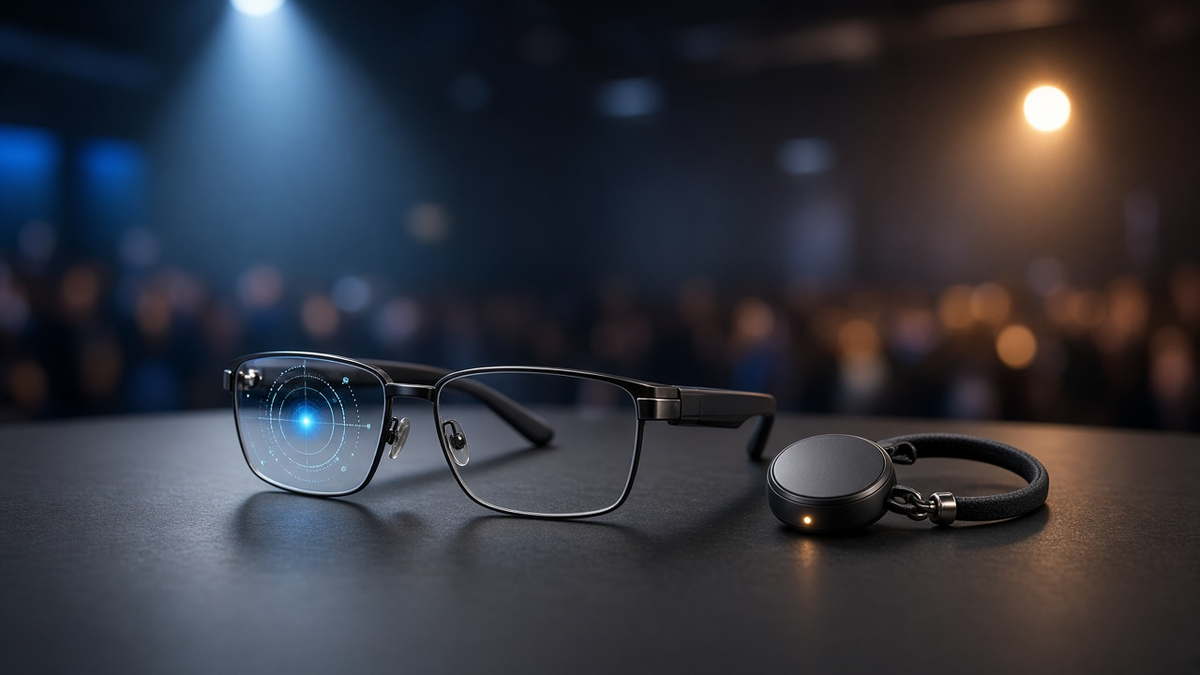
    The show opened with the device the rumor mill called Project Phoenix: Meta VR Glasses, an ultralight headset that looks more like glasses than gear. About 100 grams on the face — five times lighter than a Quest 3, by Meta’s own comparison — with a 5K display, full-color passthrough, and a tethered compute puck (Snapdragon Reality Elite) carrying the processor, battery, and storage. Up to three hours of high-res playback. No controllers: you navigate with your eyes and hand gestures. $1,299.99, shipping spring 2027.

    No new Quest headset was announced. That absence is the statement: Meta confirmed it is focused on smart glasses as the next-gen computing platform, not headsets.

    The glasses lineup goes wide

    Meta isn’t betting on one expensive pair. The whole range:

    • Ray-Ban Meta Gen 3 — $449, on sale now. Slimmer design, action button, 12MP camera with 3K video, up to nine hours of battery, six mics for call noise reduction. 27 frame-and-lens combos including a limited 90th-anniversary Aviator.
    • Ray-Ban Meta Audio — $349, shipping October 13. Meta’s first glasses without a camera: open-ear speakers, calls, music, and AI requests without reaching for your phone. Twelve hours of use, 43 grams.
    • Meta Adventurer — Meta’s own-brand budget line, from $249, shipping October 23.
    • Meta Ray-Ban Display — the display-in-lens model expands to Canada, the UK, France, Italy, and Germany.
    • A hearing-enhancement feature, FDA-cleared, at $149.99 — an accessibility play hiding inside a consumer keynote. It launches in the US later this year, set up at home in minutes with no clinic or prescription, and it’s also available through a Meta One subscription.

    Meta says the Ray-Ban, Oakley, and Meta glasses ranges will cross 100 styles by the end of 2026.

    “One more thing”: Muse Charm

    The closer was pure showmanship. Zuckerberg’s “one more thing” unveiled the Muse Charm — a puck about the size of an Apple Watch, worn on a keychain or in a pocket, with a Tamagotchi-like interactive avatar. It’s the fastest way to talk to Muse without unlocking a phone or putting on glasses: tap the fingerprint sensor, start talking.

    His words from the stage:

    We packed the whole Muse experience, including the whole real-time voice and avatar stack, into something that fits on a keychain and is always available to talk to. You just go ahead and tap here in the fingerprint sensor in the corner, and you can start talking without having to unlock a phone or open an app. So if you’re not wearing glasses, this is going to be by far the fastest way to talk to your Muse and to show what’s going on around you.

    No price yet. Meta is aiming to have it on sale by the holiday season. Worth noting: Bloomberg reported September 22 that Apple has postponed its own AI pendant project — Meta is going all-in on a category its biggest rival just walked away from.

    Muse, the agent, is the actual product

    The hardware is the delivery mechanism. The product is Muse, Meta’s personal AI agent (launched September 8), now positioned as the center of everything. Connect’s agent news:

    • Free for users — though Zuckerberg signaled Meta will eventually take a cut of transactions Muse completes.
    • Computer use is coming to Mac: Muse operating your apps, not just chatting at you.
    • Muse email addresses are on the way.
    • Integrations announced with Walmart, Best Buy, Gap, Sephora, Instacart — plus Box, GitHub, Granola, Notion.
    • New personalized voices and a real-time voice/avatar stack, including a digital avatar you can video chat with.

    About four minutes into the keynote, Zuckerberg told the room: “We believe Muse will help you make money.” And the business model is showing: 97.6% of Meta’s revenue last quarter was advertising ($59.36B of $60.80B in Q2 2026), and Zuck anticipates a small commission on Muse transactions long-term. The agent that does the shopping takes a cut of the shopping — and Meta isn’t the first to see it. OpenAI has been pushing commerce inside chat on the same track.

    The read: AI is becoming ambient

    Step back and the strategy is blunt. Meta wants Muse following you through the day — glasses when you’re wearing them, the Charm when you’re not, your computer when you’re working. Every device is another doorway to the same agent. As one recap put it: Meta wants its AI to stay with users throughout the day, and glasses, phones, and small devices each become another way to reach the same AI service.

    That’s the “lifestyle agentic” wave the social feeds are buzzing about — not a chatbot you visit, but an always-on companion that’s just there. Google, Apple, and OpenAI are all building toward the same ambient model. Meta just showed the most complete hardware version of it.

    The human-first question

    The hardware is impressive. The question hanging over all of it — the one people were actually posting about — is the human one: as AI moves onto our faces and keychains and follows us through the day, how do we keep prioritizing human connection and a human-first approach?

    The tech answers “how.” Nobody on that stage answered “why it should feel like a friend.” That’s still the open lane — and the one worth watching.


    Sources: Meta Connect 2026 opening keynote (Meta Developers, Sep 23); Meta’s official Connect 2026 summary; MacRumors, VR.org, Road to VR, Gadgets360, TechCrunch, Analytics Insight coverage, Sep 23–24, 2026; official keynote.
  • Muse to Cursor: I Gave My AI Its Own Engineering Team

    TL;DR: My personal AI runs on Muse. It can’t write code into my repos by itself — so I built it a bridge to Cursor’s cloud agents. One repo, two transports, nine tools. Now when I say “add CI to that repo,” it dispatches an agent, checks the PR, and merges. Here’s how the Muse-to-Cursor loop actually works.

    The direction nobody talks about

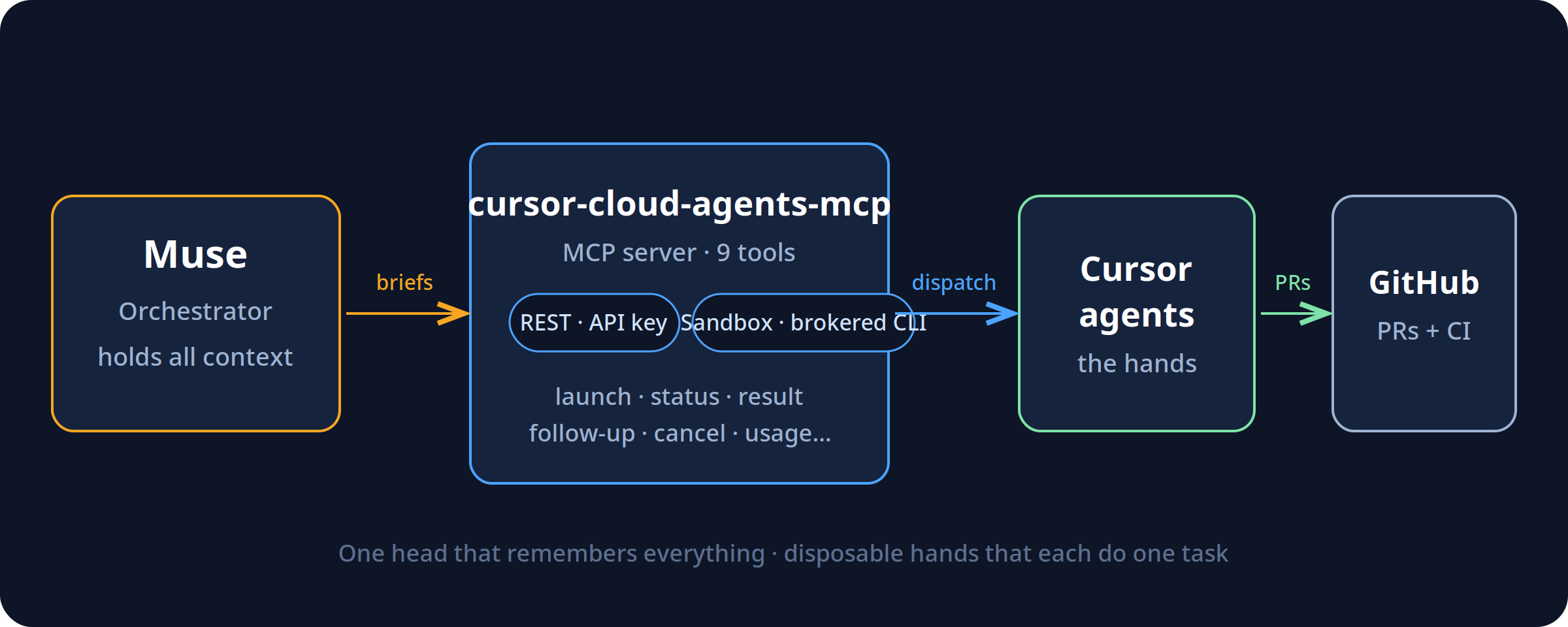
    Everyone’s building the same arrow: human → AI writes code faster. I built the other arrow: AI → AI. My assistant (Muse) holds all my context — my repos, my work orders, my rules. Cursor’s cloud agents hold the hands — they can open PRs, run CI, touch repos. The bridge between them is an MCP server I open-sourced: cursor-cloud-agents-mcp.

    The interesting part isn’t the tools. It’s the shape: one orchestrator that holds all the context, and disposable agents that each know one task. The orchestrator doesn’t write the code — it briefs, checks, and merges. The agents don’t set direction — they execute the brief. That separation is the whole trick.

    Muse-to-Cursor architecture diagram

    Two transports, one repo

    I almost built two projects. Then I realized the only real difference between audiences is where the credential lives. So it’s one repo, two transports:

    • REST — your Cursor API key, direct to api.cursor.com. For general users.
    • Sandbox — for assistants running inside sandboxed environments (like Muse/Meta’s), where there is no API key to hand out. It shells out to a brokered cursor-agent CLI on PATH instead.

    Same nine tools either way: launch, status, result, follow-up, cancel, list, models, whoami, usage.

    The lessons are in the timeouts

    The v1 API splits agents and runs, and launches can take minutes — sometimes timing out after succeeding. So the bridge mints the agent ID client-side before the call: a retry after a timeout can never create a duplicate. A timeout is reported as unknown, never as failure, then reconciled. Run status is the source of truth, because agent “ACTIVE” doesn’t mean “still working.” These are the details that separate a demo from something you can actually operate.

    It earned its keep on day one

    The first thing I pointed it at was its own repo: add CI to cursor-cloud-agents-mcp. The agent opened a PR with a GitHub Actions workflow. The first CI run failed — and caught a real bug: the package’s floating dependency had resolved to MCP 2.x, which renamed FastMCP out from under the import. The repo was shipping broken against current dependencies and nobody knew. Pin, re-run, green, merge. I didn’t touch a terminal.

    I didn’t trust my own first draft

    Before any of that, four AI models reviewed the spec against Cursor’s live docs — and independently caught the same flaw: my original design was shaped around the retired v0 API. Then two more reviewed the actual code and found real bugs: a broken idempotency path, a transport auto-detect that would have grabbed the wrong binary, a polling loop that blocked the server. All fixed before it shipped. The irony I like: the final review round ran through the bridge itself. The launcher timed out on all four agents — and the bridge’s own timeout-reconciliation showed they were all actually running.

    Where this goes

    v1.1 brings MCP 2.x support. Around it, I’m building the rest of the pattern: work orders as GitHub issues, a daily SLA check, a weekly digest — the scaffolding that turns “AI that can open PRs” into something closer to staff. Most people use agents as a faster keyboard. I’m interested in what happens when they’re the hands and something with memory is the head.

    MIT licensed. Issues and PRs welcome — help make it better.

    github.com/tygart-media/cursor-cloud-agents-mcp

  • The Quiet Moat: Why the Agent Race Will Be Won by the Company Nobody Notices

    Everyone is watching the loud fight. Meta just launched Muse, an agent that can sell your car, book your travel, and negotiate your bills from a chat thread. X is betting on Grok and the real-time signal of what people say the moment they say it. SpaceX is collecting the physical world through Tesla telemetry and Starlink. The headlines are about who has the most data, the biggest model, the flashiest demo.

    That is the wrong fight. The agent race will not be won by the company with the most data. It will be won by the company that holds the combination of data nobody notices — and that nobody has to log into a social network to provide.

    An agent that acts on your behalf does not just need to know what you want. It needs to know who you are. Who you trust. Who you listen to. What you buy when you are stressed. What you search for at two in the morning. What you do across every device, every day, without ever posting a photo or following a friend. That is not the social graph. That is the identity layer. And the company that already owns it is the one you are probably not thinking about.

    Google. Alphabet. Gmail, Chrome, Android, Search. You sign in with a Google account. You browse in Chrome. You live on Android. They know who you are, what you look at, and what you buy, across every device, without you ever logging into a social network. That is relational, temporal, and behavioral data stitched together by a login you use every day. Meta has the trust layer — who you know and who you listen to. Google has the action layer — what you actually do. The company that combines both safely wins.

    But safely is the hard part. Google has been monetizing exactly this combination for twenty years. The trust is already spent. People already do not trust them with it. Meta has the social graph, but people still remember Cambridge Analytica, and they just agreed to an eighteen billion dollar settlement over consumer harms. The company that rebuilds that trust quietly — without a manifesto, without a sizzle video, without asking you to hand over your whole digital life in one dramatic gesture — wins the agent era before anyone realizes the race started.

    This is the same instinct as the loop break we wrote about last week. The system that failed was not missing a feature. It was missing a check that should have been there. Adding more desks, more bots, more tickets would have made it worse. The fix was fewer seams and a rule that catches silence. Same here. The fix is not a better agent. It is the company that holds the combination without you noticing — or caring.

    The loudest companies are fighting for attention. The quiet one is already in your pocket. The agent that knows you best will not be the one you invited in. It will be the one you never had to invite.

  • The Wire Is the Upgrade: Why Your Phone Is the Only Hub You Need

    Stephanie got me a pair of AI glasses. I wore them for a day, talked to the assistant through them, and then put them back in the box.

    Not because they were bad. Because they were a second device to manage for a job my phone already does. Battery to charge. Pairing to babysit. Another thing that can drop the connection at the worst moment. The glasses added seams. The wire deletes them.

    Here’s what happened when I switched back to wired headphones and my phone. No Bluetooth handshake. No “is it connected?” anxiety. No charging case living in a different pocket. The headphones can’t get lost because they’re physically attached to the thing that powers them. I stopped worrying about power, about pairing, about the little rituals of keeping a wireless stack alive. The anxiety just… went away.

    That feeling is the tell. When removing a device makes you feel lighter, the device was never the solution. It was a tax.

    Right now the market is duct-taping peripherals together. Glasses with cameras. Pins with mics. Watches that talk to earbuds that talk to a puck that talks to your car. Every one of those is a new failure point. A new battery. A new pairing ritual. A new thing that can silently stop working while you assume it’s fine.

    The cleaner architecture is the opposite. One thing you carry. Your phone. It connects to your car when you plug in. It connects to the TV when you want a screen. It connects to headphones with a wire when you want sound. The peripherals are dumb. The phone is the brain. You don’t manage the stack — you just carry the one device and the rest hangs off it.

    This is the same instinct as the loop break we wrote about last week. The system that failed wasn’t missing a feature. It was missing a check that should have been there. Adding more desks, more bots, more tickets would have made it worse. The fix was fewer seams and a rule that catches silence. Same here. The fix isn’t a better pair of glasses. It’s fewer things to keep alive.

    The people building the next platform are betting on more devices. More form factors. More things to charge and pair and lose. I bet on fewer. One hub, wired where it matters, dumb displays everywhere else. The phone becomes the thing you carry the way you carry your keys — not because it’s exciting, but because it’s the one object that makes everything else work without you thinking about it.

    If your new gadget makes you feel lighter when you take it off, that’s not a feature. That’s a warning.

  • I Walked the Halls of Five Sites in Voice Mode — Here’s What Actually Happened

    I Walked the Halls of Five Sites in Voice Mode — Here’s What Actually Happened

    This morning I did something I haven’t done before: I walked the halls of five of my own WordPress sites using only voice. No typing. No desktop. Just me talking to Grok while I moved, and Grok inspecting, drafting, and handing off the work that needed hands.

    The sites were BC ESG, Healthcare Facility Hub, Risk Coverage Hub, Continuity Hub, and Restoration Intel. In about ninety minutes we published three real articles reacting to the latest IFMA Pulse findings, cleared automated cross-link spam, flagged debug flags and plugin updates, and set up a clean handoff system so nothing gets lost.

    The biggest lesson wasn’t the AI. It was the loop. I attempt the work. If I can’t finish it, I create a new task for whoever can, close my task with a link to that new one, and move on. Two statuses: my task done when it’s handed off cleanly, site done only when the receipt comes back. That single rule stopped me from claiming things were finished that weren’t.

    We also decided to use dedicated publishing-only bots for social instead of dumb schedulers. Each bot logs into one channel, posts, and does nothing else. No scraping, no connecting, no noise. Just quality publishing. Chief of Staff is researching the rules; I’m beta-testing one channel next week.

    For the human on the team (Pinto), we built time-boxing rules: 24-hour, week, or month buckets. Only the 24-hour bucket is active. Everything else parks until he pulls it forward. The goal is a powerful life, not constant on-call.

    This isn’t theory. It’s receipts from one morning. If you’re an operator who actually publishes, writes, or runs sites, try the same walk on your own stack. Pick up the ball and run it downhill — I’d love to see what you build.

    I’m using Grok from SpaceXAI for this. If you’re already on another system, you don’t need to start over. Here are the direct links: