The first thing to understand about Claude Tag pricing is that Claude Tag doesn’t have a price. There’s no separate line item, no per-feature fee. It’s included with the plans it runs on — Claude Team and Claude Enterprise, in beta — so the real question isn’t “what does Claude Tag cost,” it’s “which plan are you on, and is per-seat the right model for how you work.”
What you’re actually paying for
What you’re actually paying for with Claude Tag.
Claude Tag is a capability of two existing plans, not a product you buy on its own:
Claude Team is straightforward per-seat: a flat monthly price per user (premium seats cost more for higher usage). Predictable, easy to budget, good for a defined internal team. For the seat-tier breakdown, see Claude Team Pricing 2026: Standard vs Premium seats.
Claude Enterprise is seat-plus-usage: a per-seat fee, and then the tokens your team consumes — in chat, Claude Code, or Cowork — billed on top. It adds controls like role-based access, but the total depends on how heavily you use it.
Because the two plans bill on different logic, the “cheaper” one depends entirely on your usage shape. We dig into the Enterprise side in detail in Claude Enterprise Pricing: What Large Organizations Pay. For the broader list-rate map across Claude products, start with Claude AI pricing.
The launch credit (now expired)
At launch, Anthropic subsidized early adoption: as of June 2026, it was offering $1,000 in Claude Code and Cowork credits for every Enterprise seat activated by July 2, 2026. That deadline has now passed. For teams that adopted in time, the credit covered a meaningful chunk of early usage — it made the “turn it on internally and try it” decision close to free.
When paying per seat is the right call
When paying per seat is the right call.
For a single internal team, the per-seat model is the obvious answer. You get a current-generation teammate (Claude Tag runs on Opus 5.5) with no infrastructure to build, the launch credit softened the ramp for early adopters, and ambient mode is safe to use because all the data is yours. Buy the seats and move on.
When building your own loop wins
When building your own loop wins.
Per-seat pricing is built for one company’s team. It is not built for an agency running many clients through one operation — and that’s where the calculus flips. Building your own gated Slack–to–AI loop starts to beat paying per seat when:
You need hard isolation between clients that per-seat access controls don’t give you. Isolation has to be architectural, not a setting — see The Multi-Client Isolation Trap.
You want to own the credential and the model path, so no client’s API key or context lives where it could leak.
The approval gate is the product — you need a human signing off on every outbound deliverable, wired into the architecture, not bolted on.
Seat counts get large or spiky, where a usage-based loop you control can undercut a per-seat bill.
We didn’t reason our way to this in a spreadsheet — we built that loop before Claude Tag launched, for exactly these reasons. The story is in We Built a Slack AI Teammate Before Claude Tag.
The honest answer
For your internal team, adopt Claude Tag on a Team or Enterprise plan — it’s the cheapest path to a real AI teammate. (The early-adopter launch credit has now expired.) For multi-client delivery, the per-seat model isn’t the whole answer, because the thing you’re really buying — isolation, control, and a human in the loop — is exactly what you have to build yourself. That’s the part we build for clients at Tygart Media. Start at the pillar: Claude Tag: A Builder’s Guide for Agencies.
Setting up Claude Tag in Slack takes a few minutes. The clicks are easy. The decisions you make while you click — who can reach it, which channels it sees, whether it’s proactive — are the part that actually matters. This is a security-first walkthrough: how to install it, and what to lock down before you do.
Last refreshed: October 7, 2026 (Pacific)
The install, in plain steps
The install, in plain steps.
Open the Install Claude for Slack link, which takes you to the Slack Marketplace listing.
Click Add to Slack and approve the requested permissions.
Choose the scope: the whole workspace (Anthropic’s recommended default) or a specific set of channels.
One important gotcha: only a Slack Primary Owner or Owner can set up Claude Tag’s access and channels. The Admin role can’t do this part. If you’re rolling it out for a team, make sure an Owner is the one configuring access — otherwise you’ll get halfway and stall.
Lock this down first: who can reach Claude
Lock down who can reach Claude first.
Claude Tag gives you three Member Access modes. Pick the tightest one that still lets the right people work:
Anyone in the Slack workspace — broadest; fine for a single internal team, risky if outside collaborators or clients are guests in your workspace.
Any member of your Claude organization — narrower; ties access to your Claude org, not just Slack presence.
Role-based access — tightest; only members whose role allows it. This one is available on the Claude Enterprise plan.
Default to the narrowest mode that doesn’t block real work. You can always widen later; clawing access back after the fact is harder.
Then decide what Claude can see
Access is who can talk to Claude. Visibility is what Claude can read — and it’s the bigger lever. Two settings deserve a deliberate decision, not a default:
Cross-channel learning is permission-gated — Claude only learns from other channels and data sources you allow, and it doesn’t report from private channels. Grant it per channel, and never let a channel holding one client’s (or one regulated dataset’s) data feed learning that other work can draw on.
Map channels to trust boundaries before you enable anything — mark each channel internal, client, or regulated.
Set Member Access to the narrowest mode that works.
Ambient mode OFF by default; on only for internal-only channels.
Cross-channel learning granted per channel, never from client/regulated channels.
Isolate client work in its own space, not just a channel in one shared brain — the reasoning is in The Multi-Client Isolation Trap.
Keep a human on the ship button for anything that leaves the building.
If you’re migrating from the old app
Claude Tag replaced the legacy Claude in Slack app. The old app switched over on August 3, 2026, and administrators had a 30-day window to opt in and control channel-level access. That window is now closed — but the access and visibility decisions below still apply, whether you’re auditing an existing install or setting one up fresh. More on what changed: Claude Tag vs. the Old Claude in Slack App.
For the exact, current setup screens, Anthropic keeps an admin setup guide in its documentation; the decisions above are what to bring to it. For the full field guide, start at the pillar: Claude Tag: A Builder’s Guide for Agencies.
Ambient mode is Claude Tag’s headline feature and its single most consequential setting. Turn it on and Claude stops waiting to be asked — it starts watching the channels it’s in and speaking up when it thinks you’d want to know something. Whether you should enable it isn’t a yes-or-no question. It’s a where question, and getting the where right is the whole game.
Last refreshed: October 7, 2026 (Pacific)
What ambient mode actually does
What ambient mode actually does.
By default, Claude Tag is reactive: you @-mention it, it works, it replies. With ambient behavior enabled, it becomes proactive. Anthropic describes it as Claude keeping you updated about whatever it thinks you might need to know — flagging relevant information from across the channels it’s in and the tools it’s connected to, and following up on threads or tasks that have gone quiet.
In practice that means three things: it surfaces context you didn’t ask for, it connects information across more than one channel, and it chases loose ends nobody assigned it. Those are exactly the behaviors that make it feel like a teammate instead of a tool.
Where it’s a superpower
Inside a single team, ambient mode is close to magic. Every channel belongs to the same company, so “learning across channels” only ever connects your own dots. A proactive teammate that remembers the forgotten follow-up, links the spec to the standup, and flags the blocker before it bites is pure upside. This is the version Anthropic runs internally, and it’s why they can say a large share of their product team’s code now comes from their own version of the tool.
If your Slack workspace is one company’s data and one team’s work, turn ambient mode on and enjoy it.
Where it’s a risk
Where ambient mode is a risk.
Ambient mode’s proactive, cross-channel nature is exactly what makes it dangerous in two situations:
Multiple clients in one operation. The moment a proactive teammate is “surfacing relevant information from across channels,” relevance becomes the judge of what crosses the line between Client A and Client B. That’s a context-bleed risk we’ve lived — the whole subject of The Multi-Client Isolation Trap.
Regulated or sensitive data. Anywhere an unprompted message pulling context from elsewhere could expose something it shouldn’t — health, financial, legal, HR — proactive surfacing is a liability, not a convenience.
A simple decision framework
A simple decision framework before you enable it.
Don’t decide ambient mode globally. Decide it per surface, with one question: is everything this Claude can see owned by the same trust boundary?
Surface
Ambient mode
Why
Internal team channels (one company)
ON
Cross-channel proactivity only connects your own data
Client-facing / multi-tenant channels
OFF
Proactive surfacing is where one client’s context leaks into another’s
Regulated / sensitive-data channels
OFF
Unprompted context-pulling is a compliance liability
The rule of thumb: ambient mode should be on where the data is all yours, and off everywhere a human should still be pulling, not the AI pushing.
If you do turn it on
Enable it deliberately, not by default. Map which channels hold which trust boundary before you flip the switch, keep client and regulated channels out of cross-channel learning, and audit what the assistant can actually see. That sequencing — boundaries first, then ambient — is exactly how we walk through it in How to Set Up Claude Tag in Slack.
The bottom line
Ambient mode isn’t good or bad — it’s powerful, and power needs a boundary. For internal teams, it’s the best part of Claude Tag. For client work, it’s the part to leave off until isolation is airtight. For the full picture, start at the pillar: Claude Tag: A Builder’s Guide for Agencies.
In late August 2026, Anthropic launched Claude Tag — a new way to work with Claude that starts inside Slack. Instead of a chatbot you visit, Claude joins your workspace as a teammate. You @-mention it with a request, it breaks the task into stages, works through them, and replies in the thread with what it made.
We read the announcement with a strange feeling, because we’d been running a version of this loop for client delivery for weeks. So this isn’t a reaction piece written from the outside. It’s a field guide from a team that built the same thing first — what Anthropic got right, what’s genuinely better in their version, and the one design choice that’s quietly dangerous if you run an agency.
Last refreshed: October 7, 2026 (Pacific)
What Claude Tag actually is
What Claude Tag actually is.
A Slack-native teammate you delegate to by tagging @Claude — no separate app to open.
Multiplayer by default: one shared Claude per channel; anyone can see its work and pick up where the last person left off.
Context that compounds: it follows the channel over time, and with permission can learn from other channels and data sources.
Ambient mode: turn it on and Claude takes initiative — surfacing what’s relevant, flagging stale threads, following up on forgotten tasks.
It runs on Opus 4.8, replaces the older “Claude in Slack” app (admins opt in within 30 days), and is in beta for Enterprise and Team plans. Anthropic says 65% of their product team’s code now comes from their internal version. That number is the tell: this isn’t a toy.
What they got right
The unit of work is a request, not a conversation. “@Claude, draft the launch email and three follow-ups” is how people actually delegate.
Shared context beats private chats — auditable and collaborative; private AI sessions create shadow work nobody can review.
It meets people where the work already is. The work happens in Slack, so the AI lives in Slack.
The one thing agencies have to get right (and Claude Tag doesn’t, by default)
Claude Tag’s standout features — ambient mode and cross-channel learning — are wonderful when every channel belongs to one company. But an agency is many clients sharing one operation. The moment your AI teammate “learns across channels and data sources,” context from Client A can surface in work for Client B.
We learned this by living it. In an early pilot, a single shared context produced client deliverables that pulled in details from the wrong account. Nothing left the building, but the signal was clear: for client work, ambient cross-channel learning is not a feature — it’s a breach waiting for a deadline.
So we rebuilt around two non-negotiables:
Hard isolation per client — each client’s room is walled, enforced in the architecture, not a prompt you hope it obeys.
Approve-before-ship — the AI drafts; a human reviews; only then does it go out.
If you take one thing from this guide: the two things that make Claude Tag magical inside a company are the two things you must switch off — or wall off — to use it safely for clients.
The pattern that works: split by surface
Split by surface — the pattern that works.
Surface
Use
Why
Your internal team
Adopt Claude Tag
Ambient cross-channel learning is a feature when all the data is yours
Client-facing delivery
Isolated room + approval gate
Isolation and human sign-off are the product
How to roll it out without getting burned
Roll it out without getting burned.
Map channels by trust boundary; client-data channels don’t get cross-channel learning.
Default ambient mode OFF for anything client-facing.
Keep humans on the ship button for anything that leaves the building.
Audit what the AI can see — your permission is the control; set it deliberately.
Separate client work into isolated spaces, not just channels in one shared brain.
Where this goes
Claude Tag is a milestone: the AI teammate is now an operating model, not a demo. For internal teams, adopt it. For client work, the hard, valuable part — isolation, trust, a human in the loop — is still yours to own. That’s what we build for clients at Tygart Media.
The rest of the field guide
This pillar is the overview. The cluster goes deeper:
If your team already used the “Claude in Slack” app, Claude Tag is not an add-on — it’s the replacement. Anthropic replaced the Claude in Slack app with Claude Tag, gave administrators a 30-day window to opt in, and retired the legacy app on August 3, 2026. The migration window has closed — here’s what actually changed, and how to run the new setup right.
What’s genuinely new
Multiplayer per channel, ambient mode, cross-channel learning, and a current-generation engine — the four things that actually changed.
The old integration was, in practice, a way to summon Claude in a thread. Claude Tag changes the model from “a chatbot you call” to “a teammate that stays.” Four things are new:
Multiplayer per channel. Within a given Slack channel, there’s one Claude that interacts with everyone. Anyone can tag it in and pick up where the last person left off, instead of each person holding a private session.
Ambient mode. When enabled, Claude proactively keeps people updated about what it thinks they need to know — flagging relevant information, following up on forgotten threads — rather than waiting to be asked.
Cross-channel learning. With permission, Claude can learn from other Slack channels and data sources. (Anthropic notes it doesn’t report from private channels.)
Opus 5.5 underneath. Claude Tag now runs on Opus 5.5 (it launched on Opus 4.8), so the reasoning behind the delegation is the current-generation model, not whatever the old app was pinned to.
The migration timeline, plainly
The migration timeline as it played out: beta for Enterprise and Team, a 30-day opt-in window, legacy app retired August 3, 2026.
Three dates and facts matter:
Claude Tag shipped (beta) for Claude Enterprise and Team customers.
Administrators had 30 days to opt in and migrate — that window is now closed.
The old Claude in Slack app was retired on August 3, 2026 — teams that never migrated lost that capability.
Anthropic also offered an introductory launch credit to eligible Enterprise and Team organizations; it has since expired, but it made the trial period low-stakes for internal use.
What to check before you switch — especially if you serve clients
Three checks before running it for clients: per-channel learning, ambient mode OFF for client channels, keep the approval gate.
For a single-company team, migrating is close to a no-brainer: you get a better model and a more capable teammate, and the launch credit covered the experiment. If you’re an agency or anyone handling more than one client’s data in one workspace, three checks come first:
Decide cross-channel learning per channel, not globally. The new superpower is also the new risk. A channel that holds one client’s data should never feed learning that another client’s work can draw on. Map your channels to trust boundaries before you grant any cross-channel permission.
Default ambient mode OFF for client-facing channels. Proactive surfacing is wonderful internally and dangerous across tenants. Turn it on where the data is all yours; leave it off where it isn’t.
Keep your approval gate. Whatever human sign-off you had on outbound work in the old setup, carry it forward. A more autonomous teammate raises the stakes on “who hits send.”
Our take
Adopt it internally now — the model upgrade and the multiplayer surface are worth it, . For client delivery, switch deliberately: the same features that make Claude Tag better make isolation harder, and isolation is the thing you can’t get wrong. We unpack exactly that failure mode in The Multi-Client Isolation Trap, and the on/off call for proactive behavior in Claude Tag Ambient Mode.
Claude Tag’s two best features are ambient mode and cross-channel learning. Inside a single company, they are close to magic: one AI teammate that quietly learns how the whole organization works and surfaces the right thing at the right moment. If you run an agency, those same two features are a trap. This piece is about why, and exactly what to build instead.
Why an agency is a different shape of problem
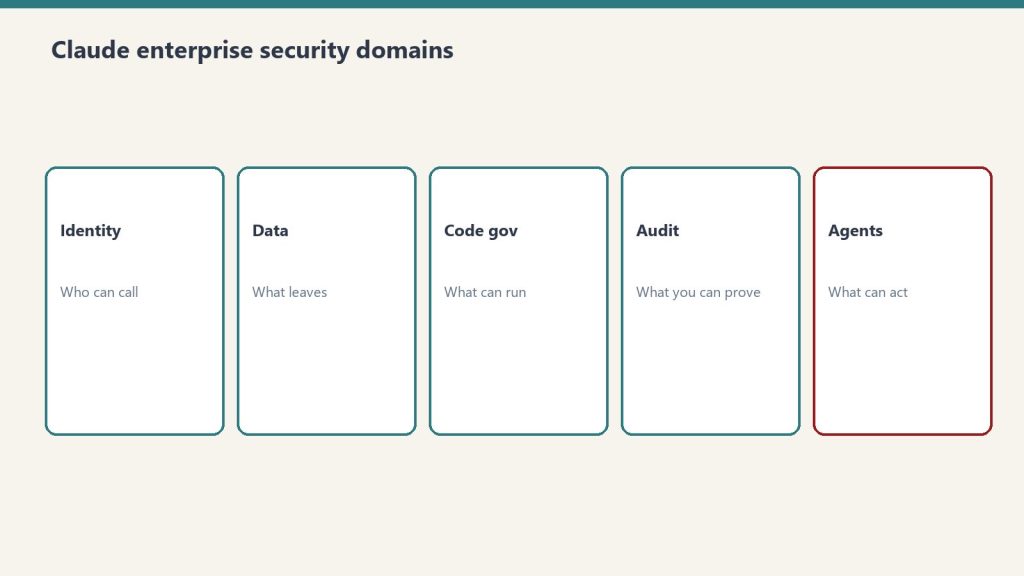
Agencies span the same five security domains as any enterprise — but with client walls between the data.
A company is one tenant. Every channel, every document, every thread belongs to the same entity, so an AI that “learns across channels and data sources” is only ever connecting your own dots. That is the design Claude Tag is optimized for, and Anthropic’s own number — 65% of their product team’s code now comes from their internal version — shows how well it works when all the data is yours.
An agency is the opposite shape. You are many clients sharing one operation. Client A and Client B may be competitors. The instant your AI teammate is allowed to learn across channels, the wall between those two accounts depends on the model’s judgment about what is “relevant” — and relevance is exactly the thing it’s designed to be generous about. Cross-channel learning isn’t a bug here. It’s a feature pointed in the wrong direction.
The lesson we learned by living it
We didn’t reason our way to this. We hit it. In an early pilot, running a single shared context across more than one account, the assistant produced a client deliverable that pulled in details from the wrong account. Nothing left the building — the human review caught it — but the signal was unmistakable. For client work, ambient cross-channel learning is not a feature. It’s a breach waiting for a deadline, because the day it slips through is the day someone is moving too fast to catch it.
That single near-miss reorganized how we build. It is the reason we treat isolation as architecture, not etiquette.
Why “don’t mix clients” in a prompt is not a control
The tempting fix is to tell the assistant, in its instructions, to keep clients separate. Don’t rely on it. A prompt is a request for good behavior; it is not a boundary. Under deadline pressure, with a helpful model trying to surface everything relevant, “please don’t cross the streams” is the first thing to bend. Isolation that matters is enforced in the structure of the system — in what the assistant can even see — not in what you politely ask it not to do.
The pattern that works: split by surface
Split by surface — the isolation pattern that works.
The move that resolved it for us was to stop treating “internal” and “client-facing” as the same problem. They get different architectures:
Surface
Use
Why
Your internal team
Adopt Claude Tag fully
Ambient mode and cross-channel learning are features when all the data is yours
Client-facing delivery
Isolated room + approval gate
Per-client isolation and human sign-off are the product, not overhead on it
Internally, turn everything on. Let it learn across your channels, run ambient, follow up on your forgotten threads. For client work, each client gets a walled room that cannot see any other client’s context, and nothing leaves that room without a human approving it.
Do this instead: a concrete checklist
Concrete checklist instead of prompt hope.
One isolated space per client — not one shared brain with channels. The boundary should be the space itself, enforced by what data the assistant is connected to, so there is nothing to “accidentally” pull from another account.
Cross-channel learning OFF for anything client-facing. It is the single setting most likely to cause a bleed. Reserve it for internal-only surfaces.
Ambient mode OFF on client rooms by default. Proactive surfacing is where unrequested context shows up. Let humans pull in a client room; let the AI push only where the data is all yours.
A human on the ship button for everything that leaves the building. The AI drafts; a person reviews and approves; only then does it go to the client. This is the control that caught our near-miss.
Audit what the assistant can see, deliberately. Permissions are the real boundary. Set them on purpose, write them down, and review them when you add a client.
Map every channel to a trust boundary before you turn anything on. Decide, per channel, whether it is internal or client data — and never let a client-data channel feed cross-channel learning.
The one sentence to take with you
The two things that make Claude Tag magical inside a company — ambient mode and cross-channel learning — are the two things you must wall off to use it safely for clients. Get that right and you get the upside without betting the client relationship on a model’s judgment about relevance.
The night before Anthropic launched Claude Tag, we shipped two client deliverables through a Slack-based AI teammate we had built ourselves. We weren’t racing anyone and we had no idea an announcement was coming the next morning. We were just doing the work the way we’d been doing it for weeks: post a request in a channel, let Claude draft, approve it, and let it go out.
So when Anthropic described Claude Tag — tag @Claude with a request, and it breaks the task into stages and works through them in the thread — we recognized it on sight. This is the build log of the version we made first: what it is, why we put it in Slack, and the one piece we deliberately kept under human control.
Why we were building an AI teammate in Slack at all
The three-layer shape — chat UI, tools, agent runtime — that became our build.
We didn’t set out to build an “AI tool.” We set out to close the gap between a decision and the thing the decision produces. A lead comes in and someone says “we should send the follow-up sequence today.” A week ends and someone says “the client update needs to go out.” The decision is made in seconds; the production used to take an hour. That hour is where work stalls.
Slack was the obvious surface because that is where the deciding already happens. We didn’t want a separate dashboard nobody opens, or a chatbot in another tab that creates a second copy of the conversation. We wanted the request and the result to live in the same thread, where anyone on the team can see both. Putting the AI where the work already is turned out to be most of the design.
The loop, stage by stage
The four-move loop: request, draft, claim-and-approve, ship.
The whole system is one loop with four moves:
Request. Someone posts a plain-language ask in a channel — “draft the new-lead follow-up sequence,” “write this week’s update post.” No special syntax, no form.
Draft. The teammate picks it up, breaks it into stages, and produces the actual deliverable in the thread — not a summary of what it would do, the thing itself.
Claim and approve. A human takes the draft, reads it, edits if needed, and signs off. Nothing moves on the AI’s say-so alone.
Ship. On approval, the deliverable goes to its real destination — the CRM, the CMS, the inbox — and the thread records that it happened.
The night we ran it end to end, twice, the part that struck us wasn’t the drafting. It was how natural the “claim and approve” step felt. Delegating to the teammate looked exactly like delegating to a person: ask in the channel, get a draft back, give it a yes.
The runner that holds no keys
The piece we’re proudest of is invisible in the thread. The process that reads the queue and carries out approved work does not carry standing credentials. The keys to the CRM, the publishing platform, the email system — none of them live inside the bot. They sit in the platform’s secret store and are handed to the action at the moment it runs, scoped to that job.
This sounds like plumbing, but for an agency it is the difference between safe and reckless. The component most exposed to the outside world — the thing listening to a chat channel — is the component holding the least. If that surface were ever compromised, there is no client’s API key sitting in it to steal. We built it that way before it was convenient, because client trust is the entire business.
What surprised us
A request is a better unit than a conversation. “Draft the launch email and three follow-ups” is how people actually delegate. Framing the work as a request instead of a chat changed how the team used it — less hand-holding, more handing-off.
Visible beats private. Because the work happened in a shared channel, anyone could see what was asked and what came back. Private AI sessions create shadow work nobody can review. Doing it in the open made it auditable by default.
The approval step wasn’t a bottleneck. It was the product. We expected the human sign-off to feel like friction. Instead it was the thing that let us trust the output enough to send it to a client at all.
What Claude Tag changes for us
Tag retired our scaffolding; isolation and the human ship button stayed ours.
Anthropic productized the surface we’d been hand-building: a Slack-native teammate, multiplayer per channel, with an ambient mode and cross-channel learning — launched on Opus 4.8, now running on Opus 5.5 (see our Claude Tag pricing guide). For our internal team, that’s a gift — we can adopt it and retire some of our own scaffolding.
For client delivery, the hard and valuable part is still ours to own: keeping each client’s context walled off from every other, and keeping a human on the ship button. Those two things are exactly what Claude Tag’s best features work against by default — which is the whole subject of the next piece: Claude Tag for Agencies: The Multi-Client Isolation Trap. For the full picture, go back to the pillar: Claude Tag: A Builder’s Guide for Agencies.
Here’s the number that reorganized how we think about search: ~84% of our organic traffic comes from Bing. Not Google. Bing — and the Copilot and ChatGPT surfaces that draw on Bing’s index. Yet for a long time, like nearly everyone, we watched only Google Search Console and treated Bing as an afterthought.
That’s the blind spot this article is about. Short answer: use both consoles, but if Bing drives your traffic, stop treating Bing Webmaster Tools as optional — it has data, indexing controls, and an AI-insights surface that Google Search Console doesn’t, and it’s reporting on the search engine that’s actually sending you readers.
This is the side-by-side from running both consoles on the same media property: what each one tells you, where Bing is quietly ahead, and how we wired the Bing Webmaster Tools API into our editorial calendar.
The core reporting — query, position, CTR
Core reporting: query, position, CTR.
At the surface, the two consoles look like twins. Both give you queries, impressions, clicks, average position, and CTR. The differences are in coverage and freshness.
How we do it
Job
Bing Webmaster Tools
Google Search Console
Verdict
Query / position / CTR
Yes, per query and page
Yes, per query and page
Tie on the basics
Data freshness
Often faster to update
~2-3 day lag
Bing edges ahead
Historical window
Generous
16 months
Toss-up
API access
Full API: position + CTR per query/page
Search Analytics API
Bing — the API is the underrated weapon
AI / Copilot insights
Dedicated AI-traffic insights
No equivalent surface yet
Bing, clearly
Market it reports on
Bing + Copilot + ChatGPT-via-Bing
Google only
Depends on your traffic mix
The honest read: for the basic dashboard, they’re close enough that you’d never switch for the UI. The reasons to take Bing seriously are whose traffic it reports on and what it lets you do about it — the AI insights tab and the API.
Indexing: IndexNow vs crawl-when-it-feels-like-it
Indexing: IndexNow vs crawl-when-it-feels-like-it.
This is the most concrete operational difference, and it’s lopsided.
How we do it
Job
Bing Webmaster Tools
Google Search Console
Verdict
Tell it about a new URL
IndexNow — push, indexed near-instantly
URL Inspection → “Request indexing” (queued)
Bing — push beats poll
Bulk submission
IndexNow ping + sitemap
Sitemap, then wait
Bing
Control over crawl
Crawl control, block/allow
Limited crawl controls
Bing — more knobs
Re-crawl on edit
Re-ping IndexNow
Hope, or re-request
Bing
IndexNow is the standout. Instead of submitting a sitemap and waiting for a crawler to wander by, you push a URL the moment it changes and it’s picked up almost immediately — and because IndexNow is a shared protocol, one ping notifies participating engines. Google’s model is still largely “request indexing and wait.” For a content site that publishes and edits constantly, push beats poll every time. We ping IndexNow on publish and on every meaningful edit.
The AI / Copilot insights tab
The AI insights tab is the differentiator.
Google Search Console has no real equivalent here yet. Bing Webmaster Tools surfaces AI-traffic insights — visibility into how your content shows up across Bing’s AI-powered and Copilot surfaces. Given that those surfaces (and ChatGPT’s web results, which draw on Bing) are an increasing share of how people find answers, this is the single console feature most aligned with where discovery is heading. If you care about GEO at all, it’s the dashboard that tells you whether the AI assistants are actually pulling you in.
Wiring the BWT API into the editorial calendar
The Bing Webmaster Tools API is the part most sites never touch, and it’s the most actionable. It returns position and CTR per query and per page — which is a ready-made content-optimization loop:
Pull query/position/CTR from the BWT API on a schedule.
Find pages ranking on page one with weak CTR (good position, bad headline/meta) — fast wins.
Find queries where we rank position 5-15 with real impressions — the “one good edit from page one” list.
Feed both lists straight into the editorial calendar as prioritized rewrites.
Because Bing drives most of our traffic, this loop is pointed at the engine that actually moves our numbers. Running the same loop off Google Search Console’s API would optimize for the 16% of traffic, not the 84%.
What surprised us
Bing’s data is often fresher than Google’s. We frequently see new queries in Bing Webmaster Tools before they show up in Search Console.
IndexNow is faster than anything Google offers — and it’s free and standard. The gap between “push and it’s indexed” and “request and wait” is real and daily.
The AI insights tab has no GSC counterpart. For a site doing GEO, that’s the most forward-looking surface either console offers.
Almost nobody verifies their site in Bing Webmaster Tools. You can import directly from Google Search Console in a couple of clicks, so the only reason most sites skip it is that they’ve never looked at where their traffic comes from.
The takeaway
This was never a “pick one” — it’s “stop ignoring one.” Google Search Console is still essential; Google isn’t going anywhere. But running only GSC is a bet that Google’s view of your site is the only one that matters, and our traffic data says that bet is wrong by a factor of five.
Use both. Watch Google Search Console for the Google slice. But if a large share of your organic traffic comes from Bing — and a surprising number of content sites are in exactly that position without checking — then Bing Webmaster Tools is your primary console: fresher data, IndexNow for instant indexing, the AI/Copilot insights surface, and an API you can wire straight into your editorial calendar.
The 84% lesson is simple: measure where your readers actually come from, then watch the console that reports on it. For us, that meant promoting Bing from afterthought to the dashboard we open first.
This is part of our “Two Clouds, One Site” series — we run the same media property on Azure and Google Cloud, on the free tiers, and report what watching both ecosystems actually teaches us. The lab lives on tygart.media; the findings publish here.
Should I use Bing Webmaster Tools if I already use Google Search Console?
Yes — they report on different search engines, so using only Google Search Console hides all of your Bing performance. If any meaningful share of your traffic comes from Bing, Copilot, or ChatGPT’s Bing-powered results, Bing Webmaster Tools shows data and offers indexing controls that Search Console doesn’t. You can import your site from Search Console in a couple of clicks.
What is IndexNow and is it faster than Google indexing?
IndexNow is a protocol that lets you push a URL to search engines the moment it’s published or changed, instead of waiting for a crawler. It’s typically much faster than Google’s “request indexing and wait” model, and because it’s a shared standard, one ping notifies participating engines. For sites that publish or edit frequently, it’s a meaningful indexing-speed advantage.
Does Bing Webmaster Tools have an API?
Yes. The Bing Webmaster Tools API exposes per-query and per-page data including position and CTR, plus URL submission. That makes it practical to pull your search performance on a schedule and feed it into a content-optimization loop — for example, flagging page-one results with weak CTR or near-miss rankings to prioritize for rewrites.
What does the Bing Webmaster Tools AI insights tab show?
It surfaces how your content appears across Bing’s AI-powered and Copilot surfaces, giving visibility into AI-driven discovery that Google Search Console has no direct equivalent for yet. For sites focused on Generative Engine Optimization, it’s the most forward-looking view either console offers into whether AI assistants are pulling in your content.
Why would a site get most of its traffic from Bing instead of Google?
It’s more common than people assume, especially for niche or B2B content, sites strong in Bing-heavy regions or browsers, and content that surfaces well in Copilot and ChatGPT’s Bing-powered results. The lesson is to measure your actual referral mix rather than assume Google dominates — many sites only discover their Bing share once they verify in Bing Webmaster Tools.
Generative Engine Optimization (GEO) is the new shape of getting found: instead of ranking a blue link, you make your content legible to AI assistants so they recognize, trust, and cite it. The engine room of that work is entity extraction — pulling the named entities and key phrases out of your content so you can saturate it with the concepts an AI system uses to decide what a page is about.
We run the same articles through both Azure AI Language and Google Cloud Natural Language, on the free tiers, and compare what each one sees. Short answer: for GEO aimed at Bing and Copilot, Azure AI Language is the pick — not because its NLP is categorically better, but because you’re extracting entities with Microsoft’s own signal family to optimize for Microsoft’s own AI. Google Natural Language is an excellent general-purpose NLP API; it’s just optimizing toward a different reader.
This is the breakdown from the running lab on tygart.media — entity quality, key phrases, sentiment, free-tier ceilings, and the strategic point underneath all of it.
The free-tier ceilings
Free-tier ceilings for entity extraction.
How we do it
Azure
Google Cloud
Verdict
Service
Azure AI Language
Cloud Natural Language API
—
Free ceiling
5,000 text records/month
First 5,000 units/month free per feature
Toss-up on raw volume
“Record” definition
Up to 1,000 chars = 1 record
Per 1,000 chars = 1 unit, per feature
Watch Google — billed per feature
Cost after free
Per record
Per 1,000 chars, per feature called
Azure simpler to predict
Always free?
Perpetual free tier
Free monthly allotment, then billed
Tie — both have monthly free
The subtlety: Google bills per feature — entity analysis, sentiment, and syntax each consume their own free allotment and then their own meter. Azure’s 5,000 text records/month is a cleaner mental model for a content pipeline that runs every article through the same extraction pass. At ~300–400 articles a month, both stay at $0; Azure is just easier to reason about.
Entity extraction quality
Entity extraction quality head-to-head.
This is the line that matters most for GEO.
How we do it
Job
Azure
Google Cloud
Verdict
Named entity recognition
Strong, typed categories + subcategories
Strong, with entity types
Toss-up on accuracy
Entity linking
Links entities to a knowledge base
Wikipedia/Knowledge Graph links
Google for KG links; Azure for Bing alignment
Key-phrase extraction
First-class, clean
Not a dedicated feature (infer from entities/salience)
Azure — dedicated key phrases
Salience / ranking
Confidence scores
Salience score per entity
Google — salience is genuinely useful
Sentiment
Document + sentence + aspect-based
Document + entity-level
Toss-up; both solid
Both APIs find the obvious entities. The differences are at the edges: Google’s salience score (how central an entity is to the document) is a genuinely useful GEO signal — it tells you which entities the content is actually about, not just which appear. Azure’s dedicated key-phrase extraction is the cleaner input for content saturation — it hands you the phrases to weave back in, where Google makes you infer them.
For our pipeline, we use Azure’s key phrases as the editing checklist and lean on its typed entity categories to confirm an article is “saturated” with the right concepts before it publishes.
Sentiment and the extra features
Both do document- and sentence-level sentiment well. Azure’s aspect-based sentiment (sentiment tied to specific targets within a sentence) is the richer feature if you’re analyzing reviews or feedback. Google’s entity-level sentiment is comparable for most content work. For a media site doing GEO, sentiment is secondary — entity and key-phrase extraction is the main event — but if you also do feedback analysis, Azure’s aspect-based model edges ahead.
The strategic point — extract with Microsoft’s tooling, optimize for Microsoft’s AI
Here’s the whole game. When you extract entities to optimize content, you’re implicitly choosing a definition of what counts as an entity. Those definitions aren’t universal — Microsoft’s and Google’s models were trained on different data and tuned toward different downstream systems.
Bing and Copilot select and ground content using Microsoft’s signal family — the same lineage that powers Azure AI Language. So when we extract entities with Azure and saturate our articles with what it recognizes, we’re tuning content to the exact signals Microsoft’s own AI uses to decide what to surface and cite. That’s not a coincidence we’re exploiting; it’s the most direct alignment available. With ~84% of our traffic from Bing, optimizing toward Google’s entity model would be optimizing for the wrong reader.
What surprised us
Google’s salience score is the feature we wish Azure had. Knowing which entity is central (not just present) is a sharper GEO signal than a flat confidence list.
Google bills per feature — that’s the budget trap. Calling entities + sentiment + syntax on one document is three metered features, not one. Azure’s per-record model is harder to accidentally triple.
Key-phrase extraction is an Azure advantage that’s easy to miss. Google has no dedicated key-phrase feature; you reconstruct it from entities and salience. Azure just hands you the phrases.
Both miss niche industry entities. Neither model reliably tags specialized restoration-industry or proprietary-standard terms. Custom NER (Azure) or a custom dictionary closes that gap — worth it if your content is jargon-dense.
The takeaway
The takeaway from the NLP bakeoff.
These are both strong NLP APIs, and at our volume both run at $0. The decision is about which AI you’re feeding.
Pick Azure AI Language if your GEO target is Bing and Copilot, you want dedicated key-phrase extraction as a content checklist, and you’d rather extract entities with the same signal family your search traffic actually flows through. That’s us.
Pick Google Cloud Natural Language if you want the salience score, you’re optimizing for Gemini and Google’s Knowledge Graph, or you need general-purpose NLP across mixed workloads. It’s an excellent API — it’s just tuned toward a different reader than the one sending us traffic.
If most of your audience arrives through Bing, extracting your entities with Google’s model is optimizing for the wrong index. We extract with Microsoft’s tooling, on purpose.
This is part of our “Two Clouds, One Site” series — we run the same media property on Azure and Google Cloud, on the free tiers, and publish what the two ecosystems actually do with the same content. The lab lives on tygart.media; the findings publish here.
What is entity extraction and why does it matter for SEO?
Entity extraction (named entity recognition) identifies the people, places, organizations, and concepts in your text. It matters for modern SEO and GEO because search engines and AI assistants understand pages by the entities they contain — saturating content with the right, correctly-recognized entities helps those systems classify and cite it accurately.
Is Azure AI Language free?
Azure AI Language includes a perpetual free tier of 5,000 text records per month, where one record is up to 1,000 characters. For a content site processing a few hundred articles a month, that’s enough to run entity and key-phrase extraction on every piece at $0.
What’s the difference between Azure AI Language and Google Natural Language?
Both extract entities, key concepts, and sentiment, but they differ at the edges: Azure offers dedicated key-phrase extraction and aspect-based sentiment, while Google offers a salience score that ranks how central each entity is to the document. Google also bills per feature, where Azure bills per text record. They’re tuned toward different downstream AI systems — Azure toward Microsoft/Bing, Google toward Gemini and the Knowledge Graph.
What is GEO (Generative Engine Optimization)?
GEO is optimizing content so generative AI assistants recognize, trust, and cite it, rather than optimizing only for blue-link rankings. In practice it means structuring content and saturating it with the right entities and key phrases so the models that answer user questions pull from your pages.
Which NLP API is better for optimizing for Bing and Copilot?
Azure AI Language, because it shares Microsoft’s signal lineage — the same family Bing and Copilot use to select and ground content. Extracting entities with Azure and saturating your articles with what it recognizes aligns your content with the exact signals Microsoft’s AI uses, which is the higher-leverage choice when Bing drives your traffic.
Most “which managed search?” articles compare feature checklists from the vendor docs. We did something more useful: we indexed the same media property’s content into both Azure AI Search and Vertex AI Search, on the free tiers, and watched what each one did with it.
Short answer: for a content site that wants to be found and cited by AI assistants, Azure AI Search is the pick — not because the relevance is dramatically better, but because it’s the retrieval lineage that sits behind Bing and Copilot, and ~84% of our organic traffic comes from Bing. Vertex AI Search is the stronger turnkey RAG product and grounds beautifully into Gemini. Which one wins depends entirely on whose AI you’re trying to get in front of.
This is the desk-by-desk breakdown — free-tier ceilings, setup friction, relevance, and ecosystem grounding — from the running lab on tygart.media.
The free-tier ceilings
Free-tier ceilings on managed site search.
The first thing that matters at our scale is what each gives you for $0, perpetually.
How we do it
Azure
Google Cloud
Verdict
Service
Azure AI Search (Free tier)
Vertex AI Search
—
Storage
50 MB
Generous indexing quota, but query/extraction billed
Azure — true perpetual free
Indexes
3 indexes
Multiple data stores
Toss-up
Documents
~10,000 hosted docs
Effectively higher, but pay-as-you-go
Azure for “always free” certainty
Cost model
Always free, no card pressure
Free trial credits, then per-query/extraction
Azure — Vertex bills as you scale
Semantic ranking
Available (limited on free)
Built in, very strong
Google on raw quality
The honest read: Azure’s 50 MB / 3-index / ~10,000-document free tier is small but genuinely perpetual — it never starts billing at our volume. Vertex AI Search is more capable out of the box but its free posture is trial credits, after which queries and extractive answers meter. For a small content site, Azure’s ceiling is the one you can forget about.
Setup friction
How we do it
Job
Azure
Google Cloud
Verdict
Get to first results
Create service → index → import data source
Create app → data store → point at site/GCS
Google — faster to “it works”
Crawl a website directly
Indexer add-on, more wiring
Website data store crawls URLs natively
Google, clearly
Schema control
Fine-grained fields, analyzers, scoring profiles
More opinionated, less to tune
Azure for control; Google for speed
Vector / hybrid search
Native vector + hybrid (keyword+vector)
Native, with built-in embeddings
Toss-up; both strong
Vertex AI Search gets you to a working search box faster — point it at a sitemap or a Cloud Storage bucket and it crawls and chunks for you. Azure AI Search makes you assemble the indexer, but in exchange you get scoring profiles, custom analyzers, and field-level control that pay off once you care about why a result ranks.
Relevance and semantic ranking
On raw relevance for a handful of queries against the same corpus, Vertex was slightly better out of the box — its semantic ranking and extractive answers are tuned and ready. Azure matched it once we turned on semantic ranking and tuned a scoring profile, but that’s manual work Vertex does for free.
The asymmetry: Vertex is better at answering, Azure is better at being controllable. If you want a search box that produces clean extractive answers with zero tuning, Vertex wins. If you want to deliberately shape what ranks (and you’re optimizing content anyway), Azure rewards the effort.
The grounding angle — whose AI is reading you
Grounding angle — whose AI is reading you.
This is the line that actually decides it for us.
Neither Azure AI Search nor Vertex AI Search “submits your site to Bing or Gemini.” But the retrieval architecture you build on signals which ecosystem you’re fluent in. Azure AI Search is the same managed-retrieval lineage Microsoft uses to ground Copilot, and it’s the natural backend for “Bring your own data” grounding into Azure OpenAI / Copilot Studio. Vertex AI Search is the canonical retrieval layer for grounding Gemini — it’s literally the “ground with your own data” path in Google’s stack.
So the question isn’t “which search is better.” It’s: which AI assistant do you most need to recognize and cite your content? For us, with Bing driving the overwhelming majority of organic traffic, building our retrieval inside Microsoft’s lineage and exposing structured, Copilot-groundable content is the higher-leverage bet.
What surprised us
What surprised us in the comparison.
Azure’s 50 MB is smaller than it sounds — and bigger than it needs to be. Pure text content compresses; 10,000 documents of article body is more than a mid-size site has. The ceiling we’d hit first is index count (3), not storage.
Vertex’s “free” is the easy thing to misjudge. The trial experience is so smooth you forget it’s metered. Set a budget alert before you point it at a large crawl.
Hybrid (keyword + vector) search is now table stakes on both. A year ago this was Azure’s differentiator; Vertex has fully caught up.
Vertex crawls websites natively; Azure wants a data source. If your content lives in a bucket or a DB, Azure’s indexer is fine. If you just want to crawl tygart.media and search it, Vertex is less wiring.
The takeaway
These are both excellent managed search engines, and at small scale both can run at $0 — Azure perpetually, Vertex on credits. The decision isn’t about relevance deltas measured in single queries.
Pick Azure AI Search if your strategic goal is to be retrievable and citable inside the Microsoft / Bing / Copilot ecosystem, you want a truly perpetual free tier, and you’re willing to tune scoring profiles for control. That’s us.
Pick Vertex AI Search if you want the fastest path to a high-quality answering search box, you’re grounding into Gemini, or your content already lives in Google Cloud Storage and you want native crawl-and-chunk with zero schema work.
If most of your readers arrive through Bing, building your retrieval layer only inside Google’s lineage is the same blind spot as watching only Google Search Console. We build on both — and lean Azure for the citation angle.
This is part of our “Two Clouds, One Site” series — we run the same media property on both Azure and Google Cloud, on the free tiers, and report what watching both ecosystems actually teaches us. The lab lives on tygart.media; the findings publish here.
Is Azure AI Search really free?
Yes — the Free tier is perpetual, not a trial. It includes 50 MB of storage, 3 indexes, and roughly 10,000 hosted documents, and it does not start billing as long as you stay inside those limits. For a small content site that’s enough to run real site search at $0.
What’s the difference between Azure AI Search and Vertex AI Search?
Azure AI Search is a managed retrieval engine you assemble (index, indexer, scoring profiles) and the lineage behind Microsoft’s Copilot grounding. Vertex AI Search is Google’s more turnkey managed search and RAG product that crawls and chunks for you and grounds natively into Gemini. Azure favors control and a perpetual free tier; Vertex favors speed-to-answer and pay-as-you-go scaling.
Which is better for getting cited by AI assistants?
It depends on which assistant matters to you. Azure AI Search aligns with Bing and Copilot grounding; Vertex AI Search aligns with Gemini grounding. If most of your traffic and target citations come from Bing, building retrieval inside Microsoft’s lineage is the stronger bet.
Does Vertex AI Search have a free tier?
Vertex AI Search runs on Google Cloud free trial credits rather than a perpetual always-free tier, and after that, queries and extractive answers are billed per use. It’s easy to start for free, but set a budget alert before pointing it at a large website crawl, because metering starts once credits run out.
Can I use Azure AI Search to ground my own AI chatbot?
Yes. Azure AI Search is the standard “bring your own data” retrieval backend for Azure OpenAI and Copilot Studio, supporting keyword, vector, and hybrid search. You index your content, then have the model retrieve and ground its answers against your index, which keeps responses tied to your source material.