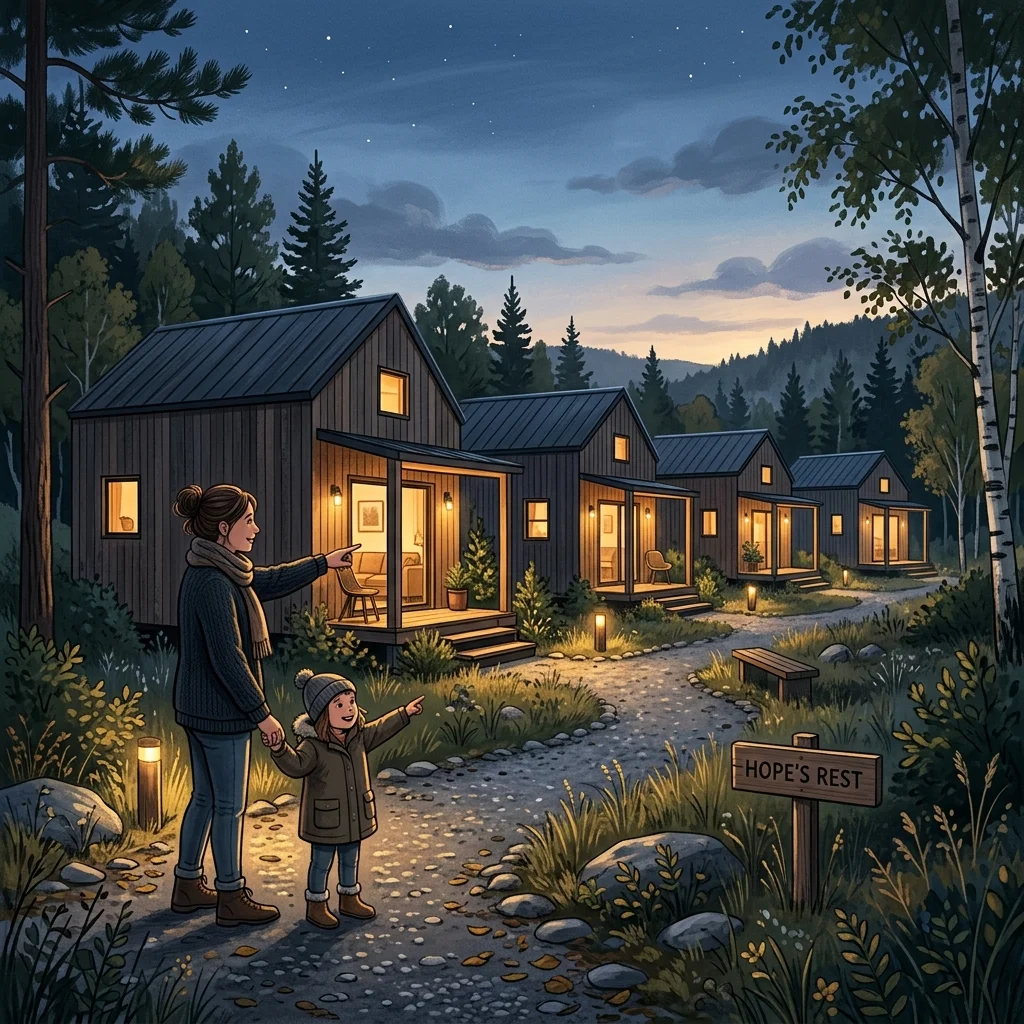
Quick answer: On Monday, April 27, 2026, the City of Everett and Volunteers of America Western Washington (VOAWW) opened a 20-unit Pallet Shelter Village for women experiencing homelessness with their children. The village is built on city-owned land off Sievers-Duecy Boulevard, includes a community kitchen, playground, showers, and detached restrooms, and offers up to 12 months of transitional stays with wraparound recovery and job support — funded by City of Everett American Rescue Plan Act dollars and a $250,000 match from Snohomish County.
There is a quiet, specific moment at a ribbon cutting that does not show up in the photo op. It is the moment a city council member, a CEO, and a mayor walk away from the cameras and the contractors start moving keys to a coordinator’s office. After that moment, the building is no longer a project. It is somebody’s address.
That moment happened in Everett on April 27, 2026, on a parcel of city-owned land off Sievers-Duecy Boulevard in the west end of town. The City of Everett and Volunteers of America Western Washington — the organization most longtime Everett residents know simply as VOAWW — cut the ribbon on a 20-unit Pallet Shelter Village. It is the city’s third Pallet shelter project. It is the first one in Everett built specifically for women and their children. And it is, by far, the cleanest answer the city has produced to a question Casino Road and Pinehurst-Beverly Park families have been asking for years: where can a mother go with her kids when she does not have anywhere to go?
Here is what is on site, how to qualify, who paid for it, and why this matters for Everett’s broader homelessness response in 2026.
What’s Actually On The Site
Twenty pallet structures sit on the lot. Each unit is designed to house one mother and up to three children — a sleeping space plus secure storage, climate control, and a lockable door. That is a different physical reality than the bunkhouse and emergency-shelter setups that most homeless families in Snohomish County had access to before this opening.
Around the units, the village has the infrastructure that makes a temporary home livable for a family with kids. There are detached restrooms. There is a separate shower facility. There is a community kitchen and gathering place — a hard-walled, year-round space, not a tent — where residents can cook, eat, and meet with case workers without leaving the village. And there is a playground, the single feature that signals more about who this village is for than any other piece of the build.
The Pallet structures themselves were built by Pallet Shelter, the Everett-based company whose modular units have been deployed across more than 70 cities. The site is enclosed and managed; access is controlled.
Who It’s For And How Long Residents Can Stay
The shelter is for women and their children, full stop. Residents can stay for up to 12 months while they work toward permanent housing.
That 12-month window is the critical difference between an emergency shelter and what VOAWW is operating here. Emergency shelters typically run on 30-, 60-, or 90-day stays — barely enough time to stabilize, let alone rebuild a life. A 12-month transitional stay is long enough for a mother to get into substance use treatment if she needs it, hold a job for long enough to build a rental history, save a damage deposit, get her kids into a stable school routine, and apply for the permanent housing programs whose waiting lists run six months and longer.
That is the math behind transitional housing as a model, and it is the math that the new village was built around.
Wraparound Services — The Part That Actually Determines Outcomes
VOAWW will be providing the wraparound services at the village. That word — wraparound — is one that gets used loosely in nonprofit-speak, but in this case it means something specific.
Recovery assistance is on the list. So is job assistance. VOAWW already operates a portfolio of programs across Snohomish County that touch substance use disorder services, behavioral health, employment readiness, and family-stabilization case management. That is the same machinery that gets connected to a Pallet shelter resident from the day she moves in. It is the part of the model that determines whether 20 units become a revolving door or become 20 successful exits to permanent housing every 12 months.
Brian Smith, the CEO of Volunteers of America Western Washington, said at the ribbon cutting on April 27 that “It’s about dignity. It’s about stability.” That language is plain on purpose. The model is not built around innovation theater. It is built around the boring, durable work of giving a mother a stable address long enough that she can put a kid in the same school for a full year.
Where The Money Came From
The City of Everett allocated American Rescue Plan Act (ARPA) dollars to the project. ARPA is the federal pandemic-recovery funding stream that gave municipalities one-time capital to spend on community resilience — and Everett’s allocation of it toward a Pallet shelter for mothers is one of the clearer uses of ARPA dollars in Snohomish County to date.
Snohomish County contributed $250,000 to the project, which the City of Everett matched. The combined county-city contribution closed the funding gap that had kept the project moving through planning and into construction over roughly two years.
The site itself is on city-owned land. That detail matters because it shortcuts one of the costliest line items in any shelter project — the land acquisition — and it gives the city long-term control over how the parcel is used.
Why This Site, Why Now
This is Everett’s third Pallet shelter project. The first two are well-known in the community — the Phil Johnson Ballfields site, which broke ground in 2023, and the South Everett site that opened earlier in the timeline. Each shelter targets a slightly different population because that is how Pallet’s modular shelter model works in practice: same structural footprint, different operator, different intake criteria.
The Sievers-Duecy site fills the gap in Everett’s shelter portfolio that had been there since the first two opened. There was emergency shelter capacity for single adults. There was capacity for families through other agencies. There was no Everett-operated Pallet shelter that was set up specifically for the configuration that had become the fastest-growing slice of Snohomish County’s homelessness data — a mother with children, fleeing or recovering from something specific (a domestic situation, a substance use crisis, a sudden housing loss), and needing both privacy and structure.
The 20-unit village answers that gap, in that geography, with that model. It is the answer to a question that residents on Casino Road, in Pinehurst-Beverly Park, and in the South Forest Park area had been raising at neighborhood meetings for the last 18 months.
Who Showed Up On April 27
The ribbon cutting was attended by Everett City Council President Don Schwab, VOAWW Executive Director of Housing Services Galina Volchkova, VOAWW CEO Brian Smith, and Everett Mayor Cassie Franklin. Each spoke in their public role; each represents a part of the partnership chain that produced the village.
The mayor’s office has been signaling pallet-shelter expansion as a multi-year priority since 2022, when the third site at Glenwood and Sievers-Duecy was first proposed in a public neighborhood meeting. The city council allocated the ARPA dollars. VOAWW is operating it. The county made the match. That kind of layered partnership is not a typical accomplishment, and it is worth naming the structure that produced it.
What Comes Next
Two things, mainly.
First, intake. VOAWW will be working through its case management pipeline to identify the first cohort of residents — women with children who are currently sheltered in less stable arrangements (couch-surfing, vehicles, emergency shelter, fleeing domestic violence) and who meet the program’s transitional-housing eligibility. The first wave of move-ins will follow the ribbon cutting by a matter of weeks.
Second, outcomes tracking. A 20-unit village with a 12-month maximum stay should be producing roughly 20 successful exits to permanent housing per year if the model works. That is the metric that determines whether Everett gets a fourth and a fifth Pallet shelter, or whether the program plateaus. Both the city and VOAWW have been clear that the data on transitional success is part of how they will be evaluating the model.
How To Help
VOAWW’s main support channels are listed at voaww.org, including the donation page that funds the wraparound services side of the operation (recovery support, job assistance, family case management). Snohomish County donors who want to support the Sievers-Duecy site specifically can contact VOAWW’s development office through the same site.
For volunteer involvement, VOAWW operates an extensive volunteer program across its housing, food, and family services lines. The volunteer page on voaww.org is the central intake.
For neighborhood residents in the immediate vicinity who want to be part of welcoming the new community in — donations of children’s books, school supplies, kitchen basics, and bedding are routinely needed when a transitional shelter opens. Contact VOAWW for the current list and drop-off instructions.
Frequently Asked Questions
Who is eligible to stay at the new Pallet shelter village? Women who are experiencing homelessness with their children, working toward permanent housing. Each unit houses one mother and up to three children. Intake is managed by VOAWW.
How long can a resident stay? Up to 12 months. The site is designed as transitional housing — a stabilizing stop, not an indefinite shelter.
Where exactly is the village located? On city-owned land off Sievers-Duecy Boulevard in west Everett. The site was originally proposed at Glenwood and Sievers-Duecy in 2022.
Who funded the project? The City of Everett allocated American Rescue Plan Act (ARPA) dollars. Snohomish County contributed $250,000, which the City of Everett matched.
Is this the only Pallet shelter in Everett? No. This is Everett’s third Pallet shelter project. The first sites at Phil Johnson Ballfields and South Everett serve different populations.
Who is operating the shelter day-to-day? Volunteers of America Western Washington (VOAWW) is the operator. VOAWW provides wraparound services including recovery assistance and job assistance.
Who built the pallet units? The structures were built by Pallet Shelter, the Everett-based company whose modular shelter units have been deployed across the country.
How can I support the new shelter? Donate through voaww.org, volunteer through VOAWW’s volunteer program, or contact VOAWW for the in-kind donation list (children’s books, school supplies, bedding, kitchen basics) when the first cohort moves in.
Related Reading From Exploring Everett
For context on Everett’s homelessness response, the Everett Gospel Mission shelter expansion piece on Exploring Everett covers the parallel growth of the city’s largest shelter provider; the Volunteers of America Western Washington complete guide details every program in VOAWW’s Everett-area portfolio; the Stations Unidos profile covers the anti-displacement work happening on Casino Road; and the Cocoon House youth-homelessness profile covers the part of the population this Pallet village will not directly serve.
The Sievers-Duecy village is one piece of a multi-organization response. The other pieces, taken together, are how Everett actually moves families out of homelessness — one address at a time.
🏠 Exploring Everett Deep Coverage — VOAWW Pallet Shelter
Leave a Reply