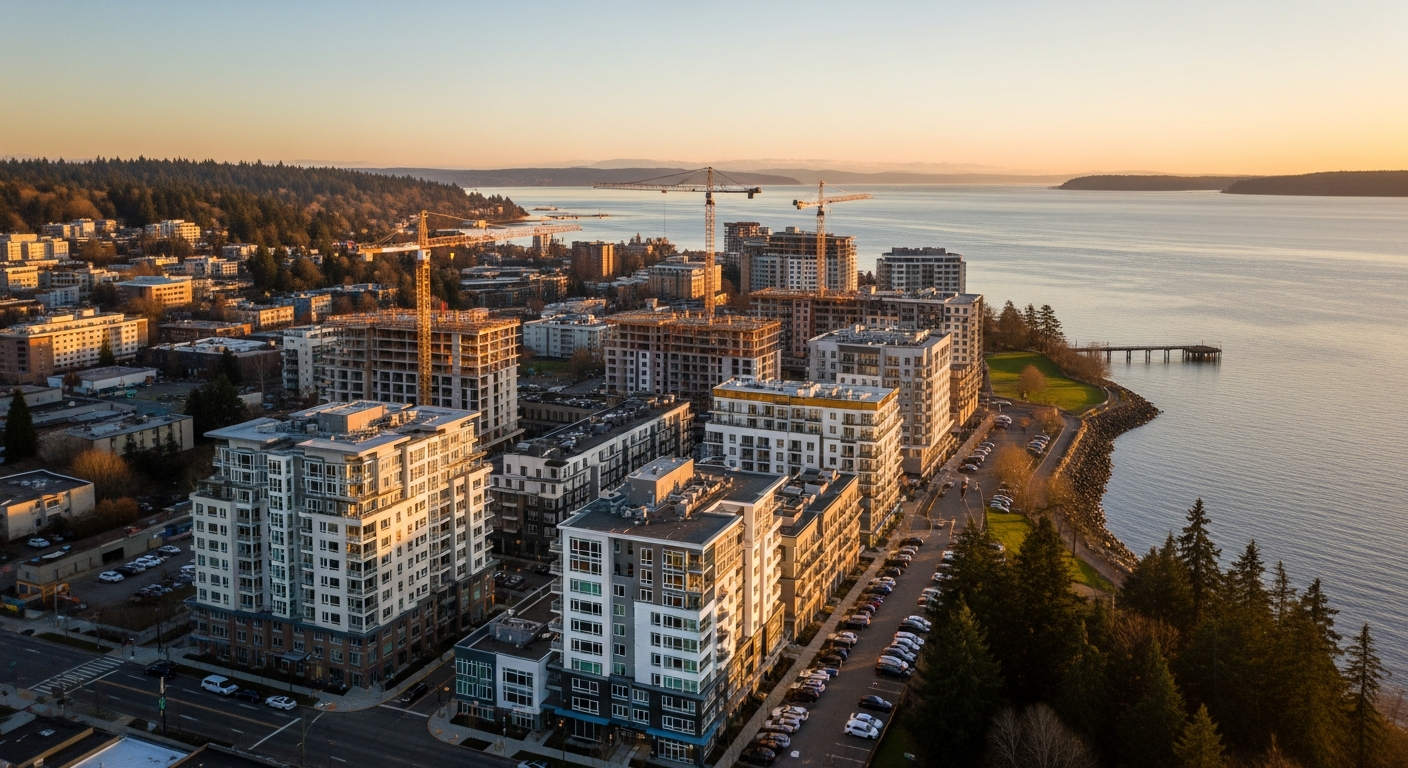
How is the Snohomish County apartment investment market performing in 2026?
Snohomish County apartment sales reached $640 million across 32 deals in 2025 — more than doubling from 2023 transaction volumes — as flat rents and stable vacancy created entry conditions that yield-focused investors found compelling. Average pricing settled around $294,557 per unit, and with 17,089 units still under construction regionally, capital is moving before the next supply cycle closes.
Most of the housing market coverage you’ve read about Snohomish County this year has been about buyers, sellers, and mortgage rates. That’s not the whole picture.
While the for-sale residential market has been digesting a 51% inventory surge and buyers have been navigating 6.4% rates, a parallel story has been unfolding in the investment market — the institutional and private capital that buys, holds, and sells apartment buildings. And that story has a very different tone.
Snohomish County apartment sales hit $640 million in 2025, according to a Kidder Mathews analysis reported by The Registry Pacific Northwest. That’s across 32 deals. The volume more than doubled from 2023 levels — the trough of what had been a significant pullback in multifamily transaction activity driven by rising interest rates and reset expectations.
The question worth asking now: what do those investors see in Snohomish County, and what does their move back into the market mean for Everett specifically?
Why the Market Reset the Way It Did
To understand where we are, it helps to understand where we came from.
The 2021-2022 apartment investment boom was driven by cheap debt and outsized rent growth. Cap rates compressed dramatically. Then the Federal Reserve raised rates, borrowing costs spiked, and sellers who bought in 2021-2022 at aggressive prices couldn’t hit the numbers that 2023-2024 buyers needed to see. Transaction volume crashed nationally, and Snohomish County wasn’t immune.
The recovery that’s now playing out isn’t a return to 2021 pricing. It’s something more durable: a market where seller expectations have adjusted, where buyers can underwrite deals to current rent levels and get a yield, and where the operating fundamentals — occupancy, rent trends — are stable enough to justify putting capital to work.
The Kidder Mathews data point on average price per unit illustrates this. At approximately $294,557 per unit with a 4% year-over-year decline from 2024 levels, pricing is off the peaks but far from distressed. That’s a reachable entry point for buyers who couldn’t compete in 2021-2022 and have been waiting.
What Makes Snohomish County Attractive Right Now
Apartment investors look at fundamentals first: vacancy rates, rent trends, and the supply pipeline.
On vacancy, Kidder Mathews’ Q4 2025 Seattle-Puget Sound regional data shows multifamily vacancy holding at 7.4% year-over-year. That’s not tight — but it’s not distressed either. For a county where the job base is anchored by Boeing, Paine Field aerospace, the Naval Station, and a growing tech cluster along I-5, that vacancy rate reflects a market with durable demand drivers.
On rent, the story for 2025 was flat. Everett’s rental market saw rents down roughly 2% year-over-year in 2025, to an average around $1,849 according to prior market data. That’s the downside. But for investors, flat rents in a well-employed market with a constrained land supply are different from flat rents in a market with weak fundamentals. Investors who can buy at current prices and hold for a rent recovery cycle are making a different bet than investors who overpaid during the growth phase.
On supply, the regional construction pipeline is thinning. Roughly 17,089 units remain under construction across the Seattle-Puget Sound metro — a 23% decline from the prior year. That contraction means the supply overhang that compressed rents will start to clear in 2026 and 2027. Capital that moves now is positioning ahead of that clearing.
What This Means for Everett Specifically
Everett is not a monolith in this investment market. The specific submarkets attracting attention are worth understanding.
The premium waterfront product — the Sawyer and Carling at Waterfront Place — has been holding occupancy at roughly 95% even as broader rents softened, with $2,202-$2,800 monthly rents demonstrating that the waterfront premium survives a soft market. For institutional investors, that occupancy and rent spread is a data point about the durability of location-driven demand.
Lincoln Properties is underway on Phase 2 of Millwright District — 300-plus units in a mixed-use waterfront setting that will be the first large new-to-the-market supply at the Port of Everett waterfront in this cycle. When those units come online, they’ll reset the comp set for waterfront multifamily in Everett.
Further south, the adaptive reuse pipeline is active. The Sage Investment Group conversion of the former Econo Lodge at 9602 19th St SE into 124 studio apartments (Phase 1 leasing August 2026) represents the workforce housing angle that Kidder Mathews noted in its investment outlook: value-add and workforce housing offer compelling yield opportunities where class-A development doesn’t pencil.
The downtown core and the corridors adjacent to the new stadium site are also drawing attention from development capital, though in earlier-stage planning. The city’s approval of the $10.6 million stadium design package in late April sets a September 2026 construction start target for the 5,000-seat Outdoor Event Center — and stadium-adjacent development is a real category of investment thesis that capital is starting to evaluate.
The Investor’s Lens vs. the Resident’s Lens
It’s worth being honest about the tension here.
When apartment investment capital flows into a market like Everett, it’s not always aligned with what existing residents need. Yield-focused buyers have incentives to optimize revenue per unit. Workforce housing conversions can displace existing tenants if not managed carefully. Rising investor interest in a market can precede rent pressure once the supply overhang clears.
The city’s tools to manage this tension — the Affordable Housing Trust Fund, inclusionary zoning in new developments, the Housing Hope ecosystem, the EHA pipeline — matter precisely because the market is now active enough to require them.
The $640 million in 2025 transaction volume tells us that capital has made a judgment: Snohomish County is on the right side of the Puget Sound affordability gradient, close enough to Seattle employment to benefit from overspill demand, with enough job diversity to hold occupancy through economic cycles. That judgment drives development, drives transactions, and ultimately drives the housing conditions that Everett residents live inside.
Understanding how this capital thinks is part of understanding where Everett’s housing goes next.
Frequently Asked Questions
How much did apartment sales reach in Snohomish County in 2025?
Snohomish County apartment sales reached $640 million across 32 deals in 2025, according to a Kidder Mathews analysis, more than doubling transaction volume from 2023 levels.
What is the average price per apartment unit in Snohomish County?
Average pricing was approximately $294,557 per unit in the most recent market data, down about 4% year-over-year from 2024 — reflecting pricing adjustments from the 2021-2022 peak.
What is the apartment vacancy rate in the Snohomish County area?
Kidder Mathews’ Q4 2025 data showed multifamily vacancy holding at 7.4% year-over-year across the Seattle-Puget Sound region. Everett’s specific figures track roughly with the broader market.
Why are investors buying apartments in Snohomish County now?
Flat rents, stable vacancy, and adjusted pricing from the 2021-2022 peak have created entry conditions that yield-focused buyers find workable. The thinning construction pipeline also suggests supply overhang will clear in 2026-2027, giving investors who buy now exposure to the next rent recovery cycle.
What new apartment projects are coming to Everett?
Lincoln Properties is underway on 300-plus units at Millwright District (Waterfront Place). Sage Investment Group is converting the former Econo Lodge on 19th St SE into 124 studio apartments with Phase 1 leasing targeting August 2026. Stadium-adjacent development opportunities are also being evaluated as the downtown Outdoor Event Center advances toward a September 2026 construction start.
How does Everett’s apartment investment market compare to King County?
Snohomish County typically offers lower per-unit pricing than King County submarkets like Bellevue or Seattle proper, while maintaining access to the same labor market. That affordability gradient is part of what draws yield-focused capital — investors can enter at lower basis points while capturing similar demand dynamics.
Leave a Reply