Quick answer: Aviation Technical Services (ATS) is Everett’s second-largest aerospace employer after Boeing, with roughly 800 people working out of a 500,000-square-foot hangar at the south end of Paine Field. The company is the largest aircraft maintenance, repair, and overhaul (MRO) operator on the U.S. West Coast — and most Everett residents drive past its hangars without realizing they hold up to 14 commercial airliners at any given time.
Drive south on Airport Road and the building most people picture as Boeing’s territory thins out. Past the Future of Flight, past the rows of stored 777-9s, past the Paine Field commercial terminal, the south end of the airport opens onto a cluster of hangars that don’t have Boeing logos on them.
That cluster is Aviation Technical Services — ATS — and it employs about 800 people in Everett. Inside Snohomish County’s aerospace economy, ATS is the company that everyone in the industry knows about and most outside of it doesn’t. The shorthand: ATS is the second-largest aerospace employer in Everett, behind only Boeing, and it operates the largest MRO operation on the West Coast of the United States.
For an aerospace ecosystem that is preparing to absorb a 737 MAX 10 North Line activation in mid-summer, a 777-9 delivery ramp into 2027, and a steady KC-46 cadence underneath all of it, ATS sits in a useful place in the supplier map. It is the company that touches the airplanes after they leave the factory and need to come back for service.
The 500,000-square-foot building most Everett residents have never been inside
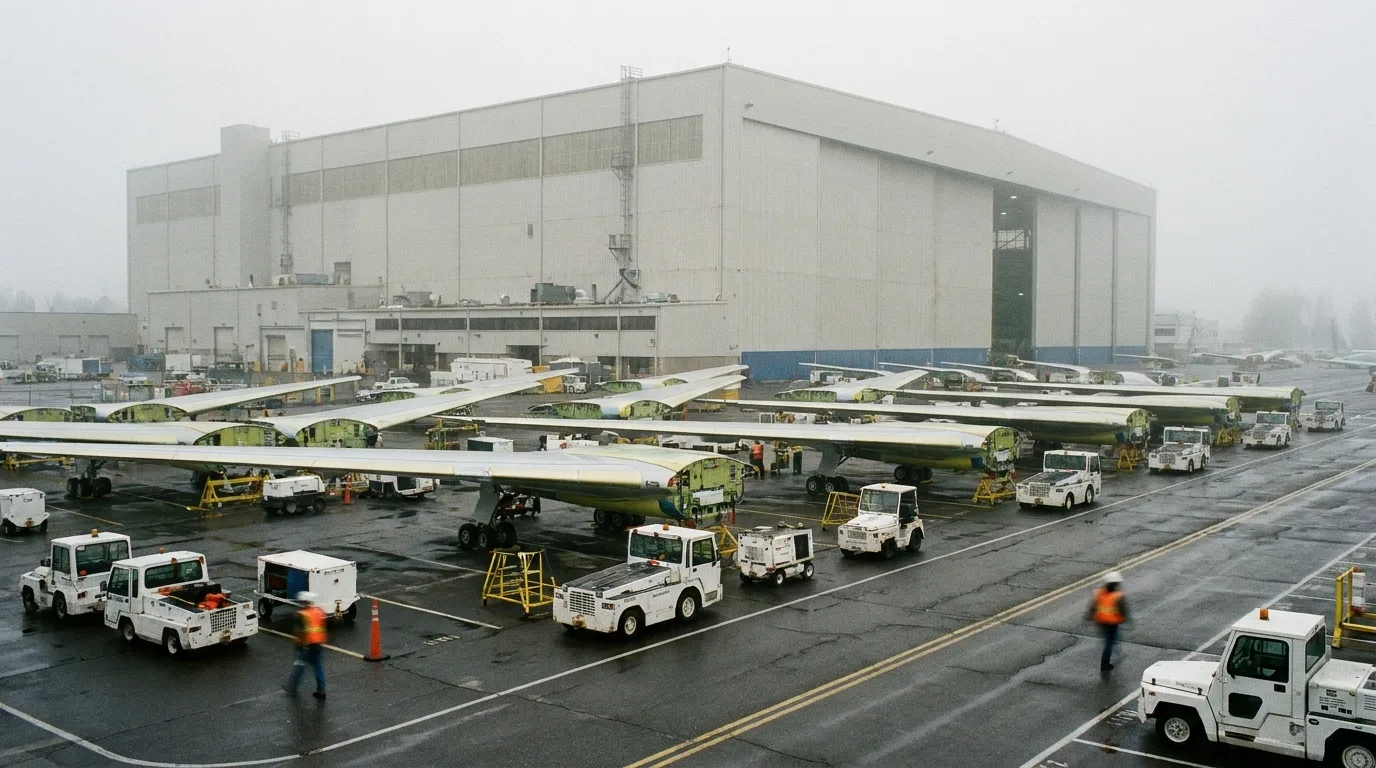
The ATS Everett airframe MRO facility runs out of a 500,000-square-foot hangar at Paine Field with bay space for up to 14 commercial airliners simultaneously. The building has the kind of scale that doesn’t read from the road — until you realize a 737 NG is roughly 130 feet long, and the building is fitting more than a dozen of them under one roof at a time.
The hangar isn’t new. It was originally built and operated by Tramco, then sold to Goodrich, then sold to ATS in the fall of 2007. The footprint has been an MRO operation in Everett for decades, which means the institutional knowledge — the techs who have seen the same airframe come back for its third C-check, the engineers who know how the supply of certain parts behaves — runs deep.
Adjacent to the airframe hangar, ATS also runs a 50,000-square-foot component repair facility. That’s the building where structural, hydraulic, and electrical components come off the airplanes and get repaired by technicians trained on the specific systems. The two facilities together — airframe and component — give ATS what the trade press calls a “full-service” MRO posture: an airline can ship the whole airplane to Everett and ship the parts that come off it to the same campus.
Why MRO matters in an aerospace town
It is easy to think about Everett’s aerospace economy as a Boeing factory and the suppliers who feed it. The factory model is the most visible part — 737 MAX 10s rolling off the North Line, 777-9s flying production tests over Puget Sound, KC-46s painted in Air Force gray, 767 freighters wearing FedEx and UPS livery.
But MRO is the other half of the airplane lifecycle, and it generates a different kind of work for the same workforce.
A factory builds a finished jet. An MRO operation tears one down to its frames, inspects every primary structure, replaces what’s worn, upgrades what’s been superseded, and puts the airplane back together to a standard the FAA and the airline both have to sign off on. The work is more diagnostic than assembly. The skills overlap with Boeing’s mechanic and inspector workforce, but the day-to-day rhythm is different: shorter project cycles, more airplane variety, deeper component-level work.
For Snohomish County, that means an aerospace mechanic who trained at the Machinists Institute on Airport Road or the WATR Center has two career destinations within a half-mile of each other — Boeing on the north end of Paine Field, ATS on the south end. The same skill set ports across the airport perimeter.
Where ATS sits in the supplier-shortage math
The 5,200-worker aerospace shortage that the Aerospace Futures Alliance has projected through the end of 2026 isn’t just a Boeing problem. It is a Snohomish County problem, and ATS is one of the companies on the demand side of that shortage. The Everett operation has historically grown its own talent — running internal mechanic training programs because the regional pipeline cannot keep up with attrition and ramp.
That training-from-within approach matters for the broader workforce conversation. When the Machinists Institute, Edmonds College, and WATR Center put aerospace mechanics into the labor market, those graduates have multiple landing spots in Everett: Boeing’s main bay floors, Boeing’s KC-46 line, ATS’s airframe hangar, ATS’s component repair facility, and the smaller aerospace suppliers scattered across the county.
For workers, optionality is leverage. For the regional economy, optionality is resilience.
The piece of the cycle Boeing doesn’t do
Boeing builds the airplane. The airline flies it. ATS — and a small number of MRO operators like it — handles the heavy maintenance checks (C-checks, D-checks) that the airline can’t perform on its own ramp.
That separation matters in a downturn. When a launch customer like Lufthansa pushes its first 777-9 delivery from late 2026 to first quarter 2027, that affects Boeing’s delivery cadence in Everett. It does not, on its own, materially affect ATS, because the MRO demand pipeline is fed by every airline operating an aging fleet anywhere in the world. Delta, Alaska, United, Hawaiian, Southwest, and dozens of cargo and charter operators send airplanes to Paine Field for the kind of structural and systems work that ATS specializes in.
That means ATS sits in a different cyclical position than Boeing. When new-jet deliveries slow, MRO demand often rises — airlines run their existing fleets longer and the heavy-maintenance interval comes due. When new-jet deliveries accelerate, the older airplanes still need their inspections. The MRO floor in Everett doesn’t oscillate the way the new-build factory does.
The Paine Field economic picture, with ATS on it
Adding ATS to the standard Paine Field map produces a different economic story than the Boeing-only version. The picture, roughly:
- Boeing’s commercial Everett operations — 737 North Line, 767, 777, 777X, KC-46 — drive the bulk of the aerospace payroll in the county.
- ATS sits at the south end of Paine Field as the second-largest aerospace employer, with 800 people on a hangar floor that handles up to 14 airplanes at a time.
- ZeroAvia’s Propulsion Center of Excellence at the south end builds the next-generation hydrogen-electric powertrains.
- The Future of Flight Aviation Center on Paine Field Boulevard is the public-facing tourism asset.
- The 600-plus aerospace suppliers across Snohomish County feed all of the above.
Each piece reinforces the others. ATS draws from the same training pipeline that feeds Boeing. ZeroAvia draws from the same engineering talent base that supports SPEEA at Boeing. The Future of Flight tour walks visitors past the active production lines that make the rest of the ecosystem possible.
The point: Paine Field is not an airport that happens to have aerospace tenants. It is an aerospace cluster that happens to have a runway running through it.
What this means for residents
For Everett residents, the practical takeaway is that the local aerospace economy is more diversified than the headline numbers suggest. A Boeing labor disruption does not pause the south end of the airport. A delay in a new program does not collapse the maintenance work. The school district’s projections of family-wage employment, the housing market’s tracking of dual-income aerospace households, and the city’s tax base all benefit from having multiple anchor employers operating side-by-side rather than one dominant one.
It also means that when local aerospace coverage talks about “the Boeing economy,” that frame is incomplete. The accurate version: the aerospace economy in Snohomish County is a Boeing-led cluster that includes a major MRO operator, a hydrogen-electric propulsion company, and 600 suppliers. Each one of those plays a role in keeping the workforce and the wage profile stable.
Frequently Asked Questions
Who is the second-largest aerospace employer in Everett?
Aviation Technical Services (ATS) is the second-largest aerospace employer in Everett after Boeing, with about 800 employees at its Paine Field operation.
What does ATS do?
ATS provides maintenance, repair, and overhaul (MRO) services for commercial airliners. The company performs heavy maintenance checks, structural repairs, component repairs, and engineering services for airlines and cargo operators across the U.S. and internationally.
How big is the ATS Everett facility?
The main airframe MRO hangar is 500,000 square feet with bay space for up to 14 commercial airliners. ATS also operates a 50,000-square-foot component repair facility adjacent to the main hangar.
Where is ATS located in Everett?
ATS operates at the south end of Paine Field, adjacent to the Boeing Everett production facility but on the opposite end of the airport from the Future of Flight Aviation Center.
How long has ATS been at Paine Field?
The Everett MRO facility has operated continuously since the Tramco era. Goodrich operated the building before selling it to ATS in the fall of 2007, so ATS itself has been in the building for nearly two decades.
Is ATS the largest MRO on the West Coast?
Yes. ATS is the largest aircraft maintenance, repair, and overhaul operator on the U.S. West Coast.
Does ATS hire from local training programs?
Yes. ATS has historically grown its own mechanic talent through internal training programs and hires from regional aerospace training programs including the Machinists Institute, Edmonds College, and the WATR Center.
How does MRO demand differ from new-aircraft demand?
MRO demand is fed by aging fleets at every airline operating worldwide and tends to be more stable cyclically than new-aircraft demand. When new deliveries slow, airlines run older fleets longer and MRO demand often rises.
- The Complete 2026 Guide to ATS at Paine Field — knowledge hub on Everett’s #2 aerospace employer
- For Boeing Line Workers: A Worker’s Guide to ATS
- For Snohomish County Aerospace Suppliers: The Aftermarket Side of Paine Field
Leave a Reply