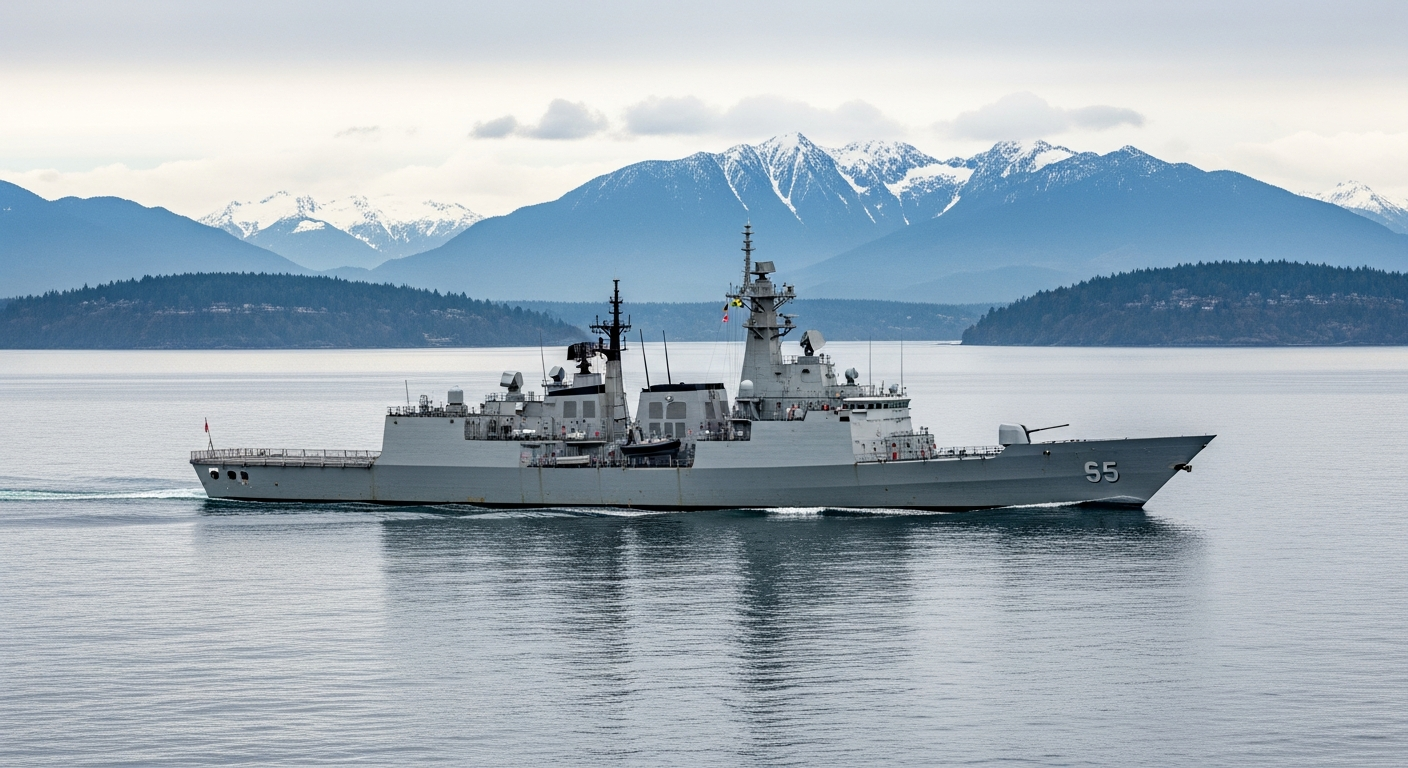
Q: Has the Navy awarded a contract for the new FF(X) frigate?
A: Yes. On April 28, 2026, the U.S. Navy awarded a $282.9 million contract to HII’s Ingalls Shipbuilding in Pascagoula, Mississippi, to begin lead yard support work on the FF(X) class frigate — the Navy’s new small surface combatant meant to replace the cancelled Constellation-class program. The first $80.6 million covers pre-construction activities including securing materials, refining designs, and beginning to cut and shape raw structural steel.
Steel Is About to Get Cut. Here’s What That Means for Everett.
For the past five months, the FF(X) frigate program has existed primarily as an announcement, a design concept, and a lobbying opportunity. As of April 28, 2026, it exists as a contract.
The U.S. Navy awarded HII’s Ingalls Shipbuilding a $282.9 million lead yard support contract, according to simultaneous announcements from the Pentagon and Huntington Ingalls Industries. The award authorizes Ingalls to begin pre-construction work on the first ship of the new FF(X) class — and the first $80.6 million activates immediately, giving Ingalls the green light to start cutting and shaping raw steel for the main structural foundation of the frigate.
That is a different kind of news than what has surrounded the FF(X) program since December. Announcements get made. Designs get chosen. Committees hold meetings. Contracts start programs. And for Naval Station Everett — which has been fighting to be named as the homeport for the incoming frigate fleet — the clock just started in a way it hadn’t before.
What the $282.9M Contract Actually Covers
Under the terms of the contract, Ingalls will perform what the Pentagon terms “lead yard support activities” — the pre-construction phase work that front-loads as much design refinement and material preparation as possible before formal construction begins.
Specifically, Ingalls is authorized to begin cutting and shaping raw materials to support future phases of work on the main structure foundation and the overall construction sequencing plan for the first frigate, according to the company. The contract also covers securing key materials and finalizing design details ahead of full construction authorization.
“We are excited to partner with the Navy to bring these preproduction steps under contract to accelerate delivery of the frigates that our warfighters need,” Brian Blanchette, president of Ingalls Shipbuilding, said in the company’s April 28 announcement.
Of the initial $80.6 million tranche, 73% — roughly $58.8 million — comes from the Navy’s fiscal year 2026 shipbuilding and conversion appropriations. The remaining 27%, about $21.8 million, is funded through Navy research and development accounts. The Pentagon’s contract announcement cited “unusual and compelling urgency” as the justification for awarding the contract without competitive bids.
The Golden Fleet Context: FF(X) Is Part of a Bigger Picture
The FF(X) contract is part of President Trump’s “Golden Fleet” initiative, a broader shipbuilding push that also includes development work on the BBG(X) — a new, much larger surface combatant class informally referred to as the Trump-class battleship. Together, the FF(X) and BBG(X) represent the Navy’s attempt to recapitalize its surface force on two ends of the size and firepower spectrum.
The fiscal year 2026 budget request, according to an April 21 Navy news release, includes $65.8 billion to buy 18 warships and 16 auxiliary ships, including three submarines, a destroyer, an amphibious assault ship, and the first FF(X) frigate. Design and development funding for the BBG(X) is included as well.
The FF(X) program was formally announced in December 2025 by then-Secretary of the Navy John Phelan, who chose the Coast Guard’s Legend-class National Security Cutter as the design framework to accelerate development timelines and reduce costs compared to building a purpose-designed warship from scratch. Ingalls, which builds the Legend-class cutters, was the natural choice as lead yard.
Phelan, who made the call to cancel the Constellation program and launch FF(X), was ousted from his position last week — but the program he set in motion is now under contract and generating steel work in Pascagoula.
The Urgency Matters for Everett
The “unusual and compelling urgency” language in the Pentagon’s contract announcement isn’t routine bureaucratic boilerplate. It’s a formal legal justification for bypassing the standard competitive bidding process — a step the DoD takes when waiting for competition would harm national security or mission-critical timelines.
In plain terms: the Navy wants frigates faster than a normal acquisition timeline would allow, and it’s willing to use procedural shortcuts to get there. The target for the first FF(X) delivery remains 2028.
For Naval Station Everett, urgency is a double-edged signal. On one hand, an accelerated build timeline is good news for the community’s homeport ambitions — if ships are coming off the line sooner, the homeport decision has to be made sooner. On the other hand, accelerated programs sometimes lock in decisions early to avoid further delays, which means Snohomish County’s window to make its case may be shorter than it appears.
The original Constellation-class program had designated Naval Station Everett as the homeport for up to 12 frigates. That designation evaporated with the November 2025 cancellation. The FF(X) program has not made a homeport announcement, and the Snohomish County Military Affairs Committee — which reconvened on February 23, 2026, specifically to advocate for Everett’s position — is still in active engagement with the congressional delegation and Navy leadership.
Representative Rick Larsen (WA-02), who serves on the House Armed Services Committee, has been the primary congressional voice for preserving NAVSTA Everett’s role in the frigate program. Larsen’s position on HASC gives him a direct line into budget and procurement decisions that will ultimately determine where these ships are homeported.
What the $340M Economic Argument Looks Like Now
Snohomish County’s economic case for homeporting the FF(X) fleet at Naval Station Everett has been framed around a roughly $340 million annual economic impact figure — the combined value of ship crews, support staff, contractor spending, and multiplier effects that each additional frigate homeport assignment generates for the local economy. That case was built for a 12-frigate assignment; the size of the FF(X) fleet and its homeport allocation haven’t been determined.
But the contract award sharpens the argument’s urgency. When the FF(X) was a program under consideration, Everett could advocate based on capacity, infrastructure, and existing relationships. Now that Ingalls is cutting steel, the program has a real timeline — and homeporting decisions for new surface combatants typically follow construction milestones, not precede them by years.
Naval Station Everett’s existing assets — deepwater berths capable of handling multiple destroyers and a carrier, established surface warfare maintenance facilities, a strong Fleet & Family Support infrastructure, and an existing destroyer squadron presence — remain the core of its competitive position. For Navy families already stationed at NAVSTA Everett, the practical question of whether a frigate rotation is coming affects PCS planning, school enrollment decisions, and community investment for the next five to seven years.
What to Watch Next
Three forward indicators will determine how this story develops for Everett:
The FF(X) homeport announcement. No timeline has been given. But as Ingalls moves from lead yard support into formal construction phases, the Navy’s Surface Forces Pacific and Forces Atlantic commands will need to plan basing, maintenance, and operational schedules. A homeport announcement could come as early as late 2026 or as late as the 2027-2028 delivery window approaches.
FY2027 appropriations. The FF(X) is funded in FY2026 as a single-ship start. How many hulls Congress authorizes in FY2027 — and how the funding is structured — will determine how quickly the fleet scales up and whether the economic case for a dedicated Pacific homeport strengthens or softens.
The fate of FFG-62 and FFG-63. The first two Constellation-class ships, the USS Constellation and USS Congress, are still being completed at Fincantieri Marinette. Their homeport assignments — wherever they land — may signal the Navy’s thinking about Pacific frigate basing before the FF(X) homeport decision is formally made.
For now, the $282.9 million contract is what Everett’s advocates needed to see: confirmation that the program is real, funded, and moving. The complete guide to where the FF(X) program stands — and what NAVSTA Everett has to do to win the homeport — remains the framework for following this story. The contract award adds a new chapter, but the outcome is still unwritten.
Frequently Asked Questions
What did the Navy just award to Ingalls Shipbuilding?
The Navy awarded a $282.9 million contract to HII’s Ingalls Shipbuilding on April 28, 2026, for lead yard support work on the FF(X) class frigate program. The initial $80.6 million tranche authorizes pre-construction activities including cutting and shaping raw structural steel, securing key materials, and refining the design ahead of formal ship construction.
What is the FF(X) frigate program?
The FF(X) is the U.S. Navy’s new small surface combatant program, announced in December 2025 to replace the cancelled Constellation-class (FFG-62) frigate program. It uses the Coast Guard’s Legend-class National Security Cutter as a design framework and is being built by HII’s Ingalls Shipbuilding yard in Pascagoula, Mississippi. The Navy aims to deliver the first ship by 2028.
Is Naval Station Everett going to be the homeport for the FF(X) frigates?
No homeport decision has been announced for the FF(X) program. Naval Station Everett had been designated as the homeport for the cancelled Constellation-class frigates. Snohomish County’s Military Affairs Committee has been actively lobbying for Everett to receive the FF(X) homeport designation, but as of April 2026 no announcement has been made.
Why did the Navy skip competitive bidding for this contract?
The Pentagon cited “unusual and compelling urgency” as the justification for awarding the contract without a competitive bidding process. This standard is applied when waiting for competition would harm national security or cause unacceptable delays in mission-critical programs. The Navy’s target delivery date of 2028 for the first FF(X) is the primary driver of that urgency posture.
What is the “Golden Fleet” and how does FF(X) fit into it?
The Golden Fleet is President Trump’s shipbuilding initiative to rapidly expand the U.S. Navy’s surface fleet. The FF(X) (a new small combatant frigate) and the BBG(X) (a new large combatant sometimes called the Trump-class battleship) are the two new ship classes at the center of the initiative, representing opposite ends of the size and firepower spectrum.
What Navy ships are currently homeported at Naval Station Everett?
As of 2026, Naval Station Everett is homeport to several surface combatants including USS Gridley (DDG-101), which is currently deployed as part of the USS Nimitz’s Southern Seas 2026 cruise. NAVSTA Everett has deepwater pier infrastructure capable of handling destroyers and carrier-class vessels, making it one of the Navy’s most capable Pacific homeports.
When will we know where FF(X) frigates will be homeported?
No timeline has been given for a homeport announcement. Such decisions typically follow construction milestones and fleet planning cycles. Given the 2028 delivery target for the first FF(X), a homeport decision could come as early as late 2026 or as late as 2027 as the delivery window approaches.
How can Everett residents stay informed about the FF(X) program?
The best sources for official FF(X) program updates are USNI News (news.usni.org), Stars and Stripes (stripes.com), and Navy.mil press releases. For Everett-specific advocacy, the Snohomish County Military Affairs Committee and Rep. Rick Larsen’s congressional office (larsen.house.gov) are the primary local points of contact.
Complete Guide: FF(X) Contract & NAVSTA Everett Homeport Bid
For Navy Families: FF(X) Contract, PCS Planning & Base Life
For Civic Watchers: $340M Snohomish County Economic Stake
Leave a Reply