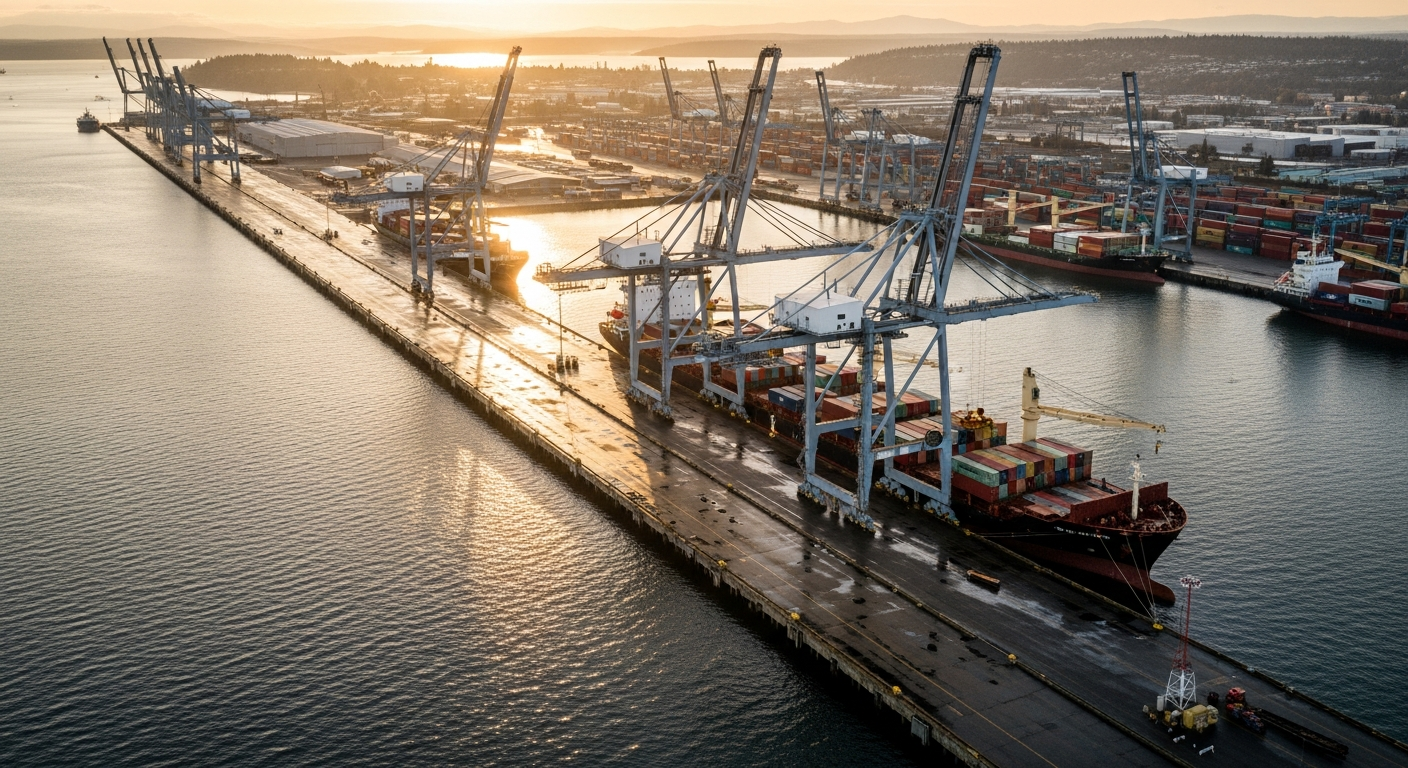
Q: What is the Port of Everett Pier 3 federal grant?
A: In April 2026, the Port of Everett was awarded an $11.25 million grant from the federal Port Infrastructure Development Program (PIDP) to modernize and strengthen Pier 3, the seaport’s longest berth. The project will install new vertical piles, restore damaged structural elements, and restore the pier to its full cargo-handling capacity — unlocking more diverse freight operations at one of the West Coast’s 18 federally designated Strategic Commercial Seaports.
The Grant: $11.25 Million to Fix the Pier That Holds Up Everett’s Supply Chain
The U.S. Department of Transportation’s Maritime Administration (MARAD) announced on April 27, 2026, that the Port of Everett had been selected for an $11.25 million competitive grant under the Port Infrastructure Development Program (PIDP). The award came as part of a broader $22 million federal investment in Northwest Washington port infrastructure, with the Swinomish Indian Tribal Community receiving the remaining funds for a separate project.
PIDP grants are awarded nationally on a competitive basis. To qualify, projects must demonstrably improve the safety, efficiency, or reliability of freight movement into, out of, or within a port. The Port of Everett’s Pier 3 project cleared that bar — and it’s not hard to see why when you understand what Pier 3 actually does and what’s been happening to it structurally.
Port of Everett CEO and Executive Director Lisa Lefeber didn’t undersell the significance: “The Port is grateful to the U.S. Department of Transportation for this critical maritime infrastructure investment that will ensure the Port of Everett Seaport continues to safely support 40,000-plus local jobs, regional economic development, and the Washington state economy.”
What Pier 3 Is — and Why It Needs This Work
Pier 3 is the longest berth at the Port of Everett Seaport, measuring 730 feet long with a 120-foot-wide concrete deck. It was constructed in 1973 and has facilitated global and regional trade for over five decades — handling bulk alumina ore, cement, general cargo, and forest products across those years.
But Pier 3 has a structural problem. The pier was originally engineered to carry a uniform live load of 800 pounds per square foot. In recent years, that rating had to be derated — the south side dropped to 600 pounds per square foot, the north side to 400 pounds per square foot, and some sections were derated even further. In practical terms, that means the pier cannot be used to its full operational potential. Cargo-handling equipment that would otherwise operate on the pier isn’t permitted because the structure can’t safely carry the load.
That’s the problem the $11.25 million fixes. The Pier 3 Strengthening Safety and Commerce project will install new vertical piles beneath the pier and restore other damaged piles, adding new structural life to a facility that Washington’s construction industry, the U.S. military, and global maritime commerce all rely on.
What Pier 3 Does Today — and What It Will Be Able to Do After
Right now, despite its compromised load rating, Pier 3 is doing a lot. Its primary use is bulk cement operations. That’s because Pier 3 sits directly adjacent to a 55,000-ton dry bulk cement storage dome at Hewitt Terminal — one of the largest cement storage facilities in the Pacific Northwest. The cement stored and moved through this terminal is a critical supply chain asset for Washington state’s construction industry. Every major building project from Seattle to Bellingham that uses concrete is connected, at some point, to freight moving through this pier.
The north side of Pier 3 serves a different critical function: ship repair. A Seaport tenant uses that berth for maintenance and repair work on vessels serving the U.S. Navy, Department of Defense, U.S. Coast Guard, Washington State Ferries, and the commercial fishing fleet. That’s not a minor side operation — it’s a direct service line to the military and to the state’s ferry system, the largest in the country.
After the strengthening project is complete, the pier’s operational envelope expands significantly. The restored load ratings will allow cargo-handling equipment to operate across the full deck, which means the Port can diversify the types of freight Pier 3 can handle — moving beyond its current cement-primary profile to take on breakbulk cargo, project cargo, and other freight categories where the Port already has a strong reputation.
Pier 3’s Position in the Larger Port Complex
What makes this grant especially significant is Pier 3’s location within the Seaport’s freight network. The pier sits close to Norton Terminal — the Port’s award-winning, 40-acre, paved, lit, and fully secured cargo yard — as well as adjacent bonded warehouse space, an additional 15-acre cargo yard, 40-foot mean lower low water (MLLW) depth, and on-dock rail access. That combination of deep-water berth, secured yard, and rail connectivity is rare on the West Coast and is a primary reason why the Port has built a reputation for handling oversized and high-value cargo.
Pier 3 is also part of the reason why the Port of Everett can make a claim that would sound improbable on paper: the Port handles 100 percent of the oversized aerospace parts for Boeing’s 767, 777, 777X, and KC-46 Tanker programs. Those parts — too large to move by truck — come down the Snohomish River from the Paine Field manufacturing campus and load out at the Seaport. Restoring Pier 3’s full operational capacity directly supports that aerospace export pipeline.
Strategic Commercial Seaport Status: What That Actually Means
Tim Ryker, the Port of Everett’s Chief of Seaport Operations, highlighted a dimension of the project that goes beyond commercial freight: “It will also allow us to better serve in our role as a Strategic Commercial Seaport in support of our national defense and our military partners.”
That’s not boilerplate language. The Port of Everett is one of just five Strategic Commercial Seaports on the West Coast and one of only 18 nationwide. That federal designation — from MARAD, the same agency that awarded this grant — means the Port must maintain military-readiness capability and be prepared to support Department of Defense cargo movements on short notice. With Pier 3 operating below its designed capacity, that readiness posture is constrained. The strengthening project restores it.
The Economic Numbers Behind the Pier
The Port of Everett Seaport sits 25 miles north of Seattle in naturally deep water. It ranks as the second largest export customs district in Washington state and the fifth on the West Coast. The port supports nearly $21 billion worth of U.S. exports annually, or roughly $30 billion when both imports and exports are counted together. The regional transportation network tied to those operations supports more than 40,000 jobs and $433 million in state and local tax revenues.
With more than 60 percent of jobs in Snohomish County tied to trade, the Port’s infrastructure isn’t a footnote to Everett’s economy — it is a primary driver of it. An $11.25 million investment in the structural integrity of the port’s longest berth is, in that context, exactly the kind of infrastructure maintenance that holds the whole system together.
The funding covers the full scope of the Pier 3 project: planning and engineering, environmental review, permitting, and construction. Representative Rick Larsen, who shared news of the award with Port representatives, has been a consistent advocate for Pacific Northwest port infrastructure funding in Congress.
What We’re Watching Next
The PIDP grant covers the complete project lifecycle, so the next step is the planning and engineering phase — the environmental review and permitting work that will precede construction. Given the Port’s track record on infrastructure projects like the Segment E bulkhead rebuild on West Marine View Drive (which is wrapping up final-phase construction right now after 20 years), we expect planning to move efficiently. What we’ll be watching: the environmental review timeline, the contractor selection process, and whether the project schedule aligns with the Port’s broader 2026 capital plan outlined in its $70 million 2026 budget.
For a deep look at what the Port’s working waterfront actually handles on a daily basis, the Hat Island Ferry harbor tour remains the best public window into that operation.
Frequently Asked Questions
What is the Port Infrastructure Development Program (PIDP)?
PIDP is a federal competitive grant program administered by MARAD (U.S. Department of Transportation Maritime Administration). Grants go to port infrastructure projects that improve the safety, efficiency, or reliability of freight movement. Awards are competitive and national in scope.
Why was Pier 3 derated?
Pier 3 was originally designed to carry 800 pounds per square foot but has experienced structural deterioration over its 53-year life. Damaged piles and structural elements required engineers to reduce the allowable load rating — to 600 PSF on the south side, 400 PSF on the north side, with some areas lower. The $11.25 million project will install new piles and restore the structure.
How many jobs does the Port of Everett support?
The Port of Everett’s regional transportation network supports more than 40,000 jobs and $433 million in state and local tax revenues. More than 60 percent of Snohomish County jobs are tied to trade.
What cargo goes through Pier 3 today?
Pier 3 currently handles bulk cement operations (adjacent to a 55,000-ton cement storage dome) and ship repair work for the U.S. Navy, Coast Guard, Washington State Ferries, and the commercial fishing fleet. After strengthening, it will be able to handle a broader range of cargo types including breakbulk and project cargo.
What is a Strategic Commercial Seaport?
A MARAD-designated Strategic Commercial Seaport must maintain readiness to support Department of Defense cargo movements on short notice while minimizing disruption to commercial operations. The Port of Everett is one of 5 on the West Coast and 18 nationwide with this designation.
Complete Guide: Port of Everett Pier 3 $11.25M Federal Grant
For Businesses & Shippers: What the Pier 3 Rebuild Means for Your Operations
Leave a Reply