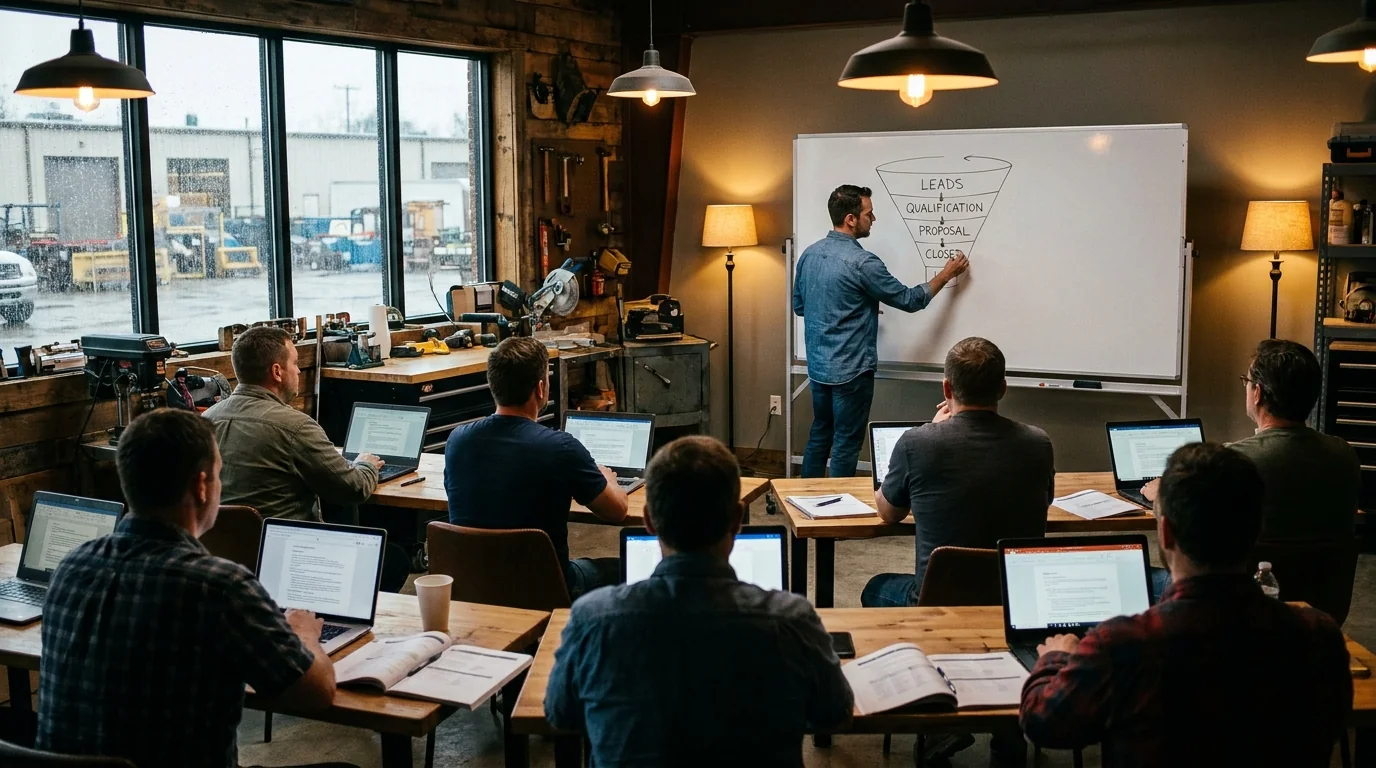
The honest answer to “where do restoration sales reps learn to sell?” is: from a patchwork of technical training, industry conferences, and outside sales programs that were not built for the restoration industry. There is no single program that produces a fully trained commercial restoration sales rep, and operators who pretend otherwise end up with reps who can talk about IICRC certifications but cannot run a buying-committee conversation.
This is a working map of the restoration sales training landscape as it exists in 2026, what each option teaches well, and where the gaps are. It is written for restoration owners and sales managers deciding where to spend training dollars.
Three Categories of Restoration Sales Training
The training landscape splits into three categories that solve different problems:
- IICRC and industry technical courses. Strong on the science, the standards, and the technical credibility that lets a sales rep hold a conversation with a facilities engineer or a risk manager.
- Restoration industry conferences and sales tracks. Strong on community, peer learning, and tactical playbooks. Variable in depth.
- Outside sales programs and sales coaching. Strong on the sales discipline itself — qualification, account management, negotiation, close mechanics — but generally not restoration-specific.
The reps who actually carry commercial restoration pipeline have typically drawn from all three. The reps who hold only one category tend to be one-dimensional in the field.
IICRC and Industry Technical Courses
IICRC courses — WRT, ASD, AMRT, FSRT, and the more advanced certifications — are the technical baseline. They are not sales courses, but they produce the technical fluency that lets a sales rep be taken seriously by buyers who care about standards. A rep who cannot speak to S500 category and class definitions, or who struggles to explain what an ASD-certified technician actually does on a job site, has a credibility ceiling in commercial restoration sales.
What technical courses do not teach: how to qualify a buying committee, how to map an account, how to run a quarterly cultivation cadence, or how to close a preferred-vendor agreement. The gap is structural — they were never intended as sales courses.
Industry Conferences and Sales Tracks
Restoration industry conferences — Experience Conference & Exchange, Restoration Industry Association events, and the various carrier and TPA-adjacent gatherings — are where tactical playbooks circulate. Sales tracks at these events typically run breakouts on commercial selling, marketing strategy, and account development.
The strength of conference-based learning is the peer-to-peer transfer. A sales rep who hears how a comparable operator runs their named-account program in a different market will absorb more in 45 minutes than from any structured curriculum. The weakness is depth — a 45-minute breakout cannot replace the cumulative skill of running a real commercial sales cycle.
Outside Sales Programs
Outside sales training programs — Sandler, Challenger, MEDDIC, and the various enterprise B2B sales methodologies — were not built for restoration but apply directly to the commercial restoration sales motion. Restoration-specific sales coaches and programs have emerged in the last five years that translate these methodologies into restoration language.
The strongest case for outside sales investment is for shops that have made the deliberate decision to pursue commercial accounts at scale. The structured discipline of a methodology like MEDDIC — identifying metrics, economic buyer, decision criteria, decision process, identify pain, and champion — maps cleanly onto the five-persona buying committee that controls commercial restoration vendor selection.
The risk is treating outside sales training as a silver bullet. A rep trained in MEDDIC who lacks the technical fluency to discuss S500 category determinations will lose credibility with the same buying committee the methodology is supposed to help them navigate.
The Internal Training That Actually Moves the Needle
The most undervalued sales training in the restoration industry is the internal kind — ride-alongs with the owner or senior sales leader, formal account reviews with critique, and structured debriefs after both wins and losses. Most restoration shops do not run this discipline because it requires senior time that is hard to carve out.
Operators who do run internal training cite a consistent pattern: a new sales rep who shadows the owner on twelve commercial cultivation meetings in the first 90 days will out-perform a rep who takes a six-week external program with no internal coaching. The mechanism is straightforward — the owner’s market-specific knowledge, account history, and judgment do not transfer through a course.
What to Look For in a Restoration Sales Training Investment
If you are an owner or sales manager evaluating where to spend training dollars in 2026, the framework that holds up:
- Verify technical baseline through IICRC certifications appropriate to the work the rep will sell.
- Build a structured methodology — Sandler, Challenger, or MEDDIC — into the rep’s first 90 days, with a clear application to commercial restoration buying committees.
- Schedule conference attendance with deliberate breakout selection, not as a perk.
- Run formal weekly sales reviews internally — pipeline, named-account progress, win/loss analysis — with the owner or sales leader present.
- Treat the first six commercial cultivation meetings as paired ride-alongs, not solo selling attempts.
The total investment is meaningful but not extreme. The alternative — a rep who learns commercial restoration sales by burning through a year of pipeline — is far more expensive.
The Marketing Class Question
Restoration sales reps frequently search for “restoration sales marketing class” as if there is a single course that solves the gap. There is not. The functional substitute is the combination above, paired with a marketing program at the company level — content marketing, paid advertising, referral systems — that produces the qualified prospects the trained rep then converts. Sales training without a parallel marketing investment produces well-trained reps with empty pipelines.
Frequently Asked Questions
Is there a single best restoration sales training program?
No. The reps who carry serious commercial restoration pipeline have typically combined IICRC technical courses, an outside sales methodology like Sandler or MEDDIC, structured internal coaching, and selective conference attendance. There is no single program that replaces this combination.
Do IICRC certifications teach sales skills?
IICRC certifications teach the technical and standards baseline that lets a sales rep be taken seriously by commercial buying committees. They do not teach sales skills — qualification, account mapping, cultivation cadence, or close mechanics — and were never intended to.
Should restoration sales reps take outside sales courses?
Yes, particularly for shops pursuing commercial accounts at scale. Methodologies like Challenger, Sandler, and MEDDIC translate directly to the multi-persona buying committee that controls commercial restoration vendor selection. The investment pays back in shorter cultivation cycles and higher win rates.
How long does it take to train a commercial restoration sales rep?
Most operators report that a new commercial sales rep needs nine to fifteen months to fully ramp — the time to complete one full cultivation cycle from cold prospect to first signed account. Compressing the ramp timeline below nine months is rarely realistic.
What is the highest-leverage internal sales training?
Paired ride-alongs with the owner or sales leader on the first six to twelve commercial cultivation meetings, paired with structured weekly pipeline reviews. This transfers market-specific knowledge and judgment that no external course can deliver.
For more on building the operational and sales infrastructure of a restoration company, see the Restoration Operator’s Playbook.
Leave a Reply