This is the second article in the Carrier & TPA Strategy cluster under The Restoration Operator’s Playbook. It builds on the strategic asset article.
Scope is where the relationship is tested

Every restoration company that does insurance-funded work has the same recurring conversation with carriers and TPAs. The contractor writes a scope. The carrier reviews it. Some line items are approved. Some are reduced. Some are denied. The contractor then has to decide which reductions and denials to accept, which to push back on, and how hard to push.
This conversation, repeated thousands of times per year across every contractor in the country, is where the carrier relationship is most often damaged or strengthened. The companies that have figured out how to run this conversation well defend their numbers without burning the relationship. The companies that have not figured it out either cave too easily and erode their margins, or push too hard and erode the relationship. Both outcomes are expensive. The middle path — defending defensible numbers while preserving the relationship — is where the discipline lies.
This article is about what scope discipline actually looks like in practice. Not the philosophy of pricing, which is well-covered elsewhere. The specific operational practices that produce defensible scope, the conversational discipline that produces productive disputes, and the documentation discipline that prevents most disputes from happening at all.
The two failure modes
Most restoration companies fail at scope discipline in one of two characteristic ways.
Get The Signal
What we actually ran, what it measured, and what it means for a restoration shop — every week, including the flops.
The first failure mode is over-acceptance. The contractor writes a scope, the carrier pushes back on items, the contractor accepts the reductions to keep the file moving and to avoid the friction of negotiation. Over time, the contractor’s scopes get smaller as estimators learn what the carrier will accept and stop including items that they expect to be reduced. The scope shrinks to fit the carrier’s expectations rather than to fit the loss’s actual conditions. The margin shrinks correspondingly. The contractor has been quietly self-selecting into a lower-margin operating mode without making an explicit decision to do so.
The over-acceptance failure mode is invisible quarter to quarter and devastating across years. The contractor does not feel the loss in any single moment. The cumulative effect is a margin profile that has drifted twenty or thirty percent below where it should be, with the contractor unsure how the drift happened. The carrier, meanwhile, has gotten used to scope numbers that fit their internal targets and has stopped offering pushback because the contractor has stopped pushing.
The second failure mode is over-resistance. The contractor writes a scope, the carrier pushes back on items, the contractor digs in on every item and turns each scope conversation into a multi-week negotiation. Over time, the contractor’s reputation with the carrier becomes that of a difficult contractor whose files always require extra effort. Adjusters start avoiding referring work to the contractor. Program managers start downgrading the contractor’s standing. The contractor’s revenue from this carrier shrinks even as the contractor’s margin per file holds.
The over-resistance failure mode is also invisible in the short term and devastating across years. The contractor feels good about defending their numbers. The cumulative effect is a relationship that has eroded to the point that the contractor is being squeezed out of work that they should be getting. By the time the contractor notices, the relationship may be too damaged to repair without significant remediation work.
The discipline is to operate between these two failure modes — defending the scope items that genuinely warrant defense while accepting the reductions that genuinely do not, and doing both in a way that the carrier experiences as professional rather than combative.
What defensible scope actually looks like
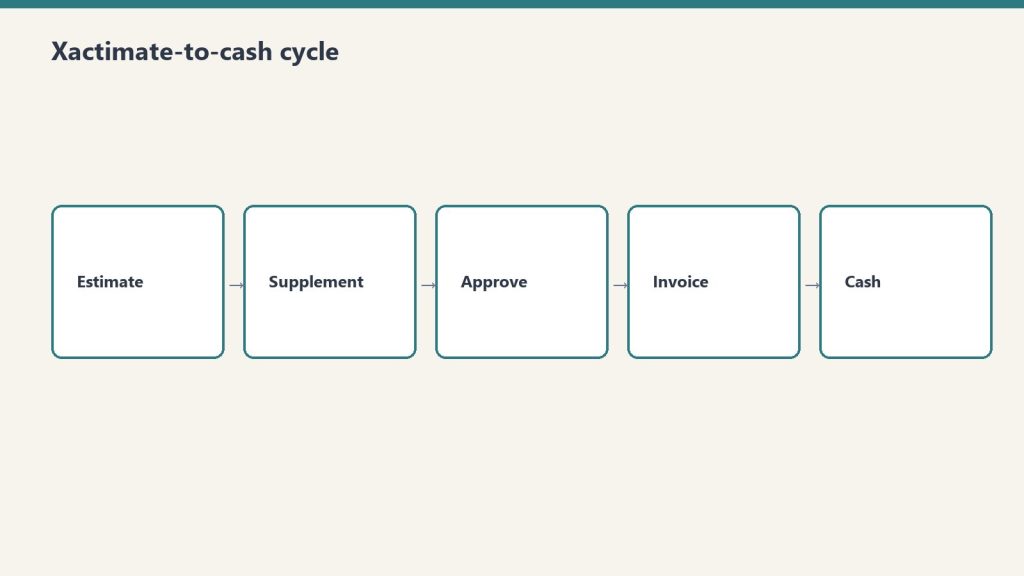
The first piece of scope discipline is writing scope that is genuinely defensible. Not maximum scope. Defensible scope. The two are different.
Defensible scope reflects the actual conditions of the loss as documented by the file. Every line item is supported by something in the documentation — a photo, a moisture reading, a condition note, a measurement. An estimator who writes a line item that is not clearly supported by the file is creating a scope dispute that they will lose, because the carrier will identify the unsupported item and reduce it.
Defensible scope reflects accurate measurement and quantity. The wall area is measured, not estimated. The flooring quantity reflects the actual room dimensions plus reasonable waste, not a round number that the estimator picked because it sounded right. The trim linear footage matches the actual trim being replaced. Estimators who guess at measurements lose disputes about measurements they could have won by measuring properly.
Defensible scope reflects appropriate pricing for the work being done. Pricing that exceeds the local market average without justification will be reduced. Pricing that includes labor at rates the carrier does not recognize will be challenged. Pricing that uses the wrong material grade for the conditions will be questioned. Estimators who price aggressively without supporting reasoning create disputes that they will partially lose.
Defensible scope reflects the carrier’s published guidelines where those guidelines exist. Most carriers and TPAs publish guidelines about how certain types of items should be scoped, how certain conditions should be priced, and how certain decisions should be documented. Estimators who scope outside the guidelines without acknowledging them invite reductions. Estimators who scope inside the guidelines or who scope outside them with explicit, documented reasoning maintain credibility.
Defensible scope acknowledges the limits of the file’s documentation. When the file’s documentation does not support a particular item, the responsible move is either to gather better documentation before writing the scope, or to write the scope without the unsupported item and supplement later when conditions are revealed. Estimators who include items in the original scope that the documentation does not support are setting up disputes they will lose and damaging their credibility for the items they could have defended.
Defensible scope, in short, is scope that has been written with the carrier’s review process in mind. The estimator is not writing for themselves. They are writing for the adjuster who will review the scope. A scope that the adjuster can approve cleanly is a defensible scope. A scope that requires the adjuster to do detective work or that contains items the adjuster will obviously reduce is not defensible regardless of what the contractor would prefer.
The conversational discipline of scope disputes
Even with defensible scope, some disputes will happen. The carrier will reduce items the contractor believes are warranted. The contractor will push back. The conversation that follows determines whether the dispute resolves productively or damages the relationship.
The first principle of the conversation is to acknowledge the carrier’s reasoning before offering counter-reasoning. Disputes that begin with the contractor explaining why the carrier is wrong tend to escalate. Disputes that begin with the contractor acknowledging what the carrier was looking at, agreeing where agreement is genuine, and then offering additional context that supports the contractor’s position tend to resolve. The conversational sequence matters.
The second principle is to ground the conversation in the file documentation. Disputes that revolve around what the contractor thinks should be true tend to go badly. Disputes that revolve around what the file documentation supports tend to resolve, because both sides can refer to the same evidence. Estimators who develop the habit of referencing specific photos, specific measurements, and specific conditions in the file are conducting more productive disputes than estimators who argue in the abstract.
The third principle is to know which items are worth fighting for and which are not. Not every reduction warrants a dispute. Some reductions are genuinely correct. Some reductions are within the carrier’s reasonable judgment even if the contractor disagrees. Some reductions are wrong and worth fighting for. Estimators who can distinguish among these in real time are more credible to the carrier than estimators who fight every reduction with equal energy.
The fourth principle is to escalate at the right level and time. Most scope disputes should be resolved between the estimator and the adjuster. When that fails, the conversation can move to the project manager and the supervisor. When that fails, it can move higher. Skipping levels or escalating prematurely damages the relationship at every level it touches. Estimators who handle their disputes at their level and escalate only when necessary build a reputation that pays back across many subsequent files.
The fifth principle is to walk away from disputes that are not winnable. Some disputes the contractor will lose regardless of how well they argue. Continuing to push past the point of clear resolution damages the relationship without producing any benefit. Estimators who recognize lost disputes and gracefully accept the outcome preserve credibility for the disputes they will win. Estimators who fight to the death on every item exhaust their credibility on items that did not warrant it.
The sixth principle is to maintain professional tone throughout. Tone that becomes combative, condescending, or personally critical of the adjuster damages the relationship in ways that scope outcomes cannot recover. The dispute is about the file, not about the people. Estimators who keep the tone professional regardless of provocation are building something across files that the contractor will benefit from for years.
The documentation layer that prevents disputes
The most efficient scope discipline is the discipline that prevents disputes from happening in the first place. This is largely a documentation question, and it connects directly to the documentation work described in earlier clusters of this playbook.
The mitigation file that arrives at the estimator’s desk should already include the documentation that will be needed to defend the rebuild scope. Photos of the existing finish profiles. Measurements of affected areas. Pre-existing condition notes. Conditions revealed during demo. Equipment placement records. The estimator who is working from a complete file writes scope that is defensible because the documentation backs it up. The estimator who is working from a thin file writes scope that is vulnerable because the supporting evidence is incomplete.
The documentation also has to be presented in a way that the adjuster can use efficiently. A photo set that is organized by location and by audience — as discussed in the photo discipline article — is far more useful than a chronological photo dump. A measurement record that ties measurements to specific locations and conditions is far more useful than a list of numbers. A condition note that explains what was found and why it matters for the rebuild is far more useful than a brief annotation.
The companies that have built strong documentation discipline as part of their operating system also experience meaningfully fewer scope disputes than companies that have not. The carrier sees a complete, well-organized file and approves it without significant pushback. The contractor’s effort goes into the operational work rather than into negotiation. Both sides benefit.
This is one of several places where the operating system pieces this playbook describes interconnect. The mitigation prep standard improves the file documentation. The improved file documentation reduces scope disputes. The reduced scope disputes preserve carrier relationship quality. The relationship quality drives program standing and referral flow. The flow funds the continued investment in the operating system. The cycle compounds.
The supplemental discipline
Most restoration jobs produce conditions during execution that were not visible at the time of the original scope. These conditions warrant supplemental scope items. The discipline of writing supplements is its own area of scope work that deserves attention.
The first principle of supplemental discipline is timeliness. Supplements should be written and submitted as conditions are discovered, not held until the end of the job and submitted as a batch. Carriers and TPAs strongly prefer supplements that arrive while the work is still in progress, because they can be evaluated against current conditions and approved without disrupting the close-out. Supplements that arrive at the end of the job are scrutinized more carefully and contested more often.
The second principle is documentation. Each supplemental item should be accompanied by photos and notes that document what was discovered, when, and why it warrants additional scope. Supplements without strong documentation are routinely reduced or denied regardless of their merits.
The third principle is honest framing. Supplements should be presented as discovered conditions that genuinely warrant additional scope, not as items that the contractor wishes had been included in the original. Supplements that read as scope creep get denied. Supplements that read as legitimate discoveries get approved.
The fourth principle is integration with the original scope. Supplements should reference the original scope and explain how the new conditions relate to or differ from what was originally documented. Supplements that float disconnected from the original file confuse the adjuster and slow the approval.
The fifth principle is selectivity. Not every discovered condition warrants a supplement. Some discoveries are within the contingencies that the original scope already covers. Some are minor enough that the time cost of a supplement exceeds its value. Estimators who supplement selectively and well build credibility. Estimators who supplement everything devalue their supplements.
What this means for owners
If you run a restoration company and your scope discipline is uneven across your team, the practical implication of this article is that the discipline is teachable and that the investment in teaching it pays back materially.
The starting point is the senior estimator who is currently producing the most defensible scopes and the most productive dispute conversations. That person’s approach should be documented, codified, and used as the basis for training the rest of the estimating team. Not as policy. As demonstrated practice.
The medium-term work is to build the documentation discipline that prevents most disputes from happening. The mitigation prep standard work, the photo discipline work, and the file packaging work all contribute to scope discipline downstream. Investments in the upstream documentation produce dividends in the downstream negotiation.
The long-term work is to build a culture where scope is treated as a professional craft, not as a fight. The estimators who hold themselves to high standards, defend defensible numbers without combativeness, and build reputations with carriers as serious professionals are the estimators who will produce the best outcomes for the company across years. Building a team of estimators who all operate this way is one of the highest-leverage operational moves an owner can make in 2026.
Scope is where the carrier relationship is tested. The companies that pass the test consistently are the companies that the carriers want more work from. The discipline is teachable. The payoff compounds.
Next in this cluster: the TPA game — understanding what third-party administrators actually optimize for and how that understanding changes the way contractors should engage with them.
Related: How Claude Cowork Can Train Every Role on a Restoration Team — estimators, PMs, admins, technicians, and sales managers each learn different project management skills.
The Missed Line Items Pack — $19
Defensible scope is written in Xactimate. The Missed Line Items Pack covers the line items most often left out of restoration scopes — and the supplement language that defends them when the dispute comes.
Get the Pack — $19Get The Signal
What we actually ran, what it measured, and what it means for a restoration shop — every week, including the flops.
Leave a Reply