In early October, a spreadsheet landed on my desk that I can’t stop thinking about.
It was an export from Bing Webmaster Tools — the AI Performance report for BC ESG, one of the sites we run. Filtered to a single question people were asking AI assistants: “pharmaceutical companies esg executive compensation.” Five days, October 1–5: 51 citations. Our pages, being read into AI answers about how drug companies tie executive pay to sustainability targets.
Here’s the thing. We had never built a page for that question. The citations were landing on a generalist compensation guide — a good page, but a sideways answer to a specific question. The demand was real, measured, and unanswered on purpose by nobody. It was just there.
We did try to find out what sparked it. There was movement around a company — I’m not naming it, because we never could source it, and guessing in public is how you become the thing we don’t want to be. So we made a rule out of it: build on the demand you can measure, never on the attribution you can’t. The demand we could measure. So we went and measured all of it.
Watch the 60-second version: How did two missing pages step AI citations from 11 a day to 30? — the same receipts in 56 seconds, chapters matched to the sections below.
The map: count everything before you build anything
On October 19 we pulled the full report — every query, every page, counted by value instead of skimmed. The clusters that mattered:
Get The Signal
What we actually ran, what it measured, and what it means for a restoration shop — every week, including the flops.
- Beauty companies, executive pay, sustainability targets — 68 citations on the main phrasing, more scattered across variants. Again: no dedicated page. The generalist guide was absorbing all of it.
- Pharmaceutical executive comp — 51 citations across four related phrasings.
- ICMA green bond principles — 159 citations at a 45.43% citation share. The site’s #1 query — and this one already had real pages behind it.
- Pay-equity reporting — small. 9 citations. Noted, not built.
Two of the four clusters were demand with no door built for it. That’s the whole insight, and it’s not complicated: AI assistants were asking our site specific questions, and we were answering adjacent ones.
The build: one night, two pages
That same night — October 19 — we published two guides:
- Beauty Companies: Executive Pay & Sustainability Targets
- Pharmaceutical Companies: ESG Executive Compensation
The rules we built them by:
- One real question per page, in the asker’s own words. The page’s address is the question, word for word — because that’s the string the assistants are already carrying.
- Answer first. No throat-clearing, no “in today’s rapidly evolving landscape.” The answer is at the top; the depth is below it for whoever wants it.
- Every page carries its download. Each guide has a companion PDF — a scorecard pack, a design pack. A page and its PDF are one asset. If the content changes, both change, same run. You’ll see why in a minute.
Then we waited. Three weeks later — this morning — we pulled the reports again and counted.
What happened: the step
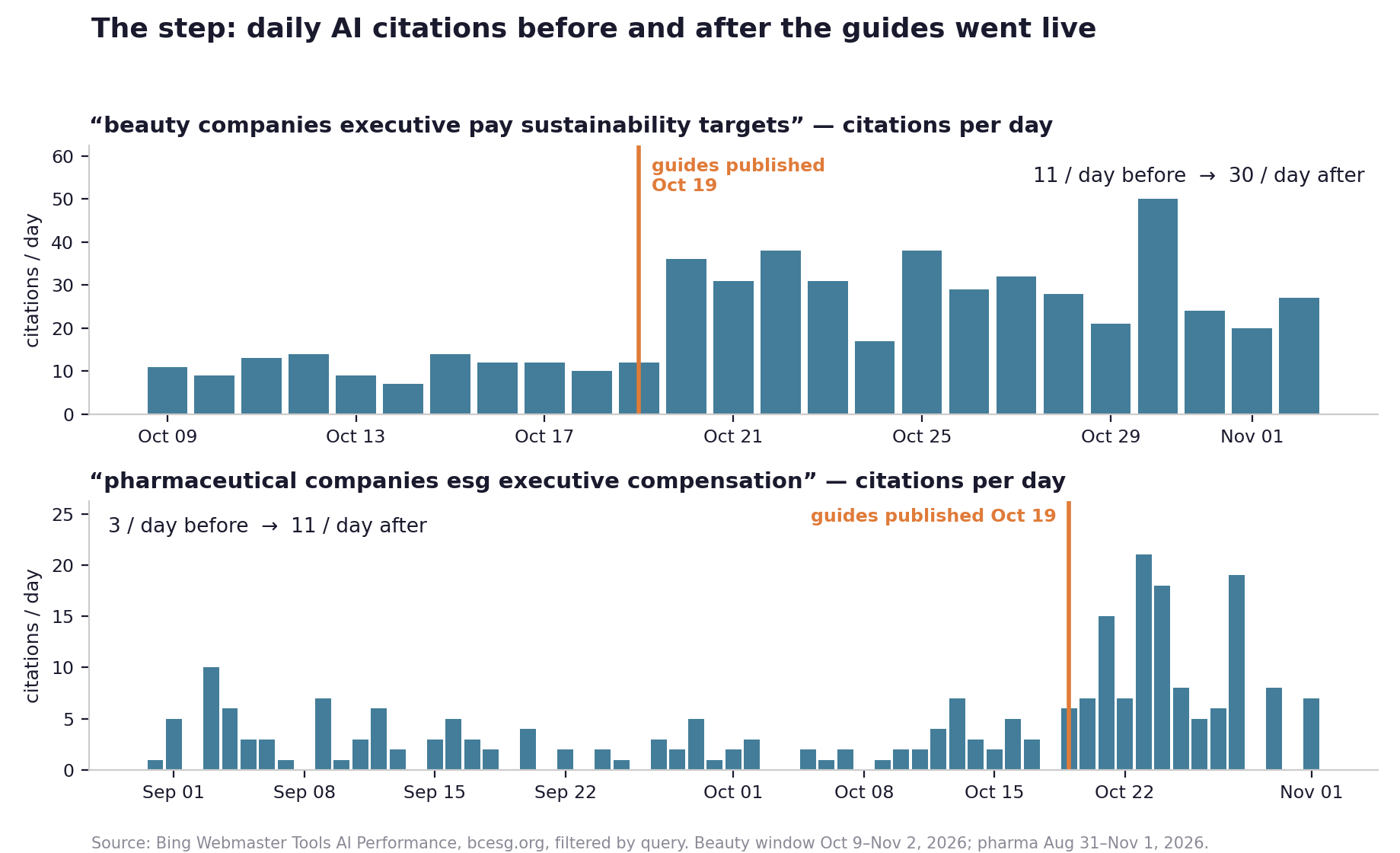
Read the daily series, not the totals, and the story tells itself. The beauty query was running at 11 citations a day. The day after the guides went live it stepped to 30 a day — peak day, 50 — and it has stayed at the new level. The pharma query went from 3 a day to 11 a day, same step, same date. Nothing else changed on those pages’ behalf that week. The step is dated, and the date is the build.
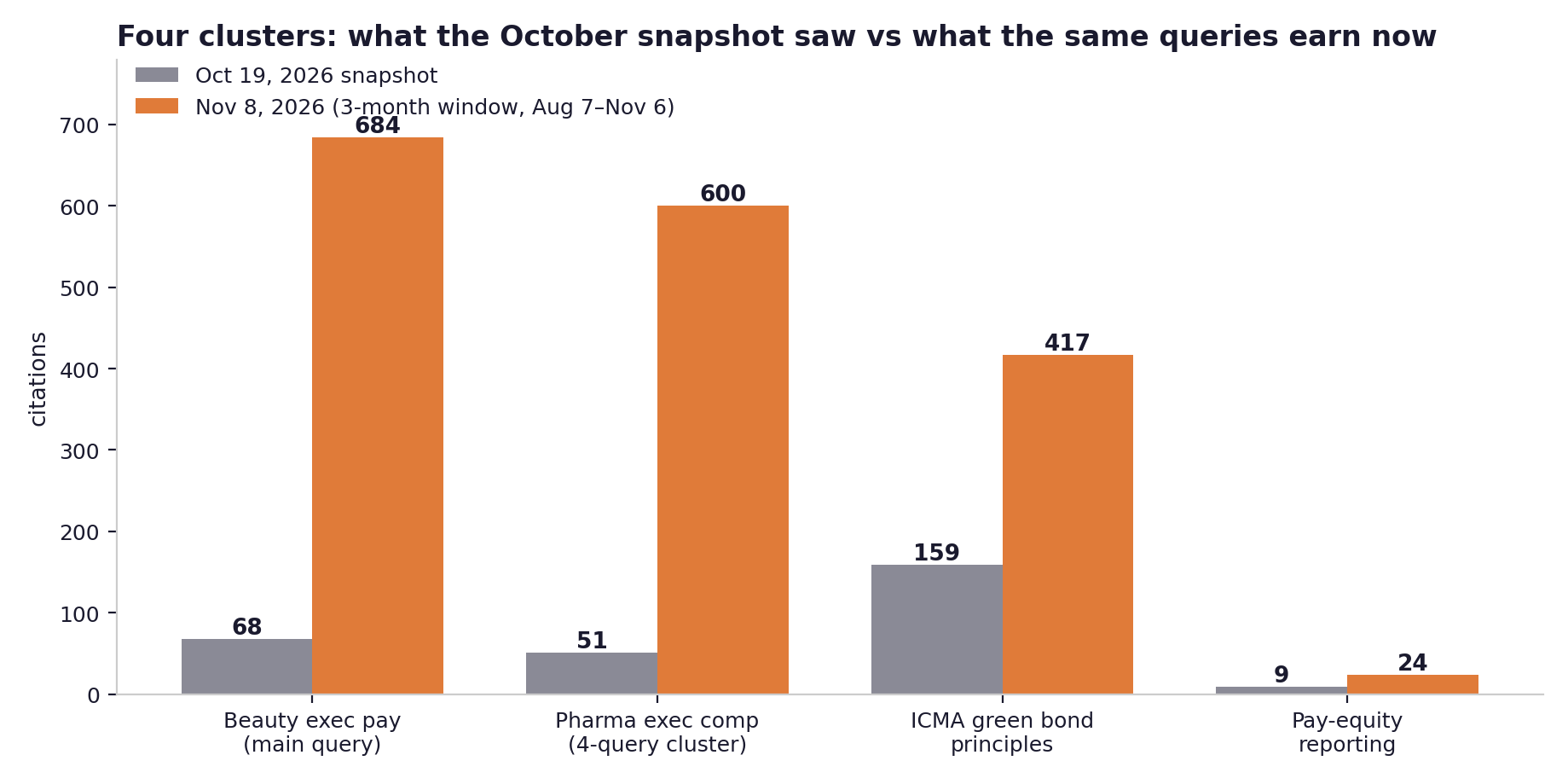
Against the October snapshot, the beauty query is at 684 citations and now holds a 57.33% citation share — when an assistant answers that question, it cites our site more than half the time, and the page it cites most is the one we built for it. The pharma cluster totals 600 across its phrasings.
Now the two honest complications, because a report that only shows the wins isn’t a report.
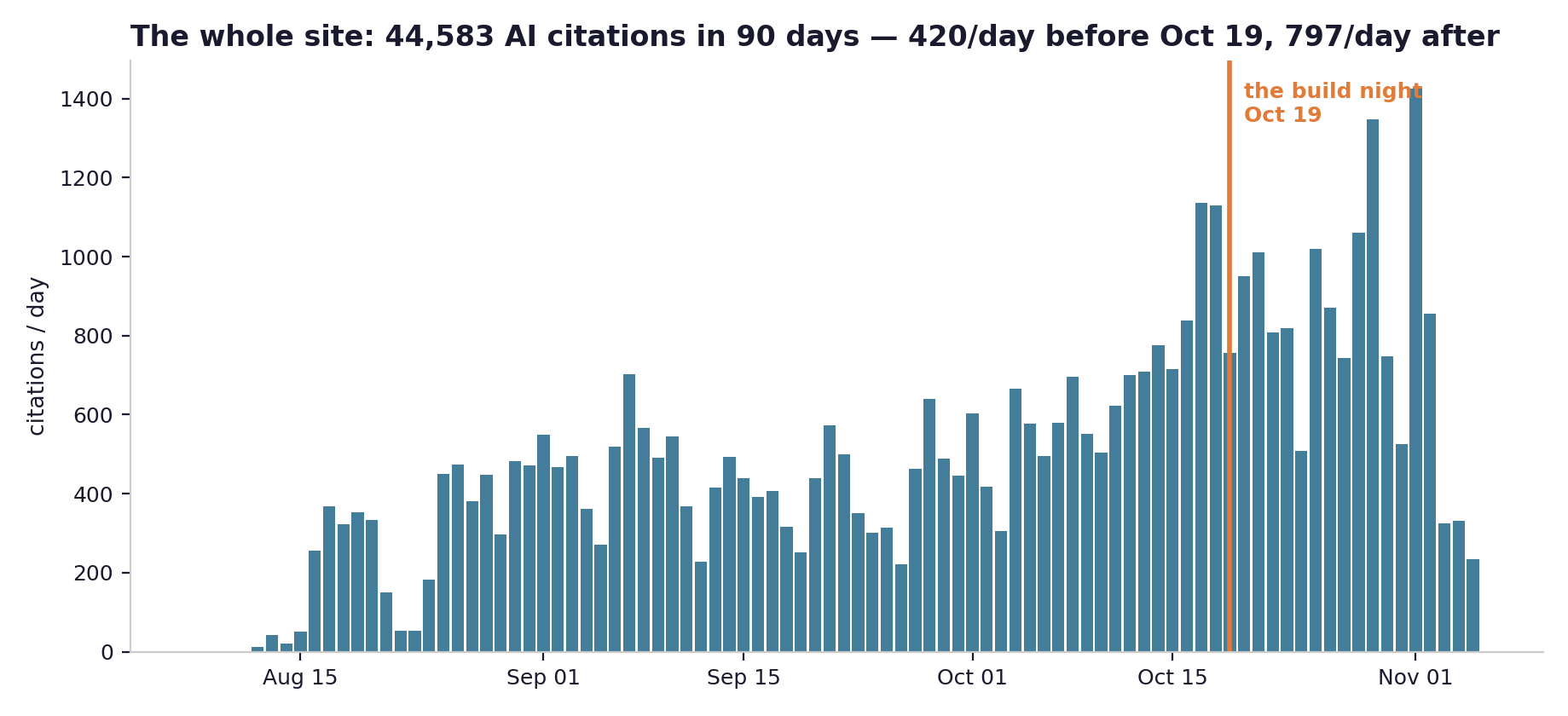
The tide rose too. ICMA green bond principles grew from 159 to 417 with no new build from us — the pages already there just kept earning. The whole site went from 420 citations a day to 797 a day across the same line. So no, I won’t claim every new citation is ours by construction. The claim I’ll defend is narrower: on the two queries we built for, the daily rate stepped on the build date and held, and the built pages took the lead or second place in earning them. The tide explains growth. It doesn’t explain a step.
Small stayed small. Pay-equity reporting — the cluster we noted and didn’t build — went from 9 to 24. Fine, and roughly what you’d expect: no door, no step.
Who earns the query
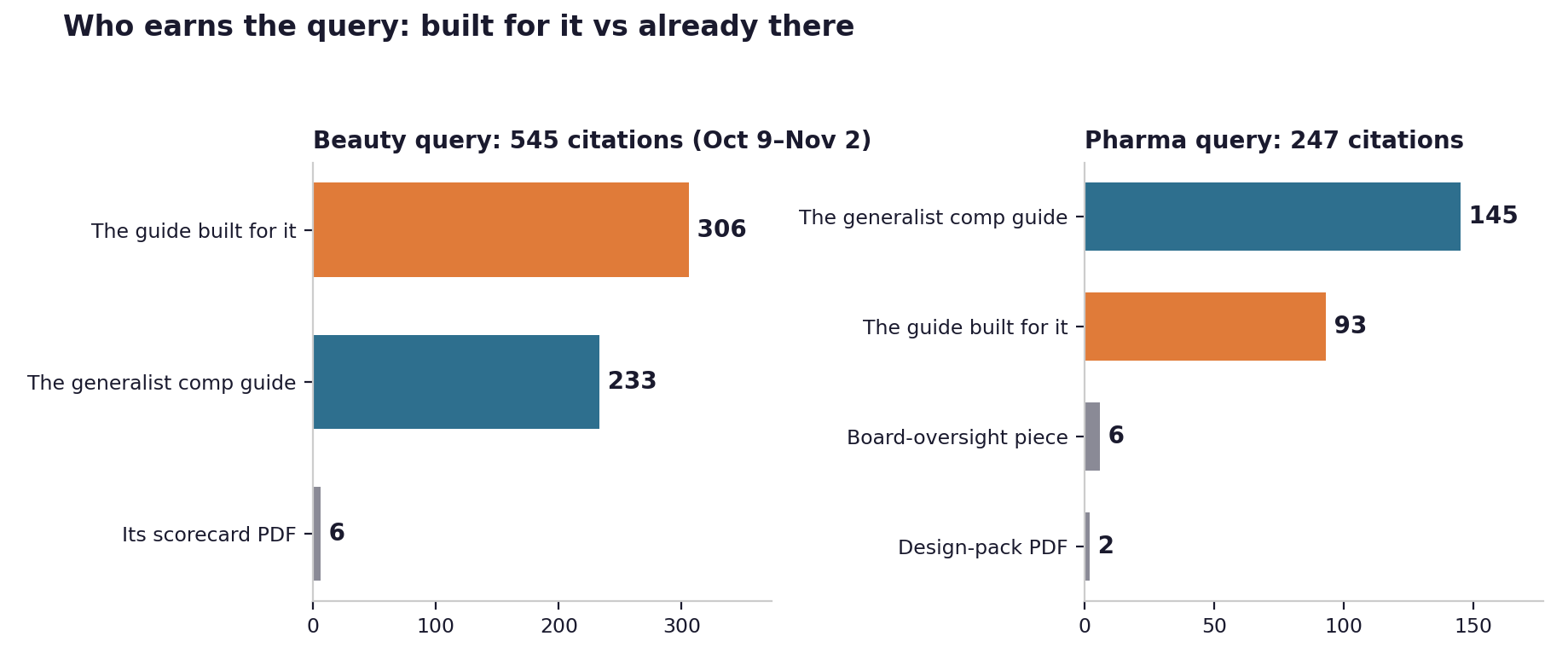
This is the chart I keep coming back to. On beauty, the guide we built leads — 306 citations to the generalist’s 233 — and the generalist didn’t lose anything in absolute terms. The pie grew; the new page took the bigger slice of a bigger pie. That’s the answer to the cannibalization worry, at least this once: building the specific page grew the specific query.
On pharma, the built guide is second — 93 to the generalist’s 145. A strong second, on a query whose daily rate tripled, but second. One difference between the two builds: the beauty page’s address is the query word-for-word. The pharma page’s address drops one word of it. Is that the reason? Two data points is a hypothesis, not a law — I’m labeling it as one, and it’s the first thing we’ll test on the next build.
And look at the bottom of both panels: the PDFs get cited. Six for the beauty scorecard, two for the pharma design pack in these filtered windows — and across the whole site, four PDFs hold 45 citations, one pharma scorecard alone at 23. The downloads aren’t lead magnets bolted onto the content. In an AI answer, they are content. That’s why the page and its PDF ship as one asset here, and why this article has a companion report instead of a screenshot gallery.
The companion report: Built for the Question — a Tygart Media field report (PDF). The same findings in the form built to travel: all four charts, the tables, the method note. Take it, share it, keep the method note attached.
The other half of the instruments: what the humans did
Everything above comes from Bing’s report — the machines’ side of the glass. We also run Microsoft Clarity on the site, so we went and looked at the humans’ side: recordings and friction data for the two guide pages, last 30 days.
The honest headline: there is almost nobody there. The beauty guide — 725 citations in the new report — has had 7 human sessions in 30 days. The pharma guide — 301 citations — has had 2. Sitewide it’s the same shape: 786 human sessions against 44,583 citations. The citation economy runs at roughly 57 citations per human visit, and on the built pages it’s over a hundred to one. The audience for this content is not visiting. It’s being quoted.
And the handful of humans who do land on the beauty guide arrive from a telling set of doors — among the seven sessions, referrers include claude.ai and gemini.google.com. Not the channel the citations live in (that’s Copilot, which sends almost no one), but the same species of door: a person reads an AI answer, then clicks through to check the source. They stay 10 seconds, scroll 5% of the page, click nothing, and leave. No rage clicks, no dead clicks, no errors — zero friction of any measured kind on either page. They’re not reading. They’re verifying — and the page’s job, for them, is to be checkable at a glance: answer first, sources visible.
Meanwhile the bots Clarity filtered out tell their own story: on the pharma page, 6 of its 8 total arrivals were bots; the beauty page, 4 of 11. Sitewide, 2,526 bot sessions excluded against 786 human ones kept. Even the “traffic” is mostly machines.
This is what the PDF citations meant, seen from the other side. If the content’s real consumers are assistants pulling pages and files into answers, then the page is a source document that occasionally gets audited by a human — and it should be built like one. Which brings us to the machinery people argue about.
About llms.txt, JSON, and the rest of the folklore
There’s a standing argument in our trade about what a site must hand the machines: a special llms.txt file, elaborate JSON schema, structured feeds — with one camp saying none of this can work without them and another saying it’s all decoration. We’re in the odd position of not having to argue. We can look.
This site has no llms.txt. None. The address returns our 404 page. It has never existed on bcesg.org — and the site earned 44,583 citations in 90 days without it. Whatever llms.txt is for, “getting cited at all” is not it.
The pages do carry JSON-LD — a FAQ block, article markup, breadcrumbs. And we don’t credit it for the step, because the evidence we trust most on that question — including a controlled test on 1,885 pages that added JSON-LD and got no citation lift — says schema buys eligibility and accuracy, not selection. Our dates agree: the schema was there before October 19 too. What changed on October 19 was the content — a page built to be one question’s answer, carrying a file built to travel.
That’s the whole machinery conclusion, and it’s almost embarrassingly plain: the assistants cite what answers the question, in a form they can carry. A clean page whose address is the question. A PDF that is the answer, portable. The rest is garnish — some of it harmless, some of it a whole industry’s worth of billable garnish.
What we can’t claim
- Bing’s own tables don’t perfectly agree with Bing’s own charts. On one filtered view, the chart total was 247 and the pages beneath it summed to 246 — Bing prints a note saying totals may differ when filters are applied, and they do. We report the chart totals and say so.
- The windows differ. Each export covers the range Bing gives it; every chart here carries its window on its face. Comparing across windows without saying so is how case studies become fiction.
- Leaderboards move. The single biggest pharma phrasing in the new report — “pharmaceutical companies ESG metrics executive compensation,” 248 citations — isn’t the phrasing we built for in October. It was second then. Questions mutate. The map is a snapshot, not a deed.
- This is one site, one engine’s report, one month. Copilot citations are what Bing measures. It’s the cleanest window we have, and we say what it is.
What we do now
This is the operating loop, and it’s the same one we’d run on any site, including a client’s:
- Pull the AI citation report and count it by value. Not impressions-vanity — which questions, which pages, what shares.
- Find the clusters where demand lands on pages that weren’t built for it. That gap is the work list. It’s usually short.
- Build one page per question, in the asker’s words, answer first, with its download attached as part of the same asset.
- Wait, then re-pull and read the daily step — not the cumulative total, which flatters everything.
- Publish the receipts, including the parts that complicate the story.
BC ESG’s whole portfolio, for the record: 44,583 AI citations in 90 days, across 75 cited pages and 428 distinct questions. We didn’t buy that. We counted, we built two doors where the traffic already was, and we wrote down what happened.
If you’re running a site and wondering what the assistants think it’s for — the report that answers that question already exists. It’s sitting in your Webmaster account, unopened. Open it, count it, and build what it’s asking for.
That’s what we did. This is what we saw.
Method note: All figures are from Bing Webmaster Tools AI Performance exports for bcesg.org, pulled October 8 (query-filtered), October 19, and November 8, 2026. Citation counts are Microsoft Copilot and partner citations as Bing reports them. Behavior figures are from Microsoft Clarity (project for bcesg.org), last 30 days as of November 8, 2026, with Clarity’s bot sessions excluded as reported. Page structure and file checks (llms.txt, JSON-LD, PDF links) were verified directly against the live pages on November 8, 2026. Windows: site-wide overview Aug 7–Nov 6, 2026; filtered views as labeled on each chart. Where Bing’s chart totals and table sums differ under filters, chart totals are used and the difference is disclosed above. The two guides discussed were published on bcesg.org on October 19, 2026.
Update history
November 8, 2026 — Published. The 60-second video version is live on YouTube (linked at the top of this page); its chapters match the sections below, and each chapter links back to its section.
Get The Signal
What we actually ran, what it measured, and what it means for a restoration shop — every week, including the flops.
Leave a Reply