The Short Answer
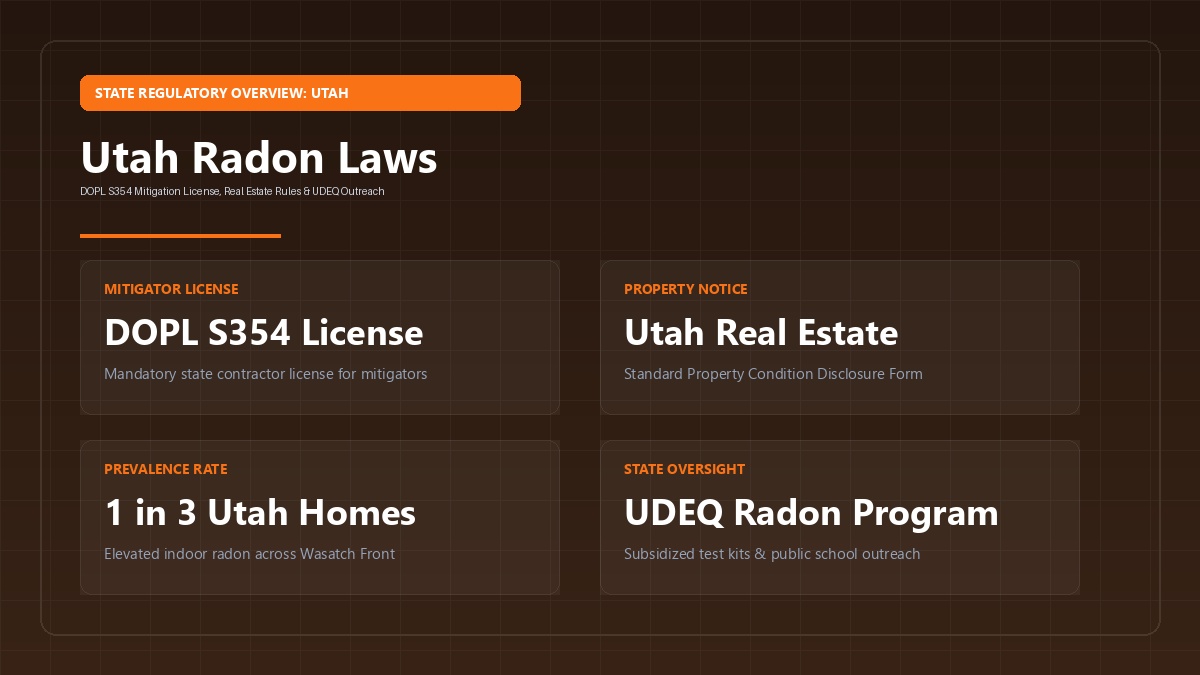
Utah regulates radon through professional contractor licensing for mitigators, standardized real estate disclosures, and targeted public health testing initiatives. Under Utah Division of Professional Licensing (DOPL) regulations, contractors installing radon mitigation systems must hold a valid state contractor license, specifically the S354 Radon Mitigation Contractor specialty license or general building credentials. Residential home sellers are required under standard Utah Real Estate Commission forms to disclose known environmental hazards, including historical radon tests. Testing reveals that approximately one in three Utah homes tests above the EPA action level, driven by uranium-bearing granitic and volcanic geology.
Testing Requirements
Radon testing is voluntary for private single-family homeowners and residential landlords in Utah; state law does not compel existing property owners to test indoor air prior to occupancy or sale. Similarly, Utah statutes do not mandate routine radon testing in public or private K-12 school buildings, though the Utah Department of Environmental Quality (UDEQ) Indoor Radon Program actively partners with local school districts and the Utah State Board of Education to conduct voluntary school screening following ANSI/AARST commercial building protocols.
Real-Estate Disclosure
Real estate disclosure is governed under general Utah contract law and the Utah Real Estate Commission approved Seller’s Property Condition Disclosure form (authorized under Utah Code Title 57). Sellers of residential real property are legally obligated to disclose known material defects affecting property value or habitability. Section 11 of the standardized disclosure form explicitly questions whether the seller is aware of any past radon testing, the test results, or the presence of an active or passive radon mitigation system. While the disclosure form requires truthful reporting of historical test records, it does not mandate pre-closing testing, leaving testing contingencies to contract negotiation.
Mitigator & Tester Certification
Contractor licensing is mandatory in Utah for individuals and businesses installing radon mitigation systems. Under Utah Code Title 58, Chapter 55 and Utah Administrative Code R156-55a, contractors performing mitigation must hold an active license from the Utah Division of Professional Licensing (DOPL). Specifically, DOPL establishes the S354 Radon Mitigation Contractor classification (or recognizes general building contractors B100/R100). To obtain the S354 license, applicants must demonstrate active national certification through the National Radon Proficiency Program (NRPP) or the National Radon Safety Board (NRSB). For individuals performing measurement or testing only, DOPL does not require a specialty contractor license, but UDEQ strongly recommends NRPP or NRSB certification.
New Construction
Radon-resistant new construction is governed under the Utah State Construction and Fire Codes Act (Utah Code Title 15A), which adopts the International Residential Code (IRC). While IRC Appendix F (Radon Control Methods) is included within model codes, Utah has not enacted a blanket statewide mandate forcing passive RRNC in all new single-family homes. Instead, adoption of Appendix F is left to local municipal and county building departments. Several high-risk municipalities and jurisdictions along the Wasatch Front and mountain resort valleys (such as Park City and Summit County) enforce passive radon rough-ins under local ordinances.
Radon Zones & the Action Level
According to the EPA Map of Radon Zones and UDEQ geological surveys, Utah features complex mountainous terrain with significant radon potential. Several central and eastern counties—including Carbon, Duchesne, Grand, Piute, Sanpete, Sevier, and Uintah—are designated as EPA Zone 1 (High Potential), where predicted average screening levels exceed 4.0 pCi/L. Widespread Zone 2 (Moderate Potential, 2.0 to 4.0 pCi/L) counties cover the densely populated Wasatch Front, including Salt Lake, Utah, Davis, and Weber counties, where state surveys indicate approximately 33 percent of tested homes exceed 4.0 pCi/L. UDEQ adopts the federal action level benchmark of 4.0 pCi/L. For complete county classifications, visit our EPA Radon Zone Map guide.
The State’s Radon Program
The state regulatory and educational authority is the Utah Department of Environmental Quality Radon Program, operating within the Division of Waste Management and Radiation Control. UDEQ coordinates statewide public education, tracks testing data, and partners with testing laboratories to provide subsidized, low-cost short-term and long-term test kits to Utah residents. Homeowners and industry professionals can order test kits and verify licensed S354 contractors through the official UDEQ Radon Program portal or by contacting program staff at 801-536-0200.
Sources & Limits
This regulatory guide is provided for educational and informational purposes only and does not constitute formal legal, building code, or engineering counsel. Contractor licensing classifications and local building codes are subject to administrative update. Real estate buyers, sellers, landlords, and contractors should verify current rules directly with the Utah Division of Professional Licensing, UDEQ, or a qualified attorney.
Official Sources: Utah Code Title 58, Chapter 55; Utah Administrative Code R156-55a; Utah Department of Environmental Quality (Division of Waste Management and Radiation Control); U.S. Environmental Protection Agency.
To compare Utah’s contractor licensing model with other Western states, explore our master guide to radon regulations across the United States or inspect the EPA Radon Zone Map.
Get The Signal
What we actually ran, what it measured, and what it means for a restoration shop — every week, including the flops.
Leave a Reply