The Short Answer
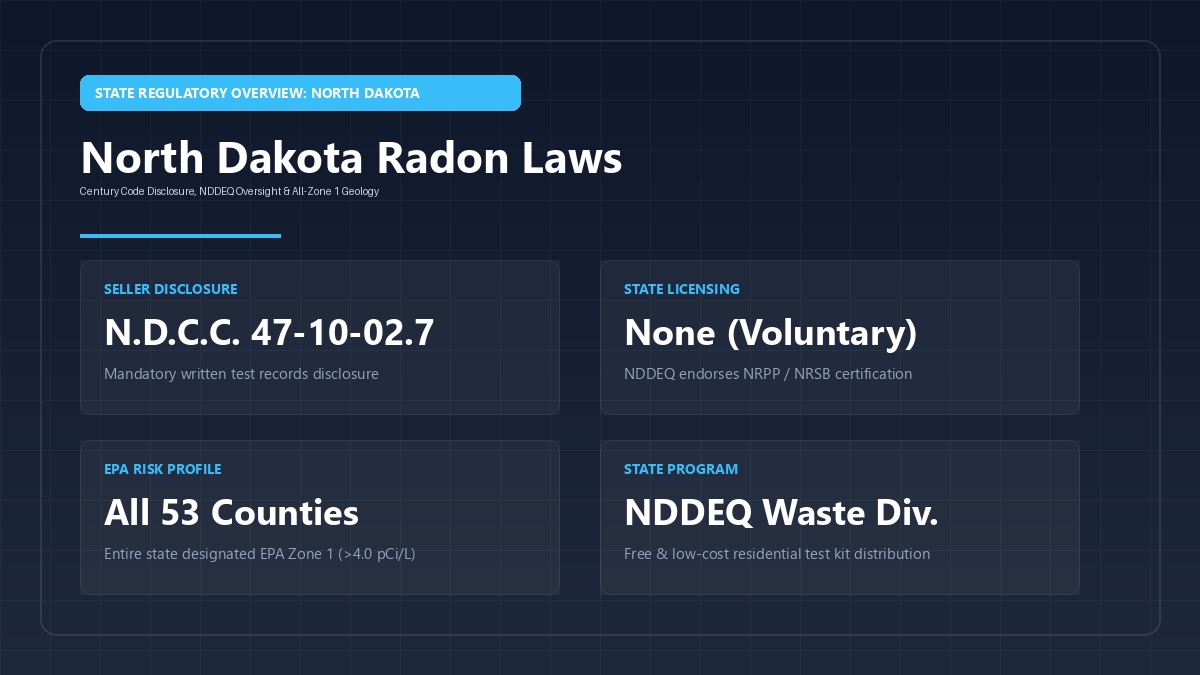
North Dakota regulates radon primarily through real estate transaction transparency and environmental public health education rather than direct state contractor licensing. Under North Dakota Century Code § 47-10-02.7, residential real estate sellers must provide written disclosures detailing any known radon concentrations, prior test reports, and existing mitigation systems before signing a purchase agreement. The state does not operate an independent licensing program for radon mitigators or testing specialists, officially directing consumers to nationally certified professionals. Geologically, North Dakota faces exceptionally high radon potential, with the U.S. Environmental Protection Agency classifying all 53 counties as EPA Zone 1.
Testing Requirements
Radon testing is voluntary for private residential homeowners and landlords in North Dakota; the state imposes no statutory mandate requiring testing in existing single-family dwellings or private rental properties. Similarly, North Dakota law does not mandate routine radon testing in public or private K-12 school buildings or licensed commercial childcare facilities. However, the North Dakota Department of Environmental Quality (NDDEQ) strongly encourages testing across all residential buildings, noting that elevated indoor levels are widespread throughout the state due to glacial till deposits containing radium and uranium.
Real-Estate Disclosure
Real estate disclosure is codified under North Dakota Century Code (N.D.C.C.) § 47-10-02.7. Before completing a binding purchase agreement for residential real property, the seller must deliver a written disclosure statement disclosing whether the property has ever been tested for radon gas and the specific results of any such tests. Furthermore, if a radon mitigation system or soil-gas depressurization equipment has been installed on the premises, the seller must disclose its operational status and provide copies of any available inspection records. While the statute requires truthful disclosure of known conditions, it does not compel sellers to conduct new testing prior to closing, leaving testing contingencies to contract negotiations.
Mitigator & Tester Certification
North Dakota has no state licensing requirement for radon measurement technicians or mitigation contractors, per the North Dakota Department of Environmental Quality, verified November 2026. The state maintains no state-administered regulatory board or credentialing registry for radon professionals. Instead, the NDDEQ officially directs homeowners, builders, and real estate professionals to hire contractors certified through the two national proficiency programs recognized by the EPA: the National Radon Proficiency Program (NRPP) and the National Radon Safety Board (NRSB). Contractors performing structural alterations or electrical wiring during fan installations must comply with local municipal building and electrical trade permits.
New Construction
North Dakota has not enacted a mandatory statewide building code requiring passive or active Radon-Resistant New Construction (RRNC) systems in new residential structures. Building code adoption and enforcement operate under local municipal and county jurisdiction across the state. While individual cities (such as Fargo and Bismarck) may adopt model building standards such as the International Residential Code (IRC) Appendix F at local discretion, there is no universal state mandate forcing homebuilders to install passive sub-slab suction pits or vertical vent pipes.
Radon Zones & the Action Level
According to the EPA Map of Radon Zones, North Dakota is one of the few states in the nation where all 53 counties are designated as EPA Zone 1 (High Potential), indicating predicted average indoor radon screening concentrations exceeding the national action level of 4.0 picocuries per liter of air (pCi/L). State health surveys confirm that over 60 percent of tested North Dakota basements exceed 4.0 pCi/L. The NDDEQ advises property owners to install active mitigation systems if indoor radon levels equal or exceed 4.0 pCi/L, and to consider remediation if levels range between 2.0 and 4.0 pCi/L. For comprehensive regional risk analysis and county classifications, explore our EPA Radon Zone Map guide.
The State’s Radon Program
The state’s official public health initiative is the North Dakota Department of Environmental Quality Radon Program, administered under the Division of Waste Management. The program provides educational resources, technical guidance, and distributes free or subsidized short-term radon test kits to North Dakota homeowners while supplies last. Residents can request test kits, access county-level screening data, and review EPA mitigation guidance directly through the NDDEQ Radon Program portal or by contacting the division office at 701-328-5166.
Sources & Limits
This regulatory guide is provided for educational and informational purposes only and does not constitute formal legal, building code, or engineering counsel. State statutory disclosure requirements and local municipal building codes are subject to legislative amendment. Property buyers, sellers, landlords, and contractors should verify current rules directly with the North Dakota Department of Environmental Quality or a licensed real estate attorney.
Official Sources: North Dakota Century Code § 47-10-02.7; North Dakota Department of Environmental Quality (Division of Waste Management); U.S. Environmental Protection Agency (Map of Radon Zones).
For national comparative analysis and federal benchmarks, return to our master overview of radon regulations across the United States or inspect the EPA Radon Zone Map.
Get The Signal
What we actually ran, what it measured, and what it means for a restoration shop — every week, including the flops.
Leave a Reply