The Short Answer
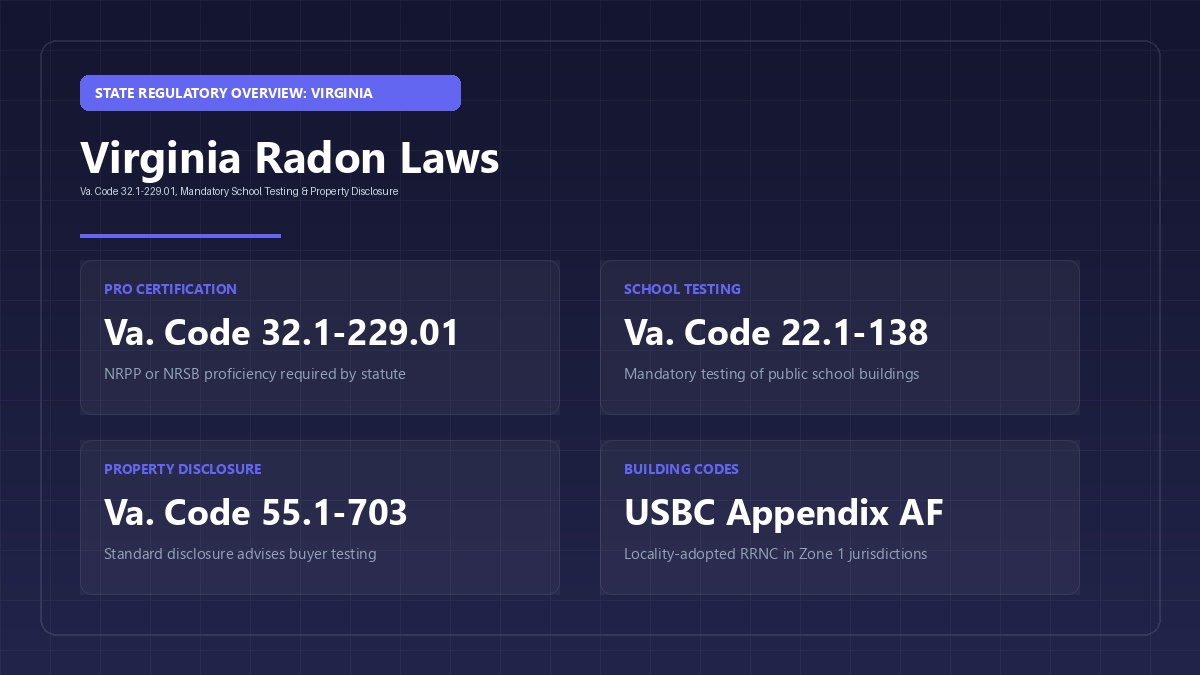
Virginia regulates radon through a unique statutory mechanism that directly codifies national contractor certification into state law, along with mandatory public school testing and real estate disclosures. Under Virginia Code § 32.1-229.01, it is unlawful for any person to conduct commercial radon testing or mitigation without active proficiency certification from the NRPP or NRSB. Virginia law (Va. Code § 22.1-138) mandated historical radon testing across all public school buildings, and the Virginia Residential Property Disclosure Act explicitly advises home purchasers to exercise due diligence regarding radon levels.
Testing Requirements
Radon testing in Virginia is voluntary for private residential homeowners and landlords; there is no statutory mandate requiring testing in private residential rental properties. However, under Virginia Code § 22.1-138, each local school board was required by statute to conduct radon testing in all public school buildings constructed prior to July 1, 1994, maintain testing records on file, and report results to the Virginia Department of Health (VDH). While private commercial spaces and childcare centers do not face universal testing mandates, VDH recommends testing every two to five years.
Real-Estate Disclosure
Real estate disclosure is governed by the Virginia Residential Property Disclosure Act (Va. Code §§ 55.1-700 et seq.). Under § 55.1-703, the owner makes no representations with respect to radon gas. However, the mandatory Virginia Residential Property Disclosure Statement explicitly notifies prospective purchasers that the owner makes no representations and formally advises buyers to exercise whatever due diligence they deem necessary, including professional radon testing. If a seller has knowledge of an unmitigated test concentration that represents a known material latent defect, common law disclosure rules apply.
Mitigator & Tester Certification
Commercial radon credentialing is governed by Virginia Code § 32.1-229.01. Rather than establishing a separate state agency licensing division, Virginia statute directly codifies national certification: no person shall conduct radon screening, testing, or mitigation for a fee unless certified as proficient by the National Radon Proficiency Program (NRPP) or the National Radon Safety Board (NRSB). Practicing commercially in Virginia without an active NRPP or NRSB credential is a violation of state law.
New Construction
New construction requirements are governed by the Virginia Uniform Statewide Building Code (USBC / 13 VAC 5-63), which incorporates the International Residential Code (IRC) Appendix AF (Radon Control Methods). Appendix AF applies to new residential construction in designated high radon potential jurisdictions (including Zone 1 counties such as Albemarle, Augusta, Chesterfield, Fairfax, Frederick, Loudoun, and Montgomery). In these designated jurisdictions, builders must install passive soil depressurization systems, including gas-permeable gravel, sealed vapor barriers, and rough-in vertical vent pipes through the roof.
Radon Zones & the Action Level
Virginia spans all three EPA Radon Zones across its diverse geological provinces:
- Zone 1 (High Potential, predicted average indoor levels > 4.0 pCi/L): Piedmont, Blue Ridge, and Valley counties, including Albemarle, Augusta, Botetourt, Chesterfield, Clarke, Culpeper, Fairfax, Frederick, Loudoun, Montgomery, Page, Roanoke, Rockbridge, Rockingham, Shenandoah, Warren, and the City of Winchester.
- Zone 2 (Moderate Potential, predicted average 2.0 to 4.0 pCi/L): Central counties, including Arlington, Fluvanna, Hanover, Henrico, Prince William, Stafford, and Richmond City.
- Zone 3 (Low Potential, predicted average < 2.0 pCi/L): Tidewater and Coastal Plain jurisdictions, including Virginia Beach, Norfolk, Chesapeake, Hampton, Newport News, and Accomack.
VDH enforces the EPA action level of 4.0 pCi/L, advising mitigation whenever living spaces test at or above 4.0 pCi/L. Explore the complete geological map on our EPA Radon Zone Map guide.
The State’s Radon Program
The state regulatory and public health authority is the Virginia Department of Health (VDH) — Office of Radiological Health, Radon Program (vdh.virginia.gov/radiological-health/indoor-radon-program/). Virginia residents can order subsidized test kits through VDH-partnered laboratories, obtain educational brochures, and verify national NRPP/NRSB contractor credentials.
Sources & Limits
This regulatory document is provided for educational and informational purposes only and does not constitute formal legal, building code, or engineering advice. Building codes and statutes are subject to revision by the Virginia General Assembly and the Board of Housing and Community Development. Confirm specific local requirements with local building officials and VDH.
Primary Official Sources: Virginia Department of Health (VDH) Office of Radiological Health; Virginia Code §§ 32.1-229.01, 22.1-138, 55.1-700 et seq.; Virginia Uniform Statewide Building Code (13 VAC 5-63 Appendix AF); U.S. Environmental Protection Agency (Map of Radon Zones for Virginia).
Return to our national guide on Radon Regulations in the United States or inspect national county risk rankings on the EPA Radon Zone Map.
Get The Signal
What we actually ran, what it measured, and what it means for a restoration shop — every week, including the flops.
Leave a Reply