The Short Answer
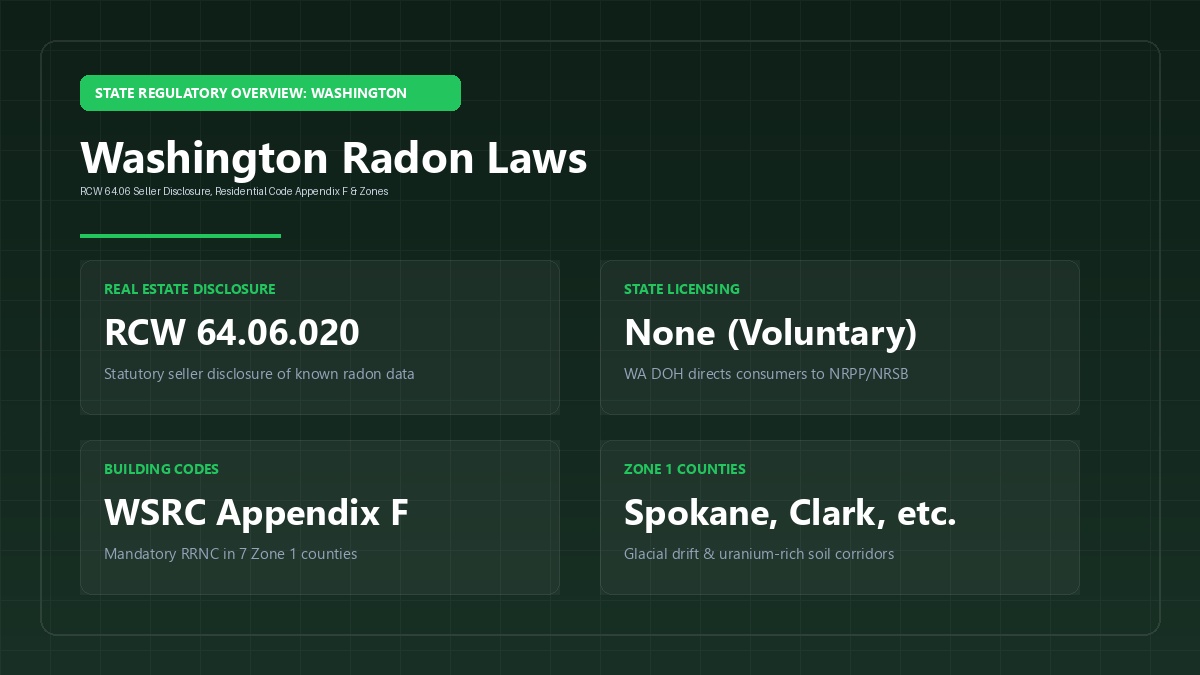
Washington regulates radon primarily through mandatory building codes in designated high-risk counties and statutory real estate disclosures. Under the Washington State Residential Code (WSRC Appendix F), new residential construction must incorporate passive radon-resistant features across seven designated Zone 1 counties in eastern Washington. In real estate transactions, sellers of residential property must complete a statutory disclosure statement disclosing known radon tests or systems under RCW 64.06.020. The state does not administer an independent radon contractor licensing board, instead directing consumers to national NRPP and NRSB certification registries.
Testing Requirements
Radon testing in Washington is entirely voluntary for private single-family homeowners, residential landlords, and commercial property owners. Washington has no statewide statutory mandate compelling testing in private rental properties. In addition, there is no state law requiring routine radon testing in public or private K-12 schools, childcare centers, or state-owned buildings, though the Washington State Department of Health (WA DOH) strongly encourages school districts in high-risk eastern Washington counties to test facilities periodically.
Real-Estate Disclosure
Real estate disclosures in Washington are governed by Revised Code of Washington (RCW) § 64.06.020. Sellers of improved residential real property must complete and deliver the statutory Real Property Transfer Disclosure Statement (Form 17) to prospective buyers. Section 7 (Environmental) explicitly inquires whether the property has any radon gas, whether testing has occurred, and whether any radon mitigation system exists. Delivering false or incomplete statements, or failing to deliver the disclosure, provides buyers statutory rights of rescission within three business days of receipt.
Mitigator & Tester Certification
Washington does not maintain a state licensing board or state certification program for radon measurement or mitigation contractors; there is no Washington state radon license. General contractors must be registered with the Washington State Department of Labor & Industries (L&I). For radon proficiency, the WA DOH Radon Program officially advises consumers to hire contractors credentialed by the National Radon Proficiency Program (NRPP) or the National Radon Safety Board (NRSB).
New Construction
Radon-resistant construction is enforced under the Washington State Residential Code (WSRC / WAC 51-51), which incorporates International Residential Code Appendix F. Radon-resistant new construction (RRNC) is mandatory across seven designated EPA Zone 1 counties in eastern Washington: Clark, Ferry, Okanogan, Pend Oreille, Skamania, Spokane, and Stevens. In these counties, all new residential construction must incorporate passive sub-slab depressurization systems, including gas-permeable gravel, sealed vapor barriers, sealed perimeter joints, and a rough-in vertical vent pipe through the roof.
Radon Zones & the Action Level
Washington displays a dramatic geological divide across the Cascade Mountain Range:
- Zone 1 (High Potential, predicted average indoor levels > 4.0 pCi/L): Clark, Ferry, Okanogan, Pend Oreille, Skamania, Spokane, and Stevens counties.
- Zone 2 (Moderate Potential, predicted average 2.0 to 4.0 pCi/L): Chelan, Douglas, Grant, Kittitas, Klickitat, Lincoln, Walla Walla, Whitman, and Yakima counties.
- Zone 3 (Low Potential, predicted average < 2.0 pCi/L): Puget Sound and western coastal counties, including King, Pierce, Snohomish, Kitsap, Thurston, and Whatcom.
WA DOH adheres to the EPA action level of 4.0 pCi/L, strongly advising mitigation for living areas testing at or above 4.0 pCi/L. Explore the state breakdown on our EPA Radon Zone Map guide.
The State’s Radon Program
The state’s official radon resource is the Washington State Department of Health (WA DOH) — Radon Program (doh.wa.gov/community-and-environment/contaminants/radon). Washington residents can access educational materials, purchase low-cost test kits through state-partnered laboratories, and look up national NRPP/NRSB contractor registries.
Sources & Limits
This regulatory guide is prepared for informational purposes only and does not constitute formal legal, building code, or engineering counsel. Building codes and administrative interpretations are subject to revision by the State Building Code Council and WA DOH. Consult local building departments or legal counsel for site-specific requirements.
Primary Official Sources: Washington State Department of Health (WA DOH); Revised Code of Washington § 64.06.020; Washington State Building Code Council (WAC 51-51 Appendix F); U.S. Environmental Protection Agency (Map of Radon Zones for Washington).
Return to our national guide on Radon Regulations in the United States or inspect national county risk rankings on the EPA Radon Zone Map.
Get The Signal
What we actually ran, what it measured, and what it means for a restoration shop — every week, including the flops.
Leave a Reply