The Short Answer
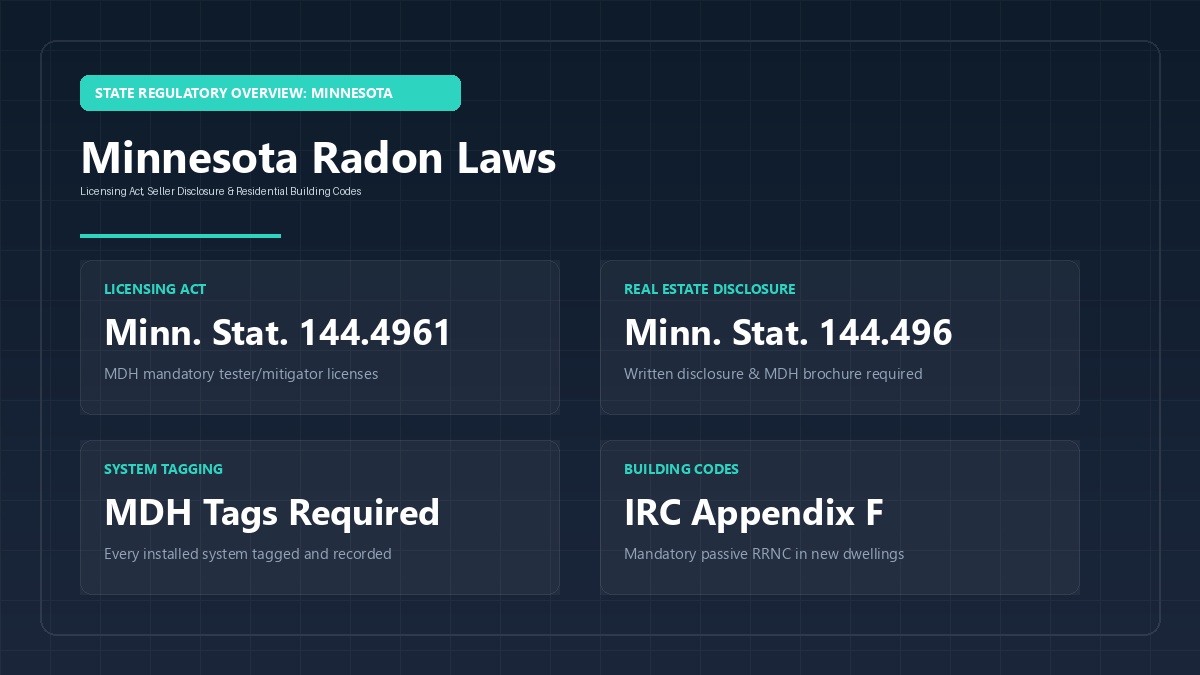
Minnesota maintains some of the most comprehensive radon protection statutes in the United States, actively regulating radon across residential sales, professional licensing, and building construction. Under the Minnesota Radon Awareness Act, home sellers must deliver a formal written disclosure, statutory warning, and state educational guide before signing purchase contracts. Since 2019, under the Minnesota Radon Licensing Act, anyone performing radon measurement, mitigation, or analysis for compensation must hold an active license from the Minnesota Department of Health (MDH) and affix a serialized state tag to every mitigation system. Furthermore, passive radon-resistant new construction is mandatory statewide for all new residential construction.
Testing Requirements
Radon testing is voluntary for private single-family homeowners and residential landlords in Minnesota; there is no statutory mandate compelling an existing homeowner or rental property owner to test indoor air. However, under Minnesota Statutes § 123B.571, school districts that receive Long-Term Facilities Maintenance revenue and choose to test for radon must adhere strictly to MDH testing protocols, test every public school building at least once every five years, report all measurement data to MDH, and present test results at a public school board meeting. Testing in private commercial buildings remains voluntary under state law.
Real-Estate Disclosure
Real estate transactions in Minnesota are governed by the Minnesota Radon Awareness Act (Minn. Stat. § 144.496). Prior to signing a purchase agreement, the seller must deliver a formal written disclosure stating: whether a radon test has occurred; the most recent test concentrations; a description of any installed radon mitigation system; and whether an active mitigation system is operational. The seller must also provide the buyer with a mandatory statutory Radon Warning Statement and the MDH brochure titled Radon in Real Estate Transactions. Under § 144.496, Subd. 7, a buyer who is not provided the required disclosure and suffers damages may bring a civil action against the seller within two years of closing.
Mitigator & Tester Certification
Under the Minnesota Radon Licensing Act (Minn. Stat. § 144.4961) and Minnesota Rules Chapter 4620, it is unlawful to test for, mitigate, or analyze radon for pay without an active credential issued by MDH. The state licenses four categories: Radon Measurement Professionals, Radon Mitigation Professionals, Radon Mitigation Companies, and Radon Analysis Laboratories. In addition to rigorous initial training, exams, and annual continuing education, licensed mitigators are required to purchase and attach an official, serialized MDH system tag to each active or passive radon reduction system installed, repaired, or inspected in Minnesota, and report system installations monthly to MDH.
New Construction
Minnesota enforces mandatory passive radon-resistant new construction (RRNC) statewide under Minnesota Statutes § 326B.106 and Minnesota Rules Chapter 1309, which incorporates Appendix F of the International Residential Code (IRC). Every newly constructed single-family home, duplex, and townhouse built in Minnesota must feature passive radon control methods. Required elements include a continuous gas-permeable sub-slab layer (clean aggregate or sand), a minimum 6-mil polyethylene soil gas retarder with taped seams, sealed foundation joints and sump basins, and a dedicated, rough-in vertical vent pipe extending through the roof to permit easy fan activation if elevated radon levels are detected post-occupancy.
Radon Zones & the Action Level
Minnesota is categorized by the EPA as having exceptionally high geological radon potential: 72 of Minnesota’s 87 counties are designated as EPA Zone 1 (High Potential), where average indoor screening levels are predicted to exceed 4.0 pCi/L. The remaining 15 counties (predominantly along the northeastern Arrowhead region) are designated as Zone 2 (Moderate Potential, 2.0 to 4.0 pCi/L). There are zero Zone 3 counties in Minnesota. MDH enforces the EPA national action level of 4.0 pCi/L, strongly advising installation of an active mitigation system whenever living spaces test at or above 4.0 pCi/L, and recommending consideration of mitigation between 2.0 and 4.0 pCi/L. For detailed regional geological maps, see our EPA Radon Zone Map guide.
The State’s Radon Program
The official state radon authority is the Minnesota Department of Health (MDH) Indoor Air Unit — Radon Program (health.state.mn.us/communities/environment/air/radon/). Minnesota residents can purchase discounted test kits directly through MDH partnerships with local public health agencies or commercial laboratory vendors linked on the MDH website. Property owners can also access the official, real-time public registry of MDH-licensed radon measurement and mitigation professionals.
Sources & Limits
This regulatory summary is provided for informational purposes only and does not constitute formal legal, building code, or environmental engineering advice. Requirements are subject to administrative rulemaking and legislative updates. Consult the Minnesota Department of Health or a qualified real estate attorney for site-specific compliance.
Primary Official Sources: Minnesota Department of Health (MDH) Indoor Air Unit; Minnesota Statutes §§ 144.496, 144.4961, 326B.106, 123B.571; Minnesota Rules Chapter 4620; U.S. Environmental Protection Agency (Map of Radon Zones for Minnesota).
Return to our national guide on Radon Regulations in the United States or inspect national county risk rankings on the EPA Radon Zone Map.
Get The Signal
What we actually ran, what it measured, and what it means for a restoration shop — every week, including the flops.
Leave a Reply