• Long-form Position
• Practitioner-grade
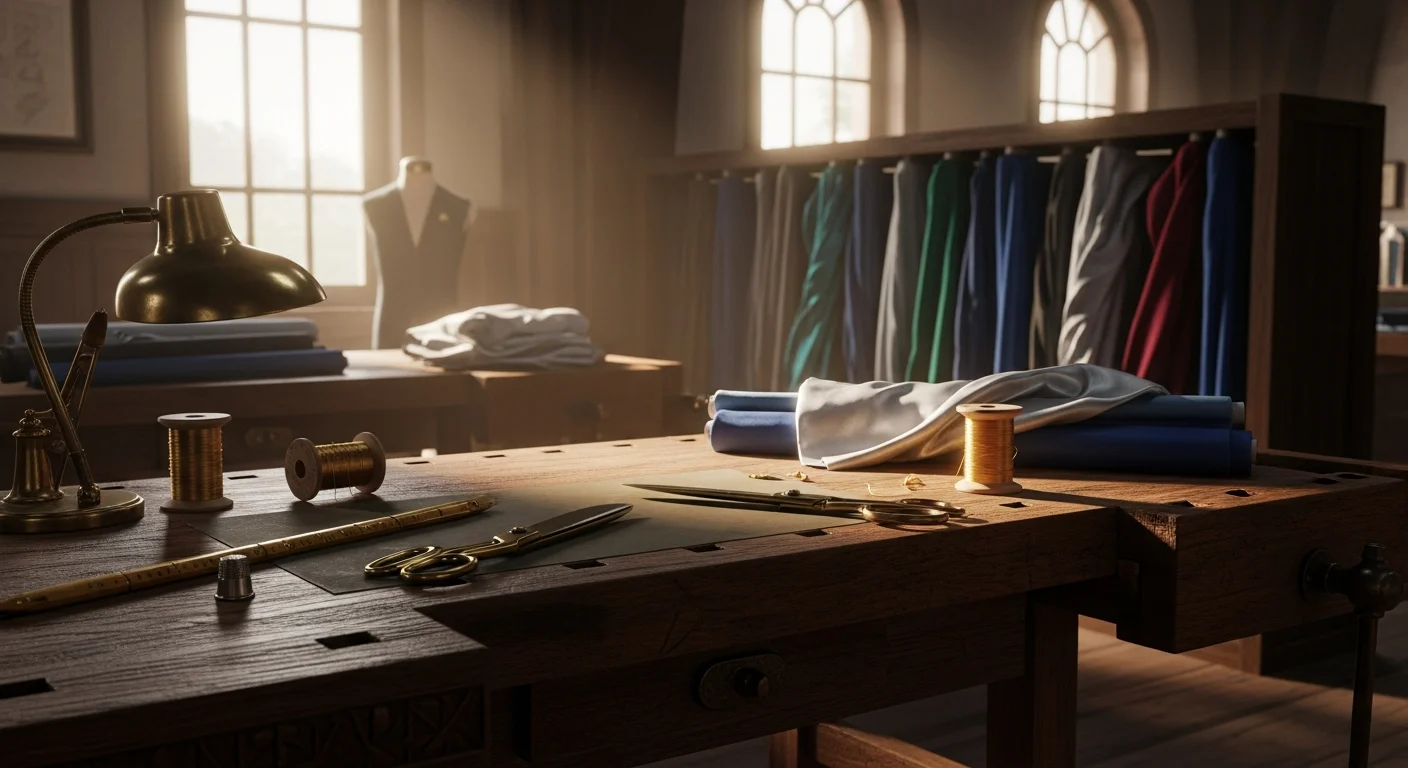
There’s a moment in every fitting room that has nothing to do with fabric.
The tailor doesn’t ask what color you want. Not yet. First, they ask where you’re going. Who will be in the room. Whether you’ll be standing all night or seated at a table. Whether this is the kind of event where people remember what you wore — or the kind where they remember what you said.
The clothes come last. The understanding comes first.
I’ve been building AI systems for businesses for the past two years, and I’ve started to realize that what I actually do has very little to do with technology. The job that’s emerging — the one that doesn’t have a name yet — looks a lot more like a Savile Row fitting than a software deployment.
Get The Signal
What we actually ran, what it measured, and what it means for a restoration shop — every week, including the flops.
The Wardrobe Problem

Every business I work with has the same issue. They have too many tools and not enough fit. They bought the SaaS equivalent of a department store rack — a CRM here, a project manager there, an AI chatbot bolted onto the side like a pocket square that doesn’t match anything. It all sort of works. None of it works together. And nobody remembers why they bought half of it.
This is the wardrobe problem. It’s not that the clothes are bad. It’s that nobody measured you before you started shopping.
The technology industry has spent twenty years selling off-the-rack solutions to bespoke problems. And for a while, that was fine. The problems were simple enough that a standard shirt fit most people. But AI changed the body. The shape of what a business needs from its technology is no longer standard. It’s personal, contextual, and it changes depending on the occasion.
Rings, Purses, and Evening Gowns

Think about what you wear every single day. A watch. A wedding ring. Maybe a pair of glasses. These are your constants — the things so essential to your identity that you’d feel naked without them. In a technology stack, these are your operating system-level tools. Your calendar. Your communication layer. Your identity. They travel everywhere. They never come off.
Then there’s the next layer — the things that come with you most of the time but not always. A purse. A briefcase. A jacket. These are contextual but frequent. In tech terms, these are your project management tools, your CRM, your analytics dashboard. You grab them on the way out the door for most occasions, but there are days — weekends, creative days, deep-work days — where you leave them behind on purpose.
And then there are the special occasion pieces. The gown. The tuxedo. The heritage piece you pull out once a year for the event that matters. In technology, these are the tools you build or commission for a specific moment — a product launch, a compliance audit, a market expansion. They’re expensive, they’re precise, and they only make sense in context. Wearing a ballgown to the grocery store isn’t elegant. It’s confused.
The problem with how most businesses adopt technology is that they treat every tool like a ring. They want everything always on, always accessible, always running. But a wardrobe that’s all rings is just a fistful of metal. The art is in knowing what to put on, when, and why.
The Fitting, Not the Fabric
An interior designer twenty years ago would walk into your home and ask about colors. What palette do you like? What fabrics feel good? Do you want modern or traditional?
The great interior designers today don’t start there. They ask about your mornings. How do you move through the space when you first wake up? Where does the light fall at 7 AM? Do you cook alone or is the kitchen a gathering point? They’re not designing a room. They’re designing a life that happens to take place in a room.
The same shift is happening in technology. The old question was: “What software do you need?” The new question is: “What does your Tuesday look like?”
When I sit down with a business now, I don’t start with their tech stack. I start with their week. I want to know what happens on Monday morning. I want to know where decisions get stuck. I want to know which person in the company holds knowledge that nobody else can access — the twenty-year veteran whose expertise lives entirely in their head, undocumented, irreplaceable, and one retirement away from gone.
That conversation is a fitting. And the technology that comes out of it isn’t a product recommendation. It’s a pattern, cut to measure.
The Three Questions That Replace the Sales Demo
In a traditional technology sale, someone shows you what their product can do and you decide if it fits your problem. The demo is king. The features are the pitch.
In the new model — the one I believe is emerging whether the industry names it or not — the demo is irrelevant until three questions are answered.
First: Where does this live? Is this a mobile-first tool that needs to work at a job site with one bar of signal? Is it a cloud platform that your whole team accesses from a desktop? Is it an edge device that processes locally and never touches the internet? Is it a plugin that extends something you already use every day? The same capability — say, document analysis — looks completely different as a phone app versus a desktop platform versus an API that lives inside your existing project manager. The capability isn’t the product. The deployment is the product.
Second: How often do you wear it? Some tools need to be on 24/7, like a ring. Some need to show up three times a week, like a work bag. Some need to exist in reserve for quarterly events. The licensing model, the integration depth, the training investment — all of it should flex based on frequency. But the industry sells everything as a subscription. Monthly. Always on. Always billing. A tailor would never sell you a tuxedo rental for every day of the year just because you wore one once.
Third: What’s already in the closet? Nobody builds a wardrobe from scratch. You already own things. Some of them are great. Some of them are taking up space. Some of them could be altered to work better than anything new you’d buy. The best fitting starts with an inventory. Not of what’s available on the market — but of what’s already hanging in your closet, and what it could become with the right adjustments.
The Accessory That Travels Everywhere
There’s a reason the smartwatch became a phenomenon and the smart refrigerator didn’t. The watch goes with you. It touches every part of your day. It’s the accessory layer — lightweight, personal, always present.
In the AI era, the “ring” layer of technology is the most interesting design problem. What is the one intelligent capability that should follow your business everywhere? Not the big platform. Not the quarterly tool. The thing that’s always on your hand.
For some businesses, it’s a knowledge layer — an AI that knows your entire operation and can answer any question from any employee at any time. For others, it’s a communication filter — something that triages, summarizes, and routes information so the right people see the right things without drowning. For others still, it’s a data lens — a persistent analytical layer that watches the numbers and taps you on the wrist when something changes.
The point is: it’s different for every business. And figuring out what it is — that’s the fitting.
Why This Job Doesn’t Exist Yet (But Already Does)
I don’t have a title for what I do that would make sense on a business card. “AI consultant” sounds like I’m selling chatbots. “Digital transformation specialist” sounds like 2019. “Technology advisor” sounds like I’m going to recommend Salesforce and leave.
What I actually do is closer to what a wardrobe stylist does for someone who just got a new job in a new city and doesn’t know the dress code yet. I look at your life — your actual operational life, not your aspirational one — and I figure out what you need to wear to show up correctly for every situation you’re going to face.
Sometimes that means building something custom. Sometimes it means taking something off the rack and tailoring it. Sometimes it means telling you that the thing you already own is perfect and you should stop shopping.
The technology industry doesn’t love that last one. There’s no margin in telling someone their existing tools are fine. But a good tailor will tell you when the suit you bought ten years ago just needs new buttons — not a replacement. That honesty is what makes them worth coming back to.
The Bespoke Economy

Here’s what I think is happening, and I think it’s bigger than AI.
We’re moving from a product economy to a fitting economy. The tools themselves are becoming commodities. There are a hundred AI platforms that can summarize a document. There are fifty that can generate an image. There are twenty that can write code. The capability layer is flattening. What isn’t flat — what can’t be commoditized — is the understanding of which tool, configured which way, deployed where, for whom, and why.
That’s the fitting. And the people who get good at it are going to build the next generation of service businesses. Not agencies. Not consultancies. Not IT departments. Something new. Something that looks more like an atelier than an office.
The interior designer of the future won’t ask about colors and fabrics. They’ll ask about history and moments. The technology advisor of the future won’t ask about features and integrations. They’ll ask about Tuesdays. And the businesses that hire them won’t be buying software. They’ll be getting measured.
The best-dressed companies won’t be the ones with the most technology. They’ll be the ones whose technology fits.
Get The Signal
What we actually ran, what it measured, and what it means for a restoration shop — every week, including the flops.
Leave a Reply