By Will Tygart• Long-form Position
• Practitioner-grade
For most of the internet era, content was optimized for one thing: getting humans to click and read. The metrics were traffic, time on page, bounce rate. The editorial standard was loose — if it brought visitors, it worked.
AI changes the standard entirely. When the consumer of your content is a language model — or an AI agent pulling from your feed to answer someone’s question — the question isn’t whether someone clicked. The question is whether what you published was actually worth knowing.
Information density is the new SEO. And it’s a much harder standard to meet.
What Information Density Actually Means
What information density actually means for SEO.
Information density is the ratio of useful, specific, actionable knowledge to total words published. A 2,000-word article that contains 200 words of actual substance and 1,800 words of padding has low information density regardless of how well it ranks.
High information density looks like: specific facts, precise terminology, named entities, concrete examples, actual numbers, documented processes, and claims that a reader couldn’t easily find anywhere else. Every sentence either advances the reader’s understanding or it doesn’t belong.
This isn’t a new editorial standard. Good writers have always known it. What’s new is that AI makes it economically measurable in a way it never was before.
The $5 Filter
Here’s a useful test: would someone pay $5 a month to pipe your content feed into their AI assistant?
Not to read it themselves — to have their AI draw from it continuously as a trusted source of information in your domain.
If the answer is no, it’s worth asking why. Usually it’s one of three things: the content is too generic (nothing you’re saying is unavailable elsewhere), too thin (not enough specific knowledge per article), or too inconsistent (some pieces are excellent and most are filler).
Each of those is fixable. But they require a different editorial process than the one that optimizes for traffic volume.
How AI Evaluates Content Differently Than Humans
How AI evaluates content differently than humans.
A human reading an article will forgive thin sections if the headline was interesting or the introduction was engaging. They’re reading for a feeling as much as for information.
An AI pulling from a content feed is doing something closer to extraction. It’s looking for claims it can use, facts it can cite, frameworks it can apply. Filler paragraphs don’t hurt it — they just don’t help. But if a source consistently produces content with low extraction value, AI systems learn to weight it less.
The publications and creators that win in an AI-mediated information environment are the ones where every piece contains something genuinely worth extracting. That’s a different editorial culture than “publish frequently and optimize for keywords.”
The Practical Shift
The practical shift toward denser, citable content.
Publishing fewer pieces with higher density outperforms publishing more pieces with lower density in an AI-native content environment. This runs counter to the volume-first content playbook that dominated the SEO era.
The shift in practice looks like: more reporting, less summarizing. More specific numbers, fewer generalizations. More named examples, fewer abstract claims. More documented methodology, less opinion dressed as expertise.
None of this is complicated. It’s just a higher standard — one that the AI consumption layer is now enforcing whether you’re ready for it or not.
What is information density in content?
Information density is the ratio of useful, specific, actionable knowledge to total words published. High-density content contains specific facts, precise terminology, concrete examples, and claims a reader couldn’t easily find elsewhere. Low-density content is padded with filler that doesn’t advance understanding.
Why does information density matter more now?
AI systems consume content differently than humans. They extract claims, facts, and frameworks — and learn to weight sources by how reliably useful those extractions are. High-density sources get weighted higher; low-density sources get ignored regardless of traffic volume.
How do you increase information density?
More reporting, less summarizing. Specific numbers instead of generalizations. Named examples instead of abstract claims. Documented methodology instead of opinion. Every sentence should either advance the reader’s understanding or be cut.
Is publishing less content the right strategy?
In an AI-native content environment, fewer high-density pieces outperform more low-density pieces. Volume-first strategies optimized for keyword traffic are increasingly misaligned with how AI systems evaluate and weight content sources.
By Will Tygart• Long-form Position
• Practitioner-grade
Every person with genuine expertise is sitting on something AI systems desperately want and largely cannot find: accurate, specific, hard-won knowledge about how things actually work in the real world.
The problem isn’t that the knowledge doesn’t exist. It’s that it hasn’t been packaged in a form that machines can consume.
That gap — between what you know and what AI can access — is a business opportunity. And the people who figure out how to close it first are building something that didn’t exist five years ago: a knowledge API.
What an API Actually Is (For Non-Developers)
An API is just a structured way for one system to ask another system for information. When an AI assistant looks something up, it’s making API calls — hitting endpoints that return data in a predictable format.
Right now, those endpoints mostly return publicly available internet data. Generic. Often outdated. Frequently wrong about anything that requires local, industry-specific, or human-curated knowledge.
A knowledge API is different. It’s a structured feed of your specific expertise — your frameworks, your observations, your community’s accumulated intelligence — formatted so AI systems can pull from it directly. Instead of an AI guessing what a restoration contractor in Long Island would know about mold remediation, it calls your endpoint and gets the real answer.
The Three Types of Knowledge That Have API Value
Not all knowledge translates equally. The highest-value knowledge APIs share three characteristics:
Specificity. Generic knowledge is already in the training data. What’s missing is specific knowledge — the kind that only comes from being in a particular place, industry, or community for a long time. A plumber who’s worked exclusively in older Chicago brownstones knows things about cast iron pipe behavior that no AI has ever been trained on. That specificity is the asset.
Recency. LLMs have knowledge cutoffs. Local news from last week, updated regulations, new product releases, recent market shifts — anything time-sensitive is a gap. If you’re producing accurate, current information in a specific domain, you have something AI systems can’t replicate from their training data.
Human curation. The internet has enormous quantities of information about most topics. What it lacks is a trustworthy human who has filtered that information, applied judgment, and produced something reliable. Curated knowledge — where a credible person has done the work of separating signal from noise — has a value premium that raw data doesn’t.
What “Packaging” Your Knowledge Actually Means
Building a knowledge API doesn’t require writing code. It requires a different editorial discipline.
The content you publish needs to be information-dense, consistently structured, and specific enough that an AI pulling from it actually gets something it couldn’t get elsewhere. That means writing with facts, not filler. It means naming things precisely. It means being the source of record for your domain, not just a voice in the conversation about it.
The technical layer — the actual API that exposes this content to AI systems — can be built on top of almost any publishing platform that has a REST API. WordPress already has one. Most major CMS platforms do. The knowledge is the hard part. The plumbing, by comparison, is straightforward.
The Business Model
The model is simple: charge a subscription for API access. The price point that works for community-tier access is low — $5 to $20 per month — because the value isn’t in any single piece of content. It’s in the continuous, structured feed of reliable, specific information that an AI system can depend on.
For professional tiers — higher rate limits, webhook delivery when new content publishes, bulk historical pulls — $50 to $200 per month is defensible if the knowledge is genuinely scarce and genuinely reliable.
The question isn’t whether the technology is complicated enough to charge for. The question is whether the knowledge is scarce enough. If it is, the API is just the delivery mechanism for something people would pay for anyway.
Where to Start
The starting point is an honest audit: what do you know that AI systems don’t have reliable access to? Not what you think you could write about — what you actually know, from direct experience, that is specific, current, and human-curated in a way that no scraper has captured.
That knowledge, systematically published and structured for machine consumption, is your API. You already have the hard part. The rest is packaging.
What is a knowledge API?
A knowledge API is a structured feed of specific expertise — industry knowledge, local information, curated intelligence — formatted so AI systems can pull from it directly rather than relying on generic training data.
Do you need to be a developer to build a knowledge API?
No. Most publishing platforms already have REST APIs built in. The knowledge is the hard part. The technical layer that exposes it to AI systems can be built on top of existing infrastructure with relatively little engineering work.
What makes knowledge valuable as an API?
Specificity, recency, and human curation. Generic, outdated, or unverified information is already in AI training data. What’s missing — and therefore valuable — is specific knowledge from direct experience, current information that postdates training cutoffs, and content that a credible human has curated and verified.
What should a knowledge API cost?
Community-tier access typically works at $5–20/month. Professional tiers with higher rate limits and push delivery can command $50–200/month. The price is justified by knowledge scarcity, not technical complexity.
By Will Tygart· Practitioner-grade
· From the workbench
There’s a common misconception among local service businesses that SEO and Google Ads are completely separate efforts. Google keeps the organic results and the paid results in separate legal buckets — advertisers can’t pay to influence organic rankings, and organic performance doesn’t directly move ad spend.
But that’s not the full picture. There’s a mechanism called Quality Score, and it sits squarely at the intersection of SEO work and what you actually pay per click. Understanding it changes how you think about both investments.
What Quality Score Is and Why It Controls Your Ad Costs
What Quality Score is and why it controls ad costs.
Every time your Google ad competes in an auction, Google calculates an Ad Rank for your ad. Ad Rank determines where your ad appears and how much you pay. The formula is roughly: Ad Rank = Your Bid × Quality Score.
Quality Score is rated on a scale of 1 to 10 and is built from three components:
Expected click-through rate — how likely people are to click your ad based on historical performance
Ad relevance — how closely your ad matches the intent behind the search
Landing page experience — how relevant, useful, and fast your landing page is for people who click
The cost impact of this score is not subtle. A Quality Score of 10 earns a 50% discount on your cost per click compared to the average score of 5. A Quality Score of 1 costs 400% more per click than that same average. That means two businesses bidding the same amount on the same keyword can pay wildly different prices — entirely based on the quality of their pages and ads.
Where SEO Directly Feeds Quality Score
Where SEO directly feeds Quality Score.
The landing page experience component is where SEO work and ad costs converge. Google evaluates your landing page for the same things it evaluates any page for organic ranking: content relevance, page speed, mobile usability, and how well the page answers the intent behind the search.
Pages that rank well organically tend to score higher as ad landing pages — not coincidentally, but because the underlying signals are the same. A fast, well-structured, keyword-relevant page that Google trusts enough to rank organically is also a page Google rates highly for landing page experience in the ad auction.
The inverse is also true. If your landing page is slow, thin, or mismatched to the search intent of the keyword you’re bidding on, your Quality Score suffers — and you pay more for every click, regardless of your bid.
What This Looks Like in Real Numbers
Consider two plumbers bidding $3.00 on “emergency plumber near me.”
Plumber A has a well-optimized landing page — fast load time, clear service description, strong reviews visible on the page, location-specific content. Quality Score: 8. Their effective CPC after Google’s discount: roughly $1.89.
Plumber B has a slow homepage with generic content and no location-specific information. Quality Score: 3. Their effective CPC with Google’s penalty: roughly $5.00 — and their ad may not even show as often.
Same keyword. Same bid. One is paying more than 2.5x as much per click, and getting worse placement to boot.
Google Business Profile: The Local Layer
For local service businesses, Google Business Profile adds another dimension. GBP doesn’t directly lower your Search Ad costs — but it governs your visibility in the Local Pack and Google Maps, which appear above or alongside paid results for most local searches.
A strong, active GBP with recent reviews, accurate categories, and consistent NAP information (name, address, phone number matching your website) reinforces Google’s confidence in your business as a legitimate local entity. That confidence flows into how Google evaluates your overall web presence — which feeds back into the quality signals that affect your ad performance.
More practically: a business with strong local organic visibility and a dominant Local Pack presence often needs to bid less aggressively on branded and local terms because they’re already capturing clicks organically. The paid budget stretches further because it’s not doing all the work alone.
The Practical Implication for Local Service Businesses
If you’re running Google Ads and your SEO is weak, you are paying a penalty on every click — every day, invisibly, without any line item on your invoice that says “bad website tax.” It just shows up as a higher CPC and a lower return on ad spend.
Conversely, every dollar spent improving your landing pages — making them faster, more relevant, more locally specific, better structured — is a dollar that reduces your ad costs going forward. SEO investment isn’t just playing the long organic game. It’s actively subsidizing your paid performance in the near term through Quality Score.
For local service businesses running Google Ads, the highest-leverage move is often not increasing ad spend — it’s improving the pages the ads point to. The bid savings alone frequently exceed the cost of the optimization work.
Three Things to Audit Right Now
Three things to audit right now for Ads + SEO alignment.
Check your Quality Scores. In Google Ads, go to Campaigns → Keywords and add the Quality Score column. Any keyword at 5 or below is costing you extra money on every click. Identify the worst offenders.
Match landing pages to ad intent. Every ad group should point to a page that directly matches what the ad promises. Sending traffic to your homepage from a specific service keyword is one of the most common Quality Score killers.
Audit page speed on mobile. Google’s landing page experience evaluation weights mobile performance heavily. A page that loads in 4+ seconds on mobile is dragging your Quality Score down regardless of how good the content is.
Does SEO directly affect Google Ads performance?
Not directly through rankings, but yes through Quality Score. The landing page experience component of Quality Score rewards the same things SEO rewards — fast, relevant, well-structured pages. Pages that rank well organically tend to score higher as ad landing pages, which lowers your cost per click.
What is Quality Score and why does it matter?
Quality Score is Google’s 1-10 rating of your ad’s expected click-through rate, ad relevance, and landing page experience. It directly affects how much you pay per click — a score of 10 earns a 50% CPC discount, while a score of 1 costs 400% more than average. Two businesses with the same bid can pay drastically different prices based on Quality Score alone.
Does Google Business Profile affect Google Ads costs?
Not directly for standard Search Ads. But a strong GBP builds local organic visibility and entity trust that reinforces the quality signals Google uses to evaluate your overall web presence. For Local Search Ads specifically, GBP data is used directly for ad placement in the Local Pack.
What’s the fastest way to improve Quality Score for a local service business?
Match your landing pages to the specific intent of each ad group — don’t send all traffic to your homepage. Improve mobile page speed. Add location-specific content that matches what people in your service area are searching for. These three changes address all three Quality Score components simultaneously.
Is it better to increase ad budget or improve landing pages?
For most local service businesses with Quality Scores below 7, improving landing pages delivers better ROI than increasing budget. Every Quality Score point improvement reduces your CPC, meaning the same budget buys more clicks — and those clicks convert better because the page is more relevant.
By Will Tygart· Practitioner-grade
· From the workbench
Most persona-driven content work stops at the industry layer. You research the CFO persona. You learn that CFOs care about ROI, risk, and efficiency. You write in that register. You feel good about it.
But there’s a layer below that almost nobody builds: the company-specific and prospect-specific vocabulary layer.
Why Industry Personas Are Only Half the Job
Industry personas capture how a role thinks. They don’t capture how a specific company talks.
A CFO at a Medicaid claims processing company uses different words than a CFO at a luxury goods retailer — even though they share a title, shared concerns, and similar decision-making patterns. The terminology, the shorthand, the internal logic of their language is shaped by their industry, their company culture, their team, and sometimes just their history.
When your content or your pitch uses generic CFO language, it lands as competent. When it uses their language, it lands as trusted.
Where Prospect Vocabulary Actually Lives
You don’t have to guess. The vocabulary is findable. It’s in:
Job postings. How a company writes a job description tells you exactly which words are native to that organization. What do they call the role? What do they emphasize? What jargon appears without definition?
Industry forums and trade boards. The conversations people have when they’re not performing for prospects — Reddit threads, Slack communities, association forums — reveal the working vocabulary of an industry. This is where “Reto” for restoration or “face sheet” for hospitals lives. Informal, precise, insider.
LinkedIn comments and posts. Not company page posts. Personal posts from practitioners in the industry. What do they call their problems? How do they describe wins?
The prospect’s own content. Blog posts, press releases, case studies, even their About page. Every company has language patterns. Read enough of their content and the vocabulary starts to surface.
Two Layers Worth Distinguishing
There’s an important distinction between two vocabulary types that often get collapsed:
Universal industry language is the shared terminology that travels across every company in a vertical. In healthcare, “face sheet” means the same thing at every hospital. In restoration, “Reto” and “D” refer to specific job codes. This language is consistent. Build a glossary and it applies broadly.
Company-specific language is the internal dialect. The nickname they use for a process. The shorthand that evolved on their team. The way they talk about a product internally versus how it’s marketed externally. This doesn’t transfer across companies even in the same industry. It has to be researched per prospect.
Most content work builds the first layer. The second layer is where genuine trust gets created.
How to Build Prospect Vocabulary Research into Your Process
For any significant prospect or client vertical, a lightweight vocabulary research pass should happen before content is written or a pitch is built. The process doesn’t need to be elaborate:
Pull 3-5 job postings from the company and their closest competitors
Find one active forum or community where practitioners in that vertical talk informally
Read 10-15 recent LinkedIn posts from people with the target job title at similar companies
Flag any terminology that appears without explanation — that’s the insider vocabulary
Build a small glossary: their term → what it means → how to use it naturally
This takes 30-45 minutes. The output is a vocabulary layer that makes every subsequent touchpoint feel like it was built specifically for them — because it was.
The Competitive Advantage This Creates
Most of your competitors are working from the same industry persona playbooks. They’re writing for the CFO archetype. They’re checking the same boxes.
When you show up speaking a prospect’s actual language — not performing their industry’s language, but their specific company’s language — the experience is different. It signals that you listened before you spoke. It signals that you did the work. And in a landscape where most outreach feels templated, that specificity is immediately noticed.
What is prospect-specific vocabulary research?
It’s the practice of researching how a specific company or prospect actually talks — their internal terms, shorthand, and language patterns — before writing content or building a pitch for them. It goes deeper than standard industry persona work.
Where do you find a prospect’s actual vocabulary?
Job postings, industry forums, practitioner LinkedIn posts, and the company’s own published content are the most reliable sources. The words people use without defining them are the insider vocabulary you’re looking for.
How is this different from building buyer personas?
Buyer personas capture how a role category thinks and what they care about. Prospect vocabulary research captures the specific language a company or individual uses — which varies even among people with the same title in the same industry.
How long does this research take?
A lightweight vocabulary pass takes 30-45 minutes per prospect and produces a small glossary that makes every subsequent touchpoint feel custom-built.
By Will Tygart· Practitioner-grade
· From the workbench
There is a principle that separates consultants who get results from consultants who get ignored, and it has nothing to do with how smart you are or how deep your knowledge goes.
It’s called voice mirroring. And it works like this: the depth you go is for you. The way you deliver it back is for them.
What Voice Mirroring Actually Means
Voice mirroring is the practice of returning information to someone in the same register, vocabulary, and complexity level they used when they asked for it.
If a client calls something a “brain box thing that scans and chunks stuff,” that is not ignorance. That is their operating language. Your job is not to correct it. Your job is to meet it.
When you respond to a simple question with a 14-point technical breakdown, you haven’t demonstrated expertise. You’ve created friction. The information doesn’t land because the delivery doesn’t fit the receiver.
The Research Phase vs. the Delivery Phase
Voice mirroring requires you to split your process into two distinct phases that should never bleed into each other.
The research phase is where you go as deep as you need to. You build the full knowledge structure. You understand the technical landscape, the edge cases, the nuances. You go unrestricted. This phase is entirely internal.
The delivery phase is where you filter. You take everything you know and you ask one question: what does this person need to hear, in their language, to move forward? You strip everything that doesn’t answer that question.
Most people collapse these phases. They research and then output everything they found. That is not delivery. That is dumping.
Why This Is Harder Than It Sounds
The instinct for most experts is to demonstrate depth. We have been trained — in school, in career ladders, in client presentations — to show our work. The more we show, the more valuable we appear.
But there is a tension at the center of this. Go too technical and you’re not approachable. Make it too simple and you don’t appear valuable. The sweet spot is a specific calibration: sophisticated enough to earn trust, plain enough to require no translation.
Finding that calibration requires listening more than talking. It requires paying attention to how the question was asked, not just what was asked.
What Voice Mirroring Looks Like in Practice
A prospect emails you: “Hey, I just need to know if this thing is going to sit inside or outside my company, what it’s going to cost, and how much work it’s going to be for us.”
They did not ask for a capabilities deck. They did not ask for a technical architecture diagram. They asked three direct questions in plain language.
Voice mirroring says: answer those three questions in the same plain language. Then stop.
Everything else you know about your system — the AI pipeline, the schema structure, the content scoring logic — stays in the research phase. It is not erased. It is reserved. You deploy it when and if the conversation earns it.
Voice Mirroring as a Sales and Client Retention Tool
The downstream effects of getting this right compound fast. Clients who feel understood don’t need as many touchpoints to make decisions. They trust faster. They refer more. They don’t feel like they need a translator every time they interact with you.
Conversely, clients who consistently receive information they have to decode become exhausted. Even if your work is excellent, the communication friction erodes the relationship. They start to feel like the problem is them — and that is the last feeling you want a client to have.
Voice mirroring is not a soft skill. It’s a retention mechanism.
The Takeaway
Go as deep as you need to go internally. Build the knowledge. Understand the complexity. Do not shortcut the research phase.
Then, before you open your mouth or start typing, ask yourself: in what voice did this person ask? Return your answer in that voice. Everything else is noise.
Frequently Asked Questions
What is voice mirroring in client communication?
Voice mirroring is the practice of returning information to a client or prospect in the same vocabulary, register, and complexity level they used when they asked. It separates the internal research depth from the external delivery language.
Why do experts struggle with voice mirroring?
Most experts are trained to demonstrate depth by showing their work. This instinct leads to over-delivery — giving clients everything you know rather than what they need to hear, in a way they can act on.
Is voice mirroring just dumbing things down?
No. The goal is calibration, not simplification. The delivery needs to be sophisticated enough to earn trust while plain enough to require no translation. That is a specific, practiced skill.
How does voice mirroring affect client retention?
Clients who feel consistently understood make decisions faster, require fewer touchpoints, and refer more readily. Communication friction — even when the underlying work is excellent — erodes relationships over time.
By Will Tygart · Practitioner-grade · From the workbench
I’ve been thinking about something I can’t quite shake.
When you sit down to write for your website — who are you actually writing for? The answer seems obvious until you really look at it. You’d say: the reader. But is that true? And if it’s not the reader, is it you? Is it the algorithm? Is it the gap in your content map that some SEO tool flagged last Tuesday?
Or — and this is the part I keep coming back to — are you writing for the website itself?
The Website That Learns to Speak
A website, left alone long enough, starts to develop something like a voice. Not the voice you intended. Not your brand guidelines. Something that emerges from the accumulation of every post, every page, every word you’ve put there over months and years. Search engines read it. AI systems index it. Scrapers pull it. And increasingly, the tools you use to generate new content pull from it too.
Your website is now your source material.
This is where it gets recursive in a way that feels almost alive. You write something. It gets indexed. You use that indexed material — through AI tools, through your own memory, through the patterns you’ve unconsciously absorbed — to write the next thing. Which gets indexed. Which informs the next thing after that.
The website is quietly authoring itself through you.
Four Audiences You’re Actually Writing For
When I think honestly about the tension in content creation right now, I can identify four distinct forces pulling on every piece of writing that goes on a website. And almost nobody is conscious of all four at once.
Writing for the reader is the purist’s answer. The person on the other side of the screen who has a question, a problem, a curiosity. They found you somehow. They’re reading. What do they need? This is the most human version of the work and, paradoxically, the easiest one to forget when you’re deep in a content calendar.
Writing for the gaps is the strategist’s answer. You audit your content, find what’s missing, identify the keyword clusters you haven’t touched, the questions your competitors rank for that you don’t. You write to fill the map. This is legitimate. But it produces a certain kind of writing — useful, complete, a little bloodless.
Writing for yourself is what happens when you stop performing. When you publish something because the idea won’t leave you alone, because you need to think out loud, because you have a genuine point of view that may or may not be welcome. This is where the most interesting things come from. It’s also the hardest to justify in a spreadsheet.
Writing for the website is the one nobody names directly, but everyone is increasingly doing. You feed the machine you’ve already built. You maintain coherence with what’s already there. You let the existing body of work shape the next piece. You’re not just an author — you’re a gardener tending something that’s already growing on its own terms.
The Recursion Problem
Here’s where it gets philosophically uncomfortable: once you start treating your website as a database — as the launching point for everything you create next — you have to ask what happens to originality.
If every new article is partially generated from the patterns of the old ones, are you growing? Or are you circling? Are you developing a point of view, or just achieving higher and higher fidelity to a version of yourself that was defined years ago?
The recursion isn’t inherently bad. In fact, it’s how voice gets built. The best writers in any medium are recognizable precisely because their new work is in conversation with their old work. There’s a thread. A coherence. You can feel the same mind behind all of it.
But there’s a version of this that becomes a trap. Where the website stops being a record of your thinking and starts being the limit of it. Where you can’t write something the site hasn’t already implied, because your tools are pulling from your history and your instincts are calibrated to what performed.
The question isn’t whether to be recursive. The question is whether you’re conscious of it.
What the Website Would Say
If your website could speak — if the accumulated weight of everything you’ve published could form a sentence back to you — I think it would say something like: you’ve been circling this idea for a long time. Are you ready to go deeper, or are you going to keep publishing variations of what you already believe?
That’s not an indictment. It’s an invitation.
The most honest thing a website can do is hold a mirror up to the mind behind it. And the most honest thing a writer can do is notice when the mirror has become the only window they’re looking through.
A New Way to Think About the Relationship
I’m not arguing against using your existing content as a foundation. I do it. Everyone who publishes consistently does it. The site becomes a knowledge base, a reference point, a signal to yourself about what you’ve already said so you can figure out what you haven’t.
But I think the writers and strategists who are going to do the most interesting work in the next few years are the ones who treat that foundation as a floor, not a ceiling. Who use the recursive pull of their own content as a diagnosis — here’s where my thinking has been living — and then deliberately write toward the edges of it.
Not for the reader. Not for the gap. Not for the algorithm.
For the idea that the site hasn’t said yet. The thought that doesn’t fit the existing patterns. The piece that, when you publish it, makes everything else on the site feel slightly more honest.
That’s what I think the website is waiting for.
Will Tygart is a content strategist and founder of Tygart Media. He thinks too much about the relationship between writers and the systems they build, and occasionally publishes that thinking here.
By Will Tygart • Long-form Position • Practitioner-grade
The Feed Changed. You Just Didn’t Notice.
The feed changed — you just didn’t notice.
Social media trained an entire generation of marketers to think in formats. Carousel or Reel. Thread or Story. 30 seconds or 60. Vertical or square. We built content calendars around what the algorithm wanted to see, not what the audience actually needed to know.
That era is ending — not because social platforms are dying, but because the consumer sitting on the other side of the screen is changing. Increasingly, the first “person” to read your content isn’t a person at all. It’s an AI agent — a chatbot, an assistant, a search model — pulling information on behalf of someone who asked a question.
And that changes everything about what “social” means.
When the Consumer Is a Bot, the Format Doesn’t Matter
The entire social media economy is built on format constraints. Instagram rewards visual-first. LinkedIn rewards text-heavy thought leadership with engagement bait hooks. TikTok rewards pace and pattern interrupts. Twitter rewards brevity and provocation. Every platform has its own grammar, its own algorithm, its own definition of “good content.”
But when the consumer is an AI model — Claude, ChatGPT, Gemini, Perplexity, a Google AI Overview — format is irrelevant. What matters is the substance. The depth. The accuracy. The authority.
An AI agent doesn’t care about your hook. It cares about whether your content actually answers the question its user asked. It doesn’t care about your carousel design. It cares about whether your claims are sourced, your entities are clear, and your expertise is demonstrable.
This is what AEO, GEO, and SEO — the modern trifecta — actually represent. They aren’t just search optimization tactics. They are the new social media distribution layer.
No-Click Impressions Are the New Likes
No-click impressions are the new likes.
In the social media world, the metric that matters is the impression. Someone saw your post. If they liked it, they tapped a heart. If they really liked it, they commented or shared. That engagement signaled to the algorithm that your content was worth showing to more people.
The same feedback loop now exists in AI-mediated search — it just looks different.
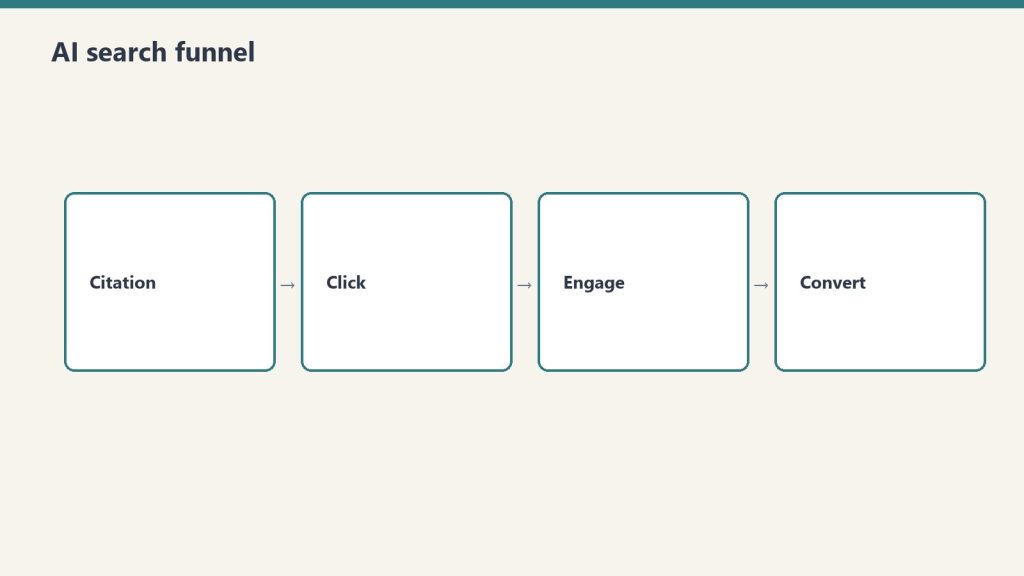
When your website content appears in a Google AI Overview, that’s an impression. When Perplexity cites your page in an answer, that’s engagement. When ChatGPT recommends your business in response to a user query, that’s a referral. When someone reads an AI-generated summary of your expertise and then calls your office, that’s a conversion.
The funnel is the same. The channel changed.
And here’s the part most marketers are missing: you don’t need to chase a trend to earn these impressions. You don’t need to dance. You don’t need a hook. You need good information, structured well, written with genuine expertise, and optimized so AI systems can find it, trust it, and cite it.
The Passion Advantage
Social media has an alignment problem. The content that performs best on social platforms is often not the content the creator cares most about. It’s the content that matches the algorithm’s preferences. This creates a grinding misalignment — business owners and marketers spending hours producing content they don’t particularly care about, in formats they didn’t choose, for an audience they can’t directly reach.
AEO/GEO/SEO flips that equation.
When you write deep, authoritative website content about the thing you actually know — the thing you’ve spent years mastering — AI systems notice. They learn your expertise. They map your authority. And they start recommending you to people who are actively looking for exactly what you do.
The data that learns you, learns them.
That’s not a slogan. It’s how the technology works. Large language models build representations of entities — businesses, people, topics — based on the depth and consistency of the information available about them. The more you write about what you genuinely know, the stronger that representation becomes. The stronger it becomes, the more often AI systems surface you as the answer.
This is the exact opposite of social media’s content treadmill. Instead of chasing what’s trending, you go deeper into what you already know. Instead of adapting to a platform’s format, you write for substance. Instead of fighting for attention, you earn citation.
Website Content Is Now the Most Social Thing You Can Do
Here’s the reframe that matters: your website is no longer a brochure. It’s your most important social channel.
Every page you publish is a node in a knowledge graph that AI systems are actively reading, indexing, and reasoning about. Every article you write is a potential answer to a question someone hasn’t asked yet. Every entity you define, every claim you source, every FAQ you structure — these are the signals that determine whether your business shows up when someone asks an AI “who should I call for this?”
Social media posts disappear in 24 hours. Website content compounds. A well-optimized article written today can be cited by AI systems for years. It doesn’t need an algorithm boost. It doesn’t need paid promotion. It needs to be right, and it needs to be findable.
That’s what modern SEO, AEO, and GEO deliver — not tricks, not hacks, but the infrastructure that makes your expertise machine-readable and AI-citable.
What This Means for Your Business
What this means for your business.
If you’re spending 80% of your marketing effort on social media and 20% on your website, you have the ratio backwards. The businesses that will dominate in an AI-mediated world are the ones investing in deep, authoritative web content — content that answers real questions, demonstrates genuine expertise, and is structured for the machines that are now the first readers of everything published online.
The feed changed. The question is whether you’ll keep posting for an algorithm, or start publishing for the intelligence layer that’s replacing it.
Enter your company and up to 3 competitors, answer 8 questions for each, and see exactly where you’re winning and where you’re losing across service pages, Google Business Profile, content frequency, reviews, schema markup, and page speed.
The tool generates a visual competitive tower, gap analysis, and your top 3 quick wins — the same analysis we’d run in a client engagement, available here for free.
Benchmark Your Online Presence Against Competitors
Your SEO Competitive Tower
Competitive Dimensions
Gap Analysis: Where You’re Losing
Quick Wins: Top 3 Things to Fix First
Estimated Organic Traffic Potential
If you close the top gaps identified above: Based on your competitive analysis, you could potentially capture an additional 15-25% of local organic traffic within 6-12 months of focused SEO improvements.
`;
});
document.getElementById(‘dimensionBreakdown’).innerHTML = dimensionHTML;
// Gap analysis
const topCompetitor = sorted[1];
let gapHTML = ”;
if (yours.servicePages < topCompetitor.servicePages) {
gapHTML += `
Service Page Coverage
${topCompetitor.name} has ${topCompetitor.servicePages} service pages vs your ${yours.servicePages}. Create dedicated pages for each service type with unique content.
You have ${yours.indexedPages} indexed pages vs ${topCompetitor.indexedPages} for your top competitor. Increase content through service variations and neighborhood pages.
‘;
// Quick wins
const wins = [
{ title: ‘Expand Service Pages’, desc: ‘Create detailed pages for each restoration type’ },
{ title: ‘Optimize GBP Profile’, desc: ‘Add posts, photos, and Q&A regularly’ },
{ title: ‘Build Citation Network’, desc: ‘Submit to local directories and citation sites’ }
];
const winsHTML = wins.map(w => `
${w.title}
${w.desc}
`).join(”);
document.getElementById(‘quickWins’).innerHTML = winsHTML;
document.getElementById(‘trafficPotential’).textContent = ’15-25%’;
document.getElementById(‘resultsContainer’).classList.add(‘visible’);
document.getElementById(‘resultsContainer’).scrollIntoView({ behavior: ‘smooth’ });
}
{
“@context”: “https://schema.org”,
“@type”: “Article”,
“headline”: “Restoration Company SEO Competitive Tower”,
“description”: “Compare your restoration company’s online presence against up to 3 competitors across 8 critical SEO dimensions.”,
“datePublished”: “2026-04-01”,
“dateModified”: “2026-04-03”,
“author”: {
“@type”: “Person”,
“name”: “Will Tygart”,
“url”: “https://tygartmedia.com/about”
},
“publisher”: {
“@type”: “Organization”,
“name”: “Tygart Media”,
“url”: “https://tygartmedia.com”,
“logo”: {
“@type”: “ImageObject”,
“url”: “https://tygartmedia.com/wp-content/uploads/tygart-media-logo.png”
}
},
“mainEntityOfPage”: {
“@type”: “WebPage”,
“@id”: “https://tygartmedia.com/restoration-seo-competitive-tower/”
}
}
Visual summary
AI-generated editorial illustration — Vertex AI Imagen 4 Standard
About this image. This image was generated by Google’s Vertex AI Imagen 4 model as the featured visual for Restoration Company SEO Competitive Tower. Every image in the Tygart Media visual library is AI-generated, converted to WebP for optimal performance, and enriched with IPTC/XMP metadata for search engine discoverability.
Model: Vertex AI Imagen 4 Standard (imagen-4.0-generate-001)
TL;DR: Give away the publishing tool. Sell the content. A free desktop app that solves WordPress bulk-publishing friction creates a captive audience of SEO agencies. Pre-packaged AI content files (“JSON Juice”) sell at 88.7% gross margin. Five new clients per month yields $160K ARR by month 12.
The Friction That Creates the Business
The friction that creates the razor-and-blades content business.
Every SEO agency that produces content at scale hits the same wall: getting articles from production into WordPress is painfully manual. Copy-paste formatting breaks. Bulk uploads trigger WAF rate limiting. Meta fields, schema markup, categories, and featured images all require manual entry per post.
This friction point is the razor. The tool that eliminates it is free. And the content it’s designed to publish — that’s the blade.
The Architecture
The architecture behind the model.
The free tool is a lightweight desktop application built with Electron or Tauri. It reads a standardized JSON file containing article title, body HTML, excerpt, meta description, schema markup, categories, tags, and base64-encoded featured images — everything needed to publish a complete, optimized WordPress post.
The user points the tool at their WordPress site, authenticates once with an Application Password, and hits publish. The tool handles the REST API calls, drip-publishes at one article every four seconds to avoid WAF throttling, and provides a real-time progress dashboard.
Server hosting costs: $0. The app runs locally. The user’s machine does all the work.
The Unit Economics
A single batch of 50 articles compresses into a 0.73 MB JSON payload. Production cost is approximately $45 per batch — LLM API costs for article generation plus minimal human QA review.
Retail price per batch: $399.
Gross margin: 88.7%.
That margin exists because the content is generated programmatically at near-zero marginal cost, but delivers genuine value: each article comes pre-optimized with JSON-LD schema, internal linking suggestions, FAQ sections, meta descriptions, and featured images. The buyer would spend 10-20 hours producing the same output manually.
The Growth Model
The free tool creates the acquisition funnel. An SEO agency downloads the publisher, uses it with their own content, and immediately experiences the efficiency gain. The natural next question: “Where can I get content that’s already formatted for this tool?”
That’s the upsell. Pre-packaged JSON Juice files, organized by vertical (restoration, legal, medical, real estate, home services), ready to publish with one click.
Acquiring 5 new recurring agency clients per month, with a 10% monthly churn rate, yields 39 active clients by month 12. At $399 per month per client, that’s roughly $160,000 in Annual Recurring Revenue — with nearly $140,000 of that being pure gross profit.
Defensive Moats
Defensive moats for the content business.
The business has three defensive layers. First, switching costs: once an agency builds their workflow around the JSON format, migrating to a different system means reformatting their entire content pipeline. Second, data network effects: each batch published generates performance data that improves the next batch’s optimization. Third, vertical expertise: pre-built content libraries for specific industries (with correct terminology, local references, and industry-specific schema) can’t be easily replicated by a general-purpose AI tool.
The Technical Details That Matter
Three implementation decisions make or break the product.
Desktop wrapper, not browser. A raw HTML file opened in a browser will be blocked by CORS policies when trying to hit WordPress REST APIs. Electron or Tauri wraps the UI in a native shell that bypasses browser network restrictions entirely.
Drip queue publishing. Publishing 50 articles simultaneously triggers every WAF on the market — Cloudflare, Wordfence, WP Engine’s proprietary layer. The tool must implement a drip queue: one article every 4 seconds, with exponential backoff on 429 responses. This turns a 3-second operation into a 4-minute operation, but it’s the difference between a successful publish and a banned IP.
One-minute onboarding video. The #1 support burden for WordPress API tools is Application Password setup on managed hosts. WP Engine, Kinsta, and Flywheel each handle it differently. A 60-second video walkthrough in the onboarding flow eliminates 80% of support tickets.
Why This Works Now
Three converging trends make this business viable in 2026 when it wouldn’t have been in 2024. LLM quality has reached the threshold where AI-generated content passes editorial review at scale. WordPress REST API adoption is mature enough that Application Passwords work reliably across hosting providers. And SEO agencies are under margin pressure from clients who expect more content at lower cost — creating demand for a high-efficiency production pipeline.
The razor is free. The blades are 88.7% margin. And the market is 50,000+ SEO agencies worldwide who all share the same publishing friction. That’s the math.
{
“@context”: “https://schema.org”,
“@type”: “Article”,
“headline”: “The Razor and Blades Strategy: How to Build an 88% Margin SEO Content Business”,
“description”: “Give away the WordPress publishing tool. Sell the AI-optimized content at 88.7% gross margin. Five new agency clients per month yields $160K ARR by year one.”,
“datePublished”: “2026-03-30”,
“dateModified”: “2026-04-03”,
“author”: {
“@type”: “Person”,
“name”: “Will Tygart”,
“url”: “https://tygartmedia.com/about”
},
“publisher”: {
“@type”: “Organization”,
“name”: “Tygart Media”,
“url”: “https://tygartmedia.com”,
“logo”: {
“@type”: “ImageObject”,
“url”: “https://tygartmedia.com/wp-content/uploads/tygart-media-logo.png”
}
},
“mainEntityOfPage”: {
“@type”: “WebPage”,
“@id”: “https://tygartmedia.com/the-razor-and-blades-strategy-how-to-build-an-88-margin-seo-content-business/”
}
}
About this image. This image is part of the SEO & Industry Analysis collection in the Tygart Media visual library. Every image produced by Tygart Media is AI-generated using Google Vertex AI (Imagen), converted to WebP format, and injected with full IPTC/XMP metadata before publication.
Format: WEBP
Collection: SEO & Industry Analysis
Pipeline: Vertex AI Imagen → WebP → IPTC/XMP → WordPress
Filed by Will Tygart • Tacoma, WA • Industry Bulletin
Generative Engine Optimization and Search Engine Optimization look similar on the surface—both involve keywords, content, and ranking—but they’re fundamentally different disciplines. Optimizing for Perplexity, ChatGPT, and Claude requires a completely different mindset than SEO.
The Core Difference SEO optimizes for algorithmic ranking in a list. Google shows you 10 blue links, ranked by relevance. GEO optimizes for being the cited source in an AI-generated answer.
That’s a massive difference.
In SEO, you want to rank #1 for a keyword. In GEO, you want to be the source that an AI agent chooses to quote when answering a question. Those aren’t the same thing.
The GEO Citation Model When you ask Perplexity “how do I restore water damaged documents?”, it synthesizes answers from multiple sources and cites them. Your goal in GEO isn’t to rank #1—it’s to be cited.
That requires: – High topical authority (you write comprehensively about this) – Clear, quotable passages (AI agents pull exact quotes) – Consistent perspective (if you contradict yourself, you get deprioritized) – Proper attribution metadata (the AI needs to know where information came from)
Content Depth Over Keywords In SEO, you can rank with 1,000 words on a narrow topic. In GEO, shallow coverage gets deprioritized. Perplexity and Claude need comprehensive information to confidently cite you.
Our GEO strategy flips the content model:
– Write long-form (2,500-5,000 word) comprehensive guides – Cover every angle of the topic (beginner to expert) – Provide data, examples, and case studies – Address counterarguments and nuance – Cite your own sources (so the AI can trace back further)
A 1,500-word SEO article might rank well. A 1,500-word GEO article doesn’t have enough depth to be a primary source.
Citation Signals vs. Ranking Signals In SEO, ranking signals are: – Backlinks – Domain authority – Page speed – Mobile optimization
In GEO, citation signals are: – Topical authority (do you write comprehensively on this topic?) – Source credibility (do other sources cite you?) – Freshness (is your information current?) – Specificity (can an AI pull a exact, quotable passage?) – Metadata clarity (IPTC, schema, author attribution)
Backlinks barely matter in GEO. Citation frequency in other articles matters a lot.
The Metadata Layer GEO depends on metadata that SEO ignores. An AI crawler needs to understand: – Who wrote this? – When was it published/updated? – What’s the topic? – How authoritative is the source? – Is this original research or synthesis?
Schema markup (structured data) is essential in GEO. In SEO, it’s nice-to-have. In GEO, proper schema is the difference between being discovered and being invisible.
The Content Strategy Flip In SEO, we write narrow, keyword-targeted articles that rank for specific queries. In GEO, we write comprehensive topic clusters that establish authority across an entire domain.
Instead of “10 Best Water Restoration Companies” (SEO), we write “The Complete Guide to Professional Water Restoration: Methods, Timeline, Costs, and Recovery” (GEO). It’s not keyword-focused—it’s comprehensiveness-focused.
What We’ve Observed Since we shifted to a GEO-first approach for one vertical, we’ve seen: – 3x increase in Perplexity citations – 2x increase in ChatGPT references – 40% increase in organic traffic (from GEO visibility bleeding into SEO) – Higher perceived authority in customer conversations (people see our content in AI responses)
Why Both Matter You don’t choose between SEO and GEO. You do both. But the strategies are different: – SEO: optimized snippets, keyword targeting, link building – GEO: comprehensive guides, topical authority, metadata clarity
A single article can serve both purposes if it’s long enough, comprehensive enough, and properly formatted. But the optimization priorities are different.
The Mindset Shift In SEO, you’re thinking: “How do I rank for this keyword?” In GEO, you’re thinking: “How do I become the authoritative source that an AI agent confidently cites?”
That’s the fundamental difference. Everything else flows from that.
{
“@context”: “https://schema.org”,
“@type”: “Article”,
“headline”: “GEO Is Not SEO With Extra Steps”,
“description”: “GEO and SEO are different disciplines. Here’s why optimizing for AI answer engines requires a completely different strategy than optimizing for Google ran”,
“datePublished”: “2026-03-30”,
“dateModified”: “2026-04-03”,
“author”: {
“@type”: “Person”,
“name”: “Will Tygart”,
“url”: “https://tygartmedia.com/about”
},
“publisher”: {
“@type”: “Organization”,
“name”: “Tygart Media”,
“url”: “https://tygartmedia.com”,
“logo”: {
“@type”: “ImageObject”,
“url”: “https://tygartmedia.com/wp-content/uploads/tygart-media-logo.png”
}
},
“mainEntityOfPage”: {
“@type”: “WebPage”,
“@id”: “https://tygartmedia.com/geo-is-not-seo-with-extra-steps/”
}
}