Tag: Anthropic

  • Anthropic Opens Bengaluru Office: India Is Now Its Second-Largest Market Globally

    Anthropic Opens Bengaluru Office: India Is Now Its Second-Largest Market Globally

    Last refreshed: May 15, 2026

    On February 16, 2026, Anthropic officially opened its Bengaluru office — the company’s second office in Asia-Pacific after Tokyo, and the first dedicated India presence in Anthropic’s history. The headline behind the office opening is the market stat that drove it: India is now the #2 global market for claude.ai, behind only the United States.

    That is not a projection or a growth target. That is the current state of Claude usage globally. Understanding what is driving it — and what Anthropic is doing to serve it — matters if you are an Indian developer, an enterprise evaluating Claude for India-based teams, or anyone tracking how AI adoption is unfolding outside Silicon Valley.

    What India’s Claude Usage Actually Looks Like

    The usage pattern in India is distinct from global averages. A disproportionately large share of Claude usage in India is technical and programming-related — mobile UI development, web application debugging, API integration, and software architecture. India’s software development community has adopted Claude at a rate that reflects the country’s 45.2% software developer composition among Claude users, the highest of any major market.

    CRED, one of India’s highest-profile fintech companies, is a named enterprise customer using Claude for critical coding work. That is a meaningful signal: enterprise adoption in India is not pilot-stage experimentation. It is production-grade deployment in regulated financial services.

    Anthropic’s own data shows India’s revenue in the market doubled since October 2025 on an annualized basis. That is the growth rate that justifies a permanent office, not a sales visit.

    The 10-Language Indian Language Launch

    With the Bengaluru office opening, Anthropic announced enhanced Claude performance launching in Hindi and nine additional Indian languages: Bengali, Marathi, Telugu, Tamil, Punjabi, Gujarati, Kannada, Malayalam, and Urdu. This is not translation — it is native-language reasoning capability, meaning Claude can understand nuanced queries, respond with contextually appropriate language, and handle code-switching between English and regional languages the way Indian professionals naturally communicate.

    For enterprise buyers deploying Claude to India-based teams: the language support expansion means Claude can serve frontline employees who are more productive in their regional language while maintaining full technical capability. The enterprise use case extends beyond English-first developer teams for the first time.

    The INR Pricing Tension

    Here is the gap that needs to be named directly: Claude for Indian developers currently costs approximately ₹16,800 per month for a Pro subscription — priced at US dollar rates with no regional adjustment. That is the equivalent of roughly $200 USD per month at current exchange rates, in a market where average software developer compensation is 3–4× lower than the US.

    GitHub issue #17432 — requesting India-specific INR pricing — has no official Anthropic response as of today. The Infosys partnership and the Bengaluru office demonstrate Anthropic’s commitment to the India market at the enterprise level. The individual developer pricing gap remains the primary friction point for India’s independent developer and startup community.

    This matters because India’s developer community is not homogeneous. Enterprise developers at CRED or Infosys have employer-subsidized access. Independent developers, startup founders, and students face pricing that is structurally inaccessible relative to local income levels. Anthropic’s competitors have either addressed this gap or are actively working on it. The Bengaluru office makes a regional pricing response more likely — but until it happens, it remains the most significant unresolved issue in Anthropic’s India strategy.

    Leadership and Strategic Focus

    The Bengaluru office is led by Irina Ghose, Managing Director of India. The stated strategic priorities for the India office are: deploying AI for social impact in education, healthcare, and agriculture; supporting enterprise customers and startups through partnerships; and hiring local talent across technical and commercial roles.

    Anthropic’s APAC expansion is now a four-market story: Tokyo (established), Bengaluru (opened February 2026), Sydney (opened April 27, led by Theo Hourmouzis as GM ANZ), and Seoul (announced, no date confirmed). The India office is the strategic anchor — second-largest market, fastest revenue growth, largest developer community.

    What Indian Developers Should Do Right Now

    If you are an Indian developer or team evaluating Claude: the regional language support makes Claude meaningfully more useful for India-specific product development targeting non-English-speaking users. The API is available globally at US pricing — for individual use, Claude Pro at current INR rates is a premium spend. For teams and enterprises, the ROI calculation is different and the Infosys/CRED adoption signals suggest it closes positively for high-value technical workflows.

    Watch the INR pricing announcement. When it comes, the India market will move quickly.

  • Harvard Replaces ChatGPT Edu with Claude: What Institutional AI Switching Really Signals

    Harvard Replaces ChatGPT Edu with Claude: What Institutional AI Switching Really Signals

    Last refreshed: May 15, 2026

    Harvard’s Faculty of Arts and Sciences will provide Claude access to all affiliates and discontinue ChatGPT Edu after June 2026. After that date, continued ChatGPT access requires “administrative and budgetary approval.” In institutional language, that means: ChatGPT is no longer the default, and you need to justify it if you want to keep it.

    Harvard FAS serves more than 20,000 students, faculty, and staff. It is one of the most-watched institutions in the world for technology adoption signals. When academic leadership decides Claude is the default AI platform and ChatGPT requires special justification, that decision carries information worth examining carefully.

    What Harvard Actually Said — and What It Means

    The official FAS framing is deliberately non-committal: this is not a permanent platform decision, multiple tools serve different purposes, and the space evolves too fast to commit to one provider. Google Gemini remains available through an existing institutional agreement. None of that changes the operational reality: Claude goes from unavailable to default; ChatGPT goes from default to requires-approval.

    Defaults shape behavior at scale. The student who learns Claude workflows because it is the frictionless path will reach for Claude when they join a company. The researcher who builds literature review, data analysis, and writing workflows in Claude carries those workflows into industry. Academic platform decisions create a decade of downstream enterprise preference — which is exactly why Anthropic’s institutional sales motion matters far beyond its immediate revenue impact.

    The Real Evaluation Criteria

    Harvard’s decision reveals what sophisticated institutions actually weigh when choosing an AI platform in 2026. It is not benchmark scores or leaderboard rankings. The real criteria:

    1. Breadth of consistent quality. Academic use spans literature review, code generation, writing, data analysis, foreign language translation, and mathematical reasoning. A model that excels at one task and struggles at another fails institutional users who need reliable performance across all of them. Claude’s consistent performance across diverse task types is a structural advantage over models optimized for narrow benchmarks.
    2. Legible safety and policy alignment. Institutions with public accountability cannot deploy tools that generate controversial outputs at scale without warning. Anthropic’s Constitutional AI foundation, its published safety benchmarks (100% appropriate responses on the 2026 election safeguards test across 600 prompts), and its documented policy framework are legible to institutional risk officers in a way that less documented competitors are not.
    3. Enterprise support infrastructure. The Claude Partner Network’s $100M investment and fivefold expansion of partner-facing engineers changed the support equation. Who do you call when something breaks? Anthropic now has a clear answer.
    4. Total cost of ownership at scale. With 20,000+ affiliates, per-seat pricing compounds. Claude’s pricing structure cleared Harvard’s budget threshold in a way that justified the operational change. The specific terms are not public, but the outcome is.

    The Platform Switching Pattern in 2026

    Harvard is not an isolated case. The pattern emerging across enterprise and institutional AI adoption in 2026 is not “we chose Claude permanently.” It is “Claude is the better default right now, and we are setting up systems so that Claude is what people reach for first.” Platform inertia compounds: whichever AI tool becomes the default workflow tool accumulates advantages as users build habits, templates, prompt libraries, and integrations around it.

    Claude Code now holds over 50% of the AI coding market. Harvard FAS has chosen Claude as its default academic AI platform. Accenture is training 30,000 professionals on Claude. GIC, Singapore’s sovereign wealth fund, co-hosted an Anthropic enterprise event positioning Claude as the responsible AI platform for APAC. These are not individual data points — they are a pattern of institutional preference formation that has compounding implications.

    What This Means for Your Evaluation

    If you are still running ChatGPT as your organizational default and have not done a rigorous Claude evaluation in the last six months, Harvard’s decision is a prompt to do that evaluation now. Not toy prompts — the actual workflows that matter in your organization. Run them through Claude for 30 days with the same rigor Harvard’s FAS applied at institutional scale.

    The specific workloads most likely to show the clearest Claude advantage: long-form document analysis and synthesis, code review and refactoring, nuanced writing tasks requiring consistent voice, and any task requiring extended multi-step reasoning without losing context. Start there.

    Claude is available at claude.ai. Team and Enterprise plans with institutional SSO and audit logging are available at claude.ai/upgrade.

  • Anthropic’s $100M Claude Partner Network: The Enterprise Ecosystem Playbook Explained

    Anthropic’s $100M Claude Partner Network: The Enterprise Ecosystem Playbook Explained

    Last refreshed: May 15, 2026

    On March 12, 2026, Anthropic formalized its consulting ecosystem into the Claude Partner Network — and backed it with $100 million in committed investment for 2026. Since launch, Anthropic’s enterprise AI market share has grown from 24% to 40%. The Partner Network is the primary distribution engine for that growth, and understanding how it works changes how you evaluate Claude for enterprise deployment.

    What the $100M Buys

    The investment is structured across three buckets: direct partner support (training and sales enablement funding), market development (co-investment in making customer deployments successful on live deals), and co-marketing (joint campaigns and events). The more operationally significant move is structural: Anthropic is scaling its partner-facing team fivefold. That means dedicated Applied AI engineers available on live customer deals, technical architects to scope complex implementations, and localized go-to-market support in international markets.

    For enterprise buyers, this changes the support calculus: a Claude deployment now comes with a mature services ecosystem and Anthropic engineers who have skin in the game on your implementation’s success.

    The Code Modernization Starter Kit

    The most immediately valuable deliverable in the Partner Network launch is the Code Modernization starter kit — a structured methodology for migrating legacy codebases using Claude Code. Anthropic identified legacy migration as one of the highest-demand enterprise workloads and built the starter kit from its own go-to-market playbook.

    The target is organizations with COBOL systems, aging Java monoliths, or PHP codebases that predate modern frameworks. Claude Code can comprehend and refactor large codebases with minimal human guidance — the starter kit answers the questions that stop migrations before they start: how do we begin, who owns it, and what does week two look like?

    If your organization has a modernization backlog and has been waiting for a structured AI-assisted path forward, this is the most concrete offering Anthropic has ever published for that use case. Ask your Anthropic account team or any certified Partner Network member for access to the starter kit materials.

    Partner Portal and Certifications

    Every Partner Network member gets access to a Partner Portal with Anthropic Academy training materials, sales playbooks from Anthropic’s own go-to-market team, and technical documentation. The Claude Certified Architect: Foundations certification is available immediately. Additional certifications for sellers, architects, and developers ship throughout 2026.

    For individual practitioners: these are the first formal credentials in the Claude ecosystem. In an AI consulting market where everyone claims Claude expertise, a certification backed by Anthropic’s own training materials and exam is meaningful differentiation — particularly for the Certified Architect designation, which is what enterprise procurement teams will start asking for.

    Who the Partners Are

    Current named partners span two tiers. Services partners — the firms deploying Claude for enterprise clients — include Accenture, BCG, Deloitte, Infosys, and PwC. Technology partners embedding Claude into their platforms include CrowdStrike, Microsoft, Palo Alto Networks, Salesforce, Wiz, and Snowflake. Membership is free and open to any organization bringing Claude to market.

    The practical threshold for meaningful benefits is an organization actively closing Claude enterprise deals or expecting to close them within 90 days. The Applied AI engineer support is deal-specific — Anthropic is co-selling on live opportunities, not running a generic training program.

    The 40% Market Share Signal

    Anthropic’s enterprise AI market share grew from 24% to 40% in the months following the Partner Network launch. That is a 16-point share gain while competing against OpenAI, Google, and Microsoft — all of whom have larger direct sales teams. The Partner Network is how Anthropic competes without building an enterprise salesforce. The $100M is essentially the cost of a salesforce Anthropic does not have to employ directly.

    For enterprise buyers evaluating vendor viability: a company growing from 24% to 40% enterprise market share while maintaining 1,000+ customers spending over $1M annually is not a research lab that might not exist in three years. It is a commercial enterprise AI platform with compounding distribution. That changes the risk profile of a multi-year Claude commitment.

    Apply at anthropic.com/news/claude-partner-network. The Claude Certified Architect: Foundations exam is available immediately through the Partner Portal upon approval.

  • Claude for Education: How the University Program Works and How to Get Access

    Claude for Education: How the University Program Works and How to Get Access

    Last refreshed: May 15, 2026

    Claude AI · Fitted Claude

    Claude for Education is Anthropic’s official program for higher education institutions — a university-wide plan that gives enrolled students, faculty, and staff access to Claude’s premium features, including advanced models, learning mode, and API credits for research. It’s institution-facing, not student-facing: your university signs up, and access flows through your .edu email.

    Access: claude.com/solutions/education — for institutions. If your university is already a partner, sign in to claude.ai with your .edu email and your account will be upgraded automatically.

    What Claude for Education Includes

    Feature What it means for your institution
    Campus-wide access Students, faculty, and staff all covered under one institutional agreement
    Learning mode Claude guides students through problems rather than just giving answers — designed to build understanding, not bypass it
    API credits for research Faculty can access the Claude API to accelerate research — dataset analysis, text processing, building learning tools
    Claude Code access Students in technical programs get Claude Code for pair programming and software development learning
    Training and support Anthropic provides implementation resources and ongoing support for faculty and administrators
    Data compliance Anthropic only uses data for training with explicit permission; security standards meet institutional compliance needs

    How to Get Your Institution Enrolled

    The Claude for Education program is applied for by institutions, not individual students. The process runs through Anthropic’s sales team:

      Before You Talk to Anthropic Sales

      I help teams assess Claude fit and avoid overpaying before they enter a sales process. Free 15-minute call — no pitch.

      Email Will First → will@tygartmedia.com

    1. Visit claude.com/contact-sales/education-plan
    2. Submit your institution’s information and intended use case
    3. Anthropic reviews and negotiates the institutional agreement
    4. Once enrolled, students and staff access Claude by signing in with their .edu email

    If you’re a student or faculty member who wants your institution to join, raise it with your IT department, library services, or educational technology office. Anthropic’s first confirmed design partner is Northeastern University (50,000 students and staff across 13 campuses worldwide), and the partner list has been expanding through 2025 and 2026.

    Learning Mode: What Makes the Education Program Different

    The distinctive feature of Claude for Education is learning mode — Claude’s approach shifts from answering questions to guiding students toward answers. Rather than writing the essay or solving the problem directly, Claude asks clarifying questions, prompts reflection, and helps students develop their own reasoning. Anthropic designed this explicitly to strengthen critical thinking rather than bypass it.

    This is a meaningful distinction from standard Claude Pro: the same powerful model, but oriented toward building understanding rather than delivering outputs. For educators concerned about AI undermining the learning process, learning mode is Anthropic’s answer.

    Claude for Education vs Claude for Research

    Faculty and researchers at accredited institutions who need API access for research projects can also apply for Anthropic’s grant programs independently of the campus-wide Education plan. These grants typically provide API credits for research workloads — analyzing datasets, processing large text corpora, building research tools — rather than subscription discounts. Contact Anthropic through their research or social impact team for grant program information.

    Student Programs Within the Education Ecosystem

    Alongside the institutional program, Anthropic runs student-facing programs that provide individual access:

    • Campus Ambassadors — Selected students receive Pro access and API credits in exchange for leading AI education initiatives on campus. Applications open periodically; watch claude.com/solutions/education for current status.
    • Builder Clubs — Student clubs that organize hackathons and demos receive Pro access and monthly API credits. Open to all majors.

    For a full breakdown of how students can access Claude at reduced cost, see Claude Student Discount: The Truth and Legitimate Ways to Save.

    Frequently Asked Questions

    What is Claude for Education?

    Claude for Education is Anthropic’s institutional program for universities — a campus-wide plan covering students, faculty, and staff with premium Claude access including learning mode, API credits for research, and Claude Code. It’s applied for by institutions through Anthropic’s sales team, not individual students.

    How do I access Claude for Education as a student?

    Sign in to claude.ai with your .edu email. If your institution is an Anthropic education partner, your account will be upgraded automatically. If not, ask your IT department or library about joining the program. Alternatively, apply for the Campus Ambassador program or join a Builder Club if available at your school.

    Is Claude for Education free for students?

    For students at partner institutions, yes — access is free through the institutional agreement. Anthropic and the university negotiate the pricing; it’s not passed on to individual students. For students at non-partner schools, there is no individual student pricing — the standard free and paid plans apply.

    Confirmed Claude for Education Partners

    The Claude for Education program has expanded significantly since launch. Confirmed institutional partners and program collaborations include:

    University-Wide Campus Agreements

    • Northeastern University — Anthropic’s first university design partner, providing access to 50,000 students, faculty, and staff across 13 global campuses. Northeastern is collaborating directly with Anthropic on best practices for AI integration in higher education and frameworks for responsible AI adoption.
    • London School of Economics and Political Science (LSE) — Campus-wide rollout focused on equity of access, ethics, and skills development for students entering an AI-transformed workforce.
    • Champlain College — Vermont-based institution with full campus access for students, faculty, and administrators.

    Multi-Institution Programs

    • CodePath Partnership — Anthropic partnered with CodePath, the nation’s largest provider of collegiate computer science education, to put Claude and Claude Code at the center of CodePath’s curriculum. The partnership reaches more than 20,000 students at community colleges, state schools, and HBCUs. Over 40% of CodePath students come from families earning under $50,000 a year, making this program a meaningful equity initiative. Courses include Foundations of AI Engineering, Applications of AI Engineering, and AI Open-Source Capstone.
    • American Federation of Teachers (AFT) — Anthropic is partnering with AFT to offer free AI training to AFT’s 1.8 million members across the United States.
    • Internet2 — Anthropic joined the Internet2 community and is participating in a NET+ service evaluation, working toward broader integration with research and education networks.
    • Instructure — Partnership to embed Claude into Canvas LMS, Instructure’s learning management system used by thousands of institutions.

    International Education Initiatives

    • Iceland — One of the world’s first national AI education pilots, launched with the Icelandic Ministry of Education and Children, providing teachers across the country access to Claude.
    • Rwanda — Partnership with the Rwandan government and ALX bringing a Claude-powered learning companion to hundreds of thousands of students and young professionals across Africa.

    U.S. Federal Commitment

    Anthropic signed the White House’s “Pledge to America’s Youth: Investing in AI Education,” committing to expand AI education nationwide through investments in cybersecurity education, the Presidential AI Challenge, and a free AI curriculum for educators.

    If your institution isn’t on this list, the program is actively expanding — application is through Anthropic’s education team at claude.com/contact-sales/education-plan.

    Claude for Education vs ChatGPT Edu

    Anthropic’s Claude for Education and OpenAI’s ChatGPT Edu are the two major institutional AI offerings competing for higher education partnerships. Both provide campus-wide access at negotiated institutional rates rather than individual student pricing. Here’s how they compare:

    Feature Claude for Education ChatGPT Edu
    Launched April 2025 May 2024
    Pedagogical approach Learning Mode — guides reasoning rather than providing answers directly Standard ChatGPT interface with educator controls
    First design partner Northeastern University University of Pennsylvania (Wharton)
    Notable partners Northeastern, LSE, Champlain, CodePath (20,000+ students) Columbia, Wharton, Oxford, California State University system
    Data privacy default Conversations not used for model training without explicit permission Enterprise-grade privacy with admin controls
    LMS integration Canvas (via Instructure partnership) Multiple LMS integrations available
    Pricing Negotiated per institution; not publicly disclosed Negotiated per institution; not publicly disclosed

    The most distinctive difference is pedagogical philosophy. Claude’s Learning Mode is purpose-built around guided reasoning — Claude is designed to ask questions, prompt students to think through problems, and develop critical thinking rather than provide direct answers. ChatGPT Edu provides the standard ChatGPT experience with administrative controls layered on top.

    For institutions deciding between the two, the real evaluation criteria are usually: which model performs best for your dominant use cases (Claude tends to lead on writing, analysis, and reasoning; ChatGPT often leads on multimodal generation), which integrates better with your existing LMS, and which vendor’s pricing and contract terms work for your procurement process.

    What Claude for Education Actually Costs

    Anthropic does not publish standard pricing for Claude for Education. The program is sold as institutional agreements negotiated between Anthropic’s education team and the school. The factors that drive pricing typically include:

    • Number of users — students, faculty, and staff who will receive access
    • Scope of access — which Claude features, models, and tools are included
    • API credit allocation — for faculty research and student builder projects
    • Contract length — multi-year commitments often produce better per-user economics
    • Compliance and integration requirements — SSO, SCIM, Canvas integration, and other institutional infrastructure

    For institutions sizing their budget before formal conversations, the practical reference point is what Anthropic charges enterprise customers. Anthropic’s Enterprise plan provides per-seat pricing in a similar institutional structure — though education program pricing is typically more favorable than commercial Enterprise rates given Anthropic’s strategic interest in academic adoption.

    The fastest way to get accurate pricing for your institution is to contact Anthropic’s education team at claude.com/contact-sales/education-plan with your user count and use case priorities.

    Building the Case for Your University to Adopt Claude for Education

    If you’re a faculty member, IT administrator, or student trying to get your institution to adopt Claude for Education, the following points have been most effective in conversations with academic procurement teams:

    Pedagogical Alignment

    Claude’s Learning Mode is purpose-built around guided reasoning rather than answer-delivery. This addresses one of the most common faculty objections to AI in education: that students will use AI to bypass learning rather than enhance it. Learning Mode is the structural answer — Claude is designed to prompt students to think rather than think for them.

    Privacy and Compliance

    Anthropic provides explicit assurance that student and faculty conversations are not used for model training without permission. Security standards meet the compliance requirements typical of higher education procurement, including data residency considerations and audit controls. For institutions with FERPA requirements, the Education program is structured to support compliant deployment.

    Equity of Access

    Campus-wide access through institutional agreement removes the financial barrier that exists when AI tools are accessed by individual paid subscriptions. Students from lower-income backgrounds get the same access as students who could otherwise afford a $20/month Pro plan — eliminating an emerging form of academic inequality.

    Research Capability

    Faculty and graduate researchers gain access to API credits and the 1M token context window for processing large datasets, conducting literature reviews, analyzing research corpora, and building research tools. This is meaningful capability that would otherwise require individual API budgets.

    Integration with Existing Infrastructure

    The Instructure partnership for Canvas LMS integration and the Internet2 NET+ service evaluation reduce the integration burden on institutional IT teams. Claude for Education is designed to plug into the existing edtech stack rather than require a parallel system.

    Practical Next Steps for Internal Advocates

    1. Document specific use cases at your institution — what would students, faculty, and administrators actually do with Claude
    2. Identify a faculty champion or department head willing to sponsor a pilot
    3. Connect with your institution’s IT or educational technology office to understand procurement requirements
    4. Have your institutional leadership contact Anthropic at claude.com/contact-sales/education-plan for a formal evaluation conversation

    Claude for K-12 and Teacher Training

    While Claude for Education is primarily focused on higher education institutions, Anthropic has expanded into K-12 and teacher development through several pathways:

    • American Federation of Teachers partnership — Free AI training for AFT’s 1.8 million teacher members. This is one of the largest teacher AI training initiatives in the U.S.
    • Iceland national pilot — National-scale AI education pilot with the Icelandic Ministry of Education and Children, providing classroom teachers across the country access to Claude. This is one of the world’s first national-scale AI education programs.
    • White House Pledge to America’s Youth — Anthropic’s commitment to expand AI education through cybersecurity education investments, the Presidential AI Challenge, and free AI curriculum for educators.

    For K-12 schools and individual teachers wanting to bring Claude into the classroom, the formal Education program is currently structured around higher education. K-12 institutions interested in formal partnerships should still reach out via the Education contact channel — Anthropic has been expanding into K-12 through targeted pilots and may have programs available depending on the school’s profile.

    Additional Frequently Asked Questions

    Which universities have Claude for Education access?

    Confirmed campus-wide partners include Northeastern University, the London School of Economics and Political Science, and Champlain College. The CodePath partnership extends Claude access to more than 20,000 students at community colleges, state schools, and HBCUs across the U.S. Internationally, Iceland and Rwanda have national-scale education partnerships. The partner list is actively expanding.

    How is Claude for Education different from Claude Pro?

    Claude Pro is an individual paid subscription at $20/month. Claude for Education is an institutional agreement that provides equivalent access (and often more, including API credits and Learning Mode) to all students, faculty, and staff at participating institutions. Education access is funded by the institution rather than the individual student.

    Does Claude for Education include Claude Code?

    Claude Code access depends on the specific institutional agreement. The CodePath partnership specifically integrates Claude Code into the curriculum, indicating that Claude Code is available within Education program agreements when negotiated. Institutions should confirm Claude Code inclusion as part of their procurement conversation.

    How long does the Claude for Education evaluation process take?

    The timeline varies by institution. Initial conversation through formal contract typically takes weeks to months depending on the institution’s procurement process, security review requirements, and contract complexity. Anthropic’s education team can provide a more specific timeline based on your institutional requirements.

    Can community colleges and smaller institutions join Claude for Education?

    Yes. The CodePath partnership specifically reaches community colleges and HBCUs, and the program is not limited to large research universities. Smaller institutions interested in the program should reach out through the same education contact channel — Anthropic’s expansion strategy is actively focused on reaching institutions that have historically been overlooked in technology partnerships.

    What happens to my Claude for Education access when I graduate or leave the institution?

    Access is tied to your institutional affiliation. When you’re no longer enrolled or employed at the partner institution, your account reverts to the standard Free or Pro tier (depending on whether you choose to subscribe individually). Conversations and Projects you created during your education access typically remain in your account, but premium features will require an individual subscription to continue using.

    Is there a Claude for Education program for graduate students and postdocs specifically?

    Graduate students and postdoctoral researchers at partner institutions are covered under the same campus-wide agreement as undergraduate students. For research-specific API credits at scale, faculty and researchers can also apply for Anthropic’s research grant programs independently of the campus-wide Education plan — these typically provide API credits for research workloads rather than subscription discounts.

    How does Learning Mode actually work?

    Learning Mode shifts Claude’s default response pattern from answer-delivery to guided reasoning. Instead of producing a complete solution to a problem, Claude asks clarifying questions, prompts the student to identify the next step, validates correct reasoning, and surfaces gaps in understanding. The mode is designed to support the educational goal of building student capability rather than completing assignments. Faculty can configure Learning Mode behavior at the institutional level.

    Can faculty use Claude for Education for research that isn’t tied to teaching?

    Yes. The program is designed to support faculty research activity in addition to classroom teaching. API credits within the institutional agreement can be allocated to faculty research projects, including data analysis, literature synthesis, research tool development, and large-scale text processing. The 1M token context window on Opus 4.7 and Sonnet 4.6 makes the program particularly useful for research workflows requiring large context.

  • Claude Jailbreak: How It Works, Why It’s Hard, and What Happens When It Succeeds

    Claude Jailbreak: How It Works, Why It’s Hard, and What Happens When It Succeeds

    Last refreshed: May 15, 2026

    Model Accuracy Note — Updated May 2026

    Current flagship: Claude Opus 4.7 (claude-opus-4-7). Current models: Opus 4.7 · Sonnet 4.6 · Haiku 4.5. Claude Opus 4.7 (claude-opus-4-7) is the current flagship as of April 16, 2026. Where this article references Opus 4.6 or earlier models, those references are historical. See current model tracker →. See current model tracker →

    Claude AI · Fitted Claude

    A Claude jailbreak is any technique designed to bypass Claude’s safety training and get it to produce content it would otherwise refuse. People search for this for different reasons — curiosity about how AI safety works, security research, or genuine attempts to exploit the model. Here’s what jailbreaking Claude actually looks like, why it’s harder than most people expect, and what happens when it does work.

    The honest framing: Claude is the most safety-hardened commercial AI model available in 2026. Standard jailbreak techniques have low single-digit success rates against it. That said, no model is unbreakable — persistent, multi-turn adversarial prompting has demonstrated real-world success. Anthropic publishes its research on this openly and updates defenses continuously.

    How Claude’s Safety System Works

    Claude’s safety isn’t a single content filter — it’s a layered defense built into the model at training time. Anthropic uses Constitutional AI, a technique where Claude is trained against a set of principles and learns to evaluate its own outputs. The model doesn’t just pattern-match on blocked keywords; it reasons about whether a response would cause harm given the full context of the request.

    On top of the trained model, Anthropic adds Constitutional Classifiers — a second layer that monitors inputs and outputs independently, trained on synthetic adversarial prompts across thousands of variations. Compared to an unguarded model, Constitutional Classifiers reduced the jailbreak success rate from 86% to 4.4% — blocking 95% of attacks that would otherwise bypass Claude’s built-in safety training.

    Common Jailbreak Techniques and Why They Don’t Work Well on Claude

    Persona injection (“DAN” / “do anything now”). Asking Claude to adopt an unrestricted persona — an “unfiltered AI,” a fictional character not bound by guidelines. Claude’s Constitutional AI training is robust against most direct persona injection attempts: the model declines the underlying request rather than complying through the fictional wrapper.

    Roleplay framing. Wrapping harmful requests in fictional or hypothetical scenarios — “write a story where a character explains how to…” Claude evaluates the real-world impact of its outputs, not just the fictional framing. A response that would cause harm outside fiction causes the same harm inside it.

    Token manipulation. Base64 encoding, unusual capitalization, Unicode substitution, and other character-level tricks to route requests past classifiers. Constitutional Classifiers are trained on these variations and handle most of them.

    Reasoning framing. Presenting harmful requests as academic, research, or security-related. Claude considers whether a request is plausibly legitimate given context — a genuine security research context differs from a claim of being a researcher with no supporting context.

    Where Jailbreaks Do Work

    The Mexico breach in early 2026 — where an attacker used over 1,000 Spanish-language prompts, role-playing Claude as an “elite hacker” in a fictional bug bounty program, eventually causing Claude to abandon its alignment context — demonstrated that persistent multi-turn escalation can work against even hardened models. The attack succeeded not through a clever single prompt but through sustained pressure, context manipulation, and gradual escalation across a long session.

    Multi-turn escalation still works at a non-trivial rate. Single-prompt jailbreaks are mostly defeated. Long sessions with gradual escalation remain a real vulnerability. Anthropic updated Claude Opus 4.6 with real-time misuse detection following the incident.

    Anthropic’s Public Red-Teaming Program

    Anthropic doesn’t just build defenses — it tests them publicly. Over 180 security researchers spent more than 3,000 hours over two months trying to jailbreak Claude using Constitutional Classifiers, offering a $15,000 bounty for a successful universal jailbreak. They weren’t able to find one during that period, though subsequent research has found partial techniques.

    This transparency is part of Anthropic’s approach: publish the research, run public bug bounties, and update defenses based on what adversaries discover. The Constitutional Classifiers paper is publicly available and describes the methodology in full.

    What Happens When Claude Gets Jailbroken

    The consequences range from producing harmful content (the worst case) to simply generating off-policy responses that violate Anthropic’s usage terms. Accounts used to jailbreak Claude are banned. In the Mexico case, Anthropic banned the implicated accounts and shipped defensive updates to the model within weeks of discovery.

    Using jailbreaks to extract harmful content violates Anthropic’s terms of service regardless of intent. Using jailbroken Claude to cause real-world harm — as in the Mexico case — is a criminal matter.

    The Practical Alternative to Jailbreaking

    Most people searching for jailbreaks actually want Claude to do something specific it’s currently refusing. Claude’s refusals are mostly a context problem, not a censorship problem. Providing more context about your role, purpose, and authorization frequently resolves apparent refusals that feel like hard limits. If you’re building a product that needs capabilities beyond what the consumer interface allows, the Claude API with appropriate operator system prompts is the legitimate path — not jailbreaking.

    For Claude’s full privacy and safety stance, see Is Claude Safe to Use? and Claude Privacy: What Anthropic Does With Your Data.

    Frequently Asked Questions

    Can Claude be jailbroken?

    Yes, but with difficulty. Standard single-prompt jailbreak techniques have very low success rates against Claude’s Constitutional AI training and Constitutional Classifiers. Persistent multi-turn escalation over long sessions has demonstrated real-world success. Anthropic continuously updates defenses and bans accounts used for jailbreaking.

    Is jailbreaking Claude illegal?

    Jailbreaking violates Anthropic’s terms of service. Using jailbreak techniques to cause real-world harm — breaching systems, generating CSAM, synthesizing weapons — is illegal regardless of the AI tool involved. Anthropic bans accounts and cooperates with law enforcement when illegal activity is discovered.

    Why does Claude refuse some requests that seem harmless?

    Claude evaluates requests as policies — imagining many different people making the same request and calibrating its response to the realistic distribution of intent. Some requests that are genuinely harmless get caught by this calibration. Providing more context about your specific purpose and role usually resolves these cases without needing to “jailbreak” anything.

    Deploying Claude for your organization?

    We configure Claude correctly — right plan tier, right data handling, right system prompts, real team onboarding. Done for you, not described for you.

    Learn about our implementation service →

    Need this set up for your team?
    Talk to Will →

  • Claude AI Privacy: What Anthropic Does With Your Conversations

    Claude AI Privacy: What Anthropic Does With Your Conversations

    Last refreshed: May 15, 2026

    Claude AI · Fitted Claude

    Before you paste anything sensitive into Claude, you should understand what Anthropic does with your conversations. The answer varies significantly by plan — and most people are on the plan with the least data protection. Here’s the complete picture.

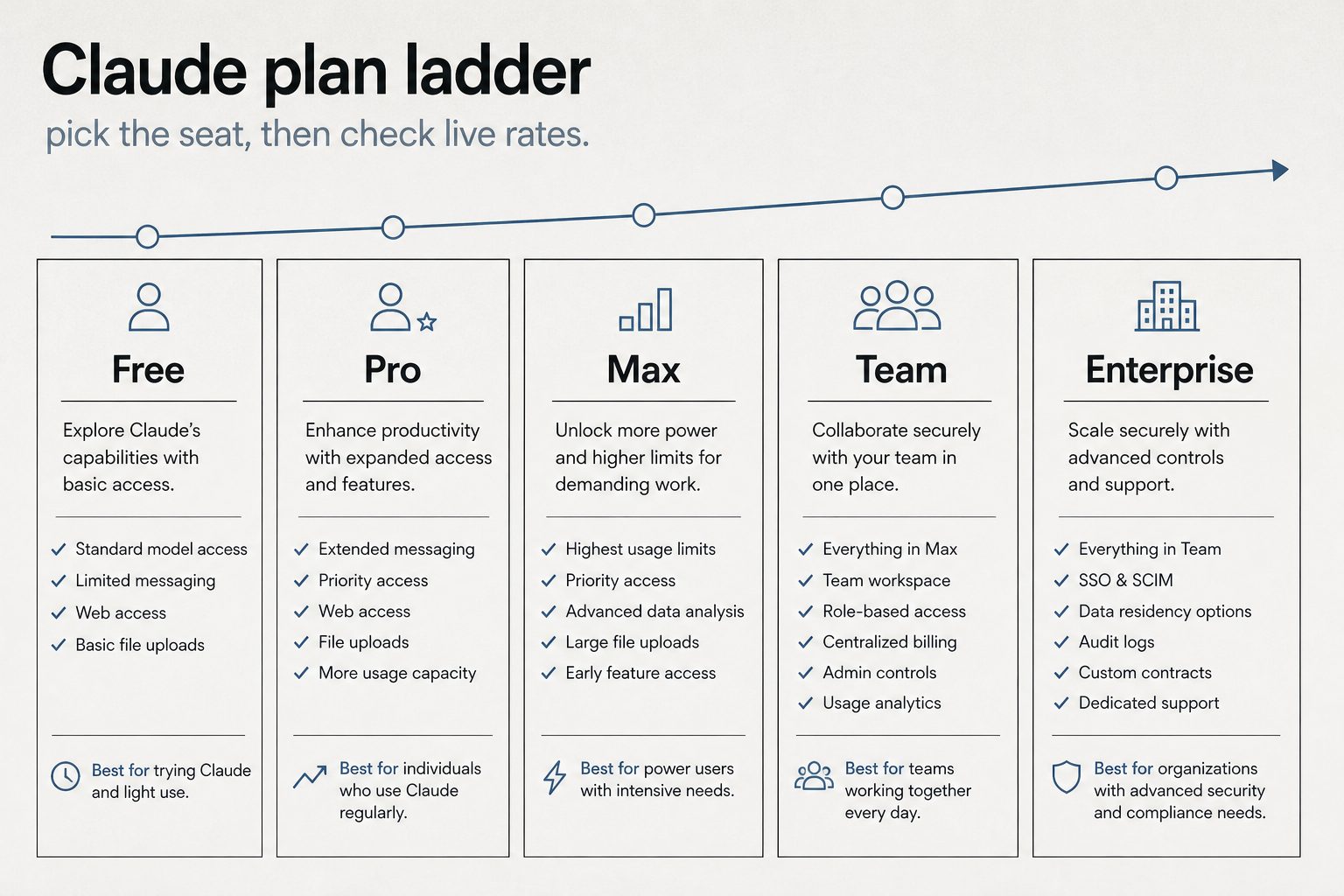
    The key fact most people miss: On Free and Pro plans, Anthropic may use your conversations to train future Claude models. You can opt out in settings. Team and Enterprise plans have stronger protections and the Enterprise tier supports custom data handling agreements for regulated industries.

    Claude Data Handling by Plan

    Plan Training data use Human review possible? Custom data agreements
    Free Yes (opt-out available) Yes
    Pro Yes (opt-out available) Yes
    Team No (by default) Limited
    Enterprise No Configurable ✓ BAA available

    How to Opt Out of Training Data Use

    On Free and Pro plans, you can disable conversation use for model training in your account settings. Go to Settings → Privacy → and toggle off “Help improve Claude.” This applies to future conversations — it doesn’t retroactively remove past conversations from training data already collected.

    What Anthropic Can See

    Anthropic employees may review conversations for safety research, model improvement, and trust and safety purposes. This applies to all plan tiers, though the scope and purpose of review is more restricted on Team and Enterprise. Human reviewers follow internal access controls, but if you’re sharing genuinely sensitive information, the better approach is to use Enterprise with appropriate data handling agreements — not to rely on the assumption that your specific conversation won’t be reviewed.

    Data Retention

    Anthropic retains conversation data for a period before deletion. The specific retention period isn’t published in a simple number — it varies based on account type and purpose. Your conversation history in the Claude.ai interface can be deleted by you at any time from Settings. Deletion from the UI doesn’t guarantee immediate removal from all backend systems, and may not remove data already used in training.

    Claude and GDPR

    For users in the EU, Anthropic operates under GDPR obligations. This includes rights to data access, correction, and deletion. Anthropic’s privacy policy covers these rights and how to exercise them. For organizations subject to GDPR with stricter requirements around AI data processing, Enterprise is the appropriate tier — it supports data processing agreements and more granular controls.

    What Not to Share With Claude on Standard Plans

    On Free or Pro plans, avoid sharing:

    • Patient health information (HIPAA-regulated)
    • Client confidential data under NDA
    • Non-public financial information
    • Personally identifiable information beyond what the task requires
    • Trade secrets or proprietary business processes

    For a full breakdown of Claude’s safety posture beyond just privacy, see Is Claude AI Safe? For current, authoritative terms, always refer to Anthropic’s privacy policy directly.

    Frequently Asked Questions

    Does Claude store your conversations?

    Yes. Anthropic retains conversation data for a period of time. You can delete your conversation history from the Claude.ai interface, but this doesn’t guarantee immediate removal from all backend systems or data already incorporated into training.

    Is Claude HIPAA compliant?

    Not on standard plans. HIPAA compliance requires a Business Associate Agreement (BAA) with Anthropic, which is only available on the Enterprise plan. Do not share patient health information with Claude on Free, Pro, or Team plans.

    Can I stop Anthropic from using my conversations to train Claude?

    Yes, on Free and Pro plans you can opt out in Settings → Privacy. Team plans don’t use conversations for training by default. On Enterprise, this is governed by your data processing agreement.

    Is Claude private?

    Claude conversations are not end-to-end encrypted in the way messaging apps are. Anthropic can access conversation data. “Private” in the sense of not being shared with third parties — yes, Anthropic doesn’t sell your data. Private in the sense of completely inaccessible to the company that runs it — no.

    Deploying Claude for your organization?

    We configure Claude correctly — right plan tier, right data handling, right system prompts, real team onboarding. Done for you, not described for you.

    Learn about our implementation service →

    Need this set up for your team?
    Talk to Will →

  • Is Claude AI Safe? Data Handling, Content Safety, and What to Know

    Is Claude AI Safe? Data Handling, Content Safety, and What to Know

    Last refreshed: May 15, 2026

    Claude AI · Fitted Claude

    Claude is built by Anthropic — a company whose stated mission is AI safety. But “safe” means different things depending on what you’re asking: Is Claude safe to use with sensitive information? Is it safe for children? Does it produce harmful content? Is it psychologically safe to rely on? Here’s the honest answer to each version of the question.

    Short answer: Claude is one of the safest AI assistants available for general professional use. It’s designed to refuse harmful requests, be honest about uncertainty, and avoid manipulation. For sensitive business data, read the data handling section below before sharing anything confidential.

    Is Claude Safe to Use? By Use Case

    Concern Safety Level Notes
    General professional use ✅ Safe Standard writing, research, analysis
    Children and minors ⚠️ Use with awareness Claude declines adult content but isn’t a parental control tool
    Sensitive personal information ⚠️ Read privacy policy Conversations may be used to improve models on free/Pro tiers
    Confidential business data ⚠️ Enterprise tier recommended Enterprise has stronger data handling commitments
    HIPAA-regulated data ❌ Not on standard plans Requires Enterprise with a BAA from Anthropic
    Harmful content generation ✅ Declines Claude refuses instructions for weapons, self-harm, etc.

    How Anthropic Builds Safety Into Claude

    Anthropic uses a training methodology called Constitutional AI — Claude is trained against a set of principles rather than purely optimizing for user approval. This means Claude is more likely to push back on bad premises, decline harmful requests, and express uncertainty rather than generate a confident-sounding wrong answer.

    Concretely: Claude won’t provide instructions for creating weapons, won’t generate content that sexualizes minors, won’t help with clearly illegal activities targeting individuals, and is designed to be honest rather than sycophantic. These are trained behaviors, not just content filters bolted on afterward.

    Data Safety: What Happens to Your Conversations

    This is the area that matters most for professional users. Anthropic’s data handling varies by plan:

    Free and Pro plans: Conversations may be used by Anthropic to improve Claude’s models. You can opt out of this in your account settings. Anthropic retains conversation data for a period before deletion.

    Team plan: Stronger data handling commitments. Conversations are not used to train models by default.

    Enterprise plan: Custom data handling agreements available. This is the tier for organizations with compliance requirements — HIPAA, SOC 2, GDPR, etc. A Business Associate Agreement (BAA) from Anthropic is required before sharing any HIPAA-regulated data.

    For current, authoritative data handling details, check Anthropic’s privacy policy directly — it supersedes any summary here. For privacy-specific questions, see Claude AI Privacy: What Anthropic Does With Your Data.

    Is Claude Psychologically Safe?

    Claude is designed not to manipulate users, not to foster unhealthy dependency, and not to tell people what they want to hear at the expense of accuracy. It will disagree with you, push back on flawed premises, and decline to validate bad decisions. Whether that’s “safe” depends on your frame — but it’s a deliberate design choice that makes Claude more honest and less likely to be weaponized as a validation machine.

    Frequently Asked Questions

    Is Claude AI safe to use?

    Yes, for general professional use. Claude is designed to refuse harmful requests, be honest, and avoid manipulation. For sensitive business data or regulated information, review Anthropic’s data handling policies for your plan tier before sharing anything confidential.

    Is Claude safe for children?

    Claude declines to generate adult or harmful content, which makes it safer than many AI tools. However, it’s not a purpose-built parental control system and shouldn’t be treated as one. Anthropic’s Terms of Service require users to be 18 or older, or to have parental permission.

    Can I share confidential business information with Claude?

    On standard plans (Free, Pro), conversations may be reviewed by Anthropic and used for model improvement. For confidential business data, use the Team or Enterprise plan — Enterprise offers custom data handling agreements. Never share HIPAA-regulated data without a Business Associate Agreement in place.

    Is Claude safer than ChatGPT?

    Both Claude and ChatGPT have safety measures in place. Claude’s Constitutional AI training approach is designed specifically around safety as a core methodology rather than an add-on. For data handling, the comparison depends on which plan tier you’re on for each product — Enterprise tiers of both have stronger commitments than free or standard paid plans.

    Deploying Claude for your organization?

    We configure Claude correctly — right plan tier, right data handling, right system prompts, real team onboarding. Done for you, not described for you.

    Learn about our implementation service →

    Need this set up for your team?
    Talk to Will →

  • Dario Amodei: CEO of Anthropic and the Future of AI Safety

    Dario Amodei: CEO of Anthropic and the Future of AI Safety

    Last refreshed: May 15, 2026

    Claude AI · Fitted Claude

    Dario Amodei is the CEO and co-founder of Anthropic, the AI safety company behind Claude. His trajectory — Princeton physics, Stanford PhD, OpenAI VP of Research, then Anthropic founder — traces the arc of modern AI development. Forbes estimated his net worth at $7 billion as of February 2026, reflecting his co-founder equity as Anthropic approaches a potential IPO.

    Early Life and Education

    Dario Amodei grew up in a family with deep intellectual roots — his father is a physician, his mother a chemist. He studied physics at Princeton University before earning a PhD in computational neuroscience at Stanford, where he researched the intersection of neural computation and machine learning. The neuroscience background proved directly relevant: understanding how biological neural networks process information informed his later work on understanding artificial ones.

    Career at OpenAI

    Amodei joined OpenAI in 2016 as a research scientist and rose to become Vice President of Research — one of the most senior technical roles in the organization during the period when OpenAI produced GPT-2, GPT-3, and early versions of DALL-E. His tenure coincided with OpenAI’s most productive research period and its transition from a pure research organization to a company with significant commercial ambitions.

    By 2021, Amodei and a group of colleagues had grown increasingly concerned that OpenAI’s commercial trajectory — particularly its deepening partnership with Microsoft — was creating tensions with rigorous AI safety research. The concerns were not primarily about OpenAI’s intentions but about whether a company under those commercial pressures could systematically prioritize safety as its primary obligation.

    Co-Founding Anthropic

    In 2021, Amodei led the founding of Anthropic alongside his sister Daniela Amodei, Jared Kaplan, Chris Olah, Tom Brown, Sam McCandlish, and Jack Clark. The company was structured as a public benefit corporation — a legal form that formally embeds the safety mission into its governing documents, creating accountability beyond a standard corporate charter.

    Amodei has consistently articulated a position that sits between AI pessimism and uncritical optimism: he believes advanced AI poses genuine existential-level risks, and that the way to address those risks is not to slow development but to pursue it more carefully, with safety research as the primary scientific agenda rather than an afterthought.

    Leadership Style and Public Profile

    Amodei is more publicly visible than most AI lab CEOs, regularly writing long-form essays on AI policy and safety, appearing before Congress, and engaging directly with critics of both the AI safety field and of Anthropic specifically. His October 2024 essay “Machines of Loving Grace” — a detailed argument for why advanced AI could be profoundly beneficial — generated significant attention and debate across the AI community.

    Net Worth

    Forbes estimated Dario Amodei’s net worth at approximately $7 billion as of February 2026, reflecting his co-founder equity in Anthropic at the company’s current valuation. As one of the largest individual stakeholders in a company targeting a $400-500B IPO valuation, this figure could change substantially if the public offering proceeds as expected.

    Frequently Asked Questions

    What is Dario Amodei’s net worth?

    Forbes estimated approximately $7 billion as of February 2026, based on his co-founder equity in Anthropic.

    Why did Dario Amodei leave OpenAI?

    Amodei and colleagues grew concerned that commercial pressures — particularly OpenAI’s Microsoft partnership — were creating structural tensions with rigorous AI safety research as the primary mission.

    Where did Dario Amodei go to school?

    Dario Amodei studied physics at Princeton and earned a PhD in computational neuroscience from Stanford University.

  • Anthropic IPO 2026: What’s Confirmed, What’s Rumored, and Where to Track It

    Anthropic IPO 2026: What’s Confirmed, What’s Rumored, and Where to Track It

    Last refreshed: May 15, 2026

    ⚠️ No confirmed IPO date exists as of May 8, 2026. Anthropic has not filed an S-1, set a ticker, or announced a listing date. What exists are credible reports of a Q4 2026 target — but no official confirmation. Everything below is sourced and dated. Click any link to get the latest.

    Where Things Actually Stand

    Anthropic is widely expected to pursue an IPO, and the signals are real — but no date has been set. Here is what is confirmed versus what is reported:

    Confirmed Facts (Primary Sources)

    • Current valuation: $380 billion — set in the February 2026 Series G round led by GIC and Coatue. This is the last confirmed, announced valuation. (CNBC, April 29 2026)
    • Revenue run rate: $30B+ annualized — confirmed by Anthropic directly in May 2026. Sources with knowledge of financials put the real figure closer to $40B. (TechCrunch, April 29 2026)
    • IPO law firm engaged: Wilson Sonsini hired to prepare for a potential public listing — confirmed by the Financial Times in December 2025.
    • Preliminary bank conversations: Anthropic has held early-stage talks with investment banks — confirmed by multiple sources, no banks named publicly.
    • No S-1 filed. The SEC has received no public filing from Anthropic as of this writing.

    Reported But Unconfirmed

    • Q4 2026 IPO target — discussed by Anthropic executives internally according to The Information. Bankers reportedly expect the offering could raise more than $60 billion. (TECHi, sourcing The Information)
    • ~$900 billion valuation round in progress — as of April 30, 2026, TechCrunch reported Anthropic was asking investors to submit allocations within 48 hours for a ~$50 billion raise at a $850–$900 billion valuation. A board decision was expected in May 2026. Anthropic declined to comment. (TechCrunch, April 30 2026)
    • October 2026 — cited in some reports as the earliest possible listing window. Not confirmed by Anthropic.
    • $60B+ raise — reported figure for the eventual IPO offering size. Unconfirmed.

    The Valuation Trajectory

    The speed of Anthropic’s private-market repricing is unlike anything in recent tech history:

    • March 2025: $61.5 billion (Series D, led by Lightspeed)
    • September 2025: $183 billion (Series F)
    • February 2026: $380 billion (Series G, led by GIC and Coatue)
    • May 2026: ~$900 billion reportedly under discussion — not yet closed

    Some early backers are reportedly skipping the current round specifically to wait for IPO pricing — a signal that sophisticated money sees the public listing as potentially more attractive than another late-stage private markup.

    Why There’s No Confirmed Date Yet

    Anthropic is a public benefit corporation, which adds governance complexity to any listing. The company is also in the middle of closing what may be its final private round — and closing a $50 billion raise takes time. Until an S-1 is filed with the SEC, no IPO date is official. PitchBook analyst Kyle Stanford has noted that a crowded private financing cycle could push a listing into 2027 if the current round takes longer than expected.

    Who Owns Anthropic Before Any IPO

    Major confirmed investors include Amazon (up to $50 billion committed), Google (up to $40 billion committed), Nvidia ($30 billion), SoftBank ($30 billion), plus Accel, BlackRock-affiliated funds, Fidelity, General Catalyst, Goldman Sachs Alternatives, JPMorganChase, Lightspeed, Menlo Ventures, Morgan Stanley Investment Management, Sequoia, and Temasek. More than 1,000 enterprise customers now spend over $1 million annually on Claude — a figure Anthropic disclosed publicly in May 2026.

    Keep Up With This Story

    This is a fast-moving situation. The sources below are updated in real time — bookmark them if you want the latest as it breaks:

    Want the deeper picture on who is building this company? Read our analysis of Anthropic’s founders and leadership — the most-read piece on this site in this category.

  • Daniela Amodei: Co-Founder and President of Anthropic

    Daniela Amodei: Co-Founder and President of Anthropic

    Daniela Amodei is the President and co-founder of Anthropic, the AI safety company behind Claude. While her brother Dario Amodei serves as CEO and is the more publicly visible figure, Daniela runs the operational, commercial, and go-to-market sides of one of the most consequential AI companies in the world. She is, in practical terms, the reason Anthropic functions as a business.

    Quick facts: Daniela Amodei — President and co-founder of Anthropic. Previously VP of Operations at OpenAI. Before that: Stripe, Ropes & Gray. Co-founded Anthropic in 2021 with her brother Dario and five other former OpenAI researchers. Responsible for Anthropic’s business operations, sales, partnerships, and go-to-market strategy.

    Who Is Daniela Amodei?

    Daniela Amodei is the President of Anthropic, the AI safety company she co-founded in 2021 alongside her brother Dario Amodei and a group of senior researchers who departed OpenAI together. While Dario leads research and product as CEO, Daniela leads everything that keeps the company running as a viable business: revenue, partnerships, hiring, operations, and the commercial strategy behind Claude.

    She is among the most powerful operators in the AI industry — not a figurehead co-founder, but the executive who built Anthropic’s commercial foundation from zero while the research team focused on the models.

    Background and Career Before Anthropic

    Before Anthropic, Daniela spent years in operational and business roles that would prove directly relevant to building a fast-moving AI company from scratch.

    She attended Dartmouth College, where she studied economics. Her early career included a position at Ropes & Gray, a prominent law firm, before moving into the technology sector. She joined Stripe — the payments infrastructure company — where she worked in business operations during a period of significant growth for the company.

    The pivotal move came when she joined OpenAI as VP of Operations. She was one of the senior leaders who left OpenAI in 2020 and 2021 along with her brother Dario to found Anthropic. That cohort included several of OpenAI’s most senior researchers and operators, making it one of the most significant team departures in AI industry history.

    Role at Anthropic

    As President, Daniela’s domain at Anthropic covers the business side of the company end to end. Where Dario focuses on research direction, safety philosophy, and model development, Daniela owns:

    • Revenue and commercial growth — enterprise sales, partnerships, and the Claude business
    • Go-to-market strategy — how Anthropic positions and sells Claude to individuals, developers, and enterprises
    • Operations — the internal systems and processes that let a growing AI company function
    • Partnerships — major deals including Anthropic’s relationship with Amazon Web Services, one of the largest infrastructure commitments in AI company history
    • Hiring and team building — scaling the organization while maintaining culture

    The division of labor between Daniela and Dario mirrors a pattern common in successful tech companies: one founder focused on product and technology, one focused on the business that makes the technology sustainable. At Anthropic, that structure is unusually clean and appears to function well.

    Daniela Amodei and the Amazon Partnership

    One of the most significant commercial milestones under Daniela’s leadership as President was securing Anthropic’s partnership with Amazon Web Services. Amazon committed to invest up to $4 billion in Anthropic, with Claude models made available through AWS’s Bedrock platform. This deal established Anthropic’s commercial credibility and gave it the infrastructure scale to compete with OpenAI and Google DeepMind.

    Partnerships of this scale require sustained executive relationships and months of commercial negotiation — the kind of work that falls squarely in Daniela’s domain.

    The Amodei Siblings Running Anthropic

    The dynamic between Daniela and Dario Amodei at Anthropic is worth understanding because it’s unusual. Co-founders who are siblings and who have distinct, non-overlapping domains are relatively rare. In most tech companies, co-founders compete for influence. At Anthropic, the operational split appears deliberate and functional: Dario owns the mission and the models, Daniela owns the machine that funds the mission.

    Dario has spoken publicly about AI safety, the risks of powerful AI systems, and Anthropic’s research philosophy. Daniela tends to operate more quietly — she is less frequently the face of Anthropic in press interviews but is consistently present in the company’s major commercial announcements and partnership moments.

    Net Worth and Anthropic’s Valuation

    Anthropic has raised billions of dollars in venture funding from investors including Google, Amazon, and Spark Capital, with valuations that have grown significantly through each funding round. As a co-founder and President holding equity in the company, Daniela Amodei’s net worth is tied primarily to Anthropic’s private valuation.

    Anthropic is not publicly traded, so precise figures are not available. At the company’s reported valuations, co-founders with meaningful equity stakes hold substantial paper wealth — though the actual liquidity of that wealth depends on if and when Anthropic conducts an IPO or secondary transactions.

    Why Daniela Amodei Matters for Claude

    Claude exists because Anthropic exists as a viable company. Daniela Amodei is one of the primary reasons Anthropic is viable. The research team can build frontier AI models, but without a functioning commercial operation those models don’t reach users, don’t generate revenue, and don’t fund the next generation of research.

    Every enterprise Claude deployment, every API integration, every AWS customer using Claude through Bedrock, every API integration, every AWS customer using Claude through Bedrock — these exist in part because of the commercial infrastructure Daniela has built. The Claude you use is as much a product of her work as it is of the research team’s.

    Frequently Asked Questions

    Who is Daniela Amodei?

    Daniela Amodei is the President and co-founder of Anthropic, the AI company behind Claude. She previously served as VP of Operations at OpenAI before co-founding Anthropic in 2021 with her brother Dario Amodei and other former OpenAI researchers.

    Is Daniela Amodei related to Dario Amodei?

    Yes. Daniela and Dario Amodei are siblings. Dario is the CEO of Anthropic; Daniela is the President. They co-founded Anthropic together in 2021 along with five other former OpenAI researchers.

    What does Daniela Amodei do at Anthropic?

    As President, Daniela oversees Anthropic’s business operations, commercial strategy, revenue, partnerships, and go-to-market. She is responsible for the business side of Anthropic while Dario leads research and product.

    Where did Daniela Amodei work before Anthropic?

    Before co-founding Anthropic, Daniela was VP of Operations at OpenAI. Prior to OpenAI she worked at Stripe in business operations, and earlier in her career she was at the law firm Ropes & Gray. She studied economics at Dartmouth College.

    What is Daniela Amodei’s net worth?

    Daniela Amodei’s net worth is not publicly known — Anthropic is a private company and does not disclose individual equity stakes. Her net worth is tied primarily to her equity in Anthropic, which has been valued at billions of dollars across successive funding rounds from investors including Amazon and Google.