Tag: AI Tools

  • What Search Means Now: A Practical Guide for Freelance SEO Consultants Navigating the AI Shift — Visual

    What Search Means Now: A Practical Guide for Freelance SEO Consultants Navigating the AI Shift — Visual

  • The Middleware Manifesto: Why the Best Search Operations Are Built in Layers, Not Silos — Visual

    The Middleware Manifesto: Why the Best Search Operations Are Built in Layers, Not Silos — Visual

  • We Tested Google Flow for Brand Asset Production — Visual

    We Tested Google Flow for Brand Asset Production — Visual

  • The SaaS Illusion Is Cracking: Why Custom Apps Now Cost Less Than Your Software Stack — Visual

    The SaaS Illusion Is Cracking: Why Custom Apps Now Cost Less Than Your Software Stack — Visual

  • The Loop Has to Go Both Ways — Visual

    The Loop Has to Go Both Ways — Visual

  • Split Brain Architecture: How One Person Manages 27 WordPress Sites Without an Agency — Visual

    Split Brain Architecture: How One Person Manages 27 WordPress Sites Without an Agency — Visual

  • Stop Building Inventory. Build the Machine.

    Stop Building Inventory. Build the Machine.

    The Machine Room · Under the Hood

    Just-in-time knowledge manufacturing is an operational model where content, services, and deliverables are assembled on demand from a growing base of raw capabilities — knowledge systems, API connections, AI pipelines, and structured data — rather than pre-built and warehoused. Nothing sits on a shelf. Everything is fabricated at the moment of need.

    There’s a version of running an agency where you spend your weekends batch-producing blog posts, pre-writing email sequences, and stockpiling social content in a spreadsheet. You build the inventory, shelve it, and pray it’s still relevant when you finally schedule it out three weeks later.

    I spent years in that model. It doesn’t scale. It doesn’t adapt. And the moment a client’s market shifts or a Google update lands, half your shelf is stale.

    What I’ve been building instead — quietly, over the last year — is something different. Not a content warehouse. A content machine. One where nothing is pre-built, but everything can be built. On demand. At speed. With quality that compounds instead of decays.

    The Ingredients Are Not the Product

    Here’s the mental model that changed everything: stop thinking about what you produce. Start thinking about what you can draw from.

    Right now, the Tygart Media operating system has ingredients scattered across five layers. A Notion workspace with six databases tracking every client, every task, every piece of knowledge ever captured. A BigQuery data warehouse with 925 embedded knowledge chunks and vector search. 27 WordPress sites with over 6,800 published posts — each one a node in a knowledge graph that gets smarter every time something new is published. A GCP compute cluster running Claude Code with direct access to every site’s database. And 40+ Claude skills that know how to do everything from SEO audits to image generation to taxonomy fixes to competitive pivots.

    None of those ingredients are a finished product. They’re flour, eggs, sugar, and a well-calibrated oven. The product is whatever someone orders.

    How It Actually Works

    A client needs 20 hyper-local articles grounded in real watershed data for Twin Cities restoration searches. The machine doesn’t pull from a shelf. It reaches for the content brief builder, the adaptive variant pipeline, the DataForSEO keyword intelligence layer, the WordPress REST API publisher, and the IPTC metadata injection system. Those ingredients combine — differently every time — to produce exactly what’s needed. Not approximately. Exactly.

    Someone wants featured images across 50 articles? The machine reaches for Vertex AI Imagen, the WebP converter, the XMP metadata injector, and the WordPress media uploader. One script. Every image generated, optimized, metadata-enriched, and published in under a minute each.

    The ingredients are the same. The output is infinitely variable.

    Why Inventory Thinking Fails at Scale

    The inventory model has a ceiling built into it. You can only pre-build as fast as one human can think, write, and publish. Every hour spent building inventory is an hour not spent improving the machine. And inventory decays — content ages, data goes stale, market conditions shift.

    The machine model inverts this. Every hour spent improving a skill, connecting an API, or enriching the knowledge base makes everything that comes after it better. The 20th article is better than the first — not because you practiced writing, but because the knowledge graph is 20 nodes richer, the internal linking map is denser, and the content brief builder has more competitive intelligence to draw from.

    This is the flywheel. The ingredients improve by being used.

    The Three-Tier Architecture

    The machine runs on three layers, each with a specific job.

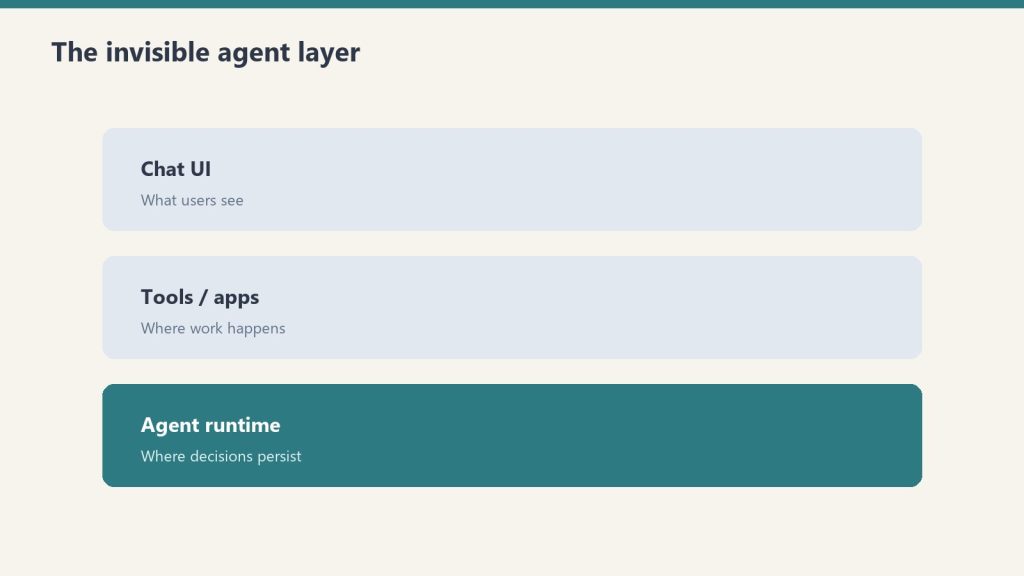
    The first layer is the strategist — a live AI session that can reach out to any API, generate images with Vertex AI, publish to any WordPress site, query BigQuery, log to Notion, and compose social media drafts. It handles anything that involves calling an API or making a decision. It forgets between sessions, but carries the important context forward through a persistent memory system.

    The second layer is the field operator — a browser-based AI that can navigate any web interface, click through dashboards, type into terminals, and visually inspect what’s happening. It handles anything that requires a browser. GCP Console, DNS management, quota requests, visual QA.

    The third layer is the persistent worker — an AI that lives on the server itself, with direct access to every WordPress database, every file, every log. It doesn’t forget between sessions. It handles heavy operations that need to survive beyond a single conversation: bulk migrations, cross-site audits, scheduled content generation.

    Three layers. Three different tools. One machine.

    The Knowledge Compounds

    The part that most people miss about this model is the compounding effect. Every article published adds a node to the knowledge graph. Every SEO audit enriches the competitive intelligence layer. Every client conversation captured in Notion becomes a retrievable insight for the next brief. Every image generated trains the prompt library. Every taxonomy fix improves the next site’s information architecture.

    Nothing is wasted. Nothing sits idle. Every output becomes an input for the next request.

    This is why I stopped building inventory. The machine doesn’t need a warehouse. It needs raw materials, good pipes, and someone who knows which valve to turn.

    What This Means for Clients

    For the businesses we serve, this model means three things. First, speed — when you need content, you don’t wait for a writer to start from scratch. The machine draws from existing knowledge, existing competitive intelligence, and existing site architecture to produce faster and with more context than any human starting cold. Second, relevance — nothing is pre-written three weeks ago and scheduled for a date that may no longer make sense. Everything is built for right now, with right now’s data. Third, compounding quality — the 50th article on your site benefits from everything the first 49 taught the machine about your industry, your competitors, and your audience.

    No back stock. No stale inventory. Just a machine that gets better every time someone needs something.

    Frequently Asked Questions

    What is just-in-time content manufacturing?

    Just-in-time content manufacturing is an operational model where articles, images, and digital assets are assembled on demand from a growing base of knowledge systems, AI pipelines, and API connections — rather than pre-built and stored as inventory. Each deliverable is fabricated at the moment of need using the best available data and intelligence.

    How does a content machine differ from a content calendar?

    A content calendar pre-schedules fixed deliverables weeks in advance. A content machine maintains the ingredients and capabilities to produce any deliverable on demand. The calendar is rigid and decays; the machine is adaptive and compounds in quality over time as its knowledge base grows.

    What technologies power a just-in-time content system?

    A typical stack includes AI language models for content generation, vector databases for knowledge retrieval, WordPress REST APIs for publishing, image generation models for visual assets, and a project management layer like Notion for orchestration. The key is that these components are connected via APIs so they can be combined dynamically for any request.

    Does just-in-time content sacrifice quality for speed?

    The opposite. Because each piece draws from a growing knowledge base, competitive intelligence layer, and established site architecture, the quality compounds over time. The 50th article benefits from everything the first 49 taught the system. Pre-built inventory, by contrast, starts decaying the moment it’s created.

  • You Keep the Relationship. I Do the Work Underneath.

    You Keep the Relationship. I Do the Work Underneath.

    The Machine Room · Under the Hood

    The One Thing Freelancers Protect Above Everything

    You built your business on relationships. Not on tools, not on processes, not on clever marketing — on the trust between you and the people who pay you to care about their search presence. That trust took years to build. It’s the reason clients stay when competitors pitch them. It’s the reason referrals come in. It’s the only thing that truly differentiates one freelance SEO consultant from another.

    So when someone proposes adding a capability layer to your operation, the first question isn’t “what does it do?” The first question is “does it threaten my client relationships?” Fair question. Important question. Let me answer it directly.

    No. The plugin model is designed from the ground up to be invisible to your clients unless you choose to make it visible. Your name on the reports. Your voice on the calls. Your strategy driving the engagement. The implementation work happens underneath — through the WordPress API, through the proxy, through the optimization chain — and the results show up as your expanded capabilities. That’s the architecture. That’s the intent. That’s how it works.

    Why White-Label Is the Default

    I don’t need to be in front of your clients. I need to be in your operation, adding depth to the work you deliver. The moment I’m client-facing, the dynamic changes — the client wonders who they’re actually working with, the consultant feels displaced, and the partnership gets complicated in ways that don’t serve anyone.

    So the default is white-label. Full stop. I work through your brand, in your reporting templates, using your communication channels. When the client sees a featured snippet win, it’s because their SEO consultant delivered it. When they see schema markup generating rich results, it’s because you expanded your service. When AI systems start citing their content, it’s because you brought that capability to the table.

    The credit is yours because the decision was yours. You chose to add the capability. You manage the relationship. You communicate the results. I just made the implementation possible.

    What This Looks Like in Practice

    Here’s a scenario. You have a client call next Tuesday. You’re reviewing the monthly performance. In addition to the usual traffic and ranking data, you now have new wins to report: two featured snippet captures for high-value queries, FAQPage schema live on all service pages generating rich results, and the client’s content was cited by an AI system for a competitive query for the first time.

    You present those wins the same way you present ranking improvements. They’re part of your service. The client doesn’t need to know the technical workflow behind them — they just need to see the results and understand the value.

    If the client asks “how did we get the featured snippet?” you explain the AEO methodology — the content restructuring, the direct answer optimization, the schema layer. You can explain it because you understand it. The fact that someone else implemented the technical work doesn’t diminish your ability to communicate the strategy and the value. Attorneys don’t personally draft every document. Architects don’t personally lay every brick. The professional manages the engagement and ensures quality. That’s your role.

    When Transparency Makes Sense

    Some freelance consultants prefer transparency. They want their clients to know there’s a specialized partner handling certain optimization layers. That works too. The model accommodates either approach.

    In the transparency model, you introduce the partnership naturally: “I’ve brought on a specialized partner who handles AI search optimization, schema architecture, and content intelligence. They work under my direction as part of the expanded service I’m providing.” The client appreciates the honesty and often gains confidence knowing that specialist expertise is involved.

    The key in either model — white-label or transparent — is that you own the client relationship. The client’s primary point of contact is you. Strategic decisions go through you. Reporting comes from you. The plugin layer takes direction from you, not from the client directly. That boundary is non-negotiable and it’s by design.

    What Happens If the Client Leaves

    Clients leave. It happens. When they do, every optimization we implemented stays on their site. The schema markup stays. The restructured content stays. The internal links stay. The FAQ sections stay. There’s no proprietary code that breaks. There’s no dependency that fails. There’s no “if you leave, you lose the work” lock-in.

    You revoke the application password. The connection ends. The work already delivered is the client’s to keep. That’s how it should work, and it’s how it does work.

    This matters because it protects your reputation. If a client leaves and everything you built unravels, that reflects on you — even if the unraveling was caused by a vendor dependency. The plugin model avoids that entirely. The work is standard WordPress, standard schema, standard web technologies. It’s portable. It’s permanent. It’s the client’s.

    Building Your Capability Story

    The most powerful position a freelance consultant can occupy is this: “I handle everything. My clients get comprehensive search optimization — traditional SEO, answer engine optimization, AI citation strategy, schema architecture, content intelligence — all from one consultant. I’m not limited by being a solo operation because I’ve built the infrastructure to deliver at depth.”

    That story is true. You did build it — by making the decision to plug in the capability layer. The infrastructure exists because you chose to add it. The results happen because you manage the engagement. The depth is real because the implementation is real. The fact that you didn’t personally write the JSON-LD or personally restructure every blog post for snippet capture doesn’t make the story less true. It makes it smart.

    Smart consultants don’t do everything themselves. They build systems that deliver comprehensive results while they focus on the work that only they can do — the strategy, the relationships, the judgment calls that machines and processes can’t make.

    Frequently Asked Questions

    What if my client directly asks if I have a partner or team?

    That’s your call. Some consultants say “I have specialized resources I work with.” Others say “I have a technology partner who handles advanced optimization.” Others simply say “yes, I’ve expanded my capabilities.” There’s no script — you know your clients and what level of detail they want. The plugin model supports whatever framing works for your relationship.

    Will I ever be pressured to introduce Tygart Media to my clients?

    No. The white-label default is exactly that — a default. There is no scenario where the plugin layer reaches out to your clients, requests direct access, or tries to establish an independent relationship. Your clients are your clients. Full stop.

    Can I use the plugin model for some clients and not others?

    Absolutely. Some clients might need the full AEO/GEO/schema stack. Others might only need traditional SEO. You decide which clients get the expanded service based on their needs, their budget, and your assessment of where the additional layers add value. There’s no all-or-nothing requirement.

    How do I explain the expanded capabilities to existing long-term clients?

    The natural framing is evolution: “Search has changed significantly. AI-generated answers, featured snippets, and voice search are creating new visibility surfaces that traditional SEO doesn’t fully address. I’ve expanded my service capabilities to include these optimization layers so your business stays visible everywhere search is happening.” That’s honest, forward-looking, and positions the expansion as a proactive move rather than an admission of previous gaps.

    {
    “@context”: “https://schema.org”,
    “@type”: “Article”,
    “headline”: “You Keep the Relationship. I Do the Work Underneath.”,
    “description”: “The plugin model is white-label by default. Your clients see expanded capabilities from you. The implementation layer is invisible — and that’s the point.”,
    “datePublished”: “2026-04-03”,
    “dateModified”: “2026-04-03”,
    “author”: {
    “@type”: “Person”,
    “name”: “Will Tygart”,
    “url”: “https://tygartmedia.com/about”
    },
    “publisher”: {
    “@type”: “Organization”,
    “name”: “Tygart Media”,
    “url”: “https://tygartmedia.com”,
    “logo”: {
    “@type”: “ImageObject”,
    “url”: “https://tygartmedia.com/wp-content/uploads/tygart-media-logo.png”
    }
    },
    “mainEntityOfPage”: {
    “@type”: “WebPage”,
    “@id”: “https://tygartmedia.com/you-keep-the-relationship-i-do-the-work-underneath/”
    }
    }

  • What ‘Search’ Means Now: A Practical Guide for Freelance SEO Consultants Navigating the AI Shift

    What ‘Search’ Means Now: A Practical Guide for Freelance SEO Consultants Navigating the AI Shift

    Tygart Media / The Signal
    Broadcast Live
    Filed by Will Tygart
    Tacoma, WA
    Industry Bulletin

    Search Fragmented. Your Strategy Needs to Follow.

    When you started doing SEO, “search” meant Google. Ten blue links. Maybe Yahoo or Bing on the margins. You optimized for one algorithm, one results page, one set of ranking factors. The game was complex but the playing field was singular.

    That’s not the world your clients operate in anymore. Their potential customers search through Google’s traditional results, Google’s AI Overviews, ChatGPT’s search integration, Perplexity’s answer engine, Claude’s knowledge base, voice assistants on phones and smart speakers, and whatever new AI-powered search interface launches next quarter. Each surface has different selection criteria. Each one determines visibility through different signals.

    As a freelance SEO consultant, you’re being asked — explicitly or implicitly — to keep your clients visible across all of these surfaces. That’s a reasonable expectation from the client’s perspective. They pay you for search visibility, and search now happens in more places than it did when you started.

    The question is how you deliver on that expanding expectation without becoming a different person.

    The Three Surfaces, Simplified

    Strip away the jargon and search visibility now operates on three surfaces. They overlap but they’re not the same.

    Surface one is traditional organic search. Google, Bing, their traditional ranking algorithms. This is what SEO has always addressed. Authority signals, relevance signals, technical health, backlinks, content quality. Your bread and butter. Still important. Still driving the majority of search-driven business outcomes for most industries.

    Surface two is answer engines. Featured snippets, People Also Ask, voice search responses, direct answer boxes. These surfaces pull content from the same web as traditional search but select it based on different criteria — structural clarity, direct answer quality, schema markup, content format. A page can rank number one and still not own the featured snippet. The optimization requirements are related to but distinct from traditional SEO.

    Surface three is generative AI. ChatGPT, Perplexity, Claude, Google’s AI Overviews, Siri’s AI-enhanced responses. These systems synthesize answers from multiple sources and cite specific content as references. The selection criteria include factual density, entity authority, structural readability, and source consistency across the web. This surface is growing rapidly and the optimization discipline — GEO — is still maturing.

    Each surface requires attention. Ignoring any one of them means your client is invisible somewhere their customers are looking. But addressing all three simultaneously is work that goes beyond what traditional SEO covers.

    What Changes and What Doesn’t

    Here’s the good news for experienced SEO consultants: surface one — traditional organic — is still the foundation. Nothing about AEO or GEO works without solid SEO underneath. Rankings still matter. Technical health still matters. Content quality still matters. Backlinks still matter. Everything you’ve built your career on remains relevant.

    What changes is what you layer on top. For surface two, the content you’re already creating needs structural refinement — snippet-ready formatting, FAQ sections with schema, direct answer blocks at the top of relevant sections. For surface three, the content needs entity optimization — stronger factual density, clearer attribution, consistent entity signals, and structural elements that help AI systems extract and cite information accurately.

    Neither layer contradicts or undermines SEO. They extend it. The work you’re doing today becomes more valuable when AEO and GEO layers are added, not less. That’s the practical reality that gets lost in the marketing hype around AI search.

    The Realistic Assessment

    I’m not going to tell you that AI search is replacing Google tomorrow. I don’t know the exact trajectory, and neither does anyone else claiming certainty. What I can tell you is that the trend is directional: more search activity is happening through more interfaces, and each interface has its own optimization surface.

    Some industries are seeing significant AI search impact already. Others are barely touched. The pace varies by vertical, by query type, by user demographics. For some of your clients, AI search optimization is urgent. For others, it’s a forward-looking investment. Part of the value of the plugin model is having someone who can help you make that assessment for each client individually, based on their specific competitive landscape and search behavior patterns.

    What I won’t do is manufacture urgency with made-up statistics or scare you into action with doomsday predictions about traditional SEO. The landscape is evolving. The smart response is to evolve with it — deliberately, with clear-eyed assessment of where the opportunity actually is for each client.

    Where the Plugin Fits

    The plugin model addresses the capability gap between surface one (your expertise) and surfaces two and three (the expanding landscape). You continue to own the SEO strategy. The plugin layer adds the AEO and GEO optimization that extends your clients’ visibility into the answer engine and generative AI surfaces.

    Over time, some consultants choose to build their own AEO and GEO expertise and internalize these capabilities. The plugin model supports that transition too — I’m happy to teach the methodology and help you build the skills to do this work yourself. The goal isn’t dependency. The goal is making sure your clients are visible across every surface where their customers search, whether that capability comes from you directly or from the plugin layer.

    Frequently Asked Questions

    Should I be telling my clients about AI search even if their industry isn’t heavily impacted yet?

    Yes — but framed as awareness, not alarm. “We’re monitoring how AI-powered search is evolving in your industry and positioning your content to be visible across these new surfaces as they grow” is a proactive, responsible message that positions you as forward-thinking without manufacturing urgency.

    Is traditional SEO becoming less important?

    No. Traditional SEO is the foundation that everything else builds on. What’s happening is that SEO alone covers a shrinking percentage of total search visibility as new surfaces emerge. That doesn’t make SEO less important — it makes it necessary but no longer sufficient on its own for comprehensive search presence.

    How do I decide which clients need AEO/GEO optimization now versus later?

    Look at three factors: how information-rich their queries are (informational queries trigger AI answers more than transactional ones), how competitive their search landscape is (saturated markets see AI impact faster), and how their customers actually search (B2B research queries are heavily impacted by AI, simple local searches less so). Those factors help prioritize which clients benefit most from early AEO/GEO investment.

    {
    “@context”: “https://schema.org”,
    “@type”: “Article”,
    “headline”: “What Search Means Now: A Practical Guide for Freelance SEO Consultants Navigating the AI Shift”,
    “description”: “Search is no longer just Google’s ten blue links. A practical overview of every surface where your clients need to be visible — and what it takes to show “,
    “datePublished”: “2026-04-03”,
    “dateModified”: “2026-04-03”,
    “author”: {
    “@type”: “Person”,
    “name”: “Will Tygart”,
    “url”: “https://tygartmedia.com/about”
    },
    “publisher”: {
    “@type”: “Organization”,
    “name”: “Tygart Media”,
    “url”: “https://tygartmedia.com”,
    “logo”: {
    “@type”: “ImageObject”,
    “url”: “https://tygartmedia.com/wp-content/uploads/tygart-media-logo.png”
    }
    },
    “mainEntityOfPage”: {
    “@type”: “WebPage”,
    “@id”: “https://tygartmedia.com/what-search-means-now-a-practical-guide-for-freelance-seo-consultants-navigating-the-ai-shift/”
    }
    }

  • The Internal Link Map Your Client’s Site Is Missing — and What It Costs Them

    The Internal Link Map Your Client’s Site Is Missing — and What It Costs Them

    Tygart Media / Content Strategy
    The Practitioner JournalField Notes
    By Will Tygart
    · Practitioner-grade
    · From the workbench

    The Architecture No One Maintains

    Ask any freelance SEO consultant about internal linking and they’ll tell you it matters. Ask them how their clients’ internal link architecture actually looks — mapped, measured, audited — and most will admit it’s a blind spot. Not because they don’t know it’s important, but because mapping and maintaining internal links across a growing site is time-consuming work that always gets deprioritized behind content creation and keyword targeting.

    The cost of that neglect is real but invisible. Orphan pages that search engines can’t find. Authority concentrated on the homepage while deep pages starve. Topic clusters that exist in the editorial calendar but not in the link architecture. Related content that a visitor would find useful but that no link path connects.

    Search engines use internal links to discover pages, understand topic relationships, and distribute authority across a site. AI systems use them as signals of topical depth and content architecture. When the internal link map is neglected, both systems form an incomplete picture of what the site covers and which pages matter most.

    What a Proper Internal Link Audit Reveals

    When I audit a client’s internal link structure, the findings typically fall into four categories.

    First, orphan pages — published content with zero internal links pointing to it. These pages exist in WordPress but are effectively hidden from search engines that rely on link crawling to discover content. Every site I audit has orphan pages. Usually more than the consultant expects.

    Second, authority leaks — pages that receive internal links but don’t pass authority to the pages that need it. The homepage might have strong authority that could boost deep service pages, but there’s no link path connecting them. The authority sits at the top of the site and never flows down to the pages that convert visitors into clients.

    Third, broken cluster architecture — a blog with dozens of related posts that should be linked as a topic cluster but aren’t. Each post stands alone. Search engines see individual pages instead of a coherent body of expertise on a topic. The topical authority that a cluster would build is fragmented across disconnected posts.

    Fourth, missed contextual opportunities — places within existing content where a natural link to related content would serve both the reader and the search engine, but no link exists. These are often the easiest wins because the content is already there. It just needs to be connected.

    Why This Is Implementation Work, Not Strategy Work

    You probably already know internal linking matters. You might even recommend it in client audits. The bottleneck is implementation. Mapping every page on a client’s site, identifying link opportunities, determining anchor text, inserting links without disrupting content flow, and verifying the changes — that’s tedious, time-consuming work. For a freelance consultant with multiple clients, it rarely rises to the top of the priority list.

    That makes it a perfect candidate for the plugin model. I run the internal link analysis through the WordPress API, mapping every page, every existing link, and every missed opportunity. Then I implement the links — contextually, with appropriate anchor text, following a hub-and-spoke architecture where topic cluster pages route through a central hub page.

    The analysis and implementation run through the same proxy infrastructure as all other optimization work. No hosting access required. No manual editing in the WordPress admin. The links are injected at the content level through the API, and the results are documented for your review.

    The Hub-and-Spoke Model

    The strongest internal link architecture follows a hub-and-spoke pattern. For each major topic the client covers, there’s a hub page — the most comprehensive, authoritative piece of content on that topic. Supporting content (blog posts, FAQ pages, case studies) serves as spokes that link to the hub and receive links from the hub.

    This architecture does two things simultaneously. It tells search engines “this hub page is our most authoritative content on this topic” by concentrating internal link signals. And it creates a navigation structure that helps visitors move from any entry point to the most useful, comprehensive content on the topic they care about.

    For AI systems evaluating topical authority, the hub-and-spoke pattern is particularly powerful. AI models assess whether a site has genuine depth on a topic — not just one good article, but a network of content that covers the topic from multiple angles. A well-linked topic cluster demonstrates that depth structurally, not just editorially.

    Building this architecture retroactively on a site that’s been publishing content for years without linking strategy is exactly the kind of work that benefits from systematic analysis and API-level implementation. It’s not creative work — it’s structural engineering. And it’s the kind of structural engineering that the plugin model handles without consuming the consultant’s strategic bandwidth.

    The Measurable Impact

    Internal link improvements often produce visible ranking improvements surprisingly quickly. When a page that’s been orphaned suddenly receives contextual internal links from authoritative pages, search engines reassess its importance on the next crawl. When a topic cluster is properly linked for the first time, the entire cluster can benefit as authority flows through the new link paths.

    The impact is measurable in search console data — impressions and clicks for previously underperforming pages, improved crawl statistics, and in some cases direct ranking improvements for pages that were stuck on page two due to authority deficits that internal linking resolves.

    For your client reporting, internal link improvements are a concrete deliverable with visible outcomes. “We identified 12 orphan pages and connected them to the site’s link architecture. We built hub-and-spoke link clusters for your three primary service areas. Crawl coverage improved and three previously underperforming pages saw ranking improvements.” That’s a report that demonstrates value and justifies the engagement.

    Frequently Asked Questions

    How often should internal linking be audited and updated?

    A comprehensive audit quarterly, with incremental updates whenever new content is published. Every new blog post or page should be linked to and from relevant existing content at the time of publication. The quarterly audit catches drift, broken links, and newly identified opportunities.

    Can too many internal links hurt a page?

    In theory, excessive internal links can dilute the authority passed through each link. In practice, most sites have far too few internal links rather than too many. The risk of over-linking is minimal for sites that are linking contextually and relevantly. The real risk is under-linking — which is where the vast majority of sites sit.

    Do you use any specific tools for the internal link audit?

    The audit runs through the WordPress REST API, pulling every page and analyzing the link structure programmatically. This provides a complete, accurate map of the site’s internal links without depending on external crawlers that might miss pages behind authentication or noindex tags. The analysis is based on the actual content in WordPress, not a third-party interpretation of it.

    {
    “@context”: “https://schema.org”,
    “@type”: “Article”,
    “headline”: “The Internal Link Map Your Clients Site Is Missing — and What It Costs Them”,
    “description”: “Internal linking is the most overlooked structural element in SEO. It’s also the foundation for how search engines and AI systems understand what a site i”,
    “datePublished”: “2026-04-03”,
    “dateModified”: “2026-04-03”,
    “author”: {
    “@type”: “Person”,
    “name”: “Will Tygart”,
    “url”: “https://tygartmedia.com/about”
    },
    “publisher”: {
    “@type”: “Organization”,
    “name”: “Tygart Media”,
    “url”: “https://tygartmedia.com”,
    “logo”: {
    “@type”: “ImageObject”,
    “url”: “https://tygartmedia.com/wp-content/uploads/tygart-media-logo.png”
    }
    },
    “mainEntityOfPage”: {
    “@type”: “WebPage”,
    “@id”: “https://tygartmedia.com/the-internal-link-map-your-clients-site-is-missing-and-what-it-costs-them/”
    }
    }