
What is an every-job post-mortem in restoration? An every-job post-mortem is a cross-functional review of every completed job — not just the bad ones — conducted by representatives from ops, sales, PM leadership, estimating, and billing, where estimated-vs-actual margin, scope variance, customer feedback, and operational friction are systematically extracted and used to adjust SOPs, pricing, and training. It is the practice that turns a restoration company from a busy business into a compounding one.
Here is what almost every restoration company does: when a job goes badly, somebody calls a meeting. Tempers get managed. Blame gets distributed. Lessons get vaguely promised. Three weeks later the same mistake happens on a different job.
Here is what almost no restoration company does: review every job. Not just the ones that went badly. Every job.
That difference is the practice that separates restoration companies that compound over a decade from the ones that plateau. Not talent. Not market. Not pricing. The presence or absence of a structured, cross-functional, every-job review that extracts what happened and feeds it back into the operating standard.
Why the Bad-Job-Only Review Fails
The instinct to post-mortem only the disasters feels reasonable. Good jobs are “fine.” Bad jobs are problems. Meetings are expensive. Focus the meetings on the problems.
That logic costs restoration companies more money than almost any other single decision.
The problem is that good jobs and bad jobs are not two categories. They are two ends of a spectrum, and the interesting data lives in the middle — the jobs that were fine but slightly under-margin, the jobs where the customer was satisfied but the carrier relationship took a small hit, the jobs where the estimate and actuals were close but the PM burned twice the hours they should have. Those are not disasters. They are also not “fine.” They are the jobs that, if patterned over twelve months, tell you exactly where the business is leaking margin.
A bad-job-only review never sees the pattern. It sees the outliers. The compounding companies work the middle of the distribution because that is where the next fifteen percent of gross margin is hiding.
The Structure of the Every-Job Post-Mortem
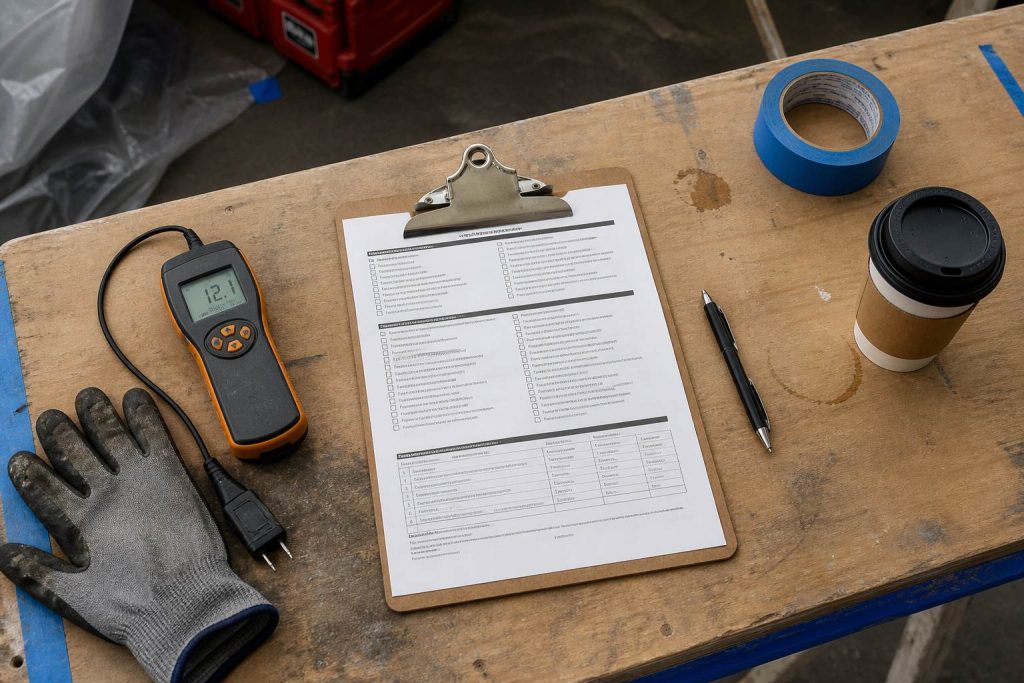
A working every-job post-mortem has a specific shape. The specifics vary by company size, but the structural elements are consistent.
Cadence. Weekly, not monthly. Monthly reviews are too far downstream of the work to change behavior. Weekly reviews catch patterns while the memory is fresh and the next job with the same exposure is still on the schedule.
Attendance. A representative from every function that touches a job. Operations. Sales. A PM (rotating). Estimating. Billing. In larger companies, add contents and reconstruction separately. In smaller companies, one person may cover two roles — but nobody covers a role without knowing it. The whole point is cross-functional visibility. Missing a seat means the review has a blind spot.
Scope. Every job that closed in the review window. Not a sample. Not a selection. Every one. In high-volume companies this means the review covers margin summary for most jobs and deep review for a structured sample — but the margin summary still goes through every job.
Inputs. Pulled from the documentation layer before the meeting. Estimated vs. actual margin. Scope variance. Change order capture. Days-from-loss-to-invoice. PM hours per dollar of revenue. Customer satisfaction signal. Carrier friction events. The inputs are the raw material. The meeting is where the team synthesizes them.
Outputs. Every post-mortem produces three things. A list of SOP adjustments (capture this artifact earlier, route this approval differently, price this job type differently). A list of training or communication gaps (this PM needs shadow estimating hours, this category of work needs a scope refresher). A flagged list of jobs that need owner or leadership follow-up (a client call, a subcontractor conversation, a carrier escalation).
Without documented outputs, the post-mortem is a discussion. With them, it is an operating practice.
The Contrarian Insight: Review the Great Jobs Harder
The jobs that went well contain more extractable learning than the jobs that went badly, because the jobs that went well can be systematized.
A job that came in ten points above target margin is not a random event. Something specific happened. A particular estimator wrote an unusually disciplined scope. A particular PM caught a change order that most PMs would have missed. A particular crew hit productivity above their usual rate. A particular carrier relationship was worked at just the right moment. If the post-mortem can extract what actually produced the outperformance, that practice can be installed as a standard for every job of that type going forward.
Most restoration companies never look at the great jobs. They celebrate them, distribute the credit, and move on. The companies that compound dissect them the same way they dissect the disasters. The upside practice is more valuable than the downside lesson, because the upside practice becomes the new baseline.
The Second Instrument: The Recorded Client Callback
The post-mortem captures what happened operationally. The client callback captures what happened from the customer’s point of view — which is often different, and often more important.
The practice: the owner or a senior manager calls the homeowner or commercial client after the job closes. Not a survey email. Not an automated NPS. A human call. With permission, recorded. Fifteen minutes. Open-ended questions. “Tell me what you remember about the first forty-eight hours.” “What would you change if you had to do it again?” “Was there a moment where you thought about calling a different company?”
Most restoration companies do not do this at all. Of the ones that try, most outsource it to a third-party surveyor whose output is a number, not a story. The owners who do the calls themselves — and listen to the recordings of the ones they cannot personally make — hear things that every other instrument misses.
They hear the PM who was great on day one and disappeared by week three. They hear the subcontractor who showed up in an unmarked truck and made the homeowner nervous. They hear the billing letter that went out with language the homeowner read as a threat. They hear what the referral conversation is going to sound like — or whether it is going to happen at all.
That qualitative layer is not a replacement for the operational post-mortem. It is the missing half. Run together, they produce a complete picture of the job that the numbers alone never will.
This pairs directly with the close-out test — the forward-looking version of the same discipline, applied at the moment of decision rather than after the job is done.
Why This Practice Rides on the Documentation Layer
The every-job post-mortem is impossible without the documentation layer. That is not rhetoric. It is a structural dependency.
If the inputs — estimated margin, actual margin, scope variance, change order capture, hours per revenue dollar, customer feedback — do not live in a central system that can be pulled before the meeting, the meeting spends its time reconciling data instead of drawing conclusions. A post-mortem that reconciles data is a two-hour status update. A post-mortem that works from clean, pre-pulled inputs is a thirty-minute margin clinic.
This is why most restoration companies never actually install the every-job review. Not because they do not believe in it. Because their documentation layer cannot feed it. The fix is always the same: build the layer first, install the review on top of it. Trying to do it in the other order always fails.
What Changes When You Run This
A restoration company that installs the every-job post-mortem starts seeing effects in the first quarter.
Margin tightens because scope discipline improves. Estimators write better scopes because they are sitting with actuals every week. PMs catch more change orders because the pattern is visible. Billing cycles compress because invoice delays get surfaced immediately. Training gaps close because the review identifies which roles need which support. Carrier relationships improve because the recurring friction points get addressed instead of absorbed.
Most importantly, the company learns faster than its competitors. That is the actual compounding mechanism. A company reviewing every job is extracting a few percentage points of operating improvement per quarter. A company reviewing only the disasters is absorbing the same few percentage points as invisible drag. Over five years, the difference is the difference between the two companies.
Where to Start
If you do not run an every-job post-mortem today, start small. One service line. Weekly cadence. Four people in the room. The inputs can be manually pulled for the first month while the documentation layer catches up.
Run it for ninety days before you judge it. The first few weeks will feel slow because the team is building the habit of looking at the numbers together. Around week six the pattern recognition starts to fire and the conversation shifts from reconciling data to drawing conclusions. That is the moment the practice starts to pay.
Extend it to the second service line at month four. Add the client callback as a parallel track at month six. By month twelve it is not a meeting — it is how the company operates. And the company that operates this way is not the same company it was a year ago.
Frequently Asked Questions
What is an every-job post-mortem? A weekly cross-functional review of every job that closed during the week — not just the problem jobs — conducted by representatives from ops, sales, PM leadership, estimating, and billing. The review extracts estimated-vs-actual margin, scope variance, and customer feedback, and produces specific SOP, training, and follow-up adjustments.
Why review every job instead of just the bad jobs? Because the jobs that went well contain extractable upside practices that can be systematized, and the jobs in the middle of the distribution contain patterns of small leakage that only become visible across multiple jobs. Reviewing only the disasters misses both.
Who should attend a restoration post-mortem? At minimum: operations, sales, a rotating PM, estimating, and billing. In larger companies, add contents and reconstruction separately. Missing a seat produces a blind spot in the review.
How long should a post-mortem meeting take? Thirty minutes to an hour for a properly instrumented company. Longer than that usually indicates the documentation layer is not feeding the meeting with clean inputs and the team is reconciling data instead of drawing conclusions.
What is the recorded client callback and why does it matter? The owner or a senior manager calls the client after job close, with permission records the call, and extracts qualitative feedback that no survey or NPS instrument can capture. It reveals friction points — a PM who disappeared, a subcontractor who made the client uneasy, a billing letter that read wrong — that operational metrics miss entirely.
Can a restoration company run an every-job post-mortem without a documentation layer? Not effectively. The inputs the review depends on must come from a central, live system of record. Without it, the meeting spends its time reconciling data instead of improving operations.
Tygart Media on restoration — an analyst-operator body of work on the systems that separate compounding restoration companies from busy ones. No client names. No brand placements. Just the operating standard.
Leave a Reply