Restoration Software & CRM - Tygart Media

Category: Restoration Software & CRM

  • Restoration Software Xactimate Integration Compared: DASH, Albi, PSA, Xcelerate, Encircle (2026)

    Restoration Software Xactimate Integration Compared: DASH, Albi, PSA, Xcelerate, Encircle (2026)

    Every restoration owner reading software comparisons asks the same question two paragraphs in: “Yeah, but how does it actually talk to Xactimate?” Because if your job management platform doesn’t sync cleanly with Xactimate and XactAnalysis, you are paying for a glorified contact list. Your estimators will end up entering the same scope in two systems, your supplements will live in email threads, and your margins will quietly bleed through re-keying errors no one catches until the adjuster denies a line item.

    So let’s skip the brochure language. Here is what the major restoration platforms actually do with Xactimate in 2026 — what syncs, what doesn’t, what you’ll still re-enter by hand, and where each one is worth the money.

    Why Xactimate integration is the real software decision
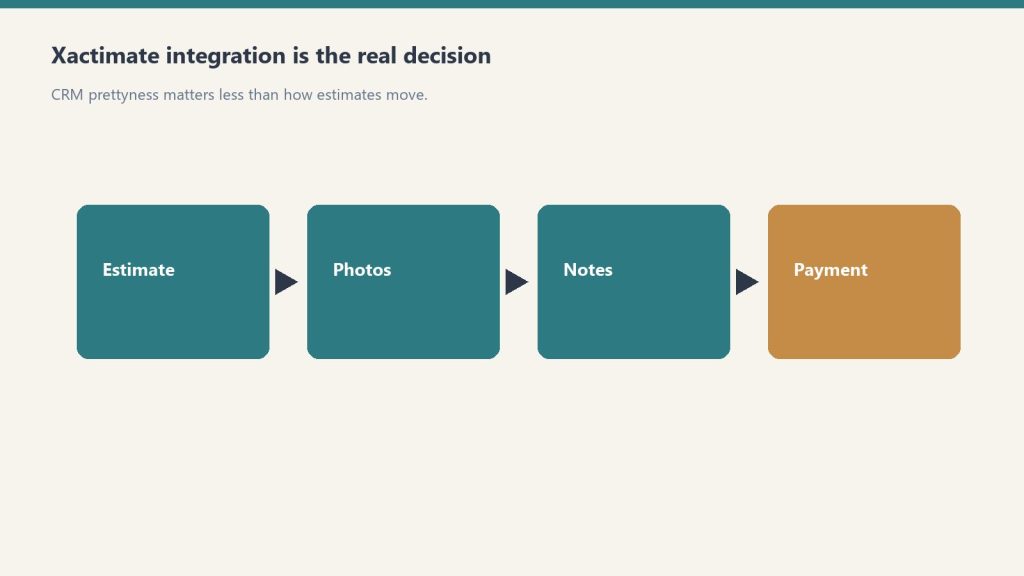
    Xactimate is the dominant property estimating platform on the carrier side of insurance restoration in North America — Symbility is the only meaningful alternative, and most major carriers default to Xactimate. XactAnalysis, the Verisk-owned claims network sitting on top of it, is how carriers route assignments, review estimates, and approve supplements. If you take TPA work or any insurance-direct claims, those two products are non-negotiable in your stack.

    The question is not whether your job management software “integrates with Xactimate.” Almost all of them claim that. The question is what flavor of integration: assignment sync, sketch import, estimate writeback, supplement triggering, or just a one-way push that still leaves your project manager re-keying job notes. Those are five different things. Vendors love to call all of them “Xactimate integration.”

    DASH: assignment-driven, deepest carrier-side workflow
    DASH (formerly Next Gear Solutions, now owned by Verisk — same parent as Xactimate and XactAnalysis) has the tightest carrier-facing integration in the category. That is by design. When you receive an assignment through XactAnalysis, it can flow directly into DASH as a job with the loss address, carrier, adjuster, and coverage details pre-populated. Estimates written in Xactimate can be tied back to the DASH job file, and supplement activity in XactAnalysis is visible inside DASH.

    Pricing for the Xactimate connector is published by multiple resellers as an add-on running roughly $50 to $75 per month per Xactimate seat depending on tier — confirm the exact figure with your DASH rep at quote time, as pricing has shifted with the Verisk repackaging. The integration is not free with the base DASH subscription.

    Where it breaks: DASH is built for high-volume insurance shops. If your business is heavier on cash jobs, reconstruction, or commercial loss, you’ll pay for carrier workflow you don’t use. Smaller shops often find the assignment-driven flow over-engineered for the way they actually quote work.

    Albi: clean UX, integration via partners

    Albi (Albiware) has been the fastest-growing platform in the under-$5M segment for a reason — the interface is genuinely the best in the category, and the implementation timeline is short. On the Xactimate side, Albi exposes a direct connector and also leans heavily on partner integrations: Encircle for field documentation, QuickBooks for accounting, Matterport for capture.

    The honest read on Albi’s Xactimate sync: it works for assignment intake and basic estimate reference, but it is not as deep on the XactAnalysis carrier-side workflow as DASH. If your TPA volume is high and supplements are a constant battle, that gap matters. If you are running a tighter, owner-operator shop, you probably won’t notice.

    Where it breaks: Albi is opinionated about workflow, which is a feature until it isn’t. Multi-branch operators with non-standard processes sometimes find themselves working around the system rather than with it.

    PSA (CanAm): open API, integrates with almost everything

    PSA’s pitch is the open API and the breadth of named integrations: Xactimate, XactAnalysis, CoreLogic Symbility, Encircle, Matterport, DocuSketch, and others on their published partner list. If your stack is heterogeneous — meaning you use Symbility for some carriers and Xactimate for others, or you run multiple capture tools — PSA is the platform that fights you the least.

    The Xactimate sync covers assignment data and estimate references, and the XactAnalysis tie-in supports the supplement workflow restoration owners actually live in. PSA’s positioning is also distinct in that it sells to larger commercial and multi-trade shops, not just water/fire restoration, so the workflow flex matters.

    Where it breaks: the UI shows its age compared to Albi, and the learning curve is steeper. Implementations take longer. Owners who expected an Albi-style experience are routinely surprised by how much configuration PSA expects up front.

    Xcelerate: native Verisk integrations, lean against Xactimate

    Xcelerate publishes its Verisk integrations openly — Xactimate, XactAnalysis, plus QuickBooks, Matterport, and Zapier. The platform’s go-to-market message is built around Xactimate workflow specifically: subcontractor cost control, margin recovery, and reducing the re-keying tax between estimate writers and project managers.

    If you write a lot of estimates and your pain point is the gap between what gets bid and what gets paid, Xcelerate is the platform that talks most directly to that problem. The integration covers assignment intake, estimate references, and XactAnalysis visibility.

    Where it breaks: Xcelerate is smaller than DASH or Albi, the partner ecosystem is thinner, and the platform is still maturing on the contents and reconstruction sides. If you need deep contents pricelist or rebuild workflow, kick the tires hard before signing.

    Encircle: not a CRM, but the integration everyone forgets to budget for

    Encircle deserves its own line item here because it sits between your field crew and Xactimate in a way none of the job management platforms replicate. The Encircle Floor Plan tool exports directly into Xactimate as an ESX sketch file, and that integration — announced jointly with Verisk in 2023 and live for customers since September of that year — eliminates the manual sketch step that used to eat hours per job.

    Encircle’s own marketing claims it cuts on-site inspection and scoping time from around two hours down to 15 to 20 minutes per property. Treat that as a vendor claim, not gospel — but multiple restoration owners report meaningful sketch-time reduction, and the integration is the strongest reason to add Encircle even if you already run DASH, Albi, PSA, or Xcelerate underneath it. Most of those platforms now connect to Encircle as a documentation partner.

    What none of them fully solve

    Supplements. Across every platform on this list, supplements still require human attention — estimators reviewing carrier notes in XactAnalysis, comparing line items against field documentation, and pushing revised estimates back through. Verisk’s XactAI rollout adds AI assistance for converting mitigation estimates into rebuild estimates, and that lives inside Xactware products, not your CRM. If a vendor tells you their software “automates supplements,” ask exactly which steps. The honest answer in 2026 is: it surfaces them, it doesn’t write them.

    Bottom line
    If you run heavy TPA volume and live in XactAnalysis, DASH is still the deepest integration in the category and the carrier-side workflow is worth the premium. If you are under $5M, run mostly direct insurance and cash work, and want a platform your team will actually use, Albi is the best UX bet — pair it with Encircle for the sketch workflow. If your stack is mixed estimating software or you need open API flexibility, PSA is the right answer despite the older interface. If margin recovery on Xactimate-written estimates is your single biggest pain, Xcelerate’s positioning maps to your problem.

    And before you sign anything: get the Xactimate integration in writing. Ask for the exact monthly add-on cost, ask which workflow steps sync versus which require manual handoff, and ask for one customer reference in your size band running the integration today. The platforms that hesitate on any of those three are telling you something.

  • DASH vs Albi vs PSA vs Xcelerate: The Honest 2026 Restoration Software Comparison

    DASH vs Albi vs PSA vs Xcelerate: The Honest 2026 Restoration Software Comparison

    If you run a restoration company doing between $1M and $10M, the software question is no longer “do we need a system?” It’s “which one do we commit to for the next five years, because the switching cost is going to hurt either way.” This is the honest comparison nobody selling you a demo will give you — built entirely from live, first-party data pulled directly from each vendor’s own site in June 2026.

    The restoration software market in 2026 has consolidated into roughly four serious purpose-built platforms — Cotality DASH, Albi, PSA, and Xcelerate — plus a tier of adjacent tools (Encircle, CompanyCam, JobNimbus, ServiceTitan) that solve part of the problem but force you to stitch the rest together.

    The short answer for impatient owners

    • DASH (Cotality): Deepest integration with the insurance ecosystem. The default if TPA volume is more than 30% of your book. Formerly DASH by Next Gear Solutions — now backed by Cotality’s full property data ecosystem.
    • Albi: Most customizable. $6,000 minimum annual subscription ($60/seat Base, $100/seat Pro). Built by restorers who hated being forced into someone else’s workflow. Now includes native Xactimate and XactAnalysis integration (Pro seats).
    • PSA (Canam Systems): The independently-owned value play for larger teams. Flat team-based pricing instead of per-user makes it dramatically cheaper once you cross 10–15 users. Serves 9,278+ restoration contractors.
    • Xcelerate: Best if you want process discipline baked in. Built by a former restoration GM. SOC 2 Type 2 certified. Strong native integrations, limited customization.
    • ServiceTitan: Only makes sense above roughly $5M revenue with 20+ technicians and multi-location complexity. Below that, you’re buying enterprise overhead.
    • JobNimbus, CompanyCam, Encircle: Component tools, not full systems. Useful inside a stack, dangerous as the stack.

    Head-to-head comparison table

    Factor Cotality DASH Albi PSA (Canam) Xcelerate
    Pricing model Contact for quote $60/seat Base · $100/seat Pro · $6K/yr min Flat team pricing, contact for quote Contact for quote
    Best for TPA-heavy, insurance restoration Retail-heavy, customization-first teams Teams 15+ users, price-sensitive Operators wanting built-in process discipline
    Xactimate integration Yes (native) Yes (Pro seats — Xactimate & XactAnalysis) Yes (Xactimate & XactAnalysis) Yes (native)
    QuickBooks integration Yes (Online + Desktop) Yes (Online + Desktop) Yes Yes
    Mobile app Yes (iOS + Android) — true offline mode Yes (Albi Mobile) Yes (Proven OnSite) Yes (field-to-office sync)
    Security certification AICPA SOC 2 Type II Not publicly disclosed Not publicly disclosed SOC 2 Type 2
    Owner type Cotality (publicly traded parent) Independent Independently owned Independent
    Customization Moderate High Moderate Low (by design)

    Quick Reference: Restoration Software at a Glance

    Cotality DASH (formerly CoreLogic DASH) — owned by Cotality, publicly traded. Native Xactimate/XactAnalysis integration, true offline mobile, Cotality Mitigate for water mitigation. Best for TPA-heavy, insurance-led restoration contractors. Contact: (866) 774-3282.

    Albi (formerly Albi Restoration) — independent, built by restorers. DryBook 2.0 for moisture tracking, open REST API + Zapier (2000+ apps), Xactimate on Pro seats ($100/user/mo). Best for retail-first and tech-forward restoration companies. 7-minute average support response. Contact: albiware.com.

    Xcelerate (by Xcelerate Software) — SOP-driven workflow for multi-location and franchise operators. 13 verified integrations including Zapier, CompanyCam, Encircle, Matterport, Xactimate/XactAnalysis, RingCentral, Power BI, TSheets. Contact: (423) 405-6417.

    PSA (by Canam Systems, independent) — full ERP for restoration with flat team-based pricing. Integrates with Xactimate, XactAnalysis, CoreLogic Symbility, Encircle, Matterport, DocuSketch. 9,278+ contractors on platform. Contact: canamsys.com.

    The four serious platforms, in detail

    Cotality DASH

    DASH is now owned by Cotality (formerly CoreLogic) and connects natively to QuickBooks Online, QuickBooks Desktop, Sage 100, Sage 300, Claims Connect, Matterport, DocuSketch, Cotality CRM, and Cotality Mitigate. If you are pulling jobs from Contractor Connection, Code Blue, or any TPA that lives inside the Cotality/CoreLogic ecosystem, DASH is the path of least resistance.

    The platform is AICPA SOC 2 Type II certified, has a true offline mobile mode (data saves locally and syncs when service is restored — critical in disaster zones), and includes an automated Compliance Manager that bakes carrier-specific workflows directly into field checklists. Cotality’s property data platform also auto-populates job file details using AI-analyzed property data from their broader data ecosystem — a genuine differentiator.

    Pricing is not publicly listed; contact Cotality directly at (866) 774-3282 for a quote. They offer web, iOS, and Android access.

    Where it breaks: Customization is limited. You operate inside DASH’s idea of a restoration workflow, not yours. Owners who pride themselves on “we do it differently” tend to fight the software. The Cotality platform is also deeply tied to the insurance ecosystem — retail-heavy shops get less value from the native integrations.

    Albi

    Albi was built by restoration contractors who got tired of being forced into preset workflows. The platform’s calling card is customization — fields, stages, reports, and metrics bend to your operation rather than the other way around.

    Verified current pricing (albiware.com/albi-pricing, June 2026):

    • Base seats: $60/user/month — field technician features (job management, field documentation, mobile, DryBook 2.0)
    • Pro seats: $100/user/month — adds invoicing, estimating, Xactimate/XactAnalysis integration, advanced scheduling, CRM, role-based permissions, full accounting integrations
    • Minimum annual subscription: $6,000 (4 seats required: 2 Base + 2 Pro)
    • Onboarding: Standard $1,000 one-time setup fee; White Glove onboarding $2,500; Enterprise onboarding $4,500 (includes 2-day in-person training)
    • Analytics Package add-on: from $250/month; Automations Package: from $250/month

    Albi’s notable 2026 additions include Albi AI, Albi Capture (floor plans), and Albi Pay (in-field payments, ACH, credit card). Integrations include QuickBooks Online, QuickBooks Desktop, Sage, Xactimate (Pro), XactAnalysis (Pro), Encircle, CompanyCam, Kahi, Zapier, and open REST API/webhooks.

    Support response time is 7 minutes average with 24-hour average resolution. The platform is used by thousands of restoration companies worldwide.

    Where it breaks: The $6K annual minimum makes it overkill for single-operator shops. The per-seat model becomes expensive at 20+ users compared to PSA’s flat pricing. Onboarding costs add up — budget for them.

    PSA (Canam Systems)

    PSA is built by Canam Systems, an independently owned technology provider that explicitly positions itself as having “restorers’ best interest in mind” — a pointed distinction from Cotality-owned DASH. The platform serves 9,278+ restoration contractors and has been adopted by brands including BluSky Restoration, Winmar, PuroClean Canada, and Dalworth Restoration.

    PSA is a full ERP for restoration: Proven Accounting (job costing, real-time financials), Proven Jobs (job management), Proven CRM (relationship management and sales), Proven OnSite (real-time SMS tech-to-customer alerts and review collection), and Proven Analytics (live reporting dashboards). The PSA Canada User Conference runs November 1–3, 2026 in Toronto.

    Integration coverage: Xactimate, XactAnalysis, CoreLogic Symbility, Encircle, Matterport, DocuSketch, plus open API access for other integrations. Pricing is team-based (not per-user) — contact Canam for a quote at canamsys.com.

    Where it breaks: The UI is less polished than DASH or Xcelerate. Implementation is more involved. If you have a tech-light operations manager, expect a real ramp. PSA is stronger in Canada than in the US market — verify US reference customers if that matters to you.

    Xcelerate

    Xcelerate was founded by a former restoration general manager, and it shows. The platform bakes operational discipline — profitability tracking, stage gates, team accountability — into the default workflow. Xcelerate is SOC 2 Type 2 certified, serving contractors across North America including CAT disaster operators and multi-location franchises.

    Feature suite: Job management, built-in CRM (referral tracking, leaderboards, route planning), analytics dashboards, marketing tools (lead-gen websites, Google listings, city landing pages), and an integrated marketing platform for digital campaigns. Field-to-office mobile sync keeps crews connected without manual re-entry. A case study from CORE Environmental Solutions shows $0 to $1.2M in sales in the first 8 months of operations.

    Integrations verified from xlrestorationsoftware.com: HubSpot, Mailchimp, and additional partners listed on their integrations page. Contact at (423) 405-6417 for a demo.

    Where it breaks: Customization is intentionally minimal. The bet Xcelerate is making is that the average restoration company should adopt best practices rather than enshrine its quirks in software. Owners who want the platform to bend to them will be frustrated. Pricing is not publicly listed — requires a strategy session call.

    The adjacent tools: useful, but not the whole system

    ServiceTitan brings enterprise-grade dispatch, reporting, and marketing attribution, plus restoration-specific modules. Per-user pricing escalates fast. Unless you are running a multi-location restoration franchise at $5M+ with 20+ technicians, this is too much platform for the problem.

    JobNimbus starts around $40/user/month and excels at visual job boards and photo documentation. It lacks restoration-specific guts: no moisture mapping, no equipment tracking, no IICRC S500 compliance prompts. Workable as a starter system under roughly $750K revenue. Above that, you outgrow it.

    CompanyCam is a documentation tool, not a CRM. It is excellent at what it does and pairs cleanly with all four major platforms. Do not buy it as your system of record.

    Encircle is the field documentation specialist — moisture mapping, photo organization, and report generation are best-in-class. Many restoration shops run Encircle alongside DASH or Albi rather than as a standalone. Contact for current pricing.

    The decision framework

    Forget feature checklists. Three questions decide this for you.

    1. What percentage of your revenue comes from TPA and direct insurance work? If it’s above 30%, DASH gets the first look because the Cotality ecosystem is where your jobs live. If it’s below 30% and you’re mostly retail, you have real options.
    2. How many users will be in the system 24 months from now? Above 15 users, PSA’s flat pricing pays for itself within a year. At 5–14 users, Albi’s per-seat model is competitive. Below 5 users, evaluate Albi’s $6K minimum against what you actually need.
    3. Are you the kind of owner who wants the software to enforce your process, or one who wants the software to mirror your process? Xcelerate enforces. Albi mirrors. DASH and PSA sit between.

    What this costs you if you get it wrong

    A restoration company doing $3M with eight users on the wrong platform will typically lose somewhere between 40 and 120 hours of estimator and admin time per month to friction — workarounds, double entry, missing supplements, late invoicing. At a fully loaded $50/hr that is $2,000–$6,000 per month of pure overhead, before you count the supplements that fall through the cracks. Software is not the place to optimize for the cheapest sticker price. It is the place to optimize for the workflow your team will actually use without resentment.

    The bottom line

    If you are TPA-heavy, start with Cotality DASH. If you are retail-heavy with strong process opinions and budget for $6K/year minimum, start with Albi. If you are 15+ users and price-sensitive, force PSA into the demo cycle. If you want the software to make your team better operators by default, look at Xcelerate. Anything else — ServiceTitan, JobNimbus, standalone CompanyCam, standalone Encircle — is either too much platform or too little. Pick one of the four, commit, and stop shopping. The compounding ROI of a fully adopted system always beats the theoretical 12% feature edge of the platform you would have switched to.

    Frequently Asked Questions

    What is the best restoration company software in 2026?

    There is no single best. Cotality DASH wins for TPA-heavy operators needing deep insurance ecosystem integration. Albi wins for customization-first retail shops ($6K/year minimum). PSA wins for teams above 15 users on flat pricing. Xcelerate wins for operators who want process discipline baked in. The best platform is the one your team will actually adopt fully.

    How much does Albi restoration software cost?

    Per albiware.com as of June 2026: Base seats cost $60/user/month and Pro seats cost $100/user/month. The minimum annual subscription is $6,000, which requires 4 seats minimum (2 Base, 2 Pro). Onboarding is a separate one-time fee starting at $1,000. Analytics and Automations packages are available as add-ons starting at $250/month each.

    Does Albi integrate with Xactimate?

    Yes. Per albiware.com/albi-pricing, Albi Pro seats include Xactimate and XactAnalysis integration. This is available on Pro user seats ($100/seat/month) but not Base user seats ($60/seat/month). This corrects older information that stated Albi lacked a native Xactimate integration.

    What integrations does Cotality DASH support?

    Per cotality.com as of June 2026, DASH integrates with QuickBooks Online, QuickBooks Desktop, Sage 100, Sage 300, Claims Connect, Matterport, and DocuSketch. It also connects natively with Cotality CRM and Cotality Mitigate to centralize the full restoration workflow. DASH was formerly known as DASH by Next Gear Solutions — same software, now backed by Cotality’s data ecosystem.

    What is PSA restoration software and who owns it?

    PSA is built by Canam Systems, an independently owned technology provider headquartered in Canada. It is a full ERP for restoration companies, covering job management, CRM, accounting, and analytics in a single platform. PSA serves 9,278+ restoration contractors and integrates with Xactimate, XactAnalysis, CoreLogic Symbility, Encircle, Matterport, and DocuSketch. Flat team-based pricing (not per-user) makes it cost-effective for larger teams.

    Is Xcelerate restoration software SOC 2 certified?

    Yes. Per xlrestorationsoftware.com, Xcelerate meets SOC 2 Type 2 standards for data security and process integrity, independently audited. Cotality DASH is also AICPA SOC 2 Type II certified. Albi and PSA do not publicly disclose equivalent certifications on their current websites.

    Is ServiceTitan good for restoration companies?

    ServiceTitan makes sense for restoration companies above roughly $5M in revenue with 20+ technicians and multi-location complexity. Below that, the cost and implementation burden outweigh the benefit versus a purpose-built restoration platform like DASH, Albi, PSA, or Xcelerate.

    Can I run my restoration company on JobNimbus or CompanyCam alone?

    JobNimbus works as a starter system below roughly $750K in revenue but lacks restoration-specific tools like moisture mapping and equipment tracking. CompanyCam is a documentation tool, not a CRM, and should be paired with a full platform rather than used as your system of record.