Author: Will Tygart

  • Claude Managed Agents Rate Limits — What 60 Requests Per Minute Means in Practice

    Claude Managed Agents Rate Limits — What 60 Requests Per Minute Means in Practice

    The Lab · Tygart Media
    Experiment Nº 561 · Methodology Notes
    METHODS · OBSERVATIONS · RESULTS

    You’re planning to run Claude Managed Agents at scale. You’ve modeled the token costs, the session-hour charge, the workload cadence. Then you hit the actual constraint: rate limits. Here’s what 60 requests per minute actually means in practice, and whether it’s going to be your ceiling.

    The Two Limits You Need to Know

    Managed Agents has two endpoint-specific rate limits, separate from your standard Claude API limits:

    • Create endpoints: 60 requests per minute
    • Read endpoints: 600 requests per minute

    Your organization-level API limits apply on top of these. If your org is on a tier with a lower requests-per-minute ceiling, that’s the actual binding constraint.

    What “60 Create Requests Per Minute” Actually Means

    A create request, in Managed Agents context, is typically a session creation call — starting a new agent session. 60/minute means you can start 60 sessions per minute maximum. For almost all real workloads, this is not the binding constraint. Here’s why:

    Think about what generates create requests. If you’re running a batch pipeline that starts one new agent session per content item, processing 60 items per minute would saturate the limit. But a 60-item-per-minute content pipeline is running 3,600 items per hour — a genuinely high-volume operation. Most production agent workloads don’t look like this. They look like one session that runs for minutes or hours, processes multiple tasks within that session, and terminates when done.

    The create limit matters most for architectures where you’re spinning up a new session per task rather than running tasks within a persistent session. If that’s your pattern, 60/minute is a hard ceiling you’ll need to design around.

    What “600 Read Requests Per Minute” Actually Means

    Read requests include polling session status, reading agent output, checking checkpoints, and retrieving session state. 600/minute is a relatively generous limit — that’s 10 reads per second. For a monitoring dashboard polling 10 active sessions every second, you’d hit this. For most production monitoring patterns (checking status every 5-30 seconds per session), you’re well under the ceiling.

    The read limit becomes relevant in high-concurrency architectures where many sessions are running in parallel and all being polled aggressively. If you’re running 50 concurrent agents and checking each one every 2 seconds, that’s 25 reads/second — still within the 10 reads/second limit per second, but compressing toward it.

    The Limit That’s More Likely to Actually Stop You

    For most agent workloads, token throughput limits hit before request rate limits do. The reasoning: a long-running agent session processing significant context generates a lot of tokens. If you’re running many such sessions in parallel, you’ll hit your organization’s token-per-minute limit before you hit 60 sessions created per minute.

    Token limits depend on your API tier. Higher tiers have higher token throughput limits. Rate limit increases and custom limits for high-volume enterprise customers are negotiated with Anthropic’s sales team.

    Designing Around the 60 Create Limit

    If your architecture genuinely needs more than 60 new sessions per minute, the primary design pattern is batching more work within each session rather than creating more sessions. A single Managed Agents session can handle sequential tasks — you don’t need a new session per task if your tasks can be queued and processed within one session’s lifecycle.

    The tradeoff: longer-running sessions accumulate more runtime charge ($0.08/hr active). For most workloads, the efficiency gains from batching outweigh the marginal runtime cost.

    The Agent Teams Implication

    Agent Teams — Managed Agents’ multi-agent coordination feature — coordinate multiple Claude instances with independent contexts. Each instance in an Agent Team is a separate entity from a context standpoint. How Agent Team member sessions count against the create rate limit is worth verifying against current documentation if you’re architecting a high-concurrency Agent Teams deployment.

    For Enterprise Workloads

    If you’re evaluating Managed Agents for enterprise-scale deployment and the published limits don’t fit your volume requirements, contact Anthropic’s enterprise sales team. Rate limit increases for high-volume applications are a documented option — they’re negotiated, not self-serve.

    Contact: [email protected] or through the Claude Console.

    Frequently Asked Questions

    Does the 60 requests/minute limit apply to all API calls or just session creation?

    The 60/minute limit applies to create endpoints — session creation being the primary one. Read operations have a separate 600/minute limit. Standard Messages API calls are governed by your organization’s standard tier limits, not these Managed Agents-specific limits.

    Do subagents count against the create rate limit separately from the parent session?

    Subagents operate within the parent session’s context and report results upward — they’re architecturally different from new sessions. Verify current documentation for precise billing treatment of subagent creation calls vs. Agent Team session creation.

    What happens when I hit the rate limit?

    Standard API rate limit behavior applies — requests over the limit receive a 429 response. Implement exponential backoff in your session creation logic for any high-volume pattern that approaches the 60/minute ceiling.

    How does this compare to OpenAI’s Agents API limits?

    Rate limit structures differ by product and tier. Direct comparison requires checking both providers’ current documentation for your specific tier. The full comparison: Claude Managed Agents vs. OpenAI Agents API.

    Full pricing context including rate limits: Claude Managed Agents Complete Pricing Reference. All questions: Claude Managed Agents FAQ.

  • Radon Mitigation System Installation in New Construction

    Radon Mitigation System Installation in New Construction

    The Distillery — Brew № 1 · Radon Mitigation

    The lowest-cost and most effective time to address radon in a home is during construction — before the slab is poured, before walls are framed, before any remediation work is necessary. New construction radon mitigation installs a passive system (pipe, no fan) that can be activated with a fan at any future point for roughly $200–$400. Doing this same work after construction costs $800–$2,500 and requires drilling through finished concrete and routing pipe through finished walls.

    What Is Radon-Resistant New Construction (RRNC)?

    Radon-Resistant New Construction (RRNC) is a set of EPA-recommended building practices that minimize radon entry into new homes and create infrastructure for easy mitigation activation if post-construction testing reveals elevated levels. The EPA first published RRNC guidance in the 1990s; AARST-ANSI standard RRNC-2022 provides the current comprehensive technical requirements.

    RRNC is not a complete radon mitigation system. It is a passive infrastructure that makes active mitigation fast and inexpensive if needed. Think of it as a pre-wired electrical box: the capacity is built in, but you turn on power when you confirm you need it.

    Is RRNC Required by Building Code?

    RRNC requirements vary by state and municipality:

    • States with mandatory RRNC: Several states in EPA Radon Zone 1 (highest risk) require RRNC for all new residential construction. These include portions of Colorado, Iowa, Montana, North Dakota, South Dakota, and others.
    • States with voluntary or conditional RRNC: Many states adopt the International Residential Code (IRC) which includes RRNC provisions as a recommended (not mandatory) section. Some counties and municipalities within these states mandate RRNC independently.
    • States with no RRNC requirement: Builders in these areas may or may not include RRNC voluntarily.

    Regardless of legal requirement, the EPA recommends RRNC for all new construction — the incremental cost during construction is $350–$700 versus $800–$2,500+ for post-construction installation.

    The Four Core RRNC Components

    Per EPA RRNC guidance and AARST-ANSI RRNC-2022, a complete passive RRNC system consists of four elements.

    1. Gas-Permeable Layer

    A 4-inch layer of clean 3/4″ gravel (or equivalent gas-permeable material) placed beneath the slab across the entire footprint. This aggregate layer allows soil gases — including radon — to move freely beneath the slab toward the suction point rather than being forced through the concrete itself.

    Some jurisdictions allow alternative gas-permeable materials (certain drainage mats, for example) in lieu of gravel. The gravel layer also serves as drainage and supports the slab from below, so it has structural benefit regardless of radon.

    2. Plastic Sheeting (Vapor Barrier)

    A continuous layer of minimum 6-mil polyethylene sheeting placed over the gas-permeable gravel layer, beneath the concrete slab. The vapor barrier:

    • Prevents soil moisture from wicking up into the slab
    • Serves as a secondary barrier reducing radon and other soil gas migration through the slab
    • Laps up the interior foundation walls and seals at all penetrations

    The sheeting must be continuous — seams lapped a minimum of 12 inches and taped, penetrations sealed — before the concrete pour. Any gap becomes a permanent bypass that undermines both moisture and radon control.

    3. Vent Pipe

    A 3-inch or 4-inch PVC schedule 40 vent pipe is installed through the vapor barrier and slab during construction, routed through the building to terminate above the roof. This is the passive vent pipe that:

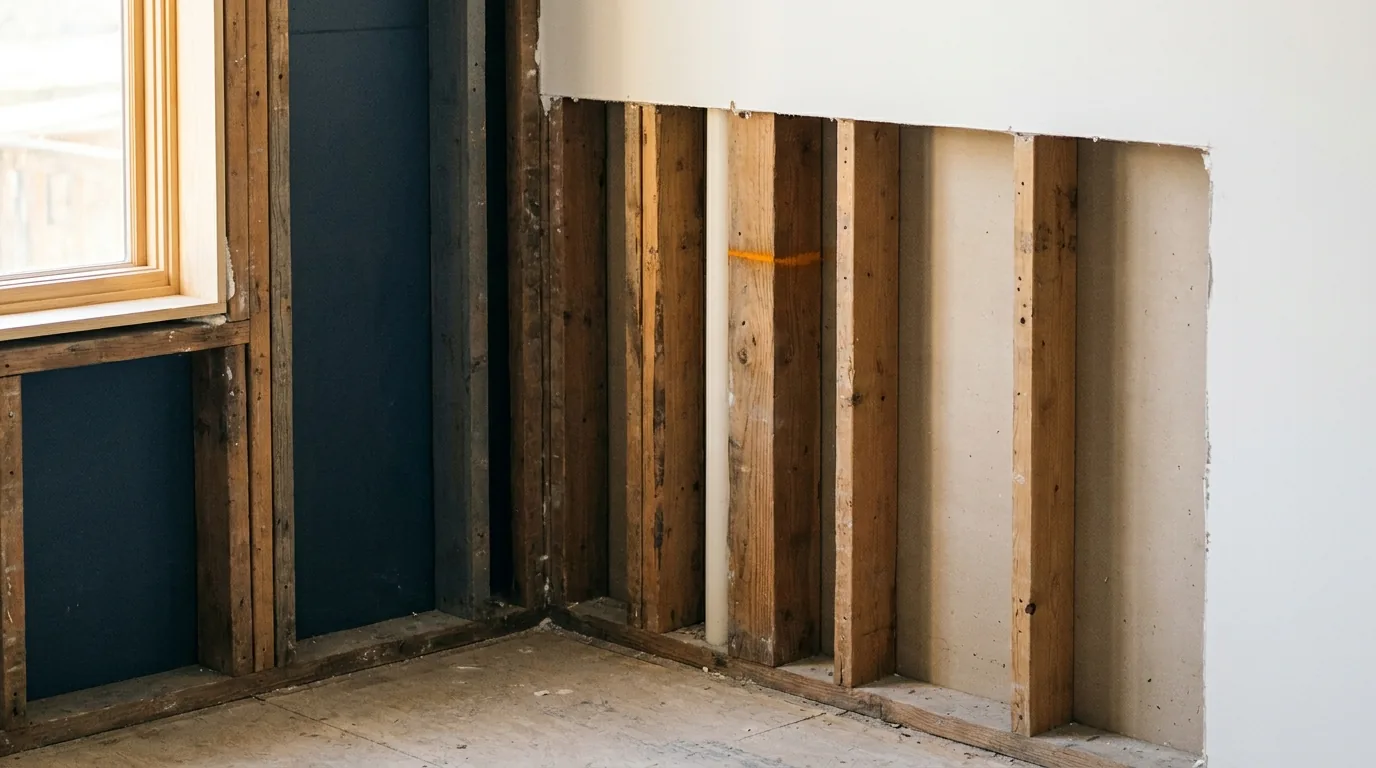
    • Runs from the sub-slab gravel layer up through the home’s interior (often inside the wall system or through a designated chase)
    • Connects to the exterior atmosphere above the roofline, providing passive thermal-draft ventilation of soil gases
    • Terminates with a cap that prevents precipitation and pest entry while allowing airflow

    The passive pipe alone — without a fan — can reduce radon by 30–50% in homes with favorable conditions (strong thermal draft, good aggregate, well-sealed slab). But it is not reliable as a sole mitigation strategy. Its primary value is as fan-ready infrastructure.

    4. Electrical Outlet in Attic or Near Fan Location

    An electrical junction box or outlet is installed in the attic (or wherever the future fan will be mounted) during initial construction. This ensures that activating the system with a radon fan requires only connecting the fan — no electrical work, no running new circuits through finished walls.

    This electrical prep step is frequently skipped by builders who are unfamiliar with RRNC or trying to minimize cost. When skipped, future fan activation requires an electrician to run a new circuit to the attic — adding $150–$400 to the activation cost.

    Passive-to-Active Conversion: Activating the System

    When post-construction radon testing shows levels at or above 4.0 pCi/L (EPA action level), or when a homeowner wants to reduce levels proactively, the passive RRNC system is activated by adding a radon fan. This is the simplest radon mitigation work available:

    • The existing passive pipe is already routed from sub-slab to above roofline
    • A radon fan is installed in the pipe run — typically in the attic between the riser and the discharge — and connected to the pre-installed electrical outlet
    • The installation takes 1–2 hours and costs $200–$500 in labor plus the fan ($100–$300)
    • A system performance indicator (manometer) is installed on the visible portion of the pipe inside the home
    • Post-activation radon testing confirms results

    Compare this to a full post-construction installation ($800–$2,500, 4–8 hours of labor) to understand why RRNC is consistently recommended by EPA, AARST, and every state radon program.

    RRNC in Crawl Space Homes

    For new construction homes with crawl spaces, RRNC provisions differ from slab/basement applications:

    • Vapor barrier: A 6-mil (minimum) polyethylene barrier is installed over the crawl space floor during construction, lapped up foundation walls and sealed at all penetrations
    • Vent pipe: A 3″–4″ PVC pipe penetrates the vapor barrier and routes through the home to above the roof — same passive vent function as the slab installation
    • Crawl space vents: AARST RRNC-2022 allows either vented or encapsulated crawl space design — the RRNC vent pipe infrastructure accommodates both

    Testing After Construction

    AARST and EPA recommend testing a new home for radon after occupancy, even if RRNC was implemented during construction. Reasons:

    • RRNC reduces radon entry but does not guarantee levels below 4.0 pCi/L — soil conditions and construction variations affect results
    • Passive-only systems may not achieve sufficient reduction in high-radon-zone homes without fan activation
    • Post-construction testing establishes a baseline for comparison if the home is later modified (addition, basement finish)

    The EPA recommends testing new homes after at least 60 days of occupancy under normal living conditions (closed house not required for initial new construction testing, as 60 days of normal occupancy provides sufficient averaging).

    Working with Builders: What to Specify

    If you are purchasing or building a new home and want to ensure RRNC is included:

    • Add RRNC to the contract as a line item — “Installation of passive radon vent system per EPA RRNC guidance and AARST-ANSI RRNC-2022”
    • Specify 10-mil or 20-mil vapor barrier (beyond the 6-mil minimum)
    • Confirm the electrical outlet in the attic is included
    • Request documentation at closing: vent pipe location, where it terminates, and outlet location
    • Ask whether the jurisdiction requires a permit for the RRNC installation and confirm the builder will obtain it

    Builders who have not done RRNC before may resist or underestimate the requirement. Having the AARST-ANSI RRNC-2022 standard number in the contract gives you a reference document that defines exactly what is required.

    Frequently Asked Questions

    What does RRNC stand for in radon mitigation?

    RRNC stands for Radon-Resistant New Construction. It refers to a set of EPA-recommended building practices that install passive radon vent infrastructure during home construction — before the slab is poured — making future radon fan activation fast and low-cost if post-construction testing shows elevated levels.

    How much does RRNC cost during new construction?

    RRNC during construction typically costs $350–$700 as a builder add-on. This includes the gas-permeable gravel layer (often already planned for structural reasons), vapor barrier (often already in the plans), vent pipe installation, and electrical outlet in the attic. Compare this to $800–$2,500 for post-construction installation.

    Does a passive RRNC system reduce radon by itself?

    Passive systems (no fan) can reduce radon 30–50% through thermal draft — warm air rising through the pipe creates natural suction. But passive systems are not reliable as sole mitigation — the thermal draft effect varies with outdoor temperature, wind, and internal building pressure. If post-construction testing shows levels above 4.0 pCi/L, fan activation is recommended.

    If I buy a new home with RRNC, do I need to test for radon?

    Yes. RRNC reduces radon entry probability but does not guarantee levels below the EPA action level of 4.0 pCi/L. Test after at least 60 days of occupancy under normal living conditions. If levels are at or above 4.0 pCi/L, activate the system by adding a fan — a 1–2 hour installation that costs $300–$800 total.

    Can RRNC be added to a home after construction has started?

    Partially. If the slab has not yet been poured, the gravel layer, vapor barrier, and pipe penetration through the slab can still be completed. If the slab is poured but walls are not yet framed, the vent pipe can still be routed through wall framing before drywall. Once walls are finished, full RRNC infrastructure cannot be added — the installation becomes a standard post-construction retrofit.

  • What Notion’s Claude Managed Agents Integration Actually Does

    What Notion’s Claude Managed Agents Integration Actually Does

    Tygart Media Strategy
    Volume Ⅰ · Issue 04Quarterly Position
    By Will Tygart
    Long-form Position
    Practitioner-grade

    When Anthropic launched Claude Managed Agents, Notion was one of four launch partners. That detail got buried in the announcement. Here’s what it actually means for people who use Notion for knowledge work, and why “Notion voice input desktop” keeps showing up as a query against a Managed Agents page.

    Short answer: Managed Agents in Notion is an ambient intelligence layer. It’s not a chatbot in a sidebar. It’s an agent that watches your workspace and acts — without you directing every step.

    What the Notion Integration Actually Does

    Notion’s Claude Managed Agents integration runs as a persistent background agent with access to your workspace. The practical capabilities, as documented at launch:

    • Autonomous page updates: The agent can read, summarize, and rewrite Notion pages without manual triggers. You set a task; it works through it.
    • Cross-database synthesis: Pull data from multiple Notion databases, synthesize it, and write outputs to a target page or database entry
    • Meeting note processing: Ingest raw meeting notes and produce structured summaries, action items, and task entries in your project database
    • Workflow automation: Trigger actions based on database property changes — a status update in one database can kick off agent work in another

    The key difference from Notion AI (which Notion has had for some time): Notion AI is request-response. You ask it something; it answers. Managed Agents in Notion can be configured to run autonomously on a schedule or on trigger, keep working through multi-step tasks, and report back when done. It’s closer to a background employee than an on-demand assistant.

    Why This Showed Up in Search as “Notion Voice Input Desktop”

    This is worth explaining, because that query cluster is real and mildly interesting. The Managed Agents announcement included voice input functionality — the ability to interact with agents via voice in some contexts. People searching “notion voice input desktop” and “notion ai voice input desktop” were looking for whether this voice capability existed in the desktop client for Notion specifically.

    The honest answer as of April 2026: voice input capabilities are in preview or context-dependent. Verify current availability in Notion’s desktop client against their current documentation — this is an area that may have evolved since launch.

    The “Decoupled Brain and Hands” Model Applied to Notion

    Anthropic describes their Managed Agents architecture as decoupling the brain (Claude, the reasoning layer) from the hands (the sandboxed containers where actions execute). In Notion’s context, this maps cleanly:

    • The brain reads your Notion workspace, understands context, makes decisions about what to do
    • The hands execute — writing to pages, updating database entries, moving content between sections

    The brain and hands operate independently. The agent can reason about what your project needs without being tightly coupled to the specific API calls that will implement it. This matters because it means the agent can handle ambiguity — “clean up the Q2 notes and create action items” is a goal, not a procedure, and the agent figures out the procedure.

    What You Actually Configure

    To run Claude Managed Agents in Notion, you’re defining:

    • Task definition: What the agent is supposed to accomplish (in natural language or structured format)
    • Tool access: Which Notion databases, pages, and capabilities the agent can read and write
    • Guardrails: What the agent cannot do — pages it can’t modify, actions it must confirm before taking
    • Trigger: When the agent runs — on schedule, on database trigger, or on demand

    You don’t write the orchestration logic. Anthropic’s infrastructure handles session management, state persistence, and error recovery. If the agent hits an error mid-task, it checkpoints and recovers — you don’t lose progress.

    The Practical Cost of Running Notion Agents

    Using Managed Agents in Notion triggers the same billing as any Managed Agents session: standard token rates plus $0.08/session-hour of active runtime. For typical knowledge work tasks:

    • A daily meeting summary agent running 15 minutes of active execution: ~$0.02/day in runtime (~$0.60/month), plus token costs for the volume of notes processed
    • A weekly database synthesis task running 45 minutes: ~$0.06/run

    For most knowledge workers, the session runtime cost is negligible — the token costs (driven by how much content the agent reads and writes) are the actual variable to model. See the complete pricing reference for worked examples.

    Asana and the Broader Pattern

    Asana was also a Managed Agents launch partner, and the integration pattern is similar: an agent that can read project data, update task statuses, move cards, and generate project summaries without constant human direction. The launch partner list (Notion, Asana, Rakuten, Sentry) suggests Anthropic targeted three categories: knowledge management (Notion), project management (Asana), enterprise operations (Rakuten), and developer tools (Sentry).

    That’s a deliberate wedge. If agents can handle the administrative layer of these four categories, the surface area for autonomous business work expands significantly.

    What This Means for How You Work

    The honest use case for most people reading this: you have a Notion workspace with databases that need regular synthesis, and you’re currently doing that manually. Managed Agents is the path to automating that synthesis without building and maintaining a custom integration.

    The constraint worth naming: you’re running your workspace data through Anthropic’s infrastructure. That’s the trade-off. For most knowledge work, the data sensitivity concern is low. For anything involving client data, legal documents, or proprietary strategy — read Anthropic’s data handling terms before configuring access.

    For the full Managed Agents setup and pricing context: Claude Managed Agents: Every Question Answered. For the enterprise deployment pattern: How Rakuten Deployed 5 Enterprise Agents in a Week.

  • Claude Managed Agents — Every Question Answered (Complete FAQ 2026)

    Claude Managed Agents — Every Question Answered (Complete FAQ 2026)

    Tygart Media Strategy
    Volume Ⅰ · Issue 04Quarterly Position
    By Will Tygart
    Long-form Position
    Practitioner-grade

    Everything people actually ask about Claude Managed Agents, answered straight. No preamble about “the exciting world of AI agents.” If you’re here, you already know why this matters — you just need answers.

    This page covers pricing, setup, capabilities, limits, comparisons, and the specific questions that don’t have obvious homes in Anthropic’s documentation. It updates as the beta evolves.

    Context

    Claude Managed Agents launched April 8, 2026 as a public beta. All answers reflect current documentation as of April 2026. Beta details change — verify specifics at platform.claude.com/docs.

    Pricing Questions

    What does Claude Managed Agents cost?

    Two charges: standard Claude API token rates (same as calling the Messages API directly) plus $0.08 per session-hour of active runtime. That’s the complete formula. See the complete pricing reference for worked examples by workload type.

    What exactly is a “session-hour” and when does it start billing?

    A session-hour is one hour of active session runtime — time when your session’s status is running. Billing is metered to the millisecond. It does not accrue during idle time, time waiting for your input, time waiting for tool confirmations, or after session termination.

    What’s included in the $0.08/session-hour charge?

    The session runtime charge covers Anthropic’s managed infrastructure: sandboxed code execution containers, state management, checkpointing, tool orchestration, error recovery, and scaling. You are not separately billed for container hours on top of session runtime.

    Does the $0.08/hr apply even if my agent is just waiting?

    No. Time spent waiting for your message, waiting for tool confirmations, or sitting idle does not accumulate runtime charges. Only active execution time counts.

    What does web search cost inside a Managed Agents session?

    $10 per 1,000 searches ($0.01 per search), billed separately from session runtime and token costs. This is the same rate as web search through the standard API.

    Are there volume discounts?

    Yes, negotiated case-by-case for high-volume users. Contact [email protected] or through the Claude Console.

    How does Managed Agents pricing compare to running my own agent infrastructure?

    The $0.08/session-hour is almost always cheaper than equivalent provisioned compute — but you trade infrastructure control and data locality for that simplicity. For a full comparison: Build vs. Buy: The Real Infrastructure Cost.

    What’s the real monthly cost if I run an agent 24/7?

    Maximum theoretical session runtime: 24 hrs × $0.08 × 30 days = $57.60/month. In practice, no production agent has zero idle time. Token costs become the dominant cost driver long before you hit the runtime ceiling. Detailed breakdown: The Real Monthly Cost of Running Claude Managed Agents 24/7.

    Setup and Access Questions

    How do I get access to Claude Managed Agents?

    Available to all Anthropic API accounts in public beta — no separate signup. You need the managed-agents-2026-04-01 beta header in your API requests. The Claude SDK adds this header automatically.

    Does it work with my existing API key?

    Yes. Same API key you’re already using for the Messages API. Same authentication. The beta header is the only new requirement.

    What three ways can I access Managed Agents?

    Via the Claude SDK (recommended — handles the beta header automatically), via direct API calls with the beta header, or via the Claude Console’s new Managed Agents section for no-code agent configuration and session tracing.

    Can I use Managed Agents through AWS Bedrock or Google Vertex AI?

    Managed Agents runs on Anthropic-managed infrastructure. This is distinct from Bedrock and Vertex AI deployments. Check Anthropic’s current documentation for multi-cloud availability status — this is an area of active development.

    Capability Questions

    What can Claude Managed Agents actually do?

    Run long autonomous sessions with persistent state, execute code in sandboxed Linux containers, use tools including web search and MCP servers, coordinate multiple Claude instances via Agent Teams, and maintain checkpoints for crash recovery. The session can last minutes or hours without you staying in the loop.

    What’s the difference between Agent Teams and subagents?

    Agent Teams coordinate multiple Claude instances with independent contexts, direct agent-to-agent communication, and a shared task list — suited for complex parallel tasks. Subagents operate within the same session as the main agent and only report results upward — more economical for sequential targeted tasks but less capable of true parallelism.

    Does it support MCP servers?

    Yes. MCP servers can be integrated as tool sources in Managed Agents sessions, extending what the agent can access and act on.

    How long can a session run?

    Anthropic’s documentation currently references session durations of minutes to hours. Claude Code’s longest autonomous sessions have reached 45 minutes. Managed Agents is architected for longer-running work. Check current documentation for specific session duration limits as the beta matures.

    What happened to Claude Code — is it the same as Managed Agents?

    No. Claude Code is a separate local coding workflow product. Anthropic’s docs explicitly note partners should not conflate the two. Managed Agents is a hosted API runtime service. Claude Code is a developer tool. Different products, different use cases, different billing.

    Rate Limit Questions

    What are the rate limits for Managed Agents?

    60 requests per minute for create endpoints; 600 requests per minute for read endpoints. Organization-level API limits still apply on top of these. For higher limits, contact Anthropic enterprise sales. Detailed breakdown: Claude Managed Agents Rate Limits Explained.

    Do standard Claude API rate limits still apply inside a session?

    Organization-level limits apply. The session runtime and create/read endpoint limits are Managed Agents-specific. If you’re running many parallel Agent Teams, model token throughput limits will become relevant.

    Comparison Questions

    How does Managed Agents compare to OpenAI’s Agents API?

    Both offer hosted agent infrastructure. Key differences: Managed Agents is Claude-native (no multi-model flexibility), sessions bill on runtime + tokens vs. OpenAI’s different pricing model, and lock-in dynamics differ. Full comparison: Claude Managed Agents vs. OpenAI Agents API.

    Should I use Managed Agents or the Claude Agent SDK?

    Use Managed Agents when you want Anthropic to host the runtime — less infrastructure work, faster to production. Use the SDK when you need tighter loop control, on-premise execution, or multi-cloud flexibility. Anthropic’s own migration docs draw this line clearly: SDK runs in your environment; Managed Agents runs in theirs.

    What companies are already using Managed Agents in production?

    Notion, Asana, Rakuten, Sentry, and Vibecode were launch partners. Rakuten deployed five enterprise agents within a week. Allianz is using Claude for insurance agent workflows. Anthropic’s run-rate from the agent developer segment exceeds $2.5 billion. How Rakuten did it in a week →

    Data and Security Questions

    Where does my data go when running in Managed Agents?

    Execution runs on Anthropic’s infrastructure. This is the explicit trade-off: you get managed infrastructure; they manage the compute. For companies with strict data sovereignty requirements, this is the key constraint to evaluate. On-premise or native multi-cloud deployment is not currently available.

    What are the sandboxing guarantees?

    Anthropic uses disposable Linux containers — “decoupled hands” in their terminology. Each container is a fresh sandboxed environment for code execution. State persistence is managed separately from the execution environment.

    Strategic Questions

    Is this a bet worth making?

    That depends on your switching cost tolerance. Lock-in is real: once your agents run on Anthropic’s infrastructure with their tools, session format, and sandboxing, switching providers isn’t trivial. The counter-argument: the infrastructure you’d otherwise build to match this is months of engineering. One developer’s reaction at launch was blunt: “there goes a whole YC batch.” That captures both the opportunity and the risk. Our take on why we’re staying our course →

    What does this mean for AI citation and visibility?

    Agents running on Anthropic’s infrastructure make decisions about what content to surface, cite, and synthesize. As agent workloads grow, being present in the knowledge sources agents draw from becomes a search strategy question in itself. What AI citation monitoring looks like →

  • Claude Managed Agents — Complete Pricing Reference + Dreaming Update (May 2026)

    Claude Managed Agents — Complete Pricing Reference + Dreaming Update (May 2026)

    Last refreshed: May 15, 2026

    May 2026 Update — Dreaming Feature + Beta Status

    Anthropic introduced Dreaming at Code w/ Claude (May 6, 2026) — a new Managed Agents capability where agents review their own session history overnight to improve future performance. Harvey (legal AI) reported a roughly 6× task completion rate increase after implementing it. Dreaming is developer-access preview only. Multiagent Orchestration and Outcomes are now in public beta. See the new Dreaming section below.

    What Is Claude Managed Agents? (Current Status, May 2026)

    Claude Managed Agents is Anthropic’s framework for long-running, stateful AI agents — agents that can maintain context across sessions, hand off between sub-agents, and now, improve themselves by reviewing their own work history. Here’s the current status of each component:

    Component Status Who Has Access
    Multiagent Orchestration Public Beta All API developers
    Outcomes Public Beta All API developers
    Dreaming Developer Preview Selected developers only

    Dreaming: The Feature the Press Mostly Missed

    Announced at Code w/ Claude on May 6, 2026, Dreaming is a Managed Agents capability that lets agents review and reorganize their own memory between sessions. The mechanism:

    1. After a session ends, the agent reads its existing memory store alongside the session transcripts
    2. It produces a new, reorganized memory store: duplicates merged, stale entries replaced, new patterns surfaced
    3. The next session starts with a higher-quality knowledge base — capturing insights no single session could hold

    This is meaningfully different from simply persisting conversation history. The agent isn’t just remembering what happened — it’s synthesizing what it learned. Think of it as the difference between taking notes and actually reviewing and reorganizing your notes the next morning.

    The Harvey Result

    Harvey, the legal AI company, reported approximately a 6× task completion rate increase after implementing Dreaming in their Managed Agents workflow. Harvey’s use case — complex legal research that spans multiple sessions with evolving context — is exactly the kind of work Dreaming was designed for. Sessions build on each other rather than starting fresh each time.

    Dreaming is developer-access preview as of May 2026. Docs: platform.claude.com/docs/en/managed-agents/dreams.

    What Dreaming Is Not

    A few clarifications worth making explicit:

    • Dreaming is not available to end users — it’s a developer-layer capability requiring implementation
    • It’s not persistent memory in the claude.ai chat interface
    • It’s not available to free or standard Pro subscribers through any interface
    • It’s a developer preview, not GA — expect it to evolve before full release

    Our Take: Why This Architecture Matters

    We run Managed Agents in our own Cowork workflows. The Dreaming announcement is the first time Anthropic has shipped something that resembles how expert human knowledge actually compounds over time — not by accumulating raw notes, but by periodically synthesizing and reorganizing what’s been learned into a cleaner structure.

    The Harvey 6× result is a real-world data point from a production legal AI workflow. That’s not a benchmark number — it’s a deployed system showing measurable improvement from session-to-session memory refinement. Whether that 6× figure holds across different use cases is unknown, but the direction of the effect is the signal: agents that learn from their own history outperform agents that don’t.

    For non-developer users watching this space: Dreaming is the preview of what agentic AI will look like when it becomes mainstream. The groundwork being laid now in developer preview will eventually surface in subscription-tier products.

    Model Accuracy Note — Updated May 2026

    Current flagship: Claude Opus 4.7 (claude-opus-4-7). Current models: Opus 4.7 · Sonnet 4.6 · Haiku 4.5. Claude Opus 4.7 (claude-opus-4-7) is the current flagship as of April 16, 2026. Where this article references Opus 4.6 or earlier models, those references are historical. See current model tracker →. See current model tracker →

    Tygart Media Strategy
    Volume Ⅰ · Issue 04Quarterly Position
    By Will Tygart
    Long-form Position
    Practitioner-grade

    You opened this tab because you need a number you can actually use. Not a vibe, not “it depends.” A real pricing breakdown you can put in a spreadsheet, a budget request, or a Slack message to your CTO.

    This is that page. Every pricing variable for Claude Managed Agents in one place, verified against Anthropic’s current documentation as of April 2026. Bookmark it. The beta will update; so will this.

    Quick Reference: The Formula

    Total Cost = Token Costs + Session Runtime ($0.08/hr) + Optional Tools
    Session runtime only accrues while status = running. Idle time is free.

    The Two Cost Dimensions

    Claude Managed Agents bills on exactly two dimensions: tokens and session runtime. Every pricing question you have collapses into one of these two buckets.

    Dimension 1: Token Costs

    These are identical to standard Claude API pricing. You pay the same rates you’d pay calling the Messages API directly. No Managed Agents markup on tokens. Current rates for the models most commonly used in agent work:

    • Claude Sonnet 4.6: ~$3/million input tokens, ~$15/million output tokens
    • Claude Opus 4.7: higher rates apply — check platform.claude.com/docs/en/about-claude/pricing for current figures
    • Prompt caching: same multipliers as standard API — cache hits dramatically reduce input token costs on long sessions with stable system prompts

    The implication: a token-heavy agent with a large system prompt that runs the same context repeatedly benefits significantly from prompt caching, and that benefit carries over unchanged into Managed Agents.

    Dimension 2: Session Runtime — $0.08/Session-Hour

    This is the Managed Agents-specific charge. You pay $0.08 per hour of active session runtime, metered to the millisecond.

    The critical word is active. Runtime only accrues while your session’s status is running. The following do not count toward your bill:

    • Time spent waiting for your next message
    • Time waiting for a tool confirmation
    • Idle time between tasks
    • Rescheduling delays
    • Terminated session time

    This is not how you’d bill a virtual machine. It’s closer to how AWS Lambda bills — you pay for execution, not reservation. An agent that “runs” for 8 hours but spends 6 of those hours waiting on human input has a very different bill than one running continuous autonomous loops.

    Optional Tool Costs

    Web Search: $10 per 1,000 Searches

    If your agent uses web search, each search costs $10/1,000 — that’s $0.01 per search. For most agents, this is negligible. For a research agent running hundreds of searches per session, it becomes a line item worth modeling separately.

    Code Execution: Included in Session Runtime

    Code execution containers are included in your $0.08/session-hour charge. You’re not separately billed for container hours on top of session runtime. This is explicitly stated in Anthropic’s docs and represents meaningful savings versus provisioning your own compute.

    Worked Cost Examples

    Example 1: Daily Research Agent

    Runs once per day. 30 minutes of active execution. Processes 10 documents, outputs a summary report. Moderate token volume.

    • Session runtime: 0.5 hrs × $0.08 = $0.04/day (~$1.20/month)
    • Tokens (estimate): 50K input + 5K output with Sonnet 4.6 = ~$0.23/run (~$7/month)
    • Total: ~$8–10/month

    Example 2: Weekly Batch Content Pipeline

    Runs 3x/week. 2-hour active sessions. Processes multiple documents, generates structured outputs.

    • Session runtime: 2 hrs × $0.08 × 12 sessions/month = $1.92/month
    • Tokens: depends on content volume — typically $10–40/month
    • Total: ~$12–42/month

    Example 3: Customer Support Agent (Business Hours)

    Active during business hours, handling tickets. 8 hours/day active, 5 days/week.

    • Session runtime: 8 hrs × $0.08 × 22 days = $14.08/month in runtime
    • Tokens: highly variable by ticket volume — the dominant cost driver at scale
    • Runtime cost alone: ~$14/month — tokens are likely 5–20x this depending on volume

    Example 4: 24/7 Always-On Agent

    The maximum theoretical runtime exposure. Continuous operation, no idle time.

    • Session runtime: 24 hrs × $0.08 × 30 days = $57.60/month
    • In practice, no agent has zero idle time — real cost will be lower
    • Token costs at this scale become the dominant factor by a wide margin

    Anthropic’s Official Example (from their docs)

    A one-hour coding session using Claude Opus 4.7 consuming 50,000 input tokens and 15,000 output tokens: session runtime = $0.08. With prompt caching active and 40,000 of those tokens as cache reads, the token costs drop significantly. The runtime charge stays flat at $0.08 regardless of caching.

    What’s Not Billed in Managed Agents

    A few things that might seem like costs but aren’t:

    • Infrastructure provisioning: Anthropic handles hosting, scaling, and monitoring at no additional charge
    • Container hours: Explicitly not separately billed on top of session runtime
    • State management and checkpointing: Included in the session runtime charge
    • Error recovery and retry logic: Anthropic’s infrastructure problem, not yours

    Rate Limits

    Managed Agents has specific rate limits separate from standard API limits:

    • Create endpoints: 60 requests/minute
    • Read endpoints: 600 requests/minute
    • Organization-level limits still apply
    • For higher limits, contact Anthropic enterprise sales

    How to Access Managed Agents Pricing

    Managed Agents is available to all Anthropic API accounts in public beta. No separate signup, no premium tier gate. You need the managed-agents-2026-04-01 beta header in your API requests — the Claude SDK adds this automatically.

    For high-volume agent applications, Anthropic’s enterprise sales team negotiates custom pricing arrangements. Contact them at [email protected] or through the Claude Console.

    The Pricing Signals Worth Noting

    Anthropic recently ended Claude subscription access (Pro/Max) for third-party agent frameworks, requiring those users to switch to pay-as-you-go API pricing. This signals a deliberate strategy: consumer subscriptions are for human-paced interactions; agent workloads route through the API. The $0.08/session-hour rate exists in that context — it’s infrastructure pricing for compute that runs beyond human attention spans.

    The session-hour model also signals something about Anthropic’s infrastructure cost structure. They’re pricing on active execution time because that’s what actually taxes their systems. Idle sessions don’t cost them much; active agents do. The billing model follows the actual resource consumption pattern.

    Frequently Asked Questions

    Is the $0.08/session-hour charge in addition to token costs, or does it replace them?

    In addition to. You pay both: standard token rates for all input and output tokens, plus $0.08 per hour of active session runtime. They’re separate line items.

    Does prompt caching work in Managed Agents sessions?

    Yes. Prompt caching multipliers apply identically to Managed Agents sessions as they do to standard API calls. If your agent has a large, stable system prompt, caching it can significantly reduce input token costs.

    What happens if my session crashes? Am I billed for the crashed time?

    Runtime accrues only while status is running. Terminated sessions stop accruing. Anthropic’s infrastructure handles checkpointing and crash recovery — the session state is preserved even if the session terminates unexpectedly.

    Can I use Managed Agents on the free API tier?

    Managed Agents is available to all Anthropic API accounts in public beta, but standard tier access and rate limits apply. Free API tier users receive a small credit for testing.

    How does this compare to running agents on my own infrastructure?

    See our full breakdown: Build vs. Buy: The Real Infrastructure Cost of Claude Managed Agents. Short version: the $0.08/hour is almost certainly cheaper than provisioning and maintaining equivalent compute, but you trade control and data locality for that simplicity.

    Are there volume discounts?

    Volume discounts are available for high-volume users but negotiated case-by-case. Contact Anthropic enterprise sales.

    Does web search billing count against the $10/1,000 rate if the search returns no results?

    Anthropic’s current docs don’t explicitly address failed searches. Treat any triggered search as billable until confirmed otherwise.

    For the full session-hour math worked out by workload type, see: Claude Managed Agents Pricing, Decoded: What a Session-Hour Actually Costs You. For the build-vs-buy infrastructure comparison: Build vs. Buy: The Real Infrastructure Cost. For enterprise deployment patterns: Rakuten Stood Up 5 Enterprise Agents in a Week.

  • Does Homeowners Insurance Cover Radon Mitigation?

    Does Homeowners Insurance Cover Radon Mitigation?

    The Distillery
    — Brew № 1 · Radon Mitigation
    Standard homeowners insurance policies do not cover radon mitigation. State Farm, Allstate, USAA, Liberty Mutual, and every other major carrier exclude it because radon is classified as a gradual environmental condition rather than a sudden event. However, alternative paths exist to reduce the cost, including state assistance programs, HSA and FSA eligibility with medical documentation, real estate transaction negotiation, and contractor financing.

    The short answer is no. Homeowners insurance does not cover radon mitigation. Not State Farm, not Allstate, not USAA, not Liberty Mutual, not Progressive, not Farmers. Not any of the major carriers and not any of the minor ones. Standard homeowners insurance policies in 2026 exclude radon mitigation as a category of expense, and they have for decades.

    But “no” isn’t actually the complete answer, because there are a handful of narrow situations where insurance can partially offset radon-related costs, and there are several alternative paths to reducing the financial burden that people routinely overlook. This is the honest breakdown: why insurance won’t cover the main cost, what exceptions might apply to you, and what realistic options exist instead.

    Why homeowners insurance doesn’t cover radon mitigation

    The reason is structural to how homeowners insurance is designed, not arbitrary. Standard policies cover losses from sudden and accidental events — fires, storms, theft, vandalism, covered water damage, liability claims when someone is injured on your property. They explicitly exclude losses from gradual conditions that develop over time — foundation settling, wear and tear, mold from chronic moisture, soil movement, and yes, radon accumulation.

    Radon sits firmly in the “gradual condition” category. Uranium has been decaying in the soil beneath your home for billions of years. Radon has been seeping up toward your foundation for the entire time the home has existed. It isn’t an event, it’s a steady-state condition. Insurance companies classify it the same way they classify foundation settling, soil subsidence, and long-term moisture damage — as a maintenance issue the homeowner is responsible for addressing.

    Every major insurance carrier’s position on radon, as of 2026:
    – State Farm: excluded from standard policies
    – Allstate: excluded from standard policies
    – USAA: excluded from standard policies
    – Liberty Mutual: excluded from standard policies
    – Progressive: excluded from standard policies
    – Farmers: excluded from standard policies
    – Nationwide: excluded from standard policies
    – Travelers: excluded from standard policies

    Some of these carriers offer add-on endorsements or riders for environmental hazards that might include limited radon coverage — typically for $25 to $100 per year in additional premium — but the coverage is usually capped at low amounts (often $500 to $1,500) and requires specific triggering events. None of them cover routine radon mitigation as a standard inclusion.

    The exclusion isn’t hidden in the fine print; it’s a standard feature of how homeowners insurance works across the industry. Radon is not insurable under conventional policies for the same reason chronic roof wear isn’t insurable — it’s a foreseeable ongoing condition, not an unexpected loss.

    The narrow exceptions where insurance might help

    There are a few specific situations where homeowners insurance can partially cover radon-adjacent costs. None of them cover routine mitigation, but they’re worth understanding because they occasionally apply.

    1. Storm damage to an existing mitigation system

    If a severe storm damages the exterior portion of your radon mitigation system — for example, high winds rip the vent pipe off the exterior wall, or hail damages the rooftop vent flashing — your homeowners insurance may cover the repair cost as storm damage. The key is that the damage was caused by a covered peril (the storm), not by the radon itself. The radon system is treated as part of the home’s physical infrastructure for the purpose of storm damage claims.

    What this covers: Physical repair or replacement of damaged mitigation system components after a covered weather event.

    What this does not cover: Any reduction in system effectiveness, any increase in indoor radon levels during the repair period, or the original installation cost.

    Realistic claim value: $300 to $1,200 for typical storm damage to a mitigation system.

    2. Covered water damage from a failed sump integration

    If your mitigation system includes sump pit integration and a component failure causes the sump pump to malfunction, resulting in basement flooding, your homeowners insurance may cover the water damage itself — even though the radon system repair is not covered. The covered peril is the water damage, not the radon system.

    What this covers: Water extraction, drying, damaged flooring and drywall replacement, damaged contents.

    What this does not cover: Repair of the sump pump, the mitigation system, or any ongoing radon-related costs.

    This is a fairly rare scenario because sump integration in well-installed mitigation systems rarely causes pump failures, but it’s worth knowing the distinction.

    3. Liability coverage in disclosure-related lawsuits

    If you sell a home, the buyer later discovers elevated radon levels, and the buyer can prove you knew about the problem and failed to disclose it, your homeowners insurance liability coverage might apply to any resulting lawsuit. Whether coverage applies depends on your policy language and your state’s disclosure laws.

    This is a complex legal scenario and not a reliable safety net. Most states require disclosure of known material defects including radon, and most disclosure-related lawsuits are settled outside of insurance coverage because they involve allegations of intentional concealment rather than accidents.

    Realistic use case: Rare. Consult a real estate attorney if this situation applies to you.

    4. Future health claims linked to radon exposure

    Homeowners insurance does not cover medical claims for illness allegedly caused by radon exposure. Health insurance might, if a doctor diagnoses a condition and documents the causal link to radon, but this is uncommon and highly fact-specific. Most radon-related lung cancer cases are not pursued as insurance claims because the latency period (typically 5 to 25 years between exposure and cancer diagnosis) makes causation difficult to establish definitively.

    This category is effectively a non-option for most homeowners.

    What homeowners insurance actually does when radon is detected

    In most cases, the interaction between a homeowner and their insurance company around radon is limited to the following:

    1. Nothing. The homeowner discovers elevated radon, pays for mitigation out of pocket, and never contacts the insurance company. This is the most common outcome.
    2. A disclosure question at renewal. Some insurance companies ask about known environmental conditions at policy renewal. Disclosing that you had elevated radon and mitigated it is honest and typically does not affect your rate — mitigation is viewed as responsible maintenance.
    3. A denied claim. If a homeowner attempts to file a radon mitigation claim anyway, it will be denied citing the policy exclusion for gradual environmental conditions.

    There is no meaningful benefit to involving your insurance company in routine radon mitigation. The outcome of the call is almost always a polite “that’s not covered.”

    Alternative paths to reducing the cost

    Insurance isn’t the answer, but there are several legitimate ways to reduce or offset the cost of radon mitigation that most homeowners don’t know about.

    1. State-level grants and assistance programs

    Several states offer grants, loans, or financial assistance for radon mitigation to qualifying homeowners. Program details and eligibility change year to year, and availability is usually limited to specific income brackets or high-risk geographic areas, but real money is available in the right situations.

    States with active radon mitigation assistance programs (as of 2026):
    Pennsylvania Department of Environmental Protection: limited grants for low-income homeowners in high-radon counties
    Illinois Emergency Management Agency: Illinois Radon Mitigation Program for qualifying households
    Iowa Department of Public Health: Iowa Radon Program mitigation assistance
    Minnesota Department of Health: financial assistance programs through the state radon office
    Colorado Department of Public Health and Environment: grants in some counties through the state radon program
    Wisconsin Department of Health Services: limited assistance through regional radon information centers

    Grant amounts typically range from $500 to $1,500 per qualifying household when awarded. Applications usually require income verification, proof of an elevated radon test, and a quote from a certified mitigator.

    How to check if your state has a program:
    – Contact your state health department’s radon section
    – Search for “[your state] radon mitigation grant”
    – Check the EPA’s state radon contacts page at epa.gov/radon/find-your-states-radon-contact-information

    2. HSA and FSA eligibility

    Radon mitigation can sometimes qualify as a medical expense for Health Savings Account (HSA) or Flexible Spending Account (FSA) purposes when a physician has documented a health condition affected by radon exposure. This is most commonly applicable when a household member has been diagnosed with lung cancer, chronic respiratory disease, or another condition where continued radon exposure is medically contraindicated.

    How HSA/FSA eligibility works for radon mitigation:

    When eligible, the mitigation cost can be paid with pre-tax HSA or FSA dollars, effectively reducing the cost by the user’s marginal tax rate. For a household in the 22% federal tax bracket plus a 5% state tax, a $2,000 mitigation paid with HSA dollars has an effective cost of roughly $1,460 — a savings of about $540.

    Requirements:
    – A licensed physician’s letter documenting the medical necessity of radon mitigation for a specific diagnosis
    – The mitigation must be installed in a primary residence (not a rental property)
    – The expense must be documented according to IRS Publication 502 guidelines
    – A Letter of Medical Necessity (LMN) is required for FSA reimbursement

    This is not a routine use of HSA/FSA funds. Most radon mitigations do not qualify because no medical diagnosis is driving the work. Consult a tax professional before relying on this approach, and keep all documentation for at least seven years in case of audit.

    3. Federal and state tax benefits

    Direct tax deductions for radon mitigation are uncommon for owner-occupied homes but possible in a few specific scenarios:

    Rental property owners: If you install radon mitigation on a rental property you own, the cost can typically be deducted as either a repair (deducted fully in the year incurred) or a capital improvement (depreciated over the property’s useful life). Classification depends on the specific circumstances. Consult a tax professional.

    Medical expense deduction: As described under HSA/FSA above, radon mitigation can occasionally qualify as a deductible medical expense when a physician documents medical necessity. The deduction only applies to the portion of total medical expenses exceeding 7.5% of adjusted gross income, which is a high threshold for most taxpayers.

    State-level credits: A few states have offered limited tax credits for residential radon mitigation at various times. Check with your state department of revenue for current availability.

    Energy efficiency credits: Radon mitigation does not qualify for the federal energy efficiency tax credits that cover HVAC, insulation, and similar improvements. Those credits are specifically for energy-saving measures.

    Tax rules change frequently. Consult a qualified tax professional before claiming any deduction related to radon mitigation.

    4. Home warranty add-on coverage

    Some home warranty companies offer optional coverage for radon fan replacement as an add-on to their standard plans. This does not cover the initial installation, but it can cover the cost of replacing a failed fan motor years after installation — typically a $300 to $600 expense that would otherwise come out of pocket.

    How home warranty radon coverage typically works:
    – Monthly premium increase of $5 to $15 for the radon add-on
    – Coverage triggers when the fan fails and requires replacement
    – Service fee of $75 to $125 per claim
    – Limits vary; typical cap is $500 to $1,000 per claim

    For homeowners with aging mitigation systems who expect fan replacement within a few years, the math can work out favorably. For homeowners with new systems still under manufacturer warranty, it’s usually unnecessary.

    5. Real estate transaction negotiation

    For homeowners buying a new home where a pre-purchase radon test comes back elevated, the most effective “cost savings” is often getting the seller to pay for mitigation as part of the sale. Depending on market conditions and negotiating leverage, sellers pay for mitigation in roughly 40 to 60 percent of cases where it becomes a contract contingency.

    Typical outcomes:
    Buyer’s market: Seller pays 70-100% of mitigation cost as a concession to close the deal
    Balanced market: Cost is often split 50/50 or the seller pays in full
    Seller’s market: Buyer often pays in full to keep the deal competitive, though sometimes splits the cost

    Sellers in high-radon states increasingly install mitigation systems proactively before listing to avoid the contingency negotiation altogether. A documented working mitigation system has become a mild selling point in regions where radon awareness is high.

    Standard contract language: Most real estate purchase contracts include a radon testing contingency that allows the buyer to request mitigation or walk away if levels exceed the EPA action level of 4.0 pCi/L. If your contract includes this contingency and your test comes back elevated, the negotiation path is well-established and usually results in some level of seller contribution.

    6. Manufacturer rebates and contractor financing

    Some radon mitigation contractors offer financing plans that spread the installation cost over 12 to 60 months, typically with low or zero interest for qualified buyers. This doesn’t reduce the total cost but makes it easier to absorb.

    Manufacturer rebates on radon fans are rare but occasionally appear — primarily from RadonAway on specific fan models during promotional periods. Savings when available are usually $25 to $100.

    Payment plan options to ask about:
    – In-house contractor financing (0% interest for 6-12 months is common)
    – Third-party home improvement financing through companies like Synchrony or Wells Fargo
    – Home equity line of credit (HELOC) for larger installations
    – Credit card payment with 0% introductory APR offers

    These don’t reduce the cost but can make it manageable for homeowners who can’t cover the full $1,500 to $2,500 installation in a single payment.

    What to do if you can’t afford mitigation

    If you’ve confirmed elevated radon levels and can’t afford the mitigation cost in the near term, several interim steps can reduce your exposure while you work out the financing.

    Short-term harm reduction:

    1. Increase ventilation in the lower level of the home. Opening windows and running ventilation fans temporarily reduces indoor radon concentrations. This is not a long-term solution and doesn’t work in cold climates where windows need to stay closed, but it can meaningfully lower exposure as a stopgap.

    2. Avoid spending time in the lowest level of the home. Radon concentrations are typically highest in basements and the ground floor. Reducing time spent in those areas proportionally reduces exposure. If your basement is where family members spend most of their waking hours, moving that activity to upper levels temporarily reduces risk.

    3. Seal obvious foundation cracks. Sealing cracks alone is not effective mitigation, per EPA and AARST, but it can marginally reduce radon entry as an interim measure while you save for a professional system.

    4. Run bathroom and kitchen exhaust fans more frequently. These fans create negative pressure in the home that actually increases radon entry rates in some cases, but when combined with open windows on upper floors they can create an air exchange pattern that dilutes indoor radon. Use with caution.

    Longer-term planning:

    • Check state grant programs and apply if eligible
    • Contact your state radon office to ask about low-income assistance
    • Discuss the installation with certified mitigators and ask about payment plans
    • Compare 2-3 quotes to find the lowest legitimate price for your specific home
    • Consider DIY passive approaches (floor sealing, increased ventilation) as temporary measures while saving

    What not to do:

    • Don’t attempt a DIY active radon mitigation system unless you have specific training. An incorrectly installed ASD system can create problems larger than the original radon issue, including fan-induced negative pressure that worsens radon entry in other parts of the home. EPA explicitly discourages DIY installation for this reason.
    • Don’t ignore the test result. Elevated radon levels are a cumulative health risk, and the cost of a professional mitigation system is a small fraction of the cost of lung cancer treatment.
    • Don’t use DIY test kits you don’t trust as a reason to conclude your home is fine. If you tested elevated once, retest before concluding anything, but don’t discount a confirmed elevated result.

    The bottom line on insurance

    Homeowners insurance does not cover radon mitigation, will not cover radon mitigation, and has never covered radon mitigation under standard policies. The exclusion is structural and industry-wide, not a gap you can negotiate around with your specific carrier.

    But the complete picture includes alternative paths that most homeowners don’t know exist: state grants, HSA/FSA eligibility with medical documentation, real estate transaction negotiation, home warranty add-ons, and contractor financing. These options don’t eliminate the cost but they can meaningfully reduce it or make it manageable for households that would otherwise struggle with a $1,500 to $2,500 out-of-pocket expense.

    The conversation that matters isn’t with your insurance company. It’s with certified mitigators about the actual installation, with your state radon program about assistance availability, with your tax professional about possible deductions, and — if you’re in a real estate transaction — with your agent about negotiating seller contribution. Those conversations produce results. The insurance call does not.

    Frequently asked questions

    Does any homeowners insurance cover radon mitigation?

    No standard homeowners insurance policy from any major carrier covers routine radon mitigation. The exclusion is structural — radon is classified as a gradual environmental condition rather than a sudden event — and applies across the industry. Some carriers offer environmental hazard riders that may provide limited coverage for radon-related costs, but these are capped at low amounts and do not cover typical mitigation installation. Routine mitigation is an out-of-pocket expense for homeowners in virtually every case.

    Will my insurance cover storm damage to my radon mitigation system?

    Yes, if the damage is caused by a covered peril like high winds, hail, or falling trees. The key is that the damage must come from an event your policy covers, not from the radon itself or from system wear. If a storm rips the exterior vent pipe off your home, the repair is typically covered as standard storm damage. The original installation cost and any ongoing radon-related costs remain the homeowner’s responsibility.

    Can I use my HSA to pay for radon mitigation?

    Only if a licensed physician documents the mitigation as medically necessary for a specific diagnosis affecting a household member. Most radon mitigations do not qualify because no medical condition is driving the work. When HSA or FSA payment is eligible, the effective cost is reduced by the homeowner’s marginal tax rate, which typically produces savings of $300 to $600 on a $2,000 mitigation. Consult a tax professional and keep medical documentation on file before relying on this approach.

    Is radon mitigation tax deductible?

    For primary residences, radon mitigation is generally not tax deductible unless it qualifies as a medical expense (requiring physician documentation and a diagnosis). For rental properties, the cost can typically be deducted as a repair or depreciated as a capital improvement, depending on how it’s classified. A few states have offered limited tax credits for residential radon mitigation in the past — check with your state department of revenue for current programs.

    What state has the best radon mitigation assistance program?

    Pennsylvania, Illinois, Iowa, and Minnesota have the most active state-level assistance programs as of 2026, typically offering grants of $500 to $1,500 for qualifying low-income households in high-radon areas. Program availability and funding change year to year. Contact your state health department’s radon section directly for current eligibility requirements and application procedures.

    If I’m buying a home, who should pay for radon mitigation?

    It depends on the market and the specific contract, but negotiation is normal. In buyer’s markets, sellers typically pay for 70-100% of mitigation cost as a contingency concession. In balanced markets, the cost is often split or paid entirely by the seller as a goodwill gesture. In seller’s markets, buyers more frequently pay to keep the deal together. Most purchase contracts include a radon testing contingency that establishes the negotiation framework. Work with your real estate agent to craft a contingency that protects your interests based on current market conditions.


    THE TYGART MEDIA DISTILLERY
    This is a knowledge node.
    Part of the Radon Mitigation knowledge base — a category being brewed openly, one node at a time. Every article passes through an eight-pass distillation pipeline before publication. Live organic value tracked publicly on the Distillery Live Value Meter.


  • Radon Mitigation Cost: Complete 2026 Pricing Guide

    Radon Mitigation Cost: Complete 2026 Pricing Guide

    The Distillery
    — Brew № 1 · Radon Mitigation
    Most American homeowners will pay $1,200 to $2,500 for a professionally installed radon mitigation system in 2026, with a national average around $1,400 to $1,800. The range depends on foundation type, system design, region, and routing complexity. Ongoing costs are $150 to $400 per year, and 30-year total cost of ownership averages about $7,600 or $253 per year.

    A radon mitigation system in 2026 will cost most American homeowners somewhere between $1,200 and $2,500, with a nationwide average that clusters around $1,400 to $1,800 for a standard single-family installation. That’s the headline number. It’s also the number that generates the most confusion, because the range is real — and where your specific home lands inside that range is not random. It’s driven by a small number of variables you can actually identify before you get a quote.

    This guide is the complete breakdown: what the national averages actually mean, what drives your individual number up or down, what regional variation really looks like in 2026, what ongoing costs to expect over a system’s lifetime, and what a legitimate quote should contain before you sign anything. Every number in this guide is sourced from 2026 pricing data published by Angi, HomeAdvisor, HomeGuide, EraseRadon, Air Sense Environmental, Peerless Environmental, and other active mitigators.

    The headline numbers for 2026

    Across the major cost-tracking sources, 2026 radon mitigation pricing for residential single-family installations breaks down like this:

    • Budget installations (simple slab, accessible routing): $800 to $1,200
    • Average installations (standard single-family basement or slab): $1,200 to $2,000
    • Complex installations (multi-zone foundations, finished basements, difficult routing): $2,000 to $3,500
    • Premium/atypical installations (very large homes, multiple suction points, concealed routing): $3,500 to $5,000+

    Angi’s 2026 data pegs the national average at $1,032 with most installations falling between $786 and $1,280. HomeGuide’s 2026 numbers show a wider band of $1,200 to $2,000 installed. HomeAdvisor’s tracking puts the median at $1,028 with a realistic high of about $2,453 for larger or more complex homes. EraseRadon Atlanta reports most Metro Atlanta installations at $1,200 to $1,500. Air Sense Environmental’s St. Louis 2026 pricing for active sub-slab depressurization systems runs $1,100 to $3,200.

    The spread between sources isn’t contradictory. It reflects the fact that the same “radon mitigation system” label covers installations ranging from a single-hour cookie-cutter job on a brand-new slab home to a full day of engineering work on a 1920s Victorian with four separate foundation sections. Both are real. Both are correctly priced in their respective ranges.

    The single most important cost variable: system type

    Every national average lumps together different installation methods, and different methods have materially different price tags. When you understand which system your home needs, you can narrow a $800-to-$5,000 range down to a few hundred dollars of actual uncertainty.

    Active sub-slab depressurization (ASD) — $1,100 to $3,200. This is the dominant technique used in roughly ninety percent of residential installations. A fan, a PVC pipe, a suction point cored through the slab, and a vent stack to above the roofline. Works for basements, slab-on-grade, and most conventional foundations. The price range covers everything from a one-point simple install to a multi-point complex one.

    Drain-tile suction — $900 to $1,800. When a home already has a perimeter drain tile loop or French drain around the foundation, a mitigator can tap the existing drain network as the suction point. This is often the cheapest professional installation because no coring is required and the drain loop naturally covers a large collection area.

    Sub-membrane depressurization (crawl space) — $1,500 to $4,500. Crawl space homes require a heavy polyethylene vapor barrier laid across the exposed dirt, sealed to the foundation walls, with a perforated pipe beneath to act as the plenum. The labor to install the membrane drives the cost up.

    Block wall depressurization — $1,800 to $3,000. For homes with hollow block foundation walls where radon is entering through the block cores, a specialized system taps into the block cavities and creates a vacuum inside the wall itself.

    Passive radon mitigation (new construction only) — $400 to $800. Relies on natural stack effect without a fan. Cheaper but significantly less effective. Usually installed during new construction in anticipation of later being upgraded to active if testing warrants it. Not a retrofit option in most cases.

    Water-based radon mitigation — $1,200 to $5,000. Required when radon is present in well water at elevated concentrations. Uses either granular activated carbon or aeration to remove radon from the water supply. Separate from and in addition to any air-based system.

    For a typical single-family home testing elevated on a short-term kit, the answer is almost certainly active sub-slab depressurization. The other methods are edge cases triggered by specific foundation types or water conditions.

    Regional variation in 2026

    Labor rates, material costs, and contractor density all vary by market, and the variation is significant. The cheapest markets run forty percent below the national median. The most expensive run double.

    Low-cost markets ($700 to $1,200 typical):
    – Kansas City, Missouri
    – Indianapolis, Indiana
    – Columbus, Ohio
    – Memphis, Tennessee
    – Oklahoma City, Oklahoma
    – Most of the Deep South and Plains states

    Mid-cost markets ($1,100 to $1,800 typical):
    – Metro Atlanta
    – Denver and Colorado Front Range
    – Minneapolis–St. Paul
    – Pittsburgh
    – Nashville
    – Most of the Midwest

    High-cost markets ($1,500 to $2,500 typical):
    – Chicago suburbs
    – Boston metro
    – Seattle
    – Philadelphia metro
    – Washington D.C. metro
    – New Jersey and southern New York

    Premium markets ($2,000 to $3,500 typical):
    – Los Angeles
    – San Francisco Bay Area
    – New York City metro
    – Connecticut Gold Coast
    – Greater Boston high-income suburbs

    There’s a counterintuitive dynamic worth noting: high-radon states often have lower mitigation prices, not higher ones. Iowa, Colorado, Pennsylvania, and Minnesota all have elevated geological radon and aggressive state radon programs, which means more certified mitigators competing for work and more standardized pricing. Low-radon states like Florida and most of the Deep South have fewer certified contractors, less competition, and sometimes higher per-job costs despite lower demand.

    What drives your specific price up or down

    The national averages assume a “typical” home. Your number moves away from the average based on a handful of concrete variables.

    Foundation complexity drives price up. A single-section slab with accessible routing is the cheapest case. Add a second foundation zone — a finished basement adjacent to an unfinished crawl space, a split-level with slab-over-basement, an addition with its own slab — and the mitigator may need additional suction points or a connecting loop. Each additional suction point adds roughly $300 to $700 to the job.

    Interior routing through finished space drives price up. If the vent pipe needs to run through a finished basement ceiling, up through a living room wall, and out through the roof, the labor involves careful demolition, concealment, and restoration. Exterior routing — pipe runs along the outside wall from rim joist to eave — is always cheaper, typically by $200 to $500, but some homeowners reject it for aesthetic reasons.

    Soil permeability affects suction point count. A mitigator will often perform pressure field extension (PFE) testing before committing to a design. On highly permeable sandy or gravelly soil, a single suction point can cover an entire 2,000-square-foot slab. On clay or rocky soil, the same slab may need two or three points. This is why two quotes on the same home can differ by $600 even when both contractors are quoting in good faith.

    Home size increases cost only past a point. A 1,500-square-foot home and a 2,500-square-foot home with the same foundation type typically cost the same to mitigate. Past about 3,000 square feet, or when the footprint crosses multiple foundation sections, additional suction points come into play and price scales up.

    High water tables and sump integration add $200 to $400. If the home has an active sump pump system, the sump needs to be sealed with a gasketed lid and integrated into the vent system, or bypassed with a separate suction point. Either approach adds modest cost but improves system effectiveness.

    Electrical work is sometimes separate. In jurisdictions that require a licensed electrician for the fan hookup — and several do — the electrical subcontract adds $100 to $400 to the job depending on local labor rates and whether a new circuit needs to be pulled.

    Permits vary by locality. Most jurisdictions require a simple building permit for the work, typically $25 to $150. A few require specialized radon mitigation permits with higher fees. High-regulation states like Illinois, Pennsylvania, and Florida may add $50 to $200 in permit and inspection costs.

    Post-mitigation testing is usually bundled. Reputable mitigators include a post-installation short-term radon test (24-96 hours) to verify the system achieved its target. This should not be a separate line item. If a quote excludes post-mitigation testing, that’s a red flag.

    A realistic line-item breakdown

    Here’s what a legitimate $1,600 mitigation quote actually looks like when broken out:

    • Labor (5-6 hours, 2 technicians): $650–$850
    • PVC pipe, fittings, sealant, flashing: $120–$180
    • Radon fan (RP145 or equivalent): $180–$260
    • Manometer, labels, certification packet: $40–$80
    • Post-mitigation short-term test kit and lab processing: $60–$120
    • Electrical hookup (if bundled): $100–$200
    • Permit (where applicable): $25–$150
    • Overhead and profit margin: $300–$500

    If you get a quote and ask a contractor to explain the line items, a legitimate operator can produce something that looks roughly like this. A quote that cannot break down into recognizable parts, or that exceeds these ranges on any single line without justification, should prompt a second opinion.

    Ongoing costs after installation

    The initial installation is one number. The total cost of ownership over the system’s lifetime is a different number — and for radon mitigation, the ongoing costs are refreshingly modest.

    Electricity for the fan: A typical radon mitigation fan draws 60 to 85 watts continuously. At the 2026 U.S. average electricity rate, that works out to roughly $70 to $140 per year in direct electricity cost. The fan runs 24/7/365. Peerless Environmental’s calculation — a 70-watt fan running for 8,760 hours per year — comes out to about 613 kWh annually, which at average U.S. rates is approximately $90 per year.

    Indirect energy loss: The fan also extracts a small amount of conditioned air from the home through soil gas exchange, which marginally increases heating and cooling costs. This effect is small in warm climates and larger in cold climates. Realistic estimates range from $50 to $150 per year in additional HVAC load, bringing total effective energy cost to $120 to $290 annually. Most mitigators quote the lower electricity-only number because the HVAC component is hard to measure.

    Fan replacement: Radon fans are typically warrantied for 5 years and have real-world service lifespans of 8 to 12 years. Replacement cost, including labor, runs $300 to $600. Spread over the fan’s service life, that’s roughly $30 to $60 per year amortized.

    Retesting: The EPA and AARST recommend retesting every 2 years to verify continued system performance. A short-term radon test costs $15 to $60 for a DIY kit or $150 to $400 for professional testing. Annualized, that’s $8 to $100 per year.

    Periodic inspection: Some mitigators offer annual inspection contracts at $100 to $200 per year. These are optional and, for a homeowner who can visually check the manometer once a month, not strictly necessary.

    Total annual ongoing cost: Roughly $150 to $400 per year all-in for a typical single-family home with a professional installation and basic maintenance discipline.

    30-year total cost of ownership

    Here is the full lifetime math for a typical ASD installation:

    • Initial installation: $1,500
    • Two fan replacements over 30 years: $800
    • 30 years of electricity (direct + HVAC load): $4,500
    • 15 retests (every 2 years): $600
    • Minor sealing/maintenance: $200

    Lifetime all-in: approximately $7,600 over 30 years, or $253 per year.

    For context, that’s less than half the cost of a typical HVAC system over the same period, and roughly the same as a water heater plus its replacements. Weighed against radon’s classification as the second-leading cause of lung cancer in the United States — the leading cause among non-smokers, according to the EPA and WHO — the value calculation is not subtle. Lung cancer treatment in 2026 averages $60,000 to $150,000 per case before factoring in quality of life and mortality. A $7,600 lifetime investment in mitigation prevents a statistically meaningful share of that risk.

    What a legitimate quote should contain

    Before signing any mitigation proposal, verify the document contains each of these elements. Missing pieces are the most common warning signs of low-quality installations.

    1. Measured pre-mitigation radon level — the number from your test that’s triggering the work
    2. Specific system type and methodology — “sub-slab depressurization,” not just “radon system”
    3. Suction point count and location — where the coring will happen and why
    4. Fan model number and specifications — RadonAway RP145, Fantech RN2, etc.
    5. Vent pipe routing — interior or exterior, visible description of the path
    6. Target post-mitigation radon level — should be below 4.0 pCi/L minimum, ideally below 2.0 pCi/L
    7. Post-mitigation test included in price — 48-96 hour verification test
    8. Warranty terms — fan warranty (5 years typical), labor warranty, performance guarantee
    9. Contractor certification — NRPP or NRSB certification number, verifiable online
    10. State license number — where required by law (Illinois, Pennsylvania, Florida, and several others)
    11. Code compliance statement — AARST standards (SGM-SF, RMS-LB) referenced

    A quote that includes all eleven elements is a professional proposal. A quote that includes fewer than eight is a ticket to regret — possibly an expensive one if the system fails post-mitigation testing and requires rework.

    The bottom line for 2026

    Most American homeowners facing a radon mitigation decision in 2026 will pay between $1,200 and $2,500 for a professionally installed active soil depressurization system, will spend another $150 to $400 per year to operate it, and will spend roughly $7,600 total over the 30-year lifespan of the installation. That range is supported by every major 2026 pricing source and by current mitigator quotes across markets.

    Your specific number depends primarily on your foundation type, the complexity of routing, your local labor market, and whether any of the edge conditions (crawl space membrane, block walls, water-based mitigation) apply. Once you know which of those apply to you, the uncertainty in your quote drops from thousands of dollars to a few hundred.

    Get two to three quotes. Make sure each quote contains all eleven elements listed above. Pick the mid-range quote from a properly certified NRPP or NRSB mitigator. Verify the system with a post-mitigation test. Then check the manometer once a month for the next thirty years.

    That’s the whole picture, in the actual numbers, for 2026.

    Frequently asked questions

    How much does a radon mitigation system cost in 2026?

    Most residential installations in 2026 cost between $1,200 and $2,500, with a national average around $1,400 to $1,800 for standard single-family homes. Simple installations can run as low as $800, while complex multi-zone foundations or premium markets like New York and San Francisco can reach $3,500 to $5,000. The dominant system type — active sub-slab depressurization — is priced in the $1,100 to $3,200 range nationally.

    What’s the cheapest type of radon mitigation system?

    Drain-tile suction systems are typically the cheapest professional installation at $900 to $1,800, because they use an existing perimeter drain loop as the suction point and require no slab coring. Next cheapest is a single-point active sub-slab depressurization system on a simple slab home, which can run $800 to $1,400 in low-cost markets. Passive radon mitigation is cheaper still at $400 to $800 but is only practical in new construction.

    Is radon mitigation cost worth it?

    Yes, on every reasonable calculation. The lifetime all-in cost of a typical mitigation system is about $7,600 over 30 years, or $253 per year. Radon is the second-leading cause of lung cancer in the United States and the leading cause among non-smokers, with an estimated 21,000 annual deaths linked to radon exposure. Lung cancer treatment averages $60,000 to $150,000 per case. Mitigation is one of the highest-value mechanical interventions available for residential health.

    Can I negotiate the price of radon mitigation?

    Yes, modestly. The most effective negotiation is getting two to three quotes from NRPP-certified mitigators and comparing line items. Prices within a 15% range are normal variation and not usually negotiable. Quotes that differ by 30% or more usually indicate different system designs (one-point vs. multi-point, different fans, interior vs. exterior routing) and the cheaper quote may be solving a different problem. The other common negotiation path is seller-paid mitigation during a real estate transaction, which is frequently included in purchase contracts.

    How much does it cost to run a radon mitigation system per month?

    About $6 to $12 per month in direct electricity cost for the fan, plus an additional $4 to $12 per month in indirect HVAC load if you live in a cold climate. Total realistic monthly operating cost is $10 to $25 for most single-family homes, or roughly the cost of a streaming service subscription.

    Does the cost of radon mitigation include post-installation testing?

    With reputable mitigators, yes. A short-term post-mitigation radon test (48-96 hours) should be included in the installation price to verify the system achieved its target reduction. If a quote does not include post-mitigation testing, that’s a red flag — the test is the only proof the system actually works. Confirm the inclusion explicitly before signing.


    THE TYGART MEDIA DISTILLERY
    This is a knowledge node.
    Part of the Radon Mitigation knowledge base — a category being brewed openly, one node at a time. Every article passes through an eight-pass distillation pipeline before publication. Live organic value tracked publicly on the Distillery Live Value Meter.


  • Radon Mitigation System: How It Works and What to Expect

    Radon Mitigation System: How It Works and What to Expect

    The Distillery
    — Brew № 1 · Radon Mitigation
    A radon mitigation system uses an inline fan to create a vacuum beneath your home’s foundation, canceling the natural pressure gradient that would otherwise draw radioactive soil gas into living spaces. It’s called active soil depressurization. The system captures radon at its source before it can enter the home and vents it outside above the roofline. Properly installed systems reduce indoor radon levels by 80-99% and typically cost $1,500-$3,000 to install in 2026.

    A radon mitigation system is a small piece of mechanical infrastructure that quietly does something remarkable: it reverses the airflow physics of your home, turning the ground beneath your foundation from a source of radioactive gas into a controlled exhaust pathway. It looks like a PVC pipe and a fan. It behaves like a tiny, purpose-built climate system for the cubic yards of soil you will never see.

    Most explanations of how these systems work stop at the pipe-and-fan level. That’s fine if you only need to nod along during a contractor’s pitch. But if you’ve just learned your home tests above the EPA action level of 4.0 pCi/L, or you’re trying to decide whether a system on the house you’re buying is actually doing its job, or you simply want to understand the one piece of permanent hardware a mitigator is about to bolt to your house for the next twenty-five years, the pipe-and-fan description is not enough. It’s the outline of an answer, not the answer.

    This is the deep version. It starts with the physics, walks through every component, explains why each one is there, covers how the system is designed and commissioned, describes what installation day actually looks like, and ends with what effectiveness really means, what failure looks like, and what to watch for across the system’s working life.

    The physics: why radon gets into your house in the first place

    Radon is a noble gas, chemically inert, colorless, odorless, tasteless, and radioactive. It forms continuously in the soil wherever uranium exists in rocks and minerals — which is nearly everywhere, in varying concentrations. As uranium decays over its multi-billion-year half-life, it passes through radium, and radium decays into radon. Radon, being a gas, moves. It percolates up through soil pore spaces, cracks, and fissures, driven by pressure and concentration gradients, until it reaches the surface and disperses into the open atmosphere where it’s diluted into irrelevance.

    Unless there’s a house in the way.

    Houses sit on their foundations like inverted cups over the soil, and houses breathe. Warm air inside a home rises and escapes through upper-level windows, attic penetrations, and leaky building envelopes. This creates what building scientists call the stack effect: as warm air leaves the top of the house, cooler air gets pulled in at the bottom to replace it. Some of that replacement air comes from outside through lower-level leaks. Some of it comes from below — drawn up through cracks in the slab, gaps around plumbing penetrations, sump pit openings, crawl space dirt, and any other pathway the soil gas can find. That upward draw from the soil is a partial vacuum on your foundation, and the soil gas it pulls in carries radon with it.

    This is the central insight that makes every mitigation system make sense. Your home, just by being warm and occupied, is actively drawing radon out of the soil beneath it. The soil is not pushing radon into your house. Your house is pulling radon out of the soil. Mitigation works by canceling that pull.

    What “active soil depressurization” actually does

    The dominant technique for residential radon mitigation — the one you will encounter in more than ninety percent of installations — is called active soil depressurization, usually abbreviated ASD. The name describes the mechanism precisely: it actively creates a pressure difference between the soil and the house that is larger than and opposite to the natural pressure difference the house was creating on its own.

    A mitigation fan, running continuously, creates a slight vacuum inside a sealed pipe that penetrates the slab or membrane beneath the home. That vacuum pulls soil gas out of the pipe, which in turn pulls soil gas out of the ground around the pipe’s suction point, which in turn creates a low-pressure zone underneath the foundation. When the soil beneath your foundation is at lower pressure than the air inside your basement, soil gas can no longer be drawn up through cracks and openings. It has somewhere easier to go: the pipe. The radon is captured at its source, routed through the vent stack, and released outdoors high above the roofline where it dilutes harmlessly into the open atmosphere.

    The key number is the magnitude of that pressure differential. Research cited by the EPA and documented in the AARST standards shows that a well-designed ASD system typically establishes a negative pressure field of around one to five pascals beneath the slab, which is enough to overcome the stack effect in any normally occupied home. That is a tiny pressure — roughly the weight of a single sheet of paper spread across a square meter. It does not need to be large. It just needs to be consistent and continuous.

    The components, one by one

    A radon mitigation system is intentionally simple. Complexity hides failure modes. The entire assembly usually has fewer than a dozen named components, and each one exists for a specific reason.

    The suction point

    The suction point is the anchor of the whole system. It is the hole cored through the concrete slab, typically four to six inches in diameter, that gives the fan a path to the soil gas beneath the foundation. Underneath the slab, the installer excavates a small pit — fifteen to twenty-five gallons of soil removed, depending on permeability — to create a plenum. This plenum acts as a collection chamber that lets the suction field extend out through the gravel and soil under the slab instead of being choked at a single pinhole.

    The number and placement of suction points is the single most important design decision in the entire system. A small, tight slab on highly permeable gravel might only need one suction point. A sprawling, multi-section foundation with interior footings and fractured permeability may need three or four. The way a competent mitigator makes this call is with pressure field extension testing, commonly called PFE. A diagnostic vacuum is pulled at a test point, and micromanometers measure whether the vacuum reaches adjacent holes drilled elsewhere in the slab. If pressure extends freely, one suction point covers a wide area. If it attenuates quickly, more points are needed. Mitigators who skip PFE testing are guessing.

    In homes with existing sumps or French drain perimeter systems, the sump pit or drain tile loop can serve as the plenum itself. A sealed sump cover with a pipe penetration, connected to the fan, turns the entire perimeter drain network into one continuous suction point. This is often the cleanest and highest-performing configuration when it’s available.

    The vent pipe

    Three- or four-inch schedule 40 PVC is the standard, selected specifically because the AARST standard ANSI/AARST SGM-SF calls for a pipe diameter sized to the expected airflow of the specified fan. Four-inch pipe is more common in high-airflow applications and in homes where sub-slab permeability is high. Three-inch pipe is used for tighter systems where high static pressure and lower airflow are expected. Undersized pipe creates excessive back-pressure and starves the fan. Oversized pipe can trap condensation. The sizing is not arbitrary.

    The pipe runs from the suction point up through the conditioned space and exits through the roof, or alternately runs outside the home along an exterior wall and rises above the eave. Either configuration is code-compliant if done correctly. The rule is the same in both cases: the discharge point must be at least ten feet above grade, at least ten feet away from any window, door, or air intake that sits within two feet below the discharge, and above the eave line. These distances exist to prevent discharged radon from re-entering the home through any nearby opening.

    Inside the conditioned space, the vent pipe must run in a way that doesn’t trap moisture. Long horizontal runs are avoided. Any unavoidable horizontal section is pitched back toward the suction point so condensate can drain downward. In cold climates, the upper outdoor section of the pipe is sometimes insulated to prevent fan freeze-up when warm, humid soil gas meets sub-freezing ambient temperatures at the top of the stack.

    The fan

    The radon fan is the system’s heart. It is a sealed inline centrifugal fan purpose-built for continuous twenty-four-hour operation in a corrosive, moisture-laden, low-pressure environment that would destroy a standard HVAC booster fan within months. The two dominant manufacturers in the North American market are RadonAway (makers of the RP-series and GP-series fans) and Fantech. Each fan model has a characteristic fan curve — a relationship between static pressure and airflow — that a qualified mitigator matches to the system’s expected resistance.

    An RP145 fan, for example, handles most standard single-family slab homes with moderate permeability. The RP265 is specified for larger homes or tighter soil conditions where more suction is required. The GP501 is typically used for the highest-pressure, lowest-airflow applications. Picking the wrong fan — too small and the system can’t generate enough vacuum to hold the pressure field, too large and it pulls conditioned air out of the house and wastes energy — is one of the most common design errors in low-quality installations.

    The fan is always installed outside the conditioned envelope of the home. It lives in an unheated attic, in a garage without living space above it, on an exterior wall, or on the roof. It is never installed in a basement, a utility room, or anywhere a pressurized leak in the fan housing could push radon-laden air back into the living space. This is a building code issue, not a preference. A fan on its discharge side is pressurizing the pipe. Any crack or joint failure downstream of the fan becomes a radon emitter.

    Power consumption for a typical residential fan runs between sixty and ninety watts continuous. Annual operating cost, at average U.S. electricity rates, is typically between seventy and a hundred and forty dollars per year. Fans run continuously for the life of the system, which is usually specified at five years under warranty but often reaches ten to twelve years in practice before replacement is needed.

    The manometer

    The manometer is the smallest component in the system and the one homeowners should care about most. It is a simple, sealed U-shaped tube, partially filled with colored oil or water, mounted on the vent pipe downstream of the fan. One side of the U is open to the atmosphere. The other side is connected by a small tap into the vent pipe. When the fan is running and the pipe is under vacuum, the liquid in the U is pulled toward the pipe side, creating a visible offset between the two fluid columns. That offset, measured in inches of water column, is the system’s operating vacuum.

    A functioning system will show a consistent, stable offset — typically between 0.5 and 2.0 inches of water column, depending on the fan, the pipe configuration, and the sub-slab permeability. If the liquid levels equalize — meaning both sides of the U are at the same height — the fan has stopped, the pipe has cracked, or the suction has failed. A stable manometer is the cheapest and most reliable diagnostic tool in residential mechanical systems. A homeowner who checks the manometer once a month will catch a failed fan within thirty days. A homeowner who never looks at it might discover the system has been off for two years only when a real estate retest comes back elevated.

    The labels and the instruction packet

    These are not optional flourishes. The AARST standards require that every mitigation system be permanently labeled with the installer’s name and contact, the installation date, the measured pre-mitigation radon level, the fan make and model, and a warning that the fan must run continuously. A second label, placed near the manometer, identifies the baseline fluid position so a future homeowner or inspector can tell at a glance whether the pressure has drifted. The instruction packet — often a folder or envelope zip-tied to the pipe — contains the warranty documents, the owner’s manual for the fan, and the post-mitigation test results that proved the system worked at commissioning.

    These details feel bureaucratic until they matter. When a home changes hands in ten years, the buyer’s inspector will read the label, check the manometer, and know within ninety seconds whether the system is legitimate, compliant, and working as designed.

    The design process, before installation day

    A competent radon mitigation installation does not start with coring a hole. It starts with a walk-through of the home, a diagnostic session, and a design conversation.

    The mitigator will inspect the foundation type, identify the locations of footings and interior walls that might divide the sub-slab into isolated zones, look for existing sumps and drain tile networks, assess the routing options for the vent pipe, and check for cosmetic constraints (some homeowners do not want a white PVC pipe running through a finished living room, and exterior routing needs to be evaluated for feasibility). The mitigator will then perform at least one PFE test if the foundation is not trivial, drilling a small test hole and measuring pressure propagation across the slab to determine whether one suction point is enough or whether more are needed.

    This diagnostic phase is what separates a twelve-hundred-dollar cookie-cutter installation from a twenty-five-hundred-dollar engineered solution. Both systems may look similar when finished. Only one of them is certain to pass post-mitigation testing on the first try.

    The design output is a proposal — a document that should specify where the suction point or points will be cored, what fan model will be installed, where it will be mounted, how the vent pipe will be routed, what sealing of the slab will be performed, whether any sump or drain tile connections are included, and what the post-mitigation target is in pCi/L. Any proposal that does not contain those specifics is a ticket to later regret.

    What installation day actually looks like

    A typical single-family residential mitigation installation is a one-day job. Two technicians arrive in the morning with a coring rig, a reciprocating saw, a supply of PVC pipe and fittings, a fan, sealant, a manometer, and the paperwork. Here is the actual sequence.

    First, the core. A water-cooled diamond coring bit drills the suction point through the slab. The slurry is vacuumed. The sub-slab pit is excavated with a shop vac and a small pry bar until a small plenum chamber is hollowed out. The suction pipe is inserted into the hole, sealed to the slab with polyurethane sealant rated for the application, and allowed to cure.

    Second, the route. The vent pipe is assembled in sections using primer and solvent cement, rising from the suction point through the planned routing. In an interior route, the pipe passes through an unused closet, a utility chase, an attic, and out through the roof with a rubber flashing boot. In an exterior route, the pipe exits the rim joist, runs up the outside wall, and rises above the eave.

    Third, the fan. The fan is cut into the line outside the conditioned envelope, secured to a bracket or strap, and connected to power. Electrical codes vary by jurisdiction; in some states a licensed electrician is required for the fan hookup, and in others a radon mitigator with appropriate licensure can perform the connection as part of the installation.

    Fourth, the manometer. The small plastic U-tube is tapped into the pipe on the vacuum side of the fan, usually just downstream of the suction point, and its baseline fluid position is marked on the label.

    Fifth, the seal. Visible cracks in the slab, the sump pit perimeter if applicable, any floor drain openings, and any utility penetrations that communicate with the sub-slab area are sealed with backer rod and urethane sealant. Sealing alone is never sufficient to reduce radon — the EPA and AARST are emphatic on this point — but it makes the ASD system more efficient by reducing air short-circuits that would otherwise bleed conditioned air through the soil.

    Sixth, the label. The installer’s label and the system data label are applied in a prominent location.

    Seventh, the test. A short-term radon test is placed in the lowest lived-in level of the home no sooner than twenty-four hours after the fan has been running. The test runs for forty-eight to ninety-six hours, closed-house conditions are maintained, and the result is sent to a lab. That number is the post-mitigation verification. Under AARST standards and most state requirements, it should be below 4.0 pCi/L. A high-quality installation routinely achieves below 2.0 pCi/L. American Radon Mitigation, one of the mitigators ranking on the first page of Google, guarantees 1.5 pCi/L or below for five years. That number represents the genuine ceiling of what’s achievable in a well-designed system.

    From coring to final cleanup, the whole job usually takes between four and eight hours.

    What effectiveness really means

    Radon mitigation is one of the few home-improvement interventions with decades of outcome data behind it. Follow-up studies cited in AARST literature and the EPA’s Consumer’s Guide show that properly installed active soil depressurization systems reduce indoor radon levels by eighty to ninety-nine percent in the vast majority of homes. The variance comes from design quality and site conditions, not from the fundamental technique.

    A home that tested at 10 pCi/L before mitigation will typically test between 0.5 and 2.0 pCi/L afterward. A home that tested at 20 pCi/L might come down to 1.0 pCi/L. The best systems push levels below the outdoor ambient background, which in most of North America sits around 0.4 pCi/L. Below that number, further reduction is physically impossible because you are now below the radon concentration of the atmosphere the fan is exhausting into.

    Whether mitigation “works” is not a meaningful question in the academic sense. It does. The meaningful questions are whether the specific system in your home was designed correctly, whether it was installed to AARST standards, whether the commissioning test verified the reduction, and whether the system is still running on the day you ask.

    What failure looks like

    Radon mitigation systems fail in a small number of recognizable ways.

    The fan dies. Over five to ten years, fan bearings wear, seals degrade, and the motor eventually stops. When it does, the manometer equalizes and the system is silent. If the homeowner never looks at the manometer, the failure can go undetected for years. Fan replacement is typically a one- to two-hundred-dollar part plus an hour of labor, unless the original installation routed the pipe in a way that makes fan access difficult.

    The pipe cracks or disconnects. Usually at a glue joint that was under-cured or at a penetration that shifted during seasonal slab movement. A cracked pipe on the vacuum side of the fan is less dangerous than one on the pressure side, but both cause the pressure field to collapse. The manometer will show it.

    The slab develops new cracks. Over long time scales, foundation settling can create new openings that the original sealing job didn’t catch. This is more of a maintenance issue than a system failure — the ASD pressure field usually overwhelms the effect of small new cracks — but it can incrementally reduce system performance in edge cases.

    The system was never actually working. This is the most pernicious failure mode because it’s invisible from the outside. An installer who skipped PFE testing, put a too-small fan on a too-large foundation, or cored the suction point in the wrong location can produce a system that looks exactly like a good one but never hit the target. The only way to catch this is the post-mitigation test. Anyone who buys a home with an existing radon system should request the post-mitigation test results along with the installation documentation, and if those results don’t exist, should perform their own retest before closing.

    The thirty-year view

    A radon mitigation system, properly installed, is expected to last the structural lifetime of the foundation it’s attached to. Fans are the only component with a realistic service life limit, and they are inexpensive and quick to replace. The pipe, the seals, and the sub-slab plenum itself will outlast the occupants. AARST recommends a system inspection every two years and a retest of the home every two years, both of which are simple enough that a conscientious homeowner can schedule them around other routine maintenance.

    Over thirty years, the realistic total cost of ownership for a typical residential ASD system is the initial installation (roughly fifteen hundred to three thousand dollars in 2026), plus two or three fan replacements (two hundred to four hundred dollars each), plus thirty years of electricity (roughly two to four thousand dollars at current rates), plus fifteen retests (seven hundred and fifty to fifteen hundred dollars). The lifetime all-in is in the range of five to seven thousand dollars.

    Weighed against a documented reduction in lung cancer risk — radon is classified by the WHO and the U.S. Surgeon General as the second-leading cause of lung cancer after smoking and the leading cause among non-smokers — the math is not subtle. A radon mitigation system is one of the highest-value mechanical interventions you can make in a home. It is also one of the quietest: once it’s installed and verified, it simply runs, continuously, for decades, and the problem it was installed to solve stops being a problem.

    That’s what a radon mitigation system does. It cancels a pressure gradient, captures a gas at its source, and keeps doing it for as long as you keep the fan plugged in. The rest is engineering detail.

    Frequently asked questions

    Do radon mitigation systems really work?

    Yes. Active soil depressurization, the technique used in more than ninety percent of residential installations, is supported by decades of field data showing eighty to ninety-nine percent reductions in indoor radon levels when the system is designed and installed correctly. The EPA and AARST both treat the effectiveness of the technique as established. The real variable is installation quality, which is why post-mitigation testing is required and why homeowners should verify the system is reaching its target after commissioning.

    What’s the average cost of a radon mitigation system?

    Most residential installations in 2026 fall between fifteen hundred and three thousand dollars. Simple single-suction-point systems on accessible slabs with good sub-slab permeability can come in under fifteen hundred. Complex multi-zone foundations, homes with finished basements requiring careful routing, or installations requiring multiple suction points can run three to five thousand. Ongoing costs are the fan’s electricity (seventy to one hundred forty dollars per year) and occasional fan replacement every eight to twelve years.

    What houses are most likely to have radon?

    Any house can have elevated radon — the EPA has documented high levels in every state — but the highest concentrations are associated with specific geological formations rich in uranium-bearing rock. States with the highest average indoor radon levels include Iowa, Pennsylvania, Ohio, Colorado, Montana, Wisconsin, Minnesota, and parts of the Appalachian, Rocky Mountain, and Upper Midwest regions. Homes with basements, homes with sealed sumps, and homes with crawl spaces over exposed dirt are typically at higher risk than slab homes, but the only reliable way to know a specific house’s level is to test it.

    How can I reduce radon naturally?

    Opening windows and running ventilation fans can temporarily lower indoor radon levels but not to a sustainable or reliable degree in any climate where closing the windows is necessary. Sealing foundation cracks without installing an active depressurization system has been proven unreliable on its own — the EPA and sosradon.org both explicitly note that sealing alone is not a durable mitigation technique. The only approach that consistently and durably reduces radon to below the action level is active soil depressurization or one of its variants (sub-membrane depressurization for crawl spaces, drain tile suction for homes with perimeter drainage). “Natural” alternatives do not work at the level required to protect occupants over time.

    Should I buy a house with a radon mitigation system?

    Generally yes, provided three things check out. First, the system should have AARST-compliant labels showing the installer, installation date, and pre-mitigation radon level. Second, the manometer should show a clear, stable offset indicating the fan is running under vacuum. Third, the seller should be able to produce post-mitigation test results proving the system achieved its target, and ideally a more recent test within the last two years confirming it’s still working. A home with a professionally installed, documented, functioning mitigation system is a safer purchase than an untested home that might have an unknown radon problem.

    How long does a radon mitigation system last?

    The pipe, seals, and sub-slab plenum are expected to last the life of the foundation. The fan is the only component with a defined service life and is typically warranted for five years, with real-world lifespans between eight and twelve years before replacement becomes advisable. Regular inspection of the manometer catches fan failures within days of occurrence. A well-maintained system, tested every two years and with the fan replaced on schedule, can realistically operate for the full thirty-year structural lifetime of most homes without meaningful degradation in performance.


    THE TYGART MEDIA DISTILLERY
    This is a knowledge node.
    Every article in the Radon Mitigation category passes through an eight-pass distillation pipeline before publication: deep research on primary sources (EPA, AARST, state health departments, peer-reviewed literature), entity saturation, adjacency and counter-narrative sweeps, schema injection, and hub-and-spoke interlinking. The category’s real-time organic value is tracked publicly on the Distillery Live Value Meter.


  • The Distillery — Live Value Meter

    The Distillery — Live Value Meter

    The Distillery
    — Brew № — · Distillery


    The Tygart Media Distillery

    Brew #1 — Radon Mitigation

    A living knowledge base, distilled from zero, published in the open.

    LIVE
    loading…
    brewed since 2026-04-10

    Category Organic Value Meter
    $0
    PER MONTH — RADON MITIGATION CATEGORY
    Day 0. The zero timestamp is real.

    Ranked Keywords
    0
    in top 100 for radon category URLs

    Nodes Published
    0 / 150
    of target corpus

    Top 10 Placements
    0
    first page Google

    Days Brewing
    0
    since 2026-04-10

    This is an open kitchen. Every knowledge node in this category is being brewed and published in public, through an eight-pass distillation pipeline that cross-references EPA guidance, AARST standards, state health departments, and peer-reviewed radon literature. The meter above tracks the category’s real organic SEO contribution to tygartmedia.com, measured daily against DataForSEO and SpyFu. No projections. No theoretical ceilings. Just what Google actually thinks the work is worth, right now.

    Brew Progress by Wave

    Top Ranking Keywords

  • The Delta Is the Asset: Why Only What Changes Knowledge Actually Compounds

    The Delta Is the Asset: Why Only What Changes Knowledge Actually Compounds

    The Distillery
    — Brew № — · Distillery

    There is one thing that justifies the existence of any piece of information — whether it is a questionnaire answer, a blog post, a research paper, or a conversation. That thing is the delta.

    The delta is the gap between what was known before and what is known after. It is the only unit of measurement that matters in a knowledge economy. Everything else — word count, publication frequency, keyword coverage, contributor count — is a proxy metric. The delta is the real one.

    What the Delta Actually Measures

    Most information does not create a delta. It moves existing knowledge from one container to another. An article that summarizes three other articles, a questionnaire response that confirms what the system already knows, a report that restates findings from prior reports — none of these change the state of knowledge. They change the location of knowledge. That is a logistics operation, not a knowledge operation.

    A delta event is different. Something enters the system that was not there before. A practitioner documents a process that existed only in their head. A contributor surfaces an edge case that the general model did not account for. A writer names a pattern that everyone in an industry recognizes but no one has articulated. After the contribution, the knowledge base is genuinely different. The world knows something it did not know before. That difference is the delta. That is the asset.

    Why the Delta Compounds

    A piece of content that contains a genuine delta does not depreciate the way a paraphrase does. It becomes a reference point. Other content cites it, links to it, builds on it. AI systems trained on it carry it forward. People who read it share what they learned from it because they actually learned something. The delta propagates.

    A paraphrase, by contrast, is immediately superseded by the next paraphrase. It has no anchor in the knowledge base because it did not change the knowledge base. It cannot be built upon because it introduced nothing to build upon. It ages and falls away.

    This is why high-delta content from years ago still ranks, still gets cited, still drives traffic. It earned its place in the knowledge base by changing what the knowledge base contained. Low-delta content from last week is already invisible because it never earned that place.

    The Knowledge Token System as a Delta Detector

    The reason knowledge token systems score contributions on novelty, specificity, and density is that those three variables are proxies for delta magnitude. A novel answer changed the state of what is known. A specific answer created a precise, actionable change rather than a vague one. A dense answer created a large change relative to the effort of processing it.

    The token grant is not payment for time spent filling out a form. It is compensation for delta generated. A contributor who spends five minutes giving a genuinely novel, specific, dense answer earns more tokens than a contributor who spends an hour giving generic, vague, low-density answers. The system is not rewarding effort. It is rewarding contribution to the actual state of knowledge.

    This inverts the typical incentive structure of content production and knowledge collection, where volume is rewarded because volume is easy to measure. Delta is harder to measure — but it is the right thing to measure, and the systems that measure it correctly end up with knowledge bases that are actually valuable rather than merely large.

    The Delta Test for Content

    Every piece of content can be evaluated with a single question: what does the collective knowledge base contain after this piece exists that it did not contain before?

    If the answer is “the same information, arranged slightly differently” — the delta is zero. The piece is a redistribution event, not a knowledge event. It may serve a purpose — reaching a new audience, establishing a presence on a keyword — but it should not be confused with a knowledge contribution. It will not compound. It will not be cited. It will not earn its place in the knowledge base because it did not change the knowledge base.

    If the answer is “a named framework that did not previously exist,” or “a documented process that only existed in one practitioner’s head,” or “a specific finding that contradicts the prevailing assumption” — the delta is real. The piece has a reason to exist beyond its publication date. It becomes the reference, not one of many paraphrases pointing at a reference that does not exist.

    Building Toward Delta

    The practical implication is that delta-generating content requires something to say before the writing begins. Not a topic. Not a keyword. Something to say — a specific insight, a documented process, a named pattern, a genuine finding. The writing is the vehicle for the delta, not the source of it.

    This is why the Human Distillery model works. It does not start with a content calendar. It starts with people who know things that have not been written down. The extraction process — the interview, the questionnaire, the structured conversation — pulls the delta out of a practitioner’s head and into a form the knowledge base can absorb. The writing that follows is the articulation of something real. That is why it compounds.

    The knowledge token economy operationalizes the same logic. Contributors who have genuine deltas to offer — real expertise, specific processes, novel findings — earn meaningful access. Contributors who are redistributing existing knowledge earn little. The system is a delta detector, and it rewards accordingly.

    The Only Metric That Matters

    Publication frequency does not compound. Word count does not compound. Keyword coverage does not compound. Contributor volume does not compound.

    Delta compounds.

    A knowledge base built on genuine deltas — whether those deltas come from structured interviews, scored questionnaires, or pieces of content that actually changed what readers know — becomes more valuable over time in a way that a knowledge base built on redistributed information never will. The compounding is not metaphorical. It is structural. Each delta makes the base more complete, which makes each subsequent delta easier to identify because you can see exactly what is missing.

    The businesses, content operations, and API systems that understand this will build knowledge bases that are genuinely defensible. Not because they published more, but because they published things that changed the state of what is known. The delta is the asset. Everything else is overhead.