Last fact-check: May 25, 2026
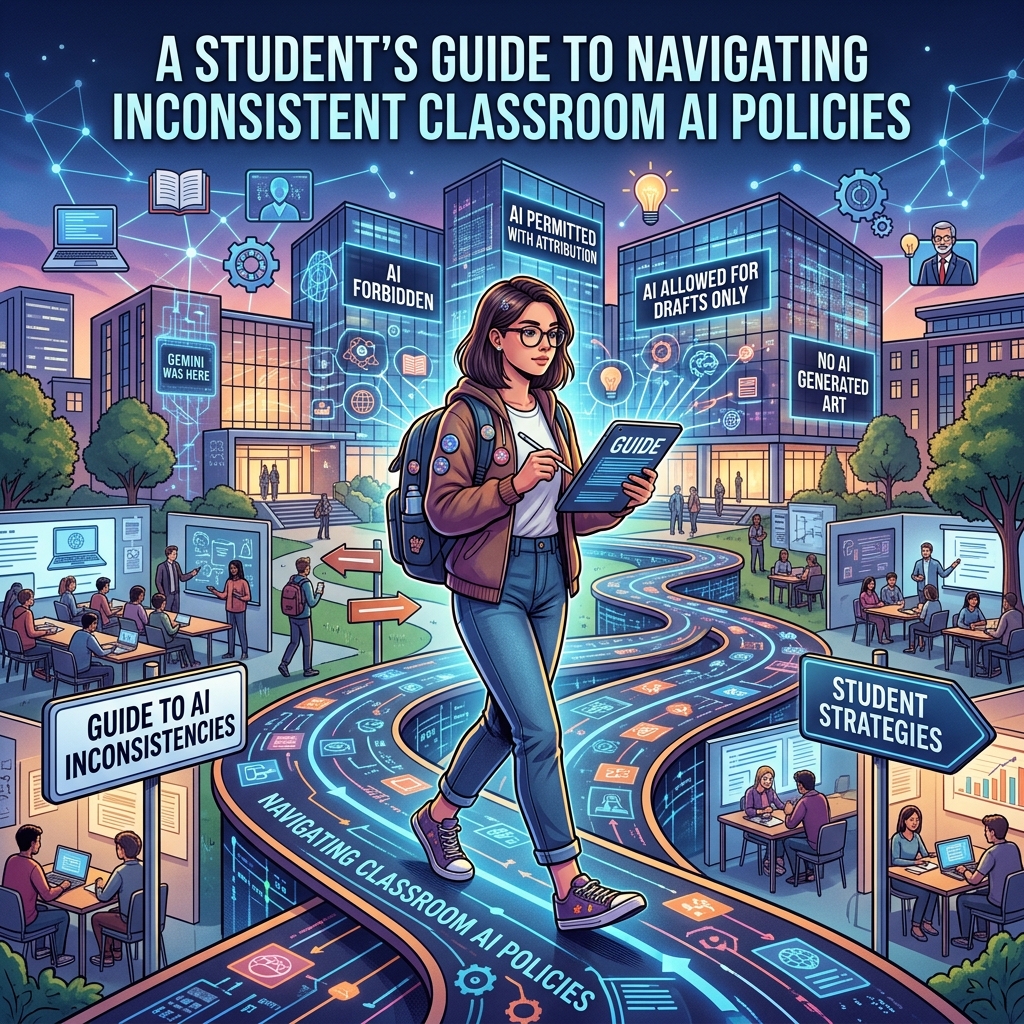
If you’re a student at CSU — or any college, really — you are currently navigating an AI policy environment that the institution itself can’t agree on. One professor will require you to use ChatGPT for assignments. The next will warn you that any AI use is grounds for academic dishonesty. A third will say nothing about it on the syllabus and answer the question differently depending on when you ask. According to the CSU systemwide survey, sixty-eight percent of faculty include an AI statement in their syllabus, which means thirty-two percent don’t. The Cal State Student Association VP described the situation as “being treated as test rats.” She wasn’t being dramatic. She was describing the actual experience of being a CSU student in 2026.
This article is for you. It assumes you’re going to use AI — most students do, and the survey data confirms it. The question isn’t whether. The question is how to do it without losing your degree, your professor’s trust, or your own learning, when the rules aren’t clear and aren’t consistent.
It’s part of Tygart Media’s free AI Literacy curriculum. The foundational pieces are worth reading first: what AI does, prompting, verification, and especially citing AI in academic work — which is the professor-side companion to this one.
The structural problem you’re navigating
Start with what’s actually happening. Your institution bought a major AI product and made it available to you. They didn’t require you to be trained on it. They didn’t require your professors to be trained on it. They left it up to each individual instructor to decide how AI fits in their class. This is a deliberate institutional choice, not an accident, and it puts the burden of figuring out what’s allowed onto you.
That means you are simultaneously expected to: use AI well, not use AI when you shouldn’t, know which is which without consistent guidance, defend your choices if questioned, and somehow learn the underlying material at the same time. This is not fair. It’s also the actual situation, and acknowledging it is the first step to navigating it well.
Some things follow from that acknowledgment. First, you need to be more careful and more deliberate than your professors are being. Their job is to teach you the subject. Your job is to protect your own academic record while you learn it. Those goals are aligned, but the protection part is mostly on you. Second, when the rules aren’t clear, you need a strategy for what to do, not just a feeling. The rest of this article is that strategy.
Step 1: Read the syllabus like a lawyer
Before the first AI question comes up in any class, read the syllabus for what it says about AI. Read it carefully, not casually. Look for the following:
An explicit AI policy section. The clearest case. If the syllabus has a section labeled “AI Policy,” “Generative AI,” “Use of ChatGPT,” or anything similar, read every word. This is your governing document for that class. Treat it as binding.
An academic integrity section that mentions AI. Many syllabi don’t have a dedicated AI section but do have an academic integrity section that addresses AI use, sometimes briefly, sometimes by reference to a university-wide policy. Read both.
A reference to a campus or department policy. Some syllabi point to a broader policy elsewhere — on the campus website, in a department handbook, in a learning management system page. If your syllabus does this, click through and read the referenced policy. The reference makes it binding even if the policy itself isn’t reprinted in the syllabus.
Silence. If the syllabus says nothing about AI at all, you’re in the riskiest position, because you have no documented guidance to defend yourself with. Plan to ask the professor explicitly — covered in step 2.
Save a copy of the syllabus and any referenced policies at the start of the term. PDF or screenshot. Date it. If the policy ever changes mid-semester (it sometimes does, especially around AI right now), you’ll have evidence of what it said when you started the class.
Step 2: When the syllabus is silent, ask in writing

If the syllabus doesn’t address AI, ask the professor explicitly, in writing, at the start of the term. Email is best. The goal is twofold: get an answer, and create a record of the answer.
A useful email looks like:
Hi Professor [Name],
I noticed the syllabus doesn’t have specific guidance on AI use for this course, and I want to make sure I understand your expectations before starting any assignments. Could you let me know your policy on the following: (1) using AI tools like ChatGPT to brainstorm or outline assignments, (2) using AI to help explain concepts I’m trying to understand, (3) using AI for grammar or editing on writing I’ve drafted myself, and (4) any uses that you’d consider a violation of academic integrity?
I appreciate the clarification — I want to be sure I’m following your expectations.
Thank you,
[Your name]
The reason to be this specific is that “what’s your policy on AI” is vague enough that you might get a vague answer. The four-part question forces the professor to think through the distinctions and gives you an answer you can actually rely on. Save the response. If it ever comes up later, you have a written policy in the professor’s own words.
If the professor doesn’t respond, follow up once. If they still don’t respond, document the attempts and proceed with the most cautious reasonable interpretation. Asking and not getting an answer is better, from a defensive standpoint, than not asking at all.
Step 3: Treat each class as its own jurisdiction
This is the most important behavioral rule: do not assume that what’s allowed in one class is allowed in another. The fact that your communications professor enthusiastically requires AI use does not mean your history professor will tolerate it. The fact that your introductory writing teacher said “AI is fine for editing” does not mean your literature professor will agree.
Mentally, treat each course as a separate jurisdiction with its own rules. Keep a short note for yourself with what each professor allows and disallows. This sounds excessive, but the alternative — assuming a consistent system-wide rule — is how students end up in academic integrity hearings. The system-wide rule doesn’t exist. The CSU survey confirmed it. You have to act accordingly.
Step 4: When in doubt, the safer interpretation wins
For any given AI use, ask yourself: if this came up in an academic integrity meeting, would I be able to defend it under the most strict interpretation of the policy? If no, don’t do it. The asymmetry of risk matters. The benefit of using AI on any given task is usually marginal. The cost of being wrong is sometimes severe — failing the course, being placed on probation, having a permanent record of academic dishonesty.
Some specific defaults that work in almost any unclear situation:
Default to disclosure. If you used AI in any meaningful way, disclose it specifically. Even if the professor doesn’t require disclosure, disclosing it preempts most academic integrity questions. The disclosure framework from the citation article applies: say what AI did, where it did it, and what you did with the output.
Default to doing the intellectual work yourself. Even if AI is permitted, do your own thinking. Use AI to support your thinking — explain a concept, suggest counter-arguments, help you find sources to read — but make the actual argument yours. This protects you regardless of the specific policy, because work that is genuinely yours can be defended in any policy regime.
Default to verification. Don’t submit anything containing AI-generated facts you haven’t verified. Citations, statistics, quotes — check every one. Hallucinated content in your submission can read as fraud regardless of whether you knew it was hallucinated.
Default to your own words. Don’t submit text that is mostly the model’s words, even if you edited it. Rewriting in your own voice means starting from your own outline of your own thinking, then writing — not paraphrasing AI’s draft of someone else’s thinking.
The specific case of group work
Group projects with inconsistent AI norms inside the group are a separate kind of trap. One member of your group uses AI heavily. Another bans themselves from using it. A third uses it in ways that turn out to violate your professor’s policy. If the final product has problems, the group typically shares the consequences — even though each member made different choices.
The protective move: have an explicit conversation early in any group project about how your group will use AI. Write it down somewhere everyone can see. “We agreed: AI for brainstorming and editing only, no AI-drafted text in the final document, anyone using AI for research will verify and cite sources personally.” This isn’t legalese for its own sake. It’s the only way you protect yourself when your grade depends partly on people whose AI judgment you don’t control.
If your group can’t agree, surface the question to the professor. “We have different views on AI use within the group — what’s your guidance?” This kicks the question to the person who should have answered it on the syllabus in the first place, and it gives you cover if problems emerge later.
The specific case of being accused
If you ever find yourself accused of improper AI use — and given current dynamics, more students will be than have actually done it — there are concrete things to know.
First: AI detection tools don’t work reliably. TurnItIn’s AI detector, the most widely deployed, has been documented to produce significant false positives. False positives disproportionately affect non-native English speakers, students whose writing is unusually polished, and students who happen to write in styles that pattern-match to AI output. The CalMatters reporting and other sources have covered this extensively. If your accusation rests on detector output alone, that’s a meaningful defense.
Second: process matters. Most institutions have formal academic integrity procedures with specific steps. The professor can suspect. They typically cannot unilaterally fail you for academic dishonesty without going through the institution’s process. Know what that process is at your school — it’s usually documented somewhere in the student handbook — and don’t agree to informal resolutions that bypass it without thinking carefully first.
Third: documentation is your friend. If you’ve kept syllabi, your written exchanges with the professor about AI policy, drafts that show your work evolving, notes on what AI was used for and how, your version history in a document editor — all of these can establish that the work was genuinely yours. Students who can show their process have a much easier time defending themselves than students who can’t.
Fourth: there’s often a campus ombudsperson or student advocacy office for exactly this kind of situation. They are not lawyers, but they know the institutional process and can help you understand your options. Use them early, not as a last resort.
The specific case of AI being required
The reverse problem is real too. Some professors require AI use, and if you have ethical objections — or worse, are subject to a different professor’s policy that conflicts — you can be caught between conflicting institutional demands.
The honest answer: if a course requires AI use and you object, the institution has built no good escape hatch. You can ask for an accommodation, but there’s no guarantee of one. You can drop the course, but that has its own cost. You can comply and document your discomfort. None of these are great options.
The closest thing to a clean answer: if you have a substantive objection to required AI use — privacy concerns, environmental concerns, ethical concerns about a specific vendor — raise it with the professor early, in writing, in a way that documents your concern. Ask whether alternatives are available. Many professors will accommodate when asked respectfully. Some won’t. At least you’ll know.
If the AI being required is one that you have specific reasons not to use (data concerns, prior account issues, religious or moral objections), it’s worth knowing that the CSU partnership with OpenAI’s ChatGPT Edu defaults to not using student data for training, but allows users to opt in. The default protects you, but the opt-in matters — check your account settings. Other AI tools required by professors may have different defaults; check each one individually.
The longer-term posture
A few habits that help over a full degree:
Build a personal record of your AI use across courses. A note app, a doc, whatever — track what you used AI for in each class, what each professor’s policy was, what your disclosure said. Over four years, this becomes a paper trail that proves you took the question seriously, which is the single best evidence in any future dispute.
Develop one human-only writing practice. Per the dependency article, the skills AI substitutes for atrophy when AI does them. At least one assignment, one journal, one paper a semester should be written entirely without AI. This is partly for skill maintenance and partly so you have proof — both to yourself and to anyone who asks — that you can still do the underlying work.
Keep current on the policies, not just at the start of term. AI policies are changing. CSU’s contract was renewed in May 2026. Faculty positions on AI are evolving in real time. The policy your professor articulated in September might be different by December. Check periodically.
Know what your AI tools are doing with your data. The data handling policies of ChatGPT, Claude, Gemini, and others vary, and they change. The Edu/enterprise versions have different defaults than consumer versions. Don’t assume your data is private just because you’re using a school-provided tool.
The institutional honesty
The deepest answer to “what do I do when the rules aren’t clear” is that the rules should be clear and aren’t, and the institution should be the one fixing that, and it isn’t. The Cal State Student Association has been saying this since the contract was signed, in increasingly explicit language. The petition that gathered 3,300 signatures said it. The legislative hearings said it. The survey data said it. The faculty union said it. The institution renewed the contract anyway.
That doesn’t change your situation in the short term, but it should change how you understand your situation. You are not failing to follow clear rules. The institution is failing to provide them. The strategies in this article are workarounds for that institutional failure. The fact that you have to use them is not your fault.
Use the workarounds. Protect your record. Do your own thinking. Verify your facts. Disclose your AI use specifically. Treat each class as its own jurisdiction. Keep documentation. And keep advocating, where you can, for the institution to do the work it didn’t do at the start. The CSU students who built the AI Writer Toolbox, the petition, the policy repositories — they’re doing the work the chancellor’s office should have done. You can join them, or you can benefit from what they’ve built. Either is legitimate.
What you cannot do, and what nobody should ask you to do, is pretend the rules are clear when they aren’t. The strategy in this article is built on the assumption that you’re not going to pretend.
About this knowledge node: This is a cluster article in Tygart Media’s AI Literacy content sprint. It’s licensed for use in any classroom, training program, custom GPT, or Claude Project as long as attribution is maintained. The pillar article that introduces the sprint is here.
Leave a Reply