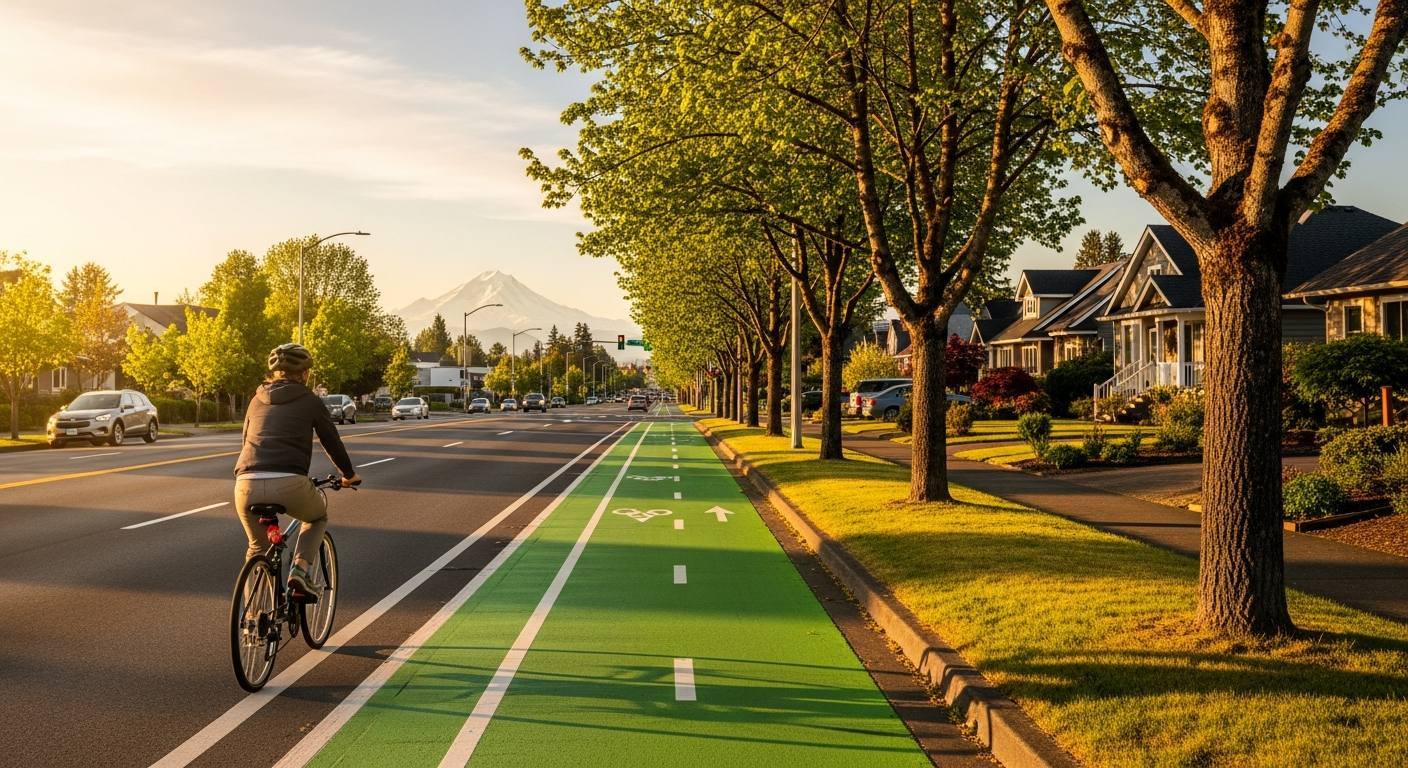
Fifteen years into a thirty-year Bicycle Master Plan, Everett is somewhere near the halfway mark. The city has built about 41 miles of on-street bike infrastructure and 23 miles of off-street trails since the plan was adopted in 2011, and a 2026 update — funded by a federal Safe Streets for All grant — will redraw the priorities for the next half of the build-out and merge bicycle planning with pedestrian planning for the first time.
May 2026 put a public face on that work. Mayor Cassie Franklin issued a National Bike Month proclamation, Everett Transit hosted two events at Everett Station (a Wednesday-morning Bike to Work coffee on May 13 and the Bike Everett Festival on Friday, May 15 from 3 to 7 p.m.), and the League of American Bicyclists again recognized Everett as a bronze-level Bicycle Friendly Community — the same designation the city first earned in 2021. City bike planning lives on the Everett Bicycling page; Safe Streets for All work is at the Public Safety: Safe Streets program page.
Underneath the festival programming is a more consequential conversation: how the next decade of bike and pedestrian infrastructure investment gets prioritized, where it lands, and which neighborhoods see the next protected lanes, bicycle boulevards, and trail connections.
What Has Actually Been Built
The 2011 Bicycle Master Plan committed Everett to a specific build-out of bike lanes, sharrows, off-street trails, and bicycle boulevards over thirty years. As of an April 2026 review presented to the city’s transportation advisory committee, about 41 miles of on-street bike infrastructure are in place, plus roughly 23 miles of off-street projects like trails. That is on the order of half the work the original plan envisioned.
What that has meant on the ground over the past few years includes the buffered bike lanes on Rucker Avenue, the bicycle boulevard work in residential neighborhoods, the city’s Bicycle Friendly Driver education program, and the widely-used Interurban Trail and Lowell Riverfront Trail connections. None of that happened by accident — each piece traces back to a specific line item in the master plan that staff and elected officials worked through over multiple budget cycles.
That is the case the city makes for keeping the plan as a living document. A long-horizon plan that residents can read tells the next planning director and the next council which projects are next in line, and it makes the case to outside funders — like the federal Safe Streets for All program — that the city has done the homework to deserve the grant.
What the 2026 Update Changes
Two things make this update meaningfully different from a routine refresh.
The first is the scope. The current plan covers bicycle infrastructure. The 2026 update will incorporate pedestrian infrastructure and what the city calls supportive facilities — the bike racks, repair stations, secure parking, signage, and crossings that determine whether a bike lane actually gets used. By 2027, when the updated plan is expected to be adopted, Everett will have a single integrated active-transportation plan covering people who walk, bike, and roll.
The second is the funding source. The update is being paid for through a Safe Streets for All grant — a federal program created under the 2021 infrastructure law and run through the U.S. Department of Transportation. Safe Streets for All explicitly requires applicants to build a Vision Zero–style safety action plan that ties infrastructure decisions to fatality and serious-injury reduction targets. That requirement is already pulling Everett’s planning toward a more data-driven framework: which corridors have the most crashes, where the high-injury network is, and which interventions show the strongest evidence of reducing serious injuries.
Cities that complete Safe Streets for All planning grants become eligible for substantially larger implementation grants in subsequent funding rounds. That is the strategic bet behind doing this update now: the planning work is the on-ramp to the construction money.
What This Means for Residents
For most Everett residents, the practical question is not how the master plan is structured — it is whether their street is going to get a bike lane, whether their kid’s walk to school is going to get a safer crossing, and whether the trail they use to commute is going to get connected to the next neighborhood over.
Those decisions get made through the priority list inside the master plan. When the update comes back to the City Council for adoption, it will include a ranked project list. Projects high on the list get built sooner. Projects lower on the list get built when funding shows up. Public input during the planning process is the period when residents have real influence over where their neighborhood sits on that list.
The city is also pointing residents toward existing tools. A map of Everett’s trails, bike lanes, and other infrastructure is posted online at everettwa.gov/bikes, and paper copies were available at the May 15 festival. Following @EverettTransit on Facebook and Instagram is the city’s recommended channel for catching the smaller, quieter input opportunities — neighborhood-scale meetings, online surveys, and pop-ups — between now and the plan’s adoption.
The May 2026 Events (now past)
Two events anchored National Bike Month locally:
Bike to Work Coffee — Wednesday, May 13, 6 to 8 a.m. at Everett Station (3201 Smith Avenue). Free coffee, Bike Everett t-shirts, and an e-bike raffle. Everett Transit hosted.
Bike Everett Festival — Friday, May 15, 3 to 7 p.m. at Everett Station (3201 Smith Avenue). Family-friendly. Free games, t-shirts, food trucks, entertainment, an e-bike raffle, and an Everett Transit bus staged for people to practice loading and unloading bikes from the front-mounted bike rack. The festival is the city’s biggest public-facing bike event of the year and the easiest entry point for residents who have not engaged with city transportation planning before.
Where the Bicycle Friendly Community Designation Comes From
The bronze-level Bicycle Friendly Community recognition comes from the League of American Bicyclists, a national advocacy organization that runs the BFC program as a benchmarking tool for cities. Communities apply, the League scores them across five categories — engineering, education, encouragement, enforcement, and evaluation — and assigns one of five ranks: bronze, silver, gold, platinum, or diamond.
Everett first earned bronze in 2021. The 2026 renewal at the same level reflects the continued work on infrastructure, the Bicycle Friendly Driver program, and ongoing community programming. Moving up to silver — the next tier — typically requires a measurable jump in bike commute mode share, a more developed protected-lane network, and a deeper safety-data culture. The 2026 master plan update is the kind of work that, done well, can underwrite a future application at the next level.
What to Do Next
- Use the city bike map and plan on the Everett Bicycling page — the living reference after the May festival window.
- Track Safe Streets for All on the Public Safety: Safe Streets program page between now and 2027 adoption.
- Read the existing bicycle map and master plan at everettwa.gov/bikes. The current map shows what is on the ground today; the plan shows what is supposed to come next.
- Follow @EverettTransit on Facebook and Instagram for the smaller input opportunities between now and adoption — surveys, neighborhood meetings, and pop-ups.
- Track the Safe Streets for All work at everettwa.gov/1802/Public-Safety-Safe-Streets-Program. The Safety Action Plan is the document that will shape which corridors the master plan update prioritizes.
Frequently Asked Questions
When was Everett’s Bicycle Master Plan first adopted? 2011. The current update is the first major revision in that thirty-year planning horizon.
How much bike infrastructure has been built so far? About 41 miles of on-street bike infrastructure and roughly 23 miles of off-street trails, as of an April 2026 review.
What is changing in the 2026 update? Two things. The plan is expanding to cover pedestrian infrastructure and supportive facilities (bike parking, repair stations, signage, crossings) in addition to bike lanes. And the planning framework is being aligned with Vision Zero / Safe Streets for All requirements, which means safety data — crashes, fatalities, serious injuries — drives more of the prioritization.
Who funded the master plan update? A federal Safe Streets for All grant administered by the U.S. Department of Transportation. The program was created under the 2021 infrastructure law.
When will the updated plan be adopted? The city expects to bring an integrated bicycle and pedestrian plan forward by 2027.
What is the bronze Bicycle Friendly Community designation? A recognition from the League of American Bicyclists. It is one of five tiers (bronze, silver, gold, platinum, diamond) and reflects evaluation across engineering, education, encouragement, enforcement, and evaluation. Everett first earned bronze in 2021 and has been re-recognized in 2026.
When was the Bike Everett Festival? Friday, May 15, 2026, 3 to 7 p.m. at Everett Station, 3201 Smith Avenue. Free, family-friendly. For ongoing bike planning, see the city Bicycling page.
Was there a Bike to Work Day event? Yes. Wednesday, May 13 from 6 to 8 a.m. at Everett Station. Coffee, t-shirts, and an e-bike raffle.
Leave a Reply