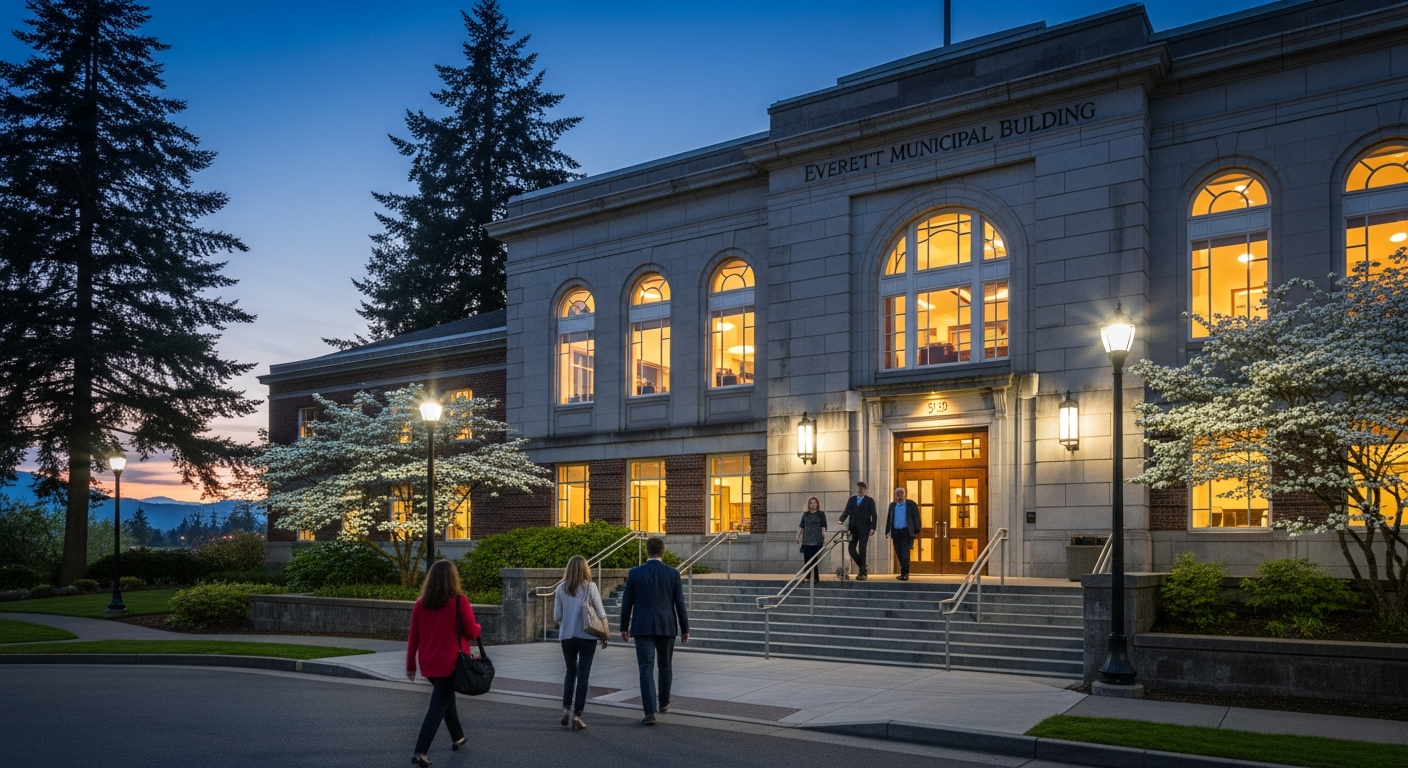
If you have ever wondered who decides how Everett spends its federal housing and community development money — and how a regular resident gets a vote in that conversation — Tuesday, May 5 is your answer.
The Community Development Advisory Committee, the citizen body that recommends how the city spends Community Development Block Grant (CDBG), HOME Program, and 2060 Affordable Housing Trust Fund (AHTF) dollars, is holding a public hearing at 5 p.m. on May 5 to set the priority needs for the 2027 program year. The hearing is hybrid — in person at the Everett Municipal Building (2930 Wetmore Avenue) or virtual — and written comments are accepted any time before then at communitygrants@everettwa.gov.
For most Everett residents, this is the most direct line into how millions of federal pass-through dollars get aimed at the city’s biggest housing and neighborhood needs each year. The committee uses what it hears Tuesday to write the priorities that will determine which projects, programs, and nonprofits get funded twelve to eighteen months from now.
What the CDAC Actually Does
The Community Development Advisory Committee is a volunteer body of Everett residents appointed to recommend how the city distributes a specific group of housing and community-development funding sources. The dollars flow from three main pots:
The Community Development Block Grant (CDBG) is a federal HUD formula grant that has funded local affordable housing, homeless services, neighborhood infrastructure, and small-business assistance since 1974. Cities the size of Everett receive CDBG annually as an entitlement community.
The HOME Investment Partnerships Program is a separate HUD funding stream specifically for affordable housing — acquisition, rehab, new construction, and tenant-based rental assistance.
The 2060 Affordable Housing Trust Fund (AHTF) is a state-authorized local fund supported by document recording fees collected by Snohomish County. It pays for affordable housing projects inside Everett city limits and is one of the few flexible local sources for housing that serves people earning under 50% of area median income.
Municipal funding may also be added to the mix in any given cycle, depending on the council’s budget decisions.
CDAC does not write checks. It writes the priorities. City staff then issue requests for proposals to nonprofits, housing developers, and service providers, who apply for funding that lines up with whatever the committee identified as a priority. That is why the May 5 hearing matters: the priorities decided in this room shape who gets funded a year from now.
What Tuesday’s Hearing Is For
The agenda has two pieces. The first and bigger one is identifying the community priority needs for 2027. CDAC is asking residents to tell them what they see as the most pressing community-development issues in Everett right now — affordable housing, homelessness response, infrastructure in lower-income neighborhoods, services for seniors or people with disabilities, microenterprise development, anything that fits inside the federal CDBG eligibility framework.
The second item is a review of updates to the Citizen Participation Plan (CPP), the document that governs how CDAC engages the public on these decisions. The CPP is technical, but it matters: it sets the rules for how hearings are publicized, how public comment is collected, and how the committee responds to feedback. Updates to the CPP every few years bring it in line with current HUD requirements and the city’s changing communications channels.
Why This One Is Worth Showing Up For
Federal CDBG and HOME funds have been under sustained pressure at the national level for years. Every cycle, the local conversation about what to prioritize gets a little harder because the formula allocations have not kept pace with cost inflation in housing, services, or infrastructure. That makes the priority-setting decision more consequential, not less. Fewer dollars chasing more needs means the priorities the committee writes down really do determine which neighborhoods, populations, and project types get served — and which get told to wait another year.
This is also a moment when Everett is making bigger housing decisions on parallel tracks. The Snohomish County Council voted unanimously on April 24 to award $23 million in Housing & Behavioral Health Capital Fund money to six projects, three of them inside Everett — the EGM 172-bed shelter expansion at 3530 Smith Avenue, Helping Hands Broadway 33 at 2410 and 2412 Broadway, and the Everett Station District Alliance 58-unit transit-oriented building at 3102 Smith. Those were county dollars. The CDBG, HOME, and AHTF priorities the city sets May 5 are a different pipeline — and they fund a different layer of the housing system, often the smaller, more locally specific projects that do not pencil at the scale a $5 million county capital award requires.
How to Participate
There are four ways to weigh in:
Attend in person. Arrive at the Everett Municipal Building, 2930 Wetmore Avenue, by 4:50 p.m. on Tuesday, May 5. City staff will escort attendees to the meeting room. Public comment is taken during the hearing portion of the agenda.
Attend virtually. A virtual attendance option is available. Instructions for joining remotely are posted on the Community Development Advisory Committee page at everettwa.gov.
Email written comments. Send to communitygrants@everettwa.gov any time before or after the hearing. Written comments become part of the official record.
Mail written comments. Send to 2930 Wetmore Avenue, Suite 8A, Everett, WA 98201.
If you need translation services, ASL interpretation, or any other accommodation to participate, contact communitygrants@everettwa.gov or call (425) 257-7185 in advance so the city can make arrangements. Spanish-language information about the hearing is published on the same news flash on the city’s website.
What Comes After May 5
Once CDAC adopts the 2027 priorities — typically at a meeting following the public input hearing — city staff translate those priorities into a request-for-proposals timeline. Nonprofits, housing developers, and service providers will apply against those priorities later in 2026. CDAC reviews the applications and recommends an allocation to the City Council. Council takes the final vote, usually as part of the broader 2027 budget adoption in late 2026.
In other words, what happens Tuesday night is the front end of a process that ends with line items in next year’s budget. The closer to that front end residents weigh in, the more influence they have over what eventually gets funded.
What to Do Next
- Read the agenda and the Citizen Participation Plan update at the Community Development Advisory Committee page on everettwa.gov.
- Submit written comments to communitygrants@everettwa.gov before or after the hearing.
- Show up Tuesday, May 5 at 4:50 p.m. at the Everett Municipal Building, 2930 Wetmore Avenue, if you want to give in-person testimony.
- Request accommodations at communitygrants@everettwa.gov or (425) 257-7185 if you need translation, interpretation, or accessibility help.
- Track the funding cycle by following the Community Development Block Grant page on the city’s website to see what gets recommended after this hearing.
Frequently Asked Questions
What is CDAC and what does it decide? The Community Development Advisory Committee is a citizen body that recommends how Everett spends federal CDBG and HOME funds, the state’s 2060 Affordable Housing Trust Fund dollars, and any municipal funding added to the mix. It does not allocate dollars directly — it writes the priorities and reviews applications, then recommends to the City Council.
When and where is the public hearing? Tuesday, May 5, 2026 at 5 p.m. The hearing is hybrid: in person at the Everett Municipal Building, 2930 Wetmore Avenue (arrive by 4:50 p.m.), or virtual. Virtual instructions are on the CDAC page at everettwa.gov.
What funding sources are CDAC’s priorities for 2027 going to shape? Community Development Block Grant (CDBG), HOME Program, 2060 Affordable Housing Trust Fund (AHTF), and any municipal funding added to the cycle.
Can I submit comments without attending the hearing? Yes. Email communitygrants@everettwa.gov or mail to 2930 Wetmore Avenue, Suite 8A, Everett, WA 98201. Written comments are part of the official record.
Is this related to the $23M county housing vote on April 24? No — those are separate pots. The April 24 vote was Snohomish County’s Housing & Behavioral Health Capital Fund, awarded to six projects (three inside Everett). The CDAC priorities being set May 5 govern a different funding stream — the city’s CDBG, HOME, and AHTF dollars — and typically fund a different layer of projects.
Who can request accommodations? Anyone. Translation, ASL interpretation, accessibility help, and other accommodations can be arranged by contacting communitygrants@everettwa.gov or calling (425) 257-7185 in advance of the hearing.
Is information available in Spanish? Yes. The official city news flash about the hearing includes a full Spanish-language version, and Spanish-language assistance can be requested through the same email and phone number.
Leave a Reply