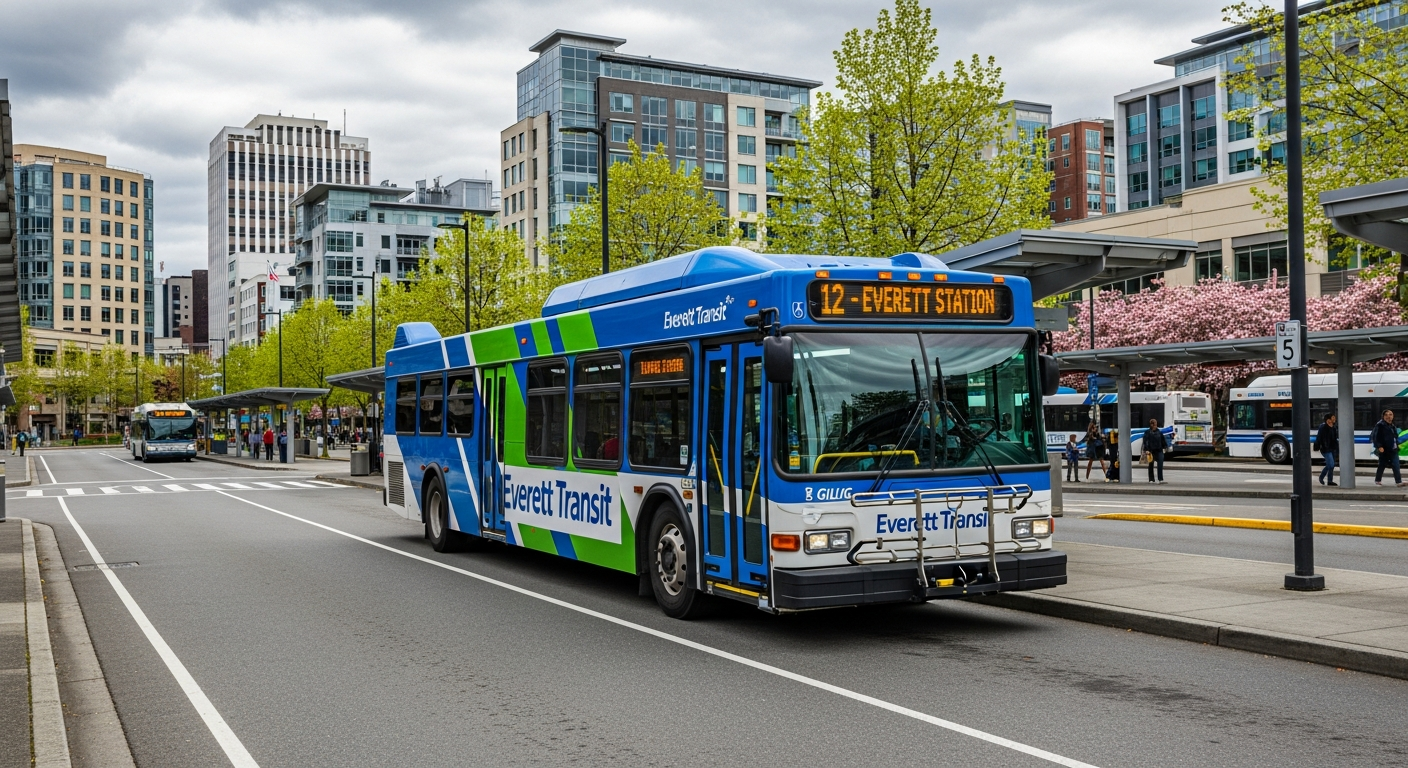
Everett’s 50-year-old municipal bus system is heading toward the most consequential vote in its history — and Everett residents won’t cast a ballot on it. The Everett City Council could vote as early as late May or June 2026 on whether to dissolve Everett Transit and absorb its 22 routes, 161 workers, and 115,000 riders into Community Transit — the regional carrier serving the rest of Snohomish County. A 2025 state law called SB 5801 makes this possible without a public vote. Here is everything you need to know about what the consolidation would mean, who’s fighting it, and what happens next.
What Actually Happened on April 22, 2026
Everett Mayor Cassie Franklin and Community Transit CEO Ric Ilgenfritz announced on April 22, 2026, that the two agencies are resuming work toward consolidation. The announcement was not a vote — it was a green light to begin drafting an interlocal agreement, conducting due diligence, and working through the legal framework before any governing bodies act.
The proposal would absorb Everett Transit — which operates 22 routes, employs 161 people, and serves an estimated 115,000 Everett residents — into Community Transit, which currently covers the rest of Snohomish County. A merged agency would serve roughly 800,000 people across Snohomish County, making it one of the largest transit networks in Washington State outside of King County Metro and Sound Transit.
Franklin framed the move as a direct response to Sound Transit’s June 30 board vote on whether to advance light rail to Everett Station. “As light rail comes closer to reality, we need a transit system built for a light rail community,” Franklin said. Ilgenfritz described the consolidation as “the next step in building a seamless, connected transit network across Snohomish County.”
The State Law That Makes This Possible Without a Public Vote
This consolidation is moving without a public ballot because Washington’s legislature passed SB 5801 in 2025, which allows public transportation benefit areas like Community Transit to annex municipal transit agencies via an interlocal agreement approved by both governing bodies. The process requires at least one public hearing by each body — separately or jointly — but does not require a citywide ballot measure.
Everett Transit Local 883 Union President Steve Oss has called for the consolidation to go before Everett voters and has alleged the legislation was crafted specifically to allow the merger without one. A community group called Keep Everett Transit (keepet.org) has formed in opposition.
If the council approves, Everett would become the first Washington city to voluntarily dissolve a standalone transit agency under this framework.
What’s Currently on the Table
Right now, the two agencies are in the due-diligence and agreement-drafting phase. No interlocal agreement has been presented to either body. No public hearing has been scheduled. The timeline that has been communicated publicly is:
- Spring–early summer 2026: Drafting of interlocal agreement, staff analysis, public hearings
- Late May or June 2026: Possible council vote (though this is a projection, not a set date)
- After council approval: Multi-year implementation — routes, labor contracts, fare structures, and service standards would need to be reconciled before Everett Transit ceases to exist as a standalone agency
What Consolidation Would Mean for Riders
Under consolidation, Everett Transit’s 22 routes would become part of Community Transit’s network. Service levels, route alignments, and fare structures would all be subject to renegotiation as part of the interlocal agreement.
Community Transit currently does not operate within the City of Everett boundaries — its routes connect Snohomish County cities to Everett but hand off at the city border. Consolidation would change that, giving a single agency control of all fixed-route bus service in and around Everett.
Supporters argue this creates the seamless transit network needed to connect to light rail. Critics, including the Keep Everett Transit coalition, argue that Community Transit’s priorities are regional, not neighborhood-focused, and that Everett-specific routes could be reduced or eliminated in a regionalized system.
What Consolidation Would Mean for Workers
The 161 Everett Transit employees — drivers represented by ATU Local 883, plus maintenance, dispatch, and administrative staff — would transition to Community Transit under any consolidation agreement. The terms of that transition, including which union contract governs, seniority treatment, and pension continuity, are among the most complex elements of the negotiation.
Union president Steve Oss has been the most prominent public opponent of the consolidation, calling explicitly for a public vote and pushing back on the no-ballot framework created by SB 5801. The union’s concerns include job security, seniority rules, and the potential for route changes that reduce driver headcount or shift work patterns.
The Tax Question
Everett residents currently pay a 0.3% city sales tax that funds Everett Transit. The Lynnwood Times has reported that the combined tax burden under Community Transit’s rate structure would represent the largest sales tax increase in Washington state history. The specific net impact on individual Everett tax bills would depend on how the interlocal agreement structures the transition period and what tax rates are set.
The public hearing process required by SB 5801 is the primary mechanism for residents to weigh in on the tax implications before any council vote.
How This Connects to Sound Transit
The consolidation proposal is explicitly tied to the Sound Transit timeline. The June 30, 2026, Sound Transit board vote — which would determine whether the agency moves forward with a revised System Plan to bring light rail to Everett Station — is the backdrop for Franklin’s framing of the merger.
The argument: if light rail comes to Everett, the city needs a transit feeder network that connects all of Snohomish County to Everett Station seamlessly. A merged Community Transit + Everett Transit system, the argument goes, is better positioned to serve as that feeder than two separate agencies with separate governance structures.
Everett’s Sound Transit light rail future is covered in this complete 2026 guide. The June 30 vote’s implications for residents and commuters are also explored in detail on this site.
How to Make Your Voice Heard
The SB 5801 process requires at least one public hearing before any council vote. Dates have not been announced as of April 30, 2026. To stay informed:
- Monitor City of Everett (everettwa.gov) for hearing announcements — confirm agendas on the live city site
- Sign up for the City of Everett’s news alerts
- Contact the Keep Everett Transit coalition at keepet.org
- Contact Everett City Council members directly — the council will make the final call
Frequently Asked Questions
Does Everett have to hold a public vote to end Everett Transit?
No. Under Washington’s SB 5801 (2025), the Everett City Council and Community Transit Board can approve consolidation through a council vote and an interlocal agreement — no public ballot required. However, at least one public hearing by each body is required.
How many routes does Everett Transit currently operate?
Everett Transit operates 22 routes and employs approximately 161 people, serving an estimated 115,000 Everett residents.
When could the Everett City Council vote on consolidation?
A council vote could come as early as late May or June 2026, though the interlocal agreement is still being drafted as of late April 2026.
What would happen to Everett Transit workers if consolidation is approved?
The 161 Everett Transit employees — including drivers represented by Local 883 of the Amalgamated Transit Union — would transition to Community Transit. Terms of that transition are subject to negotiation.
What does Everett Transit consolidation mean for residents’ taxes?
The Lynnwood Times has reported this could represent the largest sales tax increase in Washington state history when combined with Community Transit rates. The specific net impact on individual tax bills depends on the interlocal agreement’s structure.
Why is the consolidation being proposed now?
Mayor Franklin framed it as a direct response to the June 30, 2026, Sound Transit vote that could advance light rail to Everett Station.
What is Keep Everett Transit?
Keep Everett Transit (keepet.org) is a community advocacy group opposing the consolidation and calling for a public vote.
Leave a Reply