This is the third article in the End-in-Mind Operations cluster under The Restoration Operator’s Playbook. It builds on the principle article and the close-out test article.
The job is the beginning, not the end

The default operational model in restoration treats the job as a discrete unit of work that begins with the first call and ends with the close-out walkthrough. Inside that frame, the company’s responsibility starts when the loss is reported and ends when the homeowner signs the final paperwork. Everything before is marketing. Everything after is, at most, an occasional review request.
This frame is operationally simple. It is also commercially expensive. It produces companies that treat each homeowner as a single transaction, that invest exactly enough customer experience to satisfy the immediate job, and that move on to the next homeowner once the current one is closed. The compounding value of a homeowner relationship that extends past the job is, in this frame, invisible.
The companies that have grown sustainably and profitably across decades operate from a different frame. The restoration job, in this frame, is not the unit of work. It is the beginning of a customer relationship that the company intends to maintain across years and that will produce, if maintained well, a stream of additional value far in excess of the original job revenue. The customer is not a transaction. The customer is a relationship that begins on the worst day of their year and that the company has the opportunity to make into something durable.
This article is about that frame, what it means in practical terms for how a restoration company invests in customer experience, and what changes in the company’s economics when the frame is internalized.
The compounding value of a maintained relationship
To see why the customer lifetime frame produces materially different economics than the transaction frame, it helps to lay out what a single maintained customer relationship is actually worth across years.
The original job produces some amount of revenue and margin. Call it the baseline. In the transaction frame, the baseline is the entire commercial value of the customer.
The customer lifetime frame includes the baseline plus several additional revenue streams that materialize over the years following the job for customers whose relationship with the company has been maintained.
The first stream is repeat business from the same customer. Most homeowners will experience another loss within ten to fifteen years of the first one. Pipes burst again. Storms hit again. Fires happen. Floods happen. The homeowner who experienced excellent service the first time will, in nearly all cases, call the same company for the second loss. The repeat business itself is sometimes larger than the original loss, depending on the type of incident.
The second stream is referral business from the original customer. A homeowner who had a five-star experience with a restoration company will, on average, refer the company to two to four other people over the course of the following decade. Those referrals are typically people in similar life situations — neighbors, friends, family members — who eventually have their own losses and who call the referred company first. The aggregate referral revenue from a single satisfied customer is, in companies that maintain the relationship well, several multiples of the original job revenue.
The third stream is non-loss work that the company can perform for the same homeowner over time. Restoration companies that have built durable customer relationships often pick up non-emergency work from the same customers — renovations, repairs, maintenance, additional services — that the customer would otherwise have given to someone else. The economic value of this stream depends on the company’s ability to actually service it, but it can be significant.
The fourth stream is the customer’s role as a public reference. A satisfied customer who is asked about restoration companies in their network or community provides a positive recommendation, posts a positive review, mentions the company in conversations, and generally functions as a marketing asset for the company without any cost to the company itself. This stream is harder to measure than the others but is real and compounds over time.
Taken together, the lifetime value of a maintained customer relationship is typically three to ten times the original job revenue, depending on the customer type, the geographic market, and how well the relationship is maintained. The companies that operate from the customer lifetime frame are investing in the relationship knowing that the return horizon is years rather than weeks.
What relationship maintenance actually looks like

The phrase “maintaining the relationship” has to mean something specific to be useful. The companies that have figured out how to maintain customer relationships at scale do specific work that the transaction-framed companies do not.
The first practice is a structured close-out that goes beyond the legal and operational requirements. The closer walks the homeowner through the finished work in a way that highlights the choices the team made, demonstrates care for the details, and leaves the homeowner feeling that the company took the work seriously. The close-out conversation includes a clear handoff of warranty information, maintenance recommendations specific to the work performed, and a contact for any future questions. This is not a marketing pitch. It is the deliberate production of a memorable final moment that anchors the homeowner’s experience.
The second practice is a structured follow-up cadence in the months after the job. A check-in at thirty days. Another at six months. An annual touch beyond that. Each touch is brief, low-pressure, and oriented toward the homeowner’s experience rather than toward selling additional work. The cadence keeps the company present in the homeowner’s awareness without being intrusive. Companies that maintain a cadence of this kind report meaningfully higher referral and repeat rates than companies that disappear after the close-out.
The third practice is occasional value delivery between losses. Seasonal maintenance reminders. Educational content about home care. Useful information about events or conditions in the homeowner’s area. The content does not have to be elaborate. It has to be genuinely useful, which means written from the homeowner’s perspective rather than from the company’s marketing perspective. The companies that do this well are perceived by their past customers as a trusted resource, which is the perception that drives both repeat business and referrals.
The fourth practice is a defined response to negative experiences. Some jobs do not produce five-star outcomes. The customer lifetime frame requires that the company actively works to recover the relationship in those cases rather than letting the dissatisfied customer walk away quietly. The recovery effort is not always successful, but companies that try recover a meaningful share of the relationships they would otherwise lose. The recovery effort also has the side effect of identifying systemic issues that should be addressed in the operating standards, which makes future jobs better.
The fifth practice is treating the customer’s referrals with a level of care that reinforces the original customer’s confidence in their own recommendation. A referred customer who is treated badly damages two relationships — their own and the original referrer’s. A referred customer who is treated exceptionally well validates the referrer’s judgment and reinforces their willingness to refer again. Companies that have figured this out flag referred jobs internally and provide an additional layer of attention to them, recognizing that two customer relationships are at stake rather than one.
What the operational implications are
Operating from the customer lifetime frame changes specific operational decisions throughout the job, not just the activity that happens after the close-out.
It changes how the team handles moments of customer friction during the job. A transaction-framed company optimizes friction moments for resolution speed. A relationship-framed company optimizes them for the homeowner’s eventual story about how the friction was handled. These are different optimization functions and produce different decisions, even when both result in the friction being resolved.
It changes how the team handles minor scope disputes with the carrier. A transaction-framed company will sometimes accept a scope reduction that compromises the homeowner’s experience in order to close the file faster. A relationship-framed company will fight harder for the scope that the homeowner deserves, because the long-term value of the relationship justifies the short-term cost of the fight. Not every fight is worth it. The threshold is different in the two frames.
It changes how the team communicates timeline expectations. A transaction-framed company gives the homeowner the most optimistic timeline that can plausibly be defended. A relationship-framed company gives the homeowner an honest timeline with appropriate buffers, knowing that meeting expectations consistently is more valuable to the long-term relationship than starting on a higher promise that gets adjusted downward.
It changes how the team handles unexpected discoveries during the job. A transaction-framed company minimizes the disruption to the schedule and budget that an unexpected discovery causes, sometimes at the cost of communicating poorly with the homeowner about what is changing and why. A relationship-framed company invests in the explanation, walks the homeowner through the discovery and the implications, and treats the moment as an opportunity to demonstrate competence rather than as a problem to be smoothed over.
It changes how the team handles the close-out walkthrough itself. A transaction-framed company runs the walkthrough as a punch list exercise focused on getting the homeowner to sign off. A relationship-framed company runs it as the deliberate production of a memorable final moment, with attention to the emotional arc of the homeowner’s experience and to the specific things the homeowner will remember and tell others about.
None of these operational differences are dramatic in any single moment. All of them aggregate into a customer experience that produces visibly different lifetime relationships than the transaction-framed alternative.
The economics of investing in relationship
The customer lifetime frame is not free. The relationship maintenance practices described above require investment of time and resources that the transaction frame does not require. The investment is meaningful enough that it has to be justified by the returns the frame produces.
The math is favorable in the typical case but not infinitely. The follow-up cadence costs some amount per customer per year. The recovery work for negative experiences costs some amount per incident. The structured close-out takes longer than a transactional close-out. The educational content production costs something to create and distribute. None of these costs is large per customer, but at scale across thousands of past customers, the aggregate cost is real.
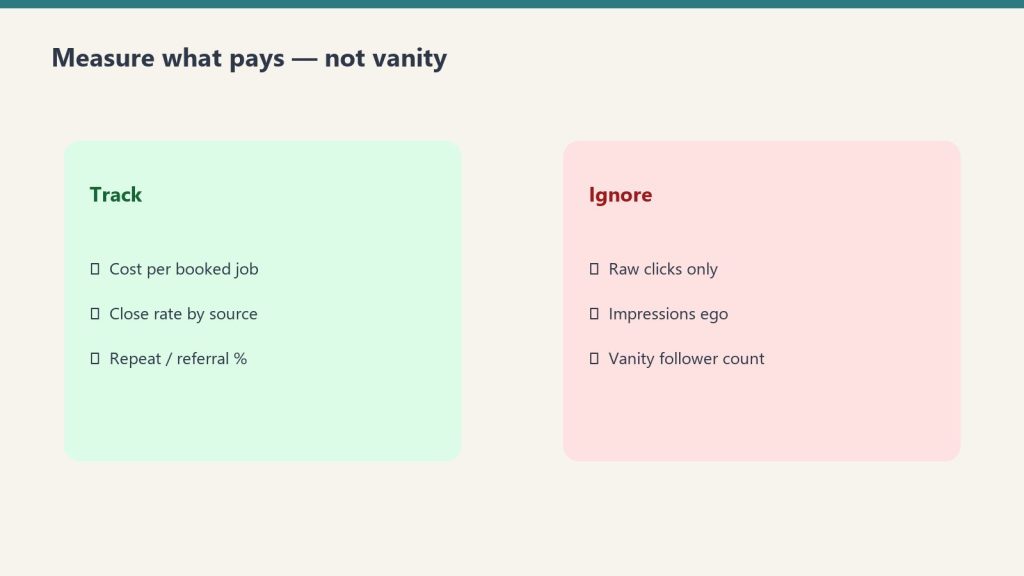
The returns are also at scale. The repeat business, referral business, non-loss work, and reference value across a customer base of thousands of past customers, maintained well, produces revenue streams that are typically several multiples of the cost of the maintenance investment. Companies that have measured this carefully report customer lifetime values in the range of three to ten times the original job revenue, with maintenance costs in the range of five to fifteen percent of the lifetime value. The return on the relationship maintenance investment is, for companies that execute it well, exceptional by any reasonable standard.
The investment also has to be made consistently across years to actually produce the returns. Companies that try to capture the lifetime value without making the maintenance investment do not capture the value. Companies that make the investment for a year and then cut it when budget pressures arise lose the relationships they had begun to build and have to start over. The investment is a long-term commitment, not a tactical program.
The cultural implication
Operating from the customer lifetime frame requires a cultural commitment that goes beyond any specific operational practice. The company has to actually believe that the customer is a relationship rather than a transaction, and the belief has to be visible in how every member of the team — not just the customer-facing roles — thinks about the work.
This cultural commitment is not equivalent across all companies. Some companies have it naturally because of the values of the founders and the people who have been hired. Others have to deliberately cultivate it through hiring, training, and cultural reinforcement over years. The cultivation work is real but achievable.
The key cultural marker is whether team members, in conversations among themselves about specific customers, refer to those customers with the kind of attention and care that a long-term relationship deserves, or whether they refer to them as transactions to be processed. The marker is visible in casual conversation. Owners who want to assess where their company actually stands on this dimension can do so by listening to how their senior team talks about customers when no leadership is in the room. The honest answer to that question reveals whether the customer lifetime frame is actually installed or whether it is aspirational.
What this means for owners deciding now
If you run a restoration company and you have not yet built the relationship maintenance practices described above, the implication of this article is that you are leaving substantial value on the table from your existing customer base. The customers you have already served are an underutilized asset.
The starting point is to begin the structured follow-up cadence with the customers you have served in the last twelve months. A simple thirty-day check-in, six-month touch, and annual contact, executed consistently, will begin producing measurable referral and repeat results within the first year. The cost is modest. The return is meaningful.
The medium-term work is to build the structured close-out, the value delivery cadence, the negative experience recovery process, and the referred-job protocol that the more advanced practices require. This work takes a year or two to fully install and produces returns that compound for the rest of the company’s existence.
The long-term commitment is to operate from the customer lifetime frame as a default cultural orientation. This is a multi-year journey that involves hiring, training, and consistent leadership reinforcement. Companies that complete the journey operate at a level that competitors cannot easily match because the cultural foundation underneath the practices is not visible from the outside and cannot be copied through process documentation alone.
The companies that operate this way already exist in restoration. Most of them are quiet about how they operate, because the advantage they have is durable and they have no incentive to teach their competitors. The owners who recognize the frame and adopt it will join that small group. The owners who continue to operate from the transaction frame will continue to leave the value on the table, year after year, until they decide otherwise.
Next in this cluster: end-in-mind subcontracting — how the companies you pair with determine what your customer remembers, and why the choice of subcontractors is a more strategic decision than most owners treat it as.
Leave a Reply