The Short Answer
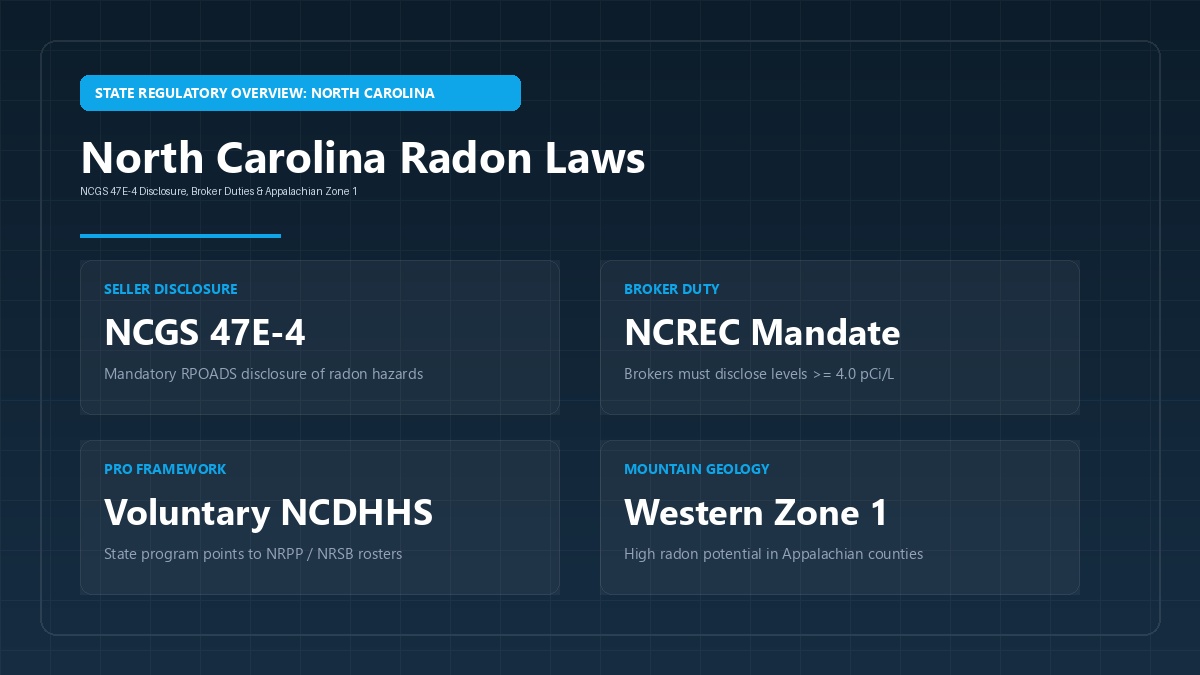
North Carolina regulates radon primarily through real estate seller disclosures and licensed broker affirmative disclosure duties, alongside public health outreach. Under North Carolina General Statutes (NCGS) § 47E-4, residential property sellers must deliver a standardized disclosure statement disclosing known environmental hazards, including radon gas. North Carolina does not currently operate a mandatory state licensing board for radon testers or mitigators, officially referring consumers to national NRPP and NRSB registries. Furthermore, licensed real estate brokers have an independent legal duty under Real Estate Commission rules to disclose known radon levels of 4.0 pCi/L or higher as a material fact.
Testing Requirements
Indoor radon testing is voluntary for private single-family homeowners and residential landlords in North Carolina; the state imposes no statutory mandate compelling property owners to test existing residential dwellings prior to lease execution or sale. In addition, North Carolina statutes do not require routine radon testing in public or private K-12 school buildings or licensed commercial childcare facilities, though the North Carolina Department of Health and Human Services (NCDHHS) actively promotes voluntary school and daycare screening following EPA protocols.
Real-Estate Disclosure
Real estate disclosure is codified under the North Carolina Residential Property Disclosure Act, NCGS Chapter 47E. Under NCGS § 47E-4, residential property owners must complete and provide a Residential Property and Owners’ Association Disclosure Statement (RPOADS) to prospective buyers prior to contract acceptance. The form explicitly requires the seller to disclose knowledge of any hazardous or toxic substances, specifically including radon gas, past test results, and installed mitigation systems. Crucially, under North Carolina Real Estate Commission (NCREC) licensing rules, real estate brokers have an independent affirmative legal obligation to discover and disclose material facts; if a broker has actual knowledge that a property has tested at or above 4.0 pCi/L, they must disclose that information to prospective purchasers regardless of what the seller marks on the form.
Mitigator & Tester Certification
North Carolina has no mandatory state licensing program for radon measurement or mitigation contractors, per the North Carolina Department of Health and Human Services Radiation Protection Section, verified November 2026. While Session Law 2023-91 authorized NCDHHS to develop certification standards, the state currently maintains no independent licensing exam or regulatory board. NCDHHS officially recommends that consumers hire professionals certified through the National Radon Proficiency Program (NRPP) or the National Radon Safety Board (NRSB). Contractors must comply with local municipal building and electrical trade permits when installing mitigation fans.
New Construction
Radon-resistant new construction is not mandated statewide under the North Carolina State Residential Code. While model codes like the International Residential Code Appendix F contain specifications for passive sub-slab suction systems, North Carolina has not adopted Appendix F as a mandatory statewide requirement for new residential construction. Local jurisdictions or individual builders may adopt passive radon reduction techniques voluntarily, which is common in western mountain communities with elevated soil gas emissions.
Radon Zones & the Action Level
According to the EPA Map of Radon Zones, North Carolina exhibits a sharp geographical divide. The Appalachian Mountain and Upper Piedmont counties in western North Carolina—including Buncombe (Asheville), Henderson, Watauga (Boone), Cherokee, Mitchell, and Alleghany—are designated as EPA Zone 1 (High Potential), where predicted average indoor screening levels exceed 4.0 pCi/L. Central Piedmont counties (such as Wake and Mecklenburg) fall primarily within Zone 2 (Moderate Potential, 2.0 to 4.0 pCi/L), while coastal plain counties are classified as Zone 3 (Low Potential, < 2.0 pCi/L). NCDHHS enforces the federal action level benchmark of 4.0 pCi/L. For regional county classifications, consult our EPA Radon Zone Map guide.
The State’s Radon Program
The state regulatory and educational authority is the North Carolina Radon Program, housed within the Radiation Protection Section of the Division of Health Service Regulation at NCDHHS. The program provides public education, maintains county-level risk maps, and distributes low-cost test kits to North Carolina residents. Homeowners and industry professionals can order test kits, access educational materials, and review nationally certified contractor directories via the official NCDHHS Radon Program portal or by contacting program staff at 919-814-2250.
Sources & Limits
This regulatory guide is provided for educational and informational purposes only and does not constitute formal legal, building code, or engineering counsel. State disclosure laws and broker licensing standards are subject to regulatory updates. Real estate buyers, sellers, landlords, and contractors should verify current rules directly with NCDHHS or a licensed North Carolina real estate attorney.
Official Sources: North Carolina General Statutes § 47E-4; North Carolina Real Estate Commission (NCREC); North Carolina Department of Health and Human Services (NCDHHS); U.S. Environmental Protection Agency.
To evaluate how North Carolina’s broker disclosure standards compare with other states, consult our comprehensive guide to radon regulations across the United States or inspect the EPA Radon Zone Map.
Get The Signal
What we actually ran, what it measured, and what it means for a restoration shop — every week, including the flops.
Leave a Reply