The Short Answer
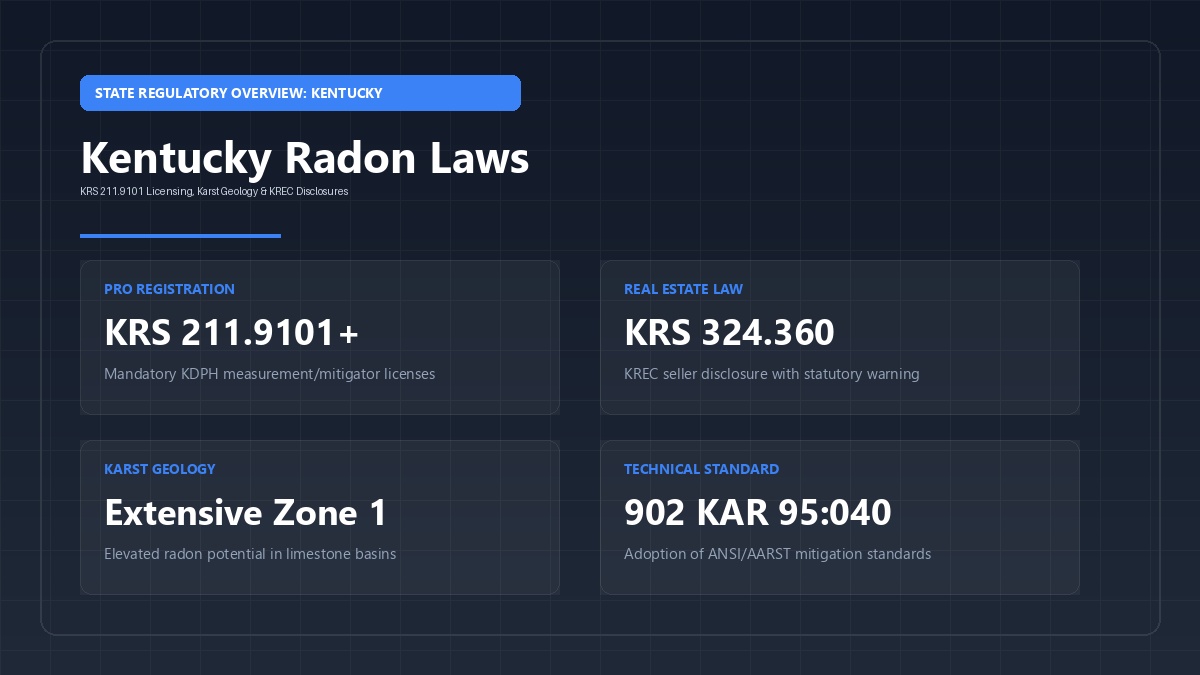
Kentucky regulates radon through mandatory professional credentialing and codified real estate disclosure. Under Kentucky Revised Statutes (KRS) §§ 211.9101 through 211.9135, all individuals and businesses providing radon measurement, mitigation, or laboratory services for fee must be officially registered and licensed with the Kentucky Cabinet for Health and Family Services (CHFS). Residential home sellers are required under KRS § 324.360 to disclose known radon test records and mitigation equipment using a standardized condition disclosure form that contains statutory health warnings. Due to extensive karst limestone topography, elevated indoor radon levels are widespread across central and western Kentucky.
Testing Requirements
Indoor radon testing is voluntary for private single-family homeowners and residential landlords in Kentucky. State law does not require existing residential properties to undergo mandatory testing prior to lease execution or occupancy. In addition, Kentucky does not currently mandate radon testing in public or private school buildings or commercial child care facilities by statute, although the Kentucky Department for Public Health (KDPH) strongly recommends that school districts and daycare centers conduct routine baseline screening using licensed measurement specialists adhering to ANSI/AARST standards.
Real-Estate Disclosure
Property transaction disclosures are governed by KRS § 324.360 and Kentucky Real Estate Commission (KREC) administrative regulations (201 KAR 11:121). In residential transactions involving licensed real estate licensees, the seller must complete the Seller’s Disclosure of Property Condition form prior to contract acceptance. The form mandates that sellers disclose any prior radon testing conducted on the premises, provide historical test scores, and state whether an active or passive radon mitigation system is installed. The KREC disclosure form explicitly incorporates mandatory statutory warning text advising prospective purchasers that radon is a radioactive gas presenting lung cancer risks and recommending independent professional testing.
Mitigator & Tester Certification
Professional licensing is mandatory in Kentucky under KRS §§ 211.9101 to 211.9135 and administrative regulation 902 KAR 95:040. Anyone offering radon measurement, mitigation, or laboratory analysis for compensation must be registered biennially with the Cabinet for Health and Family Services. To qualify for state registration, individuals must hold current national proficiency certification from either the National Radon Proficiency Program (NRPP) or the National Radon Safety Board (NRSB), adhere to ANSI/AARST standard operating procedures, maintain liability insurance, and submit mandatory semi-annual activity reports to the state radon coordinator.
New Construction
Kentucky has not enacted a blanket statewide mandate requiring Radon-Resistant New Construction (RRNC) in all new residential buildings. The Kentucky Residential Code (KRC), based on the International Residential Code, includes Appendix F (Radon Control Methods), but adoption is largely left to local building code enforcement departments or voluntary implementation by builders. However, in regions with intense karst development (such as the Bluegrass and Pennyroyal regions), many local planning commissions and progressive homebuilders voluntarily incorporate passive sub-slab suction systems during initial foundation pours.
Radon Zones & the Action Level
The EPA Map of Radon Zones classifies much of Kentucky—including the central Bluegrass region (Fayette County/Lexington), north-central counties (Jefferson County/Louisville), and south-central karst basins (Warren County/Bowling Green)—as EPA Zone 1 (High Potential), where indoor levels frequently exceed the federal action level of 4.0 pCi/L. Eastern Appalachian counties and western coalfield basins are primarily designated as Zone 2 (Moderate Potential, 2.0 to 4.0 pCi/L). KDPH adopts the EPA action level of 4.0 pCi/L, strongly urging mitigation for test results at or above this threshold. For complete geological zone details, explore our EPA Radon Zone Map guide.
The State’s Radon Program
The official state regulatory and educational authority is the Kentucky Department for Public Health Radon Program, housed within the Radiation, Food and Safety Branch of the Cabinet for Health and Family Services. KDPH maintains the official statewide registry of registered measurement and mitigation contractors, tracks regional screening data, and coordinates with local health departments to distribute free or discounted short-term test kits to Kentucky residents. Homeowners and industry professionals can verify credentials and access test kits via the official CHFS Radon Program website or by contacting program staff at 502-564-4856.
Sources & Limits
This regulatory summary is published for educational and informational purposes only and does not constitute formal legal, building code, or engineering guidance. Statutory licensing rules and real estate disclosure requirements are subject to regulatory updates. Real estate buyers, sellers, landlords, and contractors should verify current rules directly with the Kentucky Department for Public Health or qualified legal counsel.
Official Sources: Kentucky Revised Statutes §§ 211.9101–211.9135, § 324.360; 902 KAR 95:040; 201 KAR 11:121; Kentucky Cabinet for Health and Family Services; U.S. Environmental Protection Agency.
To see how Kentucky’s registration rules compare across the nation, visit our master guide to radon regulations across the United States or inspect the EPA Radon Zone Map.
Get The Signal
What we actually ran, what it measured, and what it means for a restoration shop — every week, including the flops.
Leave a Reply