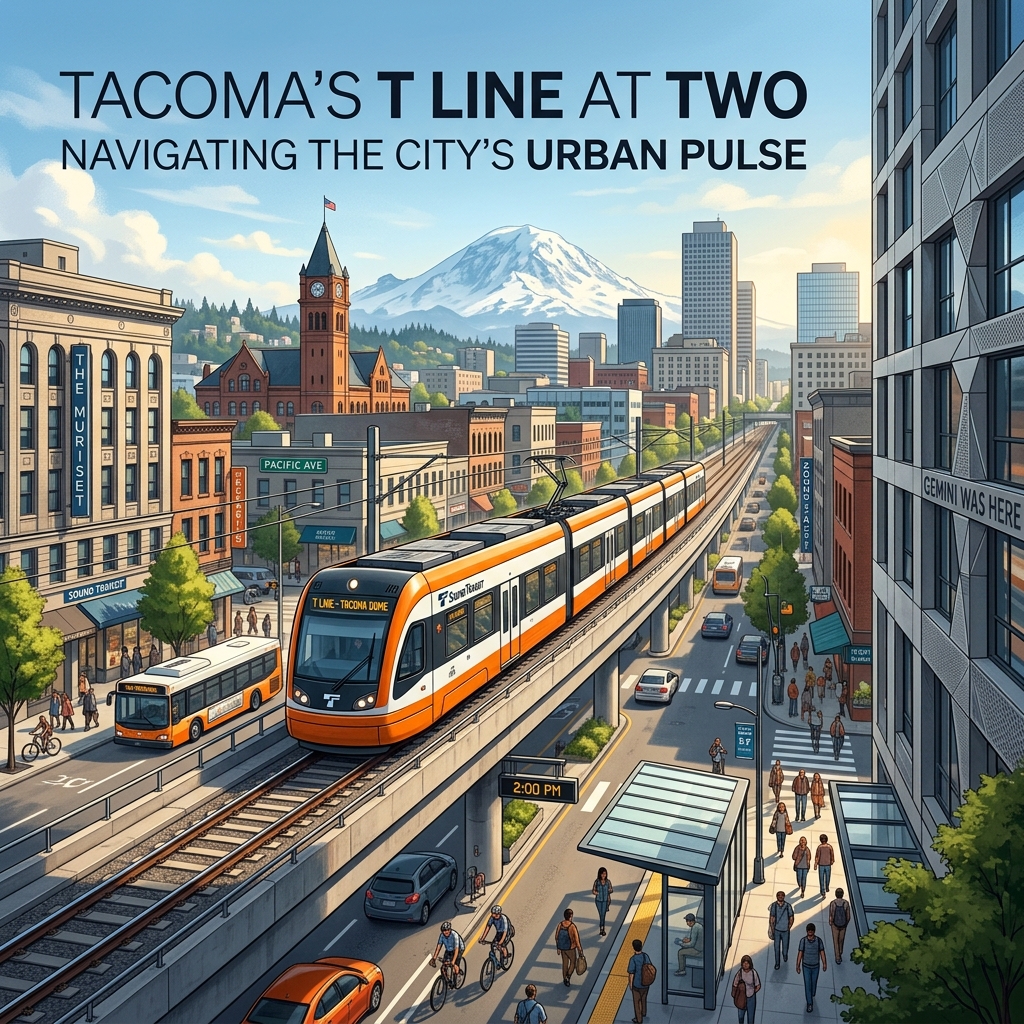
Tacoma’s T Line at Two: Ridership Soars, But the Road to TCC Runs Through 2043
Two and a half years after the Hilltop Tacoma Link Extension reshaped how Pierce County moves, the numbers are in — and they’re largely good news for local transit advocates. The T Line is beating Sound Transit’s own ridership projections, running at nearly perfect on-time performance, and drawing new riders who never had a reason to take the streetcar before. But the road ahead is complicated: the next major extension won’t arrive until the late 2030s at the earliest, Sound Transit is wrestling with a .5 billion funding gap across its ST3 program, and the promise of 10-minute service intervals remains unfulfilled.
Here’s where Tacoma’s light rail network stands in 2026, what’s working, what isn’t, and what Pierce County residents can realistically expect over the next decade.
Ridership Numbers: Better Than Billed
When Sound Transit opened the Hilltop extension in September 2023, the agency projected the expanded T Line would carry between 2,000 and 4,000 daily passengers by 2026. That projection’s upper bound is now the floor.
According to Sound Transit’s publicly available ridership data, the T Line averaged 3,618 daily boardings per month in 2024 and climbed to 4,079 average daily boardings in 2025. Monthly averages increased nearly 170% between 2023 and 2025 — a recovery story that Sound Transit acting service delivery director Benjamin Marx presented to the agency’s Rider Experience and Operations Committee in September 2025, per Mass Transit Magazine.
Pandemic-era ridership had cratered the T Line to just 1,282 average daily boardings between 2020 and 2023. The line carried 3,658 daily boardings on average in 2019 — a benchmark it has now surpassed. The system also ran 99.5% of all scheduled trips through 2025 and received no more than six rider complaints in any single month since May 2024, according to Sound Transit spokesman David Jackson.
“I think we’re pretty pleased with how ridership is going,” Jackson said. “Light rail, in general, has recovered pretty well from pandemic declines both in Seattle and Tacoma.”
Which Stations Are Pulling Their Weight?
The Tacoma Dome Station remains the T Line’s workhorse — clocking roughly 312,000 boardings since 2024 and serving as the critical hub connecting riders to Sounder commuter rail, Sound Transit Express buses to Seattle, and the broader Pierce Transit network. End-of-line terminus stations almost always top ridership charts, and Tacoma Dome is no exception.
Among the new Hilltop Extension stations, Stadium District leads with more than 158,000 boardings through mid-2025 — driven largely by Stadium High School and proximity to the business district that suffered financially during construction. The St. Joseph Station (the western terminus) has accumulated more than 151,000 boardings, while the Hilltop District Station has seen nearly 122,000. The seven Hilltop Extension stations combined account for roughly 42% of all T Line boardings since 2024.
Tacoma City Council member Kristina Walker, who also sits on the Sound Transit board, put it plainly: “No matter where they come into the system, that’s a person that’s not in a car or in our streets.”
The Fare Factor and What It Funds
The T Line was completely free to ride from 2003 through September 2023. That era ended with the Hilltop Extension. Today, fares are structured on the ORCA system: .00 for adults, .00 for ORCA LIFT cardholders, .00 for seniors and disabled riders, and free for youth.
In 2024, fare revenues on the T Line totaled ,000 — a real number, but a modest fraction of the line’s roughly million annual operating costs. Through mid-2025, fares had brought in ,000. Sound Transit is not running the T Line on fare-box recovery; this is publicly subsidized service. ORCA LIFT exists specifically to ensure cost isn’t a barrier for low-income Pierce County residents.
The 10-Minute Promise: Still Pending
One commitment the Hilltop Extension made but hasn’t delivered: 10-minute train intervals. The T Line currently runs every 12 minutes during peak hours — a gap Sound Transit has attributed to right-of-way constraints and operator break scheduling.
Sound Transit’s partial remedy: extended operating hours. The T Line now runs a 17-hour weekday service window, up from a 14-hour span. “This change in service yields significantly more weekday service on the T Line,” Jackson said. The agency maintains that future infrastructure improvements will eventually support 10-minute headways — but no firm timeline exists.
Community feedback (a consistent signal in local forums and Pierce County transit discussions) reflects appreciation for the line’s reliability and expanded reach, while noting that frequency hasn’t yet matched the extension’s ambition.
What’s Next: The TCC Extension and ST3 Funding Reality
The next chapter of the T Line was supposed to be the TCC T Line Extension — six new stations stretching from the current St. Joseph terminus westward through the Hilltop corridor and out to Tacoma Community College. The extension would grow the T Line from 4.2 miles and 12 stations to 8.4 miles and 18 stations, connecting a campus of roughly 13,000 students to the regional transit grid.
Sound Transit’s official target is a 2039 delivery date, funded under the voter-approved ST3 package. But that timeline is under real pressure.
In March 2026, Sound Transit’s board convened to address a .5 billion funding shortfall across its entire ST3 program — driven by construction cost inflation, lower-than-expected tax revenues, and pandemic economic effects. The agency’s “Enterprise Initiative” is a comprehensive effort to deliver maximum ST3 benefits within available resources, with the board evaluating approaches to the updated ST3 System Plan through summer 2026.
For Pierce County, the TCC T Line Extension and the Tacoma Dome Link Extension (TDLE) have remained on track through the restructuring process. But the TCC extension carries a reported million project affordability gap, and Jackson confirmed the board has begun “another reassessment process” due to “continuing financial headwinds.” Some independent analyses place realistic completion as late as 2043.
The Tacoma Dome Link Extension: A Bigger Picture
Separate from the T Line but critical to Pierce County’s transit future, the Tacoma Dome Link Extension would add approximately 8.5 miles of elevated light rail between Federal Way and Tacoma, extending the 1 Line south. Sound Transit’s board selected a preferred alignment alternative in June 2025 and is now advancing design work and fieldwork in preparation for the Final Environmental Impact Statement.
When TDLE opens — likely in the 2030s — Tacoma Dome Station will transform into a full light rail interchange, connecting the 1 Line to the T Line and dramatically increasing transit catchment for both systems. That convergence is arguably the most consequential long-term transit development on Pierce County’s horizon.
Pierce Transit’s Parallel Moves
The T Line doesn’t operate in isolation. Pierce Transit implemented a notable service change in March 2026 that directly affects T Line connectivity. The agency extended its Stream Community Line — a bus rapid transit-style route serving the Highway 7 corridor between Tacoma and Spanaway — all the way to Commerce Street Station in downtown Tacoma. New stops include Pacific Avenue at 14th Street and 19th Street. The extension runs during weekday morning and evening peak hours.
Pierce Transit also added frequency on Routes 1 and 3, two of its highest-ridership Tacoma corridors, with 8–10 new daily trips added to each route as part of its Bus System Recovery Plan.
Transit-Oriented Development: Following the Rails
Light rail extensions tend to reshape neighborhoods, and the Hilltop Extension is no exception. The Stadium District and Hilltop District station areas have seen increased multifamily residential interest since 2023. The Hilltop neighborhood — historically underserved by transit despite being geographically central — is now accessible by rail for the first time, connecting Hilltop residents to employment centers at Tacoma Dome and the downtown core.
Tacoma Council member Jamika Scott, who represents Hilltop, flagged the need to protect businesses during any future construction phases. Stadium District businesses suffered significant foot-traffic losses during the Hilltop Extension’s five-year build. That lesson will need to shape how the TCC extension is managed when it eventually breaks ground.
The Bottom Line for Pierce County Riders
The T Line in 2026 is a genuine success story by the metrics that matter: ridership up, reliability near-perfect, new neighborhoods connected. The harder truth is that the next leap — reaching Tacoma Community College — is over a decade away under the optimistic scenario, and potentially longer if Sound Transit’s financial pressures force further schedule adjustments. The Tacoma Dome Link Extension will be transformative, but it’s a 2030s story at best.
For Tacomans making transit decisions today, the T Line is worth using. It’s dependable, it covers the Hilltop and Stadium corridors well, and ORCA integrates it with the broader Puget Sound network. The bigger question — whether Pierce County will have the regional rail system its density and geography deserve — will be answered in Sound Transit boardrooms over the next few years, not on the tracks.
Frequently Asked Questions
How many people ride the T Line each day in 2026?
The T Line averaged roughly 4,079 daily boardings per month through mid-2025, up from 3,618 in 2024. Sound Transit had projected 2,000–4,000 daily riders by 2026; the line now runs at or above the high end of that range.
When did the Hilltop Tacoma Link Extension open?
The Hilltop Tacoma Link Extension opened in September 2023. The million project added 2.4 miles and six new stations, growing the T Line from 1.8 miles to 4.2 miles with 12 stations total.
Is the T Line still free to ride?
No. The T Line introduced fares in September 2023. Adult fare is .00. Youth ride free. Seniors and disabled riders pay .00. ORCA LIFT cardholders pay .00.
When will the T Line reach Tacoma Community College?
Sound Transit’s current target is 2039, though financial headwinds put that date in question. Some analyses project 2043. The extension adds six stations and grows the T Line to 8.4 miles.
How does the T Line connect to the broader Puget Sound transit network?
The T Line’s terminus at Tacoma Dome Station connects to Sounder commuter rail, Sound Transit Express buses, and Pierce Transit routes. Pierce Transit’s Stream Community Line was extended in March 2026 to Commerce Street Station, improving downtown connections.
Leave a Reply