Tag: Washington State

  • New to Mason County? Your First Property Tax Bill Explained — April 30, 2026 Deadline

    New to Mason County? Your First Property Tax Bill Explained — April 30, 2026 Deadline

    Moving into a Mason County home means inheriting a property tax calendar that may look different from what newcomers are used to — especially if the last place you owned was outside Washington State. The first-half 2026 Mason County property tax payment is due Thursday, April 30, 2026, and new homeowners in Shelton, Belfair, Allyn, Union, Hoodsport, and the rest of the county need to know how the system works before that date. Here is the practical walkthrough for anyone paying a Mason County property tax bill for the first time.

    How Mason County Property Tax Differs From What You May Be Used To

    Washington State does not levy an income tax, which pushes more of the cost of local services — sheriff, roads, schools, public health, courts — onto property taxes than most other states. Mason County, like all 39 counties in Washington, collects property tax twice a year rather than monthly through an escrow account (although many mortgage servicers still escrow monthly and pay the county on your behalf twice a year). The key dates are:

    • April 30 — first-half payment due
    • October 31 — second-half payment due

    If your mortgage servicer escrows your taxes, the servicer pays these bills directly from your escrow account and you typically will not receive a payment notice from Mason County. If you own free and clear — or if you are a new buyer in a cash sale or a buyer whose lender does not escrow — the responsibility is entirely yours, and the Treasurer does not send reminders beyond the initial bill mailed earlier in the year.

    How to Confirm Whether You Owe Directly or Through Escrow

    New residents often ask: did I already pay this in closing? The answer depends on the closing date and the terms of the sale. A portion of the annual tax is usually prorated between buyer and seller at closing, but that proration only covers the days the seller owned the home — not the tax bill itself. If closing happened before April 30, the outstanding first-half bill is typically paid at or before closing. If closing happened after April 30, the first half has usually already been paid by the seller and the buyer’s first real bill is the October 31 second half.

    To know for sure, log into the Mason County Property Tax Inquiry at masoncountywa.gov or call the Treasurer’s Office at 360-427-9670, extension 484. You will need your parcel number or property address to look up the current status of the tax account. If the balance shows as paid, nothing is due. If the balance shows as unpaid, you owe it by April 30 regardless of anything else.

    How to Actually Pay It

    Mason County accepts three payment methods. Each works. Pick whichever fits the day you realize you owe.

    • Online through Point & Pay — Access from masoncountywa.gov. Accepts Visa, MasterCard, Discover, American Express, and E-checks. A 2.5% credit card fee applies ($2 minimum); E-check fees are typically lower for larger amounts.
    • By phone — Call Point & Pay at 1-855-331-3631. Same cards accepted as online. Visa Debit and E-Checks are not available through the phone system — use the web portal for those.
    • In person or by mail — Mason County Treasurer’s Office, 411 N. 5th Street, Shelton, WA. Mailed payments must be postmarked on or before April 30, 2026, to be on time. Make checks payable to the Mason County Treasurer and write the parcel number on the memo line.

    What Is on Your Mason County Property Tax Bill

    A Mason County property tax bill is not a single tax — it is a stack of levies from different taxing districts layered onto the property. A typical Mason County bill includes:

    • County general fund (sheriff, roads, courts, treasurer, assessor, auditor)
    • State school levy (Washington’s contribution to public education)
    • Local school district levy (e.g., North Mason School District if the property is in the Belfair–Allyn–Tahuya area, or Shelton School District, or the Hood Canal or Pioneer districts depending on address)
    • Fire district levy (which district depends on address)
    • Library district levy
    • Port district levy (Port of Shelton, Port of Allyn, Port of Hoodsport, etc.)
    • Hospital district or public utility district assessments where applicable
    • Conservation district fee

    All of this is rolled into the single “total due” number on the bill. Each district’s rate is set annually, which is why the tax bill can change from year to year even when the assessed value of the home is flat. For new residents trying to understand why a neighbor’s bill looks different, the answer is almost always a different combination of taxing districts — a home in the city of Shelton pays different levies than a home in unincorporated Mason County outside any city limit.

    The Other Civic Deadline Newcomers Should Know About

    New residents who live in the North Mason School District (Belfair, Allyn, Tahuya) also have a special election on April 28, 2026, on a replacement Educational Programs & Operations levy that the district has asked voters to approve. That’s a school-funding question on its own timeline — the April 28 ballot — separate from the April 30 tax-payment deadline. If you recently registered to vote at your new Mason County address, your ballot has already been mailed. For coverage of what’s on that ballot, see our report on the North Mason School District levy.

    If You Are New and Overwhelmed

    The single most useful phone call a new Mason County resident can make is to the Treasurer’s Office at 360-427-9670, extension 484. The staff there can pull up your parcel in seconds, tell you exactly how much you owe for the first half, whether any portion was paid at closing, whether your mortgage servicer is handling it, and what your options are if you need a payment plan. For a broader orientation to the county you just moved into, our guide on living in Mason County, Washington covers most of the other questions newcomers ask in their first year.

    Frequently Asked Questions

    I just moved to Mason County. Do I owe property tax by April 30?

    It depends on your closing date and whether your mortgage escrows taxes. If closing happened before April 30, 2026, the first-half tax is usually paid at closing or is in the buyer’s hands to pay by April 30. If closing happened after April 30, the first half has usually already been paid by the seller, and the next bill you owe is the October 31 second half. Call the Mason County Treasurer at 360-427-9670 extension 484 with your parcel number to confirm your specific status.

    Does my mortgage company pay my Mason County property tax?

    Possibly. If your mortgage includes an escrow account for taxes and insurance, the servicer collects a portion of your monthly payment and pays the Treasurer directly by April 30 and October 31. Check your most recent mortgage statement for an escrow account balance, or call your servicer. If you have no escrow account, the full responsibility for paying Mason County directly is yours.

    What if I didn’t get a property tax bill from Mason County?

    The Treasurer’s Office mails annual tax statements earlier in the year, but new residents who closed on a home mid-year often do not receive one because the mailing went to the prior owner or to the mortgage servicer’s address. A missing bill does not excuse the deadline. Look up your balance at masoncountywa.gov using your parcel number, or call the Treasurer at 360-427-9670 extension 484 to get the amount.

    Can I set up monthly property tax payments in Mason County?

    Mason County does not offer a standard monthly-installment program for property taxes in the way a mortgage servicer does. Washington state law authorizes two payments per year: half on April 30 and half on October 31. Taxpayers who cannot meet a deadline can contact the Treasurer’s Office at 360-427-9670 extension 475 to discuss a case-by-case payment plan. The most common “monthly” approach is to set up an escrow account voluntarily through your bank or to self-budget monthly and make the two large payments yourself.

    Why does my Mason County property tax bill have so many line items?

    Your bill is a stack of levies from every taxing district your property sits in — county general fund, state school levy, local school district, fire district, library district, port district, conservation district, and sometimes a hospital or PUD assessment. Each district sets its own rate annually. The “total” on the bill is the sum. Homes in different Mason County communities pay different totals because they sit in different combinations of districts, not because the county charges them more.


  • Mason County Senior Property Tax Exemption: Who Qualifies, How to Apply, and the April 30 Deadline

    Mason County Senior Property Tax Exemption: Who Qualifies, How to Apply, and the April 30 Deadline

    Mason County seniors who own their home and live in it full-time may be eligible for a Washington State property tax exemption that can substantially reduce the annual tax bill — but the exemption is not automatic, and the clock is ticking on the April 30, 2026, first-half payment deadline. This is what homeowners 61 and older in Shelton, Belfair, Allyn, Union, and every other Mason County community need to know about qualifying, applying, and what to do in the meantime.

    Who Qualifies for the Mason County Senior Property Tax Exemption

    Washington State’s senior citizen and disabled-person property tax exemption is administered at the county level. To qualify in Mason County, a homeowner generally must meet all of these conditions:

    • Age or disability — Be 61 years or older by December 31 of the year before the exemption takes effect, or be retired from regular employment because of a physical disability, or be a disabled veteran with an 80% or greater service-connected disability rating.
    • Ownership — Own the home as of December 31 of the qualifying year, and hold the title in the applicant’s name (or through a qualifying life estate or trust).
    • Primary residence — Live in the home as a primary residence for at least nine months of the year.
    • Income — Have a total household disposable income of $55,000 or less per year. Mason County’s income threshold was increased to $55,000 effective for the 2024 tax year and remains the qualifying ceiling for the current program.

    Income under the program includes Social Security, pensions, IRA distributions, wages, rental income, interest, and dividends. Some items can be deducted — for example, non-reimbursed medical expenses and certain long-term care costs — which means households that look over the threshold on paper may still qualify once deductions are applied.

    What the Exemption Actually Does to Your Tax Bill

    The exemption is tiered by income. At the lowest income tier, a qualifying senior’s property value is frozen at the level it was when they first qualified (preventing future increases from raising the tax bill) and a portion of regular levy taxes is removed. At higher income tiers within the $55,000 ceiling, the reduction is smaller but still meaningful. For many Mason County seniors on fixed incomes, the difference between qualifying and not qualifying can run into the hundreds or low thousands of dollars per year.

    The exemption does not apply to special assessments like fire district fees, local improvement districts, or conservation district fees. Those remain payable in full regardless of exemption status.

    How to Apply Through the Mason County Assessor

    Applications for the senior and disabled exemption go through the Mason County Assessor’s Office, not the Treasurer. This is an important distinction — the Treasurer collects taxes, but the Assessor determines who qualifies for the exemption that reduces those taxes in the first place.

    Questions and application packets are available at 360-427-9670, extension 491. Applicants need to provide:

    • Proof of age (birth certificate, driver’s license) or proof of disability (from Social Security, VA, or a physician)
    • Proof the home is the primary residence
    • Documentation of total household income — typically prior-year tax returns plus Social Security and pension statements

    First-time applicants should plan for the process to take several weeks after paperwork is received. Retroactive refunds may be available if it turns out the applicant has qualified for prior years and was unaware of the program.

    What to Do About the April 30, 2026, Deadline in the Meantime

    If a qualifying senior has not yet applied — or has applied but not yet been approved — the April 30 first-half property tax payment is still due at the full amount. Missing the deadline creates interest and penalties that accrue beginning May 1, 2026, and those charges are not waived retroactively even if the exemption is later granted.

    Mason County seniors who are close to the income threshold or think they may qualify should do two things right now: (1) pay the first-half bill by April 30 through any of the three available methods — in person at 411 N. 5th Street in Shelton, by mail postmarked on time, or online/by phone through Point & Pay at 1-855-331-3631; and (2) start the exemption application process through the Assessor so it is in place for the October 31 second-half bill and future years.

    For broader payment guidance on the April 30 deadline, see our complete Mason County property tax payment guide. For the full picture of how the county government works and how the Assessor and Treasurer fit together, see how Mason County government works.

    The Federal Deferral Program (Different From the Exemption)

    Washington State also runs a property tax deferral program for seniors and disabled residents, separate from the exemption. The deferral does not reduce the tax — it delays payment, with the deferred amount becoming a lien against the property that is collected when the property is sold or transferred. The deferral program is useful for residents whose income qualifies but who want to preserve liquidity in a given year rather than reduce the long-term cost. The Assessor’s Office can explain both options during the application conversation.

    Frequently Asked Questions

    What is the income limit for the Mason County senior property tax exemption in 2026?

    The current income threshold for the Mason County senior and disabled-person property tax exemption is $55,000 per year in total household disposable income. Mason County raised the limit from $40,000 to $55,000 effective for the 2024 tax year, and that threshold applies to the current program. Deductions for non-reimbursed medical expenses and long-term care costs can bring households under the ceiling even if gross income looks higher.

    How do I apply for the Mason County senior property tax exemption?

    Applications are filed with the Mason County Assessor’s Office, not the Treasurer. Call 360-427-9670 extension 491 to request an application packet. You will need to provide proof of age or disability, proof the home is your primary residence, and documentation of your total household income from the prior year. The application is not automatic and must be renewed periodically.

    Do I still have to pay the April 30 property tax bill if I’ve applied for the senior exemption?

    Yes. If your exemption has not yet been approved by April 30, 2026, you must pay the first-half property tax at the full billed amount. Interest begins accruing May 1 on any unpaid balance and is not waived even if the exemption is later granted. Once the exemption is approved, future bills reflect the reduction. Ask the Assessor’s Office whether you qualify for any retroactive refund for prior years you may have been eligible but unenrolled.

    What’s the difference between the senior exemption and the senior deferral in Mason County?

    The senior exemption reduces the amount of property tax owed for qualifying homeowners. The senior deferral program delays payment rather than reducing it — deferred amounts become a lien on the property that is paid when the property is sold or transferred. Both are administered through the Assessor’s Office. Seniors below the income threshold can generally choose either program based on their cash-flow needs.

    Does the Mason County exemption apply to all property taxes?

    No. The exemption applies to regular levy property taxes. It does not apply to special assessments such as fire district fees, local improvement districts, conservation district fees, or similar non-ad-valorem charges. Those continue to be billed and owed in full regardless of exemption status. The Treasurer’s Office can explain which portions of your specific bill are and are not subject to the exemption.


  • Mason County Property Tax Deadline April 30, 2026: Payment Options, Fees, and What Happens If You’re Late

    Mason County Property Tax Deadline April 30, 2026: Payment Options, Fees, and What Happens If You’re Late

    Mason County property owners have until Thursday, April 30, 2026, to pay the first half of their 2026 property taxes. The Mason County Treasurer’s Office has confirmed that delinquent charges begin Friday, May 1, 2026, and is urging anyone who can pay early to do so before last-minute mail and online backlogs create problems. Here is the complete payment guide for every property owner from Shelton to Dewatto — what you can pay, how you can pay, what it costs, and what happens if you miss the deadline.

    April 30 Is a Hard Deadline Under State Law

    Under Washington state law, property tax payments of $50 or more can be split into two halves: the first due on or before April 30 and the second due on or before October 31 of the same year. Payments under $50 must be paid in full by April 30. This is not a Mason County-specific rule — every county treasurer in the state enforces the same schedule — but Mason County Treasurer’s Office has reminded local taxpayers that mail delivery times through the USPS may be delayed, so payments should be mailed well ahead of the deadline.

    Payments postmarked on or before April 30 are considered on time. After that, interest and penalties accrue on the unpaid balance beginning May 1.

    Three Ways to Pay Your Mason County Property Tax

    The Mason County Treasurer’s Office offers three primary methods for the 2026 first-half payment.

    1. Pay in Person

    The Mason County Treasurer’s Office is located at 411 N. 5th Street, Shelton, WA. In-person payments accept cash, check, cashier’s check, money order, and credit or debit cards. Office hours are generally Monday through Friday during standard business hours; Mason County residents making the trip should call ahead to confirm hours on the day of payment.

    2. Pay by Mail

    Mail-in payments must be postmarked on or before April 30, 2026, to be considered on time. The Treasurer’s Office recommends mailing early — delivery windows through the USPS can stretch several business days, and a payment received after the deadline but postmarked on time is still credited as timely. Checks should be payable to the Mason County Treasurer and include the property account number or parcel number on the memo line.

    3. Pay Online or by Phone

    Mason County uses Point & Pay for online and telephone credit/debit card processing. The online portal is accessible from masoncountywa.gov, and the automated phone payment system can be reached at 1-855-331-3631. Accepted cards are Visa, MasterCard, Discover, and American Express. Visa Debit and E-Checks are not available over the phone but are available online.

    A processing fee applies to credit card payments: 2.5% of the amount due, with a $2.00 minimum. E-checks carry a flat fee that is generally lower than the card fee for larger payments; the exact amount is disclosed at checkout on the Point & Pay portal.

    What If You Can’t Pay the Full Amount by April 30?

    Mason County offers payment plan arrangements for taxpayers who cannot pay in full by the deadline. These are not advertised on the standard payment page — they are handled case-by-case through the Treasurer’s Office at 360-427-9670, extension 475. Interest generally continues to accrue on the unpaid balance during a payment plan, so contacting the office before April 30 typically produces a better outcome than waiting until after the deadline has passed.

    Senior and Disabled Property Tax Exemptions

    Mason County participates in Washington State’s senior citizen and disabled-person property tax exemption program. The program can reduce or freeze the taxable value of a primary residence for qualifying owners. Eligibility generally requires the applicant to be 61 years or older, or to be disabled, and to own and occupy the home as a primary residence. The income threshold for Mason County was raised to $55,000 per year effective for the 2024 tax year and remains the current qualifying ceiling for the program.

    The exemption is applied for through the Mason County Assessor’s Office, not the Treasurer, and does not happen automatically. Applicants must file paperwork and provide income documentation. Questions about qualification or how to apply can go to the Assessor’s Office at 360-427-9670, extension 491.

    What Happens If You’re Late

    Interest accrues on delinquent property taxes under state law. In Washington, unpaid first-half taxes accrue interest at 1% per month beginning May 1, and additional penalties compound as the tax remains unpaid. Extended delinquency can eventually place the property at risk of foreclosure, though that process plays out over multiple years and involves formal notice before any action. The Treasurer’s Office will work with property owners who contact them early; the worst outcomes almost always involve owners who do not reach out.

    Why the April 30 Deadline Matters to Every Mason County Community

    Property taxes fund the services that show up in every Mason County community from Shelton to Dewatto. That includes the Mason County Sheriff’s Office, county roads, district courts, public health, planning, and the county elections office that runs votes like the North Mason levy special election on April 28. A high percentage of first-half collections is what keeps those services funded through the summer months until the October 31 second-half deadline brings in the next major revenue cycle.

    For a broader look at how Mason County government departments interact with each other and with residents, see our guide on how Mason County government works. Property owners weighing how the North Mason School District levy on the same election cycle affects their tax bill can also consult our coverage on what the levy means for your tax bill.

    Key Contacts and Deadlines at a Glance

    • First-half property tax due: Thursday, April 30, 2026
    • Second-half property tax due: Saturday, October 31, 2026
    • Treasurer’s Office: 411 N. 5th Street, Shelton, WA
    • Treasurer general line: 360-427-9670, extension 484
    • Payment plans: 360-427-9670, extension 475
    • Senior/disabled exemption (Assessor): 360-427-9670, extension 491
    • Automated phone payment (Point & Pay): 1-855-331-3631
    • Online portal: masoncountywa.gov

    Frequently Asked Questions

    When is the Mason County property tax deadline in 2026?

    The first-half 2026 Mason County property tax payment is due Thursday, April 30, 2026. The second-half payment is due Friday, October 31, 2026. Payments postmarked on or before the deadline are considered on time. Delinquent charges begin accruing the day after the deadline.

    How do I pay my Mason County property tax online?

    Mason County uses Point & Pay to process online property tax payments. Access the portal from masoncountywa.gov and select the property tax payment link. Visa, MasterCard, Discover, and American Express cards are accepted, along with E-checks. A 2.5% fee ($2.00 minimum) applies to credit card transactions. You can also pay by phone at 1-855-331-3631 using the same system.

    Can I split my Mason County property tax into two payments?

    Yes. Under Washington state law, any Mason County property tax bill of $50 or more can be split into two halves. The first half is due April 30 and the second half is due October 31. Bills under $50 must be paid in full by April 30. You do not need to file a special request — half-payment is the default if your bill is $50 or more.

    What happens if I miss the April 30 Mason County property tax deadline?

    Interest and penalties begin accruing May 1 under Washington state law. Interest is charged at 1% per month on the unpaid balance. Extended delinquency eventually places the property at risk of foreclosure, though that process takes years and involves multiple formal notices. If you cannot pay in full, contact the Treasurer’s Office at 360-427-9670 extension 475 before the deadline to discuss payment plan options.

    Does Mason County have a senior property tax exemption?

    Yes. Mason County participates in Washington State’s senior citizen and disabled-person property tax exemption. Owners who are 61 or older or disabled, own and occupy a primary residence in Mason County, and have an annual household income of $55,000 or less may qualify. Applications go through the Mason County Assessor’s Office at 360-427-9670 extension 491. The exemption is not automatic — you must apply and provide income documentation.

    Can I set up a payment plan for Mason County property tax?

    Yes. Mason County Treasurer’s Office works with property owners who cannot pay the full amount by the deadline. Payment plans are arranged case-by-case. Contact the Treasurer’s Office at 360-427-9670 extension 475 to discuss options. Interest continues to accrue during a payment plan, so reaching out before April 30 typically produces a better outcome than waiting until after the deadline.

    Where is the Mason County Treasurer’s Office located?

    The Mason County Treasurer’s Office is located at 411 N. 5th Street, Shelton, WA. In-person payments accept cash, check, cashier’s check, money order, and credit or debit cards. Confirm office hours at 360-427-9670 extension 484 before visiting, especially close to the April 30 deadline when lines can be long.


  • Mason County Government: North Mason School Levy Heads to April 28 Vote as Property Tax Deadline Looms — April 2026

    Mason County Government: North Mason School Levy Heads to April 28 Vote as Property Tax Deadline Looms — April 2026

    Two civic deadlines are bearing down on Mason County residents this month. Voters in the North Mason School District head back to the polls on April 28, 2026, for a third attempt at passing an Educational Programs & Operations replacement levy, and county-wide property owners have until April 30, 2026, to pay the first half of their 2026 property taxes. Here is what Mason County residents need to know.

    North Mason School Levy — April 28 Special Election

    The North Mason School District — which serves Belfair, Allyn, and Tahuya — is asking voters to approve a replacement Educational Programs & Operations (EP&O) levy on April 28, 2026. This is the district’s third attempt after prior levy measures failed to reach the required threshold.

    This time the ask is lower. The proposed rate is approximately $1.01 per $1,000 of assessed property value, down from the $1.28 per $1,000 rate in the previous attempt. District leaders have framed the smaller request as a direct response to voter feedback from the earlier elections.

    The stakes are specific. The district has already absorbed roughly $3 million in cuts tied to prior levy failures. If the April 28 measure also fails, district communications have indicated that further reductions would reach deeper into programs that parents and students directly experience — music, athletics, Advanced Placement course offerings, and campus security staffing are all on the table for additional cuts.

    EP&O levies fund the gap between state basic-education funding and the full cost of running local schools. That includes staffing, extracurriculars, security, and a wide range of services the state does not fully cover.

    Mason County voters with questions about ballots, replacement ballots, or drop-box locations can reach the Mason County Auditor’s Office at 360-427-9670, extension 469. More information on the levy itself is available at nmsd.wednet.edu.

    Mason County Property Tax — First Half Due April 30

    The first-half 2026 property tax payment is due Thursday, April 30, 2026, for every property owner in Mason County. That includes residents across Shelton, Belfair, Allyn, Union, Hoodsport, Matlock, Grapeview, Tahuya, and Dewatto.

    The Mason County Treasurer’s Office offers three ways to pay:

    • By mail — payments postmarked on or before April 30 are considered on time.
    • In person — the Treasurer’s Office is located at 411 N. 5th Street, Shelton, WA.
    • Online — through the Treasurer portal at masoncountywa.gov.

    The second-half payment is due October 31, 2026. Property owners who fall behind on the first-half deadline face interest and penalties under state law, so the Treasurer’s Office is urging early payment for anyone who can make it.

    Questions on amounts owed, payment plans, or senior and disabled exemptions can be directed to the Mason County Treasurer’s Office at 360-427-9670, extension 484.

    Why It Matters

    Both deadlines sit at the core of how local government works in Mason County. The North Mason levy decides whether schools in the Belfair–Allyn–Tahuya corridor keep programs intact or move into another round of reductions. The property-tax deadline funds the county services — roads, sheriff, courts, public health — that every community from Shelton to Dewatto depends on. Missing either one has consequences that show up quickly in Mason County residents’ daily lives.

    Sources

    This is a Mason County Minute Government/Civic beat report for April 20, 2026, covering the April 28 North Mason School levy special election and the April 30 first-half property tax deadline.

    Related Coverage — Mason County Property Tax

  • Howarth Park: The Everett Beach You Drive Past Without Knowing It’s There

    Howarth Park: The Everett Beach You Drive Past Without Knowing It’s There

    What is Howarth Park in Everett?
    Howarth Park is a City of Everett park on the Puget Sound bluff at 1127 Olympic Boulevard, with an easy 0.6-mile loop trail, a pedestrian bridge over the BNSF railroad tracks to a long beach, sport courts, a playground, and an off-leash dog beach on the north end. It’s open 6 a.m. to 9 p.m. daily, free to enter, and one of the most underused public beaches in Snohomish County.

    Howarth Park: The Everett Beach You Drive Past Without Knowing It’s There

    Olympic Boulevard in south Everett is mostly tidy residential streets, a few stop signs, and not much else to look at — which is exactly how most drivers end up cruising right past Howarth Park without noticing the turnoff. That is the central fact of this park. It’s one of the most scenic stretches of public beach in south Everett, it’s a short drive from downtown, and a huge number of Everett residents have never set foot on it.

    Let’s fix that.

    Where Howarth Park Actually Is

    Howarth Park is tucked along the western bluff of south Everett at 1127 Olympic Boulevard. Coming from downtown, the easiest route is south on Rucker Avenue, right on Mukilteo Boulevard, and then left into the park about a mile and a half after you pass Forest Park. If you hit the Mukilteo ferry, you’ve gone too far.

    The park sits on a long, narrow strip of bluff and beach that the City of Everett has owned and managed for generations. The bluff side holds the parking, playground, and sport courts. The beach is a separate world down below — reached only by the park’s signature pedestrian bridge.

    The Three Parking Lots and What Each One Gives You

    One of the things that confuses first-time visitors is that Howarth Park has three parking lots, and they’re not interchangeable. Pick the wrong one and you’ll either end up with a long walk or a missed view.

    The north parking lot is what most beach-goers want. This is the closest pedestrian access to the beach itself. A short trail leads from the lot to the park’s pedestrian bridge, which spans the BNSF railroad tracks below and drops you directly onto the sand. If your goal is to get to the water with kids, a dog, or a beach chair, this is the lot.

    The central parking lot sits at a small viewpoint on the bluff and offers a trail that drops down the hillside to the beach. This route is longer and steeper than the north access, but the view from the top is easily the best non-beach view in the park — on a clear day you’re looking straight across at the Olympic Mountains and Hat Island.

    The south parking lot is the one most Everett residents don’t realize exists. This is the family-friendly end: two sport courts (tennis and basketball), a playground, a restroom, and a short, level walking path that leads to another great water view — again with Hat Island front and center. If you have young kids and want a picnic without the pedestrian-bridge hike, come here.

    The Pedestrian Bridge and the Beach

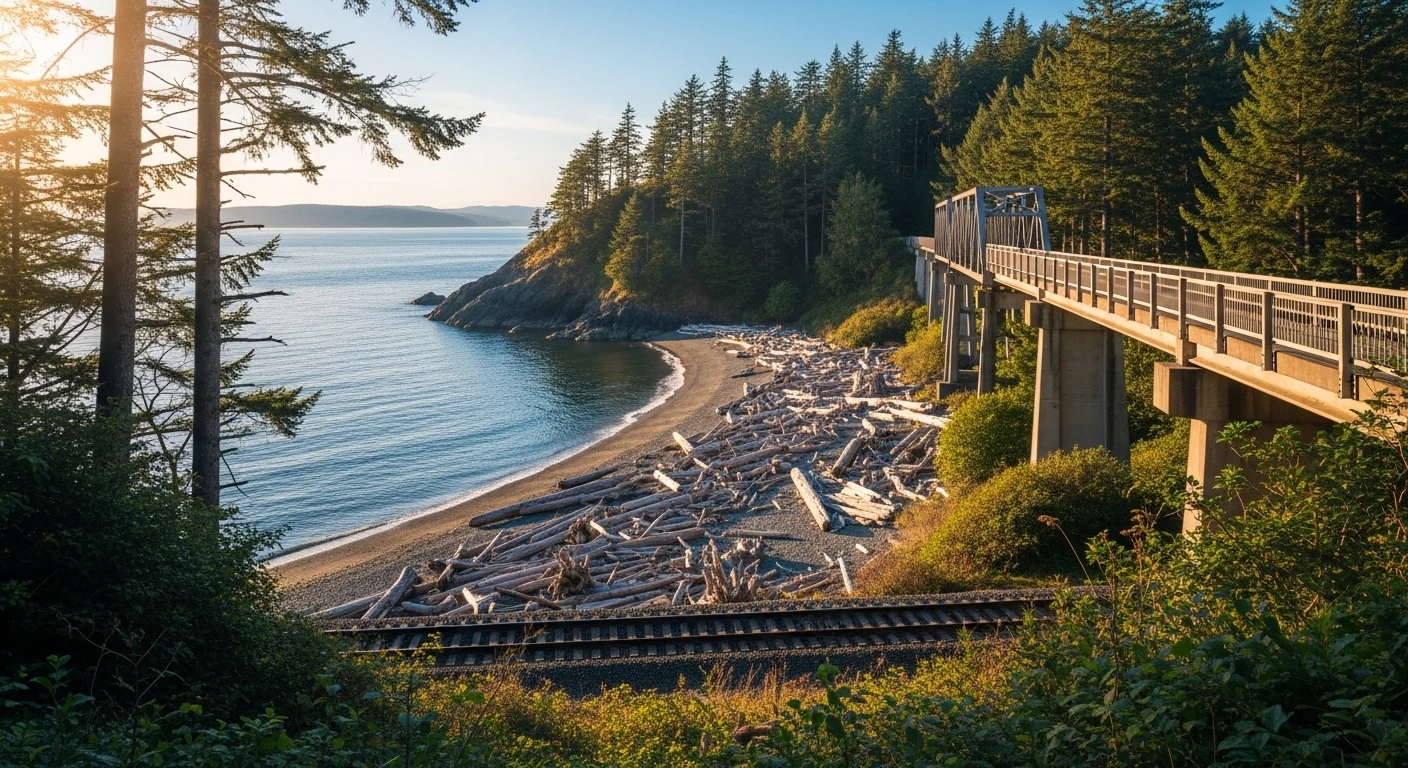
    The pedestrian bridge over the railroad tracks is the quintessential Howarth experience. It’s not fancy — a metal walkway with railings — but it feels a little bit like crossing into a hidden world. You come off the bridge onto a long, driftwood-strewn beach with Possession Sound in front of you, Whidbey Island in the distance, and the Mukilteo ferry crossing behind you.

    The beach itself runs north to south along the park’s full length. It’s sand and cobble, with plenty of driftwood washed up at the high-tide line and tide pools exposed at low tide. You’ll see people walking dogs, kids skipping rocks, the occasional fisherman, and on nice spring weekends, a handful of photographers chasing the light.

    The freight trains that run on the tracks behind you are loud and constant — that’s the tradeoff for beach access in this part of Puget Sound. After your first trip you stop noticing them.

    The 0.6-Mile Loop Trail

    On the bluff above, Howarth has a short but scenic 0.6-mile loop trail that’s generally rated as easy. It takes most people about 15 to 20 minutes and connects the three parking lots through a mix of forested switchbacks and bluff-edge sections. Strollers can handle some of it but not all. Dogs on leash are fine.

    The trail is at its best between March and September, when the alders have leafed out and the ground is dry. In winter the steeper descents can get muddy and slick — bring shoes with tread.

    The Off-Leash Dog Beach

    Here’s a Howarth detail most Everett dog owners don’t know until their neighbor tells them: the north end of the beach is off-leash. Everett has very few legal off-leash beach options, and this is one of them. The south half of the beach stays leashed, but if you walk north from the pedestrian bridge, your dog can run.

    Standard rules apply: owners are responsible for cleanup, voice control, and pulling your dog back if another leashed dog or visitor is coming through. The regulars who use this stretch have an informal etiquette that works well — show up, be considerate, and you’ll be welcomed.

    The Views and When to Come

    Howarth faces roughly west-southwest across Possession Sound. That geometry means:

    • Morning: Calm water, often glassy, great for reflective photos and cool-weather walks.
    • Golden hour to sunset: The main event. The sun drops behind Hat Island and the Olympics light up pink and orange. This is the time to come.
    • Overcast days: Still beautiful. The moody gray sky and driftwood beach are some of the most Pacific Northwest scenery Everett has.

    Weekends in July and August get busy, especially the north lot. Weekday evenings are the sweet spot — you’ll often have long stretches of beach to yourself.

    Hours, Amenities, and Rules

    • Hours: 6 a.m. to 9 p.m. daily.
    • Cost: Free.
    • Parking: Three lots, no fee.
    • Restrooms: Available at the south lot.
    • Playground: South lot.
    • Sport courts: South lot (tennis and basketball).
    • Dogs: On leash in all park areas except the north end of the beach, which is off-leash.
    • Fires: Not permitted on the beach.
    • Alcohol: Not permitted in park facilities.

    Why Howarth Is Worth the Trip

    Everett has Jetty Island for ferry-ride summer beach days, Forest Park for forest walks and the animal farm, and Legion Memorial for views and golf. Howarth is the one that fills a different slot: a real, walkable Puget Sound beach you can drive to in ten minutes, stay on for two hours, and leave without feeling like you fought a crowd.

    It’s not flashy. It’s not a destination. It’s just quietly one of the best small parks in the city, and the Everett residents who use it regularly tend to keep it that way.

    Frequently Asked Questions

    Where is Howarth Park in Everett?

    Howarth Park is at 1127 Olympic Boulevard in south Everett, on the Puget Sound bluff between downtown Everett and Mukilteo. The easiest route from downtown is south on Rucker, right on Mukilteo Boulevard, and left into the park.

    What are the hours at Howarth Park?

    Howarth Park is open 6 a.m. to 9 p.m. daily, year-round.

    How do you get to the beach at Howarth Park?

    The quickest access is from the north parking lot. A short trail leads to a pedestrian bridge that spans the BNSF railroad tracks and drops you directly onto the beach. There’s also a longer switchback trail from the central parking lot that descends the bluff to the beach.

    Is Howarth Park dog-friendly?

    Yes. Dogs are allowed throughout the park on leash, and the north end of the beach is an off-leash area. Owners are responsible for cleanup and voice control.

    How long is the Howarth Park trail?

    The main loop trail is about 0.6 miles and generally takes 15 to 20 minutes. It connects the three parking lots through a mix of forested switchbacks and bluff-edge segments.

    Is there parking at Howarth Park?

    Yes. There are three free parking lots — north, central, and south. The north lot is closest to the beach via the pedestrian bridge. The south lot has the playground, restroom, and sport courts.

    Can you swim at Howarth Park Beach?

    Wading is common on warm days, but Puget Sound water is cold year-round and the beach is not a lifeguarded swim beach. Conditions are best-suited for beachcombing, dog walking, and tide-pooling at low tide.

    When is the best time to visit Howarth Park?

    Weekday evenings between March and September are ideal. The golden-hour to sunset window is the park’s best view. Weekend afternoons in mid-summer can fill the north parking lot — come early or arrive after 4 p.m. for easier parking.

    Is Howarth Park free?

    Yes. There is no entrance fee and parking is free at all three lots.


  • Living in Mason County Washington: The Complete Guide

    Living in Mason County Washington: The Complete Guide

    Living in Mason County Washington: The Complete Guide

    Mason County, Washington is a hidden gem in the Pacific Northwest that offers a unique blend of outdoor recreation, small-town charm, and genuine community spirit. Whether you’re considering relocating here or simply curious about what makes this corner of Washington special, this guide covers everything you need to know about living in Mason County.

    What Makes Mason County Special?

    Nestled in the Olympic Peninsula region of Washington State, Mason County sits between the Cascade Range and the Pacific Ocean. This geographic position gives residents the best of both worlds: easy access to water recreation, mountains, and vibrant outdoor culture, combined with a slower pace of life than you’d find in Seattle or Tacoma.

    Our community values self-sufficiency, outdoor recreation, and neighborly connection. From the working waterfronts of Hood Canal to the forested valleys inland, Mason County has shaped residents who appreciate nature, heritage, and hard work.

    The Communities of Mason County

    Shelton is the county seat and largest city, home to about 10,000 residents. It’s the economic and cultural heart of Mason County, with downtown shops, schools, medical facilities, and local government. Shelton has a rich timber and oyster heritage and remains a working community with genuine local character.

    Belfair, located in the eastern part of the county, is a growing community popular with families. It offers access to Green Cove, several parks, and smaller-town amenities while remaining close to shopping and services.

    Hoodsport is the gateway to Hood Canal and appeals to those seeking waterfront living and recreation. This scenic area is known for its vacation homes, oyster bars, and access to water sports.

    Union sits along Hood Canal’s shoreline and has historically been a logging and oyster community. Today it’s known for its scenic beauty and access to the water.

    Allyn is another Hood Canal community with a quieter, more rural character. It attracts residents seeking privacy and waterfront access.

    Grapeview, Tahuya, and Matlock are smaller communities scattered throughout the county, each with their own local character and strong community ties.

    Geography and Climate

    Mason County spans roughly 960 square miles with diverse terrain. You’ll find forested uplands, river valleys, and the Hood Canal waterfront all within the county borders.

    The climate is maritime Pacific Northwest. Winters are mild (averaging 35-45°F) but wet, with significant rainfall from October through March. Summers are dry and comfortable (70-80°F), making June through September the prime season for outdoor activities. Most residents adjust well to the rainy season and embrace the lush, green landscape it creates.

    Cost of Living

    One significant advantage of living in Mason County is affordability compared to western Washington urban areas. Housing costs are notably lower than King County or Kitsap County, though prices have risen in recent years due to increased interest in the region.

    As of 2026, median home prices range from $350,000 to $550,000 depending on location and proximity to water. Rental availability is limited, with most rentals ranging from $1,200 to $1,800 per month for a two-bedroom residence.

    Overall cost of living (groceries, utilities, services) is reasonable but slightly higher than national averages, typical for Washington State. Gas prices track state and regional trends.

    Why People Choose Mason County

    Outdoor Recreation: Hood Canal offers world-class shellfish harvesting, boating, and water sports. The Olympic Mountains are minutes away. State parks, hiking trails, and fishing access are abundant.

    Community: Mason County communities are tight-knit. People know their neighbors. Local events, farmers markets, and community organizations create genuine connection.

    Affordability: Compared to Seattle or Tacoma metro areas, cost of living is reasonable, especially housing.

    Working Heritage: Mason County has honest, working-class roots. Logging, oyster farming, and fishing remain part of the regional identity.

    Natural Beauty: From Hood Canal to forests to mountain views, scenic beauty surrounds residents daily.

    Challenges to Consider

    Distance from Services: Serious medical specialists, major retailers, and entertainment require trips to Olympia, Tacoma, or Seattle. Expect 45 minutes to over an hour for regional medical care.

    Weather: The rainy season tests residents. Those who thrive here either enjoy the rain or learn to embrace it philosophically.

    Limited Job Market: Employment opportunities are more limited than in larger cities. Many residents commute or work remote. Tourism and natural resource industries are primary employers.

    Population Decline: Like many rural counties, Mason County has experienced population shifts. This affects services and economic vitality in some areas.

    Housing Limitations: Rental housing is scarce. New construction moves slowly. Finding rental properties can be challenging.

    Who Should Consider Moving Here?

    Mason County is ideal for:

    • Remote workers seeking small-town life with natural beauty
    • Retirees wanting affordable living and community connection
    • Outdoor enthusiasts drawn to water recreation and hiking
    • Families valuing local schools and community involvement
    • People seeking escape from urban sprawl without complete isolation

    It may be challenging for those requiring specialized services, those seeking vibrant nightlife/dining, or those needing immediate access to major employers.

    Getting Around

    A car is essential in Mason County. Public transportation is extremely limited. Most residents drive to work, school, and recreation. Highway 101 is the main north-south route. Highway 8 and Highway 3 provide regional connections.

    Conclusion

    Living in Mason County means choosing community, natural beauty, and a slower pace over urban convenience. It’s a place where neighbors matter, outdoor recreation is accessible, and genuine small-town connection still exists. For the right person, Mason County offers genuine quality of life that bigger cities simply can’t match.


    Frequently Asked Questions

    What is the population of Mason County?

    Mason County has approximately 80,000 residents, with the population distributed across multiple small communities. Shelton is the largest city with about 10,000 residents.

    Is Mason County a good place to retire?

    Yes, many retirees choose Mason County for its affordable housing, natural beauty, and strong community. The mild winters and access to recreation appeal to retirees, though limited specialized medical services should be considered.

    What’s the job market like in Mason County?

    The job market is limited compared to larger cities. Main employers include government, healthcare, retail, and tourism. Many residents work remotely or commute to Olympia or other regional centers.

    How much does it rain in Mason County?

    Mason County receives significant rainfall, especially October through March, averaging 55-70 inches annually. Winters are wet but temperatures stay mild. The rainy season creates lush green landscapes.

    What are the best neighborhoods in Mason County?

    Popular areas include downtown Shelton for urban amenities, Belfair for family-friendly living, and Hood Canal communities (Hoodsport, Union, Allyn) for waterfront access and natural beauty.

  • Mason County Real Estate: Prices, Trends and Neighborhoods

    Mason County Real Estate: Prices, Trends and Neighborhoods

    Mason County Real Estate: Prices, Trends and Neighborhoods

    The Mason County real estate market reflects the region’s appeal as an affordable alternative to western Washington’s crowded, expensive metro areas. Whether you’re searching for a cozy family home, a waterfront property, or a rural retreat, understanding the local market is essential to making an informed decision.

    Market Overview 2026

    As of 2026, Mason County’s real estate market has stabilized after several years of growth. Median home prices have increased gradually but remain substantially lower than comparable properties in King, Kitsap, or Pierce counties.

    Current Median Home Price: $425,000-$475,000 depending on area

    Market Trend: Steady appreciation with modest growth. Inventory remains limited, particularly in desirable waterfront and Shelton-area properties.

    Buyer Demand: Strong interest from remote workers, retirees, and those seeking larger properties for less money than available near Seattle.

    Shelton and Downtown Area

    Shelton’s downtown and surrounding residential areas command a premium due to access to schools, services, and employment. This is where you’ll find the most walkable neighborhoods and established infrastructure.

    Price Range: $350,000 to $600,000 for typical homes; $500,000+ for larger properties or those with special features

    Character: Established neighborhoods with mature trees, good schools, and community amenities. Downtown Shelton offers historic charm with modern convenience.

    Best For: Families prioritizing schools, those working in Shelton, or those wanting town amenities with small-town character.

    What to Expect: Properties sell within 30-60 days typically. Competition is moderate to strong for move-in-ready homes. Many houses were built 1970s-1990s, so inspection and maintenance history matter.

    Belfair and Eastern Mason County

    Belfair has emerged as Mason County’s fastest-growing community, attracting families seeking balance between small-town living and reasonable proximity to services. Green Cove provides access to water recreation.

    Price Range: $375,000 to $550,000 for typical residential properties

    Character: Mix of established neighborhoods and newer developments. More spacious lots than Shelton. Good schools and family-oriented community.

    Best For: Growing families, those wanting new or newer construction, and those seeking community connection without urban density.

    What to Expect: Inventory is moderate and relatively consistent. Properties appeal to families relocating from larger cities. Schools and parks are community focus.

    Hood Canal Waterfront Communities

    Hood Canal properties represent the premium end of Mason County real estate. Waterfront access, scenic beauty, and recreation drive values significantly higher than comparable inland properties.

    Hoodsport

    Price Range: $450,000-$800,000+ for waterfront; $350,000-$500,000 for non-waterfront

    Character: Vacation home aesthetic with active boating community. Tourist destination feel with restaurants and shops. Mix of year-round residents and seasonal visitors.

    Best For: Those prioritizing water access and recreation, vacation home investors, retirees enjoying boating lifestyle.

    Union

    Price Range: $425,000-$750,000 for waterfront; $325,000-$450,000 for non-waterfront

    Character: Quieter, more residential than Hoodsport. Strong maritime heritage. Scenic beauty with working waterfront character.

    Best For: Those seeking quiet waterfront living with less tourist activity than Hoodsport.

    Allyn and Other Hood Canal Communities

    Price Range: $375,000-$650,000 depending on waterfront access

    Character: Rural, quiet, private. Strongest appeal to those seeking to escape crowds and development.

    Best For: Those prioritizing privacy and natural setting over amenities and services.

    Rural and Acreage Properties

    Mason County’s rural areas offer exceptional value for those wanting land, privacy, and forest settings.

    Price Range: $200,000-$400,000 for 1-5 acre properties; $3,000-$6,000 per acre for raw land

    What’s Available: Forested acreage, some with creek or river frontage. Rural homes on large lots. Investment properties and hobby farms.

    Best For: Those wanting space, privacy, and self-sufficiency. Hobby farmers, artists, and those working remotely.

    Considerations: Rural properties may lack municipal water/sewer (well/septic required). Road maintenance and property access vary. Closer attention to easements and rights-of-way essential.

    Buying Tips for Mason County

    Work with Local Realtors

    Local agents understand community nuances, neighborhoods, schools, and market dynamics better than those outside the area. Ask for recommendations from local residents or online communities.

    Inspect Carefully

    Many Mason County homes have decades of history. Thorough inspections are essential. Pay attention to roof condition, foundation, septic systems (if applicable), water quality, and heating systems.

    Understand Zoning and Regulations

    Mason County has varying zoning, environmental regulations, and building codes by area. Understand what’s permitted on your property before purchasing.

    Consider Long-Term Appreciation

    While Mason County properties appreciate, growth is steady rather than explosive. Buy for lifestyle fit, not speculation.

    Factor in Commute Costs

    If you work outside Mason County, calculate commute distance and fuel costs when evaluating property value.

    Check Flood and Environmental Status

    Mason County has flood-prone areas, especially near rivers and Hood Canal. Review flood maps and environmental hazard reports.

    Rental Market

    Rental availability is extremely limited in Mason County. Most rentals are single-family homes rather than apartments.

    Typical Rental Prices: $1,200-$1,800 for 2-bedroom homes; $1,600-$2,200 for 3-bedroom

    Availability: Scarce. Expect 6+ month searches to find suitable rentals. Most are found through local networks rather than online listings.

    Investment Perspective

    Mason County real estate offers reasonable appreciation and strong rental demand for those owning properties. Waterfront and Shelton properties appreciate faster than rural areas. However, the market is not a speculative growth market—it’s better suited to buy-and-hold investors and owner-occupants.


    Frequently Asked Questions

    What’s the average home price in Mason County?

    As of 2026, the median home price ranges from $425,000 to $475,000, varying by area. Waterfront properties are significantly higher ($600,000+), while rural properties can be lower ($300,000-$400,000).

    Are Mason County homes appreciating in value?

    Yes, Mason County real estate appreciates steadily. Appreciation is moderate (3-5% annually) rather than explosive. Waterfront and Shelton properties appreciate faster than rural areas.

    Is it a buyer’s or seller’s market in Mason County?

    It’s generally a balanced market with slight advantage to sellers. Inventory is limited, particularly for desirable properties, but buyer demand is steady and consistent.

    What are closing costs in Washington?

    Typical closing costs in Washington range 2-5% of purchase price, including title insurance, escrow, appraisal, inspection, and lender fees. Your realtor and lender should provide detailed estimates.

    Should I buy waterfront property in Mason County?

    Waterfront offers superior appreciation, lifestyle appeal, and recreation access. However, prices are 30-50% higher than comparable inland properties. Consider whether the premium matches your priorities and budget.

  • Things to Do in Mason County: The Definitive Guide

    Things to Do in Mason County: The Definitive Guide

    Things to Do in Mason County: The Definitive Guide

    Mason County offers visitors and residents remarkable opportunities for outdoor recreation, natural exploration, and small-town experiences. From world-class shellfish harvesting on Hood Canal to mountain hikes and river adventures, there’s genuine adventure and relaxation available year-round.

    Water Recreation and Hood Canal

    Hood Canal is Mason County’s crown jewel for water recreation and represents one of the Pacific Northwest’s premier destinations.

    Shellfish Harvesting

    Hood Canal is famous for oyster farming and recreational shellfish harvesting. During open seasons, residents and visitors harvest oysters, clams, shrimp, and crab directly from the water. It’s accessible, educational, and results in incredible seafood dinners. Check Washington Department of Fish and Wildlife for current seasons, regulations, and closures.

    Boating and Water Sports

    Hoodsport, Union, and other Hood Canal towns have boat launches, marinas, and rental facilities. Boating, water skiing, jet skiing, and paddleboarding are popular. The canal offers protected water ideal for beginners and experienced boaters alike.

    Kayaking

    Kayaking Hood Canal is exceptional. Multiple launch points provide access. Popular routes include exploring the shoreline, visiting islands, and exploring river mouths. Calm weather (spring and summer) offers optimal conditions.

    Fishing

    Salmon, steelhead, and trout fishing in Hood Canal and tributary rivers draws anglers year-round. Consult Washington Department of Fish and Wildlife for seasons and regulations.

    Parks and Natural Areas

    Olympic National Forest

    Massive national forest covers much of Mason County’s western regions. Hiking, camping, fishing, and wildlife viewing are core activities. Popular trails include hikes to mountain peaks, river valleys, and scenic viewpoints.

    State Parks

    Hood Canal Scenic Byway: Stunning drive with multiple pullouts, picnic areas, and access points along Hood Canal. Best experienced spring through fall.

    Shelton-Matlock State Park Area: Local parks provide river access, picnic facilities, and light hiking.

    Green Cove Area: Belfair-area parks offer beach access, picnic facilities, and small-town park amenities.

    Hiking and Trail Systems

    Extensive hiking available through Olympic National Forest, state parks, and local trail systems. Options range from easy riverside walks to challenging mountain hikes. Popular destinations include mountain peaks with views of Hood Canal and the Olympics.

    Fishing and Hunting

    Mason County has strong hunting and fishing traditions. Opportunities include:

    • Salmon and steelhead fishing in rivers and Hood Canal
    • Trout fishing in lakes and streams
    • Deer and elk hunting in season
    • Upland game bird hunting

    Check Washington Department of Fish and Wildlife for seasons, regulations, and licensing. Local outdoor shops offer guides and equipment.

    Seasonal Events and Festivals

    Spring

    Rhododendron Festival (Shelton) – Celebrates spring with parades, craft vendors, local activities, and community gathering. Popular family event drawing visitors from across the region.

    Summer

    Fourth of July Celebrations: Shelton and communities throughout Mason County host Independence Day parades, fireworks, picnics, and festivities.

    Farmers Markets: Shelton and Belfair host summer farmers markets featuring local produce, crafts, and community gathering.

    Fall

    County Fair (Shelton): Traditional county fair with livestock shows, local crafts, carnival rides, and community connection. Late summer/early fall event.

    Year-Round

    Farmers Market/Community Events: Ongoing in various communities, offering fresh local produce, crafts, and community connection.

    Family Activities

    Beaches and Swimming

    Hood Canal offers saltwater beach access. Popular swimming areas include Hoodsport and Union beaches. Freshwater swimming available at local lakes and rivers during warm months.

    Picnicking

    Abundant picnic areas throughout county—state parks, riverside areas, and scenic pullouts offer perfect family gathering spots.

    Wildlife Viewing

    Washington wildlife—bald eagles, deer, elk, seals, and marine life—are visible throughout Mason County. Hood Canal particularly offers marine wildlife viewing opportunities.

    Camping

    Numerous campgrounds in state parks and national forest land offer family camping from basic tent sites to RV facilities.

    Dining and Local Food

    Seafood Restaurants

    Hood Canal waterfront towns feature casual seafood restaurants serving fresh oysters, crab, and regional seafood. Hoodsport is the epicenter of casual waterfront dining.

    Local Taverns and Pubs

    Small-town character dining and gathering. Shelton and Hoodsport have local establishments reflecting community character.

    Casual Dining

    Shelton offers typical chain and local casual dining options. Expect limited fine dining—most dining is casual, family-friendly, or sports-bar style.

    Farmers Markets

    Seasonal farmers markets offer fresh local produce, prepared foods, and crafts. Summer Saturdays in Shelton and Belfair.

    Downtown Shelton

    The county seat’s downtown area features local shops, galleries, restaurants, and community gathering spaces. Take a stroll and explore local businesses, grab coffee, and experience small-town Washington.

    Day Trips from Mason County

    Olympic National Park (1-2 hours)

    One of America’s premier national parks. Visit temperate rainforests, alpine peaks, and wild coastline. Accessible from Mason County via various routes.

    Mount Rainier National Park (2-3 hours)

    Iconic peak and national park. Hiking, scenic drives, and alpine scenery await.

    Tacoma and Seattle (1-2 hours)

    Museums, urban dining, shopping, and cultural attractions available for day trips to larger cities.

    Pacific Beaches

    Ocean beaches (Ocean Shores, Westport) are 1-2 hours away. Explore wild coastline and coastal towns.

    Nightlife and Entertainment

    Mason County is not known for vibrant nightlife. Entertainment focuses on outdoor recreation, community events, and casual dining. Expect limited live music venues, no nightclubs, and quiet evenings. Shelton and Hoodsport have casual bars and sports establishments.


    Frequently Asked Questions

    What’s the best time to visit Mason County?

    June through September offer the best weather, sunshine, and recreation opportunities. Spring (March-May) features wildflowers and mild weather. Winter is wet but offers quiet solitude and river recreation.

    Can I harvest shellfish from Hood Canal?

    Yes, during open seasons with proper licensing. Check Washington Department of Fish and Wildlife for current regulations, seasons, and area closures. Shellfish harvesting is a popular and accessible recreational activity.

    What outdoor activities are available in winter?

    Winter offers river fishing, eagle viewing, hiking through quiet forests, and enjoying the slower pace. Snow is rare at lower elevations but available in nearby mountains.

    Is there fine dining in Mason County?

    Mason County dining is primarily casual—seafood shacks, taverns, and family restaurants. Fine dining is limited. Shelton and Hoodsport have the most dining variety, but expectations should match a small rural region.

    How far is Mason County from Olympic National Park?

    Olympic National Park is 1-2 hours away via Highway 101. Multiple entry points offer different experiences—rainforests, peaks, and coastline are all accessible.

  • Mason County Schools: Complete District Guide 2026

    Mason County Schools: Complete District Guide 2026

    Mason County Schools: Complete District Guide 2026

    Mason County’s educational system includes multiple public school districts serving different geographic areas, along with private and alternative school options. This comprehensive guide helps families understand educational choices, district strengths, and programs available in the region.

    Shelton School District

    Shelton School District is the largest in Mason County and serves the county seat and surrounding areas. With approximately 4,000 students, Shelton operates elementary, middle, and high schools serving the Shelton community and surrounding regions.

    Schools

    Elementary Schools: Multiple elementary schools serve grades K-5 throughout Shelton and nearby areas. Schools focus on literacy, numeracy, and foundational skills.

    Middle School: Shelton Middle School serves grades 6-8 and provides academic preparation and enrichment programs.

    High School: Shelton High School serves grades 9-12 and offers comprehensive college-prep and vocational programs.

    District Profile

    Enrollment: Approximately 4,000 students

    Strengths: Strong community engagement, diverse program offerings, active sports programs, and college/career preparation pathways. The district maintains solid academic standards and active parent involvement.

    Special Programs: Career and Technical Education (CTE) programs, Advanced Placement courses, special education services, and English Language Learner support.

    Community Connection: Active school board, parent organizations, and community partnerships. Schools are central to community identity.

    North Mason School District

    North Mason School District serves communities in the northern portions of Mason County, including areas east and north of Shelton.

    Schools

    Elementary School: North Mason Elementary serves grades K-6 with focus on foundational academics and community connection.

    High School: North Mason High School (grades 7-12) combines middle and high school in a single building, creating unique peer mentoring and integrated programming.

    District Profile

    Enrollment: Approximately 800 students

    Strengths: Small class sizes, personalized attention, strong community bonds, and integrated 7-12 model allowing peer mentoring and academic support. Teachers know every student well.

    Challenges: Smaller staff limits some specialized programs. Athletics and extracurriculars are more limited than larger districts. Advanced program options are more constrained.

    Best For: Families valuing small-school experience, strong teacher-student relationships, and tight-knit community focus.

    Hood Canal School District

    Hood Canal School District serves communities along Hood Canal’s shoreline, including Union, Hoodsport, and surrounding areas.

    Schools

    Elementary and Middle: Combined K-8 building serves foundational through middle school grades with integrated programming.

    High School: Hood Canal High School (grades 9-12) serves secondary students with college-prep and vocational pathways.

    District Profile

    Enrollment: Approximately 600 students

    Strengths: Strong community integration, outdoor education emphasis, water-based learning opportunities, and genuine small-school character. Teachers are deeply embedded in community.

    Character: Reflects Hood Canal communities—outdoor-focused, family-oriented, tight-knit. School is gathering place for community life.

    Best For: Families seeking outdoor-focused education, strong community bonds, and small-school authenticity.

    Pioneer School District

    Pioneer School District serves the southern portions of Mason County, including Allyn and surrounding rural communities.

    Schools

    Elementary and Middle: K-8 building serves younger students with foundational academics.

    High School: Pioneer High School (grades 9-12) offers secondary education with community-focused programming.

    District Profile

    Enrollment: Approximately 400-500 students

    Strengths: Tight community bonds, individualized attention, outdoor education opportunities, and authentic small-school experience.

    Character: Rural, family-oriented, community-centered. School serves as gathering place for geographically dispersed community.

    Southside School District

    Southside School District serves communities on the southern fringe of Mason County, with very small enrollment.

    Character: Extremely small (under 200 students), highly community-focused, and reflecting rural character.

    School Performance and Ratings

    Mason County schools’ performance varies by district:

    • Shelton School District: Solid academic performance with consistent standardized test results and good college-going rates. Largest district offers most program diversity.
    • North Mason: Strong academic performance relative to size. Small class sizes enable personalized instruction.
    • Hood Canal: Consistent performance with strong community engagement. Smaller district limits specialized programs.
    • Pioneer: Adequate performance with strong community bonds. Rural challenges include limited specialized services.

    All districts operate under Washington State learning standards and assessment systems. Individual school performance varies, so research specific schools serving your area.

    Special Education and Services

    All Mason County school districts provide special education services under federal IDEA requirements. Shelton District offers the most comprehensive specialized services due to size. Smaller districts provide services but with more limited specialists and programs. Special education planning includes IEPs, 504 plans, and related services.

    English Language Learners

    Shelton School District offers comprehensive ELL support with dedicated staff and programming. Smaller districts provide ELL services but with fewer specialized personnel. Most Mason County communities are primarily English-speaking, so ELL populations are relatively small.

    Career and Technical Education (CTE)

    Shelton School District offers robust CTE programs in healthcare, trades, information technology, and business. Smaller districts offer more limited CTE options. Regional CTE centers provide additional opportunities for secondary students.

    Private and Alternative Schools

    Limited private school options exist in Mason County. Families may consider:

    • Private schools in adjacent counties
    • Homeschooling (popular option with local co-ops and support groups)
    • Alternative educational approaches within public districts

    College Preparation

    Shelton and larger districts offer AP courses and college-prep programming. Smaller districts offer foundational college prep with fewer advanced course options. Community college partnerships provide dual-enrollment opportunities for secondary students interested in associate degrees and workforce credentials.

    Extracurricular Activities

    Shelton: Full range of sports, clubs, performing arts, and activities typical of larger high schools.

    Smaller Districts: Limited but meaningful activities. Sports are available but with smaller rosters and fewer options. Arts and clubs are community-based rather than extensive.

    Choosing the Right School

    Consider:

    • Location: Which district serves your residential area?
    • School Size: Preference for large high schools with diverse programs or small schools with personalized attention?
    • Academic Programs: Needed AP courses, CTE programs, or specialized services?
    • Community Fit: Urban (Shelton), rural, or coastal school culture?
    • Extracurriculars: Importance of sports, arts, and activities?
    • Special Needs: Specialized services or alternative approaches needed?


    Frequently Asked Questions

    What are the main school districts in Mason County?

    The five primary school districts are Shelton (largest, ~4,000 students), North Mason (~800), Hood Canal (~600), Pioneer (~400-500), and Southside (smallest, ~200). Each serves specific geographic regions.

    Do Mason County schools perform well academically?

    Mason County schools meet Washington State standards with adequate performance. Shelton District is the largest with most comprehensive programming. Smaller districts offer personalized attention and community focus, though with fewer specialized programs.

    What are the high school options in Mason County?

    Shelton High School is the largest. North Mason High School combines grades 7-12. Hood Canal, Pioneer, and Southside also operate high schools. Each offers different sizes and community characters.

    Are there private schools in Mason County?

    Private school options are limited within Mason County itself. Families interested in private education may consider homeschooling or private schools in adjacent regions (Olympia, Kitsap County).

    Does Shelton School District offer AP and advanced programs?

    Yes, Shelton School District offers AP courses, honors programs, and advanced academic options. Smaller districts offer foundational college prep with fewer advanced course options.

  • Shelton Washington: Everything You Need to Know

    Shelton Washington: Everything You Need to Know

    Shelton Washington: Everything You Need to Know

    Shelton is Mason County’s heart and soul. As the county seat and largest city with about 10,000 residents, Shelton serves as the economic, educational, and cultural center of the region. Understanding Shelton means understanding Mason County itself—this is where most county services, schools, shopping, employment, and community life converge.

    A Brief History

    Shelton’s identity is rooted in timber and water. The city grew around the logging industry in the late 1800s, becoming a major lumber milling center. Mills dotted the landscape, and timber wealth built the community. Shelton’s heritage is working-class, resource-based, and tied to the land.

    Over the decades, as timber declined, Shelton diversified its economy. Today, while timber heritage remains important, government, healthcare, retail, and tourism support the local economy. The city has modernized while maintaining its small-town character and working-class identity.

    Geographic Location

    Shelton sits in Mason County’s center, roughly 60 miles southwest of Seattle, 40 miles north of Olympia, and about 30 miles from Hood Canal communities. This position makes Shelton accessible to larger cities while maintaining distinct separation and identity. US Highway 101 runs through town, connecting to regional and state routes.

    Downtown Shelton

    Downtown Shelton features a compact historic core with brick buildings, local shops, galleries, restaurants, and community gathering spaces. Unlike sprawling suburban downtowns, Shelton’s core is walkable and personal in scale. You’ll find local bookstores, antique shops, artwork, hardware stores, and dining scattered through historic buildings.

    Main Street Character: Authentic small-town Washington. Not artificially quaint or heavily touristy. Real local businesses serving real community needs, with genuine character.

    Community Hub: Downtown serves as gathering place for farmer’s market, festivals, parades, and regular community life. Schools, government offices, and many services cluster near downtown.

    Neighborhoods and Residential Areas

    Downtown/Historic Core

    Walkable neighborhoods immediately surrounding downtown feature older residential structures, historic charm, and urban convenience. Popular with those seeking walkability and town connection.

    South Shelton

    Residential neighborhoods south of downtown include established family areas with good schools, parks, and community amenities. These neighborhoods are the heart of residential Shelton.

    North Shelton

    Continues residential patterns with neighborhoods serving families and working professionals. Good school access and community services.

    Eastside

    Developing areas with newer construction and expanding residential options. Growing section of Shelton attracting families and new residents.

    Outlying Rural Areas

    Unincorporated areas surrounding Shelton offer larger properties, more privacy, and rural setting while maintaining reasonable access to town services.

    Schools in Shelton

    Shelton School District operates the county’s largest public school system with multiple elementary schools, middle school, and high school. Schools are well-integrated into community life and represent central gathering points for families.

    Shelton High School: The county’s primary high school with comprehensive academics, CTE programs, sports, and activities. Central to community identity.

    Multiple elementary schools serve different neighborhoods with strong community involvement. Schools participate actively in downtown community life.

    Economy and Employment

    Government: County government is major employer, with courthouse, county offices, and administrative functions based in Shelton.

    Healthcare: Mason General Hospital and related healthcare services employ significant numbers. Medical offices and services cluster in Shelton.

    Retail and Services: Shopping centers, restaurants, and service businesses scattered throughout provide employment and serve regional market.

    Timber Heritage: Though reduced from historical levels, timber processing and forest products remain part of regional economy.

    Remote Work: Growing trend of remote workers living in Shelton while working for Seattle or other outside employers.

    Shopping and Services

    Shelton offers typical small-town retail—grocery stores, hardware, clothing, restaurants, and services concentrated in downtown and scattered throughout town. Major chain stores and large retailers are limited; shopping for specialized items requires trips to Olympia or Tacoma.

    Downtown: Local and independent shops, galleries, restaurants, coffee shops, and services.

    Commercial Strips: Typical strip shopping with chains and local businesses scattered throughout town.

    Dining and Nightlife

    Shelton dining is casual, family-oriented, and working-class. You’ll find:

    • Local taverns and sports bars
    • Mexican, Chinese, and casual American restaurants
    • Pizza shops and casual chains
    • Coffee shops and casual lunch spots
    • Occasional fine dining options but limited

    Nightlife: Limited compared to larger cities. Local bars, occasional live music, and community gathering spaces are primary nighttime venues. Shelton is not a nightlife destination but rather supports quiet evenings and early mornings.

    Community Events and Gatherings

    Rhododendron Festival (Spring)

    Shelton’s signature spring event celebrating blooming rhododendrons with parades, vendor fairs, community activities, and regional attendance. Major community celebration.

    Fourth of July

    Downtown parade, fireworks, picnics, and community celebration. Strong community gathering.

    County Fair (Late Summer)

    Traditional county fair with livestock shows, crafts, carnival rides, and community gathering. Important community event.

    Farmers Market (Summer)

    Weekly farmers market featuring local produce, crafts, and community gathering. Community gathering place.

    Recreation and Outdoor Access

    Shelton is gateway to Mason County’s outdoor recreation. From downtown, Hood Canal is 30 minutes, Olympic National Forest is 20-30 minutes, and mountain hiking is accessible. Parks within town offer walking trails, picnic areas, and river access.

    Getting Around Shelton

    Shelton is car-dependent with limited public transportation. Most residents drive. Downtown is walkable for shopping and dining. Biking is possible on main roads. Highway 101 passes through town connecting to regional routes.

    Cost of Living

    Shelton offers affordable housing compared to western Washington cities. Median home prices ($400,000-$500,000) and rental availability (limited) reflect small-town Washington market. Overall cost of living is reasonable but higher than national averages.

    Why People Choose Shelton

    • County services and employment
    • Central location with regional access
    • Established schools and community services
    • Affordable housing relative to western Washington
    • Small-town character with real working community
    • Strong community connection and gathering spaces
    • Gateway to outdoor recreation

    Challenges in Shelton

    • Economic diversity limited—government and healthcare dominate
    • Population has declined over recent decades
    • Limited dining and entertainment compared to larger cities
    • Distance from specialized services and shopping
    • Rainy climate during winter months

    The Shelton Spirit

    Shelton embodies Pacific Northwest small-town character. Real working community where neighbors know neighbors. Downtown is genuine gathering place. Community events matter. Outdoor recreation is accessible. Heritage is valued—timber, water, and land shaped the place. Not trying to be something it’s not. Not artificially quaint or touristy. Just honest, working-class, community-centered Washington.


    Frequently Asked Questions

    What is Shelton Washington known for?

    Shelton is known as Mason County’s county seat and commercial center. Historically, it was a major timber milling town. Today it serves as the hub for government services, healthcare, schools, and retail. It’s the gateway to Hood Canal recreation.

    Is Shelton a good place to raise a family?

    Shelton is popular with families. Good schools, community involvement, affordable housing, and safe neighborhoods appeal to families. Limited nightlife and entertainment may not suit those seeking urban amenities, but community focus is strong.

    What is downtown Shelton like?

    Downtown is compact, walkable, and historically preserved with local shops, restaurants, galleries, and community gathering spaces. Genuine small-town character—not artificially quaint. Real community hub for local life.

    How far is Shelton from Seattle?

    Shelton is approximately 60 miles southwest of Seattle, roughly a 90-minute drive via I-5 and Highway 101. Close enough for day trips or occasional visits, far enough to maintain distinct identity.

    What are the main employers in Shelton?

    Main employers are government (county offices), healthcare (Mason General Hospital), retail, and tourism-related services. Timber processing remains but at reduced levels. Many residents commute or work remotely.