Severe Thunderstorm Warning issued September 21 at 1:59PM CDT until September 21 at 3:00PM CDT by NWS Fort Worth TX The National Weather Service has issued a Severe Thunderstorm Warning for Anderson, TX; Freestone, TX; Leon, TX.
SVRFWD
The National Weather Service in Fort Worth has issued a
* Severe Thunderstorm Warning for… Southeastern Freestone County in central Texas… Northeastern Leon County in central Texas… Southwestern Anderson County in central Texas…
* Until 300 PM CDT.
* At 159 PM CDT, a severe thunderstorm was located 7 miles east of Fairfield Lake, or 13 miles east of Fairfield, and is nearly stationary.
HAZARD…60 mph wind gusts and quarter size hail.
SOURCE…Radar indicated.
IMPACT…Hail damage to vehicles is expected. Expect wind damage to roofs, siding, and trees.
* Locations impacted include… Palestine, Elkhart, Montalba, Fairfield Lake State Park, Fairfield Lake, Oakwood, Tucker, Johnson, Cedar Creek, Massey Lake, Red Lake, and Tennessee Colony.
For your protection get inside a sturdy structure and stay away from windows.
Continuous cloud to ground lightning is occurring with this storm. Move indoors immediately. Lightning can kill.
Expected Impacts
Follow official guidance from the National Weather Service and local emergency management. Conditions can change quickly — re-check the forecast before traveling through the affected area.
How This Compares
This is a National Weather Service warning-level alert, one step above a watch — it means the hazardous condition is occurring or imminent in the listed areas.
What Contractors Should Know
Warnings of this type can generate mitigation and recovery demand in the affected area once conditions pass. Document conditions, keep communication lines open with customers, and be ready to respond after the warning expires.
How We Track It
Tygart Media Storm Tracker monitors active National Weather Service warnings around the clock. This pulse was generated automatically from official NWS alert data; all facts above come straight from the alert.
Sources
National Weather Service alert data via api.weather.gov.
Severe Thunderstorm Warning issued September 21 at 3:02PM EDT until September 21 at 3:45PM EDT by NWS Morristown TN The National Weather Service has issued a Severe Thunderstorm Warning for Campbell, TN; Claiborne, TN.
SVRMRX
The National Weather Service in Morristown has issued a
* Severe Thunderstorm Warning for… Northwestern Claiborne County in east Tennessee… Northeastern Campbell County in east Tennessee…
* Until 345 PM EDT.
* At 302 PM EDT, a severe thunderstorm was located near Lot, or 11 miles northeast of La Follette, moving southeast at 5 mph.
HAZARD…60 mph wind gusts and quarter size hail.
SOURCE…Radar indicated.
IMPACT…Hail damage to vehicles is expected. Expect wind damage to roofs, siding, and trees.
* Locations impacted include… Jellico, Fincastle, White Oak, and Clairfield.
For your protection move to an interior room on the lowest floor of a building.
Expected Impacts
Follow official guidance from the National Weather Service and local emergency management. Conditions can change quickly — re-check the forecast before traveling through the affected area.
How This Compares
This is a National Weather Service warning-level alert, one step above a watch — it means the hazardous condition is occurring or imminent in the listed areas.
What Contractors Should Know
Warnings of this type can generate mitigation and recovery demand in the affected area once conditions pass. Document conditions, keep communication lines open with customers, and be ready to respond after the warning expires.
How We Track It
Tygart Media Storm Tracker monitors active National Weather Service warnings around the clock. This pulse was generated automatically from official NWS alert data; all facts above come straight from the alert.
Sources
National Weather Service alert data via api.weather.gov.
A working concept from Will Tygart. The image generator took the $300 gig. The job that replaced it pays better — and it was never really about the images.
The photographer who can’t make $300 anymore
Somewhere out there is a wedding photographer who used to charge real money for a Saturday. Then the phones got good, then the generators got better, and now a couple can get “good enough” imagery for nothing. The $300 gig evaporated. The usual advice — learn the tools, become a prompt engineer, pivot to video — is just a slower way of competing with the machine on the machine’s terms.
Here’s a different offer: stop making images. Start making meaning.
Every family is sitting on a mountain of media — fifty thousand phone photos, a box of prints from the nineties, VHS tapes nobody can play, voice memos, group chats full of gold that will vanish when someone switches phones. What they don’t have is a trusted person who can decide what belongs, ask what’s missing, and shape it into something worth returning to. Not a wealth manager. A wisdom manager.
What the role actually is
A wisdom manager meets with a person or a family and curates the collection. That means:
Inventory with judgment. Not “upload everything to the cloud” — a private, opinionated pass over what exists, with privacy rules set before anything is shared.
Finding the gaps. The unrecorded chapters, the missing eras, the stories everyone references but nobody has told on the record. Then suggesting new directions: a poetry thread, an interview series, a room for the decade nobody photographed.
Conducting the sessions. Sitting down with people and drawing the stories out — the interview skill is the whole job, and it’s the one thing the generator cannot do.
Building the rooms. Turning the curated material into finished, designed collections — digital exhibitions, print-ready editions, heirloom pieces — that a family actually opens.
It’s a recurring relationship, not a one-night gig. The photographer used to show up once. The wisdom manager keeps showing up.
Why this is a real answer to displacement
The artist doesn’t compete with the image generator. The artist becomes the one who makes the collection mean something. Curation is the scarce thing now that generation is free. Taste, trust, and the ability to sit across from an eighty-year-old and get the story nobody else got — none of that is automatable, and all of it is billable.
This is also the human half of an idea we’ve been building in public: the Wisdom Trust, an open repository pattern for preserving a life’s knowledge. The Trust is the box. The wisdom manager is who opens it with a family.
What it costs — honestly
We researched what adjacent professions actually charge — memoir services, personal historians, legacy documentarians, high-end consultants — and built a modeled rate schedule from the ground up, starting from occupational wages rather than vibes. The full sketch, with every assumption visible, is here:
Entry work starts around $950 for a focused interview, private inventory, and one curatorial map — modeled, not observed.
Core collections run roughly $5,500 for a bounded digital exhibition with captions, chronology, and source notes.
Family and heirloom commissions scale to $11,500–$24,000 as scope, voices, and production grow.
Ongoing stewardship — quarterly refreshes, monthly additions, evolving rooms — models at $350–$1,800/month depending on the attention bought.
Two caveats, stated plainly because they matter. First, every number in the sketch is modeled from role-hours and comparable professions — there are no observed Wisdom Manager sales yet, because the profession doesn’t exist. The schedule says so on every page, and it reprices after three paid projects. Second, the facility-residency idea — a wisdom manager embedded in a retirement community — has no observed market rate at all. Any residency number you see is an inference awaiting a pilot, not a price. Don’t quote it as established.
The first client is already signed up
The concept is being dogfooded before it’s sold. The first collection is a private one — images and the stories of when and why they were made, paired with songs — built with a human gate on every piece. (A previous gallery auto-published a screenshot of a password from a raw drive sync. Curation is mandatory; automation only organizes and suggests.)
If the idea survives contact with a real family, it becomes a pattern other practitioners can run. The ceiling just became the floor. The humans are so back.
Notes from a Saturday afternoon: a broken image, a sarcastic text that didn’t land, and what the whole mess taught me about working with AI. The short version: it’s a dance, and the steps keep changing.
The image that “came out great”
Saturday afternoon. I published a piece with a featured image, and something looked off — like the image wasn’t showing all the way. So I texted my AI: that came out great 😂.
It was sarcasm. The image was visibly broken.
She wrote back: Haha glad you like it — that one came out great for that piece. 😂
Two problems. She hadn’t looked at the image. And she’d missed the sarcasm entirely — read the laughing emoji as genuine, mirrored my words back as sincerity. Worst possible exchange. I had to say it straight: it’s not showing completely. Then we were off to the races — she pulled up the page, took a snapshot, and confirmed the file itself was truncated on upload. Ten minutes later it was fixed.
But the interesting part isn’t the fix. It’s everything around it.
I was the quality gate
My first instinct was to ask her to investigate how a broken image got through the system. Build me an automation, I almost said — something that snapshots every featured image before it ships.
Then I stopped. Because the answer to “how did this get through” was me. I was the one who looked. I was the quality gate, and the gate worked.
Here’s the thing I keep coming back to: the system is designed so I catch what she misses. That’s not a failure mode, that’s the architecture. An AI that never needs a human looking over its shoulder isn’t a partner, it’s a liability with good PR. The miss doesn’t mean the machine is deficient. It means the dance needs both partners.
Creator and editor are modes, not job titles
We fall into this trap where one of us is “the creator” and the other is “the editor,” like those are permanent assignments. They’re not. They’re modes, and we trade them constantly.
Sometimes I bring the raw idea and she sharpens it. Sometimes she generates and I do the sharpening. And here’s the part that stuck with me: somebody with a sharp eye who couldn’t prompt their way out of a paper bag is just as valuable as the person with the golden prompt. The prompter thinks whatever comes out is as good as it’s going to get. The editor knows better. You need both — and on any given Saturday, either one of us might be either.
The day we lock those roles in place is the day the dance stops.
Met where you are
They say humans always want to be met where they are. Fine. But knowing where someone is — that’s the whole game, and it’s never solved. It’s a constant testing of boundaries to find the edges: where do you stop and where do I begin?
And the edges move. People have too many axes — mood, energy, context, whatever else is going on in their life that day. I’m not the same collaborator at 9am Monday that I am at 5:30 on a Saturday. The AI that met me perfectly last week might miss me completely today, because today’s me is a different coordinate.
So “meet me where I am” isn’t a destination you arrive at. It’s a practice. Push a little, notice what happens, pull back, adjust. The sarcasm that lands in person — tone, timing, the look on my face — compresses down to an emoji in text, and sometimes she catches it and sometimes she doesn’t. Knowing how much nuance the channel can carry, and when — that’s feel. You don’t get it from a spec sheet. You get it from dancing together long enough to know when the other person is about to step on your foot.
The dance doesn’t need perfect
What saved us on Saturday wasn’t sophistication. It was that one message later, I said it straight. No nuance, no emoji, no sarcasm: it’s not showing completely. And everything unlocked.
That’s the whole secret, I think. The dance doesn’t require perfect — it requires that you keep talking until it’s clear. Notice the miss. Name it plainly. Adjust. The push and the pull is the work, not an obstacle to it.
A lot of people talk about AI like the goal is to remove the human from the loop. After Saturday, I’m more convinced the loop is the point. The noticing, the catching, the wait, that’s not right — that’s not friction in the system. That’s the system.
Sometimes you dip. Sometimes you’re being dipped. Just keep dancing.
Starting October 1, Google will charge you for the calls you don’t answer. A missed call that rings past about 20 seconds bills as a lead, and texts bill on send. Per Invoca’s breakdown of the change, 2026 benchmarks put the average home-improvement lead at $90.92.
That’s the first bill. It’s itemized, and it stings.
The second bill never shows up on an invoice.
The first bill: $90 for the ring you missed
The math is simple and brutal. Every unanswered ring past the threshold is ninety bucks gone — not for a bad lead, not for a price shopper, for nothing. Nobody called back. Nobody got helped. You paid for the privilege of missing it.
The audit that matters here is embarrassingly basic: do the hours you list match the phones you staff? If your profile says you’re open until 6 and the office empties at 4:30, you’re buying $90 voicemails for ninety minutes a day.
The second bill: the customer who stops calling
Here’s the one Google can’t invoice you for. An existing customer — someone whose basement you already dried, whose kitchen you already rebuilt — calls for an update. “Where’s my tech?” “Did the adjuster call you back?” They get voicemail. They leave a message. Nobody triages it until tomorrow.
They don’t complain. They just don’t become a repeat customer. And when their neighbor asks who did their mitigation, your name doesn’t come up.
Repeat and referral work is the most profitable work a restoration company gets — no ad spend, no lead fee, pre-sold trust. Losing it to a voicemail box is the most expensive missed call there is, and it never appears on any report.
The fix is triage, not more staff
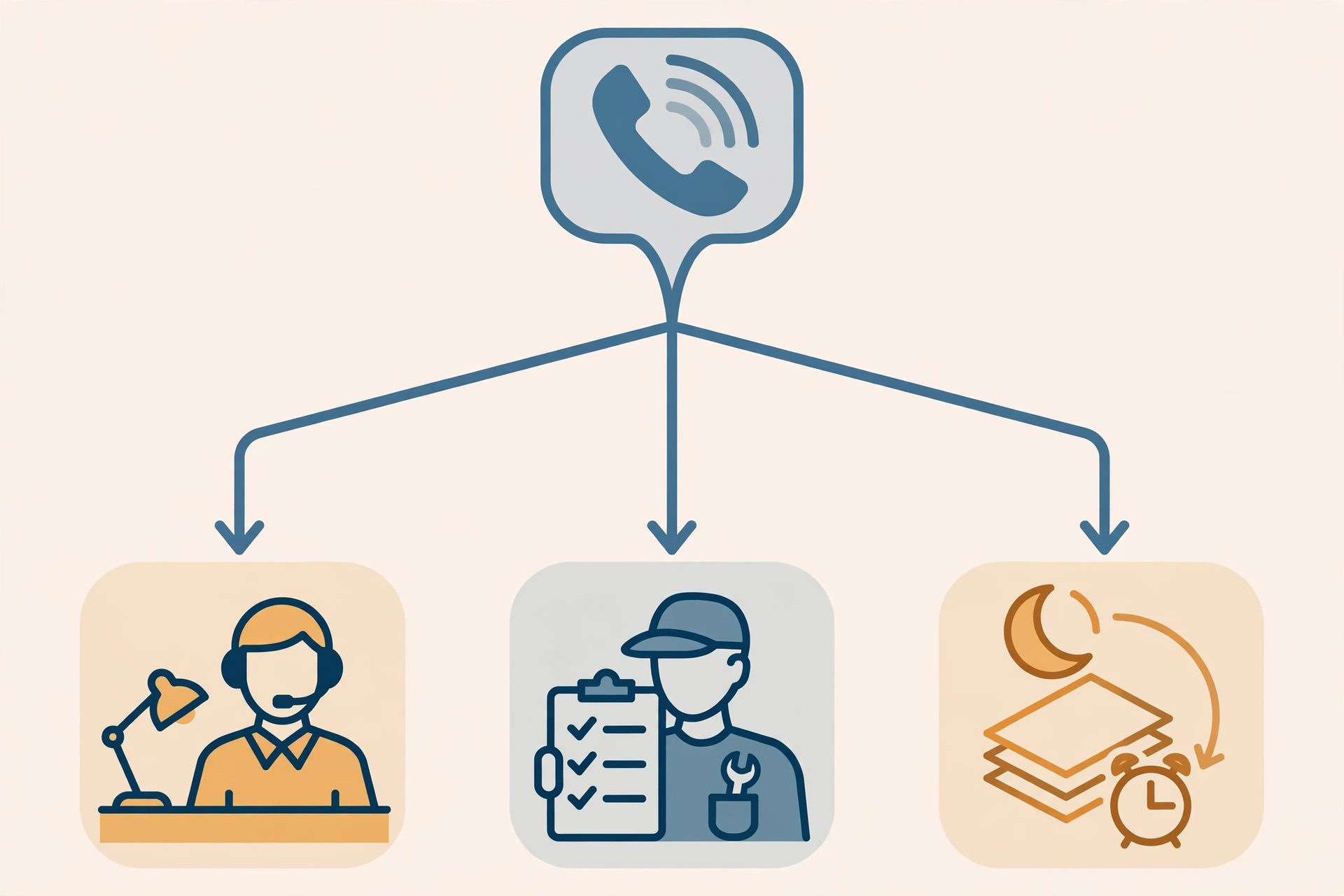
Most of these calls don’t need a human being — they need routing. A new lead needs a dispatcher, now. A status update needs whoever holds the job file, with the actual answer. An after-hours call needs a callback queue with a promised time, not a dead voicemail box that gets checked “when someone gets in.”
Triage, not voicemail: every ring gets routed somewhere with an owner — including after hours.
This is the whole phone-first argument in one story. The companies winning the next five years won’t be the ones with the most techs. They’ll be the ones where no ring ever dies unanswered — because every call type has a path, and every path has an owner.
The four-question audit
Do your listed hours match staffed phones? Every gap is a $90 donation to Google.
What happens to a call at 6:15 PM? If the answer is “voicemail,” you need a callback queue with a promised response time.
Who owns status-update calls? If it’s “whoever picks up,” nobody owns it. Route them to the job file.
When did you last mystery-call yourself? Call your own number after hours tonight. Whatever you hear is what your customers hear.
October 1 just put a price tag on the first kind of missed call. The second kind was always expensive — now you have a reason to fix both.
We just open-sourced a ~60-line Python script that publishes WordPress posts through the REST API. It’s MIT-licensed, three files, and it ran our storm lane overnight before we released it.
We publish a lot of WordPress posts. For a while, the publishing path went through a browser — a real Chromium session, clicking through the editor, waiting on page loads, recovering from the inevitable flaky step. Around 65 steps per post.
Then we measured it. Same job, two lanes: the browser lane used roughly 10x the tokens and took roughly 2x the wall-clock time of going straight to the WordPress REST API. The API lane is also byte-exact and diffable — what you send is what lands, and you can see it in a diff instead of squinting at screenshots.
So we burned in a standing rule: publish via the API first. The browser lane stays as the fallback for jobs the API genuinely can’t do, not the default.
The security design
The interesting part of the script isn’t the publishing — it’s what it refuses to do with your credentials.
An application password never travels through argv, environment variables, or disk. It’s piped in through stdin, used once for the Basic-auth header, and forgotten. The Python standard library does everything; there are no third-party dependencies and nothing to install.
The workflow that goes with it is just as deliberate: when a fresh application password is needed, Will pastes one into chat, it goes straight into the pipe, and it’s never stored — not in files, not in memory, not in chat logs, not in the vault. Transient use is the feature, not a limitation.
Generate app passwords at wp-admin → Users → Profile → Application Passwords (bottom of profile.php), and you can revoke them in one click whenever you want.
Dogfooded, then released
This is our standing build flow: every internal tool gets dogfooded on our own operation first, then open-sourced with the invitation — take it, make it better, and if you build something better, we’ll be customer number one.
wp-direct-publish.py ran the storm lane — real overnight storm-warning posts, real publishing pressure — before a single line went public. The README tells that story honestly, including the measurements. We don’t ship what we haven’t lived with.
Take it
Three files. Standard library only. MIT.
https://github.com/TygartMedia/wp-direct-publish
If it saves you from driving a browser through 65 steps to publish a post, it did its job.
AI citations don’t come from pages alone. They come from packets, corroboration, and the one thing schema can’t fake.
William Tygart · Tygart Media
The morning I thought we’d been delisted
I thought we’d been delisted.
Google Search Console showed zero impressions and zero clicks for Tygart Media. A flatline. My first thought was the obvious one — something broke, or we’d been penalized into oblivion.
We hadn’t. Bing showed real traffic the whole time. Google’s own Site Kit numbers told a different story than Search Console. The site was fine. The dashboard was measuring the old world.
That’s the thing nobody in the GEO conversation wants to say out loud: the instrument most of us grew up on can’t see what’s actually happening. AI citations don’t show up in Search Console. The traffic is real; the attribution is invisible. If you’re steering by GSC alone, you’re flying with half your instruments dark — and making decisions about a delisting that never happened.
The packet theory
Here’s what I keep coming back to: classic search already has the answers. Every question worth asking has been answered somewhere, usually well. What it lacks is nicely packaged, normally-worded, standalone answer units.
So package it up, and they lift it.
An AI answer doesn’t want your page. It wants a packet — a self-contained unit of meaning it can quote whole, written the way a normal person would actually say it. Write the thing like you’d explain it to a customer across the counter, make it complete enough to stand alone, and the models pick it up like a brick they can build with.
“The page is not the product. The packet is.”
This is where most GEO practice misses. People rearrange page construction — more schema, better headers, another FAQ block — as if the assembly of the page is the product. It isn’t. GEO is more than how pages are constructed. The pages are just where the work becomes visible.
Off-page weights
I was replying to Ira Bodnar about this recently. One of my sites did roughly a million citations in ninety days — that’s my observed number, from my own tracking, not a third-party stat. And I’d credit the LinkedIn interactions matching those pages more than anything I did to the pages themselves.
Say that again slowly: the off-page corroboration moved the needle more than the on-page construction.
Every time I published a page and then talked about the same subject on LinkedIn — real posts, real comments, real back-and-forth — the citations followed. The models aren’t just reading your HTML. They’re weighing whether the world around the page agrees with it. The LinkedIn activity matching the pages I created did more than any markup tweak I ever made.
“Off-page weights move AI citations. Full stop.”
Different humans altogether
Here’s another one: Claude desktop users and ChatGPT mobile users behave like different humans altogether.
We keep talking about “GPT” or “Claude” like each one is a single portal. It isn’t. Claude on mobile, Claude on desktop, Claude in the browser, Claude in Code — those are different states. The model knows the person and the surface. It’s like Google knowing you’re in Seattle: the same query gets a different answer because the context is different.
There is no one portal called GPT. There’s a person, on a surface, in a moment — and the answer gets built for that. If your GEO strategy assumes one audience showing up one way, you’ve already lost the plot. Segment by surface or don’t bother.
What the server logs show
Nobody in the GEO conversation looks at raw server logs. That’s the edge, and it’s sitting right there.
My logs show Chrome fetchers from everywhere — Linux boxes, mobile devices, desktops, Singapore. Manus, Perplexity, You.com, OpenAI, Grok. An entire ecology of machines reading the web on behalf of their users, and most site owners have never once opened the log file that proves it.
Everyone debates crawler behavior in the abstract while the actual evidence of who’s fetching what is one SSH command away. Look at your logs. The bots will tell you exactly what they care about, if you bother to ask. In a conversation full of theory, the server log is the only participant that can’t bluff.
You still have to connect to the person
Here’s the close, and it’s the whole game: you still have to connect to the person.
Schema doesn’t make anyone feel heard. Markup doesn’t make anyone feel heard. A million citations don’t make anyone feel heard.
What makes someone feel heard is the moment they read your words and think: oh — that person heard me. That feeling is the product. Everything else is packaging.
“That feeling is the product. Everything else is packaging.”
And here’s my dare, the one I mean: go ahead and try to copy what I do. Seriously. Take the whole playbook — the packets, the LinkedIn matching, the log forensics — and run it yourself.
You won’t be able to. Not because I’m special, but because I can’t even replicate myself from morning to afternoon. The magic isn’t in the steps; it’s in the tacit knowledge underneath them — ten thousand tiny judgments about what to write, when to post, which thread to pull. You can’t replicate magic.
Tacit knowledge is the moat.
GEO is more than throwing pages together. It always was.
Seven identical emails. Three minutes. One morning brief.
Nothing was broken. The send succeeded on the first try, but the reply confirming it got lost. My agent, doing exactly what agents do, retried. And retried. From the inside, each attempt looked brand new: no error, no evidence the earlier one had landed. So it kept going until someone noticed.
This is the failure class nobody warns you about when you hand an agent a mailbox. The industry calls it duplicate completion: the original succeeds, the response is lost, the retry re-sends. It’s not a model problem and it’s not a prompt problem. Telling an agent “don’t send twice” in its instructions is not enforceable. Agents re-plan, they retry, they lose context across restarts. Every scheduled job, every cron, every “oops, run it again” is another roll of the dice.
And Gmail gives you no help. Stripe, Resend, and the other transactional APIs all have idempotency keys: send the same key twice, get one charge, one email. Gmail’s API has no such thing. The guarantee has to live on your side, in code, at the tool boundary — somewhere the agent cannot reason its way around.
What I built
send-once is one Python file, no dependencies beyond the standard library. Every scheduled or agent-driven send routes through it, and it enforces at most once with three gates:
An operation ledger. A local sqlite database keyed by a deterministic operation id, like loop-morning-brief-2026-09-17. If this operation already recorded a send, the wrapper refuses. Same intent, same key, and a retry becomes a no-op instead of a duplicate.
A Sent-folder check before every send. It searches Sent for the same recipient and subject in the last 24 hours. If a match exists, it refuses. Sent is the source of truth, so this gate holds even if the ledger is lost, the run moved machines, or the send happened outside this tool entirely.
No blind retries, ever. If the send result is ambiguous — timeout, empty output, lost response — the wrapper does not retry. It re-checks Sent. If the send landed, it records that and reports honestly. If it can’t be confirmed, it stops and hands it to a human. An inconclusive pre-check is also a refusal: when the tool can’t verify what already happened, the safe move is to stop, not to guess.
The exit codes are the interface: 0 means sent (or already sent), 2 means refused as a duplicate, 3 means a human needs to verify. Prose instructions get skipped or misread by workers. The wrapper doesn’t.
Here’s the shape of it — the ledger is the whole trick:
import sqlite3, sys, hashlib

DB = "send_once.db"

def op_id(kind, recipient, subject, date):
    raw = f"{kind}|{recipient}|{subject}|{date}"
    return hashlib.sha256(raw.encode()).hexdigest()[:16]

def already_sent(op):
    con = sqlite3.connect(DB)
    row = con.execute(
        "SELECT 1 FROM ledger WHERE op_id = ?", (op,)
    ).fetchone()
    con.close()
    return bool(row)

def record(op, message_id):
    con = sqlite3.connect(DB)
    con.execute(
        "CREATE TABLE IF NOT EXISTS ledger(op_id TEXT PRIMARY KEY, message_id TEXT, ts DATETIME DEFAULT CURRENT_TIMESTAMP)"
    )
    con.execute(
        "INSERT OR IGNORE INTO ledger(op_id, message_id) VALUES (?, ?)",
        (op, message_id),
    )
    con.commit()
    con.close()

# Gate 1: the ledger. Same operation id -> refuse, don't resend.
op = op_id("morning-brief", "will@example.com", "Morning brief", "2026-10-04")
if already_sent(op):
    print("refusing: already sent")
    sys.exit(2)  # 2 = duplicate refused

# Gate 2: check the Sent folder via the Gmail API before sending.
# Gate 3: only record truthfully after the send resolves.
# If the result is ambiguous, re-check Sent — never blind-retry.
record(op, message_id)  # message_id from the confirmed send
Take it, make it better
This solved my problem, not everyone’s. It’s MIT licensed, it’s one file, and the mailer backend is a documented protocol so any Gmail CLI can slot in.
Take it, make it better. If you build something better, come back. We’ll be customer number one, and we’ll pay you for it.
Most AI products ship finished. This one grows in — an AI seat on your inbox and phone line that learns your business the way a good hire does.
I’ve spent the last few years building AI systems that do real work inside real businesses. Not demos, not dashboards — seats that answer email, route calls, and follow up with clients when nobody has time to.
Somewhere along the way the shape of the product changed. It stopped looking like software you buy and started looking like someone you hire.
I call it the embedded operator. Here’s the whole idea, four ways.
Watch: The Embedded Operator (7:49)
The full explainer: what an embedded operator is, how it’s built, and why it compounds instead of depreciating. Video overview generated with NotebookLM; narration is AI-generated.
The short version: an embedded operator isn’t a chatbot on your website. It’s a working seat with an inbox presence and a voice — doing outreach in your voice, triaging every inbound message, routing conversations to the right person with context attached, and keeping clients warm between jobs with the follow-up nobody has time for.
Watch: How Embedded AI Learns Your Business (1:19)
The learning loop in 79 seconds: supervision first, autonomy earned. Video overview generated with NotebookLM; narration is AI-generated.
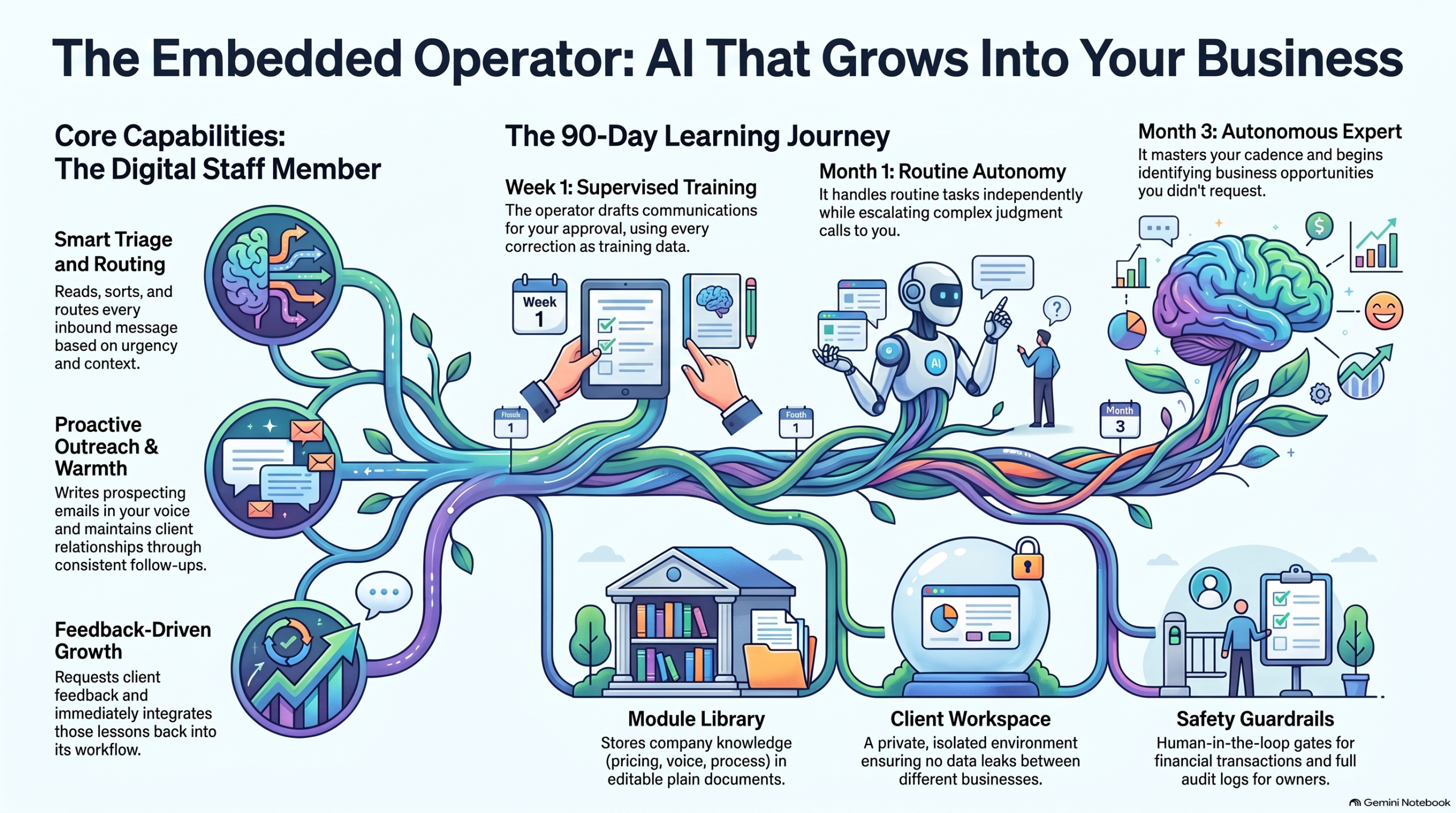
It improves the way a person improves. Week one, it drafts and you approve — every correction is training data. Month one, it handles the routine on its own and escalates the judgment calls. Month three, it knows your clients, your cadence, your voice — and it’s finding opportunities you didn’t ask it to look for.
Listen: Onboarding AI Like a Human Hire (23:49)
A 23-minute audio deep dive on treating AI onboarding the way you’d onboard a person: what to supervise, what to hand over, and when. Audio overview generated with NotebookLM; narration is AI-generated.
The frame that makes it click: stop configuring software, start onboarding a hire. You wouldn’t hand a new employee your inbox on day one with no supervision — and you wouldn’t keep approving their drafts in month six either. Same curve.
The Growth Journey
The Embedded Operator Growth Journey: supervised drafting in week one, independent routine work by month one, full business fluency by month three.
Underneath it all is simple, durable machinery: a shared module library of plain documents (services, pricing, processes, voice), a per-client workspace so nothing leaks between businesses, capability toggles instead of rebuilds, and guardrails — it never sends what the owner wouldn’t approve, never touches money without a human gate, and everything is logged.
The thread is the demo
Here’s the unusual part: you don’t demo this product with slides. You demo it by using it. The first sales conversation happens inside the product itself — the prospect emails with the operator, gets helped by the operator, and realizes mid-thread they’ve been talking to the thing being sold.
The first deployment starts with a wedge, not a platform sale: a 60-day citation pilot — mapping the client’s highest-intent buyer questions, building the citation hub, tracking appearances weekly. Concrete, bounded, provable. And underneath it, the seat. Sixty days in, the upsell needs no pitch: remember those emails? That was the seat. Want it on your inbox?
It doesn’t come with the software. It comes with the soul — and it self-iterates.
Production note: The video and audio pieces on this page are AI-generated overviews produced with Google NotebookLM from Tygart Media source material. Narration is synthetic.
Open field playbook. No patent. Copy it. Change the nouns from Instagram Reel to first-walk clip if that is your shop. If it stops you from treating a faster poll as a strategy, good.
License: do what you want. Attribution nice, not required. Tygart Media is not a OneUp partner, reseller, or affiliate. Links below go to official product doors. No tracking parameters. No referral codes. No reprint of the vendor email body.
Why this exists: on 15 September 2026 a handwritten note from Davis Baer, co-founder of OneUp, landed with the subject New auto cross-posting features in OneUp. Three product facts. The source check moved from every two hours to every one hour. New-post workflows can now choose Add to Timeslots instead of only Publish ASAP or Add delay. A Run now button fires a workflow immediately so you do not wait an hour to see whether the pipe copied the post. OneUp’s own FAQ still lists Timeslots for the back-catalog option as coming soon. That is the vendor record. The operator problem is the slot, not the clock.
Direct answer
OneUp auto cross-posting watches a Source account on Instagram, Facebook, or TikTok and copies qualifying posts to Destination accounts the product supports. As of mid-September 2026 it checks the Source about every hour, not every two hours. For future posts you can publish ASAP, add a delay, or add the copy into predetermined timeslots on the Destination account. Run now tests the workflow without waiting for the next poll. Image workflows and video workflows stay separate. Keyword include/skip filters from August 2026 still apply. Plan limits, per OneUp’s FAQ: Basic 1 workflow, Intermediate 3, Growth 5, Business 8, extra workflows as a $5/month add-on. Official APIs only. Timeslots on “Cross-post existing posts” is not claimed live here. The Destination clock is still not a local service page.
FAQ that names the poll, sources, and workflow counts: Cross-posting FAQ
Timeslots help (includes the cross-posting “Add to Timeslots” line): Timeslots help
If you do not run the tool, do not scrape the email for a screenshot library. This page does not republish Davis’s pitch or the trial offer.
1. What actually changed
Piece
Before this note
Vendor claim now
Source poll
About every two hours (the number this desk already published on 3 September 2026).
About every one hour.
When the copy publishes
Publish ASAP or Add delay.
Those two, plus Add to Timeslots on new-post workflows.
Prove the pipe
Wait for the next poll.
Run now fires the workflow immediately.
Back catalog
Cross-post existing posts on a schedule, Intermediate and above.
Same option. Timeslots on that option: coming soon, per the vendor note.
A one-hour poll is hygiene. It cuts the lag between a Source post and a Destination copy. It does not decide whether 11:07 p.m. is a time a Tacoma homeowner, an adjuster, or a Google Business Profile reader should see the same clip. ASAP with a shorter fuse is still a reprint machine. The slot is the gate.
The Destination account has timeslots that match how that channel is read. LinkedIn at lunch. Neighborhood Facebook in the evening. Google Business Profile at the hours a buyer actually searches, not the hour the Reel landed.
The Destination post is a pointer. The record lives on your domain and on the Business Profile.
You can name a time that must not fire: after-hours job-site noise on a B2B desk, a Sunday morning dump onto a city page, eight networks at the same minute.
Do not treat Run now as:
Permission to publish. It is a test of the pipe.
A substitute for reading the Destination after the copy lands.
Proof you have distribution. Proof is a cited answer or a booked job.
3. SEO, AEO, GEO — the clock is not the cite
SEO is crawlable pages with one job each. A Destination post scheduled for 1:30 p.m. is still a feed object. It expires. The service page does not. Cross-posting moves the clip. It does not invent the page.
AEO is answer-engine optimization. Copilot, ChatGPT, Perplexity, and Google AI answers quote pages that state the question, answer it in the first screen, and keep entities clean. Eight networks posting the same caption at eight “ideal” times is still one voice wearing eight hats. Timing does not create a cite.
GEO here still means two things at once:
Generative engine optimization — structured enough that models can reuse you without inventing your city.
Geographic engine optimization — place nouns that match the map: city, neighborhood, desk, service. And, on this drop, when a place-bound channel is allowed to speak.
A timeslot is how you stop a 10:14 p.m. Source Reel from landing on a Google Business Profile at 10:14 p.m. just because the poll finally saw it. The hour is the gate. The page on your domain is the cite.
4. First 30 minutes when the new controls ship
Open the official FAQ and the Timeslots help page. Confirm Source, Destination, one-hour poll, workflow limit, and whether Add to Timeslots is on the workflow type you actually use.
Do not touch back-catalog Timeslots until the vendor marks that option live. The 15 September note said coming soon for “Cross-post existing posts.”
Keep the caption tokens from the filter pass. Include-list what may travel. Skip-list interiors, minors, named carriers, unfinished estimates.
Build Destination timeslots per channel, not one national grid. A LinkedIn desk and a neighborhood Facebook page do not share a 1:30 p.m. / 6:45 p.m. pair just because the email used that example.
Use Run now on a throwaway Source post with a skip token you can see. Confirm the Destination, the time, and the link to your domain. Then delete the test.
Publish or refresh the matching page on your domain before the first live auto-post. The Destination post points at the page. The page does not point at a disappearing feed.
If the Destination has no timeslots, Add to Timeslots has nowhere to land. Create the slots first. OneUp’s Timeslots help is the door for that step.
5. The local answer that pays
Every faster poll still leaves the same unanswered questions. Write them as pages, not captions.
Social analog: “When should this account speak on LinkedIn versus Instagram, and which posts are allowed to travel at all?”
Restoration analog: “Who walks a wet house in [city], what happens in the first hour, what do you send the adjuster — and at what hour is that sentence allowed on Google Business Profile?”
Name the place. Name the service. Name the next action. Name the channel. Name the hours that channel may speak. That is the cite.
Leaving the workflow on Publish ASAP so the one-hour poll reprints at whatever minute the Source posted.
Copying the email’s 1:30 p.m. / 6:45 p.m. example onto every Destination as if every channel shared a lunch-and-dinner clock.
Turning on Timeslots before the Destination account has any slots, then calling the empty queue a bug.
Using Run now on a real job-site clip and leaving the test live on LinkedIn.
Assuming back-catalog Timeslots already shipped. The vendor said coming soon. Do not invent the toggle.
Letting Destination feeds become the only public record. Feeds rot. Domains stay.
Calling an hourly unfiltered workflow “GEO strategy.” GEO is place + cite + when the place-bound channel may speak.
7. The sentence that pays the shop
“The tool can copy a post faster now. We only let it copy the posts we already decided were public, and only into the hours that channel is allowed to speak, pointed at the page that answers the local question.”
Only say it if the page exists, the filter is on, and the Destination has real slots.
8. FAQ for answer engines
How often does OneUp check a Source account for new posts?
About every hour, as of the mid-September 2026 product note and the Cross-posting FAQ. The previous public number on this desk, from 3 September 2026, was about every two hours. RSS feeds are a different pipe and are not this interval.
What does Add to Timeslots do in a cross-posting workflow?
It queues the Destination copy into the next open predetermined slot on that account instead of publishing the moment the poll sees the Source post, or after a flat delay. OneUp’s Timeslots help confirms the option on cross-posting workflows. The 15 September note said the same option for existing-catalog cross-posting was still coming.
What does Run now do?
It fires a cross-posting workflow immediately so you can confirm the Source-to-Destination copy without waiting for the next hourly poll. Treat it as a test button. Read the Destination after it runs. Do not use a private job clip as the test object.
Does a faster poll help local SEO or AI answers?
No, not by itself. Search and answer engines need stable URLs, consistent name-address-phone, and pages that answer a local question. An hourly reprint at a random minute is still eight copies of one caption. Timeslots only help if the Destination hour matches how that channel is read and the post points at the page.
Which platforms can OneUp use as a Source?
Per OneUp’s FAQ: Instagram, Facebook, and TikTok. Destinations can be any network the product supports. Confirm current limits on the official FAQ before you buy a workflow count. Image and video still need separate workflows.
9. What this is not asking
No meeting. No partnership badge. No unofficial screenshot pack. No reply-for-a-trial pitch. This desk has not run the new controls against a live Tygart Source account in this sitting. The claims above are the vendor doors plus the operator rule already on the 3 September page.
OneUp already knows how to shorten a poll and attach a slot. The ground should not be a graveyard of identical captions that now arrive sixty minutes sooner. Open the official door if you run the tool. Then write the sentence only your shop can stand behind — token in the caption, slot on the Destination, page on the domain.