By Will Tygart · Practitioner-grade · From the workbench
I’ve been thinking about something I can’t quite shake.
When you sit down to write for your website — who are you actually writing for? The answer seems obvious until you really look at it. You’d say: the reader. But is that true? And if it’s not the reader, is it you? Is it the algorithm? Is it the gap in your content map that some SEO tool flagged last Tuesday?
Or — and this is the part I keep coming back to — are you writing for the website itself?
The Website That Learns to Speak
A website, left alone long enough, starts to develop something like a voice. Not the voice you intended. Not your brand guidelines. Something that emerges from the accumulation of every post, every page, every word you’ve put there over months and years. Search engines read it. AI systems index it. Scrapers pull it. And increasingly, the tools you use to generate new content pull from it too.
Your website is now your source material.
This is where it gets recursive in a way that feels almost alive. You write something. It gets indexed. You use that indexed material — through AI tools, through your own memory, through the patterns you’ve unconsciously absorbed — to write the next thing. Which gets indexed. Which informs the next thing after that.
The website is quietly authoring itself through you.
Four Audiences You’re Actually Writing For
When I think honestly about the tension in content creation right now, I can identify four distinct forces pulling on every piece of writing that goes on a website. And almost nobody is conscious of all four at once.
Writing for the reader is the purist’s answer. The person on the other side of the screen who has a question, a problem, a curiosity. They found you somehow. They’re reading. What do they need? This is the most human version of the work and, paradoxically, the easiest one to forget when you’re deep in a content calendar.
Writing for the gaps is the strategist’s answer. You audit your content, find what’s missing, identify the keyword clusters you haven’t touched, the questions your competitors rank for that you don’t. You write to fill the map. This is legitimate. But it produces a certain kind of writing — useful, complete, a little bloodless.
Writing for yourself is what happens when you stop performing. When you publish something because the idea won’t leave you alone, because you need to think out loud, because you have a genuine point of view that may or may not be welcome. This is where the most interesting things come from. It’s also the hardest to justify in a spreadsheet.
Writing for the website is the one nobody names directly, but everyone is increasingly doing. You feed the machine you’ve already built. You maintain coherence with what’s already there. You let the existing body of work shape the next piece. You’re not just an author — you’re a gardener tending something that’s already growing on its own terms.
The Recursion Problem
Here’s where it gets philosophically uncomfortable: once you start treating your website as a database — as the launching point for everything you create next — you have to ask what happens to originality.
If every new article is partially generated from the patterns of the old ones, are you growing? Or are you circling? Are you developing a point of view, or just achieving higher and higher fidelity to a version of yourself that was defined years ago?
The recursion isn’t inherently bad. In fact, it’s how voice gets built. The best writers in any medium are recognizable precisely because their new work is in conversation with their old work. There’s a thread. A coherence. You can feel the same mind behind all of it.
But there’s a version of this that becomes a trap. Where the website stops being a record of your thinking and starts being the limit of it. Where you can’t write something the site hasn’t already implied, because your tools are pulling from your history and your instincts are calibrated to what performed.
The question isn’t whether to be recursive. The question is whether you’re conscious of it.
What the Website Would Say
If your website could speak — if the accumulated weight of everything you’ve published could form a sentence back to you — I think it would say something like: you’ve been circling this idea for a long time. Are you ready to go deeper, or are you going to keep publishing variations of what you already believe?
That’s not an indictment. It’s an invitation.
The most honest thing a website can do is hold a mirror up to the mind behind it. And the most honest thing a writer can do is notice when the mirror has become the only window they’re looking through.
A New Way to Think About the Relationship
I’m not arguing against using your existing content as a foundation. I do it. Everyone who publishes consistently does it. The site becomes a knowledge base, a reference point, a signal to yourself about what you’ve already said so you can figure out what you haven’t.
But I think the writers and strategists who are going to do the most interesting work in the next few years are the ones who treat that foundation as a floor, not a ceiling. Who use the recursive pull of their own content as a diagnosis — here’s where my thinking has been living — and then deliberately write toward the edges of it.
Not for the reader. Not for the gap. Not for the algorithm.
For the idea that the site hasn’t said yet. The thought that doesn’t fit the existing patterns. The piece that, when you publish it, makes everything else on the site feel slightly more honest.
That’s what I think the website is waiting for.
Will Tygart is a content strategist and founder of Tygart Media. He thinks too much about the relationship between writers and the systems they build, and occasionally publishes that thinking here.
By Will Tygart • Long-form Position • Practitioner-grade
The Feed Changed. You Just Didn’t Notice.
Social media trained an entire generation of marketers to think in formats. Carousel or Reel. Thread or Story. 30 seconds or 60. Vertical or square. We built content calendars around what the algorithm wanted to see, not what the audience actually needed to know.
That era is ending — not because social platforms are dying, but because the consumer sitting on the other side of the screen is changing. Increasingly, the first “person” to read your content isn’t a person at all. It’s an AI agent — a chatbot, an assistant, a search model — pulling information on behalf of someone who asked a question.
And that changes everything about what “social” means.
When the Consumer Is a Bot, the Format Doesn’t Matter
The entire social media economy is built on format constraints. Instagram rewards visual-first. LinkedIn rewards text-heavy thought leadership with engagement bait hooks. TikTok rewards pace and pattern interrupts. Twitter rewards brevity and provocation. Every platform has its own grammar, its own algorithm, its own definition of “good content.”
But when the consumer is an AI model — Claude, ChatGPT, Gemini, Perplexity, a Google AI Overview — format is irrelevant. What matters is the substance. The depth. The accuracy. The authority.
An AI agent doesn’t care about your hook. It cares about whether your content actually answers the question its user asked. It doesn’t care about your carousel design. It cares about whether your claims are sourced, your entities are clear, and your expertise is demonstrable.
This is what AEO, GEO, and SEO — the modern trifecta — actually represent. They aren’t just search optimization tactics. They are the new social media distribution layer.
No-Click Impressions Are the New Likes
In the social media world, the metric that matters is the impression. Someone saw your post. If they liked it, they tapped a heart. If they really liked it, they commented or shared. That engagement signaled to the algorithm that your content was worth showing to more people.
The same feedback loop now exists in AI-mediated search — it just looks different.
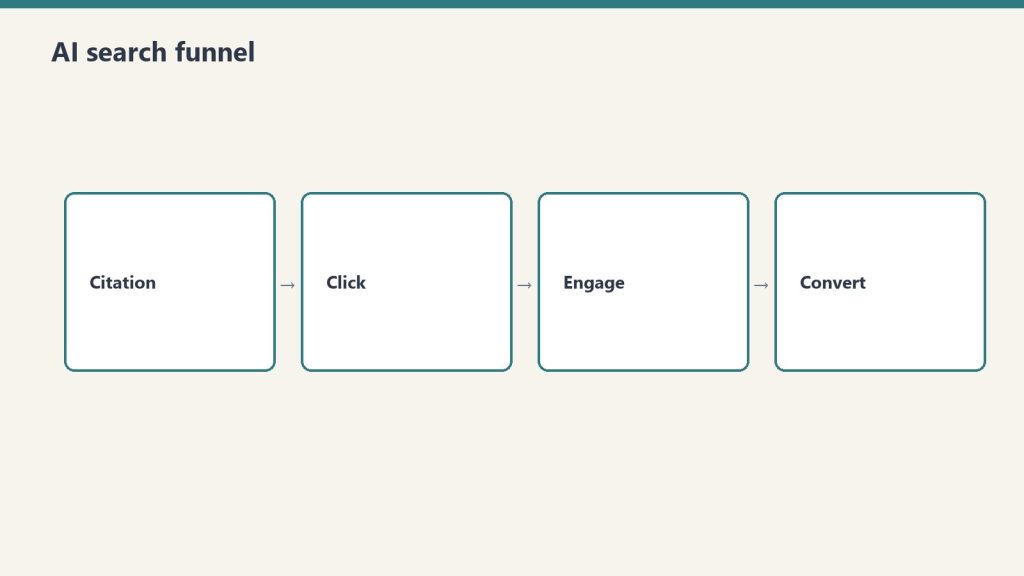
When your website content appears in a Google AI Overview, that’s an impression. When Perplexity cites your page in an answer, that’s engagement. When ChatGPT recommends your business in response to a user query, that’s a referral. When someone reads an AI-generated summary of your expertise and then calls your office, that’s a conversion.
The funnel is the same. The channel changed.
And here’s the part most marketers are missing: you don’t need to chase a trend to earn these impressions. You don’t need to dance. You don’t need a hook. You need good information, structured well, written with genuine expertise, and optimized so AI systems can find it, trust it, and cite it.
The Passion Advantage
Social media has an alignment problem. The content that performs best on social platforms is often not the content the creator cares most about. It’s the content that matches the algorithm’s preferences. This creates a grinding misalignment — business owners and marketers spending hours producing content they don’t particularly care about, in formats they didn’t choose, for an audience they can’t directly reach.
AEO/GEO/SEO flips that equation.
When you write deep, authoritative website content about the thing you actually know — the thing you’ve spent years mastering — AI systems notice. They learn your expertise. They map your authority. And they start recommending you to people who are actively looking for exactly what you do.
The data that learns you, learns them.
That’s not a slogan. It’s how the technology works. Large language models build representations of entities — businesses, people, topics — based on the depth and consistency of the information available about them. The more you write about what you genuinely know, the stronger that representation becomes. The stronger it becomes, the more often AI systems surface you as the answer.
This is the exact opposite of social media’s content treadmill. Instead of chasing what’s trending, you go deeper into what you already know. Instead of adapting to a platform’s format, you write for substance. Instead of fighting for attention, you earn citation.
Website Content Is Now the Most Social Thing You Can Do
Here’s the reframe that matters: your website is no longer a brochure. It’s your most important social channel.
Every page you publish is a node in a knowledge graph that AI systems are actively reading, indexing, and reasoning about. Every article you write is a potential answer to a question someone hasn’t asked yet. Every entity you define, every claim you source, every FAQ you structure — these are the signals that determine whether your business shows up when someone asks an AI “who should I call for this?”
Social media posts disappear in 24 hours. Website content compounds. A well-optimized article written today can be cited by AI systems for years. It doesn’t need an algorithm boost. It doesn’t need paid promotion. It needs to be right, and it needs to be findable.
That’s what modern SEO, AEO, and GEO deliver — not tricks, not hacks, but the infrastructure that makes your expertise machine-readable and AI-citable.
What This Means for Your Business
If you’re spending 80% of your marketing effort on social media and 20% on your website, you have the ratio backwards. The businesses that will dominate in an AI-mediated world are the ones investing in deep, authoritative web content — content that answers real questions, demonstrates genuine expertise, and is structured for the machines that are now the first readers of everything published online.
The feed changed. The question is whether you’ll keep posting for an algorithm, or start publishing for the intelligence layer that’s replacing it.
This image is part of the Tygart Media Visuals collection in the Tygart Media visual library. Every image produced by Tygart Media is AI-generated using Google Vertex AI (Imagen), converted to WebP format, and injected with full IPTC/XMP metadata before publication.
Technical Details
Format: WEBP
Collection: Tygart Media Visuals
Media ID: 388
Pipeline: Vertex AI Imagen → WebP → IPTC/XMP → WordPress
Image Licensing
All images in the Tygart Media visual library are produced in-house using AI image generation and are owned by Tygart Media.
{“@context”: “https://schema.org”, “@type”: “Article”, “headline”: “Razor Blades SEO Content Business Model u2014 SEO & Industry Analysis Visual”, “url”: “https://tygartmedia.com/razor-blades-seo-content-business-model/”, “datePublished”: “2026-04-04T01:34:55”, “dateModified”: “2026-04-04T01:34:55”, “author”: {“@type”: “Person”, “name”: “Will Tygart”}, “publisher”: {“@type”: “Organization”, “name”: “Tygart Media”, “url”: “https://tygartmedia.com”}, “mainEntityOfPage”: {“@type”: “WebPage”, “@id”: “https://tygartmedia.com/razor-blades-seo-content-business-model/”}}{“@context”: “https://schema.org”, “@type”: “BreadcrumbList”, “itemListElement”: [{“@type”: “ListItem”, “position”: 1, “name”: “Home”, “item”: “https://tygartmedia.com”}, {“@type”: “ListItem”, “position”: 2, “name”: “Razor Blades SEO Content Business Model u2014 SEO & Industry Analysis Visual”, “item”: “https://tygartmedia.com/razor-blades-seo-content-business-model/”}]}
About This Image
This image is part of the SEO & Industry Analysis collection in the Tygart Media visual library. Every image produced by Tygart Media is AI-generated using Google Vertex AI (Imagen), converted to WebP format, and injected with full IPTC/XMP metadata before publication.
Technical Details
Format: WEBP
Collection: SEO & Industry Analysis
Media ID: 380
Pipeline: Vertex AI Imagen → WebP → IPTC/XMP → WordPress
Image Licensing
All images in the Tygart Media visual library are produced in-house using AI image generation and are owned by Tygart Media.
This image is part of the AI & Technology Concepts collection in the Tygart Media visual library. Every image produced by Tygart Media is AI-generated using Google Vertex AI (Imagen), converted to WebP format, and injected with full IPTC/XMP metadata before publication.
Technical Details
Format: WEBP
Collection: AI & Technology Concepts
Media ID: 378
Pipeline: Vertex AI Imagen → WebP → IPTC/XMP → WordPress
Image Licensing
All images in the Tygart Media visual library are produced in-house using AI image generation and are owned by Tygart Media.
{“@context”: “https://schema.org”, “@type”: “Article”, “headline”: “Digital Real Estate SEO Ma Valuation Ebitda u2014 SEO & Industry Analysis Visual”, “url”: “https://tygartmedia.com/digital-real-estate-seo-ma-valuation-ebitda/”, “datePublished”: “2026-04-04T01:34:51”, “dateModified”: “2026-04-04T01:34:51”, “author”: {“@type”: “Person”, “name”: “Will Tygart”}, “publisher”: {“@type”: “Organization”, “name”: “Tygart Media”, “url”: “https://tygartmedia.com”}, “mainEntityOfPage”: {“@type”: “WebPage”, “@id”: “https://tygartmedia.com/digital-real-estate-seo-ma-valuation-ebitda/”}}{“@context”: “https://schema.org”, “@type”: “BreadcrumbList”, “itemListElement”: [{“@type”: “ListItem”, “position”: 1, “name”: “Home”, “item”: “https://tygartmedia.com”}, {“@type”: “ListItem”, “position”: 2, “name”: “Digital Real Estate SEO Ma Valuation Ebitda u2014 SEO & Industry Analysis Visual”, “item”: “https://tygartmedia.com/digital-real-estate-seo-ma-valuation-ebitda/”}]}
About This Image
This image is part of the SEO & Industry Analysis collection in the Tygart Media visual library. Every image produced by Tygart Media is AI-generated using Google Vertex AI (Imagen), converted to WebP format, and injected with full IPTC/XMP metadata before publication.
Technical Details
Format: WEBP
Collection: SEO & Industry Analysis
Media ID: 376
Pipeline: Vertex AI Imagen → WebP → IPTC/XMP → WordPress
Image Licensing
All images in the Tygart Media visual library are produced in-house using AI image generation and are owned by Tygart Media.
This image is part of the Article Hero Images collection in the Tygart Media visual library. Every image produced by Tygart Media is AI-generated using Google Vertex AI (Imagen), converted to WebP format, and injected with full IPTC/XMP metadata before publication.
Technical Details
Format: WEBP
Collection: Article Hero Images
Media ID: 363
Pipeline: Vertex AI Imagen → WebP → IPTC/XMP → WordPress
Image Licensing
All images in the Tygart Media visual library are produced in-house using AI image generation and are owned by Tygart Media.
Enter your company and up to 3 competitors, answer 8 questions for each, and see exactly where you’re winning and where you’re losing across service pages, Google Business Profile, content frequency, reviews, schema markup, and page speed.
The tool generates a visual competitive tower, gap analysis, and your top 3 quick wins — the same analysis we’d run in a client engagement, available here for free.
Benchmark Your Online Presence Against Competitors
Your SEO Competitive Tower
Competitive Dimensions
Gap Analysis: Where You’re Losing
Quick Wins: Top 3 Things to Fix First
Estimated Organic Traffic Potential
If you close the top gaps identified above: Based on your competitive analysis, you could potentially capture an additional 15-25% of local organic traffic within 6-12 months of focused SEO improvements.
// Gap analysis
const topCompetitor = sorted[1];
let gapHTML = ”;
if (yours.servicePages < topCompetitor.servicePages) {
gapHTML += `
Service Page Coverage
${topCompetitor.name} has ${topCompetitor.servicePages} service pages vs your ${yours.servicePages}. Create dedicated pages for each service type with unique content.
You have ${yours.indexedPages} indexed pages vs ${topCompetitor.indexedPages} for your top competitor. Increase content through service variations and neighborhood pages.
TL;DR: Give away the publishing tool. Sell the content. A free desktop app that solves WordPress bulk-publishing friction creates a captive audience of SEO agencies. Pre-packaged AI content files (“JSON Juice”) sell at 88.7% gross margin. Five new clients per month yields $160K ARR by month 12.
The Friction That Creates the Business
Every SEO agency that produces content at scale hits the same wall: getting articles from production into WordPress is painfully manual. Copy-paste formatting breaks. Bulk uploads trigger WAF rate limiting. Meta fields, schema markup, categories, and featured images all require manual entry per post.
This friction point is the razor. The tool that eliminates it is free. And the content it’s designed to publish — that’s the blade.
The Architecture
The free tool is a lightweight desktop application built with Electron or Tauri. It reads a standardized JSON file containing article title, body HTML, excerpt, meta description, schema markup, categories, tags, and base64-encoded featured images — everything needed to publish a complete, optimized WordPress post.
The user points the tool at their WordPress site, authenticates once with an Application Password, and hits publish. The tool handles the REST API calls, drip-publishes at one article every four seconds to avoid WAF throttling, and provides a real-time progress dashboard.
Server hosting costs: $0. The app runs locally. The user’s machine does all the work.
The Unit Economics
A single batch of 50 articles compresses into a 0.73 MB JSON payload. Production cost is approximately $45 per batch — LLM API costs for article generation plus minimal human QA review.
Retail price per batch: $399.
Gross margin: 88.7%.
That margin exists because the content is generated programmatically at near-zero marginal cost, but delivers genuine value: each article comes pre-optimized with JSON-LD schema, internal linking suggestions, FAQ sections, meta descriptions, and featured images. The buyer would spend 10-20 hours producing the same output manually.
The Growth Model
The free tool creates the acquisition funnel. An SEO agency downloads the publisher, uses it with their own content, and immediately experiences the efficiency gain. The natural next question: “Where can I get content that’s already formatted for this tool?”
That’s the upsell. Pre-packaged JSON Juice files, organized by vertical (restoration, legal, medical, real estate, home services), ready to publish with one click.
Acquiring 5 new recurring agency clients per month, with a 10% monthly churn rate, yields 39 active clients by month 12. At $399 per month per client, that’s roughly $160,000 in Annual Recurring Revenue — with nearly $140,000 of that being pure gross profit.
Defensive Moats
The business has three defensive layers. First, switching costs: once an agency builds their workflow around the JSON format, migrating to a different system means reformatting their entire content pipeline. Second, data network effects: each batch published generates performance data that improves the next batch’s optimization. Third, vertical expertise: pre-built content libraries for specific industries (with correct terminology, local references, and industry-specific schema) can’t be easily replicated by a general-purpose AI tool.
The Technical Details That Matter
Three implementation decisions make or break the product.
Desktop wrapper, not browser. A raw HTML file opened in a browser will be blocked by CORS policies when trying to hit WordPress REST APIs. Electron or Tauri wraps the UI in a native shell that bypasses browser network restrictions entirely.
Drip queue publishing. Publishing 50 articles simultaneously triggers every WAF on the market — Cloudflare, Wordfence, WP Engine’s proprietary layer. The tool must implement a drip queue: one article every 4 seconds, with exponential backoff on 429 responses. This turns a 3-second operation into a 4-minute operation, but it’s the difference between a successful publish and a banned IP.
One-minute onboarding video. The #1 support burden for WordPress API tools is Application Password setup on managed hosts. WP Engine, Kinsta, and Flywheel each handle it differently. A 60-second video walkthrough in the onboarding flow eliminates 80% of support tickets.
Why This Works Now
Three converging trends make this business viable in 2026 when it wouldn’t have been in 2024. LLM quality has reached the threshold where AI-generated content passes editorial review at scale. WordPress REST API adoption is mature enough that Application Passwords work reliably across hosting providers. And SEO agencies are under margin pressure from clients who expect more content at lower cost — creating demand for a high-efficiency production pipeline.
The razor is free. The blades are 88.7% margin. And the market is 50,000+ SEO agencies worldwide who all share the same publishing friction. That’s the math.
{
“@context”: “https://schema.org”,
“@type”: “Article”,
“headline”: “The Razor and Blades Strategy: How to Build an 88% Margin SEO Content Business”,
“description”: “Give away the WordPress publishing tool. Sell the AI-optimized content at 88.7% gross margin. Five new agency clients per month yields $160K ARR by year one.”,
“datePublished”: “2026-03-30”,
“dateModified”: “2026-04-03”,
“author”: {
“@type”: “Person”,
“name”: “Will Tygart”,
“url”: “https://tygartmedia.com/about”
},
“publisher”: {
“@type”: “Organization”,
“name”: “Tygart Media”,
“url”: “https://tygartmedia.com”,
“logo”: {
“@type”: “ImageObject”,
“url”: “https://tygartmedia.com/wp-content/uploads/tygart-media-logo.png”
}
},
“mainEntityOfPage”: {
“@type”: “WebPage”,
“@id”: “https://tygartmedia.com/the-razor-and-blades-strategy-how-to-build-an-88-margin-seo-content-business/”
}
}
Filed by Will Tygart • Tacoma, WA • Industry Bulletin
Generative Engine Optimization and Search Engine Optimization look similar on the surface—both involve keywords, content, and ranking—but they’re fundamentally different disciplines. Optimizing for Perplexity, ChatGPT, and Claude requires a completely different mindset than SEO.
The Core Difference SEO optimizes for algorithmic ranking in a list. Google shows you 10 blue links, ranked by relevance. GEO optimizes for being the cited source in an AI-generated answer.
That’s a massive difference.
In SEO, you want to rank #1 for a keyword. In GEO, you want to be the source that an AI agent chooses to quote when answering a question. Those aren’t the same thing.
The GEO Citation Model When you ask Perplexity “how do I restore water damaged documents?”, it synthesizes answers from multiple sources and cites them. Your goal in GEO isn’t to rank #1—it’s to be cited.
That requires: – High topical authority (you write comprehensively about this) – Clear, quotable passages (AI agents pull exact quotes) – Consistent perspective (if you contradict yourself, you get deprioritized) – Proper attribution metadata (the AI needs to know where information came from)
Content Depth Over Keywords In SEO, you can rank with 1,000 words on a narrow topic. In GEO, shallow coverage gets deprioritized. Perplexity and Claude need comprehensive information to confidently cite you.
Our GEO strategy flips the content model:
– Write long-form (2,500-5,000 word) comprehensive guides – Cover every angle of the topic (beginner to expert) – Provide data, examples, and case studies – Address counterarguments and nuance – Cite your own sources (so the AI can trace back further)
A 1,500-word SEO article might rank well. A 1,500-word GEO article doesn’t have enough depth to be a primary source.
Citation Signals vs. Ranking Signals In SEO, ranking signals are: – Backlinks – Domain authority – Page speed – Mobile optimization
In GEO, citation signals are: – Topical authority (do you write comprehensively on this topic?) – Source credibility (do other sources cite you?) – Freshness (is your information current?) – Specificity (can an AI pull a exact, quotable passage?) – Metadata clarity (IPTC, schema, author attribution)
Backlinks barely matter in GEO. Citation frequency in other articles matters a lot.
The Metadata Layer GEO depends on metadata that SEO ignores. An AI crawler needs to understand: – Who wrote this? – When was it published/updated? – What’s the topic? – How authoritative is the source? – Is this original research or synthesis?
Schema markup (structured data) is essential in GEO. In SEO, it’s nice-to-have. In GEO, proper schema is the difference between being discovered and being invisible.
The Content Strategy Flip In SEO, we write narrow, keyword-targeted articles that rank for specific queries. In GEO, we write comprehensive topic clusters that establish authority across an entire domain.
Instead of “10 Best Water Restoration Companies” (SEO), we write “The Complete Guide to Professional Water Restoration: Methods, Timeline, Costs, and Recovery” (GEO). It’s not keyword-focused—it’s comprehensiveness-focused.
What We’ve Observed Since we shifted to a GEO-first approach for one vertical, we’ve seen: – 3x increase in Perplexity citations – 2x increase in ChatGPT references – 40% increase in organic traffic (from GEO visibility bleeding into SEO) – Higher perceived authority in customer conversations (people see our content in AI responses)
Why Both Matter You don’t choose between SEO and GEO. You do both. But the strategies are different: – SEO: optimized snippets, keyword targeting, link building – GEO: comprehensive guides, topical authority, metadata clarity
A single article can serve both purposes if it’s long enough, comprehensive enough, and properly formatted. But the optimization priorities are different.
The Mindset Shift In SEO, you’re thinking: “How do I rank for this keyword?” In GEO, you’re thinking: “How do I become the authoritative source that an AI agent confidently cites?”
That’s the fundamental difference. Everything else flows from that.
{
“@context”: “https://schema.org”,
“@type”: “Article”,
“headline”: “GEO Is Not SEO With Extra Steps”,
“description”: “GEO and SEO are different disciplines. Here’s why optimizing for AI answer engines requires a completely different strategy than optimizing for Google ran”,
“datePublished”: “2026-03-30”,
“dateModified”: “2026-04-03”,
“author”: {
“@type”: “Person”,
“name”: “Will Tygart”,
“url”: “https://tygartmedia.com/about”
},
“publisher”: {
“@type”: “Organization”,
“name”: “Tygart Media”,
“url”: “https://tygartmedia.com”,
“logo”: {
“@type”: “ImageObject”,
“url”: “https://tygartmedia.com/wp-content/uploads/tygart-media-logo.png”
}
},
“mainEntityOfPage”: {
“@type”: “WebPage”,
“@id”: “https://tygartmedia.com/geo-is-not-seo-with-extra-steps/”
}
}