Tag: Everett Housing

  • Everett Asks Residents What 2027 Federal Housing Dollars Should Pay For — Public Hearing Is Tuesday at 5

    Everett Asks Residents What 2027 Federal Housing Dollars Should Pay For — Public Hearing Is Tuesday at 5

    If you have ever wondered who decides how Everett spends its federal housing and community development money — and how a regular resident gets a vote in that conversation — Tuesday, May 5 is your answer.

    The Community Development Advisory Committee, the citizen body that recommends how the city spends Community Development Block Grant (CDBG), HOME Program, and 2060 Affordable Housing Trust Fund (AHTF) dollars, is holding a public hearing at 5 p.m. on May 5 to set the priority needs for the 2027 program year. The hearing is hybrid — in person at the Everett Municipal Building (2930 Wetmore Avenue) or virtual — and written comments are accepted any time before then at communitygrants@everettwa.gov.

    For most Everett residents, this is the most direct line into how millions of federal pass-through dollars get aimed at the city’s biggest housing and neighborhood needs each year. The committee uses what it hears Tuesday to write the priorities that will determine which projects, programs, and nonprofits get funded twelve to eighteen months from now.

    What the CDAC Actually Does

    The Community Development Advisory Committee is a volunteer body of Everett residents appointed to recommend how the city distributes a specific group of housing and community-development funding sources. The dollars flow from three main pots:

    The Community Development Block Grant (CDBG) is a federal HUD formula grant that has funded local affordable housing, homeless services, neighborhood infrastructure, and small-business assistance since 1974. Cities the size of Everett receive CDBG annually as an entitlement community.

    The HOME Investment Partnerships Program is a separate HUD funding stream specifically for affordable housing — acquisition, rehab, new construction, and tenant-based rental assistance.

    The 2060 Affordable Housing Trust Fund (AHTF) is a state-authorized local fund supported by document recording fees collected by Snohomish County. It pays for affordable housing projects inside Everett city limits and is one of the few flexible local sources for housing that serves people earning under 50% of area median income.

    Municipal funding may also be added to the mix in any given cycle, depending on the council’s budget decisions.

    CDAC does not write checks. It writes the priorities. City staff then issue requests for proposals to nonprofits, housing developers, and service providers, who apply for funding that lines up with whatever the committee identified as a priority. That is why the May 5 hearing matters: the priorities decided in this room shape who gets funded a year from now.

    What Tuesday’s Hearing Is For

    The agenda has two pieces. The first and bigger one is identifying the community priority needs for 2027. CDAC is asking residents to tell them what they see as the most pressing community-development issues in Everett right now — affordable housing, homelessness response, infrastructure in lower-income neighborhoods, services for seniors or people with disabilities, microenterprise development, anything that fits inside the federal CDBG eligibility framework.

    The second item is a review of updates to the Citizen Participation Plan (CPP), the document that governs how CDAC engages the public on these decisions. The CPP is technical, but it matters: it sets the rules for how hearings are publicized, how public comment is collected, and how the committee responds to feedback. Updates to the CPP every few years bring it in line with current HUD requirements and the city’s changing communications channels.

    Why This One Is Worth Showing Up For

    Federal CDBG and HOME funds have been under sustained pressure at the national level for years. Every cycle, the local conversation about what to prioritize gets a little harder because the formula allocations have not kept pace with cost inflation in housing, services, or infrastructure. That makes the priority-setting decision more consequential, not less. Fewer dollars chasing more needs means the priorities the committee writes down really do determine which neighborhoods, populations, and project types get served — and which get told to wait another year.

    This is also a moment when Everett is making bigger housing decisions on parallel tracks. The Snohomish County Council voted unanimously on April 24 to award $23 million in Housing & Behavioral Health Capital Fund money to six projects, three of them inside Everett — the EGM 172-bed shelter expansion at 3530 Smith Avenue, Helping Hands Broadway 33 at 2410 and 2412 Broadway, and the Everett Station District Alliance 58-unit transit-oriented building at 3102 Smith. Those were county dollars. The CDBG, HOME, and AHTF priorities the city sets May 5 are a different pipeline — and they fund a different layer of the housing system, often the smaller, more locally specific projects that do not pencil at the scale a $5 million county capital award requires.

    How to Participate

    There are four ways to weigh in:

    Attend in person. Arrive at the Everett Municipal Building, 2930 Wetmore Avenue, by 4:50 p.m. on Tuesday, May 5. City staff will escort attendees to the meeting room. Public comment is taken during the hearing portion of the agenda.

    Attend virtually. A virtual attendance option is available. Instructions for joining remotely are posted on the Community Development Advisory Committee page at everettwa.gov.

    Email written comments. Send to communitygrants@everettwa.gov any time before or after the hearing. Written comments become part of the official record.

    Mail written comments. Send to 2930 Wetmore Avenue, Suite 8A, Everett, WA 98201.

    If you need translation services, ASL interpretation, or any other accommodation to participate, contact communitygrants@everettwa.gov or call (425) 257-7185 in advance so the city can make arrangements. Spanish-language information about the hearing is published on the same news flash on the city’s website.

    What Comes After May 5

    Once CDAC adopts the 2027 priorities — typically at a meeting following the public input hearing — city staff translate those priorities into a request-for-proposals timeline. Nonprofits, housing developers, and service providers will apply against those priorities later in 2026. CDAC reviews the applications and recommends an allocation to the City Council. Council takes the final vote, usually as part of the broader 2027 budget adoption in late 2026.

    In other words, what happens Tuesday night is the front end of a process that ends with line items in next year’s budget. The closer to that front end residents weigh in, the more influence they have over what eventually gets funded.

    What to Do Next

    • Read the agenda and the Citizen Participation Plan update at the Community Development Advisory Committee page on everettwa.gov.
    • Submit written comments to communitygrants@everettwa.gov before or after the hearing.
    • Show up Tuesday, May 5 at 4:50 p.m. at the Everett Municipal Building, 2930 Wetmore Avenue, if you want to give in-person testimony.
    • Request accommodations at communitygrants@everettwa.gov or (425) 257-7185 if you need translation, interpretation, or accessibility help.
    • Track the funding cycle by following the Community Development Block Grant page on the city’s website to see what gets recommended after this hearing.

    Frequently Asked Questions

    What is CDAC and what does it decide? The Community Development Advisory Committee is a citizen body that recommends how Everett spends federal CDBG and HOME funds, the state’s 2060 Affordable Housing Trust Fund dollars, and any municipal funding added to the mix. It does not allocate dollars directly — it writes the priorities and reviews applications, then recommends to the City Council.

    When and where is the public hearing? Tuesday, May 5, 2026 at 5 p.m. The hearing is hybrid: in person at the Everett Municipal Building, 2930 Wetmore Avenue (arrive by 4:50 p.m.), or virtual. Virtual instructions are on the CDAC page at everettwa.gov.

    What funding sources are CDAC’s priorities for 2027 going to shape? Community Development Block Grant (CDBG), HOME Program, 2060 Affordable Housing Trust Fund (AHTF), and any municipal funding added to the cycle.

    Can I submit comments without attending the hearing? Yes. Email communitygrants@everettwa.gov or mail to 2930 Wetmore Avenue, Suite 8A, Everett, WA 98201. Written comments are part of the official record.

    Is this related to the $23M county housing vote on April 24? No — those are separate pots. The April 24 vote was Snohomish County’s Housing & Behavioral Health Capital Fund, awarded to six projects (three inside Everett). The CDAC priorities being set May 5 govern a different funding stream — the city’s CDBG, HOME, and AHTF dollars — and typically fund a different layer of projects.

    Who can request accommodations? Anyone. Translation, ASL interpretation, accessibility help, and other accommodations can be arranged by contacting communitygrants@everettwa.gov or calling (425) 257-7185 in advance of the hearing.

    Is information available in Spanish? Yes. The official city news flash about the hearing includes a full Spanish-language version, and Spanish-language assistance can be requested through the same email and phone number.

  • Housing Hope Is Building a New Tomorrow’s Hope at 4526 Federal Avenue — The Quiet Powerhouse Behind Everett’s Affordable Housing

    Housing Hope Is Building a New Tomorrow’s Hope at 4526 Federal Avenue — The Quiet Powerhouse Behind Everett’s Affordable Housing

    Q: What is Housing Hope and what does it do in Everett?

    A: Housing Hope is an Everett-headquartered nonprofit that builds and operates affordable rental housing, supports homeownership through sweat-equity construction, and runs childcare and workforce-training programs for families exiting homelessness or poverty across Snohomish County and Camano Island. It manages more than 650 affordable units across 24 sites, has helped 328 households become homeowners through its Team HomeBuilding program, and is building a new 26,700-square-foot Tomorrow’s Hope Child Development Center at 4526 Federal Avenue in partnership with Compass Health.

    Housing Hope is the quietest big nonprofit in Everett — and 2026 is its biggest year in a long time

    If you have driven past the Compass Health campus at 4526 Federal Avenue lately, you have probably noticed survey stakes and site-prep work on the northeast corner. That is a 26,700-square-foot child development center that has been thirty years in the making. It belongs to Housing Hope — Everett’s largest affordable-housing nonprofit and probably the most consequential community organization in town that most residents could not pick out of a lineup.

    That is changing in 2026. Housing Hope has a new CEO. It is breaking ground on a new childcare facility that triples the capacity of its current Tomorrow’s Hope program. It manages more than 650 affordable units across 24 sites in Snohomish County. And it is doing all of this while quietly chasing a 1,000-unit goal by 2030. Here is what every Everett resident should know about the organization that is rewriting what affordable housing looks like in this corner of Puget Sound.

    What Housing Hope actually does

    Housing Hope’s mission is to promote and provide affordable housing and tailored services that reduce homelessness and poverty for residents of Snohomish County and Camano Island. That single sentence covers a lot of ground. In practice, the organization runs five integrated programs:

    Affordable rental housing. More than 650 units across 24 sites. Rents are set on a sliding scale based on household income and family size — not market rate. Housing Hope’s portfolio includes everything from single-room transitional units to family-sized apartments designed for households exiting homelessness.

    Team HomeBuilding. A sweat-equity homeownership program in which working families help build their own and each other’s homes. The program has produced 328 first-time homeowner households. Participants commit hundreds of hours of construction labor in exchange for a deeply discounted mortgage on a home they helped frame, side, and finish.

    Tomorrow’s Hope Child Development Center. Quality childcare for kids aged four weeks through twelve years, with a sliding-scale fee structure that prioritizes families currently living in Housing Hope properties or recently exited from homelessness. The current facility has operated for more than 30 years out of a former Sizzler restaurant building. The new building changes that.

    College of Hope. Workforce training, financial coaching, life-skills classes, and case management built directly into the housing-and-childcare model. Residents do not have to drive across town to access employment services — those services are delivered on-site.

    HopeWorks. A separate but affiliated social-enterprise nonprofit that runs job-training businesses (catering, landscaping, building trades) where Housing Hope residents and other low-income community members earn paychecks while building career skills. HopeWorks shares leadership with Housing Hope.

    Kathryn Opina takes over as CEO

    The Housing Hope Executive Board appointed Kathryn Opina as Chief Executive Officer for both Housing Hope and HopeWorks effective September 1, 2025. The announcement followed the departure of previous CEO Donna Moulton in early 2025 for family reasons. The leadership transition was reported by My Everett News and confirmed on the organization’s leadership page.

    Opina inherits an organization in the middle of one of its most ambitious capital phases in years — the new Tomorrow’s Hope facility, ongoing portfolio growth toward the 1,000-unit 2030 goal, and a continued role as the lead nonprofit voice in Snohomish County’s affordable-housing conversation.

    The new Tomorrow’s Hope is the headline project of 2026

    The current Tomorrow’s Hope center serves about 130 children. It has, in fact, outgrown the old Sizzler building it occupies. The new facility — sited at the northeast corner of Compass Health’s Federal Avenue Campus at 4526 Federal Avenue — solves three problems at once.

    First, capacity. The 26,700-square-foot building is designed to substantially increase enrollment beyond the current 130-child level. Second, integrated services. The new building includes on-site showers, laundry, a pantry, and computer stations — features that recognize many of the families using Tomorrow’s Hope are working through housing instability and need wraparound support to stay in childcare. Third, the partnership. Compass Health, Snohomish County’s largest behavioral-health provider, is leasing the corner to Housing Hope as a continuation of a 35-year partnership between the two nonprofits. Both organizations serve overlapping populations. Co-locating the new childcare center on Compass’s campus means a parent receiving behavioral-health support can drop their child off in the same parking lot.

    The site is in central Everett, walkable from several Housing Hope properties and on a Community Transit route. Construction is starting this year.

    Why Housing Hope matters for Everett specifically

    Snohomish County’s affordable-housing math is brutal. The 51.8% inventory jump that lit up the headlines in 2026 was concentrated in the market-rate single-family segment, not in the income-restricted units that working families actually qualify for. Housing Hope is the largest single producer of those income-restricted units in the county, and the bulk of its portfolio sits inside Everett city limits.

    That portfolio is also unusually integrated. Most affordable-housing developers build the building and walk away. Housing Hope builds the building, runs the childcare center next door, employs residents through HopeWorks, trains them through College of Hope, and has built sweat-equity homeowners out of dozens of its own former tenants. The model is not new — Housing Hope has been doing it since 1987 — but the scale (650+ units, 24 sites, 35-year partnerships with major institutions) is.

    For Casino Road residents, Boulevard Bluffs renters, and Twin Creeks families pricing out of Snohomish County’s higher-rent neighborhoods, Housing Hope is often the answer to “where do we go next.” The organization’s waitlists are long — as is the case for every affordable-housing operator in the region — but the units exist, and they keep getting built.

    How to engage with Housing Hope

    Housing Hope’s main offices are at 5830 Evergreen Way in Everett. The organization’s housing application process and waitlist information are available on housinghope.org, along with a current property list. For families seeking childcare, Tomorrow’s Hope information lives at tomorrowshopechildcare.com — and the new Federal Avenue location will list its enrollment process there once the building opens.

    For neighbors who want to support the work, Housing Hope accepts both donations and volunteer hours through Team HomeBuilding (no construction experience required for many roles). HopeWorks’s social-enterprise businesses also welcome contracts for catering, landscaping, and small construction projects. The organizations are 501(c)(3) nonprofits; gifts are tax-deductible.

    The bigger picture

    The story of Everett’s housing crisis usually focuses on what the market and the city are not doing — the stalled stadium financing, the utility-tax debate, the Sound Transit timeline that keeps slipping. Housing Hope’s story is the inverse. It is a nonprofit that has been quietly stacking units, training workforce, and feeding children for nearly four decades while the broader debate has gone sideways. The new Tomorrow’s Hope center, the new CEO, and the unbroken march toward 1,000 units by 2030 are the same story Housing Hope has been telling all along — just with a bigger building, a new face at the top, and an unmistakable signal that 2026 is when the organization plans to be louder about it.

    Frequently Asked Questions

    Where is Housing Hope located in Everett?

    Housing Hope’s main administrative offices are at 5830 Evergreen Way in Everett. The organization manages more than 24 housing sites across Snohomish County and Camano Island. The new Tomorrow’s Hope Child Development Center is being built at 4526 Federal Avenue on Compass Health’s campus.

    Who is the CEO of Housing Hope in 2026?

    Kathryn Opina has served as Chief Executive Officer of both Housing Hope and HopeWorks since September 1, 2025. She succeeded former CEO Donna Moulton, who departed in early 2025.

    How many affordable housing units does Housing Hope operate?

    More than 650 affordable rental units across 24 sites in Snohomish County and Camano Island, with a stated goal of 1,000 units by 2030. The organization has also helped 328 households achieve homeownership through its Team HomeBuilding sweat-equity program.

    What is Tomorrow’s Hope?

    Tomorrow’s Hope is Housing Hope’s child development center. The current facility serves roughly 130 children aged four weeks to 12 years out of a former Sizzler restaurant building in Everett. A new 26,700-square-foot facility is under construction at 4526 Federal Avenue with significantly expanded capacity and on-site family services including showers, laundry, a pantry, and computer stations.

    How can I apply for Housing Hope housing?

    Housing applications and waitlist information are available at housinghope.org. Demand exceeds supply at every Housing Hope property, and waitlists can be long. The organization’s leasing staff can advise on which properties have the shortest current waitlists and what documentation is required.

    How can I support Housing Hope?

    Donations are accepted through housinghope.org and are tax-deductible. Team HomeBuilding accepts volunteer construction labor. HopeWorks’s catering, landscaping, and trades businesses welcome contracts from neighbors and local employers. Both organizations also publish event calendars on their respective websites.

    Is Housing Hope related to Volunteers of America Western Washington or Cocoon House?

    They are separate organizations with overlapping missions. Housing Hope focuses on long-term affordable housing and homeownership for families. Volunteers of America Western Washington runs the regional food bank and broader social-services portfolio. Cocoon House serves youth experiencing homelessness. All three are major Everett nonprofits and frequently collaborate through Snohomish County’s housing and homelessness coalitions.

    Deeper coverage on this story:

  • For Boeing and Paine Field Workers: What Everett’s 51.8% Housing Inventory Jump Means for Your 2026 Buy-or-Rent Decision

    For Boeing and Paine Field Workers: What Everett’s 51.8% Housing Inventory Jump Means for Your 2026 Buy-or-Rent Decision

    For Boeing and Paine Field workers: Snohomish County’s housing inventory jumped 51.8% year-over-year in March 2026. For workers starting, transferring to, or continuing on the Everett 737 North Line or Paine Field campus, this is the best buying and renting window in three years — more options, less frenzy, and two new studio apartment projects opening in south Everett before year-end. Here is how to read the market from where you sit.

    What the 51.8% Inventory Jump Means for Aerospace Workers

    For workers who arrived in Everett in 2022–2024 and watched every rental unit disappear and every home sale go to a cash buyer with no contingencies, the March 2026 data represents a meaningful shift. Snohomish County now has approximately 2.8 months of housing supply — still a seller’s market, but far more navigable than the sub-1.5-month environment that was the norm during peak frenzy.

    What this means practically: you can take an extra day before making an offer. You can write an inspection contingency without automatically losing. You have more than three listings to choose from in any given price bracket. For new hires relocating from outside the Puget Sound area — workers coming in for the 737 MAX 10 North Line ramp, which opens midsummer 2026 with over 1,200 airline orders — this is the entry window. You are not walking into the 2022 market.

    Where Aerospace Workers Are Actually Buying and Renting

    Paine Field sits in south Everett / north Mukilteo, which means the commute catchment for North Line workers spans Silver Lake, Cascade View, south Everett neighborhoods along Highway 99, Mukilteo proper, and the I-5 corridor communities. In order of proximity to the Paine Field gate area:

    Silver Lake (98204): Closest residential zone to Paine Field with Highway 99 access. The former Econo Lodge at 9602 19th Street SE is being converted to 124 studio apartments by Sage Investment Group, with Phase 1 leasing opening August 2026. Market-rate, no income restrictions — the first new dedicated workforce rental product to hit south Everett’s 98204 zip code in several years.

    Cascade View (98204): Stable mid-century neighborhood directly south of Paine Field. Quieter than Casino Road, lower price points than north Mukilteo. Strong for first-time buyers looking in the $550,000–$700,000 range where the inventory increase has been most pronounced.

    Mukilteo: Premium location with waterfront access and ferry connection. Prices run higher (typically $750,000+), but commute to Paine Field is 5–10 minutes. For workers with dual incomes or buying rather than renting, Mukilteo remains competitive relative to comparable Seattle neighborhoods.

    North Mukilteo / Harbour Pointe: New construction and attached housing available. Longer-term upside tied to the Paine Field passenger terminal and the Everett Link Extension SW Everett Industrial Center station.

    Buying vs. Renting in 2026 for North Line Workers

    At 6.38% mortgage rates and a $738,000 county median, a conventional 20%-down purchase requires a $147,600 down payment and produces a principal-and-interest payment of approximately $3,850/month before taxes and insurance. For a single income in the $85,000–$100,000 range typical of experienced 737 North Line assembly workers, that payment is within range but not comfortable without a second income or a lower price point.

    The 51.8% inventory jump creates opportunity in the $500,000–$650,000 range — attached homes, condos, and smaller single-family properties in south Everett and Mukilteo where the supply increase has been sharpest. Workers willing to buy below the county median can find payments more manageable, and the employment-anchor demand from Boeing, NAVSTA, and healthcare employers provides some floor under Snohomish County prices even in a rising-rate environment.

    For workers newer to the North Line or not yet sure about long-term Everett plans, the rental option is cleaner in 2026 than it has been since 2021. The Sage Silver Lake studio project, existing Community Transit-accessible apartments along Casino Road, and the general inventory increase in the rental market all point to a more renter-friendly environment than workers faced during the post-COVID frenzy years.

    The Light Rail Variable

    The Sound Transit board votes June 30 on the revised ST3 System Plan. The SW Everett Industrial Center station — explicitly designed to serve the Paine Field employment cluster — is in the corridor covered even by a truncated extension scenario. For North Line workers buying near Paine Field with a 10-year hold horizon, the light rail calculus is favorable regardless of how the truncation debate resolves. The SW Everett Industrial Center station is not in dispute the way the downtown Everett Station terminus is.

    Frequently Asked Questions for Boeing and Paine Field Workers

    What neighborhoods are closest to Paine Field for Boeing workers in Everett?

    Silver Lake (98204), Cascade View (98204), Mukilteo, and north Mukilteo / Harbour Pointe are the closest residential zones to the Paine Field gate area. Silver Lake and Cascade View offer the most affordable price points. Mukilteo carries a premium for waterfront access and ferry convenience.

    Is the Everett housing market better for Boeing workers in 2026 than 2024?

    Yes. Active inventory is up 51.8% year-over-year with 2.8 months of supply — more options and less bidding-war pressure than 2022–2024. The median is still $738,000 and rates are 6.38%, but the frenzied market that forced workers to waive all contingencies has eased meaningfully.

    Are there any new rental apartments opening near Paine Field in 2026?

    Yes. Sage Investment Group is converting the former Econo Lodge at 9602 19th Street SE in Silver Lake into 124 studio apartments. Phase 1 leasing opens August 2026. Market-rate, no income restrictions, in the south Everett 98204 zip code approximately 15–20 minutes from the Paine Field gate.

    Will there be light rail to Paine Field?

    The Sound Transit Everett Link Extension includes a SW Everett Industrial Center station serving the Paine Field cluster. The June 30, 2026 ST board vote will confirm the timeline. The SW Everett Industrial Center station is less at risk in truncation scenarios than the downtown Everett Station terminus.

    What is a realistic home price for a Boeing worker buying near Paine Field?

    The county median is $738,000 but south Everett and attached housing in the 98204 zip code offers entry points in the $500,000–$650,000 range where the inventory jump has been most pronounced. At 6.38% rates, a $550,000 purchase with 20% down produces P&I of approximately $2,890/month.

    Related: Complete 2026 Housing Market Guide | Boeing North Line Workers Housing Guide | Sage Silver Lake Apartments

  • Snohomish County Housing Inventory Jumped 51.8% in 2026: The Complete Everett Buyer and Seller Guide

    Snohomish County Housing Inventory Jumped 51.8% in 2026: The Complete Everett Buyer and Seller Guide

    Quick Answer: Snohomish County active home listings surged 51.8% year-over-year in March 2026 — one of the five largest inventory increases in the entire NWMLS territory. Despite the supply jump, the median home price held at $738,000 and homes are still selling at 99.9% of asking in an average of 35 days. Rising mortgage rates (6.38% by late March) are stalling buyer momentum without collapsing prices. For Everett buyers and sellers, the window has shifted — but it has not swung fully to buyers yet.

    The March 2026 Numbers: What Changed

    The Northwest Multiple Listing Service’s March 2026 market snapshot showed 1,900 active residential listings across Snohomish County — a 51.8% year-over-year increase and one of the sharpest single-year inventory jumps in recent county history. That works out to approximately 2.8 months of supply, up sharply from the sub-1.5-month lows that defined the pandemic-era seller’s market.

    For context: real estate economists generally describe 4–6 months of supply as a balanced market. At 2.8 months, Snohomish County is still clearly a seller’s market — but the trajectory is meaningful. Buyers who spent 2022–2024 losing bidding wars on every offer now have more listings to choose from, more time to make decisions, and occasionally — not always — some negotiating room on price.

    The median home price held at $738,000 in March 2026. Homes are still selling at 99.9% of asking price in an average of 35 days. Those metrics do not reflect a market in distress — they reflect a market that has paused rather than reversed. The buyers who have stepped back are rate-sensitive; the sellers who remain active are not discounting.

    Why Inventory Jumped — and Why Prices Haven’t

    The inventory increase is being driven by two converging forces. First, sellers who held off listing during 2023–2024 (reluctant to give up historically low mortgage rates on their existing homes) are gradually re-entering the market as life events — job changes, family transitions, retirement — force the decision. Second, new construction deliveries — particularly multifamily and attached-housing units — are adding to active supply in south Everett and the Everett fringe suburbs.

    Prices are not collapsing because demand has not collapsed. Snohomish County’s employment base — Boeing’s expanding 737 North Line, NAVSTA Everett, Providence Regional Medical Center, and a dense cluster of aerospace and logistics employers — creates persistent housing demand from workers who need to live close to their job sites. That employment anchor is Snohomish County’s buffer against the kind of inventory-driven price correction that markets without a major employment base would experience.

    What This Means for Everett Buyers

    More listings mean more options — and for the first time in several years, buyers can take a breath before making an offer. The days of waiving all contingencies on sight-unseen properties are largely over in the current rate environment. Buyers who can qualify at 6.38% and are not competing for the same handful of best-in-class properties in the most desirable neighborhoods will find the market more navigable than it was in 2022.

    The Everett-specific buyer dynamic in 2026 involves several overlapping pools: Boeing 737 North Line workers relocating from Renton, Navy families PCSing to NAVSTA Everett, and Seattle-area renters making the rent-versus-buy calculation for the first time. All three groups are making decisions based on Snohomish County’s relative affordability versus King County — a spread that has narrowed but not closed.

    The motel-to-apartment conversion pipeline in south Everett — including the Sage Investment Econo Lodge project at 9602 19th Street SE opening August 2026 — adds rental supply that may absorb some demand that would otherwise convert to buyer activity. Workers who can rent a studio near their job site for a year while they watch the market are more likely to do so when inventory is rising and rate direction is uncertain.

    What This Means for Everett Sellers

    The 51.8% inventory jump does not mean sellers are in trouble — it means sellers need to price correctly. Properties at 99.9% of asking in 35 days are properties that were priced to the market. Properties that are not are sitting longer. The days of pricing 10% above comparables and relying on the frenzy to cover it are over. Sellers who price accurately, prepare the property well, and list with strong marketing are still transacting in a historically fast timeframe.

    The June 30 Sound Transit board vote on the Everett Link Extension is a latent catalyst for the seller side. If full delivery is confirmed, demand for properties in station-area neighborhoods — particularly downtown Everett and the Mariner corridor — could accelerate. If the extension is truncated, demand in those specific neighborhoods may soften relative to south Everett, where the SW Everett Industrial Center station coverage is less in dispute.

    Frequently Asked Questions

    What is the Snohomish County housing market doing in 2026?

    Active listings surged 51.8% year-over-year in March 2026 to approximately 1,900 listings (2.8 months of supply). The median home price held at $738,000. Homes sell at 99.9% of asking in an average of 35 days. Mortgage rates are 6.38%. Still a seller’s market, but meaningfully more inventory than 2022–2024.

    Is it a good time to buy a home in Everett in 2026?

    More inventory and slower frenzy pace mean buyers have more options and more time than they did in 2022–2024. Prices remain high ($738K median) and rates at 6.38% are a significant monthly payment factor. For buyers who can qualify and plan to hold for 5+ years, Everett’s employment base provides demand support.

    Why did Snohomish County housing inventory jump 51.8%?

    Sellers who held off during 2023–2024 (to preserve low locked-in mortgage rates) are re-entering the market as life events force decisions. New construction deliveries — particularly attached housing and multifamily in south Everett — are also adding to active supply.

    What is the median home price in Snohomish County in 2026?

    $738,000 as of March 2026, according to NWMLS data. Homes are selling at 99.9% of asking price in an average of 35 days. Current mortgage rates are approximately 6.38%.

    How does Everett’s housing market compare to Seattle?

    Snohomish County’s $738,000 median is significantly below King County’s comparable. The spread between Snohomish and King County has narrowed from its historical range but remains meaningful for buyers who can work remotely or commute to south Snohomish County employment rather than central Seattle.

    Related Exploring Everett coverage: Snohomish County Housing Inventory Jumped 51.8% | Everett Housing Market Three Submarkets Guide | Sage Silver Lake Apartments Complete Guide

  • Moving to South Everett in 2026: What the Sage Silver Lake Studio Apartments Mean for New Residents and Renters

    Moving to South Everett in 2026: What the Sage Silver Lake Studio Apartments Mean for New Residents and Renters

    If you are moving to Everett or looking for a first apartment: 124 new studio apartments are opening in Silver Lake in August 2026 — market-rate, no income restrictions, no waitlist. The former Econo Lodge at 9602 19th Street SE is being converted by Sage Investment Group into the kind of workforce studio housing that has been in short supply across south Everett. Here is what you need to know before you apply.

    What Is Opening and When

    Sage Investment Group purchased the Econo Lodge near Silver Lake in 2025 for $9.5 million and is investing $7 million to convert all 124 motel rooms into fully equipped studio apartments with complete bathrooms and kitchens. Phase 1 leasing opens August 2026. The address is 9602 19th Street SE, Everett, WA 98204 — in the Silver Lake area of south Everett, along the Highway 99 corridor.

    These are market-rate units. No income verification, no application waitlist, no public subsidy program to navigate. Sage’s target market is the “Missing Middle” — people who need decent housing near jobs and transit, earn a moderate income, and don’t qualify for income-restricted housing but also can’t afford new luxury apartment stock. If that describes you, this project was built for your situation.

    Silver Lake as a Place to Live: What You’re Getting Into

    Silver Lake is south Everett’s working-neighborhood corridor. It sits along Highway 99 between downtown Everett to the north and the Everett Mall / Casino Road zone to the south. The neighborhood is defined by its access to employment rather than by a walkable amenity cluster — there is no downtown square, no concentrated restaurant row, no arts district. What Silver Lake has is proximity: 15–20 minutes to Paine Field, 10–15 minutes to downtown Everett, reasonable bus access on Community Transit’s south Everett routes.

    For new residents comparing Everett to Seattle: Silver Lake offers significantly lower housing costs on a per-square-foot basis, shorter commutes to south Snohomish County employment, and none of the density pressure that characterizes Seattle neighborhoods near light rail. It is a practical choice, not a lifestyle choice — which is exactly what a lot of people moving to Everett for a job at Boeing, Providence Regional Medical Center, or an Everett-area logistics employer are looking for.

    The Everett Housing Market Context for 2026

    Snohomish County saw a 51.8% year-over-year surge in active home listings in March 2026 — but that inventory is concentrated in for-sale product above $600,000. The March 2026 median home price held at $738,000, with homes still selling at 99.9% of asking in an average of 35 days. For renters, the supply expansion at the ownership level has not translated into dramatically lower rents on the apartment side.

    The Sage Silver Lake project adds 124 rental units to Everett’s inventory without displacing existing residents — the land was previously a motel with zero long-term residential occupancy. That net-new-unit character matters in a market where most new apartment supply has come from luxury developments with $1,800–$2,400 one-bedroom asking rents. Studio units in a motel conversion should price meaningfully below that range.

    How to Track This Opening

    Sage has not announced a pre-leasing timeline as of May 2026. Based on standard practice for projects of this type, expect listings to appear on Apartments.com, Zillow, and similar platforms 60–90 days ahead of the August 2026 Phase 1 opening — meaning June or July. Check Sage Investment Group’s portfolio page (sageinvestment.com/portfolio) directly for any pre-leasing announcements.

    For people actively apartment hunting in south Everett right now: the Cascade View and Silver Lake neighborhoods have seen new neighborhood guide coverage on this site that maps the full residential and amenity picture. The motel conversion at 19th Street SE is the first major new rental addition to Silver Lake in several years — and it arrives just as the south Everett housing corridor is seeing increased attention from investors tracking the Community Transit expansion and the Everett Link Extension light rail planning.

    Frequently Asked Questions for People Moving to Everett

    How do I apply for the Sage Silver Lake apartments in Everett?

    Pre-leasing has not opened as of May 2026. Phase 1 leasing opens August 2026. Watch sageinvestment.com/portfolio, Apartments.com, and Zillow for listings. Expect availability to appear 60–90 days before the August opening.

    Do I need to meet income requirements for the Silver Lake studios?

    No. These are market-rate units with no income restrictions and no subsidized housing program requirements. Standard rental application criteria (income verification, credit, rental history) will apply, but there are no maximum income limits or program eligibility requirements.

    What is Silver Lake like as a neighborhood in Everett?

    Silver Lake is a south Everett working neighborhood along the Highway 99 corridor. It has strong access to south Snohomish County employment (Paine Field 15–20 min, downtown Everett 10–15 min), Community Transit bus service, and the practical infrastructure of a mid-density residential area. It is a commuter-practical neighborhood rather than an amenity-rich one.

    How does Everett compare to Seattle for renting?

    Everett typically offers lower per-square-foot rents than Seattle, with shorter commutes to Snohomish County employment and less density pressure. The March 2026 median home price in Snohomish County was $738,000 — lower than King County. New luxury apartments in downtown Everett have listed at $1,800–$2,400 for one-bedrooms; workforce studio conversions like the Sage project should price below that range.

    What transit is available near 9602 19th Street SE?

    The Silver Lake area is served by Community Transit bus routes along Highway 99 and Casino Road. The planned Everett Transit consolidation into Community Transit will expand route coverage. Sound Transit’s Everett Link Extension, pending the June 30, 2026 board vote, includes stations that will eventually connect south Everett to the regional light rail spine.

    Related: Complete Guide to the Sage Econo Lodge Conversion | Cascade View Neighborhood Guide | Snohomish County Housing Market 2026

  • Everett’s Econo Lodge Is Becoming 124 Studio Apartments: The Complete Guide to Sage Investment’s Silver Lake Conversion

    Everett’s Econo Lodge Is Becoming 124 Studio Apartments: The Complete Guide to Sage Investment’s Silver Lake Conversion

    Quick Answer: Sage Investment Group is converting the former Econo Lodge at 9602 19th Street SE in Everett into 124 studio apartments, with Phase 1 leasing opening August 2026. The $16.5 million project — $9.5M acquisition plus $7M buildout — is one of the most straightforward housing additions Silver Lake has seen in recent memory: no new construction permits, no public subsidy, no wait list. Just 124 units of “Missing Middle” market-rate housing arriving in a neighborhood that needs them.

    The Silver Lake Conversion: What Sage Is Building

    The Econo Lodge at 9602 19th Street SE has been operating as a budget motel along the Highway 99 corridor through Silver Lake in south Everett. Sage Investment Group, a Seattle-area real estate firm that has been active in the Puget Sound motel-to-apartment conversion market, purchased the property in 2025 for $9.5 million and is investing an additional $7 million in the buildout — converting each of the 124 motel rooms into a fully equipped studio apartment with a complete bathroom and kitchen.

    The project is part of Sage’s established playbook of acquiring underperforming hospitality properties and converting them to permanent residential use. The model works because the bones of a motel — individual lockable units with separate plumbing — translate directly to studio apartment units with minimal structural modification. The cost per unit is dramatically lower than ground-up construction, and the timeline is measured in months rather than years.

    “Missing Middle” Housing: Who This Is For

    Sage is explicitly targeting what housing economists call the “Missing Middle” — moderate-income earners who need housing near jobs and transit but earn too much to qualify for subsidized or income-restricted housing, and not enough to afford Everett’s new luxury apartment stock. In a market where Snohomish County’s median home price held at $738,000 in March 2026 even as inventory rose 51.8% year-over-year, the Missing Middle gap is acute.

    The 124 studios at 19th Street SE will lease at market rates — specific pricing has not been announced ahead of the August 2026 Phase 1 opening, but motel conversion projects of this type in the Puget Sound market typically come in well below newly constructed apartment stock on a per-square-foot basis. For single-income workers, recent graduates, and individuals transitioning from shared housing or unstable situations, this type of unit is often the only viable path to a private, independently leased home near employment centers.

    Why Silver Lake — and What It Signals About South Everett

    Silver Lake is not Everett’s headline neighborhood. It sits south of downtown along the Highway 99 corridor, defined more by its proximity to employment — Paine Field to the north, the Everett Mall area to the south — than by any particular amenity cluster. But that employment proximity is exactly why a 124-unit housing addition matters here.

    South Everett’s workforce housing gap has been documented repeatedly. The 5,200-worker aerospace labor shortage in Snohomish County is partly a housing accessibility problem: workers who could fill jobs at Paine Field and the North Line can’t find affordable housing close enough to make the commute work. The Silver Lake location — near Community Transit’s Casino Road campus, adjacent to Highway 99, with access to multiple bus routes — positions these units for workforce housing demand from the aerospace, healthcare, and logistics employers concentrated in south Everett.

    Sage’s acquisition also signals that the motel-to-apartment conversion model, which has been active in Seattle and Tacoma for several years, is now reaching south Everett’s Highway 99 corridor. There are multiple underutilized hospitality properties along this stretch. If the Sage conversion performs well at lease-up, expect similar projects to follow.

    The August 2026 Timeline

    Phase 1 leasing opens August 2026. Sage has not announced a specific marketing timeline or pre-leasing availability, but the company’s standard practice is to list units through major apartment platforms (Apartments.com, Zillow, etc.) ahead of a Phase 1 opening. Prospective tenants interested in the Silver Lake location should watch Sage’s website and major listing platforms beginning in June or July 2026.

    The conversion involves upgrading each of the 124 rooms with a full kitchen — the primary modification required to meet residential habitability standards — along with bathroom upgrades, code compliance work, and common-area improvements. Sage’s $7 million buildout budget works out to roughly $56,500 per unit, consistent with motel conversion projects of similar scale in the region.

    What It Means for Everett’s Housing Supply

    Snohomish County’s active home listings surged 51.8% year-over-year in March 2026 — but that inventory increase is concentrated in for-sale product at price points above $600,000. The rental supply side of the Missing Middle has not seen a comparable expansion. The 124 Sage units represent a meaningful, immediate addition to Everett’s rental inventory without requiring a rezoning, a public subsidy, or a multi-year permitting process.

    Everett’s Imagine Everett comprehensive plan envisions densification along transit corridors — and the Highway 99 / Silver Lake corridor is explicitly identified as a growth area. Motel conversions are a form of adaptive reuse that delivers density without displacement: the land was already developed, the units are net-new housing on a footprint that was previously providing zero long-term residential units, and the conversion brings underutilized commercial property into productive residential use.

    Frequently Asked Questions

    What is the Sage Investment Econo Lodge conversion in Everett?

    Sage Investment Group purchased the former Econo Lodge at 9602 19th Street SE in Silver Lake, Everett for $9.5 million and is investing $7 million to convert all 124 motel rooms into studio apartments. Phase 1 leasing opens August 2026. Total project cost is $16.5 million.

    When do the Sage Silver Lake apartments open?

    Phase 1 leasing is expected to begin in August 2026. Specific unit availability and pricing will be announced closer to the opening. Watch Sage’s website and major listing platforms starting June–July 2026.

    How much will the Silver Lake studio apartments cost?

    Sage has not announced specific rental pricing. The project targets “Missing Middle” market-rate renters — moderate-income workers who need housing near jobs but don’t qualify for subsidized housing. Motel conversion projects typically lease below newly constructed apartment stock in the same market.

    Where exactly is the Econo Lodge conversion in Everett?

    9602 19th Street SE, Everett, WA 98204. The property is along the Highway 99 corridor in the Silver Lake area of south Everett, near Community Transit bus routes and approximately 15–20 minutes from Paine Field by car or transit.

    What is “Missing Middle” housing?

    Missing Middle housing serves moderate-income earners who earn too much to qualify for subsidized housing but not enough to afford new luxury apartment stock. In Snohomish County, where the March 2026 median home price was $738,000, the Missing Middle gap is significant for single-income workers, recent graduates, and workforce housing candidates in aerospace, healthcare, and logistics sectors.

    Is this subsidized affordable housing?

    No. The Sage project is market-rate housing with no public subsidy or income restrictions. It targets moderate-income renters at market rates, but below the price point of newly constructed luxury apartments. Tenants do not need to meet income qualification requirements.

    Related Exploring Everett coverage: Everett Econo Lodge Becoming 124 Studio Apartments | Snohomish County Housing Inventory Up 51.8% | Everett Housing Market Three Submarkets Guide

  • Glacier View: The Mid-Century Everett Neighborhood That Rewards the People Who Actually Know It

    Glacier View: The Mid-Century Everett Neighborhood That Rewards the People Who Actually Know It

    Quick take: Glacier View is a mid-century neighborhood anchored by Lowell Elementary, the Everett Golf and Country Club, and easy access to Forest Park — with one of the most active neighborhood associations in the city and housing prices that have climbed significantly in 2025–2026. It’s a neighborhood that rewards locals who already know it and puzzles visitors who drive through without stopping.

    Glacier View: The Mid-Century Everett Neighborhood That Rewards the People Who Actually Know It

    Ask most Everett residents about Glacier View and you’ll get a vague wave southward. Ask someone who actually lives there and you’ll get a 20-minute conversation about block parties, the trail system behind their house, the view of the Cascades from their backyard, and the neighbors who’ve been around since before the kids were born.

    That gap — between how the neighborhood looks from the outside and what it actually is — is Glacier View in a nutshell. It’s one of Everett’s more established residential pockets, filled with mid-century brick ramblers and craftsman bungalows, bounded by Interstate 5 to the east, Evergreen Way to the west, roughly 41st Street to the north, and 62nd Street SE to the south. It sits between the more frequently profiled south Everett neighborhoods and downtown, close enough to both to be convenient, quiet enough to feel like neither.

    The Housing Stock That Defines the Neighborhood

    Glacier View’s character is shaped heavily by its housing stock. Mid-century brick ramblers dominate — one-story homes with clean lines, good bones, and the kind of lot sizes that feel generous compared to newer infill construction. Craftsman cottages fill in the gaps. Most of the neighborhood was built out decades ago, which means the streets have mature trees and the lots have settled into something that feels lived-in rather than speculative.

    The market has moved. The median sale price in Glacier View reached approximately $785,000 in early 2026, up significantly year-over-year — reflecting broader Snohomish County market dynamics as buyers pushed into south Everett in search of space and value relative to Seattle and the Eastside. The neighborhood scores 82 out of 100 on Redfin’s competitive market index, with homes averaging around 15 days on market as of early 2026.

    For context: mid-century ramblers and cottages in Glacier View have ranged from roughly $415,000 to $850,000 depending on condition and lot, while craftsman-style homes have started around $500,000 and run into the $930,000 range at the high end. The 7,454 residents recorded by US Census data represent a homeownership-heavy community — approximately 70% owner-occupied, which contributes to the neighborhood’s stability and the active civic engagement its association is known for.

    The Everett Golf and Country Club — Anchor and Anomaly

    The single most distinctive feature of the Glacier View neighborhood’s geography is the Everett Golf and Country Club, which occupies a substantial portion of the neighborhood’s southwest side. Founded in 1910, the private club features an 18-hole course, a fitness center, a swimming pool, and seasonal dining and social events.

    The club is members-only, which means the majority of the green space it sits on is not publicly accessible. But it shapes the neighborhood in other ways: it keeps a large area in the heart of the neighborhood at low density, it contributes to the neighborhood’s sense of green space and views, and it creates a geographic logic to Glacier View’s street layout that makes it feel more residential and less through-traveled than other Everett neighborhoods on the arterial grid.

    Forest Park and the Trail System

    Glacier View residents enjoy proximity to two significant green space assets. Forest Park — Everett’s largest and oldest park — is accessible from the neighborhood’s western edge. The park offers a splash pad, picnic areas, a large playground, sports courts, tennis courts, meeting halls, and trail access. It’s the kind of anchor amenity that makes a neighborhood feel self-contained.

    The Interurban Trail also runs through the area, providing 12 miles of paved paths for biking, jogging, and walking. For residents who want outdoor recreation without driving, Glacier View is well-positioned relative to most of south Everett.

    Schools

    Glacier View students move through an Everett School District pathway: Lowell Elementary (Pre-K–5, located in the neighborhood at approximately 5010 View Drive), then Evergreen Middle School, and on to Everett High School. Lowell Elementary has a total enrollment of approximately 543 students and a 16:1 student-teacher ratio.

    The Everett School District recorded a 96.3% graduation rate in 2025 — a district record — and Everett High was part of that picture. Parents in Glacier View looking at the school pathway are working with a district that has been putting up real numbers on student outcomes.

    Families in the neighborhood’s southern portion may also fall within proximity of Mukilteo School District boundaries — the district’s service area runs through parts of south Everett, including Cascade View and corridor areas near Casino Road.

    The Neighborhood Association

    By most accounts — including the City of Everett’s own neighborhood documentation — the Glacier View Neighborhood Association is one of the more active in the city. Meetings are held in-person at the Lowell Elementary library at 6:30 PM, on a roughly bi-monthly schedule (typical dates: January, March, May, and November). Co-chairs Katie Shaffer and Crystal Cameron lead the association, which can be reached at GlacierViewNeighbor@hotmail.com.

    In February 2026, Glacier View residents were part of a broad south Everett neighborhood meeting at the Cascade Boys and Girls Club at 7600 Cascade Drive, which brought together multiple neighborhood associations alongside Mayor Franklin and Police Chief Robert Goetz. The multi-neighborhood meeting format is one the city has been piloting for district-wide conversations — Glacier View participated as part of that broader civic engagement effort.

    Getting Around

    Glacier View sits west of Interstate 5, making highway access straightforward for commuters heading north toward Boeing’s Paine Field facilities, south toward Bellevue and Seattle, or east. The neighborhood is roughly 26 miles from downtown Seattle by car — a commute that, depending on the time of day, runs anywhere from 40 minutes to well over an hour.

    Everett Transit runs bus routes along Evergreen Way, Colby Street, and Broadway — the major arterials that border or bisect the neighborhood — providing transit access for residents who prefer not to drive. This connectivity to south Everett’s main transit corridors will take on added relevance as Sound Transit’s light rail extension to Everett moves toward completion in the coming years.

    Why People Stay

    Neighbors who live in Glacier View tend to describe the same constellation of reasons for staying: quiet streets, homes with real yards, walkable access to Forest Park and the trail system, friendly block-level community, and proximity to south Everett amenities without the traffic intensity of Evergreen Way itself. The neighborhood scores high on family-friendliness and dog-friendliness on resident review platforms, and the 70% homeownership rate means most of the people on the block have chosen to be there long-term.

    The housing prices that felt like a deal a few years ago have moved. But the neighborhood’s character — mid-century, stable, community-engaged, green-space-adjacent — is what it is because the people who lived there made it that way over decades. That doesn’t change when the comp prices move up.

    Frequently Asked Questions

    Where exactly is Glacier View in Everett?

    Glacier View is bounded roughly by 41st Street to the north, Interstate 5 to the east, 62nd Street SE to the south, and Evergreen Way to the west. It sits in the southeast portion of central Everett, between downtown and the south Everett corridor.

    What schools serve Glacier View?

    Glacier View is primarily served by Everett School District. The pathway is Lowell Elementary → Evergreen Middle School → Everett High School.

    Is the Everett Golf and Country Club open to the public?

    No. The Everett Golf and Country Club (founded 1910) is a members-only private club featuring an 18-hole course, fitness center, and swimming pool. It is not open to the general public.

    How do I get involved with the Glacier View Neighborhood Association?

    Meetings are held at Lowell Elementary’s library at 6:30 PM on a bi-monthly schedule. Contact the association at GlacierViewNeighbor@hotmail.com. The City of Everett’s Neighborhood Associations page at everettwa.gov/334 has current meeting dates and neighborhood contacts.

    What parks are closest to Glacier View?

    Forest Park — Everett’s largest park — is accessible from the neighborhood’s western edge. The Interurban Trail runs through the area with 12 miles of paved paths. Lowell Park and Emma Yule Park are also within or adjacent to the neighborhood’s boundaries.

  • Everett’s Econo Lodge Is Becoming 124 Studio Apartments — What Sage Investment’s $16.5M Conversion Means for Silver Lake

    Everett’s Econo Lodge Is Becoming 124 Studio Apartments — What Sage Investment’s $16.5M Conversion Means for Silver Lake

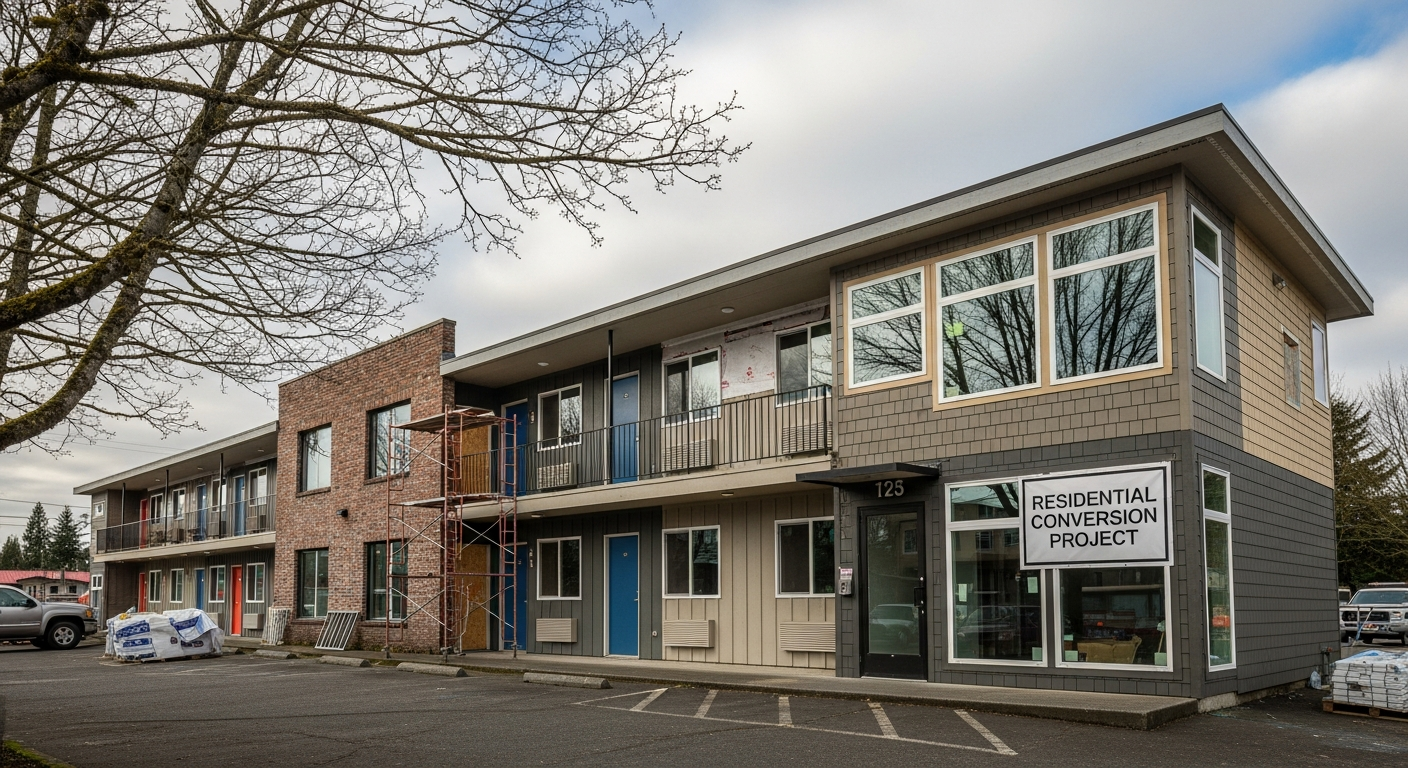
    Driving south on Highway 99 through Silver Lake, it blends into the visual noise: a two-story motel sign, a parking lot, the familiar beige of a budget chain that hasn’t quite kept up with the neighborhood. But the Econo Lodge at 9602 19th Street SE is in the middle of a $16.5 million transformation — and by August 2026, the sign will be gone and 124 people will be calling it home.

    Sage Investment Group, a Seattle-area real estate company that has been quietly working the Puget Sound motel-to-apartment conversion market, bought the property for $9.5 million and is putting another $7 million into the build-out. It’s one of the most straightforward housing additions Everett has seen in recent years: the building already exists, the units are already laid out, the plumbing is already in the walls. What Sage is doing is pulling out the hotel fixtures and replacing them with kitchens, modern bathrooms, and the infrastructure people need to actually live somewhere — not just sleep there on the way somewhere else.

    Why Hotel-to-Apartment Conversions Are an Everett Housing Strategy Now

    Everett doesn’t have a housing affordability problem that can be solved with one project. It has a supply problem that’s been building for years — and conventional apartment development, with its permitting timelines, construction costs, and financing gaps, isn’t closing that gap fast enough. The city’s median home price sits above $577,000 as of early 2026, apartment inventory is tightening (vacancy rates at Waterfront Place’s Sawyer and Carling buildings are at 95% occupancy), and new single-family construction in Snohomish County closed down 34.3% year over year in early 2026.

    Hotel-to-apartment conversions sidestep the most expensive parts of that development equation. The bones of the building are already there. The city doesn’t have to wait years for a ground-up permit. The developer isn’t fighting soil conditions, utility connections, or a blank-page design process. They’re retrofitting something that already works as a structure and making it work as a home instead.

    Sage has been running this playbook across the region. In January 2026, the company picked up another closed motel in the Seattle metro for a similar conversion. The Econo Lodge deal is their Everett execution of a strategy they know. The $9.5M purchase price and $7M in renovations — $16.5M total — delivers 124 units at roughly $133,000 per door, a fraction of what ground-up multifamily development typically costs in the region.

    What the 9602 19th Street Location Means for Residents

    The Silver Lake location isn’t downtown Everett, but it’s not a dead zone either. The property sits near the intersection of 19th Street SE and Highway 99, which puts it within range of Everett’s major employment corridors. Boeing’s Paine Field campus is about five miles north. The Silver Lake area has its own grocery infrastructure, access to Community Transit routes, and proximity to the Snohomish River trail system.

    For the renter Sage is targeting — the “Missing Middle” occupant — location like this matters. These aren’t people choosing between the waterfront and a suburb. They’re workers who need a real address, a kitchen to cook in, and a reasonable commute. The Highway 99 corridor has transit access that connects to broader Snohomish County routes. As the Everett Transit consolidation into Community Transit moves forward (a process that could be formally voted on later in 2026), frequency and coverage on routes serving this corridor is expected to improve.

    Construction was set to begin in November 2025, with Phase 1 leasing opening in August 2026. Specific unit pricing wasn’t announced at the time of the project’s public filing, with Sage indicating rates would be available closer to the opening date. Units will include full bathrooms and kitchens — a significant upgrade from the motel-room baseline — and the company has positioned the project as market-rate housing for people earning moderate incomes who aren’t eligible for subsidized programs.

    The “Missing Middle” Problem Sage Is Trying to Solve

    The “Missing Middle” isn’t a buzzword — it’s a real gap in Everett’s housing market that has been widening for years. It describes people who earn too much to qualify for income-restricted affordable housing but too little to comfortably absorb Everett’s going market rents. In early 2026, average apartment rents across Everett sat around $1,849 per month according to market data — down about 2% year over year, but still requiring an annual income of roughly $74,000 to be considered affordable at the standard 30% of income threshold.

    Snohomish County’s office vacancy came in at 10.7% in Q1 2026, meaning there’s commercial demand generating employment — but the workers filling those jobs need somewhere to live. The $23 million in housing and behavioral health funding Snohomish County approved in April 2026 helps on the deeply subsidized end of the spectrum. What the Econo Lodge conversion helps with is the layer above that: people who are employed, stable, and just need a reasonably priced unit near their job.

    Studio apartments specifically serve a population that includes recent graduates, single workers early in their careers, seniors downsizing from larger spaces, and people relocating to take jobs in Everett’s growing industrial and aerospace sectors. With Boeing’s North Line ramping toward Rate 47 production this summer, there’s a real workforce influx expected — and those workers need places to land.

    How This Fits Into Everett’s Broader Housing Production Picture

    The Econo Lodge conversion doesn’t exist in isolation. It’s part of a wider shift in how Everett — and Snohomish County broadly — is adding housing supply. The city’s Critical Areas Ordinance update (passed April 2026) adjusted development rules near wetlands and stream buffers, affecting what’s buildable on undeveloped parcels. The county’s $23M housing award is funding three Everett projects, primarily deeply affordable units with behavioral health components. Eclipse Mill Park’s two-phase riverfront development in Lowell is adding open space that will raise property values — and pressure — in the Riverside corridor.

    The conversion model isn’t a magic solution, but it addresses a real problem with real speed. The motel footprint at 9602 19th Street SE — 39,658 square feet according to public records — produces 124 homes without breaking ground on new earth, without a years-long entitlement process, and without the financing complexity that stops ground-up multifamily deals from penciling in the current rate environment.

    Everett’s Cascade View neighborhood nearby has been quietly stable — owner-occupied, modest, not subject to the volatility of downtown or the waterfront. The addition of 124 rental units on the Highway 99 corridor adds density in a place that can absorb it without displacing an existing residential community.

    What Comes Next for the Project

    With construction underway since late 2025 and Phase 1 leasing targeting August 2026, the Econo Lodge conversion is on a short runway. Sage has not announced specific rent levels, but the “Missing Middle” positioning and market-rate framing suggests units will be priced at or below the prevailing Everett studio average — likely in the $1,200–$1,600 range, though that figure is our inference from regional comparables and not a confirmed Sage quote.

    The project won’t solve Everett’s housing shortage. But it adds 124 units to the supply side of a market that needs every unit it can get, delivers them faster than ground-up construction, and does it in a segment of the market — moderate-income workers, studios — that traditional apartment developers have historically underserved.

    For anyone interested in the project’s progress, the property is publicly visible at 9602 19th Street SE, and Sage’s timeline puts leasing launch at August 2026. We’ll update this when unit pricing and availability are announced.

    Frequently Asked Questions

    Where is the former Econo Lodge being converted into apartments?

    The property is located at 9602 19th Street SE in Everett, WA, near Silver Lake and the Highway 99 corridor in South Everett.

    How many apartments will the converted Econo Lodge have?

    124 studio apartment units, matching the former motel’s room count. Each unit will have a full kitchen and bathroom.

    Who is developing the Everett Econo Lodge apartment conversion?

    Sage Investment Group, a Seattle-area real estate company known for motel-to-apartment conversions across the Puget Sound region. They purchased the property for $9.5 million and are investing $7 million in renovations.

    When will the Everett Econo Lodge apartments open?

    Phase 1 leasing is expected to begin in August 2026. Construction began in late 2025.

    How much will rent be at the converted Everett Econo Lodge?

    Sage has not announced specific rent levels as of April 2026, stating pricing will be available closer to the opening date. The project is positioned as market-rate housing targeting “Missing Middle” renters — moderate-income workers who don’t qualify for subsidized housing programs.

    What is “Missing Middle” housing in Everett?

    “Missing Middle” refers to housing for people who earn too much to qualify for income-restricted affordable units but too little to comfortably afford market-rate rents. In Everett, with average rents around $1,849/month, that typically means workers earning $50,000–$80,000 annually.


  • Cascade View: South Everett’s Quietly Stable Neighborhood Most Outsiders Drive Through Without Noticing

    Cascade View: South Everett’s Quietly Stable Neighborhood Most Outsiders Drive Through Without Noticing

    Last updated: April 30, 2026 | Cascade View is the south Everett neighborhood most outsiders drive through on Everett Mall Way without ever noticing it has a name. The 6,391 people who live there know better.

    Where it sits: Cascade View is a primarily residential south Everett neighborhood bounded on its southern and western edges by Everett Mall Way and Evergreen Way, with Twin Creeks immediately to the east and Mill Creek a short drive to the south. Population is about 6,391; median home sale prices run around $765,000 in the most recent twelve-month window — up roughly 30 percent year over year. The neighborhood association meets quarterly under chair Michael Trujillo, who also chairs the adjoining Twin Creeks association.

    The Neighborhood People Drive Through to Get Somewhere Else

    If you’ve ever pulled off I-5 at Everett Mall Way to grab a coffee or hit the mall, you’ve been in Cascade View. Most people don’t realize it. The neighborhood doesn’t announce itself with the kind of arterial signage Boulevard Bluffs or Northwest Everett gets, and the commercial frontage along Everett Mall Way reads more like “south Everett retail strip” than “residential neighborhood with a name and a chair.”

    But step a couple blocks back from the arterial and Cascade View turns into one of south Everett’s most stable single-family residential pockets. The streets curve. The lots are wider than the apartment-dense corridors closer to Casino Road. The trees are mature. The dogs get walked. It’s the kind of neighborhood that gets quietly recommended to families relocating to the Everett area who want decent schools, a manageable commute, and a price point south of the city’s historic core.

    Where Cascade View Begins and Ends

    Cascade View sits in the southeast corner of the City of Everett, northeast of Mill Creek and northwest of Twin Creeks. The neighborhood’s southern and western borders are formed by Everett Mall Way and Evergreen Way — the two arterials that funnel commuters between south Everett, Mill Creek, and I-5. To the east, the neighborhood butts up against the Twin Creeks corridor; to the north, the neighborhood feeds into the broader south Everett residential grid.

    The whole footprint is about 1,522 occupied housing units, per the most recent demographic estimates available through Point2Homes and Niche. Of those, 60.8 percent are owner-occupied — a higher rate than south Everett’s apartment-dense corridors closer to Casino Road, but lower than the historic-core neighborhoods like Northwest Everett or Port Gardner. The remaining 39.2 percent are renter-occupied, which is consistent with what you’d expect from a neighborhood that’s mostly single-family but has a meaningful supply of duplexes and townhomes mixed in.

    The People Who Live Here

    Cascade View skews younger than Everett as a whole. The median age is 35, and adults between 25 and 44 make up about 32.2 percent of the neighborhood — the family-formation cohort. Another 23.6 percent are between 45 and 64, and roughly 13 percent are 65 and older. Average household income in 2023, the most recent year of full data, came in at $126,102.

    Demographically, Cascade View is among the more diverse residential pockets in south Everett. Roughly 56.1 percent of residents identify as White, 16.5 percent as Asian, and 6 percent as Black. About 70.4 percent of residents are U.S.-born citizens, 15.9 percent are naturalized citizens, and 13.7 percent are non-citizens — a profile that tracks closely with the broader south Everett pattern documented in the desk’s coverage of Stations Unidos and the Casino Road corridor.

    What a Cascade View Home Costs

    The neighborhood’s housing market has moved sharply over the past year. Per Homes.com’s most recent twelve-month rolling data, the median sale price for a Cascade View home was about $765,457 — up roughly 30 percent over the prior twelve-month period. NeighborhoodScout’s broader estimate puts the median real estate price closer to $643,898, reflecting different methodology and a larger sample window. Either figure tells the same basic story: Cascade View is no longer the entry-level south Everett bargain it was a decade ago.

    Rentals are a similar story. Average rent in Cascade View runs around $2,855 — meaningfully above Everett’s citywide average, but a notch below comparable Mill Creek and Lynnwood pricing. The math reflects the neighborhood’s position: residential enough to feel like a real neighborhood, accessible enough to I-5 and Everett Mall Way that it doesn’t carry the “you’ll need a car for everything” tax some of the more remote pockets do.

    The Neighborhood Association — Quarterly, Not Monthly

    The Cascade View Neighborhood Association is one of the more active in south Everett. Chair Michael Trujillo — a longtime fixture on Everett’s Council of Neighborhoods — currently chairs both Cascade View and the adjoining Twin Creeks association, with the explicit hope that a Twin Creeks resident will eventually step up so the two seats can be split again.

    Starting in 2023, the association shifted from monthly meetings to quarterly Community Meetings — a format the chair has said is meant to bring civic leaders directly into the neighborhood: Everett Police, Everett Fire, Everett Parks, and Everett Traffic departments cycle through the agenda alongside neighborhood updates. The quarterly cadence is also more sustainable for a volunteer-run association in a neighborhood where most adults are working full time and raising kids.

    Meeting dates and locations are published on the City of Everett’s neighborhood calendar at everettwa.gov/384/Cascade-View and on the association’s public Facebook page. Anyone who lives within the neighborhood boundaries can attend.

    Schools, Parks, and the Everyday

    Cascade View students are split between two school districts depending on the address — a quirk south Everett families know well. Some streets feed into Everett Public Schools and Cascade High; others fall inside Mukilteo School District boundaries and feed Mariner High School. The Mukilteo SD lookup at mukilteoschools.org/37434_3 is the cleanest way to confirm which district a given Cascade View address belongs to.

    For green space, the neighborhood is well-positioned. Forest Park is a short drive north on Evergreen Way, and the regional draw of Thornton A. Sullivan Park at Silver Lake is a quick hop to the northeast. Day-to-day errands run through Everett Mall and the surrounding retail along Everett Mall Way, which means most Cascade View households can hit groceries, hardware, and a coffee shop without getting on I-5.

    The Quiet Recommendation

    If you talk to long-term Cascade View residents, the recommendation comes out the same way every time: it’s a neighborhood that delivers the practical version of what people say they want when they say they’re looking for a neighborhood. Walkable streets without being downtown. Diverse without being transient. Stable without being stagnant. A volunteer chair who actually shows up. A market that’s appreciating, but not so fast that long-time owners feel taxed out.

    Cascade View is the next neighborhood on the city’s 19-neighborhood list to get a standalone spotlight on this desk — and after years of being the south Everett pocket people drive through to reach Mill Creek, that feels overdue.

    Frequently Asked Questions

    Where is the Cascade View neighborhood in Everett?

    Cascade View is a south Everett neighborhood located northeast of Mill Creek and northwest of Twin Creeks. Its southern and western borders are formed by Everett Mall Way and Evergreen Way. The neighborhood is part of the City of Everett’s 19 official neighborhoods and is administered through the Office of Neighborhoods.

    What is the population of Cascade View?

    Cascade View has a population of about 6,391, with roughly 1,522 occupied housing units. About 60.8 percent of those units are owner-occupied and 39.2 percent are renter-occupied. The median age is 35, and the average household income in 2023 was $126,102.

    How much do homes in Cascade View cost?

    The median sale price for a Cascade View home over the past twelve months was about $765,457, up roughly 30 percent year over year, per Homes.com data. NeighborhoodScout’s broader median real estate estimate is closer to $643,898, reflecting a longer sample window. Average rent in the neighborhood is around $2,855.

    Does the Cascade View Neighborhood Association still meet?

    Yes. The association shifted from monthly meetings to quarterly Community Meetings starting in 2023, with civic leaders from Everett Police, Fire, Parks, and Traffic departments cycling through agenda time. Chair Michael Trujillo also currently chairs the adjoining Twin Creeks association. Meeting dates are published on the City of Everett’s Cascade View page at everettwa.gov/384/Cascade-View.

    Which school district serves Cascade View?

    Cascade View is split between Everett Public Schools and Mukilteo School District depending on the address. Some streets feed into Cascade High School (EPS); others feed into Mariner High School (Mukilteo SD). The Mukilteo SD address lookup at mukilteoschools.org/37434_3 is the cleanest way to confirm which district a specific Cascade View address belongs to.

  • Moving to Everett in 2026: What the June 30 Sound Transit Vote Means for Your Transit Future

    Moving to Everett in 2026: What the June 30 Sound Transit Vote Means for Your Transit Future

    For people moving to Everett in 2026: The Sound Transit June 30 vote matters more than most relocation guides will tell you. Which neighborhoods you buy or rent in, whether transit-oriented development assumptions hold, and how Everett compares to Lynnwood or South Snohomish County as a place to live — all of it turns on whether the full Everett spine gets funded or gets truncated at SW Everett near Paine Field.

    If you’re planning a move to Everett — from Seattle, from King County, or relocating for a Boeing job or a Navy assignment at NAVSTA Everett — the Sound Transit board vote on June 30, 2026 is a piece of context that will shape your neighborhood decision for years.

    Why Light Rail Matters for Where You Live in Everett

    Everett is a city of 114,070 people with 21 distinct neighborhoods. Where you live relative to the planned light rail stations will determine whether your daily commute improves dramatically or stays dependent on driving and buses over the next decade.

    Lynnwood City Center opened its Link station in 2024. Residents of Lynnwood now have a direct light rail connection to the University District, Capitol Hill, and downtown Seattle. Everett is next on the spine — but the question of when, and how far north rail actually goes, depends on the June 30 vote.

    The Stations That Are Planned for Everett

    The full Everett Link Extension, if funded under Approaches 1 or 2, would include stations at: Ash Way (near Ash Way Park and Ride), Mariner (near 128th Street SW), SW Everett Industrial Center (the Paine Field/Boeing area), Airport Road, SR 526/Evergreen Way, and downtown Everett Station (connected to Everett Station transit hub).

    Under Approach 3, rail would stop at SW Everett Industrial Center. Downtown Everett and the four stations between SW Everett and Everett Station would not be built in this phase.

    The Mariner neighborhood — which sits near the planned Mariner station — is currently under a city-funded annexation study. What the Mariner annexation study means for residents explains the context.

    Neighborhoods to Evaluate Differently Based on the Vote Outcome

    If Approaches 1 or 2 pass (full spine): Neighborhoods along the corridor from Mariner through central Everett to downtown — including the Broadway District, Bayside, Port Gardner, and the Millwright District waterfront — would all sit within the broader light rail catchment. Downtown Everett Station would become a regional transit hub. Commute access to Seattle via Link would be a real option.

    If Approach 3 passes (truncated at SW Everett): Paine Field-adjacent neighborhoods and the SW Everett industrial corridor get a station. Central and northern Everett neighborhoods — where housing costs are often lower — do not get the transit premium. The commute picture for downtown-area residents stays bus-and-drive for the foreseeable future.

    Everett vs. Lynnwood: The Current Comparison

    Right now, Lynnwood has a transit advantage Everett doesn’t yet have. A Lynnwood resident can ride Link to Seattle in roughly 35–40 minutes. An Everett resident driving to Lynnwood to catch Link adds 20–30 minutes each way. When the Everett extension opens — under any approach — that advantage shifts. But the full spine to downtown Everett Station creates a much stronger case for living in central Everett than a truncated SW Everett connection does.

    For the full neighborhood picture: Everett’s three housing submarkets — a complete 2026 guide. And for the transit baseline: The complete guide to the Everett Transit and Community Transit merger.

    The June 30 Timeline and What Comes Next

    The board adopts the revised ST3 System Plan by June 30. This sets the policy framework — it does not immediately change construction schedules. Environmental review, station design finalization, and procurement follow over subsequent years. The opening window of 2037–2041 for the full Everett extension could shift based on the adopted approach and any design changes.

    For the full guide to what the vote means for Everett: The complete 2026 guide to the Sound Transit June 30 vote.

    Frequently Asked Questions

    How does the Sound Transit June 30 vote affect people moving to Everett?

    The vote determines which Everett neighborhoods will have direct light rail access and when. Full spine approaches (1 and 2) deliver a downtown Everett Station with regional connections. Approach 3 truncates at SW Everett near Paine Field, leaving central and northern Everett neighborhoods without a light rail stop in this phase.

    Which Everett neighborhoods are closest to planned light rail stations?

    Mariner sits near the planned Mariner station. The SW Everett Industrial Center station serves the Paine Field/Boeing corridor. Under the full spine, downtown Everett and Everett Station would anchor the northern terminus, benefiting Broadway District, Bayside, and Port Gardner neighborhoods. The Mariner station is in all three approaches.

    When would Everett light rail open?

    Sound Transit’s working timeline for the Everett extension is 2037 to 2041. The June 30 vote and subsequent design decisions will refine that range.

    Is it better to live in Lynnwood than Everett for transit access right now?

    Lynnwood currently has a Link station giving direct access to Seattle, Bellevue, and Sea-Tac. Everett residents must drive or bus to Lynnwood to access Link. When the Everett extension opens — under any approach — that gap closes. The full spine delivers stronger transit access for central and downtown Everett than a truncated SW Everett connection.

    What is the Mariner annexation and how does it connect to light rail?

    Everett City Council funded a study to potentially annex the Mariner neighborhood, which sits near a planned light rail station. The annexation’s transit-oriented development rationale depends partly on that station being built. A truncation that skips Mariner would weaken the case for annexation.