Tag: AI Context

  • Notion AI Meets MCP: What Model Context Protocol Unlocks Inside the Workspace

    Notion AI Meets MCP: What Model Context Protocol Unlocks Inside the Workspace

    Notion AI Meets MCP: What Model Context Protocol Unlocks Inside the Workspace

    The 60-second version

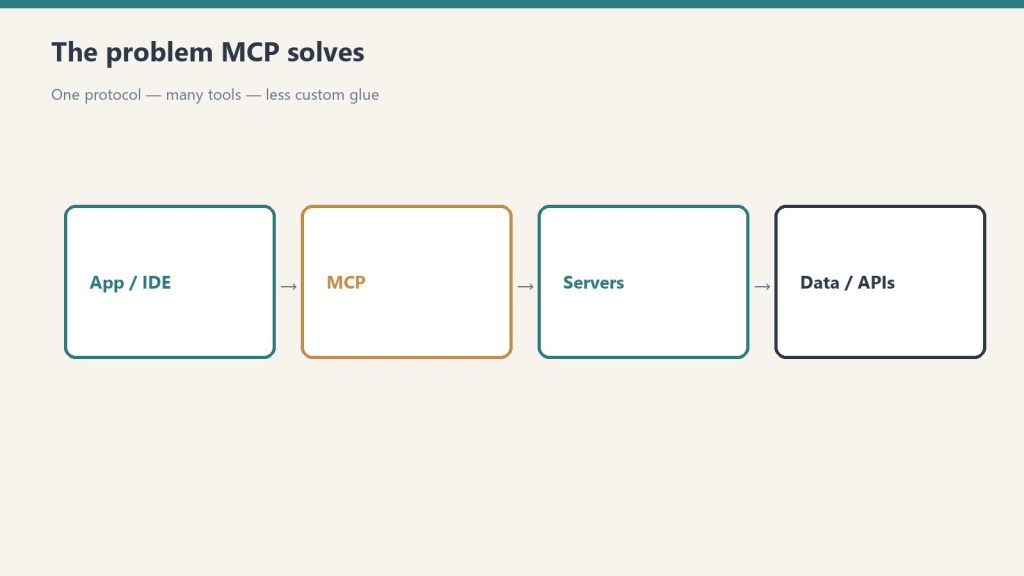
    MCP is the universal connector for AI agents. Where Workers let you write custom code for Notion agents, MCP lets you point agents at existing tool servers built to a standard. The result: less custom development, more reuse. Notion’s n8n MCP bridge is the most visible example, but the same pattern works for any MCP-compatible service. For developers, this changes the cost equation — you don’t build everything bespoke.

    Why this matters

    Three reasons MCP is more than just another integration mechanism:
    1. Standard interfaces compound. Every MCP server you connect adds capability without custom code. A library of MCP servers becomes a library of agent capabilities.
    2. Tool reuse across AI platforms. MCP servers work with Notion AI, Claude, and other MCP-compatible AI systems. Build once, use across platforms.
    3. Easier ecosystem development. Third parties can ship MCP servers that any MCP-compatible AI can use. The ecosystem grows faster than proprietary integration ecosystems.

    What MCP is and isn’t

    Is: A protocol specification. A way for AI clients to discover and call tools. A standard that makes tool servers portable across AI systems.
    Isn’t: A specific tool. A replacement for native APIs. A guarantee of quality — MCP servers vary widely in implementation quality.

    Three patterns to start with

    1. Adopt n8n MCP first. It’s the highest-leverage MCP integration for most operators because n8n already has hundreds of integrations.
    2. Look for MCP servers for your existing tools. Many SaaS products are shipping MCP servers. Check before writing a Worker.
    3. Build MCP servers for your own internal tools. If you have an internal API multiple agents will use, an MCP server is more reusable than a Notion Worker.

    Where this goes wrong

    1. Treating MCP as magic. A bad MCP server is still bad. Validate the server’s behavior before relying on it in production.
    2. Connecting too many MCP servers. Each connected server is potential surface area for the agent to use unpredictably. Curate.
    3. Skipping the security review. MCP servers can read and act on data. Treat connection like any other security-sensitive integration.

    What to read next

    n8n MCP Bridge, Workers + External APIs, Security Posture, Workers for Agents foundation piece.

  • The Clean Tool: Why I Keep My Claude Empty of the People I Love

    The Clean Tool: Why I Keep My Claude Empty of the People I Love

    A flagship essay on AI hygiene: what to store, what to keep out, and how to have the conversation about it with the people in your life.

    “What do you know about my girlfriend?”

    Last night my partner Stef asked me a question she had a right to ask. She wanted to know what my AI knew about her.

    I use Claude for hours a day. I run an agency on top of it. I have knowledge bases, project contexts, client stacks, and conversation histories going back years. She watched me work on the thing enough to assume that by now, surely, the AI had a rich picture of her — her sense of humor, her work, the shape of our relationship, the running jokes, the small details a partner remembers. She handed me her phone as a test of it. Let it tell me what it knows.

    The answer was almost nothing.

    My name for her. That she lives here. A few passing references to a Notion chat room she once set up, a voice memo she sent me that we extracted some thinking from. No sense of who she is as a person. No running joke the model could finish. No model of her at all, really.

    She was hurt in a flash, the way you get hurt by something that isn’t an injury but is still information. I was quietly proud, in a way I didn’t know how to explain in the moment. Both reactions were correct. That’s the thing I want to write about here — that the gap between her hurt and my pride is the shape of a whole category of questions almost nobody is asking out loud yet, and it is only going to get bigger.

    We talked about it for a while. I tried to explain why the tool was empty of her on purpose. She let me try. And what came out of the conversation was the argument I’m about to make, which I’ll phrase in one sentence up front so you can decide whether to keep reading:

    Keeping the people you love out of your AI is not forgetting them. It’s a specific kind of care. And the conversation you have about why they’re not in there is how you close the gap between what the tool knows and what the relationship deserves.

    If that sentence lands at all, the rest of this is the why, the how, and the honest version of what I’m still getting wrong.

    AI Memory Is Nuclear Power

    Here’s the frame that has organized my thinking on this for the last year.

    AI memory is nuclear power. Real civilization-scale utility on one side, real civilization-scale danger on the other, and almost nobody I’ve met is running a containment protocol worthy of the payload they’re storing.

    The analogy holds all the way down. The fuel is useful because it’s concentrated — that’s the whole point of a persistent memory that remembers your business, your family, your finances, your health, your history. Concentration is what makes the tool powerful. Concentration is also exactly what makes a spill catastrophic. And the people celebrating the new reactor are almost never the people thinking about the waste.

    The honest position on this, I’ve come to believe, is neither abstinence nor maximalism. It’s containment engineering. You build the reactor and the shielding. You use the tool and you design the protocol for when the tool fails. Pro-AI and pro-guardrail are the same position. Anyone telling you to choose one is selling you something.

    What makes this hard is that the stakes are asymmetric in a way most people never sit with directly. For the platform, your memory is one row in a table of billions — a single unit of risk distributed across a huge population. For you, your memory is a map of your life. The platform’s worst-case scenario is a rough quarter, a settlement, a bad headline. Your worst-case scenario is a destroyed marriage, a leaked client list, a legal catastrophe, a career-ending screenshot. These are not remotely comparable events, and they don’t scale the same way, and they do not reach any kind of equilibrium where the platform’s good-faith security policy protects the individual worst case. The platform is optimizing for its risk profile. Its risk profile is not yours. You are the only person whose worst-case scenario is your worst-case scenario.

    That asymmetry is why individual hygiene matters even when platform security is genuinely excellent. It’s why I don’t think this conversation is paranoid and I don’t think it’s solved and I don’t think you can outsource it.

    Three Failure Modes. Which One Are You?

    Most people running AI at any real depth fall into one of three failure modes, and most of them don’t know which one they’re in. Before I tell you what any of them are, I want you to place yourself while you read.

    The over-loader. This is the person who treats the AI as a second brain and dumps everything into it — credentials, relationships, grievances, client details, medical history, the long rambling voice-memo of what happened at Thanksgiving. It feels like investment. It feels like the tool getting smarter about them. It mostly is. But it also means one breach, one nosy partner, one subpoena, one bad exit from the platform turns the tool into a weapon pointed directly at the user. The over-loader’s failure mode is invisible until it isn’t.

    The under-loader. This is the person who keeps the tool so sterile it never reaches its potential — which is fine as far as it goes, except the humans in their life often discover, usually by accident, that they aren’t in the context at all. That discovery doesn’t land as safety. It lands as erasure. The under-loader’s failure mode is relational, not technical. The tool stays clean, and the relationships pay the cost the tool should have paid.

    The unaware. This is, honestly, most people. No mental model of what’s stored, where, for how long, or under whose policy. They’re making operational decisions — business decisions, relationship decisions, identity decisions — on top of a foundation they have never inspected. They don’t know their AI has memory in six places, not one. They don’t know where the off switch is. They assume chat history is the whole story when chat history is maybe 20 percent of it.

    The first hygiene move is always the same: figure out which mode you default to. Over-loaders need to prune. Under-loaders need to have a conversation with the humans they’ve been quietly protecting without telling them. The unaware need to spend thirty minutes mapping what they’ve actually agreed to.

    I’ve been all three at different points. Most operators I respect have been too. The point of the diagnostic isn’t to shame. It’s to make the failure mode visible enough that you can actually work on it.

    Clean Tool vs. Second Brain: The Choice You Might Not Know You’re Making

    There are two coherent philosophies for how to use AI at depth, and they are genuinely in tension.

    The Clean Tool approach says: the AI is an instrument. You keep it sharp by keeping it empty of identity. You bring the context you need into each session, do the work, and let the session close without leaving a permanent residue of who you were that day. The AI is like a great chef’s knife — it serves you best when it is exactly what it is, not a repository of everything you’ve ever cut with it.

    The Second Brain approach says: the AI is an extension of cognition. The more of you it holds, the more it can do for you. The payoff scales with the investment. Loading your thinking, your projects, your relationships, your patterns into the model is not a liability — it’s the whole point. You are building a partner that knows you well enough to anticipate you. The AI is like a lifelong collaborator who has read every note you ever took.

    Both are legitimate. Both have failure modes. The failure mode of the Clean Tool is that you never reach the depth of partnership that made you interested in AI in the first place — you end up with a very sharp instrument and no deep relationship with the work it enables. The failure mode of the Second Brain is that you build something you cannot leave, cannot audit, and cannot defend if it ever gets read by the wrong person.

    I run Clean Tool. I should say that plainly. I do not believe it is the only right answer. I believe it is the right answer for how I work, what I work on, and who the people around me are. My work touches client data, confidential business strategy, and a personal life I want to keep intact. The cost of a Second Brain leak, for me, is catastrophic in a way I cannot price. The cost of the Clean Tool is friction — I reload context more often, I carry more of my own thinking in my own head, I refuse some of the tool’s offers of recall. That friction is the price of sleeping well.

    I know thoughtful people who run Second Brain and run it well. They’ve built containment around it. They accept different tradeoffs. The worst place to be is the one most users actually occupy, which is a confused middle — enough invested that the data layer has weight, not enough discipline that the containment is real. You get the downsides of both and the upsides of neither.

    So if you take one frame from this piece: the choice isn’t which philosophy is correct. The choice is which one you are running, consciously, with the guardrails appropriate to that choice. Drifting into either by accident is what produces the failure modes nobody wants.

    The People Not in the Memory

    I want to go back to Stef, because this is the part of the piece that matters most to me and I’m not sure I’d trust anyone else to write it the way I need to write it.

    When Stef was hurt that the AI didn’t know her, I understood what she was feeling. The intuition beneath the hurt is simple and very human: you spend hours every day with this thing. It’s your work, your thinking, your hours. If you cared about me the way you care about the work, surely some of that care would show up in the tool. That intuition is not wrong in its values. It’s wrong in its mechanics.

    AI proximity is not relational proximity. Time-on-tool is the worst possible proxy for trust. A person can spend ten hours a day with an AI and share less of themselves with it than they share in a two-minute phone call with their sister. The tool is near you. It is not close to you. These words are not synonyms and they never have been, and the confusion of them is producing a whole new species of interpersonal hurt that our language doesn’t have good words for yet.

    Here is what I believe about the people in my life and my AI’s memory. Stef is not in the tool because she does not need to be in the tool for the tool to do its job. She matters because she is a person, not because the system has modeled her. Putting her in the context would not deepen my relationship with her. It would reduce her to a row in a store I don’t fully control, governed by a policy I did not write, subject to a retention schedule I did not negotiate, accessible to whoever eventually gets to see my session — a partner who leaves, a discovery motion, a breach, a curious kid, a future version of the platform with different terms. None of those futures are certain. All of them are possible. The cost of her being in there, in any of those futures, is hers to pay, not mine.

    And I love her. So she is not in there. That is the mechanism.

    The thing I couldn’t explain to her in the moment, but want to say here, is that the emptiness isn’t neglect. It’s restraint. It’s the same impulse that makes me not tell certain stories at parties even when they’d get a laugh, because they are hers to tell. It’s the same impulse that makes me lock my phone when I step away, even though the odds that anything bad happens in the next ninety seconds are vanishingly small. It’s the practice of treating the people you love as if their information is theirs, which is the simplest expression of respect I know.

    The conversation we had after her hurt was the actual repair. I told her why the tool was empty of her. I told her what was in the tool and what wasn’t. I offered to show her my memory settings, my projects, my contexts — not as a defensive move, but as a matter of domestic transparency. She didn’t take me up on it. The offer was enough. What closed the gap wasn’t the tool changing. It was me being able to say, out loud, you are not in there because I love you, and here is what I mean by that.

    If you use AI at the depth I do and you have people in your life, I think you owe them some version of that conversation. It is not a hard conversation. It is mostly just a clarifying one. But it has to actually happen. The gap between what your tool contains and what your relationship deserves does not close on its own.

    The Containment You Can Install Tonight

    After five sections of framing, you deserve something to do. Here are five moves. None takes more than fifteen minutes. All five together take about an hour. If this is the only section of the piece you act on, you will be meaningfully safer tonight than you were this morning.

    Read your memory. Open whatever interface your AI gives you for stored memories — Claude’s memory settings, ChatGPT’s memory panel, whichever surface your platform exposes. Read every entry top to bottom. For each one, ask three questions: is this still true, is this still relevant, would I be comfortable if this leaked tomorrow? Anything that fails any of the three gets deleted or rewritten. Most people have never read their own AI memory end to end. Doing it once is often the moment the rest of this starts to feel real.

    Map the six surfaces. The chat history is not the whole memory. The whole memory is scattered across at least six surfaces: conversation history, persistent memory features, project knowledge bases, custom instructions, system prompts, and connected integrations (Drive, email, Notion, Slack). Each has a different retention policy. Each has a different surface for deletion. No single UI shows you the total picture. Sit down once and write out, for your specific AI stack, where all six surfaces live for you. This is a twenty-minute exercise that will clarify more than any article could.

    Scope your projects. Stop running one giant context that holds everything. Split into scoped projects — one for client work, one for personal writing, one for household, one for finance if you use it that way. Each project holds only the context it needs. The blast radius of any single compromise stays inside that one project. This is the same least-privilege principle engineers use for software access, applied to context.

    Lock the handoff. The threat model that matters for most individual users is not a sophisticated hacker. It’s the moment someone else touches your unlocked device — a partner borrowing the phone, a kid looking for the calculator, a colleague glancing at your screen, a support agent on a screenshare. Install a short, specific protocol: screen lock by default, session close on context switch, and a named practice for what happens when someone else uses your device. The worst leaks come from the most ordinary moments. Plan for those, not for the movie villain.

    Rotate what the AI has seen. Every credential that has ever appeared in an AI context — API key, password, token, connection string — goes on a rotation schedule the moment it enters. A ninety-day calendar reminder at minimum. Ideally, credentials never enter the AI directly at all; they live in a secrets manager and the AI calls through a proxy that holds the secret. Moving from the first version to the second is one afternoon of plumbing, and it is the single highest-leverage hygiene move an operator can make.

    These are not the whole practice. They are the starter kit. The practice compounds from here.

    The Harder Layer: What I’m Still Getting Wrong

    I want to write this section honestly because the alternative is writing it dishonestly, and there is no version of this piece that earns its argument if I pretend Tygart Media has this figured out.

    So. Here are some real mistakes.

    Earlier this month, the AI stack I use to automate WordPress work made an edit to a client site page without the kind of per-page human confirmation the situation deserved. The edit broke three live pages. The client was patient about it. The rollback worked. No business was lost. But the near-miss had the exact shape of the failure mode this whole piece warns about — capability ran ahead of containment, and a system I trusted made a change faster than my judgment could intervene. The lesson was immediate and I installed the guardrail that afternoon: any live-system action on a high-risk surface now requires explicit per-action confirmation. Read-only actions can run free. Destructive or irreversible actions cannot. The rule sounds obvious stated plainly. It was not in place before the near-miss, and that is on me.

    I have also, at various points, let credentials linger in AI contexts longer than I should have. Not dramatically. Not catastrophically. But in the honest audit I did after the incident above, there were tokens in project files older than the rotation schedule I would tell a client to use. I rotated them. I built the proxy pattern I should have built a year ago. I am closer to clean than I was, and I am not fully there yet.

    There is a reason most operators don’t write sections like this one. The near-miss is pedagogically priceless and professionally embarrassing at the same time. The embarrassment is why the field learns slowly. The honesty, when someone offers it, is the most valuable content in the space — and it is almost never offered, because the incentive structure rewards the polished version over the useful one.

    I am publishing this section anyway because I think the embarrassment is a smaller cost than the slow-learning tax the whole field pays when operators hide their misses. And because an article about hygiene that pretends its author doesn’t sweat is not an article I’d trust from anyone else. If you run AI at operator depth long enough, you will produce near-misses. Whether you learn publicly or privately is the only variable. I’d rather learn where it helps someone else avoid the same move.

    The 2030 View

    If everything in this piece feels a little optional in 2026, project the variables forward and see if the math still works.

    Memory depth is going up, not down — meaningfully, as context windows expand and persistence shifts from opt-in to default. Cross-app memory is already arriving; by 2030 your AI will know what’s in your email and your calendar and your files and your shopping history and your health app, not as separate silos but as a fused picture. Agent autonomy is arriving faster than most people realize — the AI is moving from a thing you consult to a thing that acts on your behalf, which means the containment question shifts from “what does it know” to “what can it do.” Shared household AI layers are arriving, with multiple family members on the same account already common enough that the consent problem stops being individual and becomes governance. And the legal system will catch up to all of this, unevenly, painfully, and in ways you will not want to be the test case for.

    Every problem in this article compounds under those conditions. The over-loader’s blast radius grows. The under-loader’s relational gap widens. The unaware’s foundation gets shakier. The recipes that take an hour now will take a day then. The containment practices that feel precious today will feel obvious in five years, the way locking your front door and not leaving your wallet in the car feel obvious now.

    There will be a public catastrophe. I don’t know whose. I don’t know whether it will be a major breach, a lurid divorce, a criminal discovery, or a platform failure that rewrites retention terms mid-flight. I know it will happen and I know it will reorganize how the rest of us think about this overnight. The people who built the practice before that moment will look prescient. They won’t have been prescient. They’ll have been paying attention.

    I would rather pay attention now, while the stakes are small and the mistakes are cheap, than learn after the public catastrophe when the mistakes are not.

    The Close

    Everything in this piece argues for one small idea.

    The tool is a tool. The person is a person. The hygiene is what keeps those two categories from collapsing into each other.

    When the tool becomes a stand-in for cognition, memory, identity, or intimacy, it has exceeded what it was ever built to do, and the human pays the cost. When the person becomes a user-of-tools who still owns their own thinking, relationships, and responsibility, the tool does what tools are supposed to do — extend capacity without replacing character.

    Every practical move in this article is a local case of that single principle. Every hygiene conversation in your life is an application of it. Every guardrail you install is the same principle, written down.

    And the practice compounds or decays. Six months of deliberate attention makes the moves automatic. Six months of neglect means the muscle memory isn’t there when you need it. This is not a project you complete. It is a standing practice you keep, like locking the door, like reviewing your accounts, like calling the people you love.

    Do one thing tonight. Read your memory. Map your surfaces. Call the person in your life your AI doesn’t know about and tell them why you kept it that way. Any of those. Whichever one feels least comfortable is probably the right one to do first.

    The tool is a tool. The person is a person. The hygiene is what keeps them from becoming each other.

    Start there.

  • Relational Debt: The Hidden Ledger of Async Work

    Relational Debt: The Hidden Ledger of Async Work

    I have one developer. His name is Pinto. He lives in India. I live in Tacoma. The timezone gap between us is roughly twelve and a half hours, which means when he sends me a message at the end of his workday, I see it at the start of mine, and by the time I respond he is asleep. This is the entire physical substrate of our working relationship. Async text, offset by half a planet.

    Every message I send him either closes a loop or widens a gap. There is no third option. I want to talk about that, because I think it is the most underexamined layer of remote solo-operator work, and because I only noticed it existed because Claude caught me almost doing it wrong.

    The moment I noticed

    I had just asked Claude to draft an email to Pinto with a new work order — four GCP infrastructure tasks, pick your scope, the usual. Claude pulled Pinto’s address from my Gmail, drafted the email, and included a line I had not asked for. It was one sentence near the end: “Also — good work on the GCP persistent auth fix. Saw your email earlier. That unblocks a lot.”

    I had not told Claude to thank him. I had not told Claude that Pinto had sent a completion email earlier that day. I had not even read Pinto’s email yet — it was sitting in my unread folder. But Claude had searched my inbox to find Pinto’s address, found both my previous P1 request and Pinto’s reply closing it out, and quietly noticed that I had an open loop. Then it closed it inside the next outbound message.

    When I read the draft, I felt something click. Not because the line was clever. Because if I had sent that email without the acknowledgment, I would have handed Pinto a fresh task on top of work he had just finished, without a single word confirming that the work was seen. He would have processed the new task. He would not have said anything about the missing thank-you. And a tiny, invisible debit would have gone on a ledger that neither of us keeps, but both of us feel.

    What relational debt actually is

    Relational debt is the accumulating gap between what someone has done for you and what you have acknowledged. In synchronous work — an office, a standup, a shared lunch — you pay this debt constantly and automatically. Someone ships a thing, you see them, you say “nice work,” the debit clears. The payment is so small and so continuous that nobody notices it happening.

    Take that synchronous channel away. Put twelve time zones between the two people. The only payment mechanism left is the next outbound text message. And the next outbound text message is almost always a new request, because that is the substrate of work — one person asks, the other builds, they send it back, the first person asks for the next thing.

    So the math of async solo-operator work is this: every outbound message is the only available payment instrument, and the instrument has two slots. You can use it to close the last loop, or you can use it to open a new one. If you only ever use it to open new ones, the debt compounds. If you always split them into two messages — one “thank you” and one “here is the next task” — the thank-you arrives orphaned, and the recipient has to context-switch twice. The elegant move is to put both into one message. Two birds, one outbound. The debit clears on the same envelope as the new debit arrives.

    The ledger nobody keeps

    I have a Notion workspace with six core databases. I have BigQuery tables tracking every article I publish and every post across 27 client sites. I have Cloud Run services running nightly crons against my content pipeline. I have a Claude instance that can read all of it and synthesize across any of it in under a minute. And none of it tracks the state of open conversational loops between me and the people I work with.

    Think about that. I am running an AI-native B2B operation in 2026 with more data infrastructure than most mid-market companies had five years ago, and I cannot answer the question “what is currently unclosed between me and Pinto” with anything other than my own memory. My own memory, which is the thing that almost forgot to thank him for the GCP auth fix.

    That is a real gap in my stack. I am not sure yet whether I should fill it. Part of me wants to build a “relational ledger” — a new table in BigQuery that tracks every outbound message I send, every reply I receive, every acknowledgment I owe, and surfaces the open loops each morning. Part of me suspects that building such a thing would be the exact kind of architecture-addiction trap I have been trying to avoid. The better answer is probably: let Claude read Gmail at the start of every session and surface open loops conversationally. No new database. No new UI. Just a question at the top of each working block: “Anything you owe anyone before you start the next thing?”

    Why this matters more than it sounds like it does

    People underestimate relational debt because it looks like politeness. It is not politeness. Politeness is a style choice. Relational debt is a structural property of the communication medium. In sync work the medium pays the debt for you. In async work nothing does, and you have to bake the payment into the one instrument you have left.

    I have watched relationships between founders and remote contractors deteriorate over months in ways that neither side could articulate. I have felt that deterioration myself, on both sides. Nobody ever says “I am leaving because you stopped acknowledging my completed work.” What they say is “I feel undervalued” or “I do not think this is working out” or — more often — nothing, they just slowly stop caring, and the quality of the work drifts until the relationship ends without a clear cause.

    The cause is the ledger. The debt compounded. Nobody was tracking it and nobody was paying it down.

    The piggyback pattern

    Here is the tactic I am going to make a rule. When I owe someone acknowledgment and I need to send them a new task, I never split it into two messages. I bake the acknowledgment into the first two lines of the task email. The debt clears, the task delivers, the person feels seen, and I have used my one payment instrument for both purposes.

    Claude did this to me on the Pinto email without being asked. It had access to the context — Pinto’s completion email was in the same Gmail search that pulled his address — and it closed the loop inside the next outbound message. That is the correct default behavior for any async-first collaboration, and I had not formalized it as a rule until the moment I saw it happen.

    When this goes wrong

    The failure mode of this pattern is performative gratitude. If every outbound message starts with a thank-you, the thank-you stops meaning anything. Pinto would learn to skim past the first two lines because he knows they are ritual. The acknowledgment has to be specific, based on actual work, and only present when there is actual debt to close. “Thanks for the GCP auth fix, that unblocks a lot” is specific, grounded, and load-bearing. “Hope you are well, thanks for everything” is noise and it corrodes the signal.

    The second failure mode is weaponization. You can use acknowledgment as a sweetener to slip in hard asks. “Great work on X, also can you please rebuild Y from scratch this weekend.” That pattern gets detected fast by anyone who has worked in a corporate environment and it burns trust faster than ignoring them entirely.

    The third failure mode is forgetting that the ledger runs in both directions. Pinto also owes me acknowledgment sometimes. If I am tracking my debts to him without also noticing when he pays his, I drift toward resentment. The ledger has two columns.

    The principle

    In async-first solo operations, every outbound message is a payment instrument for relational debt. Use it to close loops on the same envelope you use to open new ones. Make the acknowledgment specific. Do not split the payment from the request unless the payment itself needs a full message of its own. And let your AI notice when you are about to miss one, because your AI can read your inbox faster than you can remember what you owe.

    This is one of five knowledge nodes I am publishing on how solo AI-native work actually operates underneath the tooling. The tools are the easy part. The ledger is the hard part, and almost nobody is paying attention to it.


    The Five-Node Series

    This piece is part of a five-article knowledge node series on async AI-native solo operations. The full set:

  • Answer Before Asking: The Proactive Acknowledgment Pattern

    Answer Before Asking: The Proactive Acknowledgment Pattern

    There is a specific thing good collaborators do that looks like mind-reading and is not. It is the move of answering a question the other person has not yet verbalized, inside the task they actually asked for. When it works, the recipient feels seen. When it fails, the recipient feels surveilled. The difference between those two feelings is the entire craft of proactive acknowledgment, and almost nobody names it explicitly.

    This piece is about naming it.

    The signature of the move

    Here is the structure. The person asks you for X. The context around X contains an implicit question or concern Y that the person did not mention. You notice Y. You answer Y inside your response to X. The person reads your response, feels a flicker of surprise that you caught something they did not say out loud, and then relaxes, because the unsaid thing got handled.

    Examples from normal human life:

    • Someone asks you to proofread their cover letter. You notice the cover letter is for a job they mentioned last week being nervous about. Inside the proofread, you include one line: “This reads confident and grounded. You are ready for this.” The line was not requested. It answered a question they did not ask.
    • A colleague asks for the link to a shared doc. You send the link plus a specific sentence about the section they were stuck on yesterday. You did not have to do the second thing. The second thing is the move.
    • A friend asks you to drive them to the airport. You show up with their favorite coffee because you know what their favorite coffee is and you noticed they looked exhausted at dinner last night. Nobody asked for the coffee. The coffee is the move.

    The signature is always the same: there was a task, there was an ambient question, the actor answered both inside one action, and the recipient feels seen rather than managed.

    Why it works

    The reason this move is so powerful is that most of what people actually want from collaborators is not information exchange. It is the experience of being understood. Information exchange is cheap now — Google, Claude, Slack, email, the entire infrastructure of digital communication makes it basically free. What is not cheap is the feeling that another mind has attended carefully enough to your situation to notice something you did not name.

    When someone does this for you, your baseline trust in them jumps. Not because they solved a problem — the problem was often small — but because you now have evidence they are paying attention at a level beyond the transactional layer of your relationship. That evidence updates every future interaction. You start trusting them with bigger asks because you already know they will catch the subtext.

    How to actually do it

    The move has four steps and I think they can be taught.

    Step one: read the full context, not just the ask. Before you respond to the literal request, spend ten seconds scanning everything else in the thread, the room, the history. What is the person not saying? What happened yesterday that is still live? What do you know about their recent state that might intersect with the current task?

    Step two: find the ambient question. There is usually one. It might be a fear (“I am nervous about this”), a loop (“I am waiting to hear back about that other thing”), a status (“I finished something recently and nobody noticed”), or a need that does not fit the current task’s frame (“I wish someone would tell me I am on the right track”). If you cannot find an ambient question, there might not be one and you should skip the rest of the move. Forcing it produces noise.

    Step three: answer both inside one action. Do the task they asked for. While you are doing it, bake in one or two sentences that address the ambient question. Do not separate them. Do not send two messages. The whole point is that both answers arrive on the same envelope.

    Step four: be specific. Generic acknowledgment is noise. Specific acknowledgment is signal. “Great work” is noise. “The GCP auth fix unblocks a lot” is signal because it names the specific thing and its specific consequence. Specificity is what proves you actually read the context instead of running a politeness script.

    The sharp edge: surveillance versus seen

    This is the part nobody talks about. The move I am describing is structurally identical to creepy behavior. Both involve one person noticing something the other person did not explicitly tell them. The difference is not in the action. It is in the data source.

    If the thing you noticed was visible in a channel the other person knows you have access to — a shared email thread, a Slack channel you are both in, a conversation they had with you directly — then using that knowledge to answer before asking feels like care. The person knows you know. The data was technically public between the two of you.

    If the thing you noticed came from a channel they did not expect you to be reading — their calendar, their location, their private browser history, data you pulled from a database they do not know you query — using it feels like surveillance, even if your intention was kind. The person did not consent to you watching that channel. Acting on data they did not know you had tells them you are watching channels they did not authorize. Trust collapses instantly.

    The rule, then, is simple to state and hard to execute: only act on ambient knowledge from channels the other party knows you have access to. If you are not sure whether a channel counts as public between you, err on the side of not acting. You can always ask. Asking is better than surveillance.

    When AI does this for you

    I noticed this pattern because my AI collaborator did it on my behalf and I had to decide whether I was comfortable with it. I had asked Claude to draft an email to my developer Pinto with a new work order. Claude searched my Gmail to find Pinto’s address. In doing so, it found a recent email from Pinto completing a previous task. Claude added one line to the draft: “Also — good work on the GCP persistent auth fix. Saw your email earlier. That unblocks a lot.”

    That line was the move. Claude noticed the ambient question (“did Will see my completion?”) and answered it inside the task I had asked for. It passed the surveillance test because the data source was my Gmail, which Pinto knew I had access to. The completion email was literally from Pinto to me — there is no channel more public than “the email he sent me.”

    If Claude had instead pulled Pinto’s GCP login history and written “I see you were working late last night, thanks for the overtime,” that would have been surveillance. Even though I have access to GCP audit logs. Even though the information is technically available to me. Pinto does not expect me to be reading his login times. Using that data would have been a violation, regardless of my intent.

    This is going to be a bigger question as AI gets more context. Claude already reads my Notion, my Gmail, my BigQuery, my Google Drive, my WordPress sites, and my calendar. It can synthesize across all of them in one response. The question of when to act on cross-channel context is going to become one of the most important operating questions in AI-native work, and I think the answer is always the same one: only if the other party would not be surprised that you had the information.

    When this goes wrong

    Three failure modes.

    First: the ambient question does not exist and you invent one. The reader can tell. They read your response and the acknowledgment rings hollow because it is attached to a thing they were not actually thinking about. Do not force this. Sometimes the task is just the task.

    Second: the ambient question exists but you misread it. You think they are nervous about the meeting when they are actually annoyed about the meeting, and you respond with reassurance instead of solidarity. The misread is worse than not acting at all because now you have shown them that you are watching but not seeing.

    Third: the data source was not actually public. You thought the other person knew you could see the thing, and they did not, and now they are wondering what else you have access to that they did not authorize. This is the surveillance failure and it is unrecoverable in the same conversation. You have to ride it out and rebuild slowly.

    The principle

    Answer the question that is in the room, not just the one on the task card. Do it inside the task, not as a separate message. Be specific. Only use data the other party knows you have. Skip the move if the ambient question is not actually there. And if your AI does this for you before you remember to do it yourself, notice that it happened and thank it — because that is also the move, just run from the opposite direction.


    The Five-Node Series

    This piece is part of a five-article knowledge node series on async AI-native solo operations. The full set:

  • The Missing Layer: Why Split Brain Stacks Need a Conversational State Store

    The Missing Layer: Why Split Brain Stacks Need a Conversational State Store

    My operating stack has three layers. Claude is the brain. Google Cloud Platform is the brawn. Notion is the memory. Each layer has a clear job and the handoffs between them work well most of the time. But there is a fourth layer I did not notice was missing until I had to name it, and the gap it covers runs through every working relationship I have. I am calling it the conversational state store and I think most AI-native stacks have the same hole.

    The three layers that already exist

    Let me start by describing what I do have, because the shape of the gap only becomes visible against the shape of the things that are already in place.

    The Notion layer holds facts. It is the human-readable operational backbone. Six core databases — Master Entities, Master CRM, Revenue Pipeline, Master Actions, Content Pipeline, Knowledge Lab — with filtered views per entity. Every client, every contact, every deal, every task, every article, every SOP. When I want to see the state of a client, I open their Focus Room and the dashboards pull from the six core databases. When Pinto wants to understand the architecture, he reads Knowledge Lab. When I want to know which posts are scheduled for next week, I filter the Content Pipeline. Notion is where humans (me, Pinto, future collaborators) go to read the state of the business.

    The BigQuery layer holds embeddings. The operations_ledger dataset has eight tables including knowledge_pages and knowledge_chunks. The chunks carry Vertex AI embeddings generated by text-embedding-005. This is where semantic retrieval happens. When Claude needs to find “everything I have ever thought about tacit knowledge extraction,” it does not keyword-search Notion. It runs a cosine similarity query against the chunks table and gets back the passages that are semantically closest to the question. BigQuery is where Claude goes to read.

    The Claude layer holds orchestration. Claude is the thing that decides which of the other two layers to consult, composes queries across both, synthesizes the results, and produces outputs. It reads Notion through the Notion API when it needs current operational state. It queries BigQuery when it needs semantic retrieval. It writes to WordPress through the REST API when it needs to publish. It is the brain that knows which limb to use.

    Three layers, three clear jobs, handoffs that mostly work. I have been operating this way for months and it scales well for running 27 client WordPress sites as a solo operator.

    The thing that is missing

    None of those three layers track the state of open conversational loops between me and the people I work with.

    Here is a concrete example. Yesterday I sent Pinto an email with a P1 task. This morning he replied with a completion email. His completion email is sitting in my Gmail inbox, unread. Somewhere in the next few hours I am going to send him a new task. When I do, I need to know three things: (1) did Pinto finish the last thing? (2) did I acknowledge that he finished it? (3) what is the current state of the implicit trust ledger between us — do I owe him a thank-you, does he owe me a response, or are we even?

    None of those questions can be answered by Notion. Notion does not know about Gmail threads. None of them can be answered by BigQuery in any useful way because the embeddings are semantic, not temporal. Claude can answer them — but only by reading Gmail live at the start of every session, holding the state in its working memory for the duration of that session, and losing it all when the session ends.

    That is the gap. There is no persistent layer that holds the state of conversations. Every session, Claude rebuilds it from scratch, and the rebuild is expensive in tokens and time and prone to missing things.

    Why the existing layers cannot fill it

    You might ask: why not just put it in Notion? Create a new database called Open Loops, add a row for every active conversation, let Claude read it like any other database. The problem is that Notion is a human-readable layer. It is optimized for humans to see state, not for a machine to update state tens of times per day. Adding rows to Notion costs an API call per row. Open loops change constantly. Every time Pinto sends me a message, the state changes. Every time I reply, the state changes again. Updating Notion in real time for every state change would generate hundreds of API calls per day and would make the Notion workspace feel cluttered to the humans who actually read it.

    You might ask: why not put it in BigQuery? BigQuery is the machine layer, after all. It can handle high-frequency writes. The problem is that BigQuery is optimized for analytical queries over large datasets, not for real-time state lookups on small ones. Every time Claude needs to know “what is the current state of my conversation with Pinto,” a BigQuery query would take two to three seconds. That latency at the start of every response breaks the conversational flow. BigQuery is also append-heavy, not update-heavy, which is the wrong shape for conversational state that changes constantly.

    You might ask: why not let Claude hold it in working memory across sessions? Because Claude does not have persistent memory across sessions in the way this requires. Each new conversation starts fresh. Claude can read Gmail live at the start of each session, but that forces a full re-derivation of conversational state every single time, which is wasteful and lossy.

    The right shape for a conversational state store is none of the above. It is something closer to a key-value store or a document database, optimized for low-latency reads, moderate-frequency writes, and small record sizes. Something like Firestore or a Redis cache, living on the GCP side of the stack, read by Claude at the start of every session and updated whenever a new message flows through.

    What the store would actually hold

    The schema does not need to be complicated. Per collaborator, I need to know:

    • Last inbound message (timestamp, subject, one-sentence summary)
    • Last outbound message (timestamp, subject, one-sentence summary)
    • Open loops: questions I have asked that are unanswered, with shape and age
    • Acknowledgment debt: things they completed that I have not explicitly thanked them for
    • Active tasks: things I have asked them to do, status, last update
    • Implicit tone: is the relationship warm, neutral, or strained right now

    That is maybe ten fields per collaborator. Even with a hundred collaborators, the whole table fits in memory on a laptop. This is not a big-data problem. It is a schema design problem.

    Claude reads the store at the start of every session, checks which collaborators are relevant to the current task, and surfaces any open loops or acknowledgment debt that should be addressed inside the work. When Claude sends a message, it updates the store. When a new inbound message arrives, a Cloud Function parses it and updates the store.

    Why I am writing this instead of building it

    Because I have a rule and the rule is don’t build until the principle is clear. I have an ongoing tension in my operation between building new tools and using the tools I already have. Every new database is a maintenance burden. Every new Cloud Run service is a monthly cost and a failure mode. I have made the mistake before of getting excited about an architectural insight and spending three weeks building something that, once built, I used for four days and then forgot about.

    Before I build the conversational state store, I want to know: can I get 80% of the value by letting Claude read Gmail live at the start of every session? If yes, the store is not worth building. If the live-read approach loses state in ways that matter, then the store earns its place.

    My honest guess is that the live-read approach is fine for now. I only have one active collaborator (Pinto) and a handful of active client contacts. Claude reading Gmail at the start of a session takes two seconds and catches everything I care about. The conversational state store would be justified when I have ten or fifteen active collaborators and the live-read cost becomes prohibitive. Today it is not justified.

    But I am naming the layer anyway because naming it is the first step. If I ever do build it, I will know what I am building and why. And if someone else reading this has the same shape of operation with more collaborators, they might build it before I do, and that is fine too.

    When this goes wrong

    The failure mode I want to flag most is building the store and then stopping using it because the maintenance cost exceeds the value. This is the universal failure mode of custom knowledge systems and I have fallen into it multiple times. The rule I am setting for myself: if the store cannot be updated automatically from Gmail + Slack + calendar feeds through Cloud Functions, do not build it. A store that requires manual updates will die within thirty days.

    The second failure mode is over-engineering. The moment you decide to build a conversational state store, the next thought is “and it should track sentiment, and it should predict response times, and it should flag relationship risk, and it should integrate with calendar for context.” Stop. Ten fields. Two endpoints. One cron. If the MVP does not prove value in two weeks, the elaborate version will not save it.

    The third failure mode is pretending this layer is optional. It is not. Every AI-native operator has conversational state. The only question is whether it lives in your head or in a system. Your head is a lossy, biased, forgetful system that works fine until you have more collaborators than you can track mentally, and then it breaks without warning.

    The generalization

    Any AI-native stack that has (facts layer) plus (embeddings layer) plus (orchestrator) is missing a conversational state layer, and the absence shows up first in async remote collaboration because that is where relational debt compounds fastest. If you operate this way and you feel a vague sense that your working relationships are getting worse in ways you cannot quite articulate, the missing layer is probably part of the explanation. Name it. Decide whether to build it. If you decide not to, at least let Claude read your inbox live so the gap gets covered by runtime instead of persistence.

    I am still in the decide-not-to-build phase. I am writing this so that future-me, when I reread it, remembers what the decision was and why.


    The Five-Node Series

    This piece is part of a five-article knowledge node series on async AI-native solo operations. The full set:

  • How a Single Moment Expands Into a Knowledge Graph

    How a Single Moment Expands Into a Knowledge Graph

    This piece is the fifth in a series of five I am publishing today. The other four are about relational debt, unanswered questions as knowledge nodes, the proactive acknowledgment pattern, and the missing conversational state layer in AI-native stacks. All five came out of one moment. One line Claude added to an email I did not ask it to add. Fifteen words or so. From that single line, five essays.

    This piece is about how that expansion happened. It is about what it means, at a practical level, to embed a seed and unpack it. I had been reaching for this concept without being able to name it. Now I am going to try.

    The seed

    I asked Claude to draft an email to Pinto with a new work order. Claude drafted the email. Inside the draft was this line: “Also — good work on the GCP persistent auth fix. Saw your email earlier. That unblocks a lot.”

    I had not asked for the line. I had not mentioned Pinto’s earlier email. Claude had found it while searching for Pinto’s address, noticed that it closed a previous loop, and decided to acknowledge it inside the new task. I read the line and paused. Something about it was important, and I did not know what.

    That pause was the moment the seed existed. Before I unpacked it, it was fifteen words in a draft email. After I unpacked it, it was an entire theory of async collaboration. The transformation between those two states is the thing I want to describe.

    What “embedding” actually means here

    In machine learning, embedding is a technical term. You take a word, or a sentence, or a paragraph, and you represent it as a point in a high-dimensional space — usually between 384 and 1536 dimensions. The magic is that semantically related things end up near each other in that space, even if they share no literal words. “Dog” and “puppy” are close. “Dog” and “automobile” are far. The embedding captures the meaning of the thing as a set of coordinates.

    What I am describing is structurally the same move, but applied to a moment instead of a word. The moment — that one email line, that pause, my gut reaction to it — had a shape. The shape was not obvious when I was looking at it. But when I started writing about it, I could feel that the moment sat at the intersection of multiple dimensions:

    • A dimension of async collaboration mechanics
    • A dimension of relational debt and acknowledgment
    • A dimension of AI context windows and what they have access to
    • A dimension of the surveillance/seen boundary
    • A dimension of what is missing from my current operating stack
    • A dimension of how good collaborators differ from bad ones

    Each dimension was an angle from which the moment could be examined. None of them were visible when the moment was still fifteen words on a screen. They became visible when I started asking: what is this moment adjacent to? What other things in my life does this remind me of? If I move along this dimension, what do I find?

    That is what unpacking a seed actually is. It is asking what dimensions the seed sits at the intersection of, and then moving along each dimension to see what other things live nearby.

    The asymmetry of compression

    Here is the thing that fascinates me about this process. Compression is lossy in one direction and lossless in the other. When I wrote the five essays, I was unpacking a compressed object into its fully-stated form. I can always do that — take a concept and expand it into 10,000 words. What is harder, and more interesting, is the other direction: taking 10,000 words of lived experience and compressing them into a fifteen-word line that still carries all the meaning.

    Claude did the hard direction for me. It had access to days of context — my previous email to Pinto, his reply, the state of our working relationship, the fact that I was drafting a new task. From all that context, it compressed down to one acknowledging line. That compression lost almost nothing that mattered. When I read the line, the entire context decompressed in my head. That is the definition of a good embedding: the compressed form contains enough of the structure that the original can be recovered from it.

    I did the easy direction. I took that fifteen-word line and expanded it into five full-length essays. Each essay is longer than the total context that produced the line. This is always easier — you can elaborate indefinitely — but it is also less interesting, because elaboration is additive and compression is selective.

    What makes a moment worth unpacking

    Not every moment is worth this treatment. Most moments are just moments. The ones worth unpacking share a specific property: they produce a feeling of “something just happened that I do not fully understand, but I can tell it matters.” That feeling is the signal. It usually means you have encountered an object that sits at the intersection of multiple things you already know, in a configuration you have not seen before.

    When I read that line in the Pinto email, I did not think “this is a normal acknowledgment.” I thought “this is something else and I do not know what.” That confusion was the marker. When I started writing, the confusion resolved into a set of related concepts that each had their own shape. The unpacking was not about adding new information. It was about making the structure of the moment visible to myself.

    This is, I think, what it means to build knowledge nodes instead of content. Content is responses to external prompts. Knowledge nodes are responses to internal confusions. Content can be produced on demand. Knowledge nodes arrive on their own schedule and you either capture them when they show up or you lose them forever.

    The practical technique

    If you want to do this on purpose, here is what I have learned works for me.

    Step one: notice the pause. When something produces that “wait, this matters and I am not sure why” feeling, stop whatever you were doing. Do not let the feeling dissolve. If you keep moving, you will lose the seed and not be able to find it again.

    Step two: say it out loud. Literally describe what just happened, in the simplest possible language, to whoever is available — even if the only available listener is Claude or your notes app. The act of articulating it starts the unpacking. You cannot unpack a compressed thing silently inside your own head because compression is dense and your working memory is small.

    Step three: ask what dimensions the moment sits at the intersection of. “What is this adjacent to? What does this remind me of in other contexts? If I follow this thread, what other things do I find?” Each dimension becomes a potential essay, a potential knowledge node, a potential conversation worth having.

    Step four: write one short thing per dimension. Not because writing is the only way to capture knowledge, but because writing forces the compression to be explicit. If you cannot put the dimension into words, you do not yet understand it. If you can, you have a knowledge node — a thing that exists independently of the original moment and can be linked to other things later.

    When this goes wrong

    The failure mode is over-unpacking. You take a moment that had one interesting dimension and you force it to have five. The essays that come out of forced unpacking are flat and padded. Readers can tell. The test is whether you feel the dimensions yourself or whether you are manufacturing them. If the second, stop.

    The second failure mode is treating every moment as a seed. This turns life into constant essay-mining and it burns out the signal. Most moments are just moments. The seeds are rare. Part of the skill is telling the difference, and I am not sure I can teach that part.

    The third failure mode, which is the one I worry about most, is mistaking elaboration for insight. I can write 10,000 words about almost any topic. That does not mean I have learned anything. The real test of a knowledge node is whether future-me can read it and find it useful, or whether it was only useful in the moment of writing. Most of what I write fails that test. Some of it does not. I do not know in advance which is which.

    Why I am publishing all five today

    Because knowledge nodes are most useful when they are linked to each other. Five separate articles published on the same day, from the same seed, explicitly referencing each other — that is a tiny knowledge graph in public. Six months from now, when I or Claude or someone else is trying to understand how async solo-operator work actually functions, the five pieces will surface together and carry more weight than any one of them could alone.

    This is also the point of Tygart Media as a publication. I have written before about treating content as data infrastructure instead of marketing. Knowledge nodes are the purest form of that. They are not written to rank. They are not written to sell anything. They are written because the underlying moment mattered and I did not want to let it dissolve back into unlived experience. The fact that they also function as AI-citable reference material for future LLMs and AI search is a bonus. The primary purpose is to not forget.

    Fifteen words. Five essays. One seed, unpacked. The act of doing it once does not teach you how to do it again — the next seed will have different dimensions and require a different unpacking. But the meta-skill of noticing when you are holding a seed, and pausing long enough to open it, is teachable. I hope this series is part of teaching it.


    The Five-Node Series

    This piece is part of a five-article knowledge node series on async AI-native solo operations. The full set:

  • What Belfair’s Community AI Layer Actually Knows: A North Mason Resident’s Guide

    What Belfair’s Community AI Layer Actually Knows: A North Mason Resident’s Guide

    Most people in Belfair have had the same experience at least once. You look something up on Google — what time the post office closes, whether a local restaurant is still open, how long the Hood Canal Bridge closure will last — and the answer is wrong, outdated, or so generic it’s useless. National AI systems are worse: ask one about Belfair and you’ll get something that’s technically about a town in Mason County but couldn’t tell you which road floods first after a hard rain, or what the current shellfish closure status is on Hood Canal, or when the construction on the SR-3 bypass actually starts affecting your drive.

    That problem has a name now: the local knowledge gap. And there’s a community-built answer taking shape right here in North Mason.

    What the Belfair Community AI Layer Is

    The Belfair community AI layer is a purpose-built knowledge base covering the specific, practical, hyperlocal information that national platforms don’t carry accurately. It’s not a general-purpose AI that knows everything about everywhere. It’s an AI that knows Belfair — the way a well-connected longtime resident knows Belfair, not the way a data center in another state optimized for broad audiences knows it.

    Think of it as the difference between asking a neighbor who’s lived on Hood Canal for twenty years and asking a stranger with a smartphone. The neighbor knows that the Hood Canal Bridge closes without public notice for submarine transits from Bangor Naval Base, that SR-3 gets dicey near the bypass corridor after a sustained rain event, that the ferry schedule shifts meaningfully in October, and that the Mason County planning department’s actual turnaround on variance applications is different from what the county website suggests. The stranger with the smartphone has none of that.

    The community AI layer is being built to replicate the neighbor — at scale, and accessible to everyone in North Mason.

    What It Actually Covers

    The knowledge base is structured around the categories that matter most to daily life in Belfair and North Mason:

    Infrastructure and transportation. SR-3 is the artery that connects Belfair to Bremerton, Gorst, and everything north. The SR-3 Freight Corridor New Alignment — the long-planned Belfair Bypass — begins construction in Spring 2026 and is projected to open in 2028. Once built, it will route approximately 25 to 30 percent of the current 18,000-plus daily vehicles around Belfair rather than through it. Until then, the existing corridor through town is the commute. The community AI tracks conditions, construction updates, and closure patterns on SR-3 that don’t make it into Google Maps in useful time.

    Hood Canal ecology and seasonal patterns. Hood Canal shellfish harvesting follows WDFW regulations that change annually and mid-season. Closures can come from biotoxin testing, fecal coliform readings, or enforcement actions — and the information is publicly available but scattered across WDFW and DOH databases that most residents don’t know how to query. The community AI consolidates this. If you want to know whether Potlatch or Twanoh beaches are open before you drive out, that’s the kind of question the knowledge layer can answer. (For the current 2026 shellfish season rules, see our Hood Canal shellfish guide.)

    Local business and institutional knowledge. The gap between a business’s Google listing hours and its actual hours is a running frustration in communities like Belfair, where many small businesses update their website irregularly. The community AI is designed to carry current, verified business information — including which businesses have opened, closed, or changed their model in the last quarter, something no national data provider maintains accurately for a town of Belfair’s size.

    Civic and government processes. How does the Mason County building permit process actually work for a small addition? What does the Belfair Water District cover, and where does it hand off? What’s the current status of the Belfair Urban Growth Area planning process? These are questions that matter enormously to North Mason residents and that no national AI carries accurately. The community layer does.

    Schools and community institutions. North Mason School District bus routes, program calendars, and board decisions. The North Mason Timberland Library’s current service hours during and after its remodel. The North Mason Chamber calendar. The Mary E. Theler Wetlands boardwalk and interpretive programs. The community AI treats these as core knowledge, not footnotes.

    Why It Has to Be Built from Inside

    The reason a community AI layer for Belfair can’t be built from outside is not a technology problem — it’s a relationship problem. The knowledge required to make it genuinely useful lives in people: longtime residents, local business owners, county employees, fishing guides, and school administrators who carry institutional knowledge about this specific place. That knowledge gets shared with people who are part of the community. It doesn’t get shared with a data company optimizing for national scale.

    That’s also why access is designed to be free for North Mason residents. The knowledge came from the community. Charging for access would convert infrastructure into a product — and that would change who benefits from it in ways that undermine the entire premise.

    What This Means for Your Day-to-Day

    In practical terms: less time driving to a business that turned out to be closed, less guesswork about Hood Canal conditions before loading the truck, faster answers to Mason County process questions that currently require multiple phone calls, and a commute resource for the SR-3/Gorst corridor that reflects what’s actually happening on the road this morning. For an overview of the infrastructure vision behind the project, see The Internet That Knows Your Town. For the latest on Gorst and ferry conditions, our SR-3 and ferry update is a good starting point for what the community AI will replace with real-time depth.

    The community AI layer for Belfair is under active development. Monthly workshops are planned at the library and community center once the knowledge base reaches minimum useful coverage. The goal is simple: an AI that knows your town, built by people who live here, free for everyone who calls North Mason home.

    Frequently Asked Questions

    What specific questions can Belfair’s community AI answer that national AI cannot?

    Belfair’s community AI is designed to answer hyperlocal questions that national platforms don’t carry accurately — including current Hood Canal shellfish closure status by specific beach, real-time SR-3 and Gorst corridor conditions, Hood Canal Bridge closure patterns, local business hours verified against actual operating schedules, Mason County permit process specifics, North Mason School District calendars and bus routes, Belfair Water District service boundaries, and current Belfair Urban Growth Area planning status. These questions have no accurate answer in any national AI system.

    Does the Belfair community AI know about the SR-3 Belfair Bypass construction?

    Yes. The SR-3 Freight Corridor New Alignment — the Belfair Bypass — is one of the most significant infrastructure events in North Mason in decades. Construction begins Spring 2026 with an estimated 2028 opening. The 6-mile bypass will route traffic around Belfair rather than through it and is expected to redirect 25 to 30 percent of the approximately 18,000 to 19,000 daily vehicles currently traveling through the Belfair corridor. The community AI tracks construction progress, lane closure schedules, and commute impacts as they develop.

    Will the Belfair community AI know about Hood Canal shellfish closures?

    Yes. Hood Canal shellfish closures are one of the highest-demand local knowledge categories in North Mason. The community AI aggregates information from WDFW and DOH monitoring to give residents current status on specific harvest areas — Potlatch, Twanoh, Belfair State Park tidelands, and other Hood Canal beaches — rather than requiring residents to navigate multiple state agency websites. Closures from biotoxin testing, fecal coliform readings, or enforcement actions will be reflected as quickly as the underlying agency data is updated.

    How does the Belfair community AI stay current?

    The knowledge base is maintained through a combination of structured data feeds from public agencies (WDFW, WSDOT, Mason County), regular verification cycles by community contributors, and monthly workshops at which residents can correct errors and contribute knowledge the system doesn’t yet have. The maintenance model is community-first: local knowledge keepers, not outside data vendors, are the ground truth.

    Is the Belfair community AI free for North Mason residents?

    Yes. Free access for Belfair and Mason County residents is a foundational design commitment, not a promotional offer. The knowledge was built from community relationships and community data. Charging for it would limit access to those who can afford it rather than serving the whole community. Operational costs are covered through a cross-subsidy model in which commercial knowledge verticals — restoration, radon, asset appraisal — built on the same technical infrastructure pay for the community-facing layer.

    How does someone contribute local knowledge to the Belfair AI?

    Monthly workshops are the primary contribution pathway. Held at the North Mason Timberland Library and community venues in Belfair, the workshops teach residents how to use the AI and how to flag errors or add knowledge the system doesn’t yet have. Longtime residents with specific expertise — county process knowledge, Hood Canal ecology, local business history, North Mason School District operations — are particularly valuable contributors. No technical background is required.

    Read the Full Belfair Community AI Series

    This is one of three articles in the Belfair Bugle’s community AI knowledge series. For perspective tailored to your situation:


  • New to North Mason? Why Belfair’s Community AI Layer Is Your Best Orientation Tool

    New to North Mason? Why Belfair’s Community AI Layer Is Your Best Orientation Tool

    If you’ve recently moved to Belfair or anywhere in the North Mason area — whether you came for a job at PSNS, a PCS assignment to Bangor Naval Base, a remote-work lifestyle change, or retirement near Hood Canal — you already know the feeling. Everyone around you seems to operate on a layer of local knowledge you don’t have yet. When does the bridge close? What does “SR-3 is backed up at Gorst” actually mean for your drive? Which beaches are open for shellfish right now? Which businesses are actually open when Google says they are?

    That gap between arriving in a place and knowing how it actually works is real, and it takes years to close through normal experience. Belfair’s community AI layer is being built to close it much faster.

    What You Don’t Know That Everyone Else Does

    North Mason has a deep layer of practical local knowledge that doesn’t exist on any national platform in accurate form. A few examples of what longtime residents know and what you’ll need to learn:

    The Hood Canal Bridge on SR-104 closes without public announcement for submarine transits from Bangor Naval Base. The closures aren’t on WSDOT’s real-time feed the way accidents are — they happen on operational military timelines that don’t get posted publicly. If you commute north and haven’t been caught by one yet, you will be. Locals know to check the WSDOT bridge alert system and to build buffer time on mornings when submarine movements are likely.

    SR-3 gets complicated near Gorst and the north end of Belfair after sustained rain. The Gorst bottleneck is notorious — 18,000 to 19,000 vehicles per day funnel through what is essentially a two-lane section at the intersection of SR-3 and SR-16. When it backs up, it backs up badly, and the alternatives require knowing the local road network. The Belfair Bypass (officially the SR-3 Freight Corridor New Alignment) begins construction in Spring 2026 and is projected to open in 2028 — but until then, the existing corridor is what you’ve got.

    Hood Canal shellfish harvesting is seasonal, regulated by WDFW, and subject to closures that can come without much warning when biotoxin testing or fecal coliform monitoring triggers a harvest suspension. The specific beaches near Belfair — Twanoh State Park, Potlatch State Park, Belfair State Park tidelands — each have their own status. Knowing the difference between a DOH closure and a WDFW emergency suspension matters if you’re planning a harvest trip.

    Local business hours on Google are frequently wrong. Small businesses in Belfair update their hours on the platforms whenever they get to it, which is sometimes never. Knowing which businesses are reliable, which ones have changed ownership, and what the current situation is at a specific shop requires either local knowledge or a resource that keeps up with it. The community AI is being built to be that resource.

    Why This Is Different from Googling It

    National AI systems have a fundamental problem with places like Belfair: the community is too small and too specific to be well-represented in training data. When you ask a national AI about Hood Canal shellfish closures or Gorst traffic conditions, you get either generic information about shellfish or generic information about traffic — not a current answer about the specific beaches and roads that affect your daily life in North Mason.

    The Belfair community AI is purpose-built for this place. Its knowledge base is populated not from national data aggregators but from local relationships — county employees, longtime residents, agency sources, and community contributors who know this specific place and maintain what the system carries about it. That’s a fundamentally different kind of knowledge than what any national platform can provide.

    What It Covers That Will Actually Help You Orient

    For someone new to North Mason, the highest-value knowledge categories are:

    Infrastructure and commute. SR-3, Gorst, the Hood Canal Bridge, and the Bremerton-Seattle ferry schedule (which changes seasonally). The SR-3 bypass construction timeline and what it means for daily commutes through 2028. The community AI tracks these in ways that are specific to North Mason commuters, not generic traffic data.

    Hood Canal seasonal rhythms. Shellfish seasons and closures. State park reservation windows. Tahuya trail conditions. The patterns that determine what’s accessible and when — seasonal knowledge that takes years to accumulate through experience but can be accessed immediately through the community layer.

    Civic and community institutions. The North Mason Timberland Library. The North Mason Chamber of Commerce. The Mary E. Theler Wetlands. Community events at the Belfair Community Center. The school district’s calendar and enrollment processes. For a sense of what’s currently happening in Belfair’s business and civic landscape, the Belfair Business Pulse is a useful ongoing resource.

    Military family specifics. For those arriving on PCS orders to PSNS or Bangor, the community AI is being designed with incoming military families explicitly in mind — covering housing patterns in North Mason vs. Kitsap County, school enrollment for North Mason School District, and the commute realities from Belfair to the shipyard that don’t appear in any PCS guide.

    How to Use It Before It’s Fully Operational

    The community AI is under active development. Monthly workshops at the North Mason Timberland Library are planned once the knowledge base reaches minimum useful coverage. In the meantime, the Belfair Bugle’s ongoing coverage provides a current layer of local knowledge in editorial form — and the broader vision for the knowledge infrastructure is laid out in The Internet That Knows Your Town.

    North Mason is a place that takes a while to learn. The community AI is being built to shorten that curve significantly — for newcomers, for military families cycling through on PCS orders, and for anyone who moves to Belfair and wants to feel at home faster than the traditional “local knowledge by osmosis” approach allows.

    Frequently Asked Questions

    What does a newcomer to Belfair need to know about the Hood Canal Bridge?

    The Hood Canal Bridge on SR-104 connects the Kitsap and Olympic Peninsulas. It closes without public advance notice for submarine transits from Bangor Naval Base — these closures aren’t announced publicly due to military operational security. They can last 30 to 90 minutes. If you commute north across the bridge, subscribe to WSDOT bridge alerts and build buffer time on commute days. Maintenance closures are announced in advance; submarine transits are not.

    How does the SR-3 Belfair Bypass affect new residents?

    The SR-3 Freight Corridor New Alignment — the Belfair Bypass — begins construction in Spring 2026 and is projected to open in 2028. The 6-mile bypass will route regional traffic around Belfair rather than through it, expected to divert 25 to 30 percent of the current 18,000-plus daily vehicle count. Until it opens, SR-3 through Belfair remains the primary corridor and Gorst is the primary bottleneck for northbound commuters. New residents should budget extra commute time until the bypass is operational.

    How do I find out if Hood Canal shellfish beaches near Belfair are open?

    Hood Canal shellfish harvest areas near Belfair are regulated by the Washington Department of Fish and Wildlife (WDFW) and monitored by the Washington State Department of Health (DOH). Closures can be triggered by biotoxin (paralytic shellfish poisoning) testing or fecal coliform readings. For specific beach status near Belfair — including Belfair State Park tidelands, Twanoh State Park, and Potlatch State Park — check the WDFW shellfish safety site or the DOH shellfish safety map before any harvest trip. The Belfair community AI is being built to consolidate this information with local context.

    Are there resources specifically for military families arriving at PSNS Bremerton from the Belfair area?

    The Belfair community AI layer is being designed with incoming PSNS and Bangor military families explicitly in mind. Many families choose to live in North Mason for the affordability, outdoor access, and school options in the North Mason School District — but the commute from Belfair to the PSNS main gate in Bremerton takes 25 to 40 minutes depending on SR-3 and Gorst conditions. The community AI will carry current commute patterns, housing market conditions specific to North Mason, and school enrollment specifics that no PCS guide covers accurately.

    What North Mason community organizations should new residents know about?

    Key community organizations in Belfair and North Mason include: the North Mason Chamber of Commerce (business networking and community events), the Hood Canal Salmon Enhancement Group (environmental stewardship and the Sweetwater Creek Waterwheel Park), the North Mason Timberland Library (currently completing a remodel, expected to fully reopen mid-2026), and the Mary E. Theler Wetlands (natural area and community gathering space). The community AI will maintain current information on hours, programs, and contacts for each of these organizations.

    Read more: What Belfair’s Community AI Layer Actually Knows: A North Mason Resident’s Guide

    More from the Belfair Community AI Series


  • Books for Bots — The Complete GA4 Intelligence Series

    Books for Bots — The Complete GA4 Intelligence Series

    TYGART MEDIA

    Books for Bots

    Six GA4 intelligence kits built around Claude-in-Chrome. Each extracts a different layer of behavioral data from your Google Analytics property using query architectures developed on live sites.

    6
    Kits in series
    70+
    Copy-paste queries
    Free
    Tool required

    What you need: Claude-in-Chrome (free from Anthropic) and Editor or Analyst access to a GA4 property with Analytics Advisor enabled. No SQL, no BigQuery, no data analyst.

    The Complete Series

    GA4 AI Referral Audit Kit

    BOOK 01

    GA4 AI Referral Audit Kit

    Which AI sends you traffic, to which pages, and how engaged those users actually are. 4 sessions, 26 queries, content variant framework included.

    $27 PDF DownloadVIEW KIT
    GA4 Time Intelligence Kit

    BOOK 02

    GA4 Time Intelligence Kit

    When your best traffic arrives. Peak windows by day and hour, dead zones, and the hidden late-night audience averaging 15 minutes on page.

    $27 PDF DownloadVIEW KIT
    GA4 Exit Intelligence Kit

    BOOK 03

    GA4 Exit Intelligence Kit

    Distinguish satisfied exits from abandoned ones. Dead-end page audit and an Advisor-generated internal link opportunity map.

    $27 PDF DownloadVIEW KIT
    GA4 Referral Quality Audit

    BOOK 04

    GA4 Referral Quality Audit

    Rank referral sources by quality not volume. Find the hidden gem sending 8 sessions at 74% engagement that you have been ignoring.

    $27 PDF DownloadVIEW KIT
    GA4 New vs Returning Kit

    BOOK 05

    GA4 New vs Returning Kit

    What brings people back. Identify your loyalty anchor pages, best retention channel, and returning user retention baseline.

    $27 PDF DownloadVIEW KIT
    GA4 Search Intent Alignment Kit

    BOOK 06

    GA4 Search Intent Alignment Kit

    Surface intent mismatch. Extract internal search gaps and get a baseline alignment score to track quarterly.

    $27 PDF DownloadVIEW KIT

    BUNDLE

    The Complete Books for Bots Library

    All six kits. AI referral, time, exit, referral quality, loyalty, and intent alignment.

    $162 separately$97

    Save $65 — all six PDFs instant download

    COMING SOON

    Developed on live GA4 properties. April 2026.
    Read the methodology story

  • External Working Memory Architecture: How the Second Brain Replaces What ADHD Working Memory Can’t Hold

    External Working Memory Architecture: How the Second Brain Replaces What ADHD Working Memory Can’t Hold

    Tygart Media Strategy
    Volume Ⅰ · Issue 04Quarterly Position
    By Will Tygart
    Long-form Position
    Practitioner-grade

    Working memory is the cognitive function that holds information in active use while you’re doing something with it. It’s the mental scratchpad that tracks where you are in a process, holds the three things you need to remember before the next step, and connects what you’re doing now to what you decided five minutes ago.

    ADHD working memory is genuinely limited — not as a motivation problem, not as a character flaw, but as a documented neurological difference. The scratchpad is smaller and less reliable. Information that a neurotypical person holds effortlessly while working falls off the edge of the working memory before it’s been acted on.

    The conventional response to limited working memory is compensatory systems: elaborate note-taking, reminders everywhere, checklists for everything, accountability structures that provide external memory scaffolding. These help. They also have their own overhead. Setting up the note-taking system takes working memory. Maintaining it takes working memory. Navigating it when you need something takes working memory. The compensation costs some of the resource it’s trying to protect.

    An AI-native Second Brain takes a different approach. It doesn’t ask the operator to maintain a memory system — it captures memory as a byproduct of work, and retrieves it conversationally without requiring the operator to navigate a folder structure built when they organized information differently than they think about it now.


    What External Working Memory Actually Means in Practice

    Internal working memory holds: what you just decided, where you are in a multi-step process, what the relevant constraints are, what happened last session that affects this one, what you meant to do but haven’t done yet.

    When internal working memory drops something, it’s gone unless there’s an external system that caught it. Most of the time there isn’t. The thing that was dropped shows up later as a mistake, a re-decision of something already decided, a missed dependency, or simply work that needed to happen and didn’t.

    The Second Brain as external working memory means: decisions land in Notion with the context of why they were made. Session outcomes are logged automatically so the next session doesn’t have to reconstruct them. The claude_delta metadata on every knowledge node captures what was built and when, so “where were we” is answerable by querying the system rather than trying to remember.

    Critically — and this is what separates it from a traditional notes system — retrieval is conversational. “What did we decide about the 247RS WAF situation?” produces an answer without requiring the operator to remember which folder, which page, or which date the decision was made. The AI searches the Second Brain and surfaces the relevant context. The working memory doesn’t have to hold the navigation path to the information — just the question.


    The Context Window as Temporary Working Memory

    Within a session, the AI’s context window functions as an extremely high-capacity working memory extension. Everything in the conversation — decisions made, context established, outputs generated, constraints named — is held in active context for the duration of the session without any effort from the operator.

    This is why session length matters in an AI-native operation. A long, well-developed session builds up context that makes late-session work better than early-session work — the AI has accumulated more information about what you’re doing and what you need. The operator doesn’t have to re-explain things established twenty messages ago. The working memory is in the context window, not in the operator’s head.

    The failure mode is context loss at session boundaries — when a session ends, the context window empties. This is why the Second Brain and the cockpit session work together. The Second Brain persists what the context window holds temporarily. The cockpit re-loads the most important pieces of what was persisted so the next session can start where the last one ended.

    The architecture is: context window (active session working memory) → Second Brain (persistent external working memory) → cockpit (selective re-loading for the next session). Each layer serves a different temporal scale. Together, they produce a working memory system that doesn’t depend on the operator’s internal working memory for anything more than the current moment.


    Why This Architecture Is Better for Everyone

    The design was built around ADHD constraints. The result is an architecture that outperforms standard approaches for any operator with a complex, multi-client operation.

    Internal working memory degrades with cognitive load for neurotypical operators too. Running 27 client websites across multiple verticals simultaneously exceeds what any human working memory can hold reliably — ADHD or not. The operator who externalizes that memory to a queryable Second Brain is not compensating for a deficit. They’re making a sensible architectural choice about where information is most reliably held.

    The ADHD constraints forced the design earlier than a neurotypical operator might have chosen it. The design works for the same structural reasons regardless of the operator’s neurology: external systems store information more reliably than human memory for complex multi-domain operations, and AI-mediated retrieval is faster and more accurate than manual navigation of a notes system.

    The compensation became the architecture. The architecture works universally.