The Mechanism That’s Actually Building Tacoma’s Housing
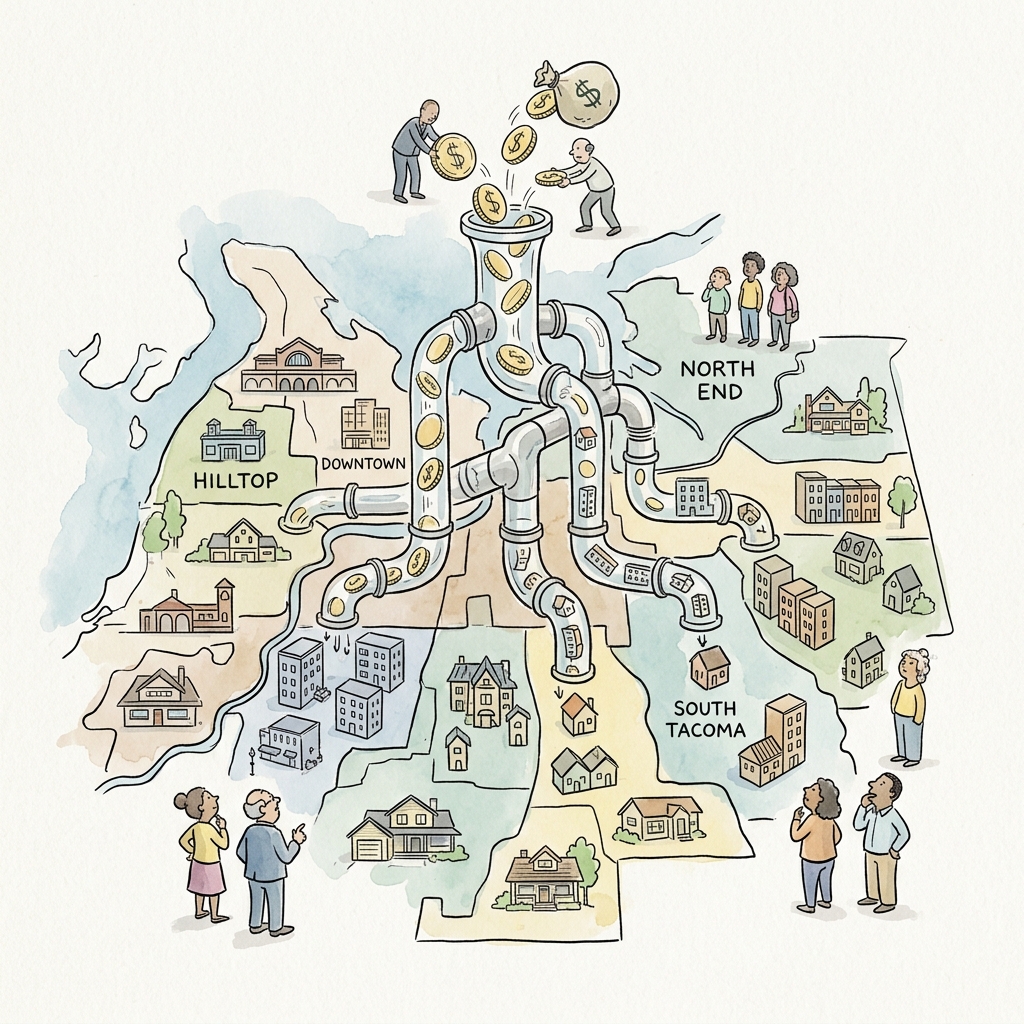
If you want to understand why multifamily construction keeps appearing along Tacoma’s transit corridors, start with four letters: MFTE. The Multi-Family Property Tax Exemption program is the City of Tacoma’s primary tool for incentivizing new housing construction while extracting affordability commitments from developers. And in 2025-2026, it’s the most active part of Tacoma’s housing policy apparatus.
The program works simply: developers who build multifamily housing in designated areas can receive an 8-year or 12-year property tax exemption on the residential improvement value. In exchange for the 12-year option, 20% of units must be affordable at 70% of Pierce County Area Median Income. That’s the trade — foregone tax revenue for guaranteed affordable units that would not otherwise be built at those price points.
2025-2026 Pipeline: Small Projects Dominate, One Major Exception
In 2025, the City approved 13 MFTE projects. The pattern is notable: most were for 20 or fewer units. These are the missing-middle projects — triplexes, sixplexes, small apartment buildings — that urbanists have been calling for and that Tacoma’s zoning reforms have enabled.
The major exception was Koz at Aviva Crossing, which received a 12-year MFTE approval for 226 units. Koz Development has built a business model around co-living and micro-unit formats that pencil at lower rents, and the MFTE makes their financing work in a market where conventional apartment economics are stressed by construction costs and interest rates.
Through March 2026, the City Council has approved four more MFTE projects, with at least two additional proposals in the pipeline, per reporting on Tacoma’s middle housing push. The bulk are taking the 12-year option, which signals that developers see the affordability requirement as workable — not punitive — in Tacoma’s cost environment.
Where the Units Are Going
MFTE projects cluster where you’d expect: along transit corridors, in mixed-use zones, and in neighborhoods where the city has designated growth targets. The Hilltop corridor along MLK Jr. Way, the Stadium District, and the Pacific Avenue corridor between downtown and the Tacoma Dome are the primary zones.
The concentration along the T Line is not coincidental. The MFTE’s designated areas overlap significantly with the city’s transit-oriented development zones, creating a double incentive: tax-exempt housing near fare-free light rail. For a renter earning 70% AMI, that combination — below-market rent plus free transit — represents a meaningful cost-of-living advantage that doesn’t exist in Seattle or most of the Eastside.
The 2025 Program Changes
The City Council passed Substitute Ordinance 29059 on October 8, 2025, with changes taking effect November 7, 2025. The ordinance updated program parameters to reflect current market conditions and policy priorities. The City also maintains a Multi-Family Tax Exempt Projects Dashboard for public tracking of all approved, active, and expired MFTE agreements.
These program adjustments matter because they signal the city’s ongoing commitment to MFTE as a tool. Some cities have let their MFTE programs languish or added requirements that made them financially unworkable. Tacoma has done the opposite — iterating the program to keep it functional in a challenging capital markets environment.
The Statewide Context
Tacoma’s MFTE operates under Washington State enabling legislation (RCW 84.14), which gives cities the authority to offer property tax exemptions for multifamily housing in designated urban centers. The state framework sets the parameters; the city controls the geography, the affordability thresholds, and the implementation details.
Compared to Seattle’s contentious MFTE overhaul, Tacoma’s program operates with less political friction and more developer participation. Part of that is scale — a 20-unit project in Tacoma doesn’t draw the same scrutiny as a 400-unit tower in Capitol Hill. But part of it is also that Tacoma’s housing economics are different. Land costs are lower, construction costs are comparable, and rents are lower. The MFTE fills a narrower gap, which makes it more effective per dollar of foregone revenue.
What Operators Should Watch
The shift toward smaller MFTE projects has implications for the market. These are buildings that local developers and small operators can build — you don’t need institutional capital to deliver a 12-unit building with an MFTE. That democratizes the development pipeline in a way that large-project-only incentive programs don’t.
For investors and operators evaluating Tacoma’s housing market, the MFTE pipeline is the leading indicator. When approvals accelerate, it means developers see the math working. When they slow down, it means either construction costs have outrun rents or capital markets have tightened beyond what the tax exemption can offset. Right now, the pipeline is active and accelerating — which is the strongest signal the market sends.
Frequently Asked Questions
What is Tacoma’s MFTE program?
The Multi-Family Property Tax Exemption is a City of Tacoma program that exempts qualifying multifamily housing projects from property taxes on residential improvement value for 8 or 12 years. In exchange for the 12-year exemption, 20% of units must be affordable at 70% of Pierce County Area Median Income. Details are available on the City of Tacoma’s Housing Division page.
How many MFTE projects were approved in Tacoma in 2025?
In 2025, the City of Tacoma approved 13 MFTE projects. Most were for 20 or fewer units, with the notable exception of Koz at Aviva Crossing, which was approved for 226 units under a 12-year MFTE.
What is the affordability requirement for Tacoma’s MFTE?
For the 12-year MFTE option, 20% of units (distributed across unit types) must be affordable at 70% of Pierce County Area Median Income for the full 12-year exemption period. The 8-year option has no affordability requirement.
Where are MFTE projects being built in Tacoma?
MFTE projects cluster along transit corridors, particularly the T Line light rail route through Hilltop, the Stadium District, and the Pacific Avenue corridor. The city’s designated MFTE areas overlap with transit-oriented development zones.
How does Tacoma’s MFTE compare to Seattle’s?
Tacoma’s MFTE program operates with less political friction and more developer participation than Seattle’s, which underwent a contentious overhaul in 2025. Tacoma’s lower land costs and favorable construction economics make the program more effective per dollar of foregone tax revenue.
Leave a Reply