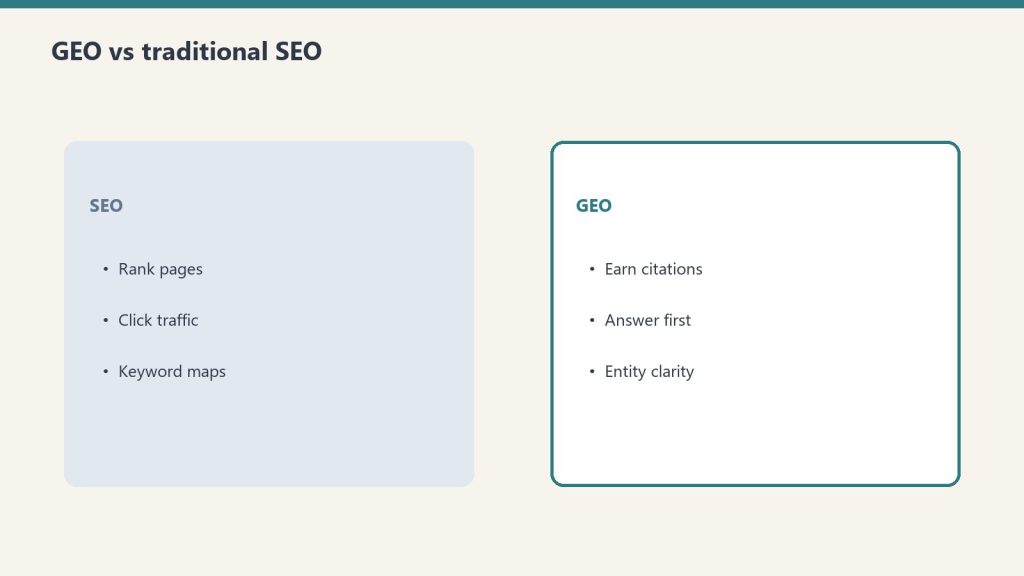
Most “GEO” advice is recycled SEO with the word “AI” pasted on top. This guide is different. It describes what actually happens when Microsoft Copilot, Bing’s AI answers, and Google’s AI Overviews build a response and decide whose page to cite — based on running content sites that get cited tens of thousands of times a month. The short version: AI engines do not cite the page that ranks #1 for a head term. They cite the page that most directly answers the specific sub-question the model is grounding on. That distinction changes everything about what you should write.
How grounding actually works (the part nobody explains)
How grounding actually works.
When you ask Copilot or Bing’s AI a question, the model does not answer from memory. It runs a retrieval step called grounding: it rewrites your question into one or more search queries, fetches a handful of live web results, reads them, and composes an answer with inline citations pointing back at the pages it used. Google’s AI Overviews work the same way with a technique it calls “query fan-out” — one user question becomes many narrower synthetic queries.
Two things follow directly from this mechanism:
The model is not searching for your keyword. It is searching for the answer to a decomposed sub-question. A user who asks “what’s the best way to instantly index a new page” triggers grounding queries like “IndexNow API endpoint”, “submit URL to Bing programmatically”, and “IndexNow key file location”. The page that wins is the one that answers those narrow strings, not the one optimized for “indexing tips”.
Citations are extracted at the passage level, not the page level. The model lifts the specific sentence or table that answers the sub-question. If your answer is buried under 600 words of preamble, it loses to a page that states the fact in the first line under a matching heading.
This is why a niche, specific page routinely out-cites a high-authority generalist. The generalist ranks; the specialist gets quoted.
Why operational and comparison pages win over head terms
Across real citation data, the pages that get pulled into AI answers cluster into three shapes. None of them are “ultimate guide to X”.
1. Operational pages with real commands, configs, and error messages
When someone asks an AI assistant “how do I fix [specific error]” or “what’s the exact command to do X”, the model needs a page that contains the literal command, the literal config, or the literal error string. Generic advice cannot be cited because there is nothing concrete to quote. A page that says:
curl "https://www.bing.com/indexnow?url=https://example.com/new-page/&key=YOUR_KEY"
# 200 = received (not "indexed"), 422 = URL/key mismatch, 429 = too many submits
…is citation gold, because the model can extract that block verbatim and the user can act on it. The error-code annotations matter: questions about failures (“IndexNow 422”, “why am I getting 429”) are high-intent and low-competition, and a page that names the exact codes owns them.
2. Comparison pages (“X vs Y”)
“Which is better, X or Y” is one of the most common shapes of AI query, and comparison content is structurally easy to cite because it maps cleanly to a decision. If you maintain honest, current head-to-head pages, you become the default source the model reaches for when a user is choosing between tools. This is exactly why we keep dedicated comparison pages like Claude Code vs Cursor and Claude Code vs Codex — they answer a decision the model is constantly being asked to make, and a table of differences is trivially quotable.
3. Fresh, dated pages on fast-moving topics
For anything that changes — pricing, model versions, API limits, feature availability — grounding strongly favors recency. The model would rather cite a page dated this month than an “authoritative” page from two years ago that might be wrong. A visible “Last verified” date and a real publish/update timestamp are not decoration; they are a relevance signal the retrieval layer reads.
The losing move is chasing broad head terms. “Best AI coding assistant” is saturated, generic, and rarely the literal grounding query. The winning move is to own the long, specific, operational and comparison strings that the fan-out actually generates.
IndexNow: how to get cited the same day you publish
IndexNow — cited the same day you publish.
Grounding can only cite pages the engine knows about. The bottleneck for new content is crawl latency — and IndexNow collapses it. IndexNow is an open protocol (backed by Microsoft Bing and Yandex) that lets you push a URL to the index the instant you publish, instead of waiting for a crawler to wander by.
Setup is two steps:
Host a key file. Generate a key of 8-128 hex characters and place it at your site root as a UTF-8 text file named {key}.txt containing exactly that key. Example: https://example.com/daa44a2c....txt. This proves you own the host.
A 200 means the endpoint received your URL (not that it is indexed yet). Submitting to api.indexnow.org shares the ping with all participating engines, so you do not need to hit Bing and Yandex separately. Most WordPress SEO plugins (Rank Math, Yoast, SEOPress) have IndexNow built in — turn it on and it fires automatically on every publish and update. The practical payoff: pages can enter Bing’s crawl queue within hours, which means they are eligible to be grounded and cited the same day, not next week.
One caveat worth stating plainly: IndexNow accelerates indexing, which is a precondition for citation. It does not force a citation. You still need the page to be the best answer to the sub-question. But for fresh, time-sensitive content, same-day indexing is often the difference between getting cited while the topic is hot and showing up after the conversation has moved on.
How to actually measure your AI citations
For a long time AI citations were invisible — you could see referral clicks in analytics but not the citations themselves (most AI answers are zero-click). That changed. As of February 2026, Bing Webmaster Tools ships an AI Performance report (public preview) that shows when your pages are cited across Microsoft Copilot, Bing’s AI answers, and partner surfaces. It is the first direct, free window into AI citation behavior, and you should be reading it weekly.
The four metrics that matter:
Total citations — how many times your site was cited as a source in AI answers over the period.
Average cited pages — the daily average count of unique URLs from your site that got referenced. This tells you whether citations are concentrated on one page or spread across the site.
Grounding queries — sample query phrases the AI used to retrieve and cite you. This is the single most actionable field in the report. It is a literal list of the sub-questions you are winning, which tells you exactly which operational/comparison angles to expand next.
Page-level citation activity — citations by URL, so you can see which pages are doing the work.
Two limitations to keep in mind so you read the data honestly: the report does not show click data (you see citations, not visits from them), and it aggregates Copilot with Bing summaries, so you cannot isolate one surface from the other. For Google’s AI Overviews there is still no equivalent citation dashboard — the closest proxy is watching impressions and referral patterns in GA4 and Search Console, plus spot-checking your target queries by hand.
The workflow that works: pull the grounding-queries list, find the patterns, and feed them straight back into your content plan. If you are getting cited for “claude mcp setup” variants, that is a signal to deepen pages like the Claude MCP setup guide and adjacent operational walkthroughs, not to chase a new head term.
A repeatable checklist for citation-optimized pages
Checklist for citation-optimized pages.
Everything above reduces to a build pattern. For any page you want AI engines to cite:
Lead with the answer. Put a short, factual, quotable answer in the first 1-2 sentences under each heading. Assume the model reads only that passage.
Use question-shaped headings. H2s and H3s that mirror real queries (“How does IndexNow work?”, “How do I measure AI citations?”) match the grounding query and give the extractor a clean anchor.
Be specific and operational. Real commands, real config, real numbers, real error codes and fixes. Concrete text is extractable; vague advice is not.
Add a visible FAQ near the end. Plain question/answer pairs are the single most citation-friendly format, because each pair is a self-contained answer to a discrete sub-question. You do not need JSON-LD schema for this to work — visible Q&A text is what the model reads.
Date it and keep it current. A “Last verified” line plus genuine updates on fast-moving topics buys you the recency edge in grounding.
Push it with IndexNow so it is indexable the same day, then watch the AI Performance report to see which sub-questions it wins.
If you want the larger system this fits into — the full toolchain for operating as an AI-first publisher, from MCP servers to publishing pipelines — start with the AI operator’s stack.
FAQ
Do AI engines cite the page that ranks #1 on Google?
Not reliably. AI engines run their own grounding retrieval and cite the page that most directly answers the specific decomposed sub-question, which is often a niche, operational page rather than the head-term winner. Ranking helps your page be discoverable, but the citation goes to whichever passage best answers the exact grounding query.
What is grounding in AI search?
Grounding is the retrieval step where an AI assistant rewrites your question into search queries, fetches live web pages, reads them, and builds an answer with inline citations to those pages. It is why current, specific pages can get cited even by a model whose training data predates them.
Does IndexNow guarantee my page will be cited by AI?
No. IndexNow guarantees fast indexing, which is a precondition for being cited. The page still has to be the best, most specific answer to the sub-question the model is grounding on. Think of IndexNow as removing the crawl-latency excuse, not as buying a citation.
How do I measure how often AI cites my site?
Use the AI Performance report in Bing Webmaster Tools (public preview since February 2026). It shows total citations, average cited pages per day, sample grounding queries, and citation counts by URL across Microsoft Copilot and Bing AI answers. It does not yet show click-through from those citations, and there is no equivalent dashboard for Google AI Overviews.
Do I need JSON-LD or schema markup to get cited?
No. Citation extraction works on visible, well-structured text — question-shaped headings, short factual answers, and a plain visible FAQ. Schema can help search features generally, but it is not required for AI grounding to read and quote your page.
What kind of pages get cited most?
Three shapes dominate: operational pages with real commands, configs, and error fixes; comparison pages that resolve a “X vs Y” decision; and fresh, dated pages on fast-moving topics like pricing and model versions. Broad head-term content tends to get skipped because it rarely matches the literal grounding query and offers nothing concrete to quote.
ChatGPT Search cites 15% of the pages it retrieves. The other 85% get pulled into the model’s context window, evaluated, and silently discarded — no visibility, no referral, no trace. If you are doing GEO work and your pages keep getting retrieved but never quoted, you are losing at the second filter, not the first.
This is the 2026 implementation guide for surviving both filters: getting retrieved by ChatGPT Search, then getting cited once you are there.
How ChatGPT Search Actually Builds an Answer
How ChatGPT Search builds an answer.
ChatGPT Search runs a three-stage pipeline. Each stage kills most candidates.
Retrieval — ChatGPT Search is powered by Bing’s index for real-time web retrieval. Seer Interactive’s analysis found 87% of SearchGPT citations match Bing’s top results, with the bulk in positions one through ten and a long tail in positions eleven through twenty. AirOps research separately put ChatGPT-to-Bing overlap at 73%. If you are not in Bing’s top 20 for a query, you almost certainly are not in ChatGPT’s candidate set.
Crawlability check — OpenAI’s OAI-SearchBot is the user agent that builds the index used for ChatGPT’s search features. It is separate from GPTBot (training) and ChatGPT-User (browsing). Block OAI-SearchBot in robots.txt and you remove yourself from ChatGPT Search entirely, even if Bing has you ranked.
Citation selection — Of the pages retrieved, AirOps found ChatGPT cites only 15%. The model picks what to quote based on structure, freshness, authority signals, and whether the page directly answers the query.
Step 1: Verify You Are Indexed by Bing
Most sites optimized for Google have never logged into Bing Webmaster Tools. Fix that first. Three checks before anything else:
site:yourdomain.com in Bing — confirms basic indexing.
Bing Webmaster Tools → URL Inspection — confirms the specific pages you want cited are indexed and have no crawl errors.
Bing rankings for your target queries — if you are not in the top 20 in Bing, ChatGPT will not see you.
If pages are missing, submit a sitemap via Bing Webmaster Tools and request URL inspection on any priority page. Bing typically reflects changes within 24–72 hours, faster than Google.
Step 2: Allow OAI-SearchBot in robots.txt
Allow OAI-SearchBot in robots.txt.
The single most-skipped step in GEO work. Add this block to your robots.txt:
# Allow ChatGPT Search to retrieve and cite this site
User-agent: OAI-SearchBot
Allow: /

# Optional: allow on-demand browsing for ChatGPT users
User-agent: ChatGPT-User
Allow: /

# Optional: block training crawler if you want retrieval without training
User-agent: GPTBot
Disallow: /
OpenAI publishes these three user agents and treats each independently. You can allow OAI-SearchBot for ChatGPT Search visibility and still disallow GPTBot from using your content for model training. The settings do not conflict. OpenAI’s systems typically recognize robots.txt changes within 24 hours.
Step 3: Structure Pages for the Citation Filter
Structure pages for the citation filter.
Retrieval is necessary but not sufficient. Once your page is in the candidate set, the model decides whether to quote it. Pages that get quoted share a structural pattern.
Direct answers in the first 100 words
ChatGPT cites sources that answer the question fully. Partial answers lose to complete ones. Lead each page with a clean direct-answer paragraph: question implied or stated, answer in the next sentence, supporting detail after. This is the same pattern that wins featured snippets, which is not a coincidence — answer engines and snippet engines reward the same structure.
JSON-LD schema
An AirOps study of 548,534 pages found pages with JSON-LD markup posted a 38.5% citation rate versus 32.0% without it. Article, FAQPage, and HowTo schema are the highest-leverage types. Add them.
Word count: 500–2,000
Pages between 500 and 2,000 words performed best in the same AirOps study. Pages longer than 5,000 words were cited less often than pages under 500. The mechanism is mechanical: long pages overflow the retrieval context window, and the model defaults to shorter, denser sources it can quote in full.
Freshness
Content updated within 30 days received 3.2x more citations than older material. The fix is not faked freshness — it is genuine updates: a new stat, a new case, a corrected claim. Update the date when you update the content, not before.
Step 4: Build the Authority Layer
Structure gets you cited once. Authority gets you cited repeatedly. AirOps found sites with over 32,000 referring domains are 3.5x more likely to be cited by ChatGPT than sites with fewer than 200. You do not need 32,000 — you need to be in the upper band of your topical neighborhood.
ChatGPT’s citation pattern leans heavily on Wikipedia (roughly 48% of top citations in multiple studies) and large news/media properties. The practitioner read on that: ChatGPT favors sources with multi-source third-party validation. Build the kind of citations on the open web that Wikipedia editors accept — peer-reviewed studies, primary sources, named author attribution, transparent methodology.
Step 5: Track Your Citation Footprint
You cannot manage what you do not measure. The minimum tracking stack for 2026:
Server log monitoring for OAI-SearchBot user agent — confirms OpenAI is actually crawling. If you allowed the bot in robots.txt three weeks ago and there are zero OAI-SearchBot hits in your logs, something is wrong (CDN block, IP firewall, misconfigured allow rule).
Manual citation audits — pick 10 priority queries, run them in ChatGPT with the Search toggle on, log which domains get cited. Repeat weekly. A spreadsheet beats no tracking.
Bing position tracking — because ChatGPT pulls from the Bing index, Bing rankings are a leading indicator. If your Bing position drops, ChatGPT visibility drops behind it.
The Practitioner Summary
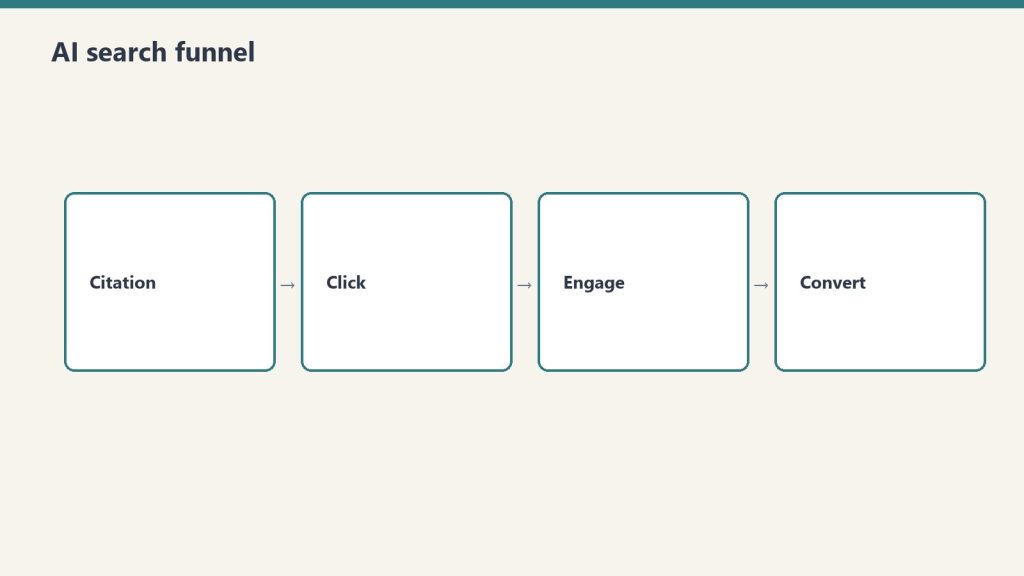
Ranking in ChatGPT in 2026 is not mysterious. It is a four-gate funnel: Bing index → OAI-SearchBot crawl access → retrieval into the candidate set → citation selection. Most sites fail at gate one (not indexed in Bing) or gate two (OAI-SearchBot blocked or not addressed). Sites that clear those two gates and write pages that answer the question fully, with schema and a 500–2,000-word range, will land in the 15% that get quoted.
Treat ChatGPT Search like a separate search engine that happens to share an index with Bing. Optimize for the index. Allow the crawler. Write the page. The rest follows.
You shipped an llms.txt file. You curated the links, you paired it with robots.txt, you validated the format. Now answer the only question that matters: is anything actually requesting it? Most site owners never check — and the data from 2026 suggests the honest answer, for most domains, is “almost nothing.” This is the verification step that turns llms.txt from an act of faith into a measurable signal. Here is how to read your own server logs and find out exactly what is fetching the file you published.
Why verification matters more than the file itself
Why verification matters more than the file itself.
The uncomfortable finding of the last year is that publishing llms.txt and benefiting from llms.txt are two different things. In OtterlyAI’s 90-day crawler study, only 0.1% of AI crawler requests touched /llms.txt at all — 84 requests out of 62,100 total AI bot visits — and the file received far fewer visits than the average content page (OtterlyAI GEO study). As of Q1 2026, no major AI company — OpenAI, Google, Anthropic, Meta, or Mistral — has publicly committed to reading or acting on llms.txt in production systems, though GPTBot does fetch the file occasionally (AEO Engine).
That does not make the file worthless. It makes measurement the whole game. If you cannot tell whether a crawler ever requested the file, you cannot tell whether your time was wasted, whether a platform quietly started honoring it, or whether your file is returning a silent 404. Verification is the difference between strategy and superstition.
The five-minute server-log check
Five-minute server-log check.
Every fetch of your llms.txt file leaves a row in your access log. The job is to isolate requests to that path, then filter by the user-agents that belong to AI systems. On any server with standard combined-format Apache or Nginx logs, this one-liner does the first pass:
The first grep narrows to requests for llms.txt or llms-full.txt. The second filters to the known AI crawler user-agent strings documented across 2026 reference work (No Hacks AI User-Agent Landscape 2026; Momentic crawler list). Each surviving line tells you three things: which bot, what time, and the HTTP status code it received.
That status code is the part people skip. A 200 means the bot got your file. A 404 means you have been congratulating yourself over a file the crawler never actually reached — a misconfigured path, a redirect loop, or a build step that drops the file on deploy. A 301 or 302 means it is being redirected, and not every crawler follows redirects for this path. Read the status column before you read anything else.
Turn the raw hits into a monthly cadence table
One grep tells you whether the file is reachable. To know whether anything is changing, you need the same query run on a schedule and counted by bot. Extend the pipeline to a count:
This produces a leaderboard of which AI user-agents requested your llms.txt across all retained logs. Capture that number on the first of each month and you have a cadence series. The signal you are watching for is not the absolute count — it will be small — but the direction: a bot that appears for the first time, a bot whose hit count jumps, or a bot that goes silent. Those inflection points are the leading indicators that a platform has changed how it treats the file.
What you see in the log
What it means
Action
No requests to /llms.txt at all
File may be unreachable, or simply not yet fetched — both are common
Request the URL yourself; confirm a clean 200 before assuming neglect
200 from GPTBot, low frequency
Consistent with reported behavior — GPTBot fetches occasionally
Log the cadence; treat as baseline, not a ranking signal
404 or 301 on the path
Crawler is not getting the file you think you published
Fix the path/redirect today — this is a silent failure
A new bot appears month-over-month
A platform may have started fetching the file
Note the date; correlate with any citation or referral changes
Cross-check against your content fetches
The llms.txt hit count means little in isolation. Compare it against how often the same bots fetch your actual content pages. If GPTBot pulls forty content URLs a day and never touches llms.txt, the file is not part of how that crawler discovers you — your content’s own structure and internal linking are doing the work. The practical monitoring approach documented for 2026 is exactly this: a server-log dashboard built against the major user-agents, watching cadence and path-preference shifts month over month (Digital Applied 30-day log study). The same study notes distinct personalities worth knowing — GPTBot crawls more aggressively than most assume, ClaudeBot is more patient than its volume suggests, and PerplexityBot is quieter than its share-of-voice would predict.
What to do with the answer
What to do with the answer.
If your logs show the file is reachable and occasionally fetched, you are in the normal range for 2026 — keep the file current and keep measuring. If they show a 404, you found a real bug that no amount of curation would have fixed. And if they show a brand-new bot starting to request the path, you have spotted a platform behavior change before the blog posts catch up to it. That last case is the entire payoff: the practitioners who read their own logs will know the standard started mattering weeks before the ones who only read about it. Verification is not the boring final step of an llms.txt rollout. On a standard that nobody has formally committed to honoring yet, it is the only step that produces evidence instead of hope.
The unit of generative engine optimization is the chunk, not the page
The unit of GEO is the chunk, not the page.
Most generative engine optimization advice still reads like SEO advice with new vocabulary. Add statistics. Build entities. Earn mentions. All true, all incomplete. The mechanic that determines whether ChatGPT, Perplexity, or Google AI Overviews quote your page in an answer is not the page. It is the chunk — the 200- to 500-character passage the retrieval layer pulled out of your page, scored against the user’s prompt, and handed to the language model as evidence.
If your paragraphs do not survive that extraction step intact, the rest of your GEO program is academic. This is the implementation gap most content teams have not closed yet, and it is the highest-leverage shift you can make in Q2 2026.
What the retrieval layer actually does
When a user asks Perplexity or ChatGPT a question, the system runs a process best described as query fan-out and chunked retrieval-augmented generation (RAG). The prompt is decomposed into sub-queries. Each sub-query is sent to a search index (Bing for ChatGPT, a proprietary index plus partner search for Perplexity, Google’s own corpus for AI Overviews). Top-ranking pages are fetched, broken into chunks, and re-scored against the original prompt for semantic match, factual density, source authority, and recency.
The model then composes its answer from the three to seven highest-scoring chunks across all retrieved pages. The visible citations are the source pages those winning chunks came from. Your page can rank well in the underlying search index and still produce no chunks that score high enough to enter the answer. That is the silent failure mode in GEO right now: traffic-tier visibility, zero citation share.
What a chunk-optimized paragraph looks like
What a chunk-optimized paragraph looks like.
The optimization target is a paragraph that reads as a self-contained answer when removed from the page around it. No pronouns referring back to a previous heading. No “as we discussed above.” No buried lede. The first sentence is the claim. The second through fifth sentences supply the supporting fact, the qualifier, and the source if one is needed.
Concretely, here is the same answer written two ways. The first will not survive extraction. The second will.
Will not chunk well:
As we covered earlier in this post, the answer depends on what you are trying to measure. It is more nuanced than most people assume. There are several factors at play, including the ones we mentioned in the introduction.
Will chunk well:
LLMs.txt is a plain-text file at the root of a domain that points AI crawlers to the most authoritative Markdown versions of a site’s documentation. The file format was proposed by Jeremy Howard in September 2024 and has seen adoption signals from major AI vendors through 2025 and into 2026. A minimal valid file is twelve lines and takes under ten minutes to deploy.
The second version has a definition, a provenance fact, an adoption signal, and a deployment qualifier — four extractable units in three sentences. A retrieval system scoring chunks for “what is llms.txt” will rank this passage higher than a longer paragraph that buries the same facts under hedging language.
The five rules that produce chunk-survivable paragraphs
These rules come from observing what actually appears in Perplexity citations, ChatGPT browsing answers, and AI Overview extractions across hundreds of cited passages. They are mechanical. Apply them in revision passes, not at first draft.
1. One claim per paragraph. Multi-claim paragraphs lose to single-claim paragraphs because the retriever cannot score them as cleanly against a specific sub-query. If you have three claims, write three paragraphs.
2. Front-load the noun and the verb. The first eight words of the paragraph determine semantic match. “Generative engine optimization is…” beats “When thinking about how to approach modern search, generative engine optimization is…” every time.
3. Resolve every pronoun within the paragraph. If a paragraph says “it” or “this” without naming the antecedent inside the same paragraph, the chunk reads as orphaned to the retriever and gets discounted.
4. Keep paragraphs between forty and one hundred twenty words. Shorter paragraphs lack the factual density that scores well. Longer paragraphs get truncated mid-thought, which destroys the chunk. The forty-to-one-twenty band is where modern retrievers operate cleanly.
5. Put the source inline. “Princeton research published in 2023 found a 30 to 40 percent visibility lift from adding statistics and citations” outperforms the same fact with a footnote, because the retriever sees the authority signal in the same chunk as the claim.
A revision protocol you can run today
Revision protocol you can run today.
For any page already ranking in the top twenty for a target query, run this three-step pass before chasing new content.
Step one: Print the article. Cover all headings. Read each paragraph in isolation. Mark any paragraph that does not answer a specific question on its own. That mark is your rewrite list.
Step two: For each marked paragraph, identify the implicit question it is trying to answer. Rewrite the first sentence to state the answer. Move supporting context into sentences two through four. Cut anything past sentence five into a new paragraph.
Step three: Add one inline source per claim that involves a number, a date, or a contested fact. Inline means “according to Anthropic’s official documentation,” not a hyperlinked footnote at the end of a sentence.
A site with eighty published pages can complete this pass in four to six weeks at one editor’s pace. The lift typically shows in AI referral traffic in GA4 — under Acquisition, Traffic Acquisition, with a manual segment for sessions where the source contains “chatgpt,” “perplexity,” “claude,” “copilot,” or “gemini” — within three to five weeks of the changes going live, because retrieval indexes refresh on independent cycles from Google’s main crawl.
Why this beats writing more content
New content takes weeks to be indexed by the underlying search layer and additional weeks before the retrieval scoring stabilizes. Rewritten paragraphs on already-indexed pages start scoring against retrieval queries the next time the page is recrawled, typically within days. The compound effect of converting forty already-ranking pages into chunk-optimized pages is larger and faster than the effect of publishing forty new pages.
This is the GEO discipline that separates teams who say they are doing generative engine optimization from teams whose names appear in actual AI answers. The unit of work is the paragraph. The test is whether the paragraph survives extraction. Everything else — entity binding, schema, llms.txt, brand co-occurrence — sits on top of that foundation.
What is the ideal chunk length for GEO?
Modern retrievers extract chunks in the 200 to 500 character range, which corresponds to paragraphs of roughly 40 to 120 words. Paragraphs in this band give retrievers enough context to score factual density without losing the chunk to mid-paragraph truncation.
How is chunk-first GEO different from entity optimization?
Entity optimization tells the AI system who you are. Chunk-first writing tells the AI system what to quote. The two operate on different surfaces and are complementary. Entity work without chunk-survivable paragraphs leaves you recognized but unquoted.
Do headings matter for chunk extraction?
Headings help retrievers segment the document and improve the score of the paragraph immediately below the heading. The heading-then-clear-paragraph pattern is the strongest GEO structure currently observable in AI Overview citations.
How do I measure whether my chunks are getting cited?
Track AI referral sessions in GA4 with a segment filtering for source contains chatgpt, perplexity, claude, copilot, or gemini. Pair that with prompt-set testing in tools that query multiple LLMs with your target queries and parse the cited URLs from the responses.
Will Google penalize chunk-optimized writing?
Chunk-optimized paragraphs read as cleanly written, source-attributed prose. The same structural rules that help retrieval scoring also help featured snippet capture and traditional on-page SEO. There is no documented penalty signal and the structure is consistent with Google’s own quality rater guidelines on clear, useful writing.
The LLMs.txt file was supposed to be the AI-era equivalent of robots.txt — a clean, declarative way to hand large language models a curated map of your most valuable content. Three years after Jeremy Howard proposed the spec, the data is in. And the data is not what implementation evangelists have been promising.
This is a case study teardown of the three largest independent measurement efforts on LLMs.txt adoption and citation impact, the one documented recovery case where it did move the needle, and the structural lesson every practitioner should pull from the divergence.
The 300,000-Domain Study That Reset the Conversation
The 300k-domain study that reset the conversation.
A widely circulated dataset of nearly 300,000 domains — analyzed across multiple AI search citation benchmarks and reported by Search Engine Journal — found no statistically significant relationship between implementing LLMs.txt and how often AI engines cite a brand. Both standard statistical analysis and machine-learning models showed no effect. Removing LLMs.txt as a feature actually improved citation prediction accuracy in one model run, meaning the file’s presence was less than noise.
Adoption sits at roughly 10.13% of domains in that dataset, distributed evenly across traffic tiers. Translation: it is neither standard practice nor a differentiator.
A separate bot-traffic audit reported by adoption researchers found that out of 62,100-plus AI bot visits over a 90-day window, only 84 requests targeted the /llms.txt path. Across half a billion LLM bot traffic events analyzed in another dataset — filtering for the agents that actually drive citations (GPTBot, ClaudeBot, PerplexityBot, OAI-SearchBot, Google-Extended) — the share of requests touching /llms.txt was statistically negligible.
The Vendor Reality Behind the Numbers
As of Q1 2026, no major AI company — OpenAI, Google, Anthropic, Meta, or Mistral — has publicly committed to reading or acting on LLMs.txt in production systems. The file is a community proposal, not a supported standard. AI language models learn what to trust from the web as it existed during training. Citation behavior reflects which sources appeared consistently in training corpora, which were cited by other credible sources, and which had claims independently corroborated. A crawl-directive file published after training cannot retroactively change any of that.
The Recovery Case That Actually Moved Traffic
Compare that to a documented recovery case reported by SEO Algorithm Recovery and corroborated by independent AI Overviews tracking: a Dallas retailer lost 72% of organic traffic to AI Overviews. Their agency deployed schema markup and restructured 150 pages around answer-first formatting. Traffic recovered to 118% of pre-AI Overview levels in 120 days, with $1.4M in revenue growth attributed to the recovered organic channel.
No LLMs.txt was involved. The intervention stack was schema markup, content restructuring for AI-extractable answers, and entity disambiguation in headings. Schema markup alone has been reported to recover 45%-plus of lost AI Overview traffic in case-study compilations across the recovery agency space.
The Structural Lesson
The structural lesson from llms.txt.
The contrast is the case study. LLMs.txt is a static directive file that AI crawlers do not currently read at scale. Schema markup is a structured-data layer that AI systems already parse to construct answer panels and citation surfaces. One is aspirational. The other is operational.
The structural pattern under every documented AI-search recovery in 2026 is the same: answer-first content directly under each H2, structured data on the entity being described, tables for comparison data, and explicit source attribution inline. Sites earning AI citations report traffic gains. Brands with strong authority signals benefit from the halo effect. Companies adapting these specific structural interventions early — not the file directives — are the ones reporting growth exceeding pre-AI Overview levels.
A Minimum-Viable LLMs.txt Anyway
A minimum-viable llms.txt anyway.
The skeptical case is not “skip LLMs.txt entirely.” It is “do not let it absorb hours that should go to schema and content restructuring.” A minimum-viable LLMs.txt is ten lines and takes ten minutes to ship:
# Your Brand Name

> One-sentence description of what your site is and who it serves.

## Core Pages
- [About](https://yoursite.com/about): Who you are, in one paragraph.
- [Products](https://yoursite.com/products): What you sell, structured.
- [Pricing](https://yoursite.com/pricing): Numbers, plans, comparison.

## Documentation
- [Getting Started](https://yoursite.com/docs/start): The 5-step onboarding.
- [API Reference](https://yoursite.com/docs/api): Full method index.
Ship it. Stop tuning it. Then spend the rest of the week on schema and answer-first H2 restructuring, which is where the recovery cases are actually being won.
The Practitioner Takeaway
When two independent measurement methodologies across 300,000-plus domains agree that an optimization has no measurable effect on the outcome it is sold to improve, the rational move is to stop selling it as a primary intervention. Treat LLMs.txt as future-proofing insurance with a ten-minute implementation cost. Treat schema, entity binding, and answer-first content structure as the actual lever. The recovery cases that crossed pre-AI Overview revenue did the second set of things. The Search Engine Land-reported audit where 8 of 9 sites saw no measurable change after implementation did the first.
Independent studies across approximately 300,000 domains have found no statistically significant relationship between LLMs.txt presence and AI citation frequency. Major AI vendors have not publicly committed to reading the file in production. Implement it as low-cost future-proofing, not as a primary citation strategy.
What actually recovers traffic lost to AI Overviews?
Documented recovery cases share a consistent intervention pattern: schema markup deployment, content restructuring with answer-first formatting directly under each H2, entity disambiguation, and inline source attribution. One published case showed 118% recovery of pre-AI Overview traffic in 120 days using this stack.
What is the minimum-viable LLMs.txt?
Ten lines: an H1 with your brand name, a blockquote with one-sentence site description, and grouped H2 sections listing your core pages and documentation with one-line summaries. Ship it once, do not over-tune it.
Which AI bot user agents matter for citation visibility?
The user agents that drive AI citations include GPTBot, ClaudeBot, PerplexityBot, OAI-SearchBot, and Google-Extended. These are the crawlers whose access determines whether your content surfaces in AI answer panels.
If LLMs.txt does not work, why is everyone implementing it?
Three reasons: it is genuinely cheap to ship, it signals to clients that you are paying attention to AI search, and there is a non-zero chance AI vendors adopt it in the future. None of those reasons justify it being your primary AI-search intervention in 2026.
Sources: Search Engine Journal’s coverage of the 300,000-domain LLMs.txt citation study; SEO Algorithm Recovery’s documented AI Overviews recovery case study; published bot traffic audits from Authority Tech and Generix Marketing on LLMs.txt request rates; recovery-stack analysis aggregated from BlankBoard Studio, Stackmatix, and Mersel AI’s 2026 AI Overviews recovery compilations.
If you have run a GEO campaign for any length of time, you already know the measurement problem: there is no Search Console for ChatGPT, no Performance report for Perplexity, and the analytics you do have leak roughly a third of the traffic into Direct. LLM visibility is real, the buyers are real, but the dashboards that prove it exist have to be assembled from at least three different layers. This is the stack we use for client work in 2026 — what each layer measures, what it costs, and the regex you need to make it work.
What “LLM visibility” actually means
What LLM visibility actually means.
LLM visibility is the percentage of relevant AI-generated answers in which your brand, content, or experts appear. It is not the same as ranking, because answers do not have ranks — they have presence or absence. A useful operational definition borrowed from the practitioner community: track a fixed list of prompts that represent buyer intent for your category, run them across a fixed list of models on a recurring cadence, and count two things. First, mention rate — what percent of responses name you at all. Second, citation rate — what percent of responses include a clickable link back to your domain. Those two numbers are the foundation of every dashboard worth building.
The three measurement layers
The three measurement layers.
No single tool gives you the full picture, so build the stack in three layers and treat them as complementary.
Layer one — Visibility tracking. Are you in the answer? This is the prompt-monitoring layer. You pick 50 to 200 prompts that a real buyer would type into ChatGPT, Perplexity, Gemini, Copilot, or Claude, then a tool re-runs them on a schedule and parses the responses for your brand and your competitors. This is the only layer that can prove a GEO campaign is working before any clicks happen.
Layer two — Referral analytics. When an AI answer does include a link and a user clicks it, does it show up in GA4? In May 2026 Google added a native “AI Assistant” channel to the GA4 Default Channel Group, which assigns the medium value ai-assistant to recognized referrers and groups those sessions automatically. That is a major improvement, but the underlying problem has not gone away: mobile apps and in-app browsers for ChatGPT, Claude, and Perplexity strip referrer headers, so a meaningful portion of AI-originated visits still arrive as Direct. Practitioner estimates put clean-referrer coverage somewhere in the 60 to 80 percent range depending on the model and the platform mix.
Layer three — Proxy signals. Branded search volume, direct traffic on long-tail URLs that have no other discovery path, self-reported attribution in lead forms, and CRM “how did you hear about us” data. None of these are clean, but together they sanity-check the first two layers and catch the AI traffic that the referrer pipeline lost.
The GA4 channel-group regex
Even with the native AI Assistant channel in place, you still want a custom channel group for granular per-platform reporting and for any property where the new default has not propagated yet. Create one under Admin → Data Display → Channel Groups and put it above Referral in the rule order — GA4 applies rules top-down and Referral will swallow the visit if it gets there first.
Match against the source dimension with this pattern:
That is the full set of recognized referrers as of the May 2026 Google update. For agency reporting we split this into one channel per platform rather than a single “AI” bucket, because the engagement profile is genuinely different — Perplexity sessions tend to behave like high-intent research traffic, while ChatGPT sessions skew more exploratory.
What the tools actually do — and what they cost
The visibility-tracking market in 2026 has consolidated into a recognizable shape. Here is the practitioner read on the four tools most likely to come up in a procurement conversation.
Profound. Tracks coverage across ChatGPT, Gemini, Google AI Overviews, Google AI Mode, Perplexity, Claude, Copilot, Grok, and DeepSeek. The Lite tier starts at $499/month per Profound’s published pricing. This is the enterprise-default option — broadest model coverage, mature competitive view, the price tag to match.
Semrush AI Toolkit. Tracks Google AI Overviews, Google AI Mode, Perplexity, ChatGPT, and Gemini. Available standalone at $99/month per domain or bundled inside Semrush One starting at $199/month. Strong choice if you already run Semrush — the prompt monitoring lives next to your traditional keyword reports.
Otterly. Tracks share of voice across ChatGPT, Google AI Overviews, Perplexity, and Copilot, with AI Mode and Gemini as add-ons. Starts at $29/month on the Lite plan, which makes it the cheapest serious on-ramp in the category. Best for solo operators and small in-house teams that need a real share-of-voice number without a five-figure annual commitment.
SE Ranking AI Visibility Tracker. Bundled inside SE Ranking’s existing SEO platform. Good fit for SE Ranking users; not a category leader for AI alone.
For a single client account we typically run Otterly for the day-to-day share-of-voice number and add Profound when the scope justifies the spend — usually when the client has more than three competitors they care about benchmarking against.
A minimal measurement framework you can ship this week
A minimal measurement framework you can ship this week.
Build it in this order. None of the steps require a tool purchase to begin.
Write your prompt list. Fifty prompts that a buyer in your category would actually type. Mix top-of-funnel (“what is X”), comparison (“X vs Y”), and bottom-of-funnel (“best X for Y”) in roughly equal thirds.
Establish a baseline manually. Run every prompt in ChatGPT, Perplexity, and Gemini once. Record: did the response mention you, did it cite you, who was cited instead. This becomes the zero-point for the campaign.
Configure GA4. Create the AI custom channel group with the regex above and place it above Referral. Verify the native AI Assistant channel is populated on the property.
Set the cadence. Monthly for the manual re-run if you are unfunded. Weekly automated tracking the moment Otterly or equivalent is in the stack.
Report two numbers. Mention rate and citation rate, broken down by model. Everything else is secondary.
The honest limitation
Every tool in this category is sampling. They re-run your prompts on their own infrastructure, not on the model instance a real user hits. The same prompt run twice in ChatGPT in the same hour can return different brand mentions because of retrieval variance and the freshness of the model’s web index. Treat any single-day number as noise and any 30-day trend as signal. The teams that get this right report on rolling four-week windows, not daily deltas.
Where to spend next
Once the measurement stack is live, the next dollar belongs in two places: the content updates that show up in your low-mention-rate prompts, and an LLMs.txt file if you don’t have one yet. Measurement without an action loop is a dashboard, not a campaign. The point of knowing your citation rate is to move it.
What is LLM visibility?
LLM visibility is the percentage of relevant AI-generated answers — across ChatGPT, Perplexity, Gemini, Copilot, and Claude — in which your brand, content, or experts are mentioned or cited. It is measured by running a fixed prompt list on a recurring cadence and counting mention rate and citation rate.
How do I track AI traffic in Google Analytics 4?
GA4 added a native “AI Assistant” channel to the Default Channel Group in May 2026 that automatically groups sessions from recognized AI referrers. For per-platform reporting, also create a custom channel group under Admin → Data Display → Channel Groups, place it above Referral, and match the source dimension against the regex of known AI domains.
What is the cheapest LLM visibility tool?
Otterly is the lowest-priced serious option at $29/month on its Lite plan, with coverage of ChatGPT, Google AI Overviews, Perplexity, and Copilot. It is the recommended starting point for solo operators and small in-house teams.
Why does AI referral traffic show up as Direct in GA4?
Mobile apps and in-app browsers for ChatGPT, Claude, and Perplexity often strip the referrer header when a user clicks an outbound link. Without a referrer, GA4 cannot identify the source and classifies the session as Direct. Industry estimates put clean-referrer coverage at 60 to 80 percent of true AI-originated traffic.
How often should I measure GEO performance?
Report on rolling four-week windows, not daily deltas. The same prompt run twice in the same hour can return different brand mentions because of retrieval variance, so single-day numbers are noise. Weekly automated tracking with monthly reporting is the practitioner standard.
This is a working theory, not a finished one. It proposes a specific reframing of how solo operators and small agencies should be using large language models day-to-day, names the failure mode of the current dominant approach, and lays out the experiments that would prove or disprove the central claim. The piece is published here so it can be referenced, tested against, and revised in public as the evidence comes in. If the claim is wrong, the next version of this article will say so.
The Claim, in One Sentence
The claim, in one sentence.
For solo operators and small agencies working with large language models, the dominant mental model — build a knowledge base, feed it to the model, ask questions of the document — is correct for a narrow class of work and wasteful or counterproductive for a much larger class, and the work most operators are doing fits the larger class.
A better mental model for that larger class is what this piece will call Elicitation Over Extraction: the assumption that the model already contains the relevant knowledge as latent capability, and that the operator’s job is to activate the right region of that latent capability with precise, compact prompts rather than to ship the knowledge into the context window through document retrieval. Knowledge stays in training. The work shifts to activation.
This is not a new idea in the AI research literature. It is, however, almost entirely absent from how operators are currently building their personal AI workflows. The gap between what the research suggests is possible and what the operator-tooling ecosystem is building toward is the gap this piece is trying to name and close.
Where the Current Dominant Pattern Comes From
The current dominant pattern in operator-side AI tooling is retrieval-augmented generation, or RAG. The pattern is straightforward. An operator builds a knowledge base — pages in Notion, files in Drive, articles in a vector database, transcripts of YouTube videos, customer support tickets, whatever the operator’s domain produces. When a question is asked of the model, a retrieval system finds the most relevant chunks of that knowledge base, packs them into the model’s context window, and asks the model to answer using that retrieved material as grounding.
The pattern works. For certain shapes of problem, it works very well. It is the right architecture when the operator’s question depends on information that is genuinely outside the model’s training data — proprietary documents, current events that postdate the training cutoff, client-specific details that no public source contains, internal organizational knowledge that exists nowhere on the open internet. For that shape of problem, RAG is not optional. It is the only honest way to get accurate answers, because the alternative is the model inventing details about things it has no real knowledge of.
The pattern has also been heavily promoted by the AI-tooling industry for reasons that have only loosely to do with whether it is the right pattern for any specific operator. Vector databases, retrieval pipelines, document-loading frameworks, embedding services, and knowledge-base products all exist because RAG creates demand for them. The narrative that every operator needs a knowledge base, that every workflow benefits from document retrieval, that the path to better AI work runs through better document organization — that narrative is commercially convenient for the vendors selling the components. It is also half true, which is the worst kind of half true, because the part that is true gets used to justify the part that isn’t.
The part that is true: when the model lacks the specific knowledge needed for the task, retrieval helps. The part that isn’t: when the model already has the knowledge, retrieval is at best redundant and at worst actively degrades the response. The middle case — when the model has the general knowledge but lacks the specific framing, voice, or activation — is the case the operator ecosystem has not figured out how to name or handle, and it is also the case most operators are actually in for most of their work.
The Specific Failure Mode
The specific failure mode of extraction.
Picture an operator who wants to write content in the voice of a particular thinker — call this thinker Senior Operator-Investor, someone who has been writing publicly for twenty years and whose work is heavily represented in the model’s training data. The operator’s default move, under the RAG pattern, is to collect transcripts of that thinker’s podcasts and YouTube videos, structure them in a knowledge base, and feed them to the model along with the question.
What actually happens when the operator does this is the following. The 20,000-token transcript dump enters the model’s context window. The model attends to that transcript on every generation step, scanning for relevant passages, weighing them against the question being asked. This is computationally expensive, slow, and noisy — most of the transcript is irrelevant to any specific question. The model also already knew this thinker’s voice from training. The transcript is mostly redundant with patterns the model can already produce from its weights. The operator is paying tokens to remind the model of things the model knows.
The more efficient version is to write a 200-token activation prompt: a careful description of the thinker’s voice, their characteristic moves, their temperament, and a few canonical reference points. That prompt activates the same region of the model’s latent space that the 20,000-token transcript was trying to activate, at one one-hundredth the token cost, with less attentional noise, and with output that is often qualitatively better because the model is not being pulled in inconsistent directions by tangentially relevant transcript passages.
The 100x token reduction is not theoretical. It is what happens in practice when prompts are designed for activation rather than information transfer. The reduction is also not the most important benefit. The more important benefit is that the operator stops doing knowledge-engineering work that is duplicative with the training the model has already received, and starts doing the work that is actually distinctive: designing the activation patterns themselves.
The failure mode of the current dominant pattern is that operators are spending their time on the wrong layer. They are building warehouses when they should be building switchboards. The warehouse holds information the model already has. The switchboard turns on specific patterns of cognition that the model can already produce but does not produce by default.
What the Research Literature Says
There is a real body of research on what is called persona prompting, role conditioning, and activation steering. The findings are nuanced and they refine the claim above in ways worth knowing.
Persona prompting does change model output. The effect is measurable and consistent across many tasks. The voice, style, and reasoning approach of the model can be meaningfully shifted by a few hundred well-chosen tokens at the start of a prompt. This part of the picture confirms the central intuition of Elicitation Over Extraction: latent capability is real, activation prompts can reach it, and the activation work is meaningful work.
But the same research literature surfaces an important caveat that the strong version of the claim has to address. Persona prompting consistently helps with style, voice, clarity, and tone — the things one might call the surface texture of generation. It is less consistent, and sometimes actively harmful, on tasks that depend on precise factual recall, multi-step logical reasoning, or strict accuracy on benchmarked knowledge. In some studies, telling a model to “act like an expert” on a factual recall task decreased accuracy compared to no persona at all. The model became so focused on performing expertise that it stopped retrieving its underlying knowledge cleanly.
This is important and it changes the shape of the claim. Elicitation Over Extraction is not a universal replacement for RAG. It is the right approach for tasks where what the operator needs from the model is voice, framing, judgment, or pattern-matching against a thinker’s known mode. It is the wrong approach — and may be worse than neutral — for tasks that depend on precise factual recall of specific data points.
The honest version of the claim, then, is something like the following. Operator work falls into at least three different shapes. The first shape is “I need the model to produce content in a specific voice or style” — activation prompts dominate, RAG is wasteful. The second shape is “I need the model to retrieve specific facts from a corpus the model has not seen” — RAG dominates, activation prompts are insufficient. The third shape is “I need the model to apply judgment to information I am providing” — both layers matter, with activation handling the judgment and retrieval handling the information.
Most operators are running shape one and shape three workflows but using shape two tooling. That mismatch is the source of the inefficiency. The fix is not to abandon retrieval. The fix is to know which shape any given workflow is and use the right layer for that shape.
Why This Is Not Obvious
Why this is not obvious.
If the distinction is real and well-documented in research, the question is why operators are not already organizing their work this way. Three reasons, in roughly increasing order of importance.
The first reason is that “knowledge engineering” carries a status premium that “elicitation engineering” does not. Building a structured knowledge base sounds like real work. Writing a 200-token prompt sounds like a parlor trick. The fact that the 200-token prompt may actually be doing more useful work than the knowledge base does not show up in the social register of the activity. Operators who are evaluating their own productivity, even if only to themselves, tend to over-weight effort that looks substantial and under-weight effort that looks easy, even when the easy effort is producing better results. The shape of effort matters more than the result of effort, until the operator becomes deliberate about correcting for that bias.
The second reason is that the dominant vendor narrative pushes against elicitation. Every vendor selling a vector database, every vendor selling a document loader, every vendor selling a RAG pipeline product has a commercial incentive to frame all problems as retrieval problems. The vendor ecosystem does not have a strong commercial incentive to teach operators how to write better activation prompts, because activation prompts do not require vendor products. There is no SaaS company selling “the activation layer” because the activation layer fits on one Notion page and does not need to be sold. The absence of a commercial narrative around elicitation makes it invisible to operators who are learning about AI through vendor content.
The third reason is the deepest one and it is about the relationship between knowledge and accessibility. The model containing knowledge in its training is not the same as the model producing that knowledge when queried. A first-year medical student who has read every textbook on the shelf is not the same as a senior physician who can produce the right diagnosis under pressure. The knowledge is the same in both cases. The accessibility is different. The senior physician has navigated the latent space of medical knowledge so many times that the relevant patterns activate automatically when the case presents. The first-year student has the same knowledge in storage but cannot get to it on demand under realistic conditions.
Operators are encountering models that are, in a precise sense, in the first-year-medical-student position with respect to most domains. The knowledge is there. The activation is unreliable. The dominant vendor response to this is to bypass the activation problem by stuffing the relevant knowledge directly into the context window — which works but treats the symptom rather than the cause. The Elicitation Over Extraction response is to do the activation work directly, build a library of activation patterns that reliably reach the relevant latent regions, and stop treating the model as an empty container that needs to be filled with documents.
The Working Theory
Pulling the threads together, the working theory of this piece is the following set of connected claims.
Claim one. Large language models contain enormous latent knowledge that is not, by default, reliably accessible through naive prompting. The knowledge is in the weights. The activation is the problem.
Claim two. The dominant operator response to this — document retrieval and knowledge-base construction — addresses the activation problem indirectly, by bypassing latent knowledge in favor of in-context knowledge. This works but is inefficient when the latent knowledge is already strong, and the inefficiency compounds across many operator workflows.
Claim three. A complementary approach, currently underbuilt in operator tooling, is to develop a library of compact activation prompts that reliably steer the model into specific cognitive modes — voices, frames, temperaments, schools of thought. This library serves a different function than a knowledge base and the two are complements, not substitutes, but most operators have heavily over-built the knowledge-base side and barely built the activation side.
Claim four. The right architecture for an operator’s personal AI infrastructure is therefore three-layered: a library of activation patterns for tasks that depend on voice, framing, and judgment; a structured set of retrieval sources for tasks that depend on specific external knowledge the model lacks; and a clear decision rule for which layer a given task draws from. The current state of most operators’ setups has layer two heavily built, layer one missing entirely, and layer three not articulated at all.
Claim five. The work of building the activation layer is fundamentally different from the work of building the retrieval layer. The retrieval layer is a knowledge-engineering problem and is well-served by the existing vendor ecosystem. The activation layer is closer to a writing and curation problem — closer to compiling a literary anthology than to building a database. It requires taste, exposure to many voices, and the willingness to test and refine specific prompts against actual generations until they produce the intended cognitive mode reliably. This is craft work, not engineering work, which is part of why the vendor ecosystem has not produced it.
Claim six, and this is the operator-specific implication. For a solo operator who has already built substantial knowledge infrastructure, the highest-leverage next move is not to build more knowledge infrastructure. It is to build the activation layer, integrate it with the existing knowledge layer through clear decision rules, and audit which existing workflows are running in the wrong layer. Most operators with mature stacks will find that a meaningful percentage of their token consumption is being spent on retrieval that activation could replace, and a meaningful percentage of their workflow latency is coming from documents the model did not need.
The Falsifiable Predictions
A working theory is only useful if it can be tested. The following are specific, falsifiable predictions that follow from the working theory. If any of them turn out to be wrong, the theory needs revision. If most of them hold, the theory has earned the right to be promoted from working hypothesis to operational doctrine.
Prediction one. For tasks that are primarily about voice, framing, or stylistic mimicry of a well-known thinker, a carefully written 200-token activation prompt will produce output of equal or greater quality than a 10,000-to-20,000-token transcript dump of that thinker’s work, as evaluated by blind comparison. The expected effect size is large for thinkers heavily represented in training data and shrinks toward neutral for niche or rarely-published thinkers. The test is straightforward: pick five well-known operator-thinkers whose work is heavily public, write activation prompts for each, generate responses to the same prompt using each method, and have multiple readers blind-rate the outputs.
Prediction two. Activation prompts will significantly underperform retrieval-augmented prompts on tasks that depend on precise factual recall of specific data points — dates, numbers, names, technical specifications, or any fact the model has not seen during training. This is not a weakness of the theory; it is the theory specifying its own limits. The test is to construct a set of factual-recall tasks where the relevant facts are either in the model’s training or outside it, and observe that activation alone fails on the outside-of-training cases.
Prediction three. For mixed-shape tasks — those requiring both voice/framing and specific factual recall — a hybrid approach using both an activation prompt and a small, focused retrieval payload will outperform either approach alone. The retrieval payload should be much smaller than the default RAG pattern produces, because the activation prompt is doing the framing work and the retrieval only needs to supply the specific facts. The test is to construct mixed-shape tasks and compare three configurations: activation alone, retrieval alone, and minimal hybrid.
Prediction four. Token consumption for an operator who switches from a retrieval-default workflow to an elicitation-default workflow with retrieval used only where required will drop by at least 50% across a representative week of operational tasks, with output quality holding constant or improving. The test requires the operator to instrument their token usage before and after the switch, with the same task types running through both configurations.
Prediction five. The activation layer, once built, will compound faster than the retrieval layer compounds. New activation prompts can be derived from existing ones with small modifications. New retrieval sources require substantial setup and maintenance per source. Six months after starting both, the operator will have a richer activation library than retrieval library, in terms of distinct cognitive modes available on demand, even with comparable effort spent on each.
Prediction six. The most useful activation prompts for an operator will not be persona prompts in the style most commonly published online. They will be more specific. Not “respond as an expert investor” but “respond as someone who has been wrong publicly enough times to have lost the need to perform certainty, who thinks in terms of base rates and second-order effects, and who treats the strongest argument against their own position as the most important argument to engage with first.” The granularity matters. The cognitive mode is the unit, not the role or job title. The test is to compare generations from generic-role prompts against granular-mode prompts and observe that the granular versions produce more distinctive and useful output.
The Experimental Protocol
The above predictions are testable, but they require a deliberate setup to test honestly. The protocol that this piece commits to running, with results published in a follow-up, looks like this.
Phase one is the activation library build. Five to ten distinct cognitive modes are identified, each one specifying a particular school of thought, temperament, or framing that the operator finds useful. Each mode gets an activation prompt of between 100 and 400 tokens. The prompts are written, tested, refined, and locked. The library is small enough to fit on a single page and visible enough that the operator can choose modes deliberately rather than defaulting to whichever was most recently used.
Phase two is the workflow audit. The operator’s actual workflows over a representative two-week period are catalogued. Each workflow is classified by shape: voice-and-framing, factual-recall, or mixed. The current configuration of each workflow is documented — what knowledge sources it draws from, how much retrieval it does, what its token costs are.
Phase three is the reconfiguration. Each workflow is reconfigured based on its shape. Voice-and-framing workflows switch to activation-prompt-only. Factual-recall workflows keep retrieval but trim the payload to the specific facts required. Mixed workflows switch to hybrid configuration. The total token consumption and output quality of the reconfigured stack is measured against the baseline.
Phase four is the head-to-head test. Specific representative tasks are run through both the old and new configurations in parallel, with output graded blind by the operator and ideally by a second reader. The results are published with no editing of inconvenient outcomes.
This protocol is honest if the results are published whether or not they confirm the theory. The commitment of this piece is that they will be. If the protocol shows that the existing retrieval-default configuration was actually working better than expected, the follow-up article will say so. If the protocol shows that the activation-default configuration produces equivalent or better output at materially lower token cost, the follow-up article will report the specific magnitudes. Either way, the working theory will be updated to match the evidence.
What This Does and Does Not Imply for Specific Operator Choices
If the working theory is roughly correct, a few specific implications follow for how solo operators should be thinking about their AI infrastructure.
It does not imply that knowledge bases are wasted effort. Some knowledge truly is not in training data — client specifics, internal processes, current events, proprietary frameworks. That knowledge has to live somewhere outside the model, and a structured knowledge base is the right place for it. The theory is about not duplicating general-domain knowledge that is already in training into knowledge bases that exist to remind the model of things the model already knows.
It does not imply that retrieval-augmented generation is the wrong architecture. RAG is correct for the class of problem it was designed for. The theory is about applying RAG to problems it was not designed for and getting worse outcomes than a simpler activation approach would have produced.
It does imply that operators should audit their knowledge bases. Some material in those bases is irreplaceable; some is duplicative with training and could be deleted with no loss of capability. The audit is honest only if the operator is willing to be told that some of their hard-won knowledge structuring was unnecessary.
It does imply that operators should start building activation libraries — small, dense pages of compact prompts that reliably activate specific cognitive modes. The library is more valuable than its size suggests, because each prompt represents a reliable reach into a region of latent space that would otherwise be hit only by accident.
It does imply that the dominant vendor narrative around AI tooling — that more documents, better retrieval, larger context windows, and more sophisticated knowledge bases are the path to better AI work — is partially right and partially misdirected. The operator who builds carefully on the activation side will, over time, produce better work with less infrastructure than the operator who builds heavily on the retrieval side without considering the activation question.
And it does imply, finally, that the relationship between operators and large language models is being mismodeled in most current operator tooling. The model is not an empty vessel that needs to be filled with documents. The model is a vast latent capability that needs to be activated. The job of the operator is to learn the activation. Most of the actual leverage is in that learning.
The Honest Limits of This Theory
This theory is a working hypothesis published in public, and a few things about it deserve to be flagged before any reader uses it to make operational decisions.
The theory is based on the current generation of large language models. If the next generation handles activation differently — through better default behavior, through changes in how training data is organized, through architectural shifts toward mixture-of-experts routing that handles activation natively — the operator-side implications change. The theory should be re-tested at every model generation, not treated as settled.
The theory is based on the current state of operator tooling. If a future vendor builds a strong “activation layer” product that handles the work this piece is describing as operator-side craft, the operator’s optimal allocation of time shifts. The theory should be revised as the tooling landscape changes.
The theory is based on the specific shape of work that solo operators and small agencies do. Large enterprises with very different scale, different data privacy constraints, and different output requirements may need different architectures. The theory is operator-flavored on purpose; it does not claim to be a universal description of how all users should engage with these models.
And the theory is, finally, a theory. It is more rigorous than a guess but less established than a doctrine. The predictions it makes are testable and will be tested. Until they are, the right posture is interested skepticism rather than adoption. The reader of this piece is invited to argue with it, propose better versions, run the experimental protocol independently, and report results that contradict the central claim if they find them. That is how working theories should be treated. The article is not the final word. It is the opening of a conversation that the evidence will close.
What Happens Next
The experimental protocol described above will run over the next sixty days. Phase one — building the activation library — begins this week. Phases two through four follow on a published schedule. A follow-up article will report results, including any results that contradict the theory laid out here.
In the meantime, this piece serves as the reference point. It is what was thought to be true on the date of publication. The version of these ideas that the evidence eventually supports may be quite different. That is the point. Working theories are published so they can be refined. The publication is the commitment to the refinement.
If the theory is right, the implications for how solo operators should be building their AI infrastructure are significant and largely opposite to what the current vendor ecosystem is pushing toward. If the theory is wrong, knowing it is wrong is itself useful — the failure modes that show up during testing will surface things about how these models actually behave that no current piece of operator-side writing has named clearly.
Either way, the work is the work. The theory is published. The experiments run next. The evidence settles it.
Perplexity does not “rank” pages the way Google does. It synthesizes an answer and then chooses which sources to attach to it. That distinction is the entire optimization problem. If your page cannot be cleanly extracted into a short, entity-clear passage, it will not be cited — no matter how strong its backlink profile is.
This guide is for SEOs and content directors who already know traditional on-page work and want the implementation layer Perplexity rewards. Skip the strategy posts. Here is what to change in the page itself.
The Three Things Perplexity Is Actually Doing
Three things Perplexity is actually doing.
When a user submits a query, Perplexity runs three operations in sequence:
Retrieval. Sonar (Perplexity’s underlying search system) pulls a candidate set of URLs from its index using hybrid semantic + keyword retrieval.
Extraction. It reads a bounded chunk of each candidate page. The Sonar API exposes this directly — max_tokens_per_page defaults to 4,096 tokens, which is roughly the first 3,000 words of clean body copy. Content past that window is invisible to the answer engine on most calls.
Synthesis with citation. The model writes the answer using passages it can attribute, then surfaces a small number of source links. Perplexity itself has stated the system uses hybrid search combined with LLM reranking and human feedback signals.
Three implications for your page:
The answer to the query must appear inside the extraction window. Buried answers do not get cited.
The passage must be self-contained enough to be quoted without surrounding context.
The source needs to look authoritative to the reranker.
The Extraction Window Test
Open any page you want to be cited. Strip the nav, sidebar, and footer mentally. Count the words from the first H1 to the point where you have answered the page’s primary question. If that number is over roughly 500 words, you are losing citations.
Industry guides reporting on Perplexity’s behavior consistently note that direct-answer formats outperform standard article structures by a wide margin in citation rates. The mechanism is mechanical, not editorial: a Q&A block fits inside the extraction window cleanly.
The Structured Pattern That Works
The structured pattern that works.
This is the structure to lift into any page you want Perplexity to cite. It is not a template for the whole article — it is the citation block that needs to appear in the first 500 words.
<section itemscope itemtype="https://schema.org/Question">
  <h2 itemprop="name">What is generative engine optimization?</h2>
  <div itemscope itemprop="acceptedAnswer" itemtype="https://schema.org/Answer">
    <div itemprop="text">
      <p><strong>Generative engine optimization (GEO)</strong> is the practice
      of structuring web content so it is selected, extracted, and cited by
      AI answer engines such as Perplexity, ChatGPT Search, and Google AI
      Overviews. Unlike traditional SEO, which optimizes for ranking position
      on a results page, GEO optimizes for inclusion inside a synthesized
      answer.</p>
    </div>
  </div>
</section>
Three things this block does that a normal opening paragraph does not:
The <h2> is the literal query phrasing. The reranker can pattern-match a user question against your heading without rewriting it.
The first sentence is a complete definition with the entity in bold. Perplexity’s extractor favors passages that resolve an entity in a single sentence.
The schema (Question / Answer) is not strictly required for citation, but it makes the passage easier for any LLM-based retrieval pipeline — including Sonar — to identify as an answer unit.
Domain Authority Still Matters — But Differently
Authority signals influence Perplexity’s reranker, but the relationship is not the same as Google’s. A smaller, well-structured page on a moderate-authority domain can outcite a thin page on a high-authority domain because the reranker rewards passage quality alongside source quality. Practitioner reporting estimates domain authority drives roughly 15% of citation likelihood, with content relevance and structure carrying more weight.
The implication: do not skip technical authority work, but do not assume it carries you. A 500-word answer block on a DR 40 site, structured properly, will beat a 2,500-word essay on a DR 70 site that buries its answer.
Freshness Is a Real Decay Curve
Freshness is a real decay curve.
Perplexity re-indexes aggressively and prefers recent material for time-sensitive queries. Practitioner audits report citation visibility starts to fade roughly two to three months after publication if a page is not updated. The fix is mechanical: refresh the dateline, add a small “Updated” block with one new fact or example, and resubmit the sitemap. Pages with rolling updates hold citations longer than pages that ship and freeze.
The Implementation Checklist
For any page you want Perplexity to cite:
Answer the query in a self-contained 2–4 sentence block within the first 500 words.
Use the user’s query phrasing as an <h2>, not a clever headline.
Wrap the answer in Question / Answer schema, or at minimum FAQPage schema if there are multiple answer blocks.
Keep the page total under the extraction window for the primary answer — long-form content is fine, but the cited passage must sit early.
Update the page on a quarterly cadence at minimum, with a visible “Updated” marker.
Treat each H2 on the page as a candidate citation unit. Every H2 should be a question or a clean entity definition, followed by a passage that resolves it without referring backward in the article.
That last rule is the one most pages fail. Pages written for human readers chain ideas across sections. Pages written for Perplexity treat each section as an independent answer.
The Measurement Layer
You cannot optimize what you cannot see. Track Perplexity citations by querying your target keywords directly in Perplexity weekly, logging which URLs appear, and noting whether your domain is in the source list. Several visibility tools now scrape this data, but a manual weekly check on your top 10 target queries is sufficient to start. Pair this with a referrer log filter for perplexity.ai in GA4 to capture downstream traffic.
The optimization loop is short: structure the page, ship, query the target keyword in Perplexity, observe whether you were cited, refine the answer block. Most pages need two to three iterations on the lead block before they earn a steady citation.
Last week we covered the four-element spec and the robots.txt pairing. This week is the harder problem: assuming you already know how to ship the file, what goes inside it? Curation is where almost every llms.txt implementation falls apart, and it is the only decision in the file that actually affects how AI systems represent you.
This is the URL-selection playbook. No spec recap. No “why llms.txt matters” framing. If you already have a file in production and you suspect it is doing nothing for you, the problem is almost certainly the link list — and this guide is the diagnostic.
The Failure Mode Almost Everyone Hits
The failure mode almost everyone hits.
The default impulse when building an llms.txt file is to dump the sitemap, or to mirror your top nav, or to copy the breadcrumb hierarchy. All three produce a file that is technically valid and functionally useless. Independent audits documented in the State of llms.txt 2026 report and the Codersera 2026 analysis both flag the same root cause: AI systems weight density, not breadth. A file with 200 URLs of mixed quality signals nothing distinctive; a file with 30 URLs that each defines a piece of your entity signals exactly what you are the authority on.
The principle from the official spec is curated context, not full coverage. Treat the file as a one-page editorial brief on what your site is for. Anything that does not contribute to that brief is noise.
The Five Buckets
The five buckets for URL curation.
A working llms.txt link list breaks into five buckets. Aim for 25 to 40 total entries across all five.
Bucket 1: Entity-defining pages (5–8 URLs). The pages where your business defines what it is. Service pages for what you sell. Methodology pages explaining your approach. The “what we do” hub. These are the highest-priority entries and should appear in your first ## Core Resources section.
Bucket 2: Answer-dense reference content (8–12 URLs). Long-form guides that answer a specific question end-to-end. Glossaries. Comparison pages. Technical documentation. The content AI systems are most likely to cite when answering a query.
Bucket 3: Proof and case studies (4–8 URLs). Documented outcomes. Customer stories with specifics. Before-and-after evidence. AI systems weight verifiable claims more heavily; give them something to verify.
Bucket 4: Active editorial (4–8 URLs). Recent articles representing current expertise. Rotate these quarterly. Stale editorial drags entity coherence.
Bucket 5: Optional supporting context (3–5 URLs). About, contact, terms, accessibility. Goes in the final ## Optional section, which the spec explicitly marks as lower priority.
If you cannot place a URL in one of those five buckets, it does not belong in the file.
The Curation Worksheet
Here is the decision sheet that turns five buckets into 30 URLs. Run it once, then version-control the output.
Step
Action
Output
1
Pull your 50 highest-traffic pages from GA4.
Raw candidate list.
2
Cross-reference with your sitemap to surface evergreen pages not in the top 50.
Expanded candidate pool.
3
Score each URL: does it define a piece of the entity? (Y/N)
Bucket 1 candidates.
4
Score each URL: does it answer a discrete question end-to-end? (Y/N)
Bucket 2 candidates.
5
Tag every page with the topical cluster it serves.
Cluster map.
6
Within each cluster, keep the single strongest representative.
Deduplicated list.
7
Write a one-sentence description for each URL that describes what it contains, not what it is optimized for.
Final list.
The single most common error in step 7 is reverting to meta-description voice — keyword-stuffed promises instead of literal descriptions. AI systems parse these literally. “This explains our pricing tiers and what each includes” is read as a factual claim about what the page contains. “Affordable enterprise SaaS pricing solutions” is read as marketing copy and discounted.
A Worked Example Across Buckets
Here is a real-shape llms.txt for a hypothetical content-marketing agency, showing how the bucket structure looks in production:
# Anchor Studio

> Anchor Studio is a content strategy agency for B2B SaaS companies between
> $5M and $50M in ARR. We build topical authority programs combining
> traditional SEO, GEO, and answer engine optimization across the full
> funnel.

## Core Resources

- [Our Methodology](https://anchor.studio/methodology): The full eight-stage
  process from topic discovery through measurement.
- [Topical Authority Framework](https://anchor.studio/topical-authority): How
  we map content clusters to entity definitions.
- [Service Tiers](https://anchor.studio/services): What we sell at each
  engagement level and what is included.

## Reference Guides

- [B2B SaaS Content Audit Checklist](https://anchor.studio/audit): The
  72-point audit we run before every engagement.
- [GEO Implementation Guide](https://anchor.studio/geo): How to optimize
  content for AI citation across ChatGPT, Claude, and Perplexity.
- [AEO Featured Snippet Playbook](https://anchor.studio/aeo): Structural
  patterns that win the answer box.

## Case Studies

- [SaaS Company A: Citation Lift Case Study](https://anchor.studio/case-a):
  Documented 90-day citation tracking across four AI platforms.
- [SaaS Company B: Editorial Rebuild](https://anchor.studio/case-b): Full
  content architecture rebuild and the traffic outcome.

## Recent Editorial

- [The 2026 GEO Landscape](https://anchor.studio/2026-landscape): Current
  state of AI search optimization and what is changing.
- [Why Most Content Audits Fail](https://anchor.studio/audit-failures):
  The three structural mistakes that invalidate audit findings.

## Optional

- [About Anchor Studio](https://anchor.studio/about): Team, mission, contact.
- [Privacy and Terms](https://anchor.studio/legal): Site policies.
Note what is missing: there is no “Blog” link dumping the full archive. No category landing pages. No tag pages. Every entry is a destination, not a directory.
The Quarterly Audit
The quarterly audit.
llms.txt is not a deploy-and-forget asset. Set a quarterly review on the calendar with three checks:
Editorial freshness. Replace Bucket 4 entries older than six months with current articles. Stale editorial signals an inactive site.
URL validity. A 404 or 301 in your llms.txt is a credibility hit. Audit links against a crawler quarterly.
Strategic alignment. Has your business changed? New service line, new vertical, new positioning? The H1 and blockquote should still describe what you actually do today.
The AI Rank Lab 2026 best-practices brief puts the quarterly cadence at the center of effective implementation, and matches what mature publishers like the developer-tools cohort are doing in practice.
What This Earns You
To be honest about expected outcomes: major AI providers do not all fetch /llms.txt on every request today, and the file is not a ranking signal in the Google sense. What it does is give you a deterministic answer to the question “what would I want a language model to know about my site if it asked one question?” That answer becomes useful in three forward-leaning scenarios — when AI providers begin weighting it explicitly, when your own AI agents and IDE tools consume it (this is happening now in developer tooling), and when third-party AI-citation tracking services begin scoring it as an authority signal.
The cost is half a day of curation and a quarterly review. The optionality is significant. Ship the file with a real link list, not a dumped sitemap, and move on.