Category: Restoration Training & Certification

IICRC certifications, in-house training programs, technician development, and continuing education for restoration teams.

  • IICRC WRT, ASD, and AMRT Certification: A Restoration Owner’s Planning Guide

    IICRC WRT, ASD, and AMRT Certification: A Restoration Owner’s Planning Guide

    Three IICRC technician certifications anchor the technical credibility of almost every restoration company in North America: Water Damage Restoration Technician (WRT), Applied Structural Drying (ASD), and Applied Microbial Remediation Technician (AMRT). For owners building or expanding a production team, knowing what each certification covers, what it costs, and how to sequence them is the difference between a planned training investment and a reactive scramble before a TPA audit.

    This guide is part of our broader restoration training and certification master guide.

    WRT — The Foundational Certification

    The Water Damage Restoration Technician (WRT) certification is the entry point into IICRC’s restoration credentialing. It covers the fundamentals of water damage response: water categories and classes, drying principles, equipment selection, and the IICRC S500 standard. WRT is also the prerequisite for both ASD and AMRT, which makes it the right starting point for every technician on the team.

    Course costs vary by training provider. A common reference point is around $449 per person for a WRT course delivered by a well-established training school. The IICRC exam fee for WRT is $80, with $80 retest fees if a candidate does not pass on the first attempt.

    ASD — The Drying Specialist Credential

    Applied Structural Drying (ASD) builds on WRT and goes deeper into the science and equipment of structural drying. ASD covers psychrometry, dehumidifier selection and sizing, air mover placement, monitoring methodology, and drying chamber strategy. For technicians who lead drying jobs in the field, ASD is the right second certification.

    WRT is a prerequisite for ASD, and most restoration training schools offer the two as a combined WRT/ASD program. Combo courses commonly run from $1,395 to $1,495 per person, plus the combined IICRC exam fees of $160 ($80 per certification). The combo format is more cost-effective than taking the two separately and reduces the time technicians spend off production.

    AMRT — The Mold Remediation Credential

    Applied Microbial Remediation Technician (AMRT) is the IICRC certification for mold remediation work. It covers the IICRC S520 standard, containment, PPE, antimicrobial application, HEPA equipment, and remediation protocols. For any restoration company performing mold work — even occasionally — AMRT is the credential that protects the business legally and operationally.

    WRT is a prerequisite for AMRT. Course costs are commonly around $995 per person, and the IICRC exam fee is $150. AMRT must be taken in person at a training center; the course is not approved for online delivery.

    How to Sequence Certifications Across a Team

    The right certification sequence for a typical restoration team:

    • All field technicians — WRT within the first 90 days of hire
    • Senior technicians and lead drying techs — WRT/ASD combo, ideally within the first year
    • Technicians performing mold work — AMRT after WRT, before the first solo mold job
    • Project managers and crew leads — All three (WRT + ASD + AMRT) as a baseline
    • Operations managers and owners — At minimum WRT, plus ASD and AMRT for credibility on customer and adjuster calls

    Budgeting Annual Certification Spend

    For a 10-person restoration team running this certification map, expect first-year certification spend in the $8,000 to $12,000 range when WRT, WRT/ASD combos, and AMRT courses are layered in. Subsequent years drop to a continuing education rhythm (covered in a separate spoke) plus new-hire WRT certifications.

    The right way to think about this spend is per-job risk reduction. A single audit reduction or compliance issue that the certification would have prevented typically pays for the certification several times over.

    Choosing a Training Provider

    The IICRC accredits multiple training schools, and not all are equivalent. The factors that matter most: instructor field experience (vs. pure classroom background), hands-on lab time built into the course, exam pass rates, and post-course support. Reading provider reviews from operators in your region is the most reliable selection signal.

    Frequently Asked Questions

    How much does IICRC WRT certification cost in 2026?

    WRT courses commonly run around $449 per person from established training schools, plus an $80 IICRC exam fee. Retest fees if needed are also $80. Pricing varies by provider and region — confirm current rates with your selected training school before budgeting.

    Is WRT a prerequisite for ASD and AMRT?

    Yes. WRT is the prerequisite for both Applied Structural Drying (ASD) and Applied Microbial Remediation Technician (AMRT). The standard pathway is to complete WRT first, then add ASD or AMRT depending on the technician’s role.

    Can IICRC certifications be earned online?

    WRT can be taken online through several approved providers. The WRT/ASD combo course must be taken at a training center because of the hands-on drying lab requirements. AMRT is approved for in-person delivery only. Always verify the delivery format with the provider before registering.

    How long does it take to earn WRT certification?

    Most WRT courses run two to three days of instruction, followed by the IICRC exam. The full timeline from course start to active certification is typically one to two weeks once exam scheduling is included. Online formats may compress the calendar but require the same instructional hours.

    How long is IICRC certification valid before renewal?

    IICRC certifications are renewed through continuing education credits (CECs) on a recurring cycle, not through a single fixed expiration date. Technicians need 14 CECs every four years; advanced certifications and Certified Inspectors require 14 CECs every two years. The CEC system is covered in detail in our continuing education spoke.

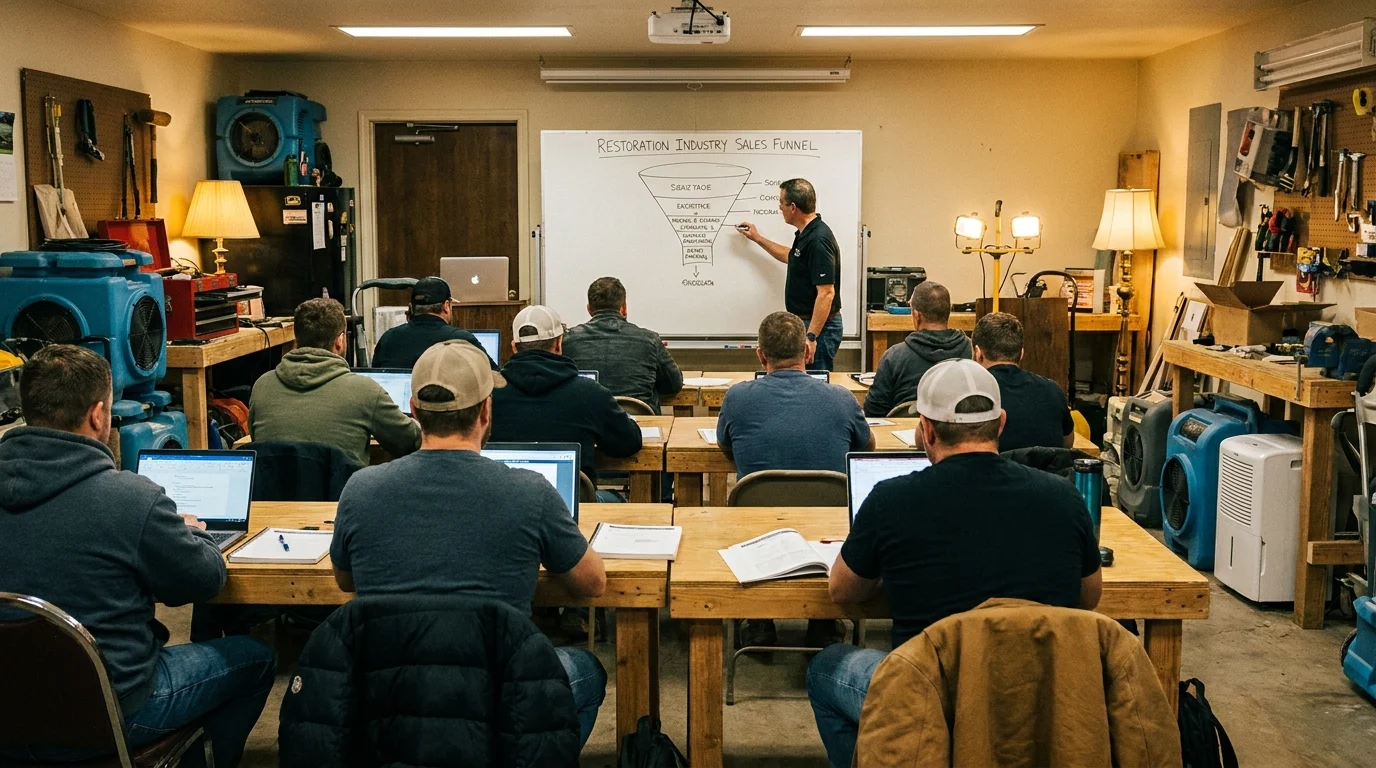

  • Restoration Technician Onboarding: The 90-Day Program That Turns Hires Into Producers

    Restoration Technician Onboarding: The 90-Day Program That Turns Hires Into Producers

    New restoration technicians do not become productive on day one, day seven, or day thirty. The realistic timeline from hire date to independent on-site productivity is 60 to 90 days for a candidate with no prior restoration experience, and even faster onboarding requires a structured program rather than the throw-them-on-a-truck approach most companies default to. This guide lays out the 90-day onboarding program profitable restoration companies use to compress that timeline and protect the new hire investment.

    For broader context on restoration team development, see our restoration training and certification master guide.

    Why Onboarding Matters Financially

    The cost of a poorly onboarded technician is rarely visible on the P&L, but it is real: callbacks, scope misses, customer complaints, premature attrition, and the time lead techs lose covering for someone who was not actually ready to work alone. A structured onboarding program converts this hidden cost into an upfront training investment with predictable ROI.

    Days 1-7 — Orientation and Safety

    The first week is not field production. The right structure is paperwork and orientation on day one, OSHA safety training and respirator fit testing in the first three days (covered in a separate spoke), company SOPs and customer service standards by end of week, and shadowing on simple jobs by day five or six. New techs should not be on a job alone until they have completed safety training and at least one shadow rotation.

    Days 8-30 — Shadowing and Skill Building

    Weeks two through four are paired-tech rotations across job types: water mitigation, content cleaning, equipment placement and monitoring, and basic demolition. The new tech is not the lead on any of these jobs — they are present, learning, and progressively taking on supervised tasks.

    By the end of day 30, a new tech should be able to: place equipment under supervision, complete a moisture monitoring log accurately, perform basic content manipulation, follow a standard scope of work without coaching, and represent the company professionally in front of customers.

    Days 31-60 — WRT Certification and Lead-Tech-Supervised Work

    The second month introduces the IICRC Water Damage Restoration Technician (WRT) certification. Most companies require WRT within the first 90 days; building it into the second month rather than waiting until day 89 produces a more confident, more capable technician for the back half of the onboarding window.

    Field work in days 31-60 expands to lead-tech-supervised production: the new tech can be the second tech on a job, can perform standard tasks without step-by-step supervision, and is responsible for documentation alongside the lead.

    Days 61-90 — Solo Production on Standard Jobs

    The final month is solo work on standard scope: simple Cat 1 water mitigation, equipment placement and monitoring on assigned jobs, basic content cleaning, and routine documentation. Complex jobs (Cat 3 water, fire cleanup, mold remediation, large losses) remain paired-tech assignments until the technician demonstrates additional readiness or earns the relevant certifications.

    By day 90, a properly onboarded tech should pass an internal evaluation covering: safety practices, equipment operation, documentation accuracy, customer interaction, scope execution, and basic estimating literacy.

    The Onboarding Coordinator Role

    The companies that execute this program well assign a specific person — usually a senior technician or operations manager — as the onboarding coordinator. This person owns the new hire’s first 90 days, schedules training milestones, runs check-ins at 7, 30, 60, and 90 days, and signs off on progression to solo work. Without a clear owner, the program collapses into ad hoc field training.

    What to Measure

    The onboarding metrics that matter: 90-day retention rate, days-to-first-solo-job, customer complaint rate by tech tenure, callback rate by tech tenure, and average gross margin per job by tech tenure. Tracking these reveals whether the program is producing capable technicians or just running them through the motions.

    Frequently Asked Questions

    How long should restoration technician onboarding take?

    The realistic timeline from hire to independent solo work on standard jobs is 60 to 90 days for candidates with no prior restoration experience. Candidates with relevant trade backgrounds may compress to 45 to 60 days. Trying to compress beyond that consistently produces under-prepared techs who generate callbacks and quality issues.

    When should new hires take their WRT certification?

    The optimal timing is days 31-60 — after the new tech has had enough field exposure to make the coursework concrete, but before they are running solo on water jobs. Most companies require WRT within the first 90 days; building it into the program intentionally produces better results than waiting until the deadline.

    Should new technicians be paid during training time?

    Yes. OSHA training, respirator fit testing, IICRC course time, and on-site shadowing are all compensable work time. Trying to treat training as unpaid creates legal exposure and signals to the hire that the company does not value the investment.

    What is the most common onboarding mistake?

    Putting new techs on jobs alone too early. The pressure of production schedules tempts owners to send a partially trained tech to a job because the truck has to roll. Each early-solo job that produces a callback or quality issue costs more than the labor that was saved. The discipline is to hold the line on the program even during busy periods.

    How do I evaluate whether a new tech is ready for solo work?

    Use a written 90-day evaluation covering safety practices, equipment operation, documentation accuracy, customer interaction, scope execution, and basic estimating literacy. The lead tech and the onboarding coordinator should both sign off. If the tech is not ready at day 90, extend the supervised period rather than rushing the milestone.


  • Restoration Leadership Development: Building Crew Leads, PMs, and Operations Managers Internally

    Restoration Leadership Development: Building Crew Leads, PMs, and Operations Managers Internally

    Restoration is a difficult industry to recruit leaders into from outside. The combination of technical depth, customer-facing pressure, insurance navigation, and operational complexity is hard to teach, and the candidates who can do all four are rarely on the job market. The companies that scale successfully build their crew leads, project managers, and operations managers from inside the team — and the companies that try to hire those roles externally typically learn this the expensive way.

    This guide is part of our broader restoration training and certification master guide.

    The Three Internal Leadership Levels

    Restoration leadership progression generally moves through three layers:

    • Crew Lead — leads a 2-3 person crew on a specific job, accountable for execution quality and documentation
    • Project Manager — owns multiple jobs at once, manages customer relationships, signs off on estimates and scope
    • Operations Manager — owns the production function across all jobs, manages PMs, sets standards, drives metrics

    Each layer has different skill requirements, and promoting a strong crew lead directly to PM (skipping the development steps) is one of the most common reasons internal leadership pipelines fail.

    Identifying Leadership Candidates Early

    The leading indicators of leadership potential in restoration techs are not the obvious ones. They are: communication clarity with customers under stress, willingness to slow down for documentation, comfort with ambiguity in scope decisions, ability to coach less-experienced techs without ego, and ownership of the outcome on jobs they did not start. Technicians who consistently demonstrate these behaviors are the right development pool.

    Identification should happen by month 6-12 of tenure. Owners who wait until they need a leader to start identifying candidates always end up either hiring externally (expensive, slow) or promoting too quickly (sets the candidate up to fail).

    The Crew Lead Development Path

    Moving a strong technician to crew lead requires explicit skill development beyond technical capability. Core curriculum areas: leading a brief and debrief on every job, customer communication frameworks, conflict resolution with crew members, documentation standards as a checklist owner rather than a participant, and basic scope decision authority within defined boundaries.

    Most companies underspend on this development step. The right investment is structured: weekly check-ins with the operations manager during the first 90 days as crew lead, mentor pairing with an experienced PM, and explicit scope-of-authority documentation so the new crew lead knows what they can decide without escalating.

    The Project Manager Development Path

    Project manager is the role where most internal promotions break down, because the skill jump from crew lead to PM is larger than it appears. PMs manage multiple concurrent jobs, own customer relationships across job types, sign off on estimates with real dollar consequences, and coordinate across crews.

    The development curriculum needs to cover: estimating literacy beyond field execution (this is where Xactimate certification matters), insurance and TPA program navigation, multi-job time management and prioritization, financial literacy on margin and gross profit, and team-leadership skills that scale beyond a single crew.

    The realistic timeline from crew lead to capable PM is 12 to 24 months of structured development. Compressing below 12 months produces PMs who can manage the schedule but cannot defend pricing or coach their crews.

    The Operations Manager Development Path

    Operations manager is the role that almost has to be developed internally, because the role requires deep knowledge of how the specific company operates. The development curriculum at this level shifts toward systems thinking, financial accountability for the production function, vendor and program management, hiring and retention strategy, and strategic planning alongside ownership.

    This level typically requires 2-4 years of PM experience as a foundation, plus structured executive development through industry programs, peer groups, or formal coaching.

    Leadership Development Programs to Consider

    Several restoration industry organizations offer formal leadership development: RIA (Restoration Industry Association) offers leadership programming through its conferences and CCT-level certifications, RTI (Restoration Training Institute) and others run multi-day leadership programs, and several private coaches and mastermind groups serve restoration owners and PMs specifically. Combining internal development with external programs accelerates the trajectory.

    What to Pay Internal Leadership

    Compensation for internal leadership should reflect both the skill premium and the difficulty of replacement. Crew leads typically earn 15-25 percent above lead tech base, PMs typically earn 30-50 percent above crew lead base, and operations managers typically earn 50-100 percent above PM base. Bonus structures tied to gross margin and customer satisfaction reinforce the right behaviors at each level.

    Frequently Asked Questions

    How long does it take to develop a restoration crew lead from a strong technician?

    The realistic timeline is 6 to 12 months of structured development beyond the technical skills the technician already has. Faster promotions consistently produce crew leads who default back to technician behaviors when the leadership demands intensify.

    Should I hire a project manager from outside or develop one internally?

    Develop internally whenever possible. External PM hires from inside the restoration industry are rare and expensive; external hires from outside the industry almost universally fail because the technical and insurance literacy cannot be learned fast enough. The 12-24 month internal development path is more reliable than the external hiring path.

    What is the most common reason internal leadership development fails?

    Promoting too fast. A strong technician promoted directly to PM without the structured development steps fails not because the candidate lacks potential but because the role demands skills they have not yet been taught. The fix is structured development with explicit milestones rather than ad hoc promotions.

    What metrics should I use to evaluate leadership readiness?

    For crew leads: customer satisfaction scores on jobs they led, callback rate, documentation completeness. For PMs: gross margin on managed jobs, customer retention, crew retention under their leadership. For operations managers: production function gross margin, crew retention rate, capacity utilization. Quantitative metrics protect against subjective bias in promotion decisions.

    Should leadership development be funded from the training budget or treated as overhead?

    It should be a deliberate line item in the training budget, with a target spend per leader per year. Treating leadership development as overhead almost guarantees it will be cut during slow periods, which is exactly when the investment matters most.


  • Restoration Sales Training: How to Build Reps Who Consistently Close Residential and Commercial Work

    Restoration Sales Training: How to Build Reps Who Consistently Close Residential and Commercial Work

    Restoration sales is a hybrid discipline. It requires enough technical knowledge to scope a job credibly, enough insurance literacy to navigate claim conversations, and enough emotional skill to sell a stressed homeowner or a guarded property manager on a meaningful spend during a crisis. Reps who can do all three consistently are not born — they are trained. This guide outlines the training program restoration companies use to build them.

    This article is part of our broader restoration training and certification master guide.

    The Four Pillars of Restoration Sales Training

    A complete restoration sales training program covers four pillars:

    • Technical literacy — restoration scope, drying science, mold protocol, fire cleanup methodology
    • Insurance and TPA navigation — claim process, deductibles, common adjuster behaviors, program-specific requirements
    • Selling skill — discovery, value framing, objection handling, closing, follow-up
    • Customer experience — empathy in crisis, communication standards, expectation setting, documentation

    Programs that cover only one or two of these pillars produce reps who are good at part of the job and weak at the rest. The strongest restoration sales programs are built around all four.

    Pillar 1 — Technical Literacy

    A restoration salesperson does not need to be a master technician, but they must be able to walk a loss intelligently, recognize the scope categories at play, and explain to the customer what the work will involve. The training should cover: water categories and classes (S500), mold containment levels (S520), fire and smoke categories, basic drying principles, and the equipment that shows up on standard jobs.

    The right way to deliver this is field exposure during onboarding. Sales reps should ride with technicians for the first two weeks, observe at least three job types, and be able to explain the basics back to the trainer before going on solo sales calls.

    Pillar 2 — Insurance and TPA Navigation

    The insurance conversation is where most under-trained reps lose the deal. Customers ask “will my insurance cover this?” and reps either over-promise (creating problems later) or punt to the carrier (creating doubt now). The training needs to cover: how a claim flows from FNOL through payment, what affects coverage decisions, when to recommend filing vs. paying cash, common adjuster scope-reduction patterns, and TPA program requirements specific to your participating programs.

    This material is best taught in small-group sessions with experienced PMs or owners present, working through real claim scenarios.

    Pillar 3 — Selling Skill

    The selling skill curriculum should cover the core sales conversation arc: discovery questions that surface the real customer concern, value framing that connects scope to outcomes, objection handling for the predictable objections (price, timing, “let me think about it”), tiered estimate presentation for cash work, and a closing approach that asks for the business without feeling pushy.

    Role-playing is the only effective way to teach this. Weekly role-play sessions with peers and managers, recording calls when possible, and structured feedback are what turn theory into reflexive skill. Programs that rely on shadow training and “watching how I do it” produce uneven reps.

    Pillar 4 — Customer Experience

    The customer experience pillar is what separates restoration sales from generic sales training. Customers in a restoration scenario are usually stressed, often grieving a loss, and almost always navigating something they have never dealt with before. Reps who recognize this and adjust their pace, language, and communication style close more deals at higher margin than reps who default to a transactional approach.

    The curriculum here covers: empathy frameworks, stress and grief recognition, expectation setting at intake and during the job, communication cadence (when to call, what to say), and documentation that reduces customer anxiety.

    The Training Cadence

    A working restoration sales training program looks like this on the calendar:

    • Weeks 1-2 — field shadowing with technicians, technical literacy
    • Weeks 3-4 — insurance and TPA training, paired sales calls with senior rep
    • Weeks 5-8 — selling skill training, role-play, supervised solo calls
    • Weeks 9-12 — customer experience training, full solo production with weekly coaching
    • Ongoing — weekly role-play, monthly call review, quarterly skill refresh

    What to Measure

    The sales training metrics that matter: close rate by rep tenure, average ticket by rep, gross margin per job by rep, callback rate, customer satisfaction by rep, and rep retention. Tracking these over the first 12 months of a rep’s tenure reveals whether the training program is producing the right outcomes.

    Frequently Asked Questions

    How long should a restoration sales training program take?

    The structured portion runs 8 to 12 weeks. Solo production typically begins in week 5 or 6, with continued coaching through week 12. Reps reach steady-state productivity around month 6 with a good program in place. Compressing below 8 weeks consistently produces under-prepared reps with high turnover.

    Should I hire experienced restoration salespeople or train from scratch?

    Both have merit. Experienced restoration reps cut training time by 60-70 percent but cost more, are harder to find, and may bring habits from a previous employer that do not fit your standards. Training from scratch is slower and more expensive upfront but produces reps who match your culture and methods. Most companies run a blend.

    What is the most common restoration sales training mistake?

    Skipping the technical literacy pillar. Companies that hire reps from generic sales backgrounds and assume the technical side will be picked up “on the job” produce reps who under-scope, over-promise, and create operational problems for the production team. The technical pillar is non-negotiable.

    How much should I pay restoration salespeople?

    Compensation models vary widely. Common structures are base plus commission on gross margin, draw plus commission, or salary plus performance bonus. The right mix balances rep stability with performance incentive. Pure commission models attract aggressive reps who often discount to close, which destroys margin. Pure salary removes the close-rate pressure that drives results.

    How do I keep a sales rep sharp after the initial training?

    Weekly role-play, monthly call reviews, quarterly skill refreshers, and a structured coaching cadence with the sales manager. Sales skill decays without practice — the reps who stay sharp are the reps in companies that invest in ongoing development rather than treating training as a one-time onboarding event.


  • Restoration OSHA Safety Training Requirements: What Owners Are Legally Required to Provide

    Restoration OSHA Safety Training Requirements: What Owners Are Legally Required to Provide

    OSHA training in restoration is not a nice-to-have or an industry best practice — it is a legal requirement under multiple federal standards, and the financial penalties for non-compliance can be severe. The good news is that the core training requirements are well-defined, the curriculum is mature, and a properly designed safety training program can be delivered without significant disruption to production.

    This guide is part of our broader restoration training and certification master guide. It is not a substitute for legal advice — consult an OSHA compliance professional for company-specific guidance.

    Respiratory Protection Training (29 CFR 1910.134)

    The OSHA Respiratory Protection Standard applies to any worker required to use a tight-fitting respirator on the job — which covers virtually every restoration technician working on mold, fire, sewage, or hazardous environments. The standard is detailed and prescriptive, and the core elements are not optional.

    Employer obligations under the standard include providing respirators, training, and medical evaluations at no cost to the employee. The training must cover how to put on and take off the respirator, how to use it, how to clean and maintain it, and worksite-specific applications. Documentation of training completion is required.

    Respirator Fit Testing

    Any worker required to wear a tight-fitting respirator must be fit-tested before their first use of the respirator and at least annually thereafter. Fit testing typically takes 15 to 20 minutes per worker and is performed using either qualitative or quantitative methods.

    The annual recurrence is the part most restoration owners underestimate. Building fit testing into a recurring annual training day — typically combined with respirator training renewal — is the most efficient way to stay compliant without scheduling chaos.

    Bloodborne Pathogens Training (29 CFR 1910.1030)

    Bloodborne pathogens training applies to any worker who may have occupational exposure to blood or other potentially infectious materials. For restoration companies that perform trauma and crime scene work, this is mandatory. For general water and fire restoration, applicability depends on actual job conditions and should be assessed with an OSHA compliance professional.

    Hazard Communication Training (29 CFR 1910.1200)

    Hazard communication training covers the safe handling of chemicals workers may encounter — antimicrobials, deodorizers, cleaners, sealers. Training must cover hazard identification, safety data sheet (SDS) interpretation, and protective measures. Initial training is required at hire and whenever new chemicals are introduced.

    Confined Space Entry (29 CFR 1910.146)

    Crawl spaces, attics, and certain commercial environments may meet OSHA’s definition of permit-required confined spaces. Companies that perform work in these environments must have a confined space entry program with associated training. The training is technical and specific; consult an OSHA professional to assess applicability.

    OSHA 10-Hour and 30-Hour Training

    OSHA 10-hour and 30-hour outreach training programs provide general workplace safety education. While not mandated by OSHA for most restoration work, many TPA programs, commercial customers, and insurance carriers require OSHA 10 or 30 cards as a condition of participation. The 10-hour course is appropriate for field technicians; the 30-hour course is appropriate for supervisors and project managers.

    Building a Recurring Safety Training Program

    The most workable structure for ongoing OSHA compliance is an annual safety training day where respirator training renewal, fit testing, hazard communication review, and other recurring requirements happen together. Combined with new-hire safety training (typically delivered in the first week), this approach keeps the team compliant without the constant scheduling pressure of ad hoc training.

    Documentation matters as much as the training itself. Every training session should be documented with date, attendees, content covered, and trainer credentials. Fit testing should be documented with date, respirator make and model, fit test method, and pass/fail result. This documentation is the company’s defense in any OSHA inspection or insurance audit.

    Common OSHA Compliance Mistakes

    The most common compliance mistakes in restoration: skipping initial fit testing for a new hire because “they have used a respirator before” (still required), letting fit testing lapse beyond 12 months for tenured techs (still required annually), incomplete documentation of training sessions, missing medical evaluations for respirator users, and assuming online training alone satisfies hands-on requirements (it does not for most fit testing).

    Frequently Asked Questions

    How often is OSHA respirator fit testing required?

    Fit testing must be performed before a worker’s first use of a tight-fitting respirator and at least annually thereafter under OSHA 29 CFR 1910.134. The annual requirement applies to every worker who is required to use a tight-fitting respirator, regardless of how long they have worked at the company.

    Do I have to pay for respirators and training?

    Yes. Under OSHA 29 CFR 1910.134, employers must provide respirators, training, and medical evaluations at no cost to the employee. Treating these as employee expenses creates legal exposure and is one of the most commonly cited respirator program violations.

    Is OSHA 10 or OSHA 30 training required for restoration workers?

    OSHA does not generally mandate the OSHA 10 or 30 outreach courses for restoration work, but many TPA programs, commercial customers, and insurance carriers require them as a condition of doing business. OSHA 10 is appropriate for field technicians; OSHA 30 is appropriate for supervisors and PMs.

    How long does respirator fit testing take per worker?

    Approximately 15 to 20 minutes per worker, plus setup and documentation time. A typical annual safety training day can fit-test 8-12 workers per trained fit tester, depending on the testing method used.

    Where can I find a qualified OSHA fit testing provider?

    Many third-party safety training companies offer on-site fit testing for restoration teams. Some IICRC training providers bundle OSHA compliance training with their certification programs. Industrial hygienists and occupational health clinics also provide fit testing services. Verify the provider’s credentials and the test method used before scheduling.


  • Restoration Continuing Education: Managing IICRC CECs Without Burning Production Days

    Restoration Continuing Education: Managing IICRC CECs Without Burning Production Days

    IICRC certifications do not expire on a fixed date — they renew through continuing education credits (CECs). The system is more flexible than a hard renewal date, but it puts the burden on the company to track CECs across the team, plan annual learning, and ensure no certification lapses. Done well, the CEC system also doubles as a structured ongoing development program. Done poorly, it produces lapsed certifications that surface during a TPA audit or an insurance dispute.

    This guide is part of our broader restoration training and certification master guide.

    The CEC Framework

    An IICRC CEC stands for “continuing education credit,” and one CEC equals one hour of online or in-person class education. The CEC requirements vary by certification level:

    • Technicians (WRT, ASD, AMRT, FSRT, etc.) — 14 CECs every four years
    • Master-level certifications (MTC, MSR, MWR) — 14 CECs every two years
    • Certified Inspectors — 14 CECs every two years

    The technician requirement of 14 CECs over four years works out to about 3.5 hours of continuing education per year — manageable when planned, painful when ignored until the renewal window closes.

    What Counts as a CEC

    CECs can be earned several ways: attending another IICRC course, completing approved IICRC continuing education courses online or in person, attending IICRC-approved events and conferences, or registering at the IICRC booth during applicable trade shows (which awards two CEC hours for the visit).

    The flexibility means companies can fit CEC accumulation into existing development activities rather than treating it as a separate annual burden. A team trip to a regional restoration conference can produce CECs for everyone who attends.

    Tracking CECs Across the Team

    The single biggest source of CEC compliance failures is poor tracking. Each technician is individually responsible for submitting their CEC documentation to IICRC, but the company benefits from maintaining a central tracker that shows: certifications held by each technician, current CEC balance for each certification, renewal deadline, and CECs scheduled or planned for the cycle.

    A simple spreadsheet works for small teams. Larger teams should consider integrating CEC tracking into the HR or training management system. The cost of building this tracking is trivial compared to the cost of a lapsed certification surfacing during an audit.

    How to Submit CECs

    Documentation of completed continuing education must be submitted to IICRC for credit to apply. The standard submission method is email to IICRC’s renewal team with the Certificate of Completion attached. The technician is responsible for the submission, but the company should remind technicians to submit promptly rather than batching at the end of the cycle.

    A Yearly CEC Plan

    The most workable approach is a yearly CEC plan rather than a four-year plan. For a typical technician with WRT, ASD, and AMRT, a year’s CEC plan might look like:

    • Q1 — one online IICRC course (4-6 CECs), one trade show visit (2 CECs)
    • Q2 — manufacturer-led product training (often free, often CEC-eligible)
    • Q3 — regional restoration conference attendance (multiple CECs)
    • Q4 — review CEC balance, schedule any catch-up needed

    This rhythm produces 8-12 CECs per year per technician, which exceeds the technician requirement and provides comfortable margin for renewal cycles.

    Combining CECs with Team Development

    The smartest restoration owners use CEC requirements as the framing for ongoing team development. Instead of treating continuing education as a compliance task, they structure it as a quarterly team learning rhythm: lunch-and-learns on specific topics, manufacturer demos at the warehouse, mini-courses on emerging techniques, and conference attendance for select team members who then teach the rest of the team.

    This approach turns the CEC requirement into a competitive advantage rather than a checkbox.

    What Happens If a Certification Lapses

    If a certification lapses due to insufficient CECs, the technician must re-test to restore the credential. The cost of re-testing (course tuition plus exam fee) almost always exceeds what the CECs would have cost, and the lapsed period creates exposure if any work was performed under the assumption that the certification was current.

    Frequently Asked Questions

    How many IICRC CECs does a technician need?

    IICRC technicians need 14 continuing education credits every four years to maintain their certifications. That works out to approximately 3.5 CECs per year. Master-level certifications and Certified Inspectors require 14 CECs every two years, which is double the annual rate.

    What counts as one IICRC CEC?

    One CEC equals one hour of online or in-person class education from an IICRC-approved source. CECs can be earned through additional IICRC courses, approved continuing education programs, IICRC-approved events, and IICRC booth visits at applicable trade shows (which award two CECs).

    Who submits CEC documentation to IICRC?

    The individual technician is responsible for submitting their Certificate of Completion to IICRC’s renewal team. The standard submission method is email to renewals@iicrcnet.org. Companies should remind technicians to submit promptly rather than waiting until the end of the renewal cycle.

    What happens if my IICRC certification lapses?

    A lapsed certification requires re-testing to restore. The re-test typically requires retaking the course (or at least the exam) and paying the exam fee. The lapsed period also creates exposure for any work performed under the assumption that the certification was current. Maintaining CECs is significantly cheaper than re-testing.

    How can I track CECs for my whole team?

    For small teams, a simple spreadsheet showing each technician’s certifications, current CEC balance, and renewal deadline is sufficient. Larger teams benefit from integrating CEC tracking into a training management system. The investment in tracking is trivial compared to the cost of a lapsed certification surfacing during an audit.


  • IICRC Certification and Restoration Training: The Complete 2026 Guide

    IICRC Certification and Restoration Training: The Complete 2026 Guide

    Certification matters more in restoration than in most trades. Insurance carriers, TPAs, commercial buyers, and many state regulators look for IICRC credentials as the baseline trust signal. A restoration company with no certifications can do residential cash work; a company with a credentialed team can win commercial accounts, qualify for preferred vendor programs, and defend scope against challenge.

    This is the complete guide to IICRC certifications and restoration training in 2026: which certifications actually matter for which roles, the realistic path for a new technician, what each course costs and covers, and how to build an in-house training program that turns new hires into productive technicians in 90 days instead of nine months.

    What the IICRC actually is

    The Institute of Inspection, Cleaning and Restoration Certification (IICRC) is the standards-setting and certification body for the cleaning, inspection, and restoration industry. Founded in 1972, it publishes the technical standards that govern the industry — most notably S500 (water damage), S520 (mold), S540 (trauma and crime scene), S700 (fire and smoke), and S800 (HVAC) — and certifies individuals and firms in specific competencies.

    IICRC certifies individual technicians through course completion and exam, and certifies firms through documentation of insurance, technician credentials, and adherence to standards. Firm certification is what most insurance carriers and commercial buyers actually look for on vendor applications.

    The IICRC certifications that matter for restoration

    The certifications that should be on every restoration company’s checklist:

    WRT (Water Damage Restoration Technician) — the foundational water mitigation certification. Three-day course covering water categories, drying science, equipment use, and the S500 standard. This is the absolute minimum for any technician handling water losses. Most companies require WRT within 60-90 days of hire.

    ASD (Applied Structural Drying) — the advanced drying certification. Builds on WRT with deeper coverage of psychrometry, drying chamber configuration, equipment sizing, and complex drying scenarios. Standard for lead technicians and project managers.

    AMRT (Applied Microbial Remediation Technician) — the mold remediation certification. Covers S520 standard, containment design, PPE, work practices, and post-remediation verification. Required for any contractor performing mold remediation work; often required by state regulators in mold-licensed states.

    FSRT (Fire and Smoke Restoration Technician) — fire and smoke damage certification. Covers smoke types, deodorization, contents cleaning, and structural restoration after fire losses. Important for any contractor handling fire work.

    OCT (Odor Control Technician) — focused certification on odor identification and removal techniques. Useful for technicians and project managers handling fire, sewage, biohazard, and HVAC remediation.

    HST (Health and Safety Technician) — covers OSHA compliance, PPE selection, hazard assessment, and crew safety practices. Recommended for project managers and crew leaders.

    UFT (Upholstery and Fabric Cleaning Technician) and CCT (Carpet Cleaning Technician) — for contents cleaning and carpet cleaning operations. Standard for contents departments.

    CCMT (Commercial Carpet Maintenance Technician) — relevant for commercial restoration operations with maintenance contract work.

    TCST (Trauma and Crime Scene Cleanup Technician) — for biohazard and trauma cleanup divisions. Required by some state regulators.

    WRT-Master, ASD-Master, AMRT-Master designations — the highest individual certifications, requiring multiple credentials, hours of field experience, and additional examination.

    The path from new hire to credentialed technician

    A realistic 12-month path for a new restoration technician: Days 1-30 — shadow experienced technicians, complete OSHA 10 and basic safety orientation, learn equipment handling. Days 31-90 — complete IICRC WRT certification (three-day course plus exam), begin running mitigation jobs as second tech under supervision. Days 91-180 — complete ASD or FSRT depending on focus area, begin running smaller jobs as lead. Days 181-365 — complete AMRT (if mold work), additional specialty certifications based on role, eligibility for lead technician promotion.

    Companies that compress this timeline (six-month path to fully certified lead tech) usually do it by combining IICRC courses with rigorous in-house training, structured ride-alongs, and weekly skill assessments.

    In-house training programs: building beyond IICRC

    IICRC certification is the baseline. The companies that consistently outperform have in-house training programs that fill the gaps. The components of a real in-house program:

    Onboarding curriculum — week one orientation covering company processes, equipment handling, safety, and customer interaction expectations. Weekly skills training — 30-60 minute sessions on specific topics: drying chamber setup, content pack-out procedures, moisture mapping, customer communication scripts. Quarterly cross-training — rotating technicians across service lines so the team has bench depth. Annual recertification — refresher training on IICRC standards updates, new equipment, and procedural changes. Mentor pairing — every new technician paired with an experienced lead for the first 90 days.

    Training cost: what to budget

    Realistic 2026 cost per new restoration technician: WRT certification $700-$1,000 (course + exam + travel), ASD $700-$1,000, AMRT $800-$1,200, FSRT $700-$1,000, plus 40-80 hours of paid in-house training time. Total first-year investment per technician: $3,000-$8,000 depending on path. Companies often recoup this within a few months through improved productivity and reduced supervision burden.

    Training providers worth knowing

    Restoration training providers fall into three categories. IICRC-approved training schools deliver the certification courses themselves — Restoration Sciences Academy, IICRC-approved regional providers, and online options through providers like KEY Restoration. Industry consultants and coaches deliver advanced training in estimating, sales, operations, and leadership — Violand Management, GrowthWerks, Performance Restoration, and several others. Manufacturer training from equipment vendors like Phoenix Restoration Equipment, Drieaz, and chemical suppliers covers product-specific operations.

    Frequently Asked Questions

    What is IICRC certification?

    IICRC (Institute of Inspection, Cleaning and Restoration Certification) is the industry standards-setting and certification body. It publishes the technical standards (S500 for water, S520 for mold, S700 for fire) and certifies both individual technicians and restoration firms in specific competencies. Insurance carriers, TPAs, and commercial buyers commonly require IICRC credentials.

    How much does IICRC certification cost?

    Individual IICRC certification courses typically run $700-$1,200 each, including course materials, the exam, and exam administration. Travel and lodging (when courses are in-person) add to the total. Online and hybrid options are increasingly available at lower cost. Annual maintenance fees apply to keep credentials active.

    What IICRC certifications do restoration technicians need?

    The baseline for any water mitigation technician is WRT (Water Damage Restoration Technician). Lead technicians typically add ASD (Applied Structural Drying). Companies handling mold work require AMRT (Applied Microbial Remediation Technician). Fire restoration adds FSRT (Fire and Smoke Restoration Technician). Specialty roles add OCT, HST, TCST, and others as needed.

    How long does IICRC certification take?

    Most individual IICRC courses are three days of in-class instruction followed by a written exam. Some courses are available in compressed two-day or hybrid formats. From start to certified takes one to four weeks depending on exam scheduling. The full certification path (multiple credentials) for a senior technician usually spans 6-18 months.

    What is the difference between IICRC certification for individuals and firms?

    Individual IICRC certification is earned by a single technician completing a course and exam. Firm certification is earned by a company that documents insurance coverage, employs a minimum number of certified technicians, agrees to abide by the IICRC code of ethics, and participates in customer complaint resolution. Firm certification is what most carriers and commercial buyers look for on vendor applications.

    Where can I take IICRC courses?

    IICRC courses are delivered by approved training schools across the US and internationally. Major providers include Restoration Sciences Academy and various regional IICRC-approved schools. Many manufacturers and equipment vendors also offer IICRC-approved training. The IICRC website maintains an updated list of approved providers.