Last fact-check: May 25, 2026
The honest problem with citing AI in academic work is that the rules don’t exist yet, and the people enforcing them often don’t know the rules either. Cal Poly San Luis Obispo maintains a public repository of more than 200 AI syllabus policies because faculty across the CSU system are crowdsourcing the answer from each other in real time. One professor will require disclosure. The next will ban AI entirely. The next will require its use. None of them are wrong. There just isn’t a settled standard.
If you’re a student, you’re navigating this with no map. If you’re a professor, you’re writing the map while teaching the class. This article is for both of you. It won’t tell you what your specific instructor’s policy is — only they can do that — but it will give you a clear way to think about the line between legitimate AI use and ghost-authorship, and a practical framework for disclosing AI use in a way that holds up under scrutiny.
This is part of Tygart Media’s free AI Literacy curriculum. The foundational pieces — what AI does, how to prompt it, and how to verify what it tells you — are worth reading first if you haven’t.
The actual line, stated clearly
Ghost-authorship in academic work happens when someone else produced the intellectual content of your submission and you put your name on it. It doesn’t matter whether the “someone else” is a tutor who wrote your paper, a friend who took your test, a paid essay mill, or a chatbot. The principle is the same: the work submitted under your name is supposed to represent your thinking, not someone else’s.
The line isn’t whether AI was involved. The line is whether the intellectual work was yours.
Some examples to make this concrete:
Clearly fine in almost every classroom: using AI to brainstorm ideas you then evaluate, develop, and write up yourself. Using AI to explain a concept you’re trying to understand. Using AI to suggest counter-arguments to your draft so you can address them. Using AI to clean up grammar in a paragraph you wrote. Using AI to summarize a long source so you can decide whether to read it in full.
Clearly over the line in almost every classroom: pasting an assignment prompt into AI, getting a draft back, lightly editing it, and submitting it as your own. Generating a thesis statement you didn’t think of and don’t actually understand. Having AI write your conclusions, your analysis, or your arguments. Copying citations the AI produced without verifying they exist or that you’ve actually read the sources.
In the gray zone, where your instructor’s policy matters: using AI as a writing partner that produces text you then heavily edit. Using AI to outline structure. Using AI to suggest phrasing for ideas that are yours. Using AI to find sources you then read and evaluate. Using AI to produce a first draft you then substantially rewrite.
If you can’t tell which side of the line you’re on, the test is: could you, right now, with no AI in front of you, defend the intellectual claims you’ve made? Could you explain why your argument is structured the way it is? Could you answer questions about your sources? If yes, the work is yours regardless of what tools you used. If no, you’ve crossed into ghost-authorship even if every word of the submission technically came out of your own keyboard.
The disclosure principle
Even when AI use is allowed, the question of how to disclose it is its own minefield. Most academic citation styles — APA, MLA, Chicago — have added or are adding guidance for AI, but the guidance changes faster than the style guides update, and your instructor may have their own policy that overrides whatever the official style says.
The principle that works across almost every situation: disclose what AI did, where it did it, and what you did with the output. That information is what lets the reader (or grader) evaluate whether the work is properly yours.
A bad AI disclosure looks like this: “I used ChatGPT for this assignment.” It doesn’t say what for. It doesn’t say what part of the work was AI-shaped. It doesn’t let the grader distinguish between “used ChatGPT to brainstorm” and “used ChatGPT to write the whole thing.”
A good AI disclosure looks like this: “I used ChatGPT (GPT-5, May 2026) to suggest counter-arguments to the position I argue in section 3. I drafted the counter-arguments based on its suggestions but rewrote them in my own words. I also used it to clean up grammar in the final paragraph. The thesis, structure, source selection, and analysis are mine. All cited sources were read in full, not summarized by AI.”
The second disclosure is longer, but it’s the one that protects you. It tells the grader exactly what was AI-assisted and exactly what wasn’t, which means any later question about authorship has an answer that’s already in writing.
The specific case of AI-suggested sources
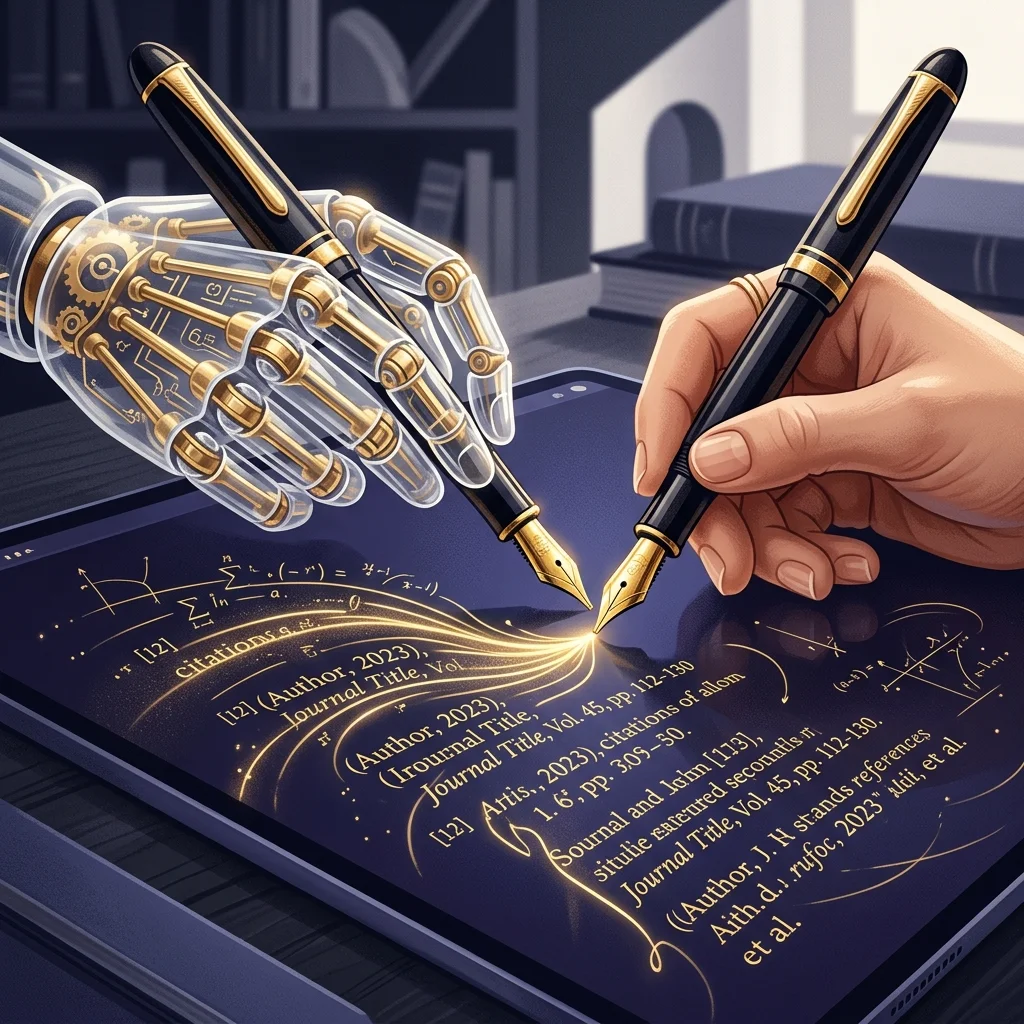
One pattern that gets students in trouble more than any other: pasting a citation from AI into a paper without confirming the source exists or reading it.
Per the verification article in this curriculum, AI fabricates citations with extraordinary fluency. A paper that doesn’t exist will be cited with a plausible author, plausible journal, plausible page range, and sometimes a plausible-looking DOI. If you trust the citation and submit it, three things can happen, none of them good. The professor checks the citation and finds it doesn’t exist. The professor doesn’t check, but a later reader does. Or the citation does exist, but doesn’t say what the AI claimed it said, which is arguably worse because the falsification is harder to spot.
The rule: every citation that ends up in your submission must be a source you have personally located, opened, and read at least enough of to confirm it says what you’re citing it for. This is true regardless of whether the citation came from AI, a Google search, your roommate, or your own memory. The rule has always been true. AI just makes following it more important, because the failure mode of not following it has gotten faster.
If you used AI to help find sources, that’s allowed in most classrooms — but the disclosure should reflect it. “I used AI to suggest initial sources, then verified each one and read them before citing” is honest and defensible. Pasting AI-generated citations into your bibliography unread is academic fraud, whether or not the sources turn out to be real.
The “I rewrote it in my own words” problem

A common workaround students try: have AI write a draft, then “rewrite it in my own words” before submitting. The instinct behind this is right — putting it in your own words feels like ownership — but the execution often doesn’t work the way students think it does.
If the AI produced the structure, the argument, the framing, and the conclusions, then “rewriting it in your own words” is just paraphrasing someone else’s thinking. The words are yours. The thinking isn’t. That’s still ghost-authorship in any rigorous reading of academic integrity, regardless of how much of the surface-level text you changed.
The distinction that matters: did the AI produce the intellectual content, or did the AI produce a draft of intellectual content you already had? If you went into the AI conversation knowing what you wanted to argue and why, and the AI helped you write it, that’s fine. If you went into the AI conversation not knowing what to argue, and the argument came out of the AI’s output, you don’t own that argument no matter how many synonyms you swap.
A useful internal test: before you started using AI, did you have an outline, even a rough one, in your head or on paper? Did you know what your thesis was? Did you know what your sources were going to say? If yes, you’re using AI as a tool. If no, the AI is doing the thinking and you’re doing the typing.
How to use AI in academic work and stay clearly on the right side

A practical workflow that keeps you well clear of ghost-authorship territory, while still letting you benefit from AI:
Before opening the AI: read the prompt, read the sources, take notes, sketch an outline, decide what you’re going to argue. Do all of this with no AI involvement. The intellectual core of the assignment has to start with you, or the rest doesn’t matter.
Use AI for the parts where it’s clearly a tool, not a co-author. Asking for explanations of concepts you’re trying to understand. Asking for counter-arguments to your position. Asking for help phrasing a sentence that isn’t working. Asking it to point out logical weaknesses in a draft. Asking for examples that illustrate a principle.
Don’t ask AI to make decisions for you. Don’t ask it what to argue. Don’t ask it which source is best. Don’t ask it what your conclusion should be. Those are the decisions that constitute “doing the work.” If you outsource them, you’ve outsourced the work itself.
Verify everything specific that AI produced. Quotes, statistics, citations, technical claims, dates, names. The verification article in this curriculum covers the how.
Keep a record of what you did. Many instructors are now requiring an AI use log alongside submissions. Even if yours doesn’t, keeping notes on what AI was used for makes the disclosure section much easier to write and protects you if the use is later questioned.
Disclose specifically, not generically. Per the disclosure section above.
For professors writing AI policies
A pivot, because this curriculum is for both audiences. If you’re a professor — particularly a CSU professor reading this because your campus didn’t give you a syllabus template — here are the elements a defensible AI policy usually includes:
Be specific about what’s allowed and what isn’t. “AI use is permitted” is too vague to enforce. “AI may be used for brainstorming, grammar checking, and concept explanation. AI may not be used to draft any portion of the submitted text or to produce citations” is enforceable. Students who break it know they broke it. Students who follow it can tell when they’re inside the rules.
Require disclosure rather than banning use. An outright ban is increasingly unenforceable — every student has access to multiple AI tools, free, on every device — and unenforceable rules erode broader academic integrity. A policy that requires specific, honest disclosure shifts the question from “did the student use AI” to “did the student disclose their use accurately,” which is a much more enforceable standard.
Tie disclosure to a structured format. Tell students exactly what an acceptable disclosure looks like. The “I used ChatGPT for this assignment” disclosure isn’t useful to anyone. The structured disclosure described earlier is. If you give students the format, they can use it.
Distinguish “AI involvement” from “AI authorship.” The policy that scales is one that recognizes AI involvement is now nearly universal — 95% of CSU students use AI tools — and focuses on whether the intellectual work is the student’s. Banning involvement is asking students to lie. Banning authorship is asking them to actually do their work.
Build in an oral component for high-stakes assignments. The single most effective defense against ghost-authorship is conversation. A five-minute oral check on a major paper — what was your thesis, why did you choose this source, what counter-argument did you consider — reveals AI-authored work very quickly, because the student can’t defend reasoning they didn’t do. This is more work for the professor, but it’s the only reliable signal.
Don’t rely on AI detection tools. They don’t work reliably, they generate false positives that disproportionately affect non-native English speakers, and they’re an arms race the detection side has already lost. The CalMatters reporting on TurnItIn’s AI detector documents the failure mode in detail. Detection is not the answer. Disclosure plus oral defense is.
The honest framing
The reason this is hard is that AI use is now genuinely a continuum. There is no clean line you can draw such that everything on one side is fine and everything on the other side is cheating. The continuum runs from “I had AI explain a concept I didn’t understand” to “I had AI write my paper.” Almost every student is doing some version of the first thing. Some are doing some version of the second. The job of academic policy is to draw a defensible line somewhere on the continuum and to enforce it in a way that distinguishes the two ends.
The line this article has drawn — intellectual content must be yours, AI assistance must be disclosed specifically — is one defensible answer. It is not the only answer. Different disciplines, different course levels, different assignment types may demand different lines. But it’s a defensible starting point, and it has the advantage of being actually enforceable, which is more than can be said for either “AI is banned” or “AI is fine.”
What is not a defensible answer is no answer. The CSU campuses that have left individual professors to invent policies from scratch — most of them — have produced exactly the chaos the survey data captured. Students confused about what’s allowed. Faculty divided on what to allow. Tutoring centers caught in the middle. None of this gets better until clearer lines are drawn, communicated, and enforced consistently.
That clarity has to be built. This article is one attempt at building a piece of it. Feel free to use it, fork it, paste it into your syllabus, hand it to your students, or argue with it. It exists to be used.
About this knowledge node: This is a cluster article in Tygart Media’s AI Literacy content sprint. It’s licensed for use in any classroom, training program, custom GPT, or Claude Project as long as attribution is maintained. The pillar article that introduces the sprint is here.
Leave a Reply