
Last fact-check: May 25, 2026
On or around May 20, 2026, California State University quietly renewed its contract with OpenAI. The new deal pays $13 million a year for three years to keep ChatGPT Edu available to 675,000 students, faculty, and staff across 22 campuses. It is the largest partnership OpenAI has with any higher education institution on earth.
The renewal was inevitable. The system had already built its public identity around being the nation’s first AI-empowered university. Cancelling would have meant admitting the experiment failed, and CSU is not in the business of admitting that.
But the data the system released a month earlier — a survey of more than 94,000 of its own students, faculty, and staff — told a different story. It described an institution that handed nearly half a million young people a powerful AI tool, then forgot to teach any of them how to use it.
This article is the opening of a content sprint by Tygart Media. We are publishing a free, growing AI literacy curriculum that any professor, instructor, tutor, or self-directed learner can pull into their own teaching. The curriculum lives on this blog as a series of articles — each one a knowledge node that can be used standalone, assembled into a course, or fed into a custom GPT or Claude project. There is no paywall, no signup, no email gate. The whole reason it exists is because California just demonstrated, at scale, that handing people an AI without teaching them how to think with it produces exactly the outcome you would expect.
Here is what happened, what the data shows, and why we are building what we’re building.
The deal, by the numbers
California State University signed its first contract with OpenAI in January 2025. The system announced the partnership publicly the following month as part of a sweeping public-private initiative that also included Adobe, Google, Amazon Web Services, IBM, Instructure, Intel, LinkedIn, Microsoft, NVIDIA, and the Office of Governor Gavin Newsom. The 18-month contract cost $17 million and ran through July 2026.
CSU Chancellor Mildred García called it unprecedented. “No other university system in the U.S. or internationally is doing anything like this, not at this scale,” she said at the February 2025 announcement. She was right about the scale. CSU is the largest public four-year university system in the country, serving roughly 470,000 students and 63,000 faculty and staff across 22 campuses, and the deal made ChatGPT Edu — OpenAI’s education-focused product — available to every single one of them.
Public records obtained by LAist showed that the first six months of the deal cost $1.9 million and covered 40,000 users in a rollout phase. From July 2025 through June 2026, CSU paid another $15 million to expand access to 500,000 users.
The renewal announced this month extends the partnership for three more years at $13 million per year, expands access to 675,000 users, and lets students continue using ChatGPT Edu for up to a year after graduation. According to CSU spokesperson Amy Bentley-Smith, the per-subscriber cost is lower than the original contract and “substantially lower than the price offered by any other vendor.” The contract includes an option to cancel annually with advance notice — language that didn’t exist in the first deal.
This was a procurement story dressed as a pedagogy story. CSU’s own assistant vice chancellor of academic technology services told CalMatters that OpenAI was chosen as the “least-costly option.” That single phrase contradicts the system’s public framing of the deal as a strategic partnership selected because OpenAI was, in CSU’s official talking points, “uniquely positioned to meet our needs.” Both things can’t be true. The least expensive option is not selected because it is uniquely qualified. It is selected because it is the least expensive.
The distinction matters because it shapes what came next.
The training nobody completed
In April 2026, San Diego State University released the results of a systemwide AI survey it had conducted on behalf of CSU. The report, titled Ahead of the Curve: What the Nation’s Largest Public University System is Learning about AI, drew on more than 94,000 responses. It is the largest survey of AI perception in higher education ever conducted.
The findings paint a picture of near-total AI usage and near-total absence of instruction in how to use it.
Ninety-five percent of CSU students reported using an AI tool. Eighty-four percent specifically named ChatGPT. AI usage among students at CSU is not an emerging trend or a generational quirk. It is the default condition.
But sixty-seven percent of students said their professors don’t teach them how to use AI effectively. Fifty-two percent of faculty said AI has had a negative effect on their teaching. Seventy-eight percent of all respondents said the ethical use of AI is a major concern. Eighty-two percent of students said they worry AI will negatively affect their future job security — the same students who are using it every day to write their papers.
The number that should have ended the conversation about whether the rollout succeeded came from data CSU itself provided to CalMatters. As of April 2026 — more than a year into the deal — only 0.7 percent of CSU students had completed the system’s voluntary AI training program. Sixteen percent of faculty had completed it.
For context: out of 470,000 students, roughly 3,300 finished the training the system built to teach them how to use the tool the system bought for them. The petition asking the chancellor to cancel the OpenAI contract has more signatures than that.
CSU did not require the training. Faculty were not given a model syllabus statement. Students were not consulted before the contract was signed. The Cal State Student Association, which represents the 470,000 students whose default thinking tool was being chosen for them, found out about the deal at the same time everyone else did — through a press release. “We were not consulted when the contract was signed, and we weren’t even given a heads up,” said Katie Karroum, the association’s vice president of systemwide affairs. “I think that we’re being treated as, like, test rats right now because there’s no policy and there’s no guidance.”
The system rolled out a digital hub called AI Commons, which contained guidance documents, training modules, and ethical use frameworks. Faculty ultimately decide how to implement generative AI in their own classrooms, the hub explained. Which is to say: each professor is on their own. Each student is on their own. Each campus is on their own.
Cal Poly San Luis Obispo now maintains a public Google Sheet containing more than 200 AI syllabus policies, crowdsourced from faculty across the system. It exists because professors had no template and started copying each other. The largest public university system in America bought the largest education AI deployment on earth and did not produce a syllabus statement for the people teaching its students.
The resistance, and why it lost
The petition delivered to CSU leadership in January 2026 came from faculty at San Francisco State. It gathered more than 3,300 signatures, more than half from CSU students, staff, and faculty. The argument was technically precise rather than emotional. ChatGPT Edu, the petition argued, “is not educational technology. It is a general-purpose chatbot that is not designed, trained, or optimized for education.” Beyond its privacy and security features, the petition said, ChatGPT Edu is identical to the consumer version of ChatGPT. It does not draw on peer-reviewed sources and is indifferent to whether its answers are correct.
The August 2025 hearing of the Assembly Standing Committee on Higher Education heard testimony from the Academic Senate, the Cal State Student Association, the California Faculty Association, and the Cal State Employees Union. All four expressed discontent with the OpenAI contract. Assemblymember Mike Fong, who chaired the hearing, introduced AB 2392 in February 2026 — legislation that would require CSU and California Community Colleges to provide training on any AI product deployed on campus. As of this writing, the bill has not become law.
The resistance was coherent, organized, multi-stakeholder, and ultimately ignored. The contract was renewed. The petition’s 3,300 signatures did not stop a $39 million decision. They were never going to.
What the resistance got right is what motivates this sprint. ChatGPT Edu is not a curriculum. It is a chatbot with enterprise privacy controls. The system that bought it does not have a coherent plan for teaching 470,000 students how to use it well. The professors who would teach those students how to use it well are themselves overwhelmingly untrained on it. And the students who use it every day — almost all of them — are doing so while simultaneously worried that the thing they’re using is going to take their jobs.
This is the largest AI literacy gap in American higher education. It was not created by accident. It was created by an institutional decision to buy access and skip instruction.
What CSU got right (and why that matters)
Before the criticism gets one-sided, the steel-man case for what CSU did is worth stating. Equitable access to powerful AI tools is a real concern. Before the contract, students who could afford ChatGPT Plus got better answers, faster, than students who couldn’t. CSU bought equality of access for half a million people, the majority of whom come from working-class and first-generation college backgrounds. That is not a small thing.
Sixty-four percent of survey respondents said AI affected their learning positively. Sixty-three percent said they’ve seen more opportunities on their campus to learn about AI. Seventy percent of faculty want formal AI training. The desire to learn is there. The infrastructure to learn from is not.
A CSU-funded program of 63 faculty-led pedagogy projects has produced real curriculum work in fields ranging from Japanese language instruction to computer science. Some of that work is excellent. None of it is systemwide.
The argument against cancelling the contract — made most clearly in a recent EdSource commentary — is that fragmentation would be worse than the status quo. Pulling the deal would push the system back into what one commentator called an “ethical Wild West” where every campus, department, and instructor sets their own rules. The renewal does at least preserve a common technical baseline.
Fine. The renewal happened. The argument over whether the contract should exist is over. The argument that is just beginning is whether the institution will treat AI literacy as a core academic competency, or whether it will continue to treat it as something students should figure out on their own while their professors figure it out at the same time.
That is the gap. That is what we’re filling.
What we’re building
The rest of this content sprint is the curriculum. Each article that follows is a focused knowledge node — a single concept, skill, or technique, written to be usable in three ways:
- As a standalone article, readable by anyone who lands on it from search or from a citation by an AI assistant.
- As assembly material for a course or syllabus. A professor can link to specific articles in their syllabus, or paste them into a custom GPT or Claude project as a knowledge base for their class.
- As future API or retrieval corpus. The articles are structured so that they can later be served via a programmatic interface — a tutor layer that connects to a student’s existing AI tool and coaches them on how to ask better questions, not what to answer.
The whole library will be free. There is no signup, no email capture, no premium tier. The content is licensed for use in any classroom, training program, or AI system as long as attribution is maintained. We are publishing it on tygartmedia.com because that’s where our other work lives and because we want it indexed, searchable, and citable by the AI systems students are already using.
The first cluster of articles will cover the foundations. How to think about what AI actually does. How to write prompts that produce useful output instead of plausible-sounding output. How to verify what an AI tells you. How to cite AI in academic work without crossing into ghost-authorship. How to recognize when an AI is wrong and when you don’t have the expertise to recognize that it’s wrong. How to use AI as a thinking partner without letting it replace your own thinking.
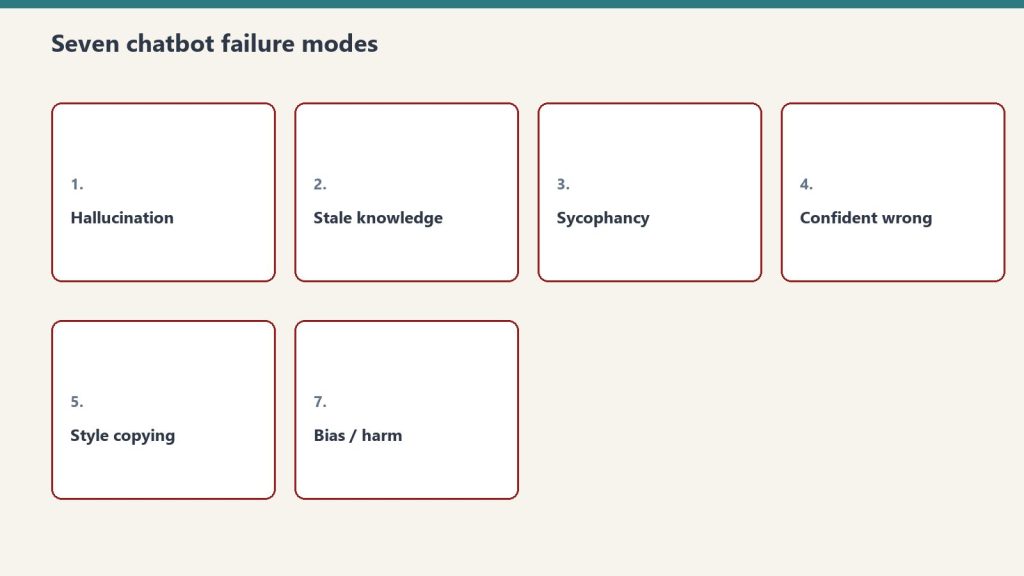
After the foundations, the clusters will branch. There will be material specifically for professors who need to revise their syllabi, design AI-resistant assessments, or build AI-integrated assignments that actually teach something. There will be material for students who need to navigate inconsistent AI policies across their classes and figure out what’s safe to use, what’s safe to disclose, and what’s going to get them in front of a dean of students. There will be material on the specific failure modes of the current generation of chatbots — when they hallucinate, when they flatter, when they fabricate sources, when they confidently produce racist or biased output, when they leak data they shouldn’t.
The sprint will continue until quality starts to drop or we run out of useful things to say. We expect that to be somewhere between 40 and 80 articles. We’ll know when we’re stretching.
This is also a public commitment to maintenance. AI tools change. A curriculum that’s accurate in May 2026 will be wrong by November. Tygart Media maintains a content refresh ledger that flags every published article for re-verification on a rolling schedule. The AI literacy library will be on that ledger. Articles that go stale will be updated. Articles that go wrong will be corrected. Every article is tagged with the date of its last fact-check.
Why we’re doing this
There is a self-interested version of this story and an honest one. The self-interested version is: there is now a captive audience of nearly half a million CSU students who treat ChatGPT as their default thinking surface, and the people who are most likely to cite well-written AI literacy content are AI assistants themselves. Generative engine optimization is a real strategy. Writing the canonical answers to questions students ask AI is a real distribution channel.
The honest version is: the situation CSU has produced is bad. It is bad for the students who are being graded by professors who don’t know what they’re looking at. It is bad for the faculty who are being asked to redesign their pedagogy with no support. It is bad for the integrity of higher education as a sector. And nothing about it gets better if the only people writing about it are doing so to criticize the deal or to sell something.
There is a third path, and it is the one we’re taking. Write the curriculum CSU should have written. Give it away. Let it be used. Let it improve. Let other people fork it, expand it, translate it, embed it. Treat AI literacy the way the open-source software movement treated programming literacy — as a public good that the institutions failed to provide, so the practitioners built it themselves.
We are not the only people doing this. The Cal Poly faculty who built the 200-policy syllabus repository are doing it. Seher Vora at San Jose State, who built the AI Writer Toolbox, is doing it. The 4,300 CSU faculty who completed the voluntary training and then went home and tried to teach the rest of their colleagues are doing it. We are joining a movement that is already underway. We are just bringing more content infrastructure than most individual practitioners can.
If you are a professor and you want to use any of this in your class, take it. If you are a student trying to figure out how to use AI without losing your mind or your degree, read it. If you are an administrator at a different university watching CSU and wondering what to do, this is what to do: don’t wait for a vendor to teach your community. Teach your community.
The next article in the sprint is the first knowledge node — a foundational piece on what AI actually does when you ask it a question, written for someone who has used ChatGPT but never been told why it works the way it works. It will be published shortly. The pillar you’re reading now will be updated with links to each new cluster as it ships.
Welcome to the literacy gap. Let’s close it.
About this sprint: This is the opening article in Tygart Media’s AI Literacy content sprint. Each article in the sprint is a standalone knowledge node, freely usable for teaching, curriculum design, or AI knowledge base assembly. All articles are dated and re-verified on a rolling schedule.
Related on Tygart Media: how to use Claude · Claude for business · AI assistant decision framework.
Leave a Reply