Related on Tygart Media: how to use Claude · Notion AI review.
The 60-second version
Most prompting advice was written for ChatGPT. ChatGPT prompts treat the AI as a blank-context entity that needs everything explained. Notion AI is different — it knows your workspace, so the right prompt patterns reference workspace structure rather than recreate it. Generic “act as an expert and provide a detailed analysis” prompts work poorly. Specific “read the project page X, summarize against rubric Y, output in format Z” prompts work well.
Five patterns that work in Notion specifically
1. Reference workspace structure explicitly.
“Read the [Project Name] page and the linked research database. Summarize key decisions in the format below.”
Better than: “Summarize this project.”
2. Pin sources by name.
“Using only content from the Q3 Strategy database and the Customer Interviews page, identify themes.”
Better than: “Identify themes from our research.”
3. Specify output structure with examples.
“Output as: [Decision], [Date], [Owner], [Status]. Example: ‘Switch CRM to HubSpot, 2026-03-15, Sarah, Approved’.”
Better than: “Format as a table.”
4. Constrain length per section.
“Five sections, two sentences each, in active voice.”
Better than: “Be concise.”
5. Reference style guides as named sources.
“Match the voice of the Tygart Media style guide page.”
Better than: “Use a professional tone.”
Three patterns that don’t work in Notion
1. Role-play prompts. “Act as an expert McKinsey consultant” produces generic consultancy-speak. Notion AI doesn’t need persona priming; it needs context priming.
2. Long preamble. “I am working on a project that involves…” is wasted tokens when the agent can read the project page directly.
3. Hypothetical scenarios. Notion AI works on workspace reality. Hypothetical prompts pull the agent away from the actual data.
The compound prompt pattern
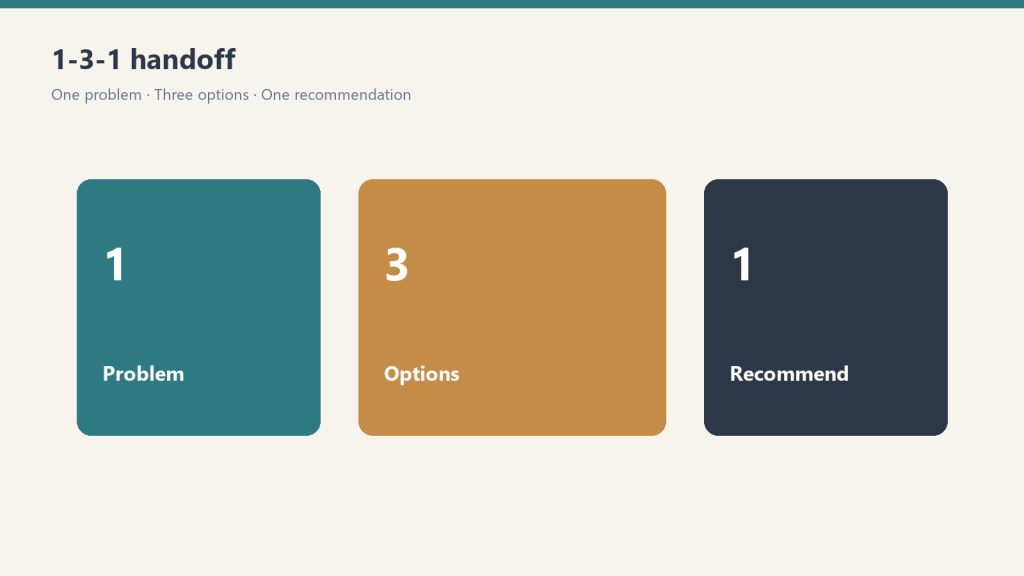
Effective complex prompts inside Notion stack three elements:
– Source pinning (which pages/databases)
– Task specification (what to do with the source)
– Output specification (format, length, sections)
A good prompt reads like a small specification. A bad prompt reads like a conversation starter.
Where this goes wrong
1. Importing ChatGPT habits. Long preambles and role-play priming hurt Notion AI more than they help.
2. Vague source references. “Our notes” is ambiguous; “the Customer Interviews database” is specific.
3. Output ambiguity. “Summarize” produces variance. “Five-section summary, two sentences each” produces consistency.
What to read next
How Notion Skills Work, Building Your First Skill, Auto Model Selection, Editorial Surface Area.
Leave a Reply