Related on Tygart Media: what Notion AI agents are · first Notion skill · Notion prompt patterns.
The 60-second version
Skills are how you stop re-prompting. If you find yourself typing the same instructions to your Notion Agent every Friday — “summarize this week’s project updates in our team format with a green/yellow/red status and an action items list” — that’s a skill waiting to be saved. Once captured, you call it by name and the agent runs the workflow. Skills became prominent with Notion 3.3 in February 2026 and they’re the bridge between “I have an AI assistant” and “I have an AI teammate that knows how we do things here.”
What a skill actually is
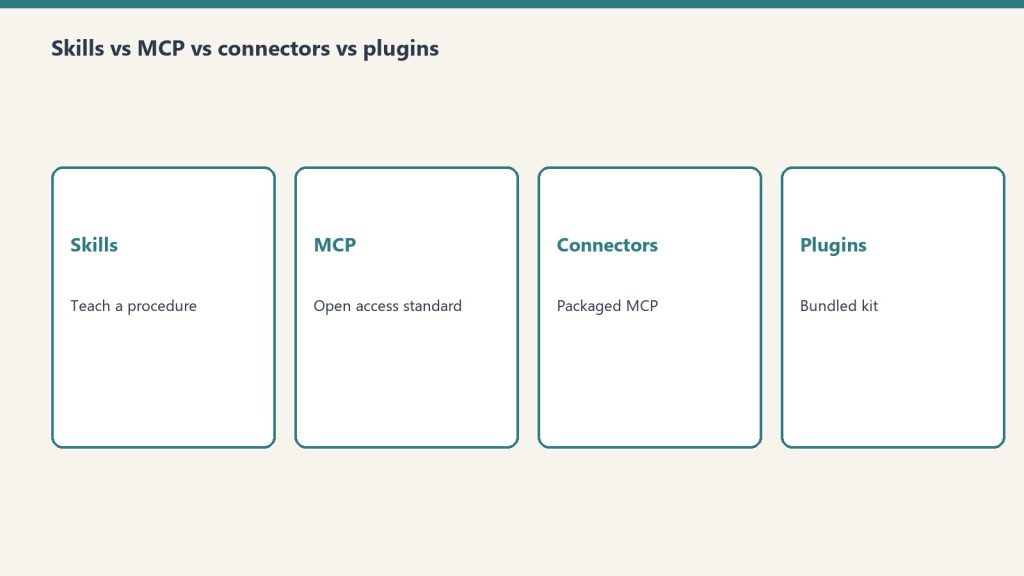
A skill is three things bundled:
1. A trigger phrase or name — what you call it when you want it run
2. The instructions — the prompt logic the agent follows
3. The context boundaries — which databases, pages, or sources the agent can pull from
That last piece is what separates a skill from a saved prompt. A saved prompt is just text. A skill is text with scope. The agent knows where to look, what format to produce, and which pages to update.
The four skills every operator should build first

If you’re new to skills, these four pay back the time investment within a week.
1. The weekly digest skill. Reads your project database, your meeting notes, and your Slack archive. Produces a one-page digest in your team’s format. Run it Friday afternoon. You stop writing weekly updates.
2. The brief-prep skill. Triggered before a meeting. Pulls the relevant project page, the last meeting notes with this person or team, any open action items, and synthesizes a one-page brief. Run it 30 minutes before the meeting. You stop showing up cold.
3. The inbox-to-action skill. Reads new entries in a specified database (support requests, sales leads, content pitches). Categorizes them, assigns owners based on rules you set, and drafts a first response. You stop processing inbound manually.
4. The doc-reshape skill. Takes any document and reformats it into your team’s house style — your headings, your sections, your tone. Solves the “we have great content from a partner but it doesn’t read like us” problem.
How to build a skill that actually works

Three rules, learned the hard way:
Be specific about format. “Summarize” produces wildly different outputs depending on the agent’s mood. “Produce a one-page summary with these five sections in this order, max two sentences per section, in active voice” produces consistent outputs. Specificity is the difference between a skill you trust and a skill you babysit.
Bound the context tightly. The temptation is to give the agent access to everything. The result is slower runs, more credits consumed, and outputs that pull from irrelevant sources. Pin the skill to specific databases or page trees. You can always expand later.
Test it five times before you trust it. Run the skill against five different inputs and look at the outputs side by side. The variance you see is the variance you’ll get in production. If the spread is too wide, tighten the instructions until the outputs converge.
What skills can’t do well yet
Skills inherit the limits of the underlying agent. They struggle with:
– Tasks that require fresh judgment. A skill that’s supposed to “decide whether this lead is qualified” produces inconsistent results because the criteria aren’t fully explicit. Better to have the skill score the lead on five named dimensions and let a human make the call.
– Long autonomous chains. A skill that triggers another skill that triggers another skill is a debugging nightmare. Keep skills atomic. Compose them in workflows outside the skill itself.
– Cross-workspace work. A skill in one Notion workspace can’t reach into another. If you operate across multiple workspaces, you need parallel skills, not one shared skill.
Skills and the May 3 cliff
After May 3, 2026, every Custom Agent run consumes Notion Credits. That includes skills run by Custom Agents. The implication: a well-built skill that takes 30 seconds to run is cheap; a sloppy skill that takes 8 minutes because the context isn’t bounded is expensive.
This is why “specificity” and “context boundaries” graduated from style advice to financial advice. Tight skills cost less. Sloppy skills bleed credits. The audit you should be doing on your skills before May 4 is the same audit you’d do on any line item: is the output worth the cost?
Leave a Reply