
What are the three digital priorities for a restoration company? Google Business Profile first, a service-by-sub-service-by-location website matrix second, disciplined review capture and advocacy third. Those three, done right, produce the organic asset that the entire rest of the marketing stack amplifies. A restoration company that nails the three-legged stool barely needs paid advertising.
When a claim happens at 2 AM, the sequence is predictable. Someone grabs a phone. Someone Googles. Someone calls the name at the top of the map pack or the first organic result that looks real. The digital presence of a restoration company is not a branding exercise. It is the difference between getting the call and being the fifth company on the list the homeowner considered.
The digital stack for a local or regional restoration company does not need to be complicated. It needs to be three things done well — Google Business Profile, a disciplined website architecture, and a review practice — stacked in that specific order.
Leg One: Google Business Profile
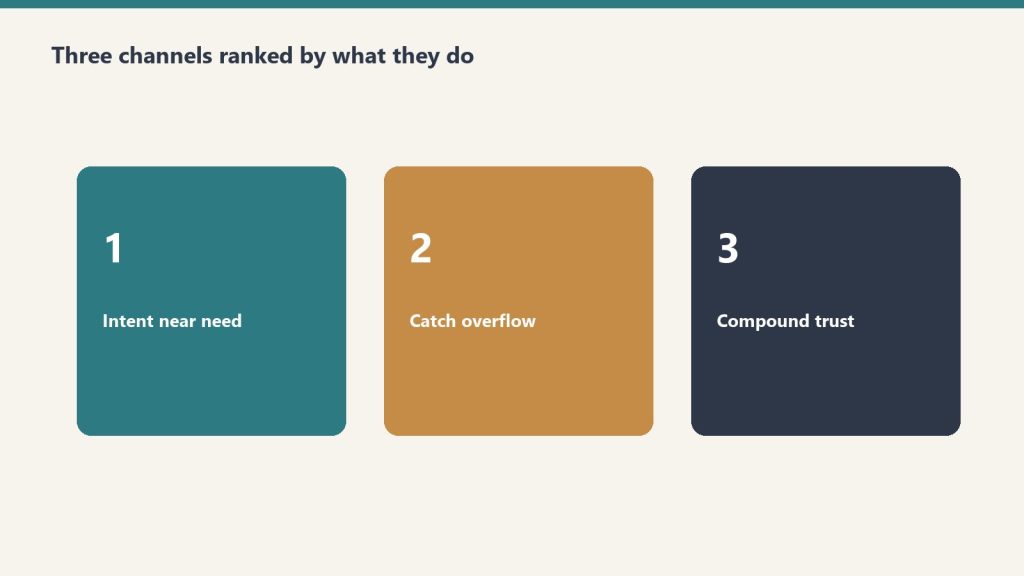
Google Business Profile is the first priority because it is the source of truth. Google uses it. Apple Maps syndicates from it. Bing pulls from it. Social platforms pull from it. AI chatbots and answer engines pull from it. Directory sites pull from it. When GBP is wrong, everything downstream is wrong.
A complete GBP is not just the business name and phone number. It is every service category fully populated, every service area defined, every attribute selected, hours accurate by day and for holidays, a full description written for both humans and semantic search, service menu listed out, products listed where applicable, photos from actual jobs updated regularly, posts published consistently, questions answered by the business, and reviews responded to consistently.
The companies that treat GBP as a set-up-once asset and move on miss most of what it can do. The companies that treat it as a living publishing channel — updating photos weekly, publishing posts, keeping the service menu current, answering questions in real time — dominate the map pack because they are feeding Google the freshness and completeness signals the algorithm is designed to reward.
Get The Signal
What we actually ran, what it measured, and what it means for a restoration shop — every week, including the flops.
The specific GBP treatment deserves its own deeper article, covered in the GBP playbook. What matters at the cluster level is this: GBP is the first digital priority, and it is never finished.
Leg Two: The Website Matrix
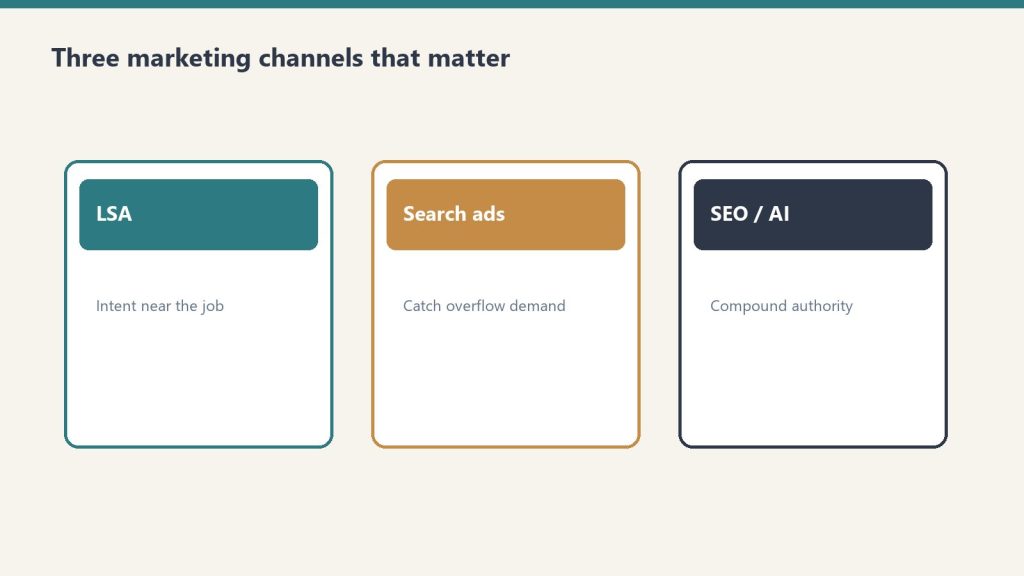
The restoration website has a specific architecture that most restoration sites miss. It is a matrix — every service, every sub-service, every location.
Think of it like a phone book. Someone in a specific neighborhood is looking for a specific service. The site needs to have a page that matches that exact query. Water mitigation in Edina. Mold remediation in Chanhassen. Fire cleanup in Houston Heights. Crawl space drying in Minneapolis. Contents cleaning in Deephaven.
The matrix is: – Top-level service pages (water, fire, mold, storm, contents, biohazard, reconstruction) – Sub-service pages under each (water: emergency extraction, structural drying, sewage cleanup, burst pipe, appliance leak, etc.) – Location pages for each service in each city or neighborhood served
The multiplication gets big quickly. A company with eight services, six sub-services each, and thirty locations served has a theoretical matrix of hundreds of pages. That sounds like a lot until you realize each page is genuinely useful to a genuinely different search query from a genuinely different potential customer.
The matrix is tough to build. It is neverending to maintain. That is the discipline. The companies that do it produce a site that functions like a complete local directory of their own services. Search engines index it that way. People find it that way.
The Neighborhood Page, Specifically
Inside the location layer of the matrix, there is one specific kind of page that compounds faster than the others: the neighborhood-specific job page built off of an actual completed job.
The pattern is simple. The tech finishes a job. While on-site, the tech takes photos — the work itself, the local area, the street sign, the neighborhood details, any distinctive local features (the park across the street, the coffee shop on the corner, the main street landmark). Those photos and the job description get turned into a page published that week.
A page titled “Water Mitigation in [Specific Neighborhood Name] — [Date]” with real photos, real job details, real neighborhood references, real before-and-after of the work, is a fundamentally different asset than a generic location page with stock photos. Google can tell the difference. More importantly, the next homeowner in that neighborhood who Googles the service finds a page that proves you actually work there.
This is the anti-fabrication content doctrine applied to local SEO. The neighborhood page strategy is covered in detail in the companion article. The key point here: real jobs, real photos, real place, published within a week.
Leg Three: Reviews
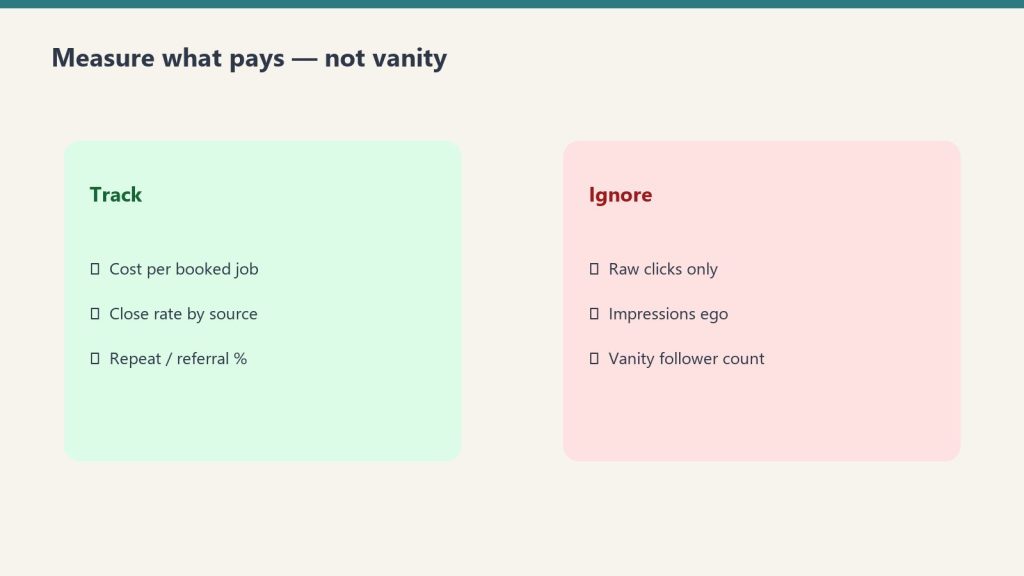
The third leg is reviews, and specifically the practice of turning satisfied clients into advocates rather than hoping they leave one unprompted.
Review quantity matters. Review recency matters more. Review star average matters most. A company with 400 reviews averaging 4.9 over five years beats a company with 90 reviews averaging 4.6 with the most recent one eight months ago. The algorithm rewards freshness and consistency.
The practice that produces the reviews is specific. Every completed job ends with an ask, done in a way that feels natural rather than scripted. The ask is routed to the client in the way they prefer to respond — a text link, an email follow-up, a card with a QR code, whatever fits. The response is tracked. The stars are noted.
And this is where the discipline gets interesting: staff compensation should be navigated and bonused partially based on the stars the customer gives. Not as a punitive measure on bad reviews. As a positive reinforcement on good ones. A tech who consistently produces five-star customer experiences is creating a different asset than a tech who produces four-star experiences — even if both are technically competent — and the comp structure should reflect that. The reviews-as-compensation-driver article goes deeper on the mechanics.
When those three levers are working together — asking at the right moment, making the submission frictionless, and tying staff comp to the outcome — review velocity builds without feeling forced. The company becomes the one with the most recent, highest-rated reviews in its service area, and that pulls every downstream digital metric with it.
Why These Three Are Enough
A restoration company with a fully developed Google Business Profile, a complete service-by-location website matrix with real neighborhood pages, and a disciplined review practice with staff incentives attached, can operate a profitable local restoration business without meaningful paid advertising spend.
That is a contrarian statement. Most marketing consultants sell paid advertising as a core layer rather than an amplifier. Their incentive is to run more budget through more channels, because that is how their businesses scale. A restoration company’s incentive is to build an asset, not a spend.
The three-legged stool is the asset. Paid — covered in the organic-asset-paid-rent article — is what you do once the asset exists, not what you do while trying to build it.
Skipping the stool to run paid is how restoration companies end up paying for leads in perpetuity, at rising costs, with nothing to show for the spend once the budget stops. Building the stool first produces an engine that works whether you ever spend a paid dollar or not.
The Order Matters
These are three legs of the same stool, but they are built in a specific order.
GBP first because it is the cheapest to complete, the fastest to produce returns, and the foundation every other digital asset pulls from. Get the profile to 100 percent complete and keep it updated before anything else.
Website matrix second because it is the deepest investment and takes the longest to compound. The first thirty location pages do not move much. The two hundredth location page is when the site starts to dominate. Start early, commit to the slow compound.
Reviews third — not because they are less important, but because the infrastructure to capture them (the ask, the submission process, the staff incentive) is easier to install once the company has a GBP to receive them and a site to link to them.
All three at once if possible. In order if not.
Where to Start
If your company does not have a complete, regularly updated GBP, that is the project this month.
If GBP is complete but the website does not cover every service by every sub-service by every location you actually serve, the site expansion is the quarterly investment. Start with the highest-volume service lines and the biggest service areas first.
If reviews are incidental rather than systematic, install the review ask into the job close-out SOP this week. Tie a staff bonus mechanic to the outcome next quarter once the volume is flowing.
None of these are glamorous. All of them produce the organic asset that the rest of the marketing stack multiplies.
Frequently Asked Questions
What is the most important digital asset for a restoration company? Google Business Profile. It is the source of truth that every other platform — maps, social, AI search engines, directory sites — pulls from. Everything downstream depends on GBP being accurate, complete, and actively maintained.
How should a restoration company structure its website? As a matrix: every service, every sub-service under each service, every location served. A company with eight services, six sub-services each, and thirty locations served has hundreds of legitimate pages. Each page matches a specific search query from a specific potential customer.
What is a neighborhood page? A page specifically about a completed job in a specific neighborhood, with real photos from the job site, real neighborhood references, and real before-and-after detail. Built after the job, published that week. Proves the company actually works in that area to both search engines and homeowners.
How many reviews does a restoration company need? Quantity matters less than recency and star average. A company with 400 reviews averaging 4.9 over five years beats a company with 90 reviews averaging 4.6 with a gap in recent reviews. The practice is consistent capture forever, not a one-time push.
Should reviews be tied to staff compensation? Yes. Techs who consistently produce five-star customer experiences are creating a different asset than techs who produce four-star ones. Tying comp to review outcomes — positively, not punitively — reinforces the behavior that produces the reviews.
Is the digital three-legged stool enough to skip paid advertising? For most local restoration companies, yes. A complete GBP, a full location matrix, and a disciplined review practice will produce enough organic lead flow to run a profitable business. Paid is appropriate as amplification once the asset exists, not as a substitute for building it.
Tygart Media on restoration — an analyst-operator body of work on the systems that separate compounding restoration companies from busy ones. No client names. No brand placements. Just the operating standard.
Get The Signal
What we actually ran, what it measured, and what it means for a restoration shop — every week, including the flops.
Leave a Reply