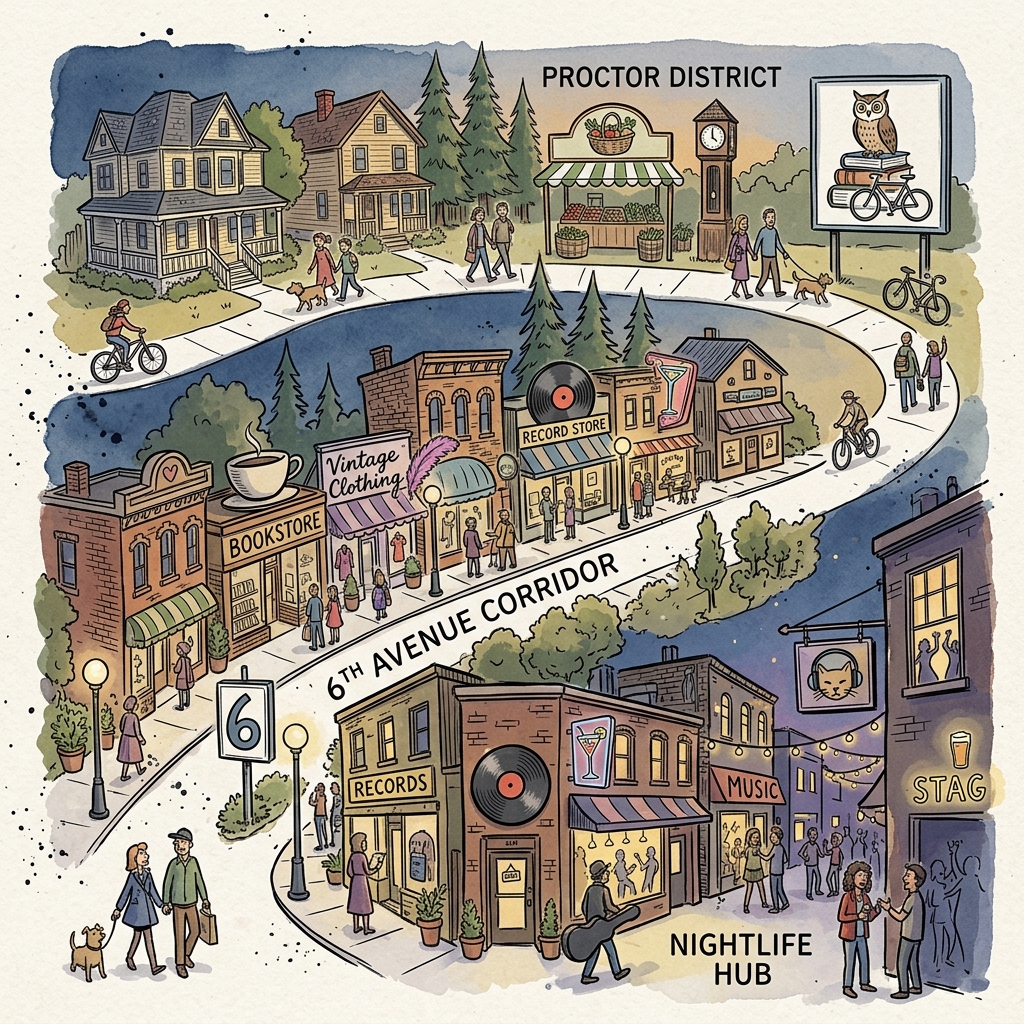
Two Neighborhoods, One Corridor, Completely Different Energy
Tacoma’s 6th Avenue runs east-west through the city’s central residential core, but two distinct commercial districts sit along it — and they could hardly be more different. The 6th Avenue business district (roughly between Sprague and Alder) is Tacoma’s nightlife strip: dive bars, music venues, late-night food, tattoo shops, vintage stores. The Proctor District (centered on North 26th and Proctor Street, about a mile north) is family-friendly: bookstores, bakeries, a farmer’s market, yoga studios. Together they represent the full spectrum of Tacoma’s independent business culture.
6th Avenue: The Independent Strip
6th Avenue between Sprague Avenue and Alder Street is Tacoma’s densest concentration of independent, non-chain businesses. The commercial district stretches about 15 blocks and is characterized by small storefronts, minimal corporate presence, and a character that feels more like a neighborhood in Portland than anything in the Seattle metro.
The strip’s identity is built on several categories:
Bars and nightlife: The Red Hot, Doyle’s Public House, The Spar, Bob’s Java Jive (the iconic coffee-pot-shaped building), Jazzbones — these establishments form Tacoma’s primary going-out corridor. On weekend nights, the 6th Ave bar scene draws from across Pierce County. The vibe is decidedly unpretentious — this is not Capitol Hill pricing or attitude.
Music venues: Several bars along 6th Ave host live music regularly, making this corridor Tacoma’s de facto music scene hub for local and touring indie/punk/rock acts. The venues are small (100-300 capacity) which means intimate shows and low cover charges.
Independent retail: Vintage clothing stores, record shops, used bookstores, comic shops, and local art galleries. The rent structure on 6th Ave has historically been low enough to support businesses that would be priced out of Seattle’s commercial corridors.
Food: The restaurant mix on 6th Ave ranges from late-night pizza and teriyaki to legitimate sit-down options. It’s not a fine-dining destination — it’s a neighborhood food corridor with emphasis on affordable, unpretentious, and open late. Several food spots specifically target the post-bar crowd.
The Proctor District: Family-Friendly Independent
About a mile north of 6th Avenue’s bar district, the Proctor District occupies the intersection of North 26th Street and Proctor Street. The character here is 180 degrees from 6th Ave: daytime-oriented, family-friendly, and anchored by retail that serves the residential neighborhoods surrounding it.
Key anchors of the Proctor District:
Blue Mouse Theatre — A single-screen independent cinema that has operated since 1932, showing second-run films at discount prices. It’s a genuine community institution and one of the oldest continuously operating theaters in Washington State.
Proctor Farmer’s Market — Operates Saturdays during growing season (typically April through October) in the parking area near the district center. Farm-direct produce, prepared foods, flowers, and local crafts. Smaller than the larger Tacoma Farmers Market but more neighborhood-scale and walkable for North End residents.
Independent bookstore, bakeries, coffee shops — The district supports businesses that explicitly serve a residential neighborhood: places where you walk from your house, get a coffee, browse books, pick up bread, and walk home. This is buy-local culture at its most functional.
Why They Work: The Rent Advantage
Both 6th Avenue and Proctor maintain their independent character for a structural reason: commercial rents are substantially lower than equivalent locations in Seattle. A storefront that might cost $35-50/sq ft in Seattle’s neighborhoods leases for $18-28/sq ft on 6th Avenue or in Proctor. This gap allows businesses with thinner margins — bookstores, record shops, single-owner restaurants — to survive in a way they increasingly cannot in King County.
The City of Tacoma has designated both corridors as priority areas for small business support, including facade improvement grants and streamlined permitting for independent operators. Whether this preferential treatment will survive as property values rise (particularly near the light rail extension zones) is a live question.
Getting There and Parking
Both districts are served by Pierce Transit bus routes. 6th Avenue is served by Route 1 (one of Pierce Transit’s highest-frequency routes). The Proctor District is accessible via Routes 2 and 13.
Street parking is free in both districts — no meters, no time limits outside of a few rush-hour restrictions on 6th Avenue itself. This is another advantage over Seattle’s commercial districts and a deliberate policy choice by the city. Small parking lots exist behind some businesses in both districts.
What Locals Debate
The ongoing conversation on r/Tacoma and in community forums: can 6th Avenue maintain its dive-bar independent character as Tacoma’s overall cost of living rises? New development along the corridor (apartments replacing single-story commercial) threatens to change the rent structure that enables marginal businesses. Proctor faces the same pressure from a different angle — rising residential values around it push commercial rents upward.
For now, both districts remain intact and independently-operated in character. But anyone who’s watched similar corridors in Portland or Seattle knows the pattern. The next five years will determine whether Tacoma’s growth manages to sustain these commercial ecologies or compress them.
Frequently Asked Questions
What’s the difference between 6th Avenue and the Proctor District?
6th Avenue is Tacoma’s nightlife and independent retail strip — bars, music venues, vintage shops, late-night food. The Proctor District is family-oriented — bookstores, bakeries, a farmer’s market, and the Blue Mouse Theatre. Same city, completely different energy and hours of operation.
Is 6th Avenue in Tacoma safe at night?
The commercial strip is generally safe during business hours and bar hours due to consistent foot traffic. Like any nightlife district, basic urban awareness applies late at night. The area is well-lit along the main corridor and populated until bar close (2 AM). Side streets are residential and quiet.
Does Tacoma have good nightlife?
Yes, centered on 6th Avenue. The strip offers dive bars, craft cocktail spots, live music venues, and late-night food within a 15-block walkable corridor. It’s unpretentious, affordable compared to Seattle, and locally-owned throughout. Not a club scene — more of a pub/music venue culture.
What is the Blue Mouse Theatre in Tacoma?
The Blue Mouse Theatre is a single-screen independent cinema in the Proctor District that has operated continuously since 1932. It shows second-run films at discount prices and is one of the oldest operating movie theaters in Washington State. It’s a neighborhood institution.
Is there free parking on 6th Avenue in Tacoma?
Yes. Street parking along 6th Avenue and in the Proctor District is free — no meters and no time limits outside of a few rush-hour restrictions. This is a deliberate city policy that helps support the independent business character of both districts.
Leave a Reply