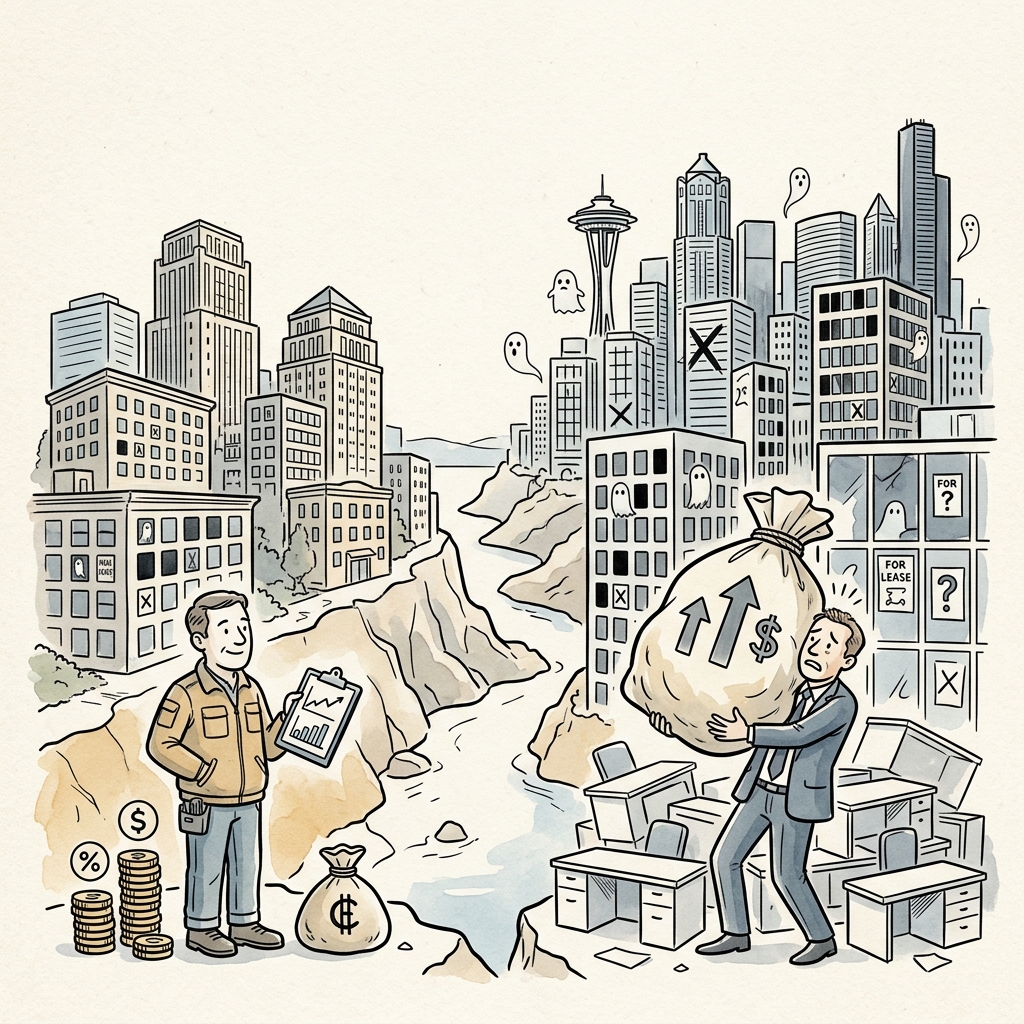
Here’s a number that should get every commercial real estate operator’s attention: Tacoma’s central business district office vacancy sits at approximately 18.5%, while Seattle’s downtown vacancy has ballooned past 35%. If you’re an investor, a value-add fund, or an adaptive reuse developer, Tacoma’s cost basis tells a completely different story than what you’ll find 30 miles north — and the spread is widening.
The Vacancy Gap Is Structural, Not Cyclical
Seattle’s office market collapse isn’t a blip. The combination of remote work permanence at major tech employers, the departure of companies like Amazon shifting workers to other metros, and a 2019-era construction pipeline that delivered millions of square feet into a market that no longer needs them has created a structural oversupply problem. The City of Seattle’s own economic data shows office-dependent foot traffic downtown remaining 30-40% below pre-pandemic levels.
Tacoma is different. The CBD never had the same concentration of tech-sector office tenants that drove Seattle’s bubble. Tacoma’s tenant base is more diversified: government agencies (federal, state, county, and city offices), healthcare systems, law firms, financial services, and the military-adjacent professional services sector tied to Joint Base Lewis-McChord. These are tenants that require in-person operations and aren’t going fully remote.
The Cost Basis Story
According to data from CoStar and local brokerage reports, Class B office space in Tacoma’s CBD trades at $150-$250 per square foot — roughly 40-60% below comparable Seattle CBD product. Lease rates follow the same pattern: $22-$32 per square foot full-service in Tacoma versus $38-$55+ in Seattle’s core.
For adaptive reuse operators, this cost basis creates a fundamentally different project math. Converting a 50,000 SF Class B office building to mixed-use (ground floor retail, upper floors residential or creative office) in Tacoma means acquiring the asset at a fraction of what the same conversion costs in Seattle, while serving a market with genuine demand for housing and experiential retail.
The City of Tacoma Planning and Development Services department has been actively encouraging adaptive reuse through streamlined permitting for conversions and the Multi-Family Tax Exemption (MFTE) program that provides 8-12 year property tax exemptions for qualifying residential projects in designated areas including downtown.
What’s Already Converting
Tacoma’s adaptive reuse wave isn’t theoretical — it’s happening. The Stadium District and downtown core have seen multiple conversions of older office and commercial buildings to residential, boutique hospitality, and mixed-use projects over the past five years. The economics work because the acquisition cost is low enough that conversion costs (typically $80-$150 PSF for office-to-residential depending on mechanical systems) still produce viable total project costs.
The Tacoma downtown submarket benefits from genuine walkability, proximity to the University of Washington Tacoma campus, Sound Transit Link light rail connectivity, and a restaurant/entertainment scene that has matured significantly since 2018. These are the demand drivers that make conversions pencil — tenants and residents actually want to be there.
Why the Spread Will Widen
Seattle’s vacancy problem is self-reinforcing. As buildings empty, ground-floor retail suffers, which reduces foot traffic, which makes remaining tenants less likely to renew. The tax base erodes, leading to service cuts that further reduce downtown’s attractiveness. Seattle’s CBD is entering a doom loop that will take years to stabilize.
Tacoma, conversely, has natural demand floors. Pierce County government operations aren’t leaving downtown. The federal courthouse isn’t relocating. The healthcare systems serving South Sound aren’t going remote. This institutional demand provides a vacancy floor that Seattle’s tech-dependent market lacks.
Additionally, Pierce County population growth continues to outpace available housing supply, creating sustained residential conversion demand. The Puget Sound Regional Council projects continued in-migration to Pierce County through 2040, driven by relative affordability compared to King County.
The Operator Playbook
For CRE operators looking at Tacoma, the playbook is straightforward: acquire Class B or C office assets in the CBD or Stadium District at current basis ($150-$250 PSF), evaluate adaptive reuse feasibility (the City’s permitting team is responsive and experienced with conversions), and target the residential/mixed-use end state that the market actually demands.
The risk is low relative to Seattle. You’re not buying at a $400+ PSF basis hoping that tech workers return to offices. You’re buying at a basis that works even if the property stays partially office — and becomes highly profitable if you convert to the higher-demand use.
Tacoma isn’t Seattle’s cheaper alternative. It’s a market with better fundamentals, lower basis, diversified demand, and a local government that actively supports adaptive reuse. The 18.5% vs 35.6% vacancy spread is the headline, but the real story is what it tells you about where the smart money should deploy next.
FAQ
What is Tacoma’s current CBD office vacancy rate compared to Seattle?
Tacoma’s central business district office vacancy sits at approximately 18.5%, while Seattle’s downtown vacancy exceeds 35%. This spread reflects structural differences in tenant composition rather than a temporary market fluctuation.
What incentives does Tacoma offer for adaptive reuse projects?
The City of Tacoma offers the Multi-Family Tax Exemption (MFTE) program providing 8-12 year property tax exemptions for qualifying residential projects in designated areas, streamlined permitting for office-to-residential conversions, and an experienced planning department that actively supports adaptive reuse development.
What does Class B office space cost in Tacoma versus Seattle?
Class B office space in Tacoma’s CBD trades at approximately $150-$250 per square foot, which is 40-60% below comparable Seattle CBD product. Lease rates in Tacoma run $22-$32 per square foot full-service versus $38-$55+ in Seattle’s core.
Why is Tacoma’s vacancy rate more stable than Seattle’s?
Tacoma’s tenant base is diversified across government agencies, healthcare systems, law firms, and military-adjacent professional services — sectors that require in-person operations and aren’t adopting full remote work. This creates a natural demand floor that Seattle’s tech-dependent market lacks.
What types of adaptive reuse projects work best in Tacoma’s market?
Office-to-residential conversions and mixed-use projects (ground floor retail, upper floors residential or creative office) show the strongest economics. The low acquisition basis ($150-$250 PSF) combined with conversion costs of $80-$150 PSF produces viable total project costs in a market with genuine housing demand.
Leave a Reply