Tag: Public Works

  • Everett Just Voted to Study Annexing Mariner: What the $200,000 Decision Actually Means

    Everett Just Voted to Study Annexing Mariner: What the $200,000 Decision Actually Means

    Q: What did the Everett City Council vote on April 8, 2026?

    A: The council approved a $250,000 budget amendment — $200,000 to fund a consulting study of potential annexation (with south Everett’s Mariner neighborhood as the top priority) and $50,000 for a subarea plan and community outreach in the Casino Road neighborhood. The Mariner area alone has roughly 21,000 residents, and Everett’s full urban growth area — the land the state already considers part of the city’s future footprint — contains about 47,690 people.

    Everett Just Voted to Study Annexing Mariner: What the $200,000 Decision Actually Means

    On Wednesday, April 8, 2026, the Everett City Council approved a $250,000 budget amendment that does two things most residents will hear very little about — but that could reshape the city more than any single vote in a decade. The bigger piece, $200,000, funds a consulting study of whether Everett should annex parts of its urban growth area, with the Mariner neighborhood in south Everett as Mayor Cassie Franklin’s stated top priority. The smaller piece, $50,000, will pay for community outreach and a subarea plan for the Casino Road neighborhood in 2026 and 2027.

    City spokesperson Simone Tarver called the vote “just a first step in the process.” That is a fair description. No one got annexed on April 8. No city boundaries moved. What moved is the starting line.

    Why This Vote Matters Even Though Nothing Changes on the Map

    Annexation — the legal process by which a city absorbs unincorporated county land and the residents on it — is one of the slowest-moving municipal decisions in Washington. It typically requires a study, a state boundary review, negotiations with Snohomish County over which city services replace which county services, fiscal modeling of whether the new revenue covers the new costs, and usually some form of voter approval. Everett last tried a large annexation in 2008 and abandoned the effort, citing the cost of providing services to the new areas.

    What the April 8 vote does is reopen that door. The $200,000 contract will hire a consulting firm to answer the questions Everett could not answer in 2008: would annexation actually pay for itself through property tax revenue and state-issued sales tax credits, or would it deepen an already difficult budget picture? City staff have said they look forward to “having more specifics to share as the progress moves forward.”

    What’s Actually in the Mariner Area

    The Mariner neighborhood sits mostly west of Interstate 5, south of the current Everett city limits. It includes portions of 4th Avenue West, Airport Road and 128th Street SW. About 21,000 people live there today. It is also home to Mariner High School, a Sno-Isle Libraries branch, several busy bus routes and — critical to the annexation math — a planned Sound Transit light rail station on the Everett Link Extension.

    During her State of the City address on March 6, Franklin singled out two Mariner-area landmarks as symbolic of the case for annexation: Mariner High School and the Dicks Drive-In location on Highway 99. “They have Everett addresses but don’t yet benefit from the full range of city services,” the mayor said, describing residents of the broader urban growth area. Eastmont, southeast of the current city, is also in scope for the study.

    If Everett ultimately annexed the full 47,690-person growth area, the city’s population would climb from roughly 111,000 today to about 159,000 — a roughly 43 percent increase. That scale of change is why Franklin has used the phrase “One Everett” to frame the idea publicly.

    What Mariner Residents Would and Wouldn’t Get

    Residents of unincorporated Snohomish County currently receive some services from the county (sheriff’s office patrol, county roads, county parks, some planning) and some from special districts (fire, water, library). Annexation generally transfers the county-provided services to the city, while special district services often continue under new contracts or are folded into city operations.

    In Everett’s case, that would mean the Everett Police Department — not the Snohomish County Sheriff’s Office — would patrol Mariner. Everett Public Works would take over local roads. Sno-Isle Libraries, which runs the Mariner branch today, would negotiate with the Everett Public Library system. Zoning, permitting, parks programming and neighborhood engagement would all shift to the city.

    The tax picture is where it gets complicated, and why the city is paying $200,000 to find out. Annexed residents would pay Everett’s property tax rate instead of the county’s, though Washington’s levy limits and the potential for state-issued sales tax credits (available to cities annexing more than 10,000 residents at once) change the net picture. The study is expected to model several scenarios, including a full Mariner annexation, a partial annexation, and leaving the status quo in place.

    The $50,000 Casino Road Piece

    The smaller half of the budget amendment is arguably more concrete in the short term. The $50,000 subarea plan for Casino Road — the diverse, densely populated corridor south of 41st Street that is already inside city limits — funds community engagement and land use planning in 2026 and 2027.

    Casino Road is already part of Everett. The subarea plan will update how the city zones, invests in and delivers services to the neighborhood. For residents, the practical output is a year of outreach meetings, surveys and planning workshops, followed by a land use plan that feeds into future decisions about housing, commercial corridors and public investment.

    How This Connects to Everett’s Bigger Fiscal Picture

    The annexation study does not exist in a vacuum. City finance staff have projected a $14 million general fund shortfall for the 2027 budget — a larger gap than the $12.6 million 2024 deficit that forced 31 layoffs and the 2024 property tax levy lid lift ballot measure that voters rejected.

    Franklin has publicly framed annexation as one lever among several in Everett’s structural revenue challenge. “We cannot cut our way to a sustainable future,” she said during the March 6 keynote speech, citing the need for “economic growth and new pathways to long-term, sustainable revenue.” Other levers on the table for the 2027 budget include regionalizing fire and library services, selective service cuts and another attempt at a property tax levy lid lift — all of which would require voter approval.

    What Happens Next

    With the budget authority approved, the city will now seek a contractor for the annexation study. A typical scope of work would include boundary analysis, demographic and fiscal modeling, a service cost assessment, community outreach in the target areas, and a final report with recommended paths forward. Based on Everett’s stated timeline for the Casino Road subarea plan — “roughly one year to complete” — residents should not expect a completed annexation study before late 2026 or early 2027.

    Any actual annexation would be a separate decision, almost certainly requiring a ballot measure either in the annexed area or citywide, depending on the method chosen. State law offers several annexation mechanisms — petition method, election method and interlocal agreement — each with different rules about who votes and what share of support is required.

    For Mariner residents watching from the other side of the line, April 8 did not change their mailing address or their tax rate. It moved the question from the shelf to the desk. That, for Everett’s civic calendar, is news.

    Frequently Asked Questions

    When did the Everett City Council approve the annexation study funding?

    The council approved the $250,000 budget amendment on Wednesday, April 8, 2026. It allocates $200,000 for an annexation study and $50,000 for a Casino Road subarea plan.

    Which area of Everett might be annexed first?

    Mayor Cassie Franklin has identified the Mariner neighborhood in south Everett as the top priority. Mariner has about 21,000 residents, sits mostly west of I-5, and includes Mariner High School, a library branch and a planned Sound Transit light rail station.

    How many people live in Everett’s urban growth area?

    Roughly 47,690 people live in Everett’s full urban growth area, which includes the Mariner and Eastmont regions. Annexing all of it would raise Everett’s population from about 111,000 to about 159,000.

    Does the vote mean Mariner is now part of Everett?

    No. The vote only funds a study. Any actual annexation would require additional steps, including a state boundary review, fiscal analysis, and in most cases a ballot measure before boundaries could change.

    Will Mariner residents’ taxes go up if annexation happens?

    That is one of the questions the $200,000 study is designed to answer. Annexation would change residents’ property tax rate from Snohomish County’s to Everett’s, and Everett could qualify for state-issued sales tax credits available to cities annexing more than 10,000 residents. The study will model several scenarios.

    Why is Everett considering annexation now?

    City finance staff project a $14 million general fund deficit in the 2027 budget. Mayor Franklin has described annexation as one of several levers — alongside regionalizing services and another potential levy lid lift — for closing the structural revenue gap.

    What happens to the Casino Road part of the budget amendment?

    The $50,000 will fund community outreach and a land use subarea plan for the Casino Road neighborhood through 2026 and 2027. Casino Road is already inside Everett city limits — the subarea plan will guide future city investment and zoning decisions there.

    When will the annexation study be finished?

    The city has not published a final timeline. Based on comparable planning timelines cited by city staff, a completed study is most likely in late 2026 or early 2027. Any annexation election would follow from there.

  • Everett’s New Edgewater Bridge Adds Bike Lanes and Sidewalks for the First Time: What Cyclists and Pedestrians Need to Know

    Everett’s New Edgewater Bridge Adds Bike Lanes and Sidewalks for the First Time: What Cyclists and Pedestrians Need to Know

  • SR-3 Closure, Gorst Roundabout, and the Belfair Bypass Delay: What Every North Mason Commuter Needs to Know in 2026

    SR-3 Closure, Gorst Roundabout, and the Belfair Bypass Delay: What Every North Mason Commuter Needs to Know in 2026

    If you drive SR-3 between Belfair and Bremerton, 2026 is going to test your patience. Three overlapping infrastructure projects — a 16-day full road closure near Gorst, a new roundabout at the SR-3/SR-16 Spur intersection, and the politically uncertain Belfair Bypass — will reshape how North Mason residents get to PSNS, Bangor, and everywhere south of Gorst. Here’s what’s actually happening, when, and what it means for your daily drive.

    The 16-Day SR-3 Closure: Fish Barrier Removal Near Gorst

    WSDOT’s fish barrier removal project on SR-3, SR-16, and SR-166 near Gorst will require a complete closure of SR-3 for up to 16 consecutive days during summer 2026. Crews will remove a section of the highway near Sunnyslope Road Southwest and install a new 150-foot-long box culvert to restore fish passage.

    This is not a lane restriction. This is a full road closure — no through traffic on SR-3 at that location for over two weeks.

    Early work starts in April 2026 with nighttime lane closures at two locations for utility relocations and limited vegetation removal. The 16-day closure itself is scheduled for summer, though WSDOT has not yet locked the exact dates.

    Detour Routes During the SR-3 Closure

    WSDOT has published three signed detour routes:

    • Passenger vehicles: Sunnyslope Road Southwest to Southwest Lake Flora Road
    • Pedestrians, cyclists, and those who roll: Northeast Old Belfair Highway to West Belfair Valley Road
    • Commercial vehicles: SR-16 to SR-302 (a significantly longer route)

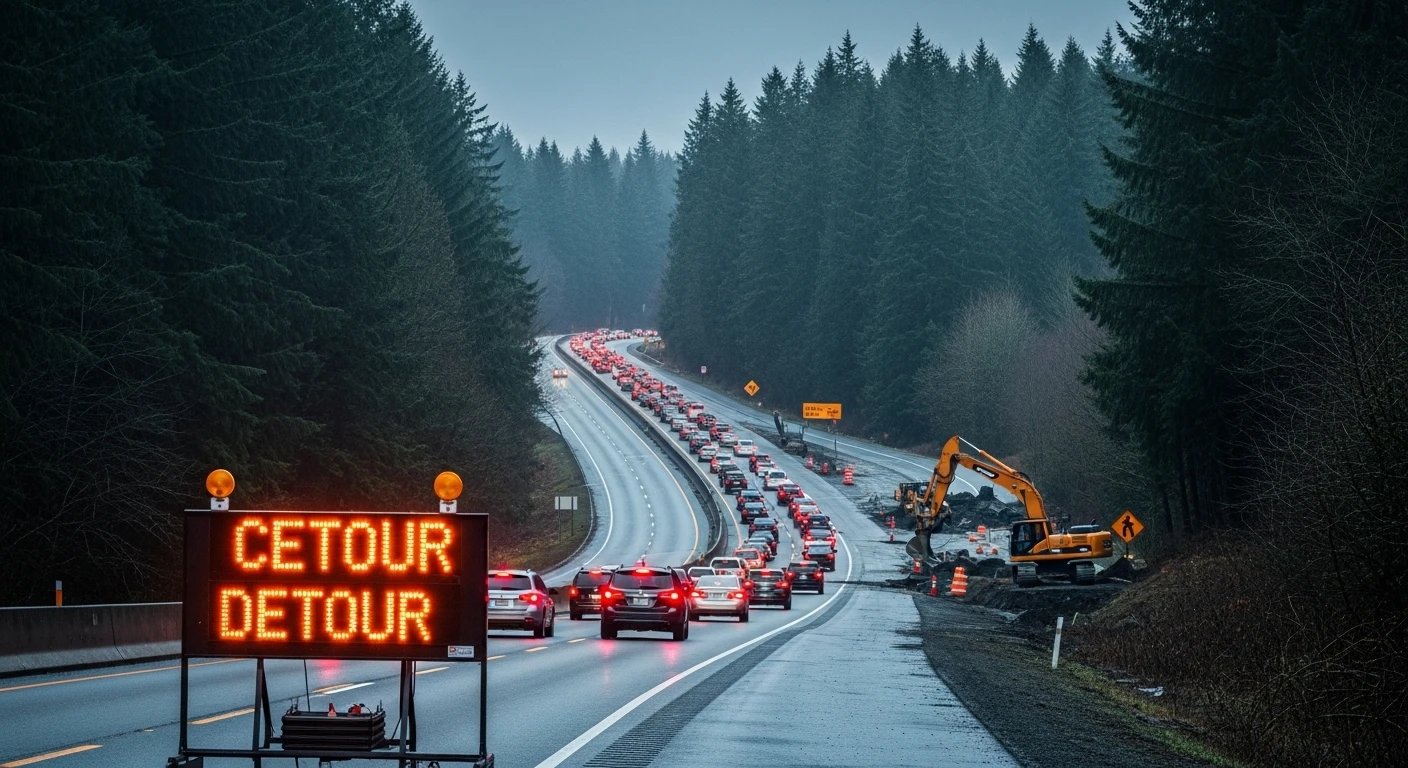
    For PSNS commuters leaving Belfair at 6 AM, the Sunnyslope/Lake Flora detour adds approximately 15-25 minutes depending on traffic volume. During shift changes — particularly the 7 AM gate surge — expect these detour roads to carry far more traffic than they were designed for.

    The New Gorst Roundabout

    As part of the same project, WSDOT will construct a new roundabout at the intersection of SR-3, SR-16 Spur, and West Sam Christopherson Avenue. This intersection has been an accident cluster point for decades, and the roundabout is designed to reduce collision potential and improve traffic flow.

    For daily commuters, the roundabout should eventually smooth the stop-and-go pattern that defines Gorst. But during construction, expect lane shifts, temporary signals, and reduced speeds through the area.

    The Belfair Bypass: Delayed or Dead?

    The SR-3 Freight Corridor — commonly known as the Belfair Bypass — was a 6-mile new alignment designed to route regional through-traffic around Belfair’s commercial corridor rather than through it. The Federal Highway Administration issued a Finding of No Significant Impact (FONSI) in November 2024, and construction was originally planned to begin in spring 2026 with completion by 2028.

    Then Governor Bob Ferguson’s proposed transportation budget pushed the project’s funding to the 2031-33 biennium. As reported by the Mason County Journal in February 2026, this delay could push the bypass back by five years or more.

    For North Mason commuters, this means the Belfair commercial corridor — SR-3 through town — remains the only route. The 18,000+ daily vehicle count through Belfair’s main stretch will continue growing without relief.

    What This Means for Your Daily Drive

    If you commute from Belfair to PSNS or Bangor:

    • Plan now for the 16-day closure. If your shift schedule allows flexibility, consider adjusting during the closure window. Carpooling through the detour reduces vehicle volume on roads not built for this traffic.
    • The Sunnyslope/Lake Flora detour is narrow. These are rural roads. Two large trucks passing in opposite directions will slow everything down.
    • Gorst roundabout construction will overlap. Even after the 16-day closure ends, expect reduced capacity through Gorst for months as the roundabout is built.
    • The Belfair Bypass is not coming soon. Don’t make housing or commute decisions based on the bypass being operational by 2028. The current political reality suggests 2033 at the earliest.

    Related Belfair Bugle Coverage

    For more context on commuting from North Mason, see our complete guide to commuting from Belfair to PSNS, our military families in Belfair guide, and the latest commuter alert.

    Frequently Asked Questions

    When exactly will SR-3 be fully closed near Gorst in 2026?

    WSDOT has confirmed the closure will last up to 16 consecutive days during summer 2026. Early utility work begins in April 2026 with nighttime lane closures. The exact summer closure dates have not been finalized — check WSDOT’s SR-3 project page for updates.

    What is the best detour route from Belfair to PSNS during the SR-3 closure?

    For passenger vehicles, WSDOT’s signed detour uses Sunnyslope Road Southwest to Southwest Lake Flora Road. This adds approximately 15-25 minutes to a typical Belfair-to-Bremerton commute depending on traffic volume during the closure.

    Is the Belfair Bypass still being built in 2026?

    The SR-3 Freight Corridor (Belfair Bypass) received federal environmental approval in November 2024, but Governor Ferguson’s proposed transportation budget delays construction funding to the 2031-33 biennium. Construction originally planned for spring 2026 is now unlikely before 2033.

    Will the new Gorst roundabout help PSNS commuters from Belfair?

    Yes, long-term. The roundabout at SR-3, SR-16 Spur, and West Sam Christopherson Avenue replaces a collision-prone intersection. Once completed, it should reduce stop-and-go delays through Gorst. During construction, expect temporary lane shifts and reduced speeds.

    How many vehicles use SR-3 through Belfair daily?

    SR-3 through Belfair’s commercial corridor carries more than 18,000 vehicles per day. Without the Belfair Bypass, this volume will continue increasing as the North Mason population grows.

    What is the Gorst fish barrier removal project?

    WSDOT is removing fish passage barriers on SR-3, SR-16, and SR-166 near Gorst. The project includes installing a 150-foot-long box culvert on SR-3 near Sunnyslope Road Southwest, which requires the 16-day full road closure, plus building a new roundabout to improve safety.


  • Beat: Infrastructure/Services — Mason County Minute — 2026-04-16

    Beat: Infrastructure/Services — Mason County Minute — 2026-04-16

    Mason County Minute — Infrastructure/Services Beat — April 16, 2026

    Two major utility infrastructure projects are shaping connectivity and electrical capacity across Mason County this spring. Here’s what residents need to know.

    Belfair Electrical Capacity Infrastructure Project — PUD 3 Multi-Phase Upgrade

    Mason County PUD 3 (PUD No. 3) continues its multi-phase Belfair Electrical Capacity Infrastructure Project, a critical investment in the county’s electrical grid serving the growing Belfair corridor.

    Phase 1 — a new switching station — is currently under construction, with completion targeted for summer 2026. Phase 2, which upgraded the Belfair Substation transformer, was completed in July 2025.

    Still ahead: Phase 3 will install a 3.6-mile 115 kV transmission line, and Phase 4 will construct a new high-capacity substation near the Belfair Water Tower to support the Log Yard Road and WSDOT Belfair Freight Corridor development.

    The project positions Belfair for continued residential and commercial growth while improving grid reliability across the PUD 3 service territory.

    Sources: pud3.org, kilmer.house.gov, publicpower.org

    Hood Canal Communications HFC Network Upgrade

    Hood Canal Communications (HCC) launched major upgrades to their Hybrid Fiber Coaxial (HFC) network in January 2026, improving broadband service for cable modem customers across Union, Hoodsport, and surrounding Hood Canal communities.

    The HFC upgrade is part of HCC’s broader fiber expansion effort targeting underserved parts of Mason County. Residents in the affected service areas can expect improved internet speeds and network reliability as the work progresses through 2026.

    Sources: hcc.net, hcc.net/projects


    The Mason County Minute is a daily local news digest covering government, business, infrastructure, outdoors, and community across Mason County, Washington. Published by Tygart Media.

  • When Is Fiber Internet Coming to My Mason County Neighborhood? What Residents Need to Know in 2026

    When Is Fiber Internet Coming to My Mason County Neighborhood? What Residents Need to Know in 2026

    For a lot of Mason County households, the question isn’t whether fiber internet would improve life — it obviously would. The question is when it’s actually coming to your street, and what you’re supposed to do in the meantime.

    Here is the honest, practical answer based on how PUD 3’s buildout actually works.

    Step One: Check If Your Address Is Already Covered

    PUD 3 maintains a live service zone map at pud3.servicezones.net/masoncounty. Enter your address and it will tell you whether fiber is already built to your area, whether construction is underway, or whether your neighborhood hasn’t reached the sign-up threshold yet.

    If you’re in Pacific Ridge, Arcadia Shores, or Fern Way — those fiberhoods went live in March 2026. Cloquallum Communities and the adjacent Wivell Road and Loertscher Road fiberhoods came online in February. If you’re in any of those areas and don’t have fiber yet, the infrastructure is likely already in front of your house — you just need to schedule an installation.

    How the Fiberhood Model Works

    PUD 3 doesn’t build fiber everywhere at once. It uses a fiberhood model: neighborhoods that reach a minimum sign-up threshold get prioritized for construction. Think of it as a neighborhood petition, except instead of signatures you’re pre-committing to subscribe to internet service once the fiber is built.

    This matters for households in areas that haven’t been reached yet. The most effective thing you can do is go to pud3.org, sign up, and tell your neighbors to sign up. Every address in your fiberhood that signs up is one step closer to getting on the construction schedule.

    What Internet Speeds Are We Talking About?

    PUD 3’s fiber delivers symmetrical gigabit service — 1,000 Mbps upload and 1,000 Mbps download. To understand what that means in practice: streaming 4K video takes about 25 Mbps. A video conference call uses around 4 Mbps. A family of four running multiple devices simultaneously rarely needs more than 100 Mbps of consistent speed.

    Gigabit is future-proof capacity. But the real improvement for many Mason County households isn’t the ceiling — it’s the floor. Some neighborhoods have been operating on connections of 1.5 Mbps or less. That’s not enough to stream video reliably, let alone work from home or connect to telehealth. Fiber doesn’t just upgrade their internet — it changes what’s possible in their daily life.

    What About the Cost?

    PUD 3 does not set the retail price — that’s handled by the internet service providers that deliver service over PUD 3’s fiber. Because PUD 3 runs an open-access network with multiple competing providers, pricing tends to be more competitive than in areas where a single private ISP holds a monopoly. Check PUD 3’s website for a list of current participating retail providers and their pricing in your area.

    What If You’re Waiting for Fiber and Need Internet Now?

    Satellite internet (Starlink being the most common in rural Mason County) is the most viable interim option for households that can’t wait for the fiber buildout to reach them. It requires a clear view of the sky and runs around $120/month for residential service. It won’t match fiber speeds or reliability, but it’s substantially better than legacy DSL or cellular-based connections for most households.

    For the full picture on PUD 3’s expansion and which areas have already been connected, read our main coverage: Mason County PUD 3 Fiber Internet Is Reaching More Homes in 2026

    Related: SR-3 Belfair Bypass: The other big Mason County infrastructure investment in 2026

    Frequently Asked Questions

    How do I check if PUD 3 fiber is available at my Mason County address?

    Go to pud3.servicezones.net/masoncounty and enter your address. The map will show whether your area has fiber built, is under construction, or is still in the sign-up phase. You can also call PUD 3 directly at their customer service line.

    What is a fiberhood and how does PUD 3 decide which areas get built first?

    A fiberhood is a geographic cluster of addresses that are grouped together for fiber construction purposes. PUD 3 builds fiberhoods that reach a minimum customer sign-up threshold first — so neighborhoods where more residents pre-commit to service get prioritized. This community-driven model helps ensure construction investment goes where demand is confirmed.

    If fiber is already built to my area, how do I get it connected to my house?

    Contact PUD 3 to schedule a drop installation — the short cable run from the utility pole or underground conduit to your home. Once that’s done, choose a retail internet service provider that operates on PUD 3’s open-access network and schedule service activation.

    Does PUD 3 fiber require a long-term contract?

    Contracts vary by retail service provider, not by PUD 3 itself. Check with the specific provider you choose. PUD 3 itself does not impose service contracts — the infrastructure connection is separate from your retail service agreement.


  • Skokomish Valley Road Closed at the Dips — What Mason County Residents Need to Know About the Flood Closure

    Skokomish Valley Road Closed at the Dips — What Mason County Residents Need to Know About the Flood Closure

    Skokomish Valley Road is closed to all through traffic. Mason County Public Works has shut down the road at approximately milepost 3.749 — the intersection with Eells Hill Road, in the area known locally as the Dips — due to active flooding. The closure is in effect until further notice.

    Residents in the Skokomish Valley, agricultural operations along the valley floor, and anyone who uses Skokomish Valley Road as a through route to or from U.S. Highway 101 should plan alternate routes. Mason County Public Works is monitoring the road and the Skokomish River throughout the day.

    Why the Dips Flood

    The section of Skokomish Valley Road near Eells Hill Road sits at low elevation in the Skokomish River floodplain. The Skokomish River is one of the more flood-prone rivers in western Washington — its drainage basin covers a large portion of the Olympics, and during periods of heavy or sustained rainfall, the river can rise rapidly. At moderate flood stage (around 17.5 feet), the Skokomish Valley Road begins to take water, along with Bourgault Road West, Purdy Cutoff Road, and portions of Highway 106.

    This is not an unusual occurrence. The Dips has flooded during high rain events regularly over the years, and Mason County Public Works has an established protocol: monitor conditions, close the road when flooding at the closure point is confirmed, and reopen once waters recede and the road surface is safe for travel.

    Current Risk: Heavy Rainfall and Debris Flow

    In addition to roadway flooding, Mason County Public Works has issued a broader advisory: ongoing heavy rainfall is raising the risk of rapid river rises and debris flows in steep or saturated areas throughout the Skokomish Valley. Residents in low-lying locations, along the river, or near hillside slopes should stay alert to changing conditions.

    Debris flows — a mix of water, soil, rocks, and vegetation that can move down slopes rapidly — are a secondary hazard when soil saturation reaches critical levels after extended rain. This risk is concentrated in steep terrain adjacent to the valley floor and along drainages feeding into the Skokomish River system.

    What to Do Now

    For travel: Plan alternate routes. Highway 106 along Hood Canal and U.S. 101 through Shelton provide access to North Mason communities via routes that avoid the Skokomish Valley floor.

    For residents along the Skokomish River or in known low-lying areas: Monitor the Mason County Public Works road closure page at masoncountywa.gov for current status. The USGS stream gauge data for the Skokomish River near Potlatch is publicly accessible and updates in real time — useful for tracking whether river levels are rising or falling.

    For emergency information, Mason County Emergency Management coordinates through the county’s official channels. MasonWebTV.com regularly posts updated road closure notices for the Skokomish Valley area.

    Related: Infrastructure and services beat roundup — April 9, 2026

    Related: SR-3 Belfair Bypass project — the long-term infrastructure investment that will reshape North Mason access routes

    Frequently Asked Questions

    Where exactly is Skokomish Valley Road closed?

    The closure is at approximately milepost 3.749, at the intersection of Skokomish Valley Road and Eells Hill Road — the area known as the Dips. This point is closed to all through traffic until further notice per Mason County Public Works.

    What is causing the Skokomish Valley Road flooding?

    Heavy rainfall is raising the Skokomish River and saturating the valley floor. The Dips area sits in the river’s floodplain at low elevation. At moderate flood stage on the Skokomish River, this section of road typically takes water. Mason County Public Works is monitoring conditions and the closure will remain in effect until flooding recedes and road conditions are safe.

    What alternate routes can I use to get through the Skokomish Valley?

    Highway 106 along the south shore of Hood Canal provides an alternate east-west route through North Mason communities. U.S. Highway 101 north and south of Shelton connects to the Highway 106 corridor. Avoid using Skokomish Valley Road through the Dips area until Mason County Public Works confirms the road has reopened.

    How do I check if Skokomish Valley Road has reopened?

    Check the Mason County Public Works road closure page directly at masoncountywa.gov/departments/public_works/road_closures.php. MasonWebTV.com also posts road closure updates for the Skokomish Valley area. These are the most reliable real-time sources for closure status.

    Is there a flood risk to homes in the Skokomish Valley?

    Mason County Public Works has issued an advisory noting that ongoing heavy rainfall is increasing the risk of rapid river rises and debris flows in steep or saturated areas. Residents in low-lying locations, along the river, or near hillside slopes should monitor conditions closely. FEMA has previously conducted acquisition and elevation projects in the Skokomish Valley specifically because of the area’s chronic flood risk. If you are in a known flood zone, review your emergency preparedness plans and monitor official advisories.


  • Mason County PUD 3 Fiber Internet Is Reaching More Homes in 2026 — Here’s What’s Coming to Your Neighborhood

    Mason County PUD 3 Fiber Internet Is Reaching More Homes in 2026 — Here’s What’s Coming to Your Neighborhood

    If you have been waiting for fast internet in Mason County, the map is getting smaller. Mason County Public Utility District No. 3 has been connecting fiberhoods across the county through the winter and into spring 2026 — and two of the county’s biggest expansion projects are in their final stages right now.

    In March alone, PUD 3 lit up three neighborhoods: Pacific Ridge connected on March 18, Arcadia Shores on March 25, and Fern Way on March 26. Each connection means residents who may have been running on dial-up-equivalent speeds — some areas were getting as little as 1.5 Mbps — are now able to access gigabit service: symmetrical 1000/1000 Mbps fiber, the same kind of speeds most Seattle households take for granted.

    Cloquallum Communities: 680+ Homes, October 2026 Target

    The Cloquallum Communities Fiberhood is one of the largest single projects in PUD 3’s fiber buildout, serving more than 680 customers across the greater Cloquallum area. This project is funded through an American Rescue Plan Act (ARPA) grant that PUD 3 was awarded in late 2023 through the Washington State Broadband Office.

    The main fiber backbone was completed in July 2025. Individual home connections began in September 2025 and are expected to wrap up by October 2026. In a significant milestone, the Cloquallum Fiberhood — along with Wivell Road and Loertscher Road fiberhoods — officially connected on February 10, 2026, meaning the first Cloquallum homes are already online. The October 2026 date marks full project completion for the entire service area.

    Three Fingers Fiber: Federal ReConnect Grant, Final Connections Underway

    The Three Fingers Fiber Project was funded through a federal ReConnect Program grant awarded to PUD 3 in early 2020. Construction of the mainline distribution network is complete. PUD 3 is now in the customer connection phase, working through individual service hookups with an April 2026 project completion deadline.

    Like all PUD 3 fiber, Three Fingers runs on an open-access network — meaning multiple internet service providers can deliver service over the same fiber cable. Residents aren’t locked into one provider. Unlimited, symmetrical gigabit speeds (1000/1000 Mbps) are available from participating retail providers.

    What PUD 3’s Fiber Network Means for Mason County

    Mason County is largely rural, and rural broadband access in Washington State has historically lagged well behind urban and suburban areas. PUD 3’s aggressive fiberhood buildout — which uses a neighborhood-based sign-up model to determine construction priority — has been one of the most significant public infrastructure investments in the county in years.

    The combination of federal ReConnect grants, ARPA funding, and the state Washington Broadband Office partnership has allowed PUD 3 to extend fiber to communities that private carriers have never reached and likely never would on a commercial basis. For residents who have been working from home on spotty satellite connections or driving to the library to upload files, these connections are genuinely life-changing.

    For Mason County as a whole, reliable broadband is increasingly a prerequisite for economic development — attracting remote workers, supporting small businesses, enabling telehealth, and making rural property competitive with suburban alternatives.

    Is Fiber Coming to Your Area?

    PUD 3 uses a fiberhood model: neighborhoods that meet a minimum sign-up threshold get prioritized for construction. If your neighborhood hasn’t been connected yet, the way to move it up the list is to sign up and encourage neighbors to do the same. Check current project status and sign up at pud3.org.

    For residents in areas already built out, connection to your home requires scheduling an installation with PUD 3 and then selecting a retail internet service provider. Visit PUD 3’s service zone map to check your address.

    Related: SR-3 Belfair Bypass secures $48.3M — another major Mason County infrastructure win in 2026

    Related: Mason County infrastructure beat recap — April 9, 2026

    Frequently Asked Questions

    Which Mason County neighborhoods got fiber in March 2026?

    PUD 3 connected Pacific Ridge on March 18, Arcadia Shores on March 25, and Fern Way on March 26, 2026. The Cloquallum Fiberhood and adjacent Wivell Road and Loertscher Road fiberhoods also came online in February 2026.

    When will the Cloquallum Communities Fiberhood be fully complete?

    The project targets full completion by October 2026. More than 680 homes and businesses in the Cloquallum area are included. Individual connections began in September 2025 and are being installed in stages through the October deadline.

    What speeds does PUD 3 fiber provide?

    PUD 3’s fiber network supports symmetrical gigabit service — 1000 Mbps download and 1000 Mbps upload — through its participating retail internet providers. This is a significant upgrade for areas that previously had speeds as low as 1.5 Mbps on legacy connections.

    How is PUD 3 funding its fiber expansion?

    The buildout is funded through multiple sources: a federal ReConnect Program grant (Three Fingers Fiber), an American Rescue Plan Act grant through the Washington State Broadband Office (Cloquallum Communities), and PUD 3’s own fiberhood program funded through customer sign-up revenue. No property taxes are being raised for this expansion.

    What is PUD 3’s open-access fiber model?

    Unlike most private ISPs, PUD 3 builds and owns the fiber infrastructure but allows multiple retail service providers to deliver internet, TV, and phone service over the same cable. Customers choose their preferred provider. This prevents monopoly pricing and gives Mason County residents more options than they typically have in rural areas.

    How do I get fiber internet through PUD 3 in Mason County?

    Check your address on PUD 3’s service zone map at pud3.servicezones.net. If your area is built out, you can schedule an installation with PUD 3 and then select a retail internet provider. If your area hasn’t been built yet, signing up on the fiberhood waitlist helps push your neighborhood toward the construction threshold.


    More From This Series

  • Everett’s New Edgewater Bridge Opens April 28: What Commuters and Neighbors Need to Know

    Everett’s New Edgewater Bridge Opens April 28: What Commuters and Neighbors Need to Know

    What is the Edgewater Bridge? The Edgewater Bridge spans the Mukilteo ravine on the border between Everett and Mukilteo, connecting the two cities along Mukilteo Boulevard. The 366-foot-long bridge is a primary commute corridor for residents of both cities and was built in 1946 — making the original structure nearly 80 years old when it closed for replacement.

    After 18 months of construction and a $34.9 million investment, Everett’s new Edgewater Bridge will open to vehicle traffic on Tuesday, April 28, 2026. The community is invited to walk across the bridge the day before at a free celebration event on Sunday, April 27 at 3:30 p.m.

    Why the Bridge Had to Be Replaced

    The original Edgewater Bridge was built in 1946. By the time the City of Everett closed it in October 2024, the structure had reached the end of its rated useful life and had known seismic vulnerabilities. Rather than patch an aging span, the city moved forward with full replacement.

    Replacing the bridge was not a straightforward project. Construction crews encountered significant underground obstacles — old timber and concrete debris from a previous, earlier bridge structure were embedded deep in the soil, complicating the installation of the steel piling needed to support the new span. Then, in December 2025, an atmospheric river weather event caused damage to portions of the project and pushed the completion date back further, into April 2026.

    The scale of the work was considerable: crews had to fully remove the 366-foot-long, 60-foot-tall original bridge and build two temporary work platforms on either side of the ravine from which the new structure was constructed piece by piece.

    What’s Different About the New Bridge

    The new Edgewater Bridge is not just a replacement — it’s a meaningful upgrade in several key ways.

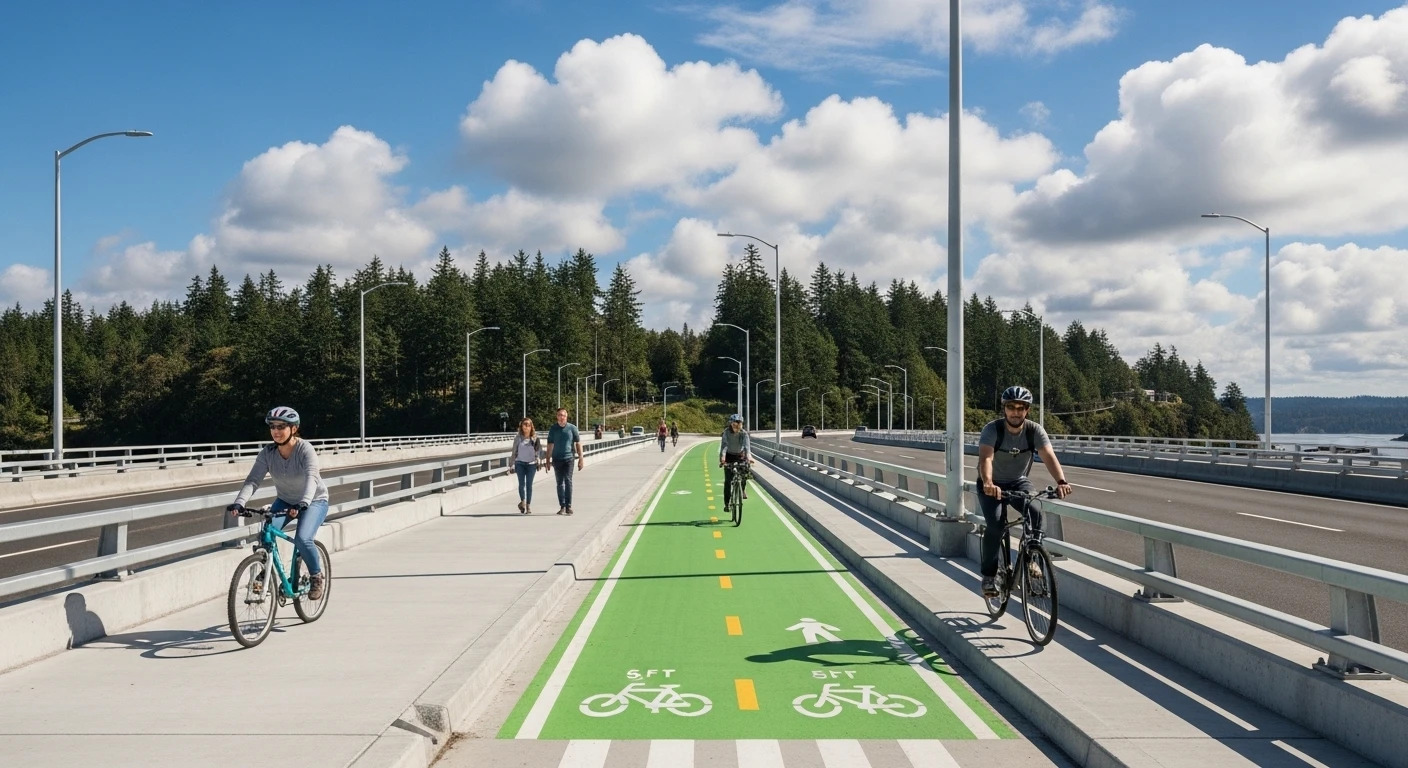
    • Wider sidewalks and bike lanes on both sides of the roadway — a significant improvement for pedestrians and cyclists who previously had more limited options on the original structure.
    • Modern seismic engineering — the new bridge is designed to perform better in an earthquake, addressing the structural concerns that made replacement necessary.
    • Longer designed service life — built to current standards, the bridge is intended to serve Everett and Mukilteo for decades.

    The bridge straddles the city boundary, welcoming travelers into both Everett and Mukilteo. Once the final finishing work is complete, pedestrians and cyclists will have dedicated, protected lanes on each side of the roadway.

    How the $34.9 Million Project Was Paid For

    The total project cost is $34.9 million. Of that, $28 million — roughly 80 percent — came from federal grant funding. The remaining portion was covered by city transportation funds.

    Mayor Cassie Franklin said she was “excited to see the brand-new Edgewater Bridge open again and serving our community,” acknowledging the disruption the closure caused. “Construction brought real impacts — especially to the neighbors who live close to the bridge — but I’m proud to deliver a more structurally sound bridge that’s built to last and ready for the future.”

    What to Expect at the April 27 Celebration

    The City of Everett is hosting a community event on Sunday, April 27 at 3:30 p.m. where residents from both Everett and Mukilteo can walk across the new bridge, meet members of the project team, and hear remarks from city officials.

    Important note: the bridge will not be open to vehicle traffic at the time of the celebration. You can approach from either side but will not be able to drive across. Vehicles will begin crossing on Tuesday, April 28.

    What’s Still Being Finished After Opening

    Even after vehicles start using the bridge on April 28, some work will continue. According to the City of Everett, permanent roadway striping, barriers, lighting, paint, and other finishing tasks may still be in progress. The new sidewalks and bike lanes will remain closed to pedestrian and cyclist use until that final phase of work is complete — so pedestrian access will follow the vehicle opening by a short period.

    Why This Reopening Matters for Everett and Mukilteo

    Mukilteo Boulevard is a primary east-west connector used daily by commuters heading toward Interstate 5, Paine Field, and local destinations in both cities. The 18-month closure forced drivers to reroute through already-congested surface streets — an impact felt by neighborhoods on both sides of the ravine. The reopening directly relieves that pressure.

    The new bike lanes and wider sidewalks also represent a real win for non-motorized transportation in a corridor that previously had limited options. Both Everett and Mukilteo have been working to improve walkability and bikeability, and this crossing is now part of that network in a meaningful way.

    Frequently Asked Questions About the Edgewater Bridge Opening

    When does the Edgewater Bridge open to vehicles?

    The bridge opens to vehicle traffic at the end of the workday on Tuesday, April 28, 2026.

    When is the community celebration for the new Edgewater Bridge?

    The City of Everett is hosting a community walk-across event on Sunday, April 27 at 3:30 p.m. The bridge will not be open to vehicle traffic at that time. Residents can approach from either the Everett or Mukilteo side.

    How much did the new Edgewater Bridge cost?

    The total project cost is $34.9 million, with $28 million funded by federal grants — about 80 percent of the project cost covered by federal dollars.

    Is the new bridge safer in an earthquake?

    Yes. The new bridge was built to modern seismic engineering standards and is significantly more earthquake-resistant than the 1946 original, which had known structural vulnerabilities.

    Why did the bridge closure last 18 months?

    The original construction schedule was extended twice — first due to underground obstructions from an older bridge structure buried beneath the site, and again after an atmospheric river weather event in December 2025 caused damage to portions of the project.

    Will there be bike lanes and sidewalks on the new Edgewater Bridge?

    Yes. The new bridge includes bike lanes and wider sidewalks on both sides. They will open to use once final finishing work on the project is complete, which is expected to happen shortly after the vehicle opening.

    What cities does the Edgewater Bridge connect?

    The Edgewater Bridge straddles the boundary between Everett and Mukilteo, connecting both cities along Mukilteo Boulevard.

  • Planning a Trip Around the Olympic Loop This Summer? Here’s What WSDOT Has on US 101

    Planning a Trip Around the Olympic Loop This Summer? Here’s What WSDOT Has on US 101

    2026 construction season: WSDOT has multiple active work zones on US 101 and connecting state routes around the Olympic Peninsula this year. Most are part of a long-running fish barrier removal program. Expect reduced speeds, shifted lanes, and occasional one-way alternating traffic at several locations. Plan extra travel time.

    Driving the Olympic Loop in 2026? Here’s What WSDOT Wants You to Know

    If your summer plans include a drive around the Olympic Loop — or a trip to the Hoh Rain Forest, the coast, or Hood Canal — you’ll be navigating some construction zones this season. WSDOT has multiple active projects on US 101 and connecting routes across Jefferson, Clallam, and Grays Harbor counties in 2026.

    The good news: WSDOT is keeping traffic moving through all work zones. The practical advice: leave early, check the WSDOT app before you go, and don’t count on maintaining highway speeds at every stretch.

    Active Work Zones on US 101 — What to Expect Where

    Near Port Angeles — Lees and Ennis Creeks

    On US 101 just outside Port Angeles, fish barrier removal work at Lees Creek and Ennis Creek is ongoing through summer 2026. The speed limit is reduced from 40 mph to 25 mph through both work zones. Travelers will see shifted lanes. No daytime lane reductions at these sites — nighttime lane closures happen between 7 PM and the early morning hours.

    Near Ruby Beach — Milepost 165

    One-way alternating traffic controlled by a signal is in place at milepost 165 near the Olympic National Park Ruby Beach entrance. This is an ongoing erosion repair on the highway shoulder following December 2025 winter storms. WSDOT is monitoring conditions and scheduling a permanent repair.

    South of Forks — Jefferson/Clallam County Line

    A fish passage work zone south of Forks at the Jefferson-Clallam county line remains in place through the end of 2026. This is part of the Coastal 29 fish barrier correction project that has been running on the peninsula since 2023.

    SR 116 — Chimacum Creek Closure Coming This Summer

    On State Route 116, a culvert replacement at Chimacum Creek is scheduled to begin after the July 4 holiday weekend in summer 2026. This will include a longer-term road closure with a signed detour via State Route 19, Irondale Road, and Chimacum Road. Travelers heading to Port Hadlock and beyond should plan accordingly.

    Hood Canal Bridge — SR 104

    In late spring and summer 2026, travelers using the Hood Canal Bridge (SR 104) will see overnight closures from 11 PM to 4 AM as preservation work continues on the bridge’s shock absorbers and center lock system. Short maintenance openings lasting 30–40 minutes may occur during daytime hours. Check the Hood Canal Bridge status page at wsdot.wa.gov before crossing.

    Tips for Driving the Peninsula This Summer

    • Download the WSDOT app for real-time traffic, closures, and ferry updates
    • Check engage.wsdot.wa.gov/olympic-peninsula-construction for the full project map
    • Build in extra time at known work zones, especially on US 101 near Port Angeles and south of Forks
    • For ferry planning, make reservations early on the Port Townsend/Coupeville route

    Frequently Asked Questions: US 101 Olympic Peninsula Construction 2026

    Where are the main construction zones on US 101 on the Olympic Peninsula in 2026?

    Key areas: Lees and Ennis Creeks near Port Angeles (25 mph reduced speed, shifted lanes); milepost 165 near Ruby Beach (one-way alternating traffic); south of Forks near the Jefferson-Clallam county line (ongoing through end of 2026).

    Is the Hood Canal Bridge open in 2026?

    Yes, but expect overnight closures from 11 PM to 4 AM in late spring and summer 2026 for preservation work. Check wsdot.wa.gov for current status before crossing.

    Why is WSDOT doing so much construction on US 101?

    Most projects are part of a court-ordered statewide fish barrier removal program, replacing outdated culverts under highways that block salmon migration. The “Coastal 29” project has been correcting 29 barrier sites along US 101 and SR 109 since 2023.

    Where can I check current Olympic Peninsula road conditions?

    Use the WSDOT app, visit wsdot.wa.gov, or check engage.wsdot.wa.gov/olympic-peninsula-construction for the full project map.

  • Everett City Council Approves Fair Labor Ordinance 9-1: What It Means for City Contractors

    Everett City Council Approves Fair Labor Ordinance 9-1: What It Means for City Contractors

    The Everett City Council voted 9-1 on March 25, 2026 to approve a new fair labor standards ordinance that requires contractors doing business with the city to maintain detailed payroll records, properly classify workers, and allow employees to report violations directly to city officials.

    The ordinance gives Everett expanded enforcement tools against contractors who commit wage theft or misclassify employees — and applies the protections not just to union workers, but to all workers on city contracts.

    What the Ordinance Requires

    Under the new law, contractors seeking city business must meet a set of labor standards as a condition of their contract. According to Ward 2 Councilor Stephanie Martins, who championed the measure, those requirements include:

    • Maintaining industrial coverage insurance
    • Properly classifying employees rather than misclassifying them as independent contractors
    • Keeping daily sign-in and sign-out logs for workers on the job
    • Complying with federal healthcare reform law
    • Submitting monthly certified payroll records to the city

    Employees working under city contracts will be able to report violations through a city-managed reporting system. If a contractor is found to be out of compliance, the city gains the authority to revoke or suspend the contract, or attach additional conditions to it.

    Why It Matters Beyond Union Workers

    One of the central arguments Councilor Martins made during debate was that the ordinance fills a protection gap that union contracts don’t address. Union members typically have collective bargaining agreements that cover labor standards. Non-union workers on city-funded projects have had less formal protection.

    “A developer in the wrong will find it cheaper to pay employees than fighting the city,” Martins argued during council deliberations.

    The ordinance was also framed as a tool to combat trafficking and immigration-related exploitation of workers on city job sites — not just traditional wage theft.

    The One Dissenting Vote

    Ward 1 Councilor Michele Capone cast the lone no vote, expressing concern that Everett’s city government lacks the administrative capacity to meaningfully enforce the ordinance’s requirements.

    “I don’t think the City of Everett can even enforce all of the different issues within this ordinance suggestion,” Capone said, also raising questions about potential legal challenges to the measure.

    Supporters of the ordinance pushed back on the enforcement concern. Councilor Rogers explained during debate that enforcement does not have to fall entirely on city staff — the ordinance creates a mechanism to “elevate a violation to the state,” meaning complaints can be referred to state labor agencies with broader investigative authority. “We would have the ability to elevate a violation to the state,” Rogers said, noting this gives the city meaningful enforcement reach without requiring a large new city bureaucracy.

    Who’s Affected

    The ordinance applies to contractors who enter into agreements with the City of Everett. It does not apply retroactively to existing contracts. Businesses that rely on city contracts — from construction firms to service providers — will need to ensure their record-keeping and employment practices meet the new requirements before seeking future city work.

    What Happens Next

    The ordinance passed with a veto-proof 9-1 margin and is now city law. Contractors working on upcoming city projects should review the requirements and consult with their legal counsel about compliance timelines.

    Residents who believe a contractor working on a city project is violating the ordinance can report concerns through the city’s official channels at everettwa.gov.

    Frequently Asked Questions

    What did Everett’s new fair labor ordinance do?
    The ordinance requires contractors doing business with the city to maintain proper payroll records, correctly classify workers, and provide employees with a way to report violations. The city can now revoke or suspend contracts for noncompliance.

    When did the ordinance pass?
    The Everett City Council passed the ordinance on March 25, 2026, by a 9-1 margin.

    Who voted against it?
    Ward 1 Councilor Michele Capone cast the sole dissenting vote, citing concerns about the city’s ability to enforce the ordinance.

    Does this apply to union workers?
    Union workers on city contracts are already covered by their collective bargaining agreements. The ordinance primarily extends protections to non-union workers, though it applies to all contractors working under city agreements.

    Can employees report violations?
    Yes. The ordinance creates a formal reporting mechanism so employees can flag violations to the city. The city can then act on those reports or refer them to state labor enforcement agencies.

    Does this apply to all businesses in Everett?
    No. The ordinance applies to contractors seeking or holding contracts with the City of Everett — not to all private employers operating within city limits.

    What can the city do if a contractor violates the ordinance?
    The city can revoke a contract, suspend it, or impose additional conditions. It can also refer violations to state labor agencies for investigation.