Most water mitigation supplements get killed not because the work wasn’t done, but because the line items were never written down. If you’re running a restoration company and watching your margin bleed out on Category 2 and Category 3 jobs, there is a near-certainty that your initial Xactimate sketch is missing four to seven line items that your crews actually performed. The desk adjuster never saw them. So they never approved them. And your gross margin took the hit.
This is the Xactimate supplement audit your estimator probably isn’t running. Walk through it before you submit your next water loss, and then walk through it again before you accept a partial denial.
Why supplements get killed
Supplements die when docs are late or vague.
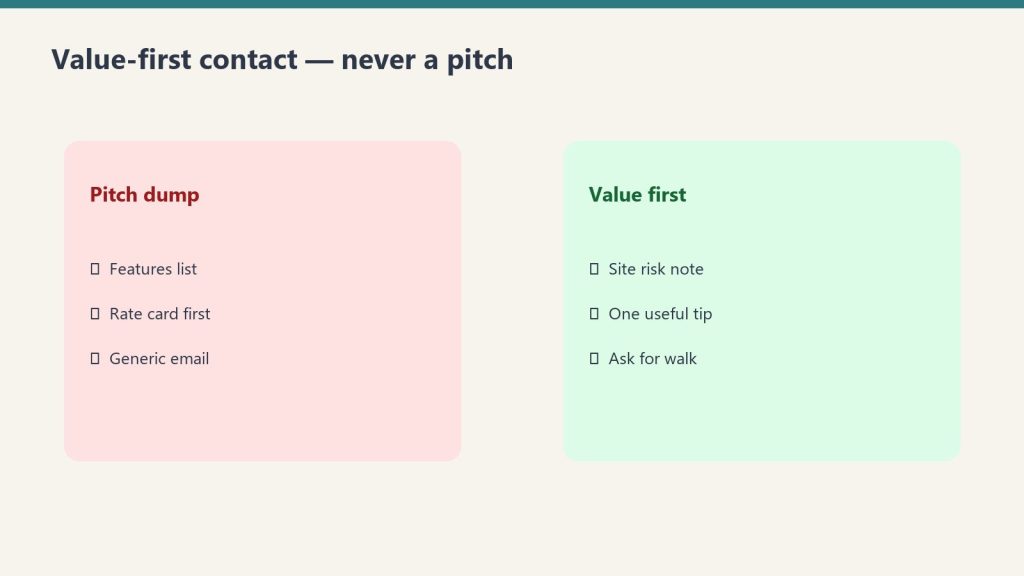
The honest reason most supplements come back partially approved or denied is that they arrive looking like an afterthought. A clean Xactimate file that uses the carrier’s current price list, includes photo documentation tied to each line item, and matches the scope to the loss category gets reviewed apples-to-apples. A supplement that arrives as a PDF list with no photos and no sketch revision gets reviewed as a request for more money. Those are two very different conversations.
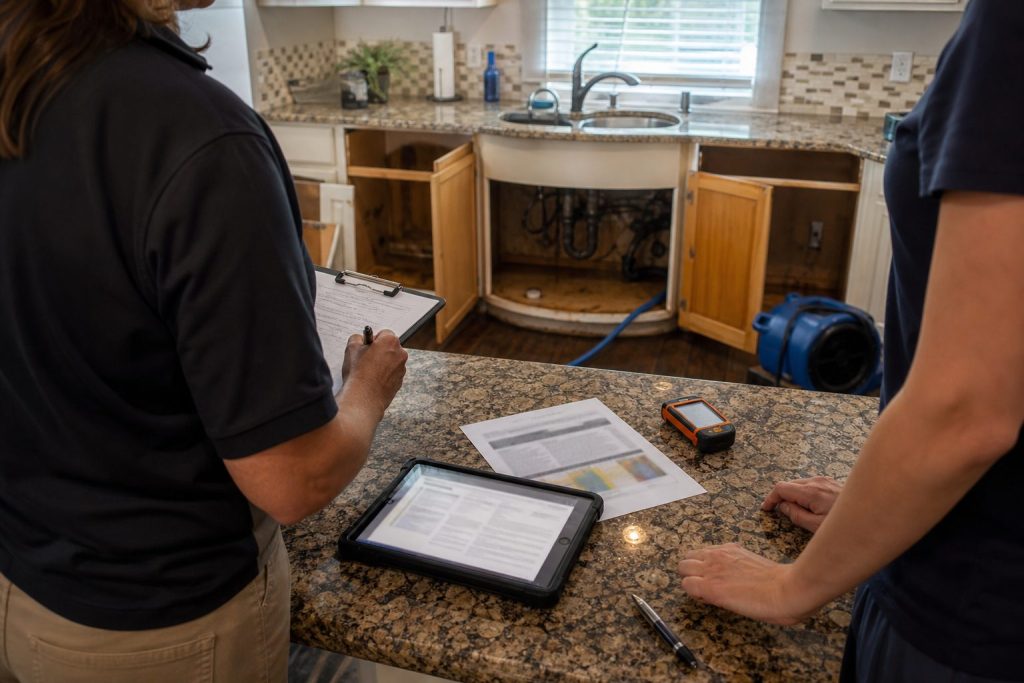
If you want approvals to move faster, every supplement needs three things: a revised sketch with new room tags or affected areas marked, photographs that directly correspond to each added line item, and pricing pulled from the same Xactimate price list the carrier is using. Verbal approvals over the phone do not create a paper trail. Email or carrier portal submissions do.
The line items most crews actually perform but never bill
Crews do the work — the estimate has to say so.
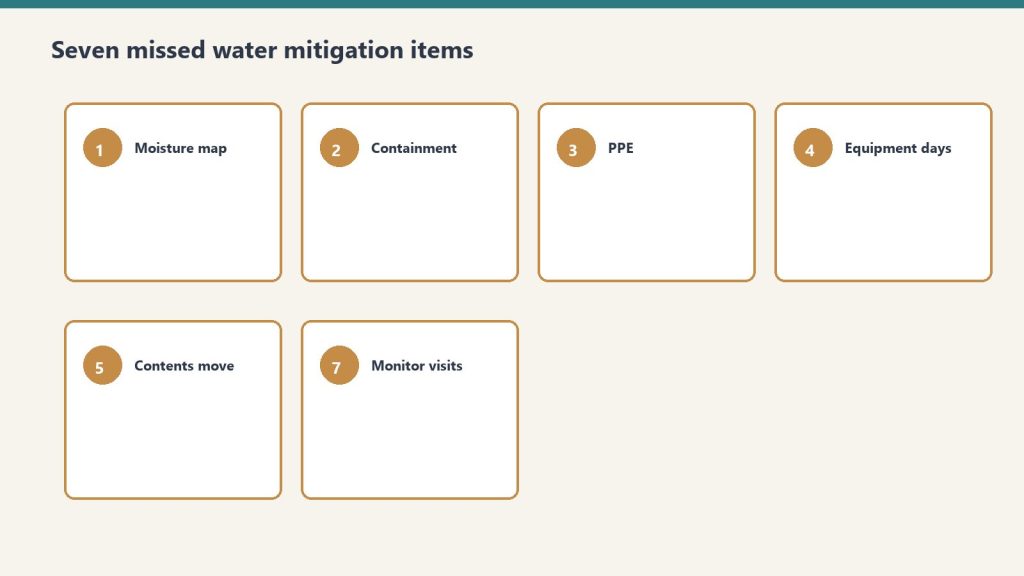
These are the WTR category items that show up in real water loss workflows and get left off the initial estimate. None of these are exotic. All of them are billable when the work was performed and documented.
Equipment decontamination on Category 3 losses. Every air mover, dehu, HEPA, and hose that entered a Category 3 environment requires decontamination before the next job. This is a line item, not a cost of doing business absorbed by your overhead. If your crew is bagging hoses and wiping down equipment with a quaternary cleaner, that is a billable task.
Antimicrobial application to affected surfaces. Plant-based or quaternary antimicrobial application on framing, subfloor, and the bottom plates is a separate line item from the cleaning. On Category 2 and Category 3 work the IICRC S500 protocol calls for antimicrobial treatment of affected materials. If you applied it, bill for it.
Containment and drying chamber setup. Plastic sheeting, zipper doors, and the labor to build a containment that isolates the drying chamber from unaffected areas is its own line item. The chamber itself is the reason your equipment count is justified — a smaller controlled volume dries faster, runs fewer days, and uses fewer air movers than an open room. If the adjuster is questioning your equipment count, the containment line item is the answer.
Detach and reset of contents. Moving the homeowner’s furniture, boxing contents, blocking the legs of upholstered pieces, and putting it back at the end of the job is not free. Contents manipulation has its own line items in Xactimate and is one of the most consistently missed billable activities in mitigation work.
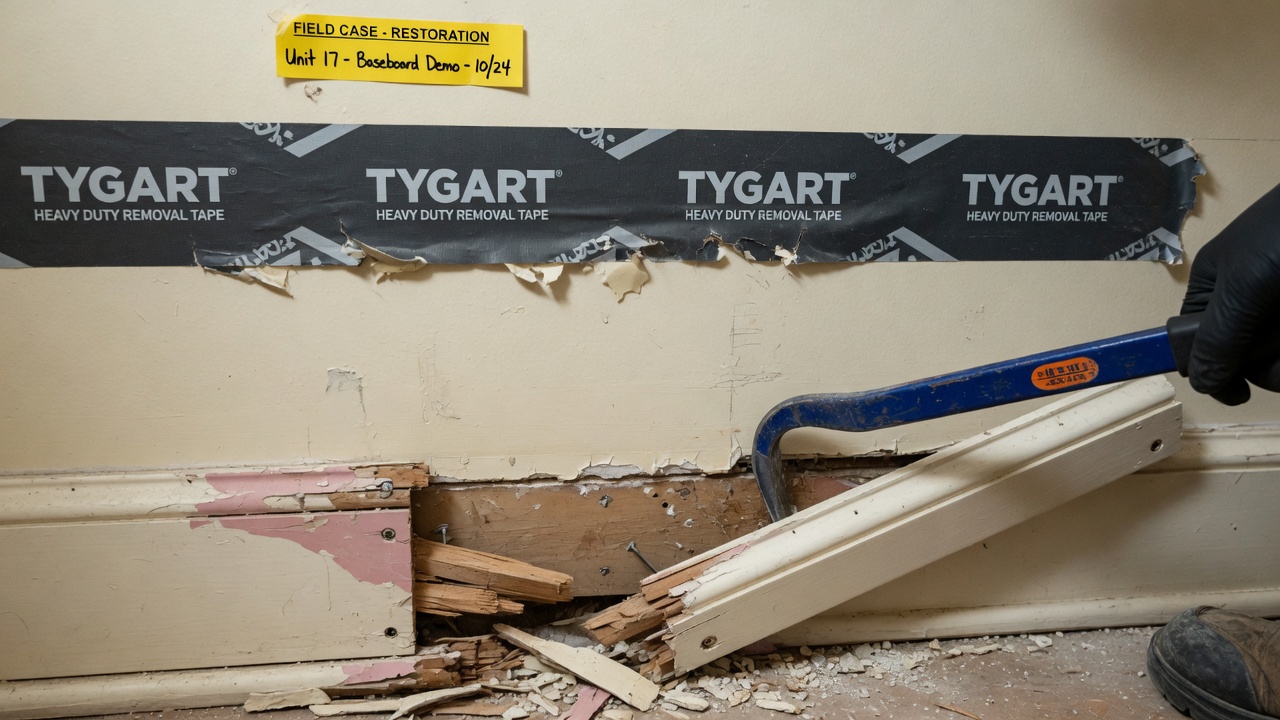
Multi-member baseboard removal. If the baseboard had quarter round or a separate cap, the WTRBASEB> line item covers the additional labor to remove and dispose of each layer. Estimators trained on the older single-member baseboard removal habitually leave the extra members off the estimate.
HEPA vacuum of demolition area. After a flood cut and material removal on a Cat 2 or Cat 3 loss, HEPA vacuuming the cavity before reconstruction begins is a billable task. It is also a defensible task if the homeowner ever questions whether the area was properly cleaned.
Disposal of contaminated water and materials. Extracting Category 3 water and disposing of it is different from extracting Category 1. There are separate line items for contaminated water extraction, contaminated material disposal, and the dump fees. If your crew hauled six contractor bags of sewage-soaked drywall to the landfill, that is documentable and billable.
The documentation that makes a supplement get approved
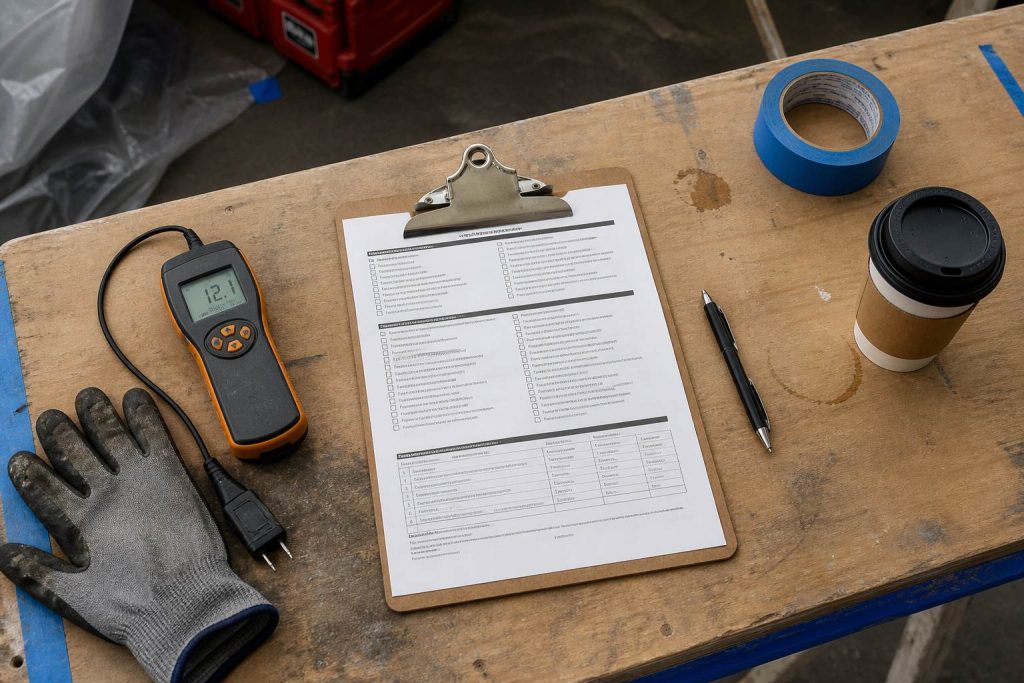
Moisture maps and photos make supplements get approved.
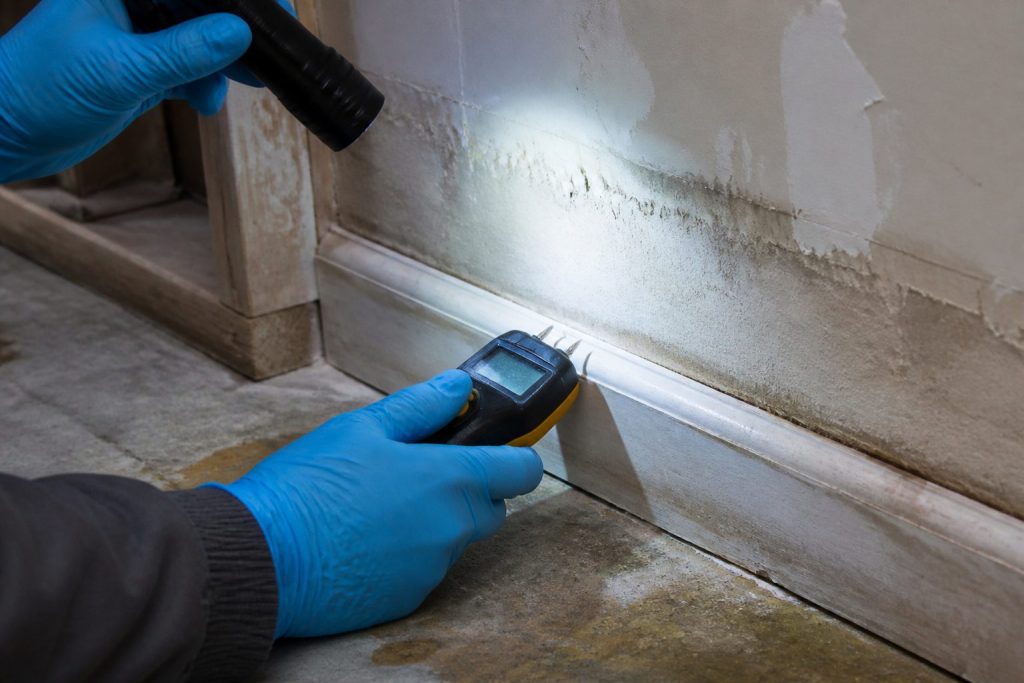
Pricing arguments are losing arguments. Scope arguments are winning arguments. When you submit a supplement, do not lead with cost. Lead with scope, and let the Xactimate price list speak for itself.
The fastest path to approval is to use Room ID tags in the Xactimate sketch so every space is clearly labeled, attach a photograph for every added line item that shows the affected area and condition, reference the loss category and IICRC standard where applicable, and submit the revised estimate as an attachment in the carrier portal rather than as a phone call or text.
When a line item is denied, the response should not be a longer email. It should be a request for the specific reason for the denial, in writing, tied to the carrier’s policy language or pricing logic. Most contractors give up at the first denial. Most adjusters expect that. The ones who push back with documentation get a measurable percentage of denied items approved on second submission.
The bottom line
Restoration owners obsess over labor cost and equipment utilization, but the single biggest lever on water mitigation gross margin is the completeness of the initial Xactimate scope and the discipline of the supplement process. Every line item your crew performs that does not make it onto the estimate is pure margin loss — the cost was already incurred. Building a checklist of the seven items above and running it as a pre-submission audit on every Cat 2 and Cat 3 loss is a one-week implementation that will pay for itself on the first job.
If your average water mitigation ticket is in the $4,000 to $6,000 range and a complete supplement audit recovers an additional $400 to $900 per job through previously uncaptured line items, the math at any meaningful job volume is the kind of margin recovery most owners spend years trying to find in payroll, fleet, or marketing instead.
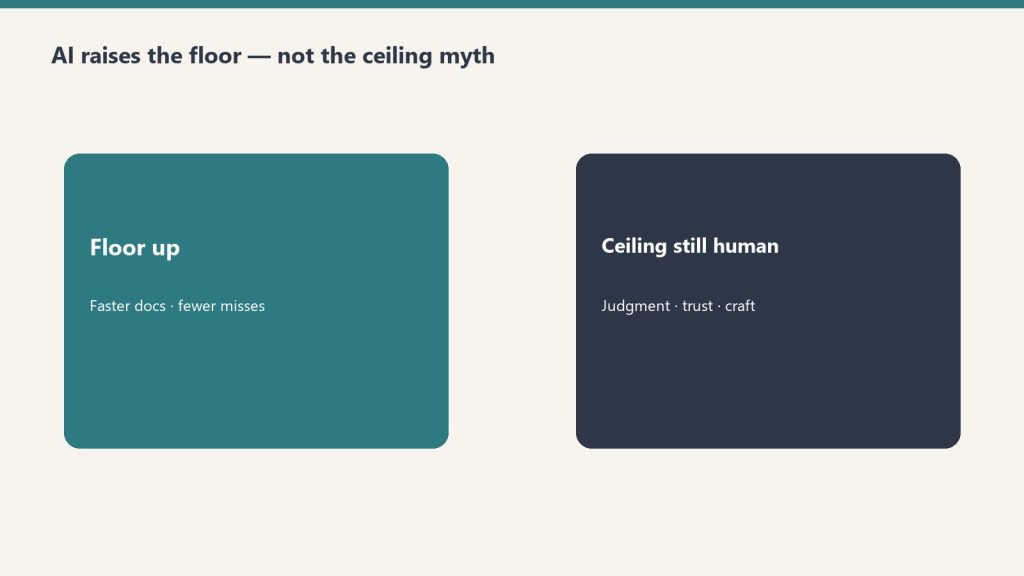
AI is raising the floor of the restoration industry. It is not raising the ceiling. The ceiling will always belong to the operators who have actually stood in a flooded basement at 2 a.m. and made the call. Once you internalize that distinction, the panic about AI replacing skilled trades collapses, and a more useful question takes its place: what happens to an industry when the floor finally catches up to the people who have been carrying it?
This is a commentary about restoration. It is also a commentary about AI in general. The two stories are the same story.
The Floor and the Ceiling
AI raises the floor. Craft still owns the ceiling.
Every industry has a floor and a ceiling. The floor is the minimum competence a customer can expect from anyone in the trade. The ceiling is what the best practitioners are capable of — the judgment calls, the pattern recognition, the gut feel that comes from doing the work for fifteen years and seeing every kind of failure mode at least twice.
In restoration, the floor has been embarrassingly low for a long time. There are operators in this industry who genuinely should not be allowed near a moisture meter. They mis-scope projects, they bill for equipment they did not run, they cut corners on containment, and they sell jobs they cannot deliver. They depress the curve for everyone who is trying to do this work properly. Every honest contractor who has ever lost a job to a lowball bid from a fly-by-night competitor knows exactly who I am talking about.
The ceiling, meanwhile, lives inside the heads of people who have been at this for decades. The Project Manager who can walk into a loss and tell you within ten minutes which insurance adjuster will push back, which trades need to be sequenced first, and which homeowner is going to file a complaint regardless of the outcome. The technician who knows by smell alone whether the mold is active or dormant. The estimator who has internalized the regional cost variance between a Houston hurricane and a Minneapolis ice dam and can write an accurate scope without opening Xactimate. None of that knowledge lives in a database. It lives in the brains of the operators who built it the hard way.
What AI Actually Does to Skilled Trades
Here is the part most takes get wrong. AI is not coming for the ceiling. AI is coming for the floor.
What AI does extremely well is the work that is procedural, well-documented, and pattern-matched against existing data. Writing the initial scope of work. Generating a clean estimate from a photo set. Drafting customer communications. Filling in the IICRC-aligned drying log. Producing the daily progress report. Pulling the right documentation for the carrier. Comparing this loss against the last hundred similar losses in the database and flagging the parts that look off.
None of that is the hard part of restoration. The hard part of restoration is the judgment that comes after the data is collected. The hard part is knowing that the moisture reading the AI just generated is technically correct but practically wrong because of the building envelope quirk you cannot see from the photo. The hard part is reading the homeowner across the kitchen table and knowing they need to hear the truth a specific way or they will fire you by Thursday. The hard part is the call between mitigation and replacement when the numbers are genuinely close and the carrier is going to fight you either way.
AI raises the floor by making the procedural part faster, cheaper, and more consistent across the industry. The technician who used to spend two hours writing a sloppy scope now has a clean scope in fifteen minutes. The estimator who used to fight Xactimate now has a draft to react to. The office admin who used to chase signatures now has a workflow that runs itself. All of that is the floor rising.
The ceiling — the actual judgment, the actual experience, the actual feel for the work — is unmoved. It is still entirely inside the heads of the operators who built it. If anything, it becomes more valuable because the floor is rising fast enough that the only meaningful differentiation left is what the AI cannot replicate.
Why the Bad Actors Get Starved Out
Bad actors get starved when docs and SOPs get cheap to do right.
This is the part that should make every honest operator in the restoration industry hopeful rather than nervous.
The rogue restoration company that has been distorting the curve for fifteen years survives on a specific edge. They can underbid the honest operators because they cut corners on the procedural work — they do not document properly, they do not run the right equipment, they do not follow IICRC standards, they do not handle the carrier paperwork with any rigor. The bid they hand a homeowner looks competitive only because the work they are quoting is not the same work an honest contractor would quote.
When AI raises the floor, that arbitrage disappears. The procedural work becomes table stakes. Any contractor with a smartphone can now produce a clean scope, a defensible drying log, a proper carrier-facing report. The reckless contractor who used to win on speed-by-cutting-corners is suddenly competing on a level surface against operators who have always done the work properly and now have AI making them faster too.
What the reckless contractor cannot do is the ceiling work. They cannot reproduce the judgment, because they never had it. They cannot reproduce the relationships with adjusters, the reputational depth, the operator instinct. When the floor rises and the differentiation moves up to the ceiling, the bad actors are the first ones starved out. Their entire edge was the floor being low.
This is the part nobody is telling honest restoration operators clearly enough. AI is not your threat. AI is the thing that finally levels the playing field against the contractors who have been undercutting you on quality for years.
Data Is Cheap, Fast, and Incomplete
Right now, in 2026, data is cheap. Compute is cheap. Inference is cheap. Every AI system on the market is leveraging the same approximate pool of public data, the same scraped industry documentation, the same generic training corpus. That is why the AI-generated restoration content flooding the internet right now is so painfully shallow — it can describe what a Category 3 water loss looks like in textbook terms, but it cannot tell you what it actually feels like to walk into one.
The data is incomplete. It will stay incomplete until somebody systematically extracts the tacit knowledge from the operators who actually have it. That is the part of the AI story almost everybody is missing. The models are not bottlenecked on compute. They are bottlenecked on the kind of experiential, hard-won, in-the-field knowledge that has never been written down and never made it into the training corpus.
This is true across every industry, not just restoration. It is true in HVAC, in commercial real estate, in healthcare operations, in B2B sales, in any field where the floor is procedural and the ceiling is experiential. The AI floor will continue to rise everywhere. The ceiling will continue to belong to the people who actually did the work.
The Human Distillery
This is why the most important AI work happening right now is not building bigger models. It is what we are calling the Human Distillery — the deliberate, structured extraction of tacit knowledge from industry insiders, captured in a form that becomes AI-ready and operator-ready at the same time.
The way you do this is not with a survey. It is not with a content brief. It is with a long conversation with somebody who has spent twenty years in the field, asking them the questions only an insider would know to ask, then converting their answers into structured artifacts that capture the judgment patterns underneath the words. The scope decisions they make instinctively. The risk signals they read before anyone else sees them. The customer-handling moves they have refined across thousands of jobs. The mistakes they made early in their career and the corrections they internalized.
That body of knowledge has historically died with the operator who held it. They retire, they sell the business, the kid takes over without the same instincts, and the depth of the operation drops a tier. The industry loses that ceiling-raising knowledge every time a senior operator walks away.
The Human Distillery is the methodology for stopping that loss. For a direct take on what this moment means specifically for senior operators, see this letter to the older generation of operators in the AI era. You distill the knowledge while the operator is still in the field, you convert it into both AI-ready training data and operator-ready playbooks, and you compound it. The first restoration company that does this systematically will have a competitive moat that no AI system can replicate by ingesting public data, because the knowledge you are encoding was never public in the first place.
What This Looks Like in Practice
In practice: techs + AI drafts, owners still decide.
Imagine a regional restoration operator with thirty years of field experience. Imagine sitting down with that operator for ten hours across a series of structured conversations. Imagine asking them to walk through every category of loss they have ever handled — water, fire, mold, storm, biohazard, commercial, residential, multi-unit — and surface the specific judgment moves they make at each decision point.
What scope are they running for a Cat 3 with mixed materials in a 1980s slab-on-grade? What changes if the homeowner is elderly and lives alone? What changes if the adjuster is from a specific carrier they have history with? What changes if the loss happened on a Thursday before a holiday weekend?
None of that is in any database. None of it is in any IICRC standard. It is the ceiling. It is the thing that makes that operator’s company twice as profitable as the regional competitor down the road who has the same trucks and the same equipment and the same certifications.
The Human Distillery captures it. It becomes a structured artifact the operator can use to train their own next generation of technicians. It becomes AI-ready content that the operator’s own AI tooling can use to outperform every generic restoration-trained model on the market. And critically, it stays inside the operator’s company. It is not training data for the broader model pool. It is the operator’s proprietary ceiling, made durable and transferable.
Why This Should Give the Industry Faith
The anxiety about AI in restoration — and in every skilled trade — comes from a flawed mental model. The model says: AI gets better, humans get less valuable, eventually AI does the job. That model is wrong.
The correct model is: AI raises the floor faster than humans can lower it, so the floor rises. The procedural work that used to differentiate okay operators from bad operators becomes commoditized. The bad operators, who were surviving by underdelivering on the floor, get starved out because the floor is now too high for them to fake. The honest operators get faster and more profitable because their procedural work is now AI-accelerated. And the great operators, the ones with the ceiling-level experience, become the most valuable people in the industry, because the only remaining differentiation is the part AI cannot do.
That is not a future to fear. That is a future where the people who have always been doing this work properly finally get to compete on the merits.
The very best of who we are as an industry is about to open up. The contractors who have been holding the line on quality for decades — paying their technicians properly, running their equipment to spec, documenting their work the right way, treating their customers like neighbors — are about to find out that the playing field is finally tilting in their direction. The race to the bottom is ending. The race to the top is starting.
Have faith. The knowledge will be the value again. It always was. It is just becoming visible again, because the noise is finally getting filtered out.
No. AI is replacing the procedural and documentation work that used to consume hours of a contractor’s day — scoping, estimating, drying logs, carrier paperwork. The judgment work that defines a great restoration operator (reading a loss site, sequencing trades, handling adjusters, managing homeowner expectations) is unchanged and arguably more valuable, because it is now the only meaningful differentiator left.
What does “AI raises the floor, not the ceiling” actually mean?
The floor is the minimum competence a customer can expect from any operator in the industry. The ceiling is what the best operators are capable of. AI commoditizes the procedural work, which lifts the minimum baseline across the industry. It does not touch the experiential judgment that defines the top performers. The gap between average and excellent does not close. The gap between bad and average disappears.
Why will bad actors get pushed out of the restoration industry?
Bad actors survive on an arbitrage where they underbid honest contractors by cutting corners on procedural work — documentation, equipment, IICRC standards, carrier-facing reports. When AI makes that procedural work fast and cheap for everyone, the underbidding edge disappears. Honest operators get the same speed advantage without sacrificing quality. The bad actors are left competing on judgment and experience, which they never had to begin with.
What is the Human Distillery?
The Human Distillery is a structured methodology for extracting tacit, hard-won industry knowledge from experienced operators and converting it into AI-ready and operator-ready artifacts. It captures the judgment patterns, decision frameworks, and field instincts that have historically lived only inside the heads of senior practitioners and disappeared when those people retired. It is how a restoration company turns its founder’s thirty years of experience into a durable competitive asset.
If AI training data is incomplete, why is AI still useful in restoration today?
AI is useful today for the procedural floor work — scoping, documentation, customer communication, report generation — because those tasks are pattern-matched against public, well-documented content. The incompleteness shows up the moment you ask AI to make a judgment call that requires tacit field experience. Used inside its actual capability envelope, AI is a force multiplier for any honest operator. Used outside that envelope, it produces the shallow, generic content the industry is currently drowning in.
How should a restoration company prepare for the AI shift?
Two parallel moves. First, deploy AI aggressively on the procedural floor — scoping, estimating, documentation, customer-facing communication — to capture the speed and margin advantages. Second, systematically extract the tacit knowledge inside the company’s senior operators using a Human Distillery methodology, and build a proprietary knowledge layer that becomes the company’s defensible ceiling. The companies that only do the first move will be commoditized. The companies that do both will dominate their regions.
The Bottom Line
The restoration industry is a perfect commentary on AI in general. Fancy tools and faster calculations are not the gold. The gold, which it always has been, is the learned experience. AI is raising the floor, and the floor needed to be raised. The rogue contractors will be starved out. The reckless ones will go away. The honest operators with real experience will find themselves on a playing field that finally rewards what they have always been doing properly. And the ceiling will keep belonging to the people who actually showed up, did the work, and earned the knowledge the hard way.
That is when the knowledge will be the value again, just like it always was. The ceiling will start to rise. The very best of who we are as an industry will open up opportunities for the people who built it. Have faith. The floor was the part that was broken. The floor is finally getting fixed.
The Tacit Knowledge Cluster — Further Reading
This piece is part of a larger body of writing on what the AI shift and the broader software-platform shift actually mean for service professions and the workers in them. The full cluster:
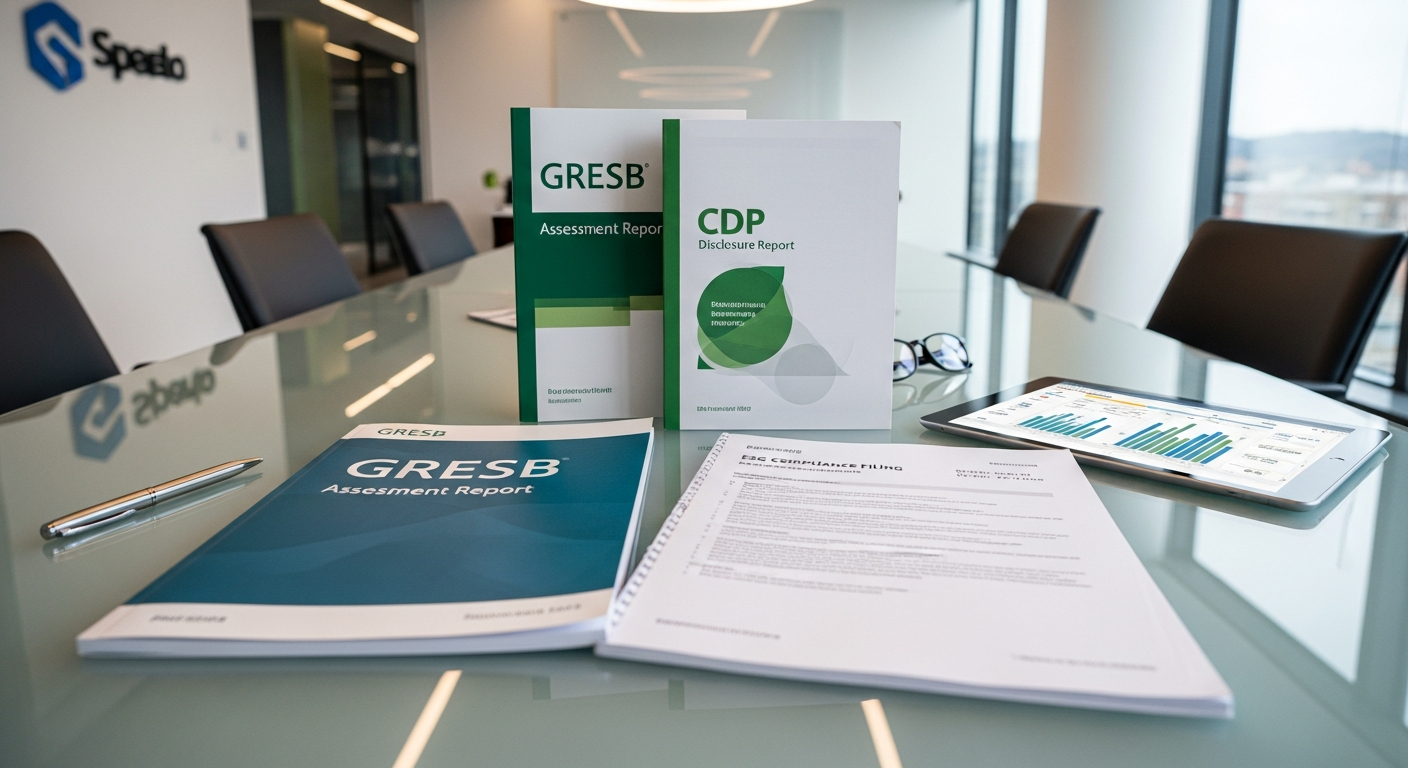
Property owners and asset managers in institutional real estate operate in an increasingly layered ESG disclosure environment. GRESB drives investor-facing ESG scoring. CDP provides voluntary supply chain disclosure that is increasingly investor-requested. California SB 253 mandates Scope 3 disclosure for large entities. And the EU’s Corporate Sustainability Reporting Directive (CSRD) extends mandatory ESG reporting to European operations and, through supply chain due diligence requirements, reaches global real estate companies with EU exposure.
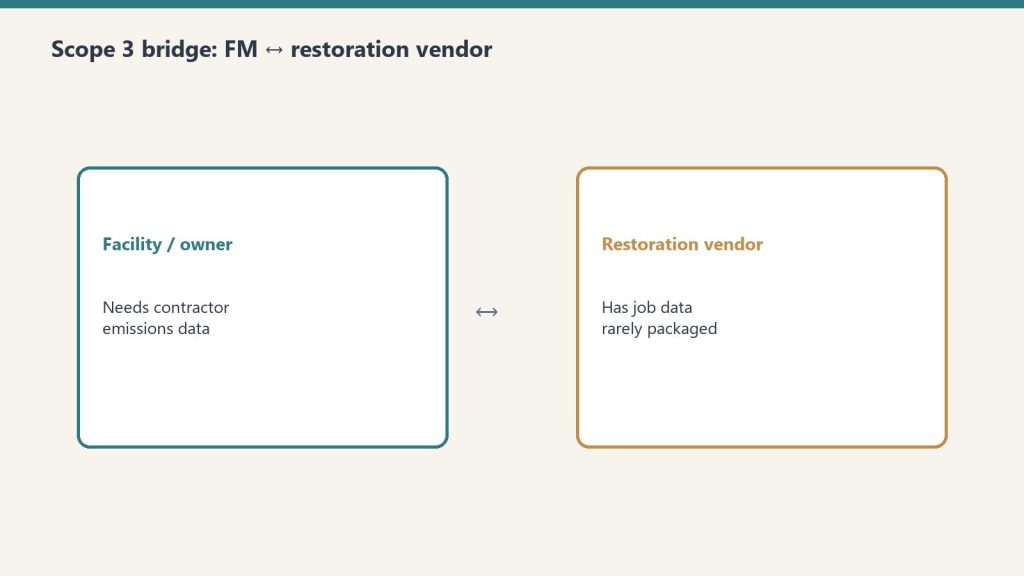
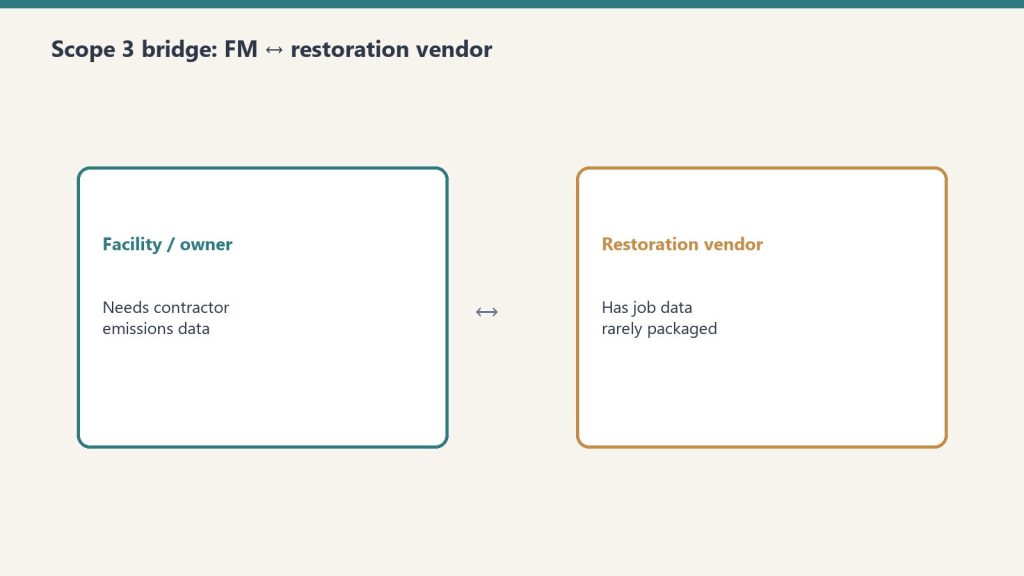
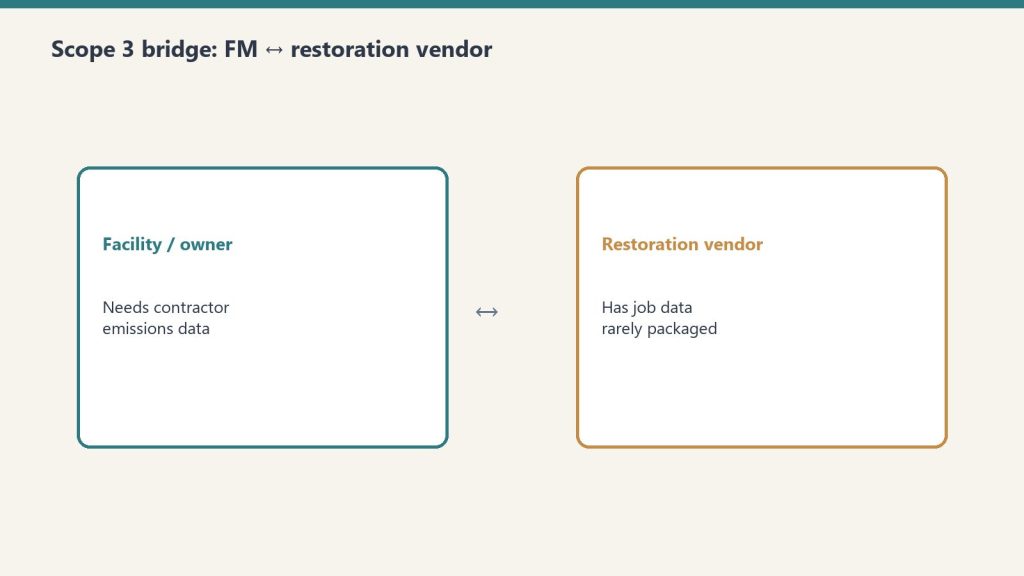
For BOMA members — building owners, REITs, asset managers — understanding which framework governs which obligations, and where they overlap, is essential for building an ESG program that satisfies all of them without duplicating work. This article maps each framework against the specific Scope 3 obligations it creates for property owners, with particular focus on the contractor supply chain data gap that sits at the intersection of all three.
GRESB: Investor-Driven, Asset-Level, Annual
GRESB — investor-driven, asset-level, annual.
GRESB is the primary ESG accountability mechanism for institutional real estate globally. It is not a regulation — it is an investor-driven benchmark that most institutional property owners participate in voluntarily because their capital partners require it. GRESB assessments are annual, asset-level, and scored on a 0–100 scale that investors use to compare portfolio ESG performance.
For Scope 3, GRESB evaluates both governance (do you have a Scope 3 target and supply chain policy?) and performance (do you have actual Scope 3 data?). Contractor emissions — Scope 3 Category 1 — factor into both components. Property owners without contractor data collection programs score lower on supply chain governance and leave Category 1 data fields blank in the Performance section.
GRESB is the most immediate Scope 3 pressure for most BOMA members because it directly affects your capital relationships. A poor GRESB score can affect asset valuations, borrowing costs, and investor mandates in ways that regulatory compliance does not.
CDP: Voluntary, Supply Chain Driven, Escalating
CDP’s supply chain program allows large corporations — including real estate companies’ major tenants and capital partners — to request Scope 3 supply chain data from their vendors. For property owners, CDP requests typically arrive from two directions: from institutional tenants whose corporate ESG programs require supply chain data from their landlords, and from institutional investors whose own CDP commitments require portfolio-level Scope 3 supply chain data.
CDP participation is voluntary, but declining a CDP request from a major tenant or capital partner has commercial consequences. As CDP participation expands — the program now covers thousands of companies — the probability that a significant counterparty will request Scope 3 data from your organization continues to increase.
California SB 253: Mandatory, Regulated, Enforced
California SB 253 — mandatory and enforced.
SB 253 is the only mandatory framework in this set, at least for US-domiciled organizations. It applies to entities doing business in California with revenues above the threshold, requires Scope 1 and 2 disclosure starting with fiscal year 2025 data, and adds Scope 3 starting with fiscal year 2026 data. CARB administers the program and has authority to assess penalties for non-compliance and material misstatement.
For real estate entities with California assets, SB 253 transforms the Scope 3 contractor data question from an investor relations consideration into a legal compliance obligation. The same contractor emissions data that improves your GRESB score and satisfies CDP supply chain requests now also needs to be accurate enough to withstand CARB review.
Where Restoration Contractor Data Fits in Each Framework
Where restoration contractor data fits.
The Restoration Carbon Protocol addresses the same data gap across all three frameworks. An RCP-compliant restoration contractor provides project-level emissions data in a format aligned with GHG Protocol Category 1. That data feeds directly into your GRESB Performance section, satisfies CDP supply chain data requests for Category 1, and provides the documented, methodology-backed Scope 3 Category 1 data that SB 253 requires.
The strategic efficiency argument for RCP adoption by property owners is that solving the restoration contractor data problem once solves it for all three frameworks simultaneously. You do not need different data for GRESB, CDP, and SB 253 — you need GHG Protocol Category 1 data, and RCP produces it in that format.
Building a Unified Response
For BOMA members navigating GRESB, CDP, and SB 253 simultaneously, the most efficient path is a unified Scope 3 data program rather than three separate compliance efforts. The foundation is a GHG Protocol-aligned inventory methodology that covers all fifteen Scope 3 categories. Contractor data — collected through RCP-compliant vendor agreements and green lease extensions — feeds into that inventory once and satisfies all three frameworks.
The timeline pressure is real: SB 253 Scope 3 data collection for fiscal year 2026 should already be underway, GRESB 2026 assessments will open in the first quarter, and CDP supply chain requests arrive year-round. The property owners who have built the contractor data infrastructure now — preferred vendor panels with RCP adoption, ESG clauses in service agreements, documented methodology — will be the ones with defensible Scope 3 inventories when all three frameworks converge on the same data set in 2027.
Both require Scope 3 GHG data aligned with the GHG Protocol Corporate Standard. GRESB collects it through an annual assessment submitted to the benchmark platform. SB 253 requires public disclosure filed with CARB. The underlying data set is the same — a GHG Protocol-compliant Scope 3 inventory by category — which is why building one unified inventory program satisfies both frameworks efficiently.
How does CSRD affect US-based property owners?
The EU’s Corporate Sustainability Reporting Directive (CSRD) applies directly to large EU-domiciled companies and EU subsidiaries of non-EU companies above defined thresholds. For US-based real estate companies with EU operations or EU-listed capital partners, CSRD may apply directly. Even for those it does not reach directly, CSRD’s supply chain due diligence requirements mean EU-based capital partners and tenants will increasingly request Scope 3 supply chain data from their US counterparties as part of their own CSRD compliance.
What is the Restoration Carbon Protocol and why do BOMA members need it?
The Restoration Carbon Protocol (RCP) is an industry self-standard that gives restoration contractors a structured GHG accounting methodology for project-level emissions reporting. For BOMA members, RCP-compliant contractors provide the Scope 3 Category 1 data needed for GRESB performance scores, CDP supply chain responses, and SB 253 mandatory disclosure — in a format directly compatible with GHG Protocol reporting requirements.
California’s Climate Corporate Data Accountability Act (SB 253) has been widely discussed in the context of large manufacturers and technology companies. Less discussed — but equally significant — is the exposure it creates for real estate entities. Property owners, REITs, and asset managers with California operations and revenues above the threshold face mandatory Scope 3 disclosure beginning with fiscal year 2026 data, due in 2027.
For BOMA members managing California commercial real estate, SB 253 changes the contractor relationship in a material way. The restoration contractor who responds to a water loss event at your San Francisco office tower, your Los Angeles industrial park, or your San Diego mixed-use development is generating Scope 3 Category 1 emissions that will need to appear in a mandatory public disclosure. And that contractor almost certainly has no mechanism for providing you that data today.
Who SB 253 Applies To
Who SB 253 applies to.
SB 253 applies to entities doing business in California with total annual revenues exceeding $1 billion. The law is administered by the California Air Resources Board (CARB). For Scope 3, the first reporting year is fiscal year 2026 — meaning data collection for Scope 3 needs to begin now for organizations that have not already started.
Many institutional real estate owners — national REITs, pension fund asset managers, sovereign wealth fund-backed property companies — clear the revenue threshold and have California assets. For these entities, SB 253 Scope 3 reporting is not a future consideration. It is an active compliance requirement with a defined first filing date.
The Reactive Vendor Problem for Real Estate
The reactive vendor problem for real estate.
SB 253’s Scope 3 requirement covers all fifteen GHG Protocol categories. For property owners, Category 1 (Purchased Goods and Services) includes every contractor engaged during the reporting year — planned maintenance vendors, capital project contractors, and reactive emergency-response vendors like restoration companies.
The planned vendor relationship is manageable. You can add ESG data reporting to your master service agreements with recurring maintenance contractors, HVAC firms, and janitorial services. You can build it into your RFP process and annual vendor reviews.
Reactive vendors are the structural problem. You do not choose when a pipe bursts or when a fire damages a tenant floor. You do not run a competitive procurement when a Category 1 water loss event hits your building at 2 AM. The restoration contractor who shows up is whoever your property manager calls — and the emissions from their equipment, materials, and transportation are your Scope 3 Category 1 obligation regardless of whether they provide data or not.
The Restoration Carbon Protocol as a Compliance Bridge
The Restoration Carbon Protocol (RCP) was developed specifically to address the reactive vendor data gap. It provides restoration contractors with a standardized methodology for calculating project-level GHG emissions across equipment fuel consumption, materials, waste, and transportation — and for communicating that data to property owner clients in a format aligned with GHG Protocol Category 1 requirements.
For SB 253 compliance purposes, an RCP report from your restoration contractor provides the documented, methodology-backed data needed to populate your Scope 3 Category 1 inventory for loss events. Without it, your organization faces the CARB-specified alternative: estimation using spend-based methods — which typically overstate emissions and provide no path to reduction.
What to Put in Your Vendor Agreements Now
What to put in vendor agreements now.
For California property owners preparing for SB 253 Scope 3 compliance, three vendor agreement changes directly address the restoration contractor gap. Add a GHG data delivery requirement to your preferred restoration vendor agreements, specifying RCP-compliant project emissions reports as a deliverable within 30 days of project completion. Add an ESG pre-qualification question to your emergency vendor panel selection process, asking whether candidates have adopted RCP or an equivalent methodology. And brief your property managers on the new data requirement — so that when a loss event occurs, GHG data collection is part of the project closeout process, not an afterthought six months later during annual reporting.
SB 253 enforcement has a ramp period, but the data collection requirement is retroactive to fiscal year 2026. The time to build the vendor data pipeline is now, before the loss events that will generate the data you need occur.
For property owners and asset managers in institutional real estate portfolios, the Global Real Estate Sustainability Benchmark (GRESB) is not optional — it is the standard by which your ESG performance is measured, scored, and reported to institutional investors. And as GRESB’s scoring methodology continues to align with TCFD, ISSB, and the GHG Protocol, Scope 3 supply chain data has moved from a nice-to-have to a measurable gap in your assessment score.
This article examines exactly where contractor Scope 3 data fits in the GRESB Real Estate Assessment, what the consequences of a data gap look like in practice, and how the Restoration Carbon Protocol (RCP) gives property owners a direct path to closing it.
How GRESB Measures Scope 3
How GRESB measures Scope 3.
The GRESB Real Estate Assessment is structured around two components: Management (governance, policy, targets, and reporting) and Performance (actual environmental and social data). Scope 3 emissions surface in both.
In the Management component, GRESB evaluates whether your organization has a GHG emissions reduction target that includes Scope 3, and whether your supply chain policies address emissions reporting from contractors and vendors. Property owners without explicit contractor emissions standards in their procurement policies lose points here.
In the Performance component, GRESB collects actual GHG data at the asset level — and Scope 3 Category 1 (Purchased Goods and Services, including contractors) is part of the expected data set for organizations reporting under GHG Protocol Corporate Standard.
The Contractor Data Gap in Practice
The contractor data gap in practice.
Most property owners managing large portfolios have reasonable visibility into Scope 1 (direct combustion at owned assets) and Scope 2 (purchased electricity). The contractor supply chain is where the inventory breaks down.
Restoration contractors are among the highest-emission vendor categories in a property owner’s supply chain — yet they are engaged reactively, after loss events, and almost universally lack any mechanism for providing GHG data to their clients. A commercial building fire or flood event that triggers a six-figure restoration project will generate significant Scope 3 Category 1 emissions. Those emissions belong in your GRESB data. In most cases, they are simply missing.
What RCP-Compliant Contractors Provide
The Restoration Carbon Protocol gives restoration contractors a standardized methodology for calculating and communicating project-level emissions data — covering equipment fuel consumption, materials with embedded carbon, waste generation, and transportation. RCP output maps directly to GHG Protocol Category 1 reporting requirements.
For GRESB participants, this means an RCP-compliant restoration contractor can provide the data needed to populate your Scope 3 Category 1 inventory for loss events — closing a gap that most property owner GHG inventories currently leave blank. That data supports your GRESB Performance score and demonstrates supply chain governance maturity in the Management component.
Tenant Emissions: The Category 13 Problem
While contractor data is the most actionable gap for most BOMA members, tenant emissions represent the largest Scope 3 exposure in most property portfolios. GRESB specifically evaluates whether property owners collect tenant energy and emissions data — and whether green lease clauses are in place to facilitate that collection.
The contractor and tenant problems are structurally similar: both involve third parties operating within your assets whose emissions appear in your Scope 3 inventory, but whose data collection you do not directly control. Green leases address the tenant side. Contractor ESG requirements in your procurement standards — and RCP adoption by your preferred vendor panel — address the contractor side.
Practical Steps for GRESB Participants
Practical steps for GRESB participants.
For property owners currently completing or preparing for GRESB assessments, three actions directly improve your Scope 3 contractor data position. First, add an ESG data reporting requirement to your preferred vendor agreements — specifying that contractors must provide project-level GHG data in a format compatible with GHG Protocol Category 1 reporting. Second, ask your preferred restoration contractors whether they have adopted the Restoration Carbon Protocol or a comparable methodology. Third, build contractor emissions data into your post-loss project closeout process — making GHG reporting a deliverable alongside cost documentation and certificate of completion.
These are not theoretical improvements. They are the specific steps that convert a data gap in your GRESB Performance section into a documented, improving metric — the kind institutional investors recognize as evidence of genuine ESG program maturity rather than checkbox compliance.
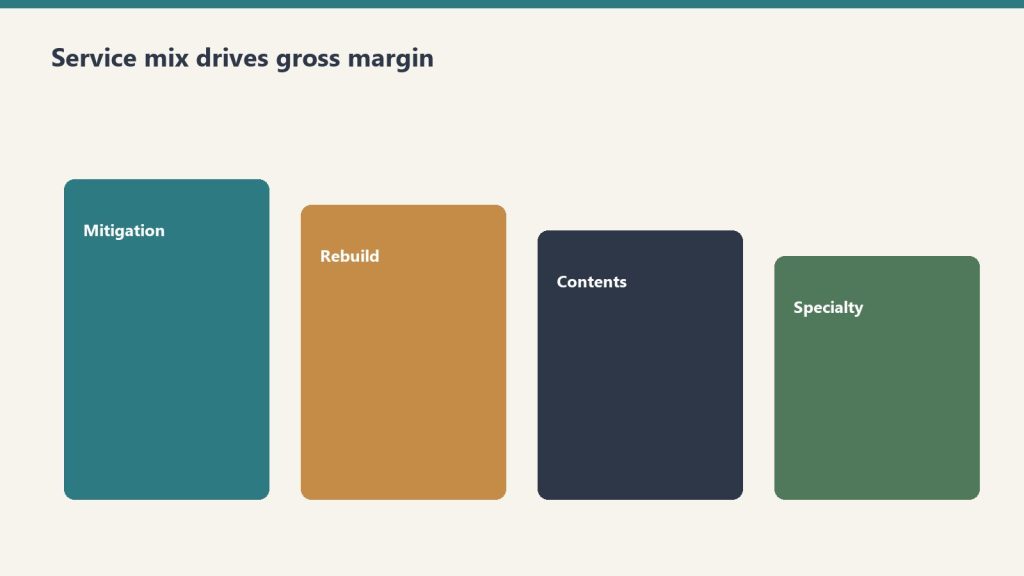
Direct answer: A restoration company’s profitability is determined more by service mix than by total revenue. Industry references consistently show water mitigation gross margins of 70-80%, mold remediation 40-50%, fire damage 25-30% with some references showing 20-25%, and reconstruction commonly cited around 10% with high-capacity volume shops achieving up to 50%. Two shops with the same $5 million revenue and the same operational competence can produce radically different profit dollars depending on whether the mix is mitigation-heavy or reconstruction-heavy. The well-run shop measures gross margin by line, prices each line to absorb appropriate overhead, and chooses mix deliberately rather than letting it drift based on whatever walks through the door.
The previous article in this cluster framed the AR cycle as the foundation discipline. This article frames service mix as the most important strategic decision an operator makes. The decisions are linked — the cycle problem is harder to solve in a reconstruction-heavy mix than in a mitigation-heavy mix, because reconstruction billing cycles are inherently longer and reconstruction margin is inherently thinner. An operator working on both at once will find that fixing service mix actually compounds the AR cycle improvements from the previous article.
The case for thinking carefully about mix starts with arithmetic. Consider two restoration companies, both running $5 million in annual revenue with identical overhead structures, identical labor costs, and identical operational discipline. Company A runs 60 percent water mitigation at 75 percent gross margin and 40 percent reconstruction at 15 percent gross margin. Company B runs 30 percent water mitigation at 75 percent gross margin and 70 percent reconstruction at 15 percent gross margin. Same revenue, same competence — different financial outcomes. Company A produces roughly $2.55 million in gross profit; Company B produces roughly $1.65 million. The mix decision alone costs Company B about $900,000 in gross profit, which after fixed overhead becomes a far larger gap in net profit. The two companies look similar from the street and from the customer-facing pitch. They are not similar businesses.
This is the conversation most restoration owner-operators do not have with themselves. They think of revenue as the goal and mix as whatever happens. They take the work that comes in. The discipline this article describes is to invert that — to treat mix as the deliberate choice and revenue as the consequence of mix multiplied by efficient execution.
What each service line actually pays
Mix shifts margin more than slogans do.
Industry references including Restoration Profits, Kiwi Cashflow’s restoration CFO commentary, the Cost of Doing Business Survey covered by Restoration & Remediation Magazine, and restoration franchise public materials produce a consistent directional picture of gross margin by service line. The numbers vary by region, geography, and company-specific factors, but the relative ordering is robust.
Water mitigation. Gross margin 70-80 percent. The highest-margin line in restoration. The economic engine: equipment does most of the work. Air movers, dehumidifiers, and air scrubbers run on 24-hour cycles with limited human attendance. Xactimate’s mitigation pricing rewards the equipment-heavy model. A typical mitigation job has labor cost around 15-20 percent of revenue, equipment rental or amortization around 5-10 percent, materials and consumables around 2-5 percent, leaving roughly 70-80 percent for overhead absorption and profit. The math works because equipment, once owned, has marginal cost approaching zero per additional job day. Industry coverage from Claims Delegates and others has explicitly described high-margin mitigation strategies as “$1,000 per hour” lines when Xactimate is used correctly.
Mold remediation. Gross margin 40-50 percent. Lower than water mitigation because the labor content is heavier and the protective cost (PPE, containment, disposal) is real. Mold work is also more documentation-intensive, more regulated, and often more disputed by carriers, all of which add cost without proportional revenue. Mitigation-style equipment (HEPA filtration, negative-air, dehumidification) supplements but does not replace skilled hand labor for source removal and structural cleaning. Mold is a real margin line for shops with the capability, but it is not the equipment-leveraged windfall that water mitigation can be.
Fire damage restoration. Gross margin 25-30 percent commonly cited; 20-25 percent in some references. The work is labor-intensive, slow, contents-heavy, and odor-and-soot-management-heavy. Fire jobs are larger and more complex than water jobs, requiring skilled project management and coordination layered on the technical work. The pricing in Xactimate supports the work but does not provide the equipment-leverage that water enjoys. Fire-damage restoration is good revenue at honest margin, but it does not produce the windfall margin that an underloaded mitigation crew can produce on the right water job.
Reconstruction. Gross margin 10-20 percent in typical operator references; up to 50 percent for high-volume operators per Cleanfax-published commentary on the most efficient operators. The wide range reflects two different business models. The standard model treats reconstruction as a service line layered onto the restoration relationship — the restoration company handles the rebuild because the customer is already in their hands, but margins are construction-industry margins (10-15 percent) plus general overhead absorption. The high-volume model treats reconstruction as a primary business with restoration relationships as the customer acquisition channel — these shops have invested in subcontractor management, project management depth, scheduling systems, and supplier relationships that allow them to run reconstruction at 30-50 percent gross margin through volume efficiency and subcontractor leverage. Most owner-operator restoration shops run reconstruction in the 10-20 percent range. A few have built the operational discipline to run it higher.
Contents cleanup. Gross margin around 50-65 percent for shops with capability. Per the same Cleanfax operator commentary, high-capacity contents shops achieve 65 percent gross margin on cleaning and around 50 percent on packouts when subcontractor pricing is doubled into invoiced cost. Contents work is real margin for shops that specialize, more variable for shops that treat it as ancillary to structure work. This line has the largest gap between specialist operators and generalist operators.
Specialty services. Gross margin variable but often strong on coordination revenue. As covered in the specialty restoration cluster, specialty work performed through a vetted subcontractor bench produces coordination revenue at high effective margin (the coordination fee is high-margin because the direct work cost is the specialist’s, not the restoration company’s). Specialty work performed in-house by the restoration company is rare and is its own business model.
Biohazard, trauma, and crime scene cleanup. Gross margin commonly cited 40-60 percent for trained operators with appropriate licenses. This is a smaller volume, higher-emotional-stakes line that pays at a premium because few operators are equipped or willing to do it. Operators who specialize here can run profitable practices at relatively low total revenue.
The overhead absorption problem
Pure gross margin numbers do not tell the full story because each service line absorbs a different proportional share of fixed overhead. A shop that runs at $5 million revenue with $1.5 million in fixed overhead (rent, salaried staff, fleet, equipment depreciation, insurance, software, marketing) has to allocate that overhead across the work it produces.
The well-run shop allocates overhead to service lines based on the share of resources each line consumes, not based on revenue share. A reconstruction job uses substantially more project-management time, more office support, more procurement effort, and more accounting time per revenue dollar than a water mitigation job. If overhead is allocated by revenue share, reconstruction looks more profitable than it actually is and mitigation looks less profitable than it actually is.
The accounting fix is service-line P&L with deliberately allocated overhead. The shop sets up its accounting to track direct cost (labor, materials, equipment, subs) by service line, then allocates fixed overhead using a cost-driver methodology — project-management time, billing time, office support time, fleet usage — that reflects actual consumption. The result is service-line contribution margin that shows what each line is actually earning after overhead absorption, not just what it earns before overhead.
Most restoration shops do not run this analysis. Most operators are surprised by the answer when they do. Reconstruction often emerges as a marginal contributor or actual loser after appropriate overhead allocation, even when its gross margin looks acceptable. Water mitigation often emerges as a much larger contributor than its revenue share suggests. The strategic implications follow from the analysis — and they are usually different from what the gut-feel running of the business produced.
How mix actually shifts in the day-to-day operation
Day-to-day mix shifts are decisions — not accidents.
Mix is not chosen in a strategy session. It shifts based on a series of small decisions made across the operation, often without anyone realizing they are shifting mix.
Marketing channels favor specific lines. Google Ads bids on emergency water keywords drive water mitigation calls. Roofer partnerships drive storm-damage reconstruction. Insurance preferred-vendor program leads come in line-mix patterns specific to each program. The marketing decisions made in the prior cluster (Marketing Stack on Tygart Media) directly shape mix.
Sales scripts favor specific lines. The way the call-taker scopes the conversation, the way the on-site rep frames the work, and the way the project manager presents options to the customer all subtly steer the work mix. A shop whose sales conversation centers on “let us handle everything” tends to capture more reconstruction. A shop whose sales conversation centers on “we are the mitigation specialist” tends to keep more focused mix.
Staffing tilts the mix. A shop that has hired heavily on reconstruction project managers will sell more reconstruction because that is what the team is configured to deliver. A shop with deep mitigation lead techs and a thin reconstruction PM bench will lean toward mitigation. The org structure and the work mix shape each other.
Carrier program enrollments drive specific line mixes. Some carrier programs are mitigation-heavy, others are reconstruction-heavy, others are biohazard-and-emergency-response-heavy. The shop’s program portfolio shapes its inbound mix more than most operators recognize.
Customer relationship behaviors drive mix. A shop that subcontracts reconstruction to trade partners on relationship terms (offering them the rebuild work in exchange for emergency referral flow) keeps mitigation margin while passing through reconstruction. A shop that holds reconstruction in-house captures both lines but absorbs both margin profiles.
Recognizing that mix is the cumulative result of these small decisions is the first step. Choosing to make those decisions deliberately is the second.
Strategic mix archetypes
Most well-run shops fall into one of four mix archetypes, each with its own logic and its own trade-offs.
Mitigation specialist. Mix heavily weighted toward water mitigation and mold remediation, with reconstruction passed through to trade partners or refused entirely. Highest gross margin profile of the four archetypes; smallest revenue per claim; highest claim volume requirement to hit a given revenue target. This model works well in metro markets with high water-loss frequency and a reliable network of reconstruction partners. The trade-off is that the specialist sees a smaller share of total restoration spend per claim — the rebuild work and the contents work go to others — and the customer relationship is shorter.
Full-service generalist. Mix balanced across mitigation, reconstruction, and contents. Most common archetype in mid-size independent shops. Captures the full claim economically but at blended margin that includes the lower reconstruction line. Works in most geographies. Trade-offs: requires operational depth across multiple service lines, requires management depth to run reconstruction at acceptable margin, and tends to produce lower overall gross margin than the specialist model.
Specialty commercial wedge. Mix weighted toward commercial accounts with specialty recovery components (documents, electronics, art, medical equipment) plus the general mitigation and reconstruction those accounts produce. The model described in the previous specialty restoration cluster. Higher revenue per relationship, higher complexity, higher operational bar. Trade-offs: longer sales cycles, regulatory and compliance overhead, and dependency on a smaller number of larger accounts.
High-volume reconstruction operator. Mix weighted toward reconstruction at scale, with mitigation as a feeder. Less common as a deliberate strategy but possible — these are the operators who have built reconstruction operational discipline equivalent to a homebuilder or commercial GC and who run reconstruction at 30-50 percent gross margin. The Cleanfax-cited high-capacity volume shops fall in this archetype. Trade-offs: requires substantial management investment in reconstruction operations, exposes the business to construction-cycle dynamics, and runs into the long-cycle AR problem from the prior article harder than the mitigation-led models.
The choice of archetype is not permanent. Many shops evolve from one to another as they grow, change ownership, or respond to market shifts. The point is to choose deliberately, build the operations to support the chosen archetype, and resist drift back to whatever-walks-through-the-door because that drift is what produces undisciplined service mix and the lower margins that follow.
Pricing each line to absorb appropriate overhead
The 10-and-10 myth — that restoration contractors should bill 10 percent overhead and 10 percent profit on top of direct costs as the standard markup — is one of the most damaging conventions in the industry. Industry coverage from Restoration & Remediation Magazine has covered this extensively under the “10 and 10 myth” framing. The math simply does not work. A shop with $5 million in revenue and $1.5 million in fixed overhead is running at 30 percent overhead, not 10 percent. Pricing at 10-and-10 means the shop is losing money on every job and making it up only when extreme volume covers the gap.
The disciplined alternative is to know the shop’s actual overhead rate as a percentage of direct cost and to price each service line with a markup that absorbs an appropriate share. For a shop with 30 percent overhead, the minimum markup over direct cost is roughly 50 percent (which produces gross margin around 33 percent — exactly the breakeven before profit). For acceptable profit, markup of 75-100 percent over direct cost is more common. The Xactimate price list, when used correctly, supports this markup level on most service lines. The shop’s price list and Xactimate practice should reflect the true overhead structure and the target profit margin, not industry conventions that are decades out of date.
The pricing decision differs by service line. Water mitigation can support high markup because the equipment-heavy model produces low direct cost, leaving room. Reconstruction is harder to mark up because direct cost is dominated by subcontractor and material cost, both of which are visible to customers and adjusters. The well-run shop applies different markup logic to different lines and matches its pricing to its actual cost structure rather than to a uniform convention.
For shops that are uncertain whether their pricing is right, the diagnostic is simple. Pull twelve months of P&L. Compute gross margin by line. Compute fixed overhead as a percentage of revenue. Compute net margin. If net margin is below 8-10 percent, pricing or mix is wrong. If gross margin on water mitigation is below 70 percent, Xactimate practice is the likely culprit. If gross margin on reconstruction is positive at any level, the shop is doing better than many; the question is whether the reconstruction is absorbing its appropriate share of overhead. The numbers reveal the problem; the operator’s job is to diagnose specifically and intervene at the right point.
What to refuse
What to refuse is a margin decision wearing a values jacket.
The hardest discipline in service mix is refusing work that does not fit. Most restoration owner-operators struggle with this because every job feels like revenue and revenue feels like progress. But work that runs below contribution margin (revenue minus direct cost minus appropriate overhead allocation) actually subtracts from the business — every dollar of bad-fit revenue requires the next dollar of good-fit revenue to make up the loss.
Specific patterns of work that the disciplined shop is willing to refuse:
Reconstruction at price points that require the shop to break its actual cost structure. Customers and adjusters who insist on 10-and-10 markup on reconstruction are asking the shop to lose money on the rebuild. The discipline is to either decline or to pass the rebuild to a trade partner who can do it at the contemplated price.
Out-of-area work that requires excessive mobilization. The labor and equipment cost of crews working far from base eats margin in ways the customer does not see. A shop with capacity issues during a CAT event can sometimes justify out-of-area work at higher pricing, but routine out-of-area work at standard pricing is usually a margin loser.
Carrier programs whose pricing structure does not fit the shop’s cost structure. Some preferred-vendor programs price meaningfully below market with the expectation of volume making up for unit margin. Whether this trade is worth taking is operator-specific, but the shop that signs into every program offered without doing the math is signing into structural losses.
Customer relationships that consume management time at scale. Some customers and adjusters require an hour of phone time and three documentation revisions for every invoice. The shop’s project management cost on these accounts often exceeds the gross profit. The discipline is to identify these accounts and either reset the relationship or end it.
Work the shop does not have the operational depth to deliver well. Taking a fire job when the shop has no fire-experienced lead tech, or a commercial loss when the shop has no commercial PM, is taking work the shop will execute poorly and damage its reputation on. The work feels like revenue; the reputation cost compounds against future revenue.
The operator who can decline bad-fit work calmly and confidently is operating from financial clarity. The operator who cannot is operating from fear that the next call may not come. The financial clarity is what comes from running this analysis and knowing the numbers cold.
How this article fits the cluster
Mix is the second foundation decision after AR cycle. With both in place, the rest of the cluster has solid ground to stand on. The next article — equipment economics — depends on understanding mix because equipment ROI is line-specific (water mitigation equipment has different utilization economics than reconstruction equipment). The crew structure and KPI dashboard articles that follow build on both foundation decisions.
If the prior article (AR cycle) is the highest-leverage operational improvement most restoration shops can make, this article (service-line mix) is the highest-leverage strategic improvement. They are different kinds of work — AR is a tactical, weekly operating discipline; mix is a quarterly and annual strategic discipline — but both produce outsized returns relative to the effort required.
Should I be running service-line P&L if my accounting system doesn’t support it natively?
Yes, with manual allocation if necessary. The first version can be a quarterly spreadsheet exercise — pull total revenue, total direct cost, and total overhead from the financial statements, then estimate the mix and the line-specific direct cost ratios. The numbers are imprecise but directionally accurate, and they will surface the strategic question even before the accounting system is reconfigured. Once you have decided that mix matters, invest in setting up the accounting to produce the analysis automatically.
Why is reconstruction so much harder to make money on?
Three structural reasons. First, the work is dominated by labor and materials, both of which are heavily benchmarked by competitors and carriers. Second, the cycle is long, so working capital cost is higher. Third, the customer can see the cost of the materials and the visible labor in ways they cannot for mitigation, which makes pricing pressure harder to absorb. The operators who run reconstruction at high margin have invested in subcontractor management, supplier relationships, and project-management efficiency that takes years to build.
Should an owner-operator pursue the high-volume reconstruction archetype?
Probably not as a starting strategy. The high-volume reconstruction model requires substantial management infrastructure that is expensive to build and difficult to maintain. Most owner-operators who try to evolve into this model end up with reconstruction-heavy mix at standard 10-15 percent margin rather than the 30-50 percent the well-built operators achieve. The honest assessment is that this archetype works for a small number of operators who have the construction-management capability, and most owner-operators are better served by mitigation specialist or full-service generalist archetypes.
What is a realistic mix to target if I want to maximize gross profit?
A mix-of-business analysis specific to your geography, capability, and capacity is needed for an actual answer. As a directional reference, mitigation specialists often run 60-75 percent mitigation and mold (combined), 15-25 percent contents and specialty, and 0-15 percent reconstruction (often passed through). Full-service generalists run 35-50 percent mitigation and mold, 15-20 percent contents and specialty, and 30-50 percent reconstruction. The right mix for a specific shop is a function of the local market, the shop’s operational depth, and the owner’s risk tolerance.
Does the specialty restoration wedge from the prior cluster fit into mix strategy?
Yes, directly. Specialty work is a high-coordination-margin add to the mix. The specialty cluster’s commercial-account focus produces relationships that generate mitigation, reconstruction, and specialty revenue together, and the specialty coordination component is high-margin in a way that lifts the blended profile. Operators who have built specialty capability typically see their mix shift toward more mitigation and specialty, less commodity reconstruction.
How often should I revisit the mix question?
At minimum, annually as part of business planning. More frequently if the shop is growing fast, going through ownership changes, expanding geography, or seeing significant changes in carrier program enrollments. A quarterly directional review is good discipline. Monthly is overkill. Weekly is panic.
What if I’m carrying lines I’m bad at because I haven’t done this analysis before?
The disciplined response is to either invest in becoming good at the line (hire, train, partner) or exit the line. Carrying lines you are bad at is carrying work that produces below-average margin and below-average customer experience. It is the worst of both worlds. The annual review process should produce these decisions explicitly.
Are biohazard, trauma scene, and unattended death cleanup really good margin work?
For shops with proper licensing and trained crews, yes. The pricing supports the work and the competitive density is low because most operators do not want the work. The trade-offs are emotional weight on the crew, careful customer-facing communication, and licensing and disposal compliance overhead. For shops with the right operational fit, this is a legitimate niche.
What’s the relationship between mix and consolidator interest in acquiring my shop?
Consolidators value mix-driven margin profile. A shop with disciplined mitigation-heavy mix at clean margin is a more attractive acquisition target than a shop with the same revenue but lower margin from undifferentiated reconstruction-heavy mix. The mix work this article describes is also exit-positioning work, and operators who run it well over a few years are positioning for a stronger acquisition outcome whether or not they intend to sell.
What is the single move I should make this week from this article?
Pull last quarter’s P&L, estimate revenue and direct cost by service line, compute the implied gross margin per line, and compare to the industry directional ranges in this article. If your mitigation gross margin is below 70 percent, your reconstruction gross margin is below 10 percent, or your overall mix is reconstruction-heavy without operational depth supporting it, the analysis has identified the largest profitability lever in your business. Treat the answer as the agenda for the next quarter.
Direct answer: A restoration company’s profit and loss statement and its bank account tell two different stories, and the gap between them is the AR cycle. Industry data references show construction-sector DSO averaging around 83 days — the highest of any major industry — and restoration claim cycles stretching well beyond 60-90 days are common. The well-run shop measures days sales outstanding by carrier, by service line, and by job size, builds working capital reserves sized to the actual aging profile rather than the optimistic version, and runs documentation discipline that removes the most common reasons adjusters delay payment. Compressing days-to-cash from 90+ down to a defensible 45-60 is worth more to most restoration companies than a 5-point margin improvement, because it directly funds growth without external capital.
The single most common silent killer of growing restoration companies is not bad work, bad marketing, or bad people. It is the gap between when the cash goes out and when the cash comes in. A restoration company growing at 30 percent per year is, by definition, funding 30 percent more labor, more equipment, more materials, and more subcontractor invoices than the previous year — out of working capital that has not yet been replenished by the carrier checks for last quarter’s work. The math compounds. Every additional dollar of revenue requires roughly the same proportional dollar of working capital. A growth rate that exceeds the working-capital cycle eventually exhausts the bank account, even while the P&L looks healthy and the owner cannot understand why payroll is suddenly hard to make.
The first move toward fixing this is recognizing that the AR cycle is not a back-office annoyance. It is the central operational metric of the restoration business model. Operators who understand and manage it correctly run growing companies without external capital. Operators who do not understand it either grow slower than their market opportunity allows or take on debt they do not need to take on. The well-run shop treats AR cycle as a strategic discipline.
This article is the first cluster piece in the finance and operations stack and is the one most operators should attack first. The rest of the cluster builds on the assumption that the AR cycle is under control. Without it, the other improvements in service mix, equipment economics, crew structure, and KPI hygiene cannot compound.
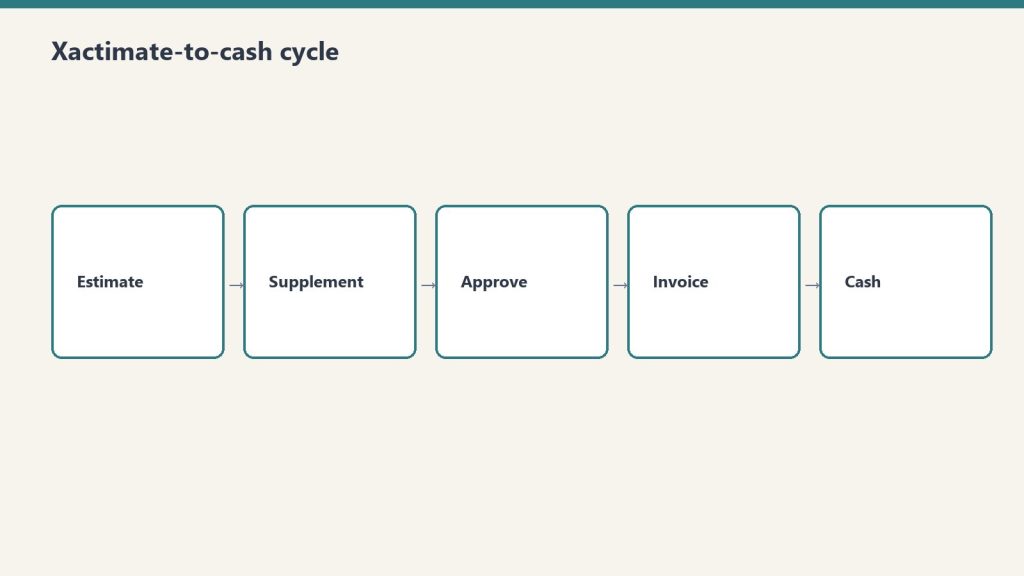
What the Xactimate-to-cash cycle actually looks like
What the Xactimate-to-cash cycle actually looks like.
The Xactimate-to-cash cycle has more steps than most operators map out. Each step is a place where days accumulate. The full sequence on a typical commercial or residential insurance claim:
Loss event and dispatch. Day zero. Restoration company arrives, performs emergency mitigation, begins documentation.
Mitigation completion. Days three to seven on a typical water loss. Drying complete, dry standards verified, mitigation invoice ready to assemble.
Mitigation invoice submission. Days seven to fourteen. Restoration company assembles the mitigation invoice — Xactimate estimate, photos, moisture logs, daily reports, work authorization, certificate of completion — and submits to the adjuster.
Adjuster review and approval. Days fourteen to thirty-five. Adjuster reviews the submission, may request additional documentation, may negotiate scope or pricing, eventually approves the invoice in whole or in part. Independent industry references from restoration billing services note that documentation gaps are the most common reason adjusters extend this window — missing photos, incomplete moisture logs, inconsistent line items, or scope items that cannot be supported by the documentation.
Carrier payment processing. Days thirty-five to sixty. Carrier processes the approved invoice and issues payment. For claims involving a mortgaged residential property, the check is typically made out jointly to the policyholder and the contractor, which means the homeowner has to endorse and forward, and lender involvement is required for claims above a threshold (commonly $10,000-$15,000) where mortgage companies release funds in stages.
Reconstruction or repair phase. Begins after mitigation phase. The reconstruction scope is developed, approved, and executed. The cycle for reconstruction billing repeats — invoice assembly, adjuster review, carrier processing — but on a longer cycle because reconstruction work itself takes longer.
Final invoice and closing. Days ninety to one-hundred-eighty for a fully reconstructed loss. Final scope reconciliation, depreciation holdback recovery on RCV claims, retainage release if applicable.
The aggregated cycle on a typical mid-size residential or commercial loss runs sixty to one-hundred-twenty days from loss to full payment. On larger commercial losses with multiple phases, scope disputes, or coverage issues, it stretches to one-hundred-eighty days or more. On problematic claims with denied items, public adjuster involvement, or litigation, it can stretch into multi-year territory.
For working-capital math, the simple version is that every dollar of revenue requires roughly the proportional dollars of cash held in AR for the average cycle length. A shop with $10 million in annual revenue and a 90-day cash cycle is carrying roughly $2.5 million in average AR — and that AR is funding the labor, equipment, materials, and subcontractor cost the shop is incurring on the next set of jobs. Compress the cycle to 60 days and the shop’s working-capital requirement drops to roughly $1.65 million, freeing $850,000 in cash for growth, debt reduction, equipment investment, or distribution. Compress further to 45 days and the freed cash hits $1.25 million. These are real, recoverable numbers, and they show up in the bank account, not just on the spreadsheet.
Why DSO is the wrong single metric and the right multi-metric
Most restoration companies that measure AR at all measure a single overall DSO number, calculated as accounts receivable divided by total revenue, multiplied by the number of days in the period. This is the standard cross-industry calculation and it produces a useful directional read — but on its own it is not actionable, because the underlying AR is not homogenous. The well-run shop measures DSO three ways simultaneously.
DSO by carrier. The DSO with State Farm is different from the DSO with USAA, which is different from the DSO with Allstate, which is different from the DSO with the local independent commercial carriers. Some carriers pay reliably in 30-45 days; some stretch to 60-90; some stretch beyond 90 routinely. The shop that knows its DSO by carrier can make rational decisions — which programs to lean into, which to pull back from, which to limit exposure on. The shop that knows only its blended DSO is making aggregate decisions on heterogeneous data.
DSO by service line. Mitigation invoices typically pay faster than reconstruction invoices because they are smaller, simpler, and structured to industry-standard mitigation Xactimate line items. Reconstruction invoices pay slower because they involve more scope negotiation and more adjuster review. Specialty work — documents, electronics, art, medical — pays in patterns that depend on the carrier’s familiarity with the specialty pricing and on whether the specialist bills direct or through the prime restoration company. A shop that knows DSO by service line can spot whether the cycle problem lives in mitigation, reconstruction, or specialty.
DSO by job size. Small jobs (under a few thousand dollars) often pay quickly because adjusters approve them with minimal review. Mid-size jobs ($10,000-$50,000) often hit the worst of both worlds — large enough to require full documentation review, small enough to lack the executive attention that moves large losses through the system. Large jobs (over $100,000) often have dedicated adjuster attention, large-loss specialists involved, and faster decision-making once scope is settled, although the cycle from loss to first payment can still be long. A shop that knows DSO by job size can identify the band where the cycle is most painful and target documentation and follow-up effort there.
The combined picture — DSO by carrier, by service line, by job size — is what produces actionable management information. Most restoration companies do not produce this view because their accounting systems are not configured to slice AR this way and their internal reporting effort has been on top-line metrics. Configuring the accounting system to support this slicing is a one-time investment that pays back almost immediately.
What is causing the long cycle, and which causes are operator-controllable
Operator-controllable causes of a long cycle.
The long restoration cycle has multiple causes, and the operator’s intervention point is different for each.
Documentation gaps. Operator-controllable, high impact. Industry references from restoration billing services consistently identify documentation as the single largest cause of payment delays. An invoice missing photos, moisture logs, daily reports, signed work authorizations, or scope justification gives the adjuster a defensible reason to delay payment with a request for more information. Each round trip costs five to fourteen days. A shop that submits complete, clean, defensible documentation on the first submission collects faster than a shop that submits incomplete documentation and chases revisions.
Xactimate scope quality. Operator-controllable, high impact. An Xactimate estimate that uses incorrect line items, that prices outside the standard price list without justification, or that includes scope items not supported by the documentation will be reduced or returned. Real Xactimate proficiency — Level 1 certification at minimum, Level 2 ideal, in-house or contracted — pays for itself on the first half-dozen invoices. Operators who use Xactimate as a glorified word processor without understanding the underlying line-item logic submit estimates that produce avoidable disputes.
Carrier program structure. Partially operator-controllable. Different carrier preferred-vendor programs have different documentation requirements, different review cycles, and different payment-processing timelines. Some require submission through specific portals (Verisk’s claims platforms, Symbility, carrier-specific systems) that produce faster cycles than email-based submission. Some require pre-approval at scope thresholds. The operator’s intervention point is to learn the program’s specifications cold and submit to specification, and to selectively de-prioritize programs whose cycle structure does not work for the shop’s working-capital tolerance.
Mortgage company involvement. Limited operator-controllability. On residential losses where the property is mortgaged, the lender’s check-handling protocol adds a cycle layer the contractor cannot eliminate. The intervention is to communicate the lender process to the homeowner early, provide the documentation the lender will require (final invoices, work completion certificates, lien waivers) ahead of need, and follow up actively rather than passively waiting.
Public adjuster involvement. Mixed operator-controllability. When a PA is on the file, scope is scrutinized harder and disputes take longer. The contractor’s intervention is to maintain documentation discipline strict enough to survive PA scrutiny, communicate professionally with the PA on scope questions, and avoid behaviors that escalate the file unnecessarily.
Coverage disputes. Limited operator-controllability. When the carrier disputes coverage on items the contractor has performed, the cycle stretches indefinitely. The intervention is upfront — confirming coverage on questionable items before performing the work, getting written authorization on scope expansions, and avoiding work the policy clearly does not cover.
Litigation. Not operator-controllable except by avoidance. Once a claim is in litigation, the cycle is governed by the legal process rather than the claims process. The contractor’s defense is to not get into litigation in the first place, which means honest scope, complete documentation, professional communication, and a willingness to walk away from disputes that are not worth litigating.
The pattern in this list: the highest-impact causes are operator-controllable. Documentation discipline and Xactimate scope quality are the two largest levers, and they are entirely within the shop’s control. Operators who blame the long cycle on the carriers without first auditing their own documentation and Xactimate practice are diagnosing the wrong problem.
The operational moves that compress the cycle
Operational moves that compress the AR cycle.
The well-run shop runs a specific set of operational practices that compress the AR cycle. These are not novel and they are not glamorous. They are the practices that produce the difference between a 90-day cycle and a 45-60 day cycle.
Document at the job level, in real time. Not at invoice time. Photos taken on day one, moisture logs updated daily, daily reports completed by the lead tech before leaving site, scope-of-loss documented progressively as the work develops. Documentation assembled at invoice time is documentation that has gaps. Documentation assembled in real time is documentation that is complete on day seven when the mitigation invoice is ready to go out.
Use a documentation platform. Several industry-standard platforms — including CompanyCam for photos, MICA and ENCIRCLE for full documentation packages, and proprietary platforms from larger carriers’ preferred-vendor programs — automate documentation capture. Operators using these platforms submit cleaner invoices and submit them faster than operators relying on phone photos and paper logs.
Build the Xactimate estimate as the work progresses, not after. The mitigation Xactimate estimate should be largely written by the time the drying is finished. The reconstruction Xactimate estimate should be developed during the mitigation phase, not after the customer authorizes the rebuild. Operators who treat Xactimate as a billing-time activity add days to the cycle that the operators who treat it as a project-execution activity do not.
Submit the invoice on a schedule. The shop’s standard should be invoice within seven days of mitigation completion, with no exceptions for shop-side delays. Customers and adjusters pay invoices that arrive promptly faster than they pay invoices that arrive late, partly because the file is fresh and partly because prompt invoicing signals professional operations.
Follow up on a schedule. Adjuster contact at day fourteen post-submission if not approved, day twenty-one with escalation request, day thirty with escalation to the carrier’s claims service line. Adjusters have hundreds of files. The files that get attention are the ones the contractor stays present on. The files that drift are the ones where the contractor submits and waits silently.
Reconcile cash to invoices weekly, not monthly. The accounting team should know which invoices are open, by carrier and by adjuster, every week. Stale aging that is not reviewed is aging that gets older. Weekly review with explicit follow-up assignments produces faster collections than monthly review.
Use a billing service when in-house capacity does not exist. Restoration-industry-specific billing services — companies like Restoration Insurance Billing, Blackwater Billing Services, NetClaimsNow, and others — exist specifically to handle Xactimate invoice assembly, submission, and follow-up. For shops that do not have in-house Xactimate competence or in-house collections discipline, outsourcing this function to a specialist often produces a faster cycle than handling it in-house at the shop’s current capability level. The fee is paid out of the cash-cycle compression.
Working capital strategy
Compressing the AR cycle reduces but does not eliminate working capital intensity. Even at a defensible 45-60 day cycle, a growing restoration company carries substantial cash in receivables. The well-run shop has a deliberate working capital strategy that funds this intensity without surprises.
Cash reserve sized to the actual aging profile. A shop with a 60-day cycle should carry cash reserves sufficient to operate for at least 60 days at current burn rate, plus a buffer for delayed collections on specific files. Many operators size reserves to 30 days of operating cost, which is too thin for restoration’s cycle. Sizing reserves to 75-90 days of operating cost, with a clear policy on when reserves can be drawn down for growth investment versus when they must be held, gives the shop room to absorb a slow collection month without payroll stress.
Line of credit as a flex tool, not a permanent funding source. Most growing restoration shops should have a working-capital line of credit with a commercial bank, sized to cover one to two months of operating cost. The line is a tool for absorbing month-to-month variation in collections, not a tool for funding ongoing operations. Shops that operate continuously on the line of credit are shops with a structural cash problem they have papered over with debt.
Customer financing as a deliberate tool. On residential reconstruction work where insurance does not cover the full scope, customer financing can be offered through restoration-industry-specific finance partners or general home-improvement finance platforms. This converts a payment-cycle question into a marketing question and shifts the cycle off the shop’s balance sheet.
Avoid AOB-driven cash flow models. Some restoration companies build their cash flow on aggressive use of assignments of benefits, where the carrier pays the contractor directly. AOBs solve the homeowner-endorsement step but do not address the underlying claim cycle, and several states have passed AOB reform that complicates or restricts the practice. Building working capital strategy around AOBs is fragile both legally and operationally.
Factoring as last resort, not first option. Specialty receivables-factoring firms exist that will advance against restoration AR, but the cost is meaningful (often 2-4 percent per month effective rate) and using factoring routinely indicates that the underlying cycle problem has not been fixed. Use factoring only as a bridge while implementing the operational improvements that compress the cycle, not as a permanent solution.
What the AR cycle reveals about the rest of the business
The AR cycle is a diagnostic tool as much as it is an operational metric. Specific patterns in the AR aging report point to specific underlying issues elsewhere in the operation.
Long cycle on a specific carrier. The carrier’s program structure may not fit the shop’s working-capital tolerance, or the shop’s documentation may not fit the carrier’s submission requirements. Either way, this is a focused intervention point.
Long cycle on a specific service line. The Xactimate competence in that service line may be weaker, or the documentation discipline may be looser. Investigate the lead tech and project manager on that service line and compare practice to the better-performing service lines.
Long cycle on a specific job size. Process gaps in the size band — possibly insufficient project-management attention on mid-size jobs or insufficient documentation rigor on small jobs that get treated casually. Address process at the size band rather than the job level.
Long cycle on jobs led by a specific project manager. The PM’s documentation, communication, or follow-up practice may be substandard. Coachable, often quickly.
Spike in cycle in a specific month. Look for upstream issues — was a billing person out, did a software change disrupt invoice generation, did a regulatory change affect a common scope item, did a carrier change its program. The cycle is the downstream symptom of upstream operations.
The shop that uses AR aging as a diagnostic produces continuous improvement. The shop that uses AR aging only as a financial-statement input misses most of the management information the metric carries.
How this article fits the cluster
The AR cycle is the foundation. The next article in the cluster — gross margin by service line — depends on the AR cycle being defensible, because service-line economics that look good on margin but fail on cash conversion are not actually good economics. The articles that follow on equipment economics, crew structure, KPI dashboards, and the rest all assume the operator has working capital under control. An operator who works through the rest of the cluster without first fixing the AR cycle is building on sand.
If you take only one operational improvement from this entire cluster, take this one. The investment is modest — documentation discipline, Xactimate competence, scheduled follow-up, weekly cash review. The return is direct, measurable, and recurring. Compressing days-to-cash from 90 to 60 frees roughly two months of revenue in working capital. For a $5 million shop, that is roughly $830,000 in cash. For a $20 million shop, it is roughly $3.3 million. Those are not theoretical numbers. They are sitting in your AR right now.
What is a realistic DSO target for a restoration company?
For mitigation-heavy work with disciplined operations, 45-60 days is achievable. For mixed mitigation and reconstruction work, 60-75 days is realistic. For reconstruction-heavy work, 75-90 days is realistic. Operators running 90+ days have specific operational issues that should be diagnosable from the by-carrier, by-service-line, by-job-size view. Targeting under 30 days is unrealistic in this industry; targeting under 45 is achievable on the mitigation side but not the reconstruction side.
Should I use a restoration-specific billing service or build in-house?
Depends on shop size and current capability. Shops under $3 million with no in-house Xactimate-certified estimator typically benefit from a billing service — the cost is roughly offset by the cycle compression. Shops over $5 million should generally have in-house capability because the service fees become a real expense at scale and because in-house ownership of the cycle produces better discipline. Shops in between can go either way; the deciding factor is whether in-house capacity is genuinely competent or whether it is the owner-operator’s spouse doing it on weekends.
How do I get my AR aging by carrier, service line, and job size if my accounting system doesn’t slice it that way?
This is a one-time configuration project. Most accounting systems used by restoration companies (QuickBooks Online, QuickBooks Enterprise, Sage Intacct, NetSuite, restoration-specific platforms like Albi, KnowHow, and others) support custom fields or class tracking that can produce this slicing. The configuration takes a few days of accountant time and pays back permanently. If your current system genuinely cannot support this, the system is the bottleneck.
What about retainage on commercial work?
Commercial reconstruction often involves retainage (commonly 5-10 percent held until project completion) which extends the cycle on the retained portion well beyond the standard cycle. Build retainage into the AR aging view as a separate category so the operating cycle on the non-retained portion is visible cleanly. Retainage release is its own follow-up activity that should be treated as a managed process, not as something that happens automatically.
What if a specific carrier program is producing a long cycle but represents a meaningful portion of revenue?
This is a strategic decision, not just an operational one. The cycle math is real — if a carrier program produces revenue at acceptable margin but stretches AR by an extra 30 days, that’s a working-capital cost that the program revenue should justify. Quantify the cost (roughly the additional AR carried at the cost of capital), compare to the program’s contribution to gross profit, and decide whether the program is net positive on cash-adjusted economics. Many operators discover that programs they thought were valuable are actually drag once the cycle cost is accounted for.
How do I handle homeowners who do not endorse the joint check from the mortgage company?
This is a customer-service issue layered on a cash-cycle issue. Communicate the joint-check process to the homeowner before the loss is even mitigated, get them comfortable with the workflow, and follow up actively when the check is issued. Most customers cooperate; the few who do not usually have a deeper issue (dispute over scope, dispute over quality, financial distress) that needs to be addressed directly. Avoid letting these accounts age silently.
Is a line of credit absolutely necessary, or can a shop run without one?
Smaller shops under $1-2 million can sometimes run without one if reserves are healthy and growth is moderate. Shops over $3 million typically benefit from having one even if it sits unused most months — the optionality is worth the modest commitment fee. The decision is risk tolerance: a line of credit is insurance against a slow collection month, and like all insurance, it is most valuable when not needed.
How do I know if my Xactimate practice is the bottleneck?
Pull your most recent ten mitigation invoices and ten reconstruction invoices. For each, document the date submitted, the date approved, and any back-and-forth requests from the adjuster. If more than 30 percent of submissions trigger requests for revisions, your Xactimate practice has gaps. The specific gaps will be visible in the revision requests — line items used incorrectly, pricing outside standard with insufficient justification, scope items unsupported by documentation. Address those gaps directly, and the cycle compresses.
Can compressing the AR cycle actually replace the need for outside capital on a growing shop?
For most shops in the $1-30 million range, yes. The math works because each dollar of cycle compression frees a proportional dollar of working capital, and that capital recurs every cycle. Compressing cycle from 90 to 60 days on a $10 million shop frees roughly $830,000 in cash; on a $20 million shop, roughly $1.7 million. Those numbers fund meaningful growth without any external capital. Operators with cleaner AR cycles typically do not borrow for working capital because they do not need to.
What is the single most important practice I can install this week?
Daily documentation by the lead tech on every job, completed before the tech leaves site. Photos of pre-mitigation and post-mitigation conditions, moisture readings logged with timestamps, daily report covering work performed and conditions encountered, signed work authorization on file from day one. This single practice will compress your invoice submission time and reduce documentation-driven adjuster delays by more than any other change. Everything else in this article matters; this is where to start.
Direct answer: On a commercial specialty loss, the room is bigger than most restoration operators assume. The carrier has a staff, independent, or TPA adjuster running the file. The facility has a risk manager and often a broker. A public adjuster may be retained. A large loss brings in large-loss specialists, accountants for business interruption, and technical experts for specialty valuations. The restoration company that understands this room — who decides what, what documentation each party needs, and how specialty work fits into commercial policy structures — is treated as a participant in the claim rather than as a vendor waiting for scope approval. That shift in positioning is worth more revenue over time than any rate-sheet negotiation.
The previous seven articles in this cluster have built the operational case for the specialty wedge: what the categories are, what the ESA looks like, what accounts respond to it, and how the specialist bench gets built. This article covers the financial and contractual mechanics that run in parallel — the insurance and adjusting side of every commercial specialty loss. Miss this side and the operational work does not convert into paid work.
Commercial insurance is structurally different from residential insurance in ways that matter for every decision a restoration company makes on a specialty event. Policies are written on different forms. Deductibles are higher and sometimes paid out-of-pocket by the insured before the carrier engages. Business interruption is a live coverage that runs on its own clock. Scope of loss is adjudicated against policy language and often against pre-existing replacement-cost-value schedules. Specialty items frequently carry their own endorsements, riders, or scheduled coverages separate from the main property form. And the adjusting function is distributed across multiple roles rather than concentrated in one person. A restoration company that enters this environment with residential habits — “I’ll do the work and the carrier will pay the invoice” — spends two years getting punished by the system before learning how it actually works.
The rest of this article is the operator-level map.
Who is actually in the room
Who is in the room on a commercial specialty loss.
The parties at the table on a commercial specialty loss, in roughly the order they appear:
The insured. The facility itself — through its facilities director, risk manager, operations leader, or corporate real estate director. This is the party whose property is damaged and whose coverage is at stake. On significant losses, the insured is represented by its risk function, which is materially different from the facilities function. Risk manages the policy relationship and the financial outcome; facilities manages operations. Both matter. They do not always agree with each other.
The broker. Most commercial policies are placed through a broker — Aon, Marsh, Willis, Lockton, Gallagher, Alliant, Brown & Brown, Hub, and many regional and specialty brokers. The broker is the insured’s advocate with the carrier, is paid by the carrier out of premium, and usually has a long relationship with the insured’s risk function. On large losses, the broker’s claims advocacy team is actively involved in negotiating scope and settlement.
The carrier’s adjuster. This is the person running the claim on the carrier’s side. Three variants exist. A staff adjuster is a carrier employee; common on small to mid-size losses and on carriers that use in-house handling. An independent adjuster (IA) is a contractor deployed by the carrier through firms like Alacrity Solutions, Pilot Catastrophe, Eberl, Worley, Crawford, or Sedgwick; common on large losses, CAT events, and geographically dispersed exposure. A TPA (third-party administrator) adjuster is the primary handler for carriers that outsource claims administration and for self-insured and captive-insured programs; common on commercial programs, public entities, and corporate risk-management structures. The restoration company’s ability to work productively with the adjuster depends significantly on which type is assigned, because their authority, their time horizon, and their reporting structure differ.
The public adjuster. When retained by the insured (usually on significant losses where the insured wants its own adjusting advocate), the public adjuster — PA — is paid by the insured, typically on a percentage of settlement, and represents the insured’s interests in scope development and negotiation. PAs are regulated state by state; several states prohibit them on commercial losses, others allow them with restrictions. On losses where a PA is involved, the dynamic shifts — negotiations take longer, documentation is scrutinized harder, and the restoration company needs to provide tighter scope evidence.
The large-loss adjuster or general adjuster. On losses above a dollar threshold — typically $250,000 to $1 million depending on the carrier — the file escalates to a large-loss or general adjuster. These are senior, experienced adjusters with broader authority and usually a more commercial orientation. Some are staff, some are GA-track independents. When a large-loss adjuster takes the file, the restoration company’s interaction becomes more substantive and more documentation-driven.
Specialty consultants. On large or technically complex losses, the carrier commonly retains technical experts: a forensic engineer for cause-and-origin, a certified industrial hygienist for environmental and IAQ work, a forensic accountant for business interruption, a specialty valuer for art or antique items, a cost consultant for high-dollar reconstruction, and sometimes a building consultant for envelope or structural issues. These specialists produce deliverables that drive scope decisions.
The TPA’s file examiner. When a TPA is administering claims, an examiner manages the file behind the scenes — reviewing adjuster work product, authorizing payments, and enforcing the program’s service-level standards. The examiner is rarely on site and is often invisible to the restoration company, but their decisions affect payment timing and scope approval.
Coverage counsel. On disputed losses or large losses where coverage issues surface, the carrier will engage coverage counsel. The insured may engage its own. At this point the claim has become a negotiation in a legal frame. The restoration company’s documentation becomes evidence.
The restoration company does not work with all of these parties on every loss. On a $50,000 commercial water event, it may be only the insured and an independent adjuster. On a $5,000,000 hospital fire with specialty equipment and business interruption, it may be all of them. The operator’s task is to map who is at the table on each event and communicate with each party at the right level of technical and contractual detail.
Commercial policy structures and what they cover on specialty losses
Commercial property policies are not written on a single form. Four families of forms matter for the restoration company’s day-to-day work.
ISO Commercial Property program. The Insurance Services Office writes standardized forms — Building and Personal Property Coverage Form (CP 00 10), Causes of Loss forms (Basic, Broad, Special), and various endorsements. Most mid-market commercial policies are written on ISO forms or close variants. Specialty items get coverage through the Building and Personal Property form unless they are scheduled out into separate endorsements.
Manuscript forms and package policies. Large commercial accounts and specialized verticals (healthcare, universities, financial services, real estate portfolios, manufacturing) often have carrier-specific or manuscript forms that modify or replace ISO language. AIG, Zurich, Chubb, FM Global, Travelers, Liberty Mutual, and The Hartford all publish proprietary commercial forms. These forms generally provide broader coverage than ISO Special Form but with more complex conditions and sublimits.
Scheduled property. Certain high-value items are scheduled individually rather than covered under the general property form. Fine art (blanket or itemized scheduled), rare books, specialty medical equipment, trading-floor technology, and specific pieces of machinery are often scheduled with specific values, specific covered perils, and sometimes specific named conservators or repair vendors.
Inland marine. Specialty coverages that sit outside the building are often written as inland marine — fine art (scheduled or blanket), medical equipment on lease (Motor Truck Cargo for mobile medical imaging, for example), contractor’s equipment, and data-processing equipment at multiple locations.
The implication for restoration companies: the answer to “is this covered?” on a specialty item is rarely obvious from the general property policy. The insured’s broker or risk manager will know how a specific item is scheduled, endorsed, or covered. The restoration company should ask — politely, early — about coverage structure on high-value items before assuming the work will be paid under the mainline property form.
Three coverage concepts that appear on most commercial losses:
Replacement cost value vs. actual cash value. RCV settles at the cost to replace with like kind and quality. ACV settles at RCV less depreciation. Most commercial forms pay RCV if the insured repairs or replaces, but pay ACV initially with a holdback until repair is proven. For restoration services, this distinction matters because the invoice structure has to support the RCV conversion — which means documented scope, documented completion, and invoicing that tracks to the carrier’s RCV recovery process.
Coinsurance. Commercial property forms usually contain a coinsurance clause requiring the insured to carry coverage at a specified percentage (commonly 80%, 90%, or 100%) of the insured value. Under-insurance triggers a penalty that reduces the settlement. This is not usually a restoration company problem, but it affects the insured’s willingness to accept an aggressive scope because a scope that triggers a coinsurance penalty is a scope that costs the insured money. Restoration companies that scope aggressively without understanding the policy structure damage the insured’s financial outcome and the relationship.
Sublimits. Commercial policies routinely have sublimits for specific categories: contents in rooms subject to flood, fine art, electronic data, business records, and items in specific storage configurations. A loss that exceeds a sublimit is paid only up to the sublimit, regardless of the full loss value. Restoration companies working on specialty losses should know the sublimits in play so they can scope and communicate realistically.
Business interruption and the restoration clock
Business interruption and the restoration clock.
Business interruption coverage is the financial engine behind commercial restoration urgency and is the single coverage most often misunderstood by operators.
BI pays the insured for lost income during the period of restoration — the time from the loss event until the property can, with reasonable speed, be repaired or replaced and operations restored. The clock runs during restoration. The longer the restoration, the more BI the insured collects — which sometimes makes people assume that slower restoration is better for the insured. That is backwards in most cases. BI is capped by period-of-indemnity limits (often 12 months), by policy sublimits on dependent property and civil authority extensions, by extra expense limits that may be exhausted mid-loss, and by the insured’s actual lost margin — which includes lost customers who do not return when operations resume.
The correct operational posture is that the insured and the restoration company share an interest in restoring quickly. BI is not an excuse to slow down; it is the mechanism that funds the urgency. Specialty work is directly BI-sensitive — a hospital whose imaging is down is losing procedure revenue and triggering BI; a financial firm whose records are off-site in freeze-drying is limited in its operations; a cultural institution whose galleries are closed is generating BI on lost admissions and event revenue. The specialty wedge reduces BI duration, which is often the strongest ROI argument for the ESA in the first place.
Three BI-adjacent coverages that restoration companies should know:
Extra expense. Pays the insured for costs incurred to continue operations or accelerate restoration beyond normal costs. A temporary imaging suite rental, expedited manufacturer recertification, priority freeze-drying at premium rates, emergency specialist activation — these are often extra expense items. Getting them pre-approved by the adjuster at the time of incurrence is cleaner than arguing about them at invoice.
Civil authority coverage. Pays BI when a civil authority prohibits access to the insured property because of damage at an adjacent property. Relevant on CAT events and in urban environments.
Dependent property / contingent business interruption. Pays BI when a dependent property (a supplier, a customer, a key logistics node) suffers a loss that impacts the insured. Emerging in commercial coverage and usually outside the scope of restoration work, but sometimes in play when the specialty loss affects a contract manufacturer, logistics hub, or shared facility.
The scope-of-loss process
The scope of loss is the formal document that defines what the restoration work is. It is the central artifact of any commercial claim, and the quality of the scope drives the quality of the payment.
The standard scope-of-loss process on commercial work:
Initial inspection. Carrier adjuster, insured or PA, and restoration company walk the loss. Observations recorded by all parties. On large losses, specialists from the specialty bench may be present on the walk-through.
Mitigation scope. The emergency services work — water extraction, dry-out, containment, specialty stabilization — is scoped separately and billed early, often before the full scope of loss is developed. This is priced against the ESA rate schedule or against Xactimate mitigation line items.
Full scope of loss. After the property is stable, the carrier’s adjuster, often with specialists (engineering, IAQ, specialty valuers), develops a full scope covering structural repair, contents, specialty items, and business interruption. This scope is the basis for settlement of the claim and the basis for the restoration company’s reconstruction and specialty work pricing.
Scope approval and work authorization. The insured and the carrier agree on scope. The restoration company receives authorization for each phase of work.
Execution and documentation. Work is performed. Documentation is produced on a rolling basis — daily notes, photographs, moisture logs for drying, chain-of-custody logs for document work, biomed sign-offs for medical equipment, conservator reports for art. This documentation is the evidence that the work was performed to scope.
Invoice and payment. Invoices submitted against approved scope with supporting documentation. Payment processed through the adjuster or directly through the carrier’s claims system. Some carriers pay through an insured-controlled account (insured pays the contractor, carrier reimburses the insured); some pay direct to the contractor (common when there is an AOB or direct-bill arrangement); some pay jointly (to insured and contractor).
Xactimate is the dominant estimating platform. Approximately 80% of property claims are estimated in Xactimate. Restoration companies working commercial need Xactimate proficiency — either an in-house estimator with Level 1 or Level 2 certification or a relationship with a third-party estimating service. Scope developed in Xactimate using current carrier price lists settles faster than scope developed in other formats. Scope that deviates from Xactimate norms needs specific justification — unique conditions, specialty pricing not in the standard price list, or negotiated departures from default pricing.
Specialty scope is where Xactimate runs out of detail. Freeze-drying a pallet of documents, ultrasonic cleaning of a rack of servers, biomed recertification of a CT scanner, conservation of a damaged oil painting — none of these live cleanly inside Xactimate line items. The restoration company, in partnership with the specialist, has to develop specialty scope separately using the specialist’s own pricing methodology (per cubic foot, per square foot of material, per piece, per instrument) and then incorporate that into the overall scope. The adjuster may or may not accept the specialty scope at face value. On significant losses, the carrier will often retain a specialty consultant to validate the specialty scope and pricing. Being ready for that validation — with chain-of-custody documentation, technical evidence of the recovery need, and industry-standard pricing references — is what converts specialty scope into paid work.
Documentation discipline on specialty losses
Documentation discipline on specialty losses.
The documentation produced during a specialty loss is both operational evidence and financial instrument. On commercial losses, the quality of documentation drives settlement speed, settlement value, and audit defensibility. Five documentation streams that belong on every specialty loss:
Loss environment documentation. Photographs at arrival, photographs during stabilization, photographs at completion. Moisture mapping. Environmental readings (temperature, relative humidity, particulate, air pressure). Atmospheric condition logs for the first 72 hours (the window in which most specialty loss decisions are made). Any readings beyond normal environmental parameters — toxic vapor, asbestos disturbance, lead dust — with documentation of the protective measures deployed.
Chain of custody. Every physical item removed from the site, every location it travels to, every person who handles it, every environmental condition it is stored in, every return event. For documents, this is boxes and pallets tracked by RFID or barcode. For electronics, this is serialized equipment with date/time/handler logs. For art, this is object-level tracking including photographic documentation of condition at each transfer. For medical equipment, this is serial-number-tracked items with biomed sign-off at each transfer. Chain-of-custody is the single most important specialty documentation stream and the one most often underbuilt.
Scope evidence. Line-item justification for every scope item. Xactimate documentation for standard items. Specialty-specific pricing documentation with industry references where possible (freeze-drying per cubic foot reference ranges, ultrasonic cleaning per square inch, conservation per hour with AIC conservator rate guidance, biomed recertification per OEM schedule).
Specialist technical reports. Each specialty subcontractor produces a technical report on their portion of the work: conservator’s treatment report, biomed’s recertification documentation, electronics restoration’s testing and clearance reports, document recovery’s drying logs and post-processing condition reports. These reports are the basis for specialty scope, specialty pricing, and specialty settlement.
Compliance documentation. For regulated environments — HIPAA, GxP, FERPA, PCI — documentation of the compliance posture maintained during the loss. BAA references, data-handling logs, secure-destruction certificates, access logs, training records for on-site personnel. This documentation is what defends against a regulatory finding layered on top of the loss.
The documentation produced during a specialty loss should be assembled into a final loss package at closure — a single comprehensive deliverable that the carrier, the insured, and the broker each receive. This final package is the artifact that closes the claim cleanly and that serves as evidence if any part of the claim is later disputed or audited.
How the restoration company earns a seat at the table
Commercial restoration companies are rarely invited to participate in scope discussions. They are usually asked to submit estimates and then wait for approvals. The specialty wedge changes this dynamic for two reasons. First, the specialty work requires technical input the adjuster does not have — the carrier needs the specialist’s voice to develop the scope. Second, the ESA relationship pre-establishes the restoration company as a known, trusted, pre-vetted party with an existing relationship with the insured.
The combination of technical specialty and pre-loss relationship is what converts the restoration company from vendor to participant. Concrete behaviors that accelerate that conversion:
Bring specialty expertise to the scope meeting. The first walk-through after a specialty loss should include the specialty subcontractor, not just the restoration company’s general lead. A walk-through where the specialist points out what the carrier’s generalist adjuster will miss — environmental degradation windows, irreversible damage thresholds, specialty-specific salvage considerations — is a walk-through where the restoration company demonstrates value beyond commodity labor.
Build credibility with the adjusting community. The commercial adjusting world is relationship-dense. Independent adjusters working for multiple carriers carry reputations from job to job. TPA file examiners talk to each other. Large-loss adjusters know the handful of restoration companies that operate at a high-specialty level. Sustained, consistent, high-documentation work on a handful of losses produces a reputation that compounds — and eventually a reputation that the adjusting community refers work to rather than one that chases work.
Communicate in the adjusters’ language. The restoration company that can speak about scope in terms of ISO forms, sublimits, coinsurance, RCV versus ACV, extra expense allowance, dependent property coverage, and specific Xactimate line items is taken seriously by the adjuster. The restoration company that speaks only in operational terms is relegated to operational status. The language is learnable — a few IICRC-adjacent certifications (NICA or RIA’s classes on insurance, Xactimate certification, a few hours reading ISO CP form language) is enough to change the conversation.
Avoid adversarial postures on ordinary disputes. The scope process produces routine disagreements over items, pricing, and methods. These are negotiations, not fights. Restoration companies that treat every disagreement as a fight train the adjuster to minimize future interaction; restoration companies that negotiate professionally with evidence build relationships that pay forward. Reserve adversarial postures for the few cases where a carrier is genuinely behaving inappropriately, and handle those through coverage counsel and the broker rather than directly.
Invest in the broker relationship. Brokers are often the most overlooked party in the room. A strong broker-side relationship means the restoration company is referenced when the broker is advising a client after a loss, and sometimes means the broker recommends the restoration company for the ESA conversation in the first place. Time with brokers, participation in broker-hosted client events, and involvement in broker-sponsored risk-management content are all high-ROI activities for restoration companies targeting commercial accounts.
When the relationship should route through a public adjuster
On significant commercial losses, the insured may retain a public adjuster. This changes the dynamic. PAs are paid by the insured as a percentage of settlement, which means they are motivated to maximize scope and valuation. That motivation aligns with the restoration company’s interest in being paid fully for the work but can create tension with the carrier’s cost-control interest.
Operating effectively when a PA is on the file:
Recognize the PA as the insured’s advocate. The PA will push hard on scope, pricing, and documentation. The restoration company’s job is to be ready — scope that was developed casually will be scrutinized, pricing that was loose will be challenged, documentation that was informal will be demanded in finished form. The PA is not the enemy; they are the scope’s quality control.
Keep the carrier relationship professional. The carrier will respond to a PA’s scope pressure in kind. If the restoration company appears aligned with the PA against the carrier, the carrier’s cooperation evaporates. The restoration company’s proper posture is neutral service provider with documented scope and professional communication on both sides.
Watch for PA fees coming out of the restoration company’s invoice. In a few states and a few PA contracts, the PA’s percentage fee is calculated against the total settlement including mitigation and restoration payments to the contractor. This can effectively reduce the contractor’s payment. Restoration companies should understand how the PA fee structure flows and negotiate for pre-deducted arrangements when possible.
Regulatory and coverage exposure the restoration company carries
A specialty commercial loss creates a handful of exposures the restoration company needs to manage regardless of how the insurance pays out.
HIPAA and data regulations. Discussed in earlier cluster articles. A healthcare-loss mishandling triggers direct regulatory exposure under HIPAA. A financial-services-loss mishandling may trigger GLBA or state financial-privacy law. A student-records mishandling triggers FERPA. These regulatory exposures are not paid by the insured’s insurance and are the restoration company’s own problem.
Contractual indemnification to the facility. Discussed in the ESA article. Indemnity provisions in the ESA govern how losses caused by the restoration company’s performance route back. Insurance is the funding mechanism; the contract is the liability structure. Restoration companies operating at the commercial specialty level need adequate general liability and professional liability coverage to support the indemnity they have agreed to.
Subcontractor liability. Specialty work performed by subcontractors flows back to the restoration company through the master subcontractor agreements. Insurance coordination between the restoration company and the specialist is what funds this liability. The additional-insured posture and the certificate-of-insurance cross-referencing from the earlier bench and ESA articles is the operational answer.
State-specific licensing and consumer-protection exposure. Many states regulate insurance-restoration contracts, including post-loss AOBs, fixed-price contracts, work authorizations, and cooling-off periods. Restoration companies operating multi-state need to know their exposure in each state they work. A contract that is enforceable in one state may be void in another.
Xactimate scrutiny and audit. Repeated carrier work produces audit patterns over time. Consistent overbilling patterns, scope padding, or line-item inflation are tracked across the industry and eventually produce carrier pushback, reduced approvals, or removal from preferred-vendor lists. The operational discipline of scoping honestly, pricing against Xactimate as the default, and negotiating deviations transparently is what preserves long-term commercial work.
How this article completes the specialty cluster
The pillar and seven cluster articles before this one have covered, in sequence: why specialty is a commercial door-opener, what the four specialty categories are, what the ESA needs to contain, what accounts to pursue, how to build the specialist bench. This article covers the financial mechanics that make the system sustainable.
The specialty restoration wedge as a commercial strategy depends on operating competently in each of these domains simultaneously. A restoration company with a great bench but weak ESA structure loses to the contract. A restoration company with a great ESA but thin bench loses to the event. A restoration company with both but no understanding of the adjusting dynamics gets paid slowly, paid incompletely, or paid after disputes that erode the relationship. The system works when every layer works.
The operator’s takeaway: the specialty wedge is not a single product. It is an integrated capability that includes operational specialty execution, contract infrastructure, account-portfolio focus, bench relationships, and claims-handling competence. Any restoration company building toward this model should treat the eight articles in this cluster as a checklist. A company that has made progress on six or seven of the eight dimensions is a company that will convert commercial specialty opportunities. A company that has only focused on one or two dimensions will keep losing to companies that have covered all eight.
How is a commercial claim different from a residential claim from the restoration company’s perspective?
Three practical differences. First, the adjusting is distributed across more parties (broker, adjuster, PA, specialists, large-loss adjuster, coverage counsel) rather than concentrated in one adjuster. Second, the policy is more complex — specialty items are often scheduled or sub-limited, business interruption is a live coverage, and the language matters more. Third, the documentation bar is higher. Commercial claims are audited more aggressively, disputed more technically, and settled more formally than residential claims.
What is the most common reason specialty scope is denied or reduced?
Insufficient technical documentation. A specialist saying “this needs freeze-drying” is not enough. The scope needs to document why the material is unstable, what the degradation window is, what the alternative (replacement or reconstruction) would cost, and why the specialty work is the economically correct choice. Adjusters reduce scope they cannot defend to their file examiners. Technical documentation is what makes scope defensible.
How do we avoid being paid slowly on commercial work?
Invoice promptly with complete documentation. Incomplete invoices delay payment more than anything else. Invoice against approved scope, reference approvals in the invoice, attach supporting documentation in standard format, and follow up on the adjuster’s payment-processing timeline. Restoration companies that become easy to pay get paid faster.
When should we recommend the insured retain a public adjuster?
Rarely. Recommending a PA creates apparent alignment with the insured against the carrier and damages the restoration company’s neutrality. If the insured asks whether to retain a PA, the appropriate answer is that this is a decision for the insured, the broker, and the insured’s counsel, and that the restoration company works effectively with or without a PA on the file. State law also matters — in some states, a restoration company recommending a PA can itself be a licensing violation.
How much Xactimate competence do we actually need?
Enough to produce a defensible mitigation estimate in Xactimate format, enough to read and discuss an adjuster’s Xactimate scope, and enough to identify line items that are mis-applied or missing. Level 1 certification meets this bar. Anything beyond is useful but optional. Specialty work does not live inside Xactimate, but everything around the specialty work does, so Xactimate fluency is the table-stakes communication layer.
What role does the broker play and how do we engage them?
The broker is the insured’s advocate with the carrier and is often involved in large-loss scope discussions. Engaging the broker means building relationships before the loss — meeting commercial brokers in the region, participating in broker-hosted events, and being referenceable as a restoration partner. Brokers who have worked with the restoration company on prior losses are far more likely to recommend the company in future situations.
What happens when a specialty item exceeds its scheduled coverage?
The item is paid up to the scheduled limit, and the excess is the insured’s uninsured loss. Restoration companies should understand this before developing scope on scheduled items, because scoping aggressively on an item that is already at its coverage limit pushes the insured into out-of-pocket territory. A scope discussion that acknowledges the coverage ceiling and negotiates trade-offs is more useful than a scope that exceeds the ceiling and creates a conflict.
How do large-loss adjusters differ from regular adjusters, and how should we behave differently?
Large-loss adjusters have broader authority, more technical experience, and less tolerance for informal handling. Behaviors that work on a $30,000 loss with a junior adjuster will not work on a $3,000,000 loss with a GA. The restoration company’s posture on a large loss should be more documented, more formal, more specialist-integrated, and more patient. Large-loss claims are settled on their documentation; shortcuts cost real money.
What is the single most important piece of advice for a restoration company starting to work commercial specialty losses?
Invest in understanding commercial insurance before you chase commercial accounts. A few weeks of study — ISO property forms, Xactimate certification, the basics of commercial underwriting, familiarity with the major carrier claims programs — is worth more than a year of trying to figure it out one loss at a time. The language and the structure of commercial insurance is learnable. Once learned, it converts specialty capability from a sales pitch into a durable commercial practice.
What closes this cluster?
This cluster closes the specialty restoration wedge as a complete commercial strategy: the categories, the contract, the accounts, the bench, and now the financial mechanics. The remaining work is execution — picking two verticals, building the bench, signing the first two or three ESAs, running the first few real events, and iterating. The framework is in place. The specialty wedge is durable because it serves a real need that commercial facilities feel and that general restoration positioning does not answer. Build it, run it, and protect it.
Close every job with complete documentation — without spending an hour assembling it.
Who This Is For
Who the job closeout package builder is for.
Built for restoration project managers who know closeout documentation matters for billing and disputes but routinely send final invoices without complete file documentation because assembling it takes too long.
The Problem
The closeout documentation problem.
Job closeout is the last impression you make on both the homeowner and the adjuster. A complete, professional closeout package — customer summary, adjuster narrative, equipment retrieval confirmation, certificate of completion — signals a professional operation. Most restoration companies skip parts of it because it takes time they do not have at the end of a job. This skill assembles it in under ten minutes.
What It Does
What the closeout skill does.
Customer summary letter: plain-language explanation of what was done, why, and what the outcome was — written for a homeowner, not an adjuster
Adjuster closeout narrative: technical documentation of scope, process, and measurable outcomes in the language adjusters expect
Internal closeout checklist: confirms every documentation item is in the file before the final invoice goes out
Equipment retrieval confirmation log: documentation that all equipment was retrieved and in what condition
Certificate of completion draft: ready to sign and include in the file
What You Get
The complete skill file in Claude-compatible format, a prompt library specific to the use case, and a setup guide that gets you running in under five minutes. After purchase, everything downloads instantly.
Job Closeout Package Builder — Claude AI Skill for Restoration
$47
Delivered to your inbox within 24 hours — skill file, prompt library, and setup guide
Can I customize the closeout package for different job types?
Yes — the skill generates output based on the job type and details you provide. Water jobs produce different documentation than fire or mold jobs.
Does this integrate with my job management software?
No integration required. You provide the job details and the skill generates the documents. You then place them in whatever system you use.
What if the job had complications or supplements?
You can include that context in the job details you provide. The closeout narrative will reflect the full job history including any supplemented scope.
How is this delivered?
Within 24 hours of purchase via email from will@tygartmedia.com. Skill file, prompt library, and setup guide delivered as a ZIP download.
Does this require a paid Claude subscription?
Installing as a custom skill requires a paid Claude plan (Pro, $20/mo, or higher) with code execution enabled. Your download also includes a free-plan setup option — paste the skill into a Claude Project’s instructions — which works on any plan.
Can I get a custom version built for my specific business?
Yes. Email will@tygartmedia.com with a description of your business and workflows. Custom skill builds are available as part of The Fitting service.
The supplement money you are leaving on the table is a Claude prompt away.
Who This Is For
Who the restoration supplement writer is for.
Built for restoration contractors who are closing jobs without submitting supplements, or submitting supplements that get denied because the justification language wasn’t strong enough.
The Problem
The supplement writing problem.
Industry research consistently shows that restoration companies leave significant money on the table per job in unsupported or unpursued supplements. The line items are legitimate. The documentation exists. The problem is the writing — getting from job notes and moisture logs to a professionally written, line-by-line supplement request that adjusters are trained to approve. This skill does exactly that, on every job, in under ten minutes.
What It Does
What the supplement skill does.
Reads your job notes, moisture logs, scope data, and existing estimate
Identifies supplementable items by damage category — items that were done but not included in the original scope
Writes each supplement line with specific IICRC-referenced justification language
Formats the complete request as a professional submission letter ready to send
Flags items that need additional documentation before submission so nothing gets denied on a technicality
Supplement phrase library by damage type included — water, fire, mold, structural, contents
What You Get
The complete skill file in Claude-compatible format, a prompt library specific to the use case, and a setup guide that gets you running in under five minutes. After purchase, everything downloads instantly.
Restoration Supplement Writer — Claude AI Skill
$97
Delivered to your inbox within 24 hours — skill file, prompt library, and setup guide
How is this different from the Adjuster Communication Kit?
The Adjuster Communication Kit handles all adjuster communications — supplement requests, disputes, follow-ups, and denials. This skill is specifically and deeply focused on supplement writing, with a complete phrase library and more output examples. If you primarily need supplement writing help, this is the right product. If you need the full communication toolkit, consider the kit.
How much supplement revenue should I expect to recover?
That varies significantly by job type, carrier, and how thorough your existing documentation is. We do not make specific dollar projections. What we can say is that professionally written supplements with standards-based justification language have a materially higher approval rate than informal submissions.
Does it require a specific format or documentation input?
No — the skill works with whatever job documentation you have. The more complete your input, the more complete the supplement. It asks clarifying questions when information is missing.
How is this delivered?
Within 24 hours of purchase via email from will@tygartmedia.com. Skill file, prompt library, and setup guide delivered as a ZIP download.
Does this require a paid Claude subscription?
Installing as a custom skill requires a paid Claude plan (Pro, $20/mo, or higher) with code execution enabled. Your download also includes a free-plan setup option — paste the skill into a Claude Project’s instructions — which works on any plan.
Can I get a custom version built for my specific business?
Yes. Email will@tygartmedia.com with a description of your business and workflows. Custom skill builds are available as part of The Fitting service.