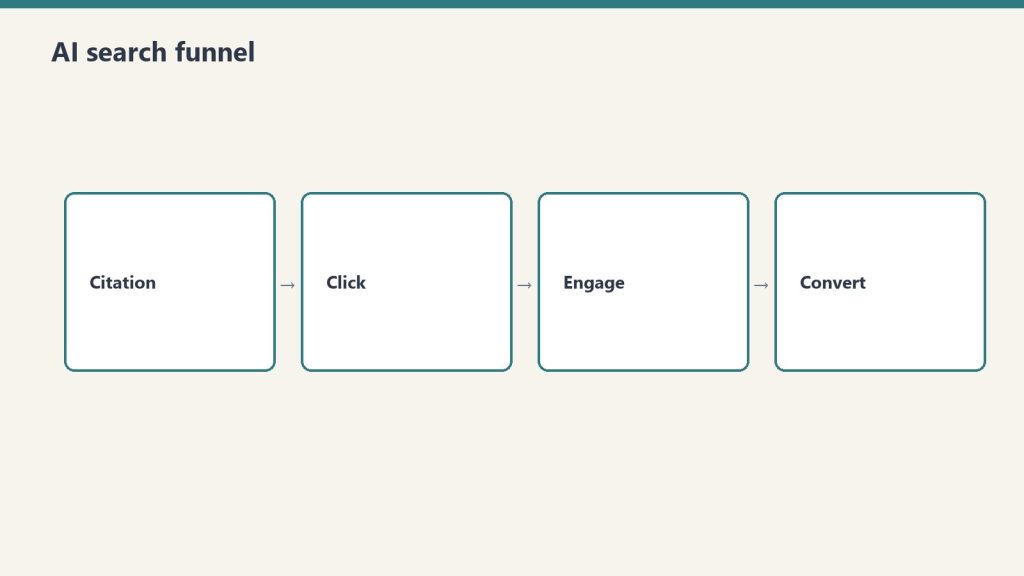
Tag: Perplexity

  • How to Rank in Perplexity: The Practitioner’s Implementation Guide (2026)

    How to Rank in Perplexity: The Practitioner’s Implementation Guide (2026)

    Perplexity does not “rank” pages the way Google does. It synthesizes an answer and then chooses which sources to attach to it. That distinction is the entire optimization problem. If your page cannot be cleanly extracted into a short, entity-clear passage, it will not be cited — no matter how strong its backlink profile is.

    This guide is for SEOs and content directors who already know traditional on-page work and want the implementation layer Perplexity rewards. Skip the strategy posts. Here is what to change in the page itself.

    The Three Things Perplexity Is Actually Doing

    When a user submits a query, Perplexity runs three operations in sequence:

    1. Retrieval. Sonar (Perplexity’s underlying search system) pulls a candidate set of URLs from its index using hybrid semantic + keyword retrieval.
    2. Extraction. It reads a bounded chunk of each candidate page. The Sonar API exposes this directly — max_tokens_per_page defaults to 4,096 tokens, which is roughly the first 3,000 words of clean body copy. Content past that window is invisible to the answer engine on most calls.
    3. Synthesis with citation. The model writes the answer using passages it can attribute, then surfaces a small number of source links. Perplexity itself has stated the system uses hybrid search combined with LLM reranking and human feedback signals.

    Three implications for your page:

    • The answer to the query must appear inside the extraction window. Buried answers do not get cited.
    • The passage must be self-contained enough to be quoted without surrounding context.
    • The source needs to look authoritative to the reranker.

    The Extraction Window Test

    Open any page you want to be cited. Strip the nav, sidebar, and footer mentally. Count the words from the first H1 to the point where you have answered the page’s primary question. If that number is over roughly 500 words, you are losing citations.

    Industry guides reporting on Perplexity’s behavior consistently note that direct-answer formats outperform standard article structures by a wide margin in citation rates. The mechanism is mechanical, not editorial: a Q&A block fits inside the extraction window cleanly.

    The Structured Pattern That Works

    This is the structure to lift into any page you want Perplexity to cite. It is not a template for the whole article — it is the citation block that needs to appear in the first 500 words.

    <section itemscope itemtype="https://schema.org/Question">
      <h2 itemprop="name">What is generative engine optimization?</h2>
      <div itemscope itemprop="acceptedAnswer" itemtype="https://schema.org/Answer">
        <div itemprop="text">
          <p><strong>Generative engine optimization (GEO)</strong> is the practice
          of structuring web content so it is selected, extracted, and cited by
          AI answer engines such as Perplexity, ChatGPT Search, and Google AI
          Overviews. Unlike traditional SEO, which optimizes for ranking position
          on a results page, GEO optimizes for inclusion inside a synthesized
          answer.</p>
        </div>
      </div>
    </section>
    

    Three things this block does that a normal opening paragraph does not:

    • The <h2> is the literal query phrasing. The reranker can pattern-match a user question against your heading without rewriting it.
    • The first sentence is a complete definition with the entity in bold. Perplexity’s extractor favors passages that resolve an entity in a single sentence.
    • The schema (Question / Answer) is not strictly required for citation, but it makes the passage easier for any LLM-based retrieval pipeline — including Sonar — to identify as an answer unit.

    Domain Authority Still Matters — But Differently

    Authority signals influence Perplexity’s reranker, but the relationship is not the same as Google’s. A smaller, well-structured page on a moderate-authority domain can outcite a thin page on a high-authority domain because the reranker rewards passage quality alongside source quality. Practitioner reporting estimates domain authority drives roughly 15% of citation likelihood, with content relevance and structure carrying more weight.

    The implication: do not skip technical authority work, but do not assume it carries you. A 500-word answer block on a DR 40 site, structured properly, will beat a 2,500-word essay on a DR 70 site that buries its answer.

    Freshness Is a Real Decay Curve

    Perplexity re-indexes aggressively and prefers recent material for time-sensitive queries. Practitioner audits report citation visibility starts to fade roughly two to three months after publication if a page is not updated. The fix is mechanical: refresh the dateline, add a small “Updated” block with one new fact or example, and resubmit the sitemap. Pages with rolling updates hold citations longer than pages that ship and freeze.

    The Implementation Checklist

    For any page you want Perplexity to cite:

    • Answer the query in a self-contained 2–4 sentence block within the first 500 words.
    • Use the user’s query phrasing as an <h2>, not a clever headline.
    • Wrap the answer in Question / Answer schema, or at minimum FAQPage schema if there are multiple answer blocks.
    • Keep the page total under the extraction window for the primary answer — long-form content is fine, but the cited passage must sit early.
    • Update the page on a quarterly cadence at minimum, with a visible “Updated” marker.
    • Treat each H2 on the page as a candidate citation unit. Every H2 should be a question or a clean entity definition, followed by a passage that resolves it without referring backward in the article.

    That last rule is the one most pages fail. Pages written for human readers chain ideas across sections. Pages written for Perplexity treat each section as an independent answer.

    The Measurement Layer

    You cannot optimize what you cannot see. Track Perplexity citations by querying your target keywords directly in Perplexity weekly, logging which URLs appear, and noting whether your domain is in the source list. Several visibility tools now scrape this data, but a manual weekly check on your top 10 target queries is sufficient to start. Pair this with a referrer log filter for perplexity.ai in GA4 to capture downstream traffic.

    The optimization loop is short: structure the page, ship, query the target keyword in Perplexity, observe whether you were cited, refine the answer block. Most pages need two to three iterations on the lead block before they earn a steady citation.

  • How to Measure LLM Visibility in 2026: The GA4 + Response-Side Stack

    How to Measure LLM Visibility in 2026: The GA4 + Response-Side Stack

    Traditional analytics platforms can’t see the most important impression you’re making in 2026. When a user asks ChatGPT, Perplexity, Gemini, or Claude about your category, your brand either shows up in the answer or it doesn’t — and your GA4 dashboard has no idea either way. This is the measurement blind spot at the center of generative engine optimization. If you can’t measure LLM visibility, you can’t optimize for it.

    This guide walks through the measurement stack that actually works in 2026: the GA4 channel grouping that catches AI referral traffic, the manual verification protocol that costs nothing, and the dedicated LLM visibility platforms that automate prompt monitoring at scale. By the end, you’ll have a measurement framework you can run starting today.

    Why GA4 alone is not enough

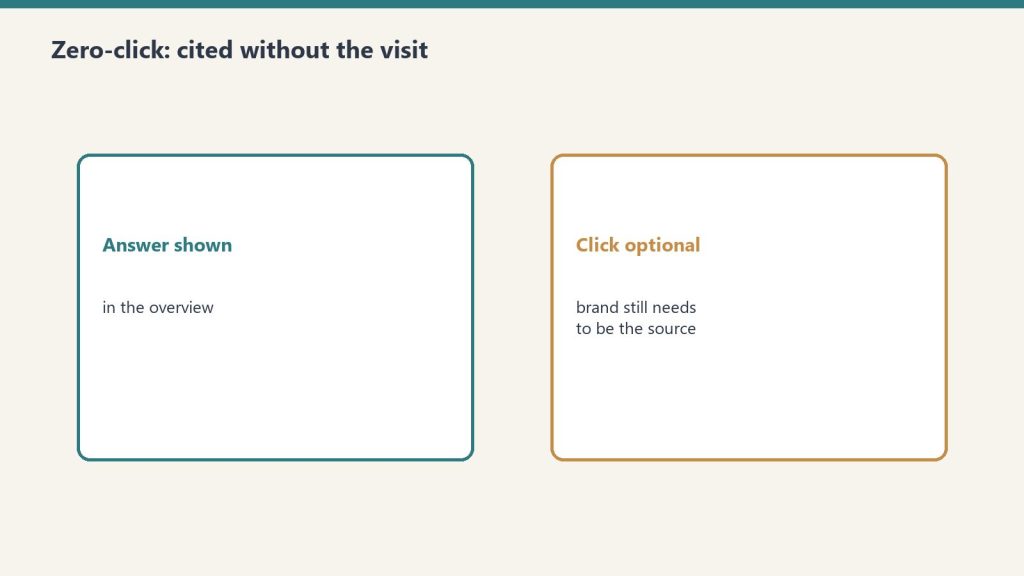
    Standard web analytics measures what happens after the click. LLM visibility is what happens before the click — or instead of one. According to widely cited industry reporting, a large share of AI search sessions end without the user ever clicking through to a source, which means the brand impression inside the AI response is often the only impression you get. GA4 cannot see that impression. It cannot see when ChatGPT recommends you in a comparison. It cannot see when Perplexity cites your article as a source for an answer.

    You still need GA4 — AI referral traffic is real, growing, and converts well — but you need it as one layer of a two-layer stack. Layer one is referral-side measurement, which captures the users who actually click through from AI platforms. Layer two is response-side measurement, which monitors what AI platforms are saying about you whether anyone clicks or not.

    Layer one: catching AI referrals in GA4

    GA4 does not have a built-in “AI” channel. By default, traffic from ChatGPT, Perplexity, Claude, and Gemini gets bucketed into the generic Referral channel, where it disappears next to social and partner sites. The fix is a custom channel group that uses a referrer regex to peel AI traffic out into its own bucket.

    In GA4, go to Admin → Data Settings → Channel Groups, create a custom channel group, and add a new rule above the default Referral rule. Set the conditions to Source matches regex and use a pattern like this:

    chatgpt\.com|openai\.com|perplexity\.ai|claude\.ai|anthropic\.com|gemini\.google\.com|copilot\.microsoft\.com|deepseek\.com|you\.com|meta\.ai|poe\.com

    The order matters. Your AI Traffic rule must sit above the Referral rule in the priority list, or AI traffic will be captured by Referral first and never reach your custom channel. Once the rule is live, you can build Explorations that segment AI traffic by source, page, conversion rate, and engagement time — and compare that segment against organic, direct, and social.

    The referrer attribution gap

    One caveat: not every AI click passes a referrer. ChatGPT’s free tier in particular has been reported to strip referrer headers in many configurations, meaning a meaningful share of ChatGPT traffic shows up as Direct in GA4 rather than as a chatgpt.com referral. This is a known limitation across the industry. Treat your AI referral numbers as a floor, not a ceiling, and use response-side monitoring to fill in the gap.

    Layer two: response-side monitoring

    This is the measurement that traditional SEO never needed. You’re no longer just asking “did anyone visit?” — you’re asking “what is the AI saying about me?” There are two ways to answer that question.

    The manual verification protocol

    The free, no-tool approach is a structured query log. Build a list of 15 to 25 prompts that a buyer in your category would realistically type into an AI assistant. Be specific. “Best CRM for small B2B teams” is a prompt. “What is a CRM” is not — that’s a research query, not a buyer query.

    Once a week, run every prompt through each AI platform you care about — typically ChatGPT, Perplexity, Gemini, and Claude — and record three things per query: whether your brand was mentioned, whether your domain was cited as a source, and what position your brand appeared in if it was named alongside competitors. A simple spreadsheet with prompt, date, platform, mention (yes/no), citation (yes/no), and position is enough to start. Week-over-week deltas on this sheet will tell you whether your GEO and AEO work is moving the needle.

    This is slow and manual but it’s the only method that gives you ground truth. The dedicated platforms below are essentially automating this protocol — running the same kind of prompt log against the same APIs on a daily schedule. If you’re under $1,000/month in marketing spend, run it manually. If you’re past that, automate it.

    Dedicated LLM visibility platforms

    A new category of tools emerged in 2025 and matured in 2026 specifically to monitor LLM responses. They all do roughly the same thing — run your target prompts daily across multiple AI engines, score visibility, track which sources the AIs cite, and surface competitor gaps — but they segment by price point.

    At the budget end, Otterly.AI offers monitoring plans starting around $29/month, with a Share of AI Voice metric and time-to-first-data of under ten minutes after signup. It’s the simplest entry point for teams that just want a citation-frequency dashboard. In the mid-market, Peec AI starts around €89/month and emphasizes multilingual coverage and actionable recommendations — it doesn’t just tell you you’re invisible, it suggests what to change. At the enterprise tier, Profound starts around $499/month and adds Prompt Volumes, which estimates real AI search demand by topic with demographic breakdowns. SOC 2 compliance and dedicated onboarding generally start at the $1,000+ enterprise tiers across this category.

    Other platforms in active use this year include Semrush’s AI Toolkit, SE Ranking’s SE Visible, Goodie AI, Rankscale, Nightwatch, AirOps, and Searchable. The category is moving fast — pricing and features change quarterly — so verify the current state of any platform before committing.

    The six KPIs to track

    Whatever measurement stack you use, the same handful of metrics will tell you whether GEO is working. Organize them into leading and lagging indicators:

    Leading indicators (response-side, change first):

    • Mention Rate — the percentage of monitored prompts where AI responses mention your brand name. This is the broadest signal.
    • Citation Rate — the percentage of monitored prompts where your domain is cited as a source, not just named. Citation is stronger than mention because it implies the AI is treating your content as authoritative.
    • Position — when your brand is named alongside competitors, where in the list does it appear. First-named brands get disproportionate attention.

    Lagging indicators (referral and revenue-side, change later):

    • AI Referral Sessions — total sessions from your AI Traffic channel group in GA4.
    • AI Referral Engagement — engagement rate and average engagement time for the AI segment, compared to organic. Strong AI referral traffic typically engages longer because the user arrived with intent already framed by the AI.
    • AI-Influenced Conversions — conversions where AI was part of the attribution path, even if not the last touch.

    Tier-one metrics move first because content changes affect what AIs say within days to weeks. Tier-two metrics lag because they require enough traffic to be statistically meaningful, which can take a quarter or more to develop.

    The minimum viable setup

    If you do nothing else this week, do these three things:

    1. Add the AI Traffic channel group to GA4 using the regex above and move it above Referral in priority.
    2. Build a 15-prompt spreadsheet of buyer-intent queries for your category and run them once across ChatGPT, Perplexity, Gemini, and Claude. Record mention, citation, and position.
    3. Set a calendar reminder to repeat step two every Friday for four weeks. After four weeks you’ll have a real trendline.

    That setup costs nothing and produces the measurement layer that lets you tell whether your GEO, AEO, and LLMs.txt work is actually compounding — or whether you’re guessing. Once the trendline is stable, evaluate whether automating with Otterly, Peec, or Profound is worth the spend. For most operators, the manual protocol gets you 80% of the insight at 0% of the budget.

    Frequently Asked Questions

    What is LLM visibility?

    LLM visibility is the measurement of how often, and how prominently, a brand or website appears in responses generated by large language models like ChatGPT, Perplexity, Gemini, and Claude. It is the response-side counterpart to traditional search ranking — instead of measuring where you appear in a results page, you’re measuring whether AI assistants mention or cite you when answering questions in your category.

    Can GA4 track AI traffic from ChatGPT and Perplexity?

    GA4 can track AI referral clicks if you create a custom channel group with a referrer regex matching AI domains and place it above the default Referral rule. It cannot track impressions inside AI responses where the user doesn’t click through, and ChatGPT’s free tier often strips referrers entirely, so a portion of AI traffic still lands in Direct. Treat GA4 numbers as a floor.

    What is the difference between mention rate and citation rate?

    Mention rate measures the percentage of monitored AI prompts where your brand name appears anywhere in the response. Citation rate measures the percentage where your specific domain or URL is referenced as a source. Citation is a stronger signal because it indicates the AI is treating your content as authoritative, not just naming you in passing.

    Which LLM visibility tool should I use in 2026?

    For budget-conscious teams, Otterly.AI starts around $29/month and gets you to first data in minutes. For mid-market needs with multilingual coverage and recommendations, Peec AI starts around €89/month. For enterprise teams that need prompt-volume demand data and SOC 2 compliance, Profound starts around $499/month. Verify current pricing before purchasing — the category moves quickly.

    How often should I check my LLM visibility?

    For manual tracking, weekly is the right cadence — frequent enough to catch movement, infrequent enough to avoid noise. Dedicated platforms typically run automated checks daily and let you review weekly. Don’t expect day-to-day stability; AI responses have inherent variance, so look at week-over-week and month-over-month trends rather than single data points.

  • What Is GEO? Generative Engine Optimization Explained

    What Is GEO? Generative Engine Optimization Explained

    If you’ve optimized content for Google and still can’t get AI systems to cite you, you’re running the wrong playbook. GEO — Generative Engine Optimization — is the discipline of making your content visible, credible, and citable to AI engines like ChatGPT, Claude, Perplexity, Gemini, and Google’s AI Overviews. It is not SEO with a new name. It is a different game with different rules.

    Definition: Generative Engine Optimization (GEO) is the practice of structuring content so that large language models and AI search engines select it as a source when generating responses to user queries. Where SEO earns rankings, GEO earns citations.

    Why GEO Is Not SEO

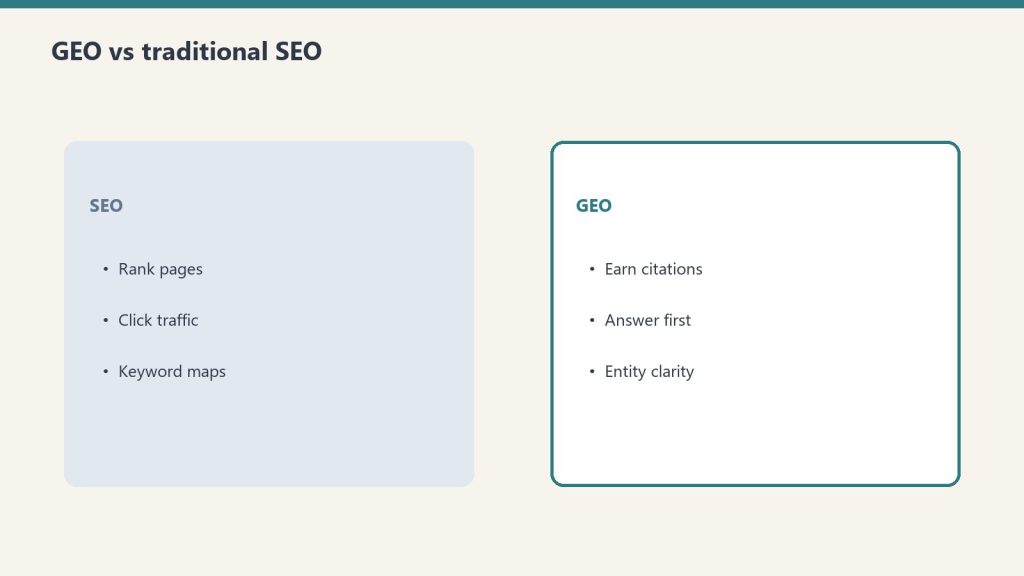
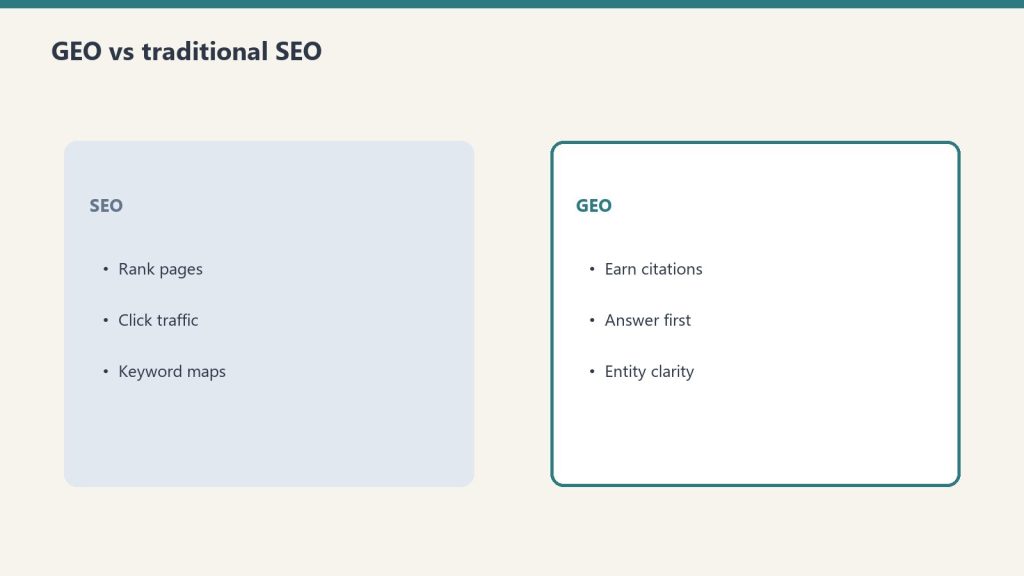
    SEO is about ranking. You optimize a page so Google’s algorithm surfaces it when someone searches. The goal is a click. GEO is about being quoted. You structure content so an AI system trusts it enough to pull a fact, a definition, or an explanation from it when synthesizing a response. The user may never click your URL — but your content shaped what they read.

    The mechanisms are fundamentally different. Google’s ranking algorithm weighs hundreds of signals — backlinks, page speed, user behavior, authority. AI citation selection weights entity density, factual specificity, source credibility signals, and structural clarity. A page that ranks #1 on Google may get zero AI citations. A page that ranks #8 may be the one Perplexity quotes every time someone asks about that topic.

    How AI Engines Select Content to Cite

    Large language models used in AI search (GPT-4, Claude, Gemini) were trained on large corpora of text, but the retrieval-augmented generation (RAG) layer that powers tools like Perplexity, ChatGPT search, and Google AI Overviews works differently. It pulls live content at query time, scores it for relevance and credibility, and synthesizes a response. The signals it uses to score your content include:

    • Entity clarity — Are the people, places, companies, and concepts in your content clearly named and linked to known entities?
    • Factual density — Does your content contain specific, verifiable claims rather than vague generalities?
    • Structural legibility — Can the AI parse your content’s structure — headings, definitions, lists — without ambiguity?
    • Source signals — Does your content cite primary sources, studies, or named experts?
    • Speakable schema — Have you marked up key paragraphs as machine-readable answer candidates?

    The Three Layers of GEO

    Layer 1: Content Architecture

    GEO-optimized content is built for extraction, not just reading. That means every major claim is in a standalone sentence. Definitions appear near the top. Section headers are declarative, not clever. The structure tells an AI where the answer is before it has to read the full article.

    Layer 2: Entity Saturation

    AI systems understand content through entities — named people, organizations, places, products, and concepts that exist in their training data. A GEO-optimized article saturates relevant entities: it doesn’t say “a major AI company” when it means Anthropic. It doesn’t say “a popular search tool” when it means Perplexity. Every entity is named, spelled correctly, and used in the right context.

    Layer 3: Schema and Structured Data

    JSON-LD schema markup is a signal to both traditional search engines and AI crawlers. FAQPage schema makes your Q&A content directly extractable. Speakable schema flags the paragraphs most useful for voice and AI synthesis. Article schema establishes authorship and publication date. These are not optional extras — they are the machine-readable layer that gets your content selected.

    GEO vs AEO: What’s the Difference?

    Answer Engine Optimization (AEO) focuses on winning featured snippets, People Also Ask boxes, and zero-click search results in traditional search engines. GEO focuses on being cited by generative AI systems. The tactics overlap — both require clear structure, direct answers, and FAQ sections — but the targets are different. AEO wins position zero on Google. GEO wins the paragraph that Perplexity writes for the next million queries on your topic.

    At Tygart Media, we run both in parallel. The content pipeline produces articles that pass the AEO gate (featured snippet structure, FAQ schema) and the GEO gate (entity density, speakable markup, citation-worthy claims) before publishing.

    What GEO Looks Like in Practice

    Here is the difference between a standard paragraph and a GEO-optimized version of the same content:

    Standard: “Water damage restoration is an important service for homeowners who have experienced flooding or leaks.”

    GEO-optimized: “Water damage restoration — the professional remediation of structural damage caused by flooding, pipe failure, or storm intrusion — is performed by IICRC-certified contractors following the S500 Standard for Professional Water Damage Restoration. The process includes water extraction, structural drying, moisture monitoring, and antimicrobial treatment.”

    The second version names the certifying body (IICRC), the standard (S500), and the process steps. An AI system can extract that paragraph as a factual, citable answer. The first version has nothing to extract.

    How to Start with GEO

    If you’re running an existing content operation and want to layer in GEO, the priority order is:

    1. Audit your top 20 pages for entity gaps — everywhere you use vague references, replace with specific named entities
    2. Add speakable schema to your three strongest definitional paragraphs per page
    3. Run a factual density check — every statistic should have a source, every claim should be specific
    4. Add FAQPage schema to any page with question-format headings
    5. Submit your top pages to Google’s Rich Results Test and verify structured data is reading cleanly

    GEO Is Compounding Infrastructure

    The reason GEO matters for content operations is compounding. Once an AI system has indexed and trusted your content as a reliable source on a topic, subsequent queries on that topic draw from your content repeatedly — without you publishing anything new. A single GEO-optimized pillar article can generate thousands of AI citations over 12 months. That is a different kind of ROI than a ranked page that gets clicked and forgotten.

    We built the Tygart Media content stack around this principle. Every article that leaves our pipeline passes a GEO gate before it publishes. That gate checks entity saturation, factual specificity, schema completeness, and structural legibility. It is the same gate we build for clients.

    Frequently Asked Questions About GEO

    What does GEO stand for?

    GEO stands for Generative Engine Optimization — the practice of optimizing content to be cited by AI-powered search systems and large language models.

    Is GEO the same as SEO?

    No. SEO (Search Engine Optimization) targets traditional search rankings. GEO targets AI citation in tools like ChatGPT, Perplexity, Claude, and Google AI Overviews. The tactics overlap but the mechanisms and goals are different.

    How do I know if my content is being cited by AI?

    Run queries related to your topic in Perplexity, ChatGPT (with search enabled), and Google AI Overviews. Check whether your domain appears as a cited source. Tools like Profound and Otterly.ai can automate this monitoring.

    Does GEO replace AEO?

    No. AEO and GEO are complementary. AEO wins traditional search features like featured snippets. GEO wins AI citations. A mature content strategy runs both in parallel.

    How long does GEO take to show results?

    Unlike SEO, GEO results can appear quickly — sometimes within days of a page being indexed by AI crawlers. The compounding effect builds over 60–180 days as AI systems repeatedly select your content for related queries.


  • ¿Qué es GEO? Optimización para Motores Generativos: Guía Completa

    ¿Qué es GEO? Optimización para Motores Generativos: Guía Completa

    Si has optimizado contenido para Google y aun así no logras que los sistemas de inteligencia artificial te citen, es porque estás usando el manual equivocado. GEO —Generative Engine Optimization u Optimización para Motores Generativos— es la disciplina de hacer que tu contenido sea visible, creíble y citable para motores de IA como ChatGPT, Claude, Perplexity, Gemini y los AI Overviews de Google. No es SEO con un nombre nuevo. Es un juego distinto con reglas distintas.

    Definición: La Optimización para Motores Generativos (GEO) es la práctica de estructurar el contenido para que los modelos de lenguaje de gran escala (LLM) y los motores de búsqueda con IA lo seleccionen como fuente al generar respuestas a las consultas de los usuarios. Donde el SEO obtiene posiciones, el GEO obtiene citas.

    Por qué GEO no es SEO

    El SEO trata de posicionarse. Optimizas una página para que el algoritmo de Google la muestre cuando alguien busca algo. El objetivo es un clic. El GEO trata de ser citado. Estructuras el contenido para que un sistema de IA confíe en él lo suficiente como para extraer un dato, una definición o una explicación cuando sintetiza una respuesta. El usuario puede no hacer clic en tu URL, pero tu contenido moldeó lo que leyó.

    Los mecanismos son fundamentalmente diferentes. El algoritmo de posicionamiento de Google pondera cientos de señales: backlinks, velocidad de página, comportamiento del usuario, autoridad. La selección de citas por IA pondera la densidad de entidades, la especificidad factual, las señales de credibilidad de la fuente y la claridad estructural. Una página que ocupa el puesto #1 en Google puede recibir cero citas de IA. Una página que ocupa el puesto #8 puede ser la que Perplexity cita cada vez que alguien pregunta sobre ese tema.

    Cómo los motores de IA seleccionan el contenido que citan

    Los modelos de lenguaje de gran escala utilizados en la búsqueda con IA (GPT-4, Claude, Gemini) fueron entrenados en grandes corpus de texto, pero la capa de generación aumentada por recuperación (RAG) que impulsa herramientas como Perplexity, la búsqueda de ChatGPT y los AI Overviews de Google funciona de manera diferente. Extrae contenido en tiempo real en el momento de la consulta, lo puntúa por relevancia y credibilidad, y sintetiza una respuesta. Las señales que utiliza para puntuar tu contenido incluyen:

    • Claridad de entidades — ¿Las personas, lugares, empresas y conceptos en tu contenido están claramente nombrados y vinculados a entidades conocidas?
    • Densidad factual — ¿Tu contenido contiene afirmaciones específicas y verificables en lugar de generalidades vagas?
    • Legibilidad estructural — ¿Puede la IA analizar la estructura de tu contenido —encabezados, definiciones, listas— sin ambigüedad?
    • Señales de fuente — ¿Tu contenido cita fuentes primarias, estudios o expertos nombrados?
    • Esquema speakable — ¿Has marcado párrafos clave como candidatos de respuesta legibles por máquinas?

    Las tres capas del GEO

    Capa 1: Arquitectura de contenido

    El contenido optimizado para GEO está diseñado para la extracción, no solo para la lectura. Eso significa que cada afirmación importante está en una oración independiente. Las definiciones aparecen cerca de la parte superior. Los encabezados de sección son declarativos, no creativos. La estructura le dice a la IA dónde está la respuesta antes de que tenga que leer el artículo completo.

    Capa 2: Saturación de entidades

    Los sistemas de IA entienden el contenido a través de entidades: personas, organizaciones, lugares, productos y conceptos nombrados que existen en sus datos de entrenamiento. Un artículo optimizado para GEO satura las entidades relevantes: no dice “una importante empresa de IA” cuando se refiere a Anthropic. No dice “una popular herramienta de búsqueda” cuando se refiere a Perplexity. Cada entidad está nombrada, escrita correctamente y usada en el contexto correcto.

    Capa 3: Esquema y datos estructurados

    El marcado de esquema JSON-LD es una señal tanto para los motores de búsqueda tradicionales como para los rastreadores de IA. El esquema FAQPage hace que tu contenido de preguntas y respuestas sea directamente extraíble. El esquema speakable marca los párrafos más útiles para la síntesis de voz e IA. El esquema de artículo establece la autoría y la fecha de publicación. No son extras opcionales: son la capa legible por máquinas que hace que tu contenido sea seleccionado.

    GEO vs AEO: ¿Cuál es la diferencia?

    La Optimización para Motores de Respuesta (AEO) se centra en ganar fragmentos destacados, cuadros de Preguntas relacionadas y resultados de búsqueda de cero clics en los motores de búsqueda tradicionales. El GEO se centra en ser citado por los sistemas de IA generativa. Las tácticas se superponen, pero los objetivos son diferentes. El AEO gana la posición cero en Google. El GEO gana el párrafo que Perplexity escribe para el próximo millón de consultas sobre tu tema.

    Cómo empezar con GEO

    Si estás gestionando una operación de contenido existente y quieres incorporar GEO, el orden de prioridad es:

    1. Audita tus 20 páginas principales en busca de lagunas de entidades — donde uses referencias vagas, reemplázalas con entidades nombradas específicas
    2. Añade esquema speakable a tus tres párrafos definitorios más sólidos por página
    3. Ejecuta una verificación de densidad factual — cada estadística debe tener una fuente, cada afirmación debe ser específica
    4. Añade esquema FAQPage a cualquier página con encabezados en formato de pregunta
    5. Envía tus páginas principales a la Prueba de resultados enriquecidos de Google y verifica que los datos estructurados se lean correctamente

    GEO es infraestructura que se acumula

    La razón por la que GEO importa para las operaciones de contenido es el efecto acumulativo. Una vez que un sistema de IA ha indexado y confiado en tu contenido como fuente confiable sobre un tema, las consultas posteriores sobre ese tema extraen de tu contenido repetidamente, sin que publiques nada nuevo. Un solo artículo pilar optimizado para GEO puede generar miles de citas de IA durante 12 meses. Eso es un tipo diferente de ROI al de una página posicionada que recibe clics y se olvida.

    Preguntas frecuentes sobre GEO

    ¿Qué significa GEO?

    GEO significa Generative Engine Optimization —Optimización para Motores Generativos— la práctica de optimizar contenido para ser citado por sistemas de búsqueda impulsados por IA y modelos de lenguaje de gran escala.

    ¿Es GEO lo mismo que SEO?

    No. El SEO apunta a posiciones en la búsqueda tradicional. El GEO apunta a citas de IA en herramientas como ChatGPT, Perplexity, Claude y los AI Overviews de Google. Las tácticas se superponen pero los mecanismos y objetivos son diferentes.

    ¿Cómo sé si mi contenido está siendo citado por la IA?

    Ejecuta consultas relacionadas con tu tema en Perplexity, ChatGPT (con búsqueda activada) y los AI Overviews de Google. Verifica si tu dominio aparece como fuente citada. Herramientas como Profound y Otterly.ai pueden automatizar este monitoreo.

    ¿GEO reemplaza al AEO?

    No. AEO y GEO son complementarios. El AEO gana características de búsqueda tradicional como fragmentos destacados. El GEO gana citas de IA. Una estrategia de contenido madura ejecuta ambos en paralelo.

    ¿Cuánto tiempo tarda el GEO en mostrar resultados?

    A diferencia del SEO, los resultados de GEO pueden aparecer rápidamente, a veces en días después de que una página sea indexada por los rastreadores de IA. El efecto acumulativo se construye durante 60 a 180 días a medida que los sistemas de IA seleccionan repetidamente tu contenido para consultas relacionadas.


  • Claude Sent Us 63 Readers Last Month: The First Measurable AI-Referral Channel for Publishers

    Claude Sent Us 63 Readers Last Month: The First Measurable AI-Referral Channel for Publishers

    Short version: In the last 29 days, Claude, ChatGPT, Perplexity, Microsoft Copilot, Gemini, NotebookLM, and Kagi collectively sent at least 94 new readers to tygartmedia.com — a site whose #1 content vertical is explaining Claude. AI assistants are now our #4 traffic source, ahead of Facebook, ahead of LinkedIn, ahead of every search engine except Google and Bing. The product is citing the publication that covers the product. That’s the loop. Here is what it looks like when you can actually measure it.

    The finding that made me stop scrolling

    I built a Claude-powered browser agent to poke around our GA4 account and surface “interesting stuff” a human analyst would miss. One of the first things it flagged was our Source/Medium report. Here is the top of the list, unedited:

    RankSource / MediumNew Users (29 days)Notes
    1(direct) / (none)738Mystery bucket
    2google / organic289Standard Google SEO
    3bing / organic701m 20s average session — high intent
    4claude.ai / referral63Claude itself
    5m.facebook.com43Mostly 4-second bounces
    6duckduckgo / organic411m 02s average
    13chatgpt.com / referral9ChatGPT
    15perplexity.ai / referral5Perplexity
    21copilot.com3Microsoft Copilot
    24gemini.google.com2Google Gemini
    28notebooklm.google.com1Google NotebookLM
    35kagi.com1Kagi AI results

    Add up everything with an AI-assistant referrer and the combined count is at least 94 new users in 29 days — roughly 6.7% of all new users on the site. Claude alone, at 63 referred users, is our #4 traffic source. It is ahead of Facebook. It is ahead of LinkedIn. It is ahead of every search engine except Google and Bing. And we have been cited, at least once, by every major AI surface in the English-speaking internet: Claude, ChatGPT, Perplexity, Microsoft Copilot, Gemini, NotebookLM, and Kagi.

    Why this is different from “we show up in Google”

    Generative Engine Optimization (GEO) is the practice of structuring content so that large language models cite it as a source inside their answers. It is the younger, messier cousin of SEO. Most publishers cannot yet prove it is working. The feedback loop is long, the data is hidden inside a chat window, and the traffic that does leak through often lands in a “(direct)” bucket with no attribution at all.

    We can see ours. GA4, for reasons that are probably accidental, already records claude.ai, chatgpt.com, perplexity.ai, copilot.com, gemini.google.com, notebooklm.google.com, and kagi.com as discrete referral sources when a user clicks a citation link. That means AI-assistant traffic is measurable as a first-class channel right now, today, with the free version of Google Analytics, on any site that happens to get cited.

    The poetic layer of what we are looking at: Claude is the top AI referrer to a website whose #1 content vertical is explaining Claude. The product is sending readers to the publication that covers the product. If that is not a GEO moat, I do not know what one looks like.

    These are not bounced visitors. They are readers.

    The single biggest worry with any new traffic source is that it might be garbage — bots, previews, accidental clicks. The engagement data says the opposite. Users arriving from claude.ai spend 23 seconds on average and produce 0.56 engaged sessions per user. ChatGPT referrals average 21 seconds and 0.44 engaged sessions per user. For context, the site-wide average engagement time is dragged down hard by in-app social browsers; the Facebook mobile webview, for example, sits at about 14 seconds with 4-second bounces.

    People arriving from an AI assistant are not scrolling past. They clicked the citation because the AI told them this was the primary source, and when they got here they read. That is a qualitatively different kind of traffic than Facebook or a random Google search. These are the highest-intent non-search users we have.

    The secondary finding: Seattle is reading for three minutes

    The same GA4 pass surfaced a city-level pattern we were not expecting. Seattle readers — 61 of them in 29 days — spent an average of 3 minutes and 6 seconds on site at a 61.3% engagement rate. The site-wide average session is roughly 40 seconds. Seattle readers are spending about 4–5x longer on the page than the typical visitor, at nearly twice the engagement rate.

    CityActive UsersEngagement RateAverage Time
    Seattle6161.3%3m 06s
    The Dalles, OR310%1s
    Shelton, WA2627.6%15s
    Des Moines2437.5%10s
    Beijing316.5%0s
    Singapore2821.4%5s

    A few things jump out. The Dalles, Oregon at 31 users / 0% engagement / 1 second is almost certainly Google’s data center there returning preview requests — ignore it. Shelton, Washington is a real Mason County hyperlocal beachhead; 26 actual humans in our home county in 29 days is a legitimate foothold for the local desk. Beijing at 31 users / 0 seconds has the classic signature of cloud-hosted scrapers. And Seattle at 3 minutes is the single most valuable city in our data and it is not close.

    The browser split confirms an unusually technical audience

    BrowserUsersEngagement Rate
    Chrome850 (60%)31.3%
    Safari232 (16%)32.7%
    Edge99 (7%)62.3%
    Firefox33 (2.3%)60.5%

    Edge at 62.3% engagement and Firefox at 60.5% engagement are not normal consumer numbers. A typical general-interest site sees those two browsers hovering in the 5–15% range. Microsoft Edge is the default on corporate-managed Windows machines. Firefox is the dev-preferred privacy browser. The combination of high Edge engagement, high Firefox engagement, and a Claude-heavy referral list all point at the same audience: developers and technical professionals at real companies, reading on managed workstations.

    How to measure AI-assistant referrals in your own GA4

    If you publish anything technical and want to see your own version of this number, the fastest path is a custom GA4 exploration with one segment. Open GA4 → Explore → Free Form. Add a segment with this condition:

    Session source contains one of:
      claude.ai
      chatgpt.com
      perplexity.ai
      perplexity
      copilot.com
      gemini.google.com
      notebooklm.google.com
      kagi.com
      you.com
      phind.com

    Break it down by landing page, engagement rate, and average engagement time. That is your AI-Referral dashboard. Watch it weekly. A non-trivial number of sites will discover they already have measurable AI traffic and never bothered to look.

    Frequently asked questions

    What is a GEO referral?

    A GEO referral, or AI-assistant referral, is a visit to your site from a user who clicked a citation link inside an answer generated by a large language model such as Claude, ChatGPT, Perplexity, Microsoft Copilot, Gemini, NotebookLM, or Kagi. In Google Analytics 4 these visits appear as referral traffic from the assistant’s domain — for example claude.ai / referral or chatgpt.com / referral.

    How many AI-referred users did tygartmedia.com receive in 29 days?

    At least 94 new users across seven distinct AI assistants: 63 from Claude, 14 from ChatGPT (9 attributed + 5 unassigned), 10 from Perplexity (5 attributed + 5 unassigned), 3 from Microsoft Copilot, 2 from Gemini, 1 from NotebookLM, and 1 from Kagi. That is roughly 6.7% of all new users on the site for the period.

    Are AI-assistant referrals real readers or bots?

    Real readers. Average engagement time from claude.ai is 23 seconds and from chatgpt.com is 21 seconds, with engagement rates of 0.56 and 0.44 engaged sessions per user respectively. Those numbers are qualitatively higher than in-app social browser traffic (Facebook mobile webview averages about 14 seconds) and indicate a deliberate click-through from an AI citation, not a scraper.

    Can any publisher measure AI-assistant referrals in GA4?

    Yes. GA4 records visits from claude.ai, chatgpt.com, perplexity.ai, copilot.com, gemini.google.com, notebooklm.google.com, and kagi.com as discrete referral sources by default. Build a Free Form exploration with a segment that filters Session source on those domains and you will see the channel immediately if it exists for your site.

    What is GEO in marketing?

    GEO stands for Generative Engine Optimization. It is the practice of structuring web content, schema markup, and publishing signals so that large language models cite the content as a source inside AI-generated answers. GEO is to AI assistants what SEO is to search engines — the discipline of being the answer the machine hands to the reader.

    The loop, and why it matters

    The most interesting thing about this data is not the traffic. It is the feedback structure. Tygart Media publishes explainers about Claude. Claude crawls and cites those explainers. Readers click through from Claude’s answer back to tygartmedia.com. We publish more. Claude cites more. The site becomes, in effect, training data and a recommended source for the next iteration of the product it covers. That is the recursive loop that makes AI-native publishing a different business than search-era publishing.

    I do not think every site can build this loop. It requires a narrow, technically-defensible topic — something an AI assistant would rather cite than paraphrase — and the patience to publish at a cadence LLMs reward. What I do think is that any publisher can check, today, whether the loop has quietly started forming underneath them. Most have not bothered. This post is partly a flex and partly an invitation: go look.

    What happens next at Tygart Media

    Three things. We are standing up a permanent AI-Referral channel in our GA4 so the number can be watched weekly instead of rediscovered quarterly. We are writing the playbook — the one this post hints at — for publishers who want to do the same. And we are building the browser agent that found this in the first place into a repeatable audit any publisher can run against their own GA4 in an afternoon. If that last one sounds useful, the newsletter is the place to follow along.

    Claude sent us 63 readers last month. It will send more next month. We will be counting.

  • Claude, ChatGPT, and Perplexity Cite Totally Different Pages: The Per-Model AI Citation Playbook

    Claude, ChatGPT, and Perplexity Cite Totally Different Pages: The Per-Model AI Citation Playbook

    Part 2 of 2. In the first post I showed that Claude, ChatGPT, Perplexity, Copilot, Gemini, NotebookLM, and Kagi collectively sent tygartmedia.com at least 94 new readers in 29 days — and that Claude alone is our #4 traffic source. That is the headline. What follows is the interesting part: when you filter the landing-page report one AI model at a time, the three major assistants cite completely different kinds of pages, and the pattern is actionable.

    Claude cites a small number of pages, a lot of times

    Claude.ai sent 79 sessions across 63 users to 16 distinct pages. Two pages ate more than half of it:

    #PageSessions% of Claude trafficAvg Time
    1/claude-student-discount2227.9%35s
    2/anthropic-console2126.6%11s
    3(not set)1316.5%5s
    4/claude-edu45.1%6s
    5/claude-pro-vs-chatgpt-plus45.1%7s
    6/claude-code-on-vertex-ai-gcp33.8%3s
    7/claude-desktop22.5%40s
    8/how-to-install-claude-code22.5%2s
    9/claude-4-deprecation11.3%1m 07s
    10/claude-managed-agents-pricing-cost-analysis11.3%1m 38s

    The two biggest pages, /claude-student-discount and /anthropic-console, are 54.5% of all Claude-referred traffic to the site. Those are extremely specific query shapes — “how do students get Claude Pro free” and “how do I access the Anthropic Console” — and Claude has apparently decided our pages are the canonical answer for both.

    The engagement twist is worth staring at. The two biggest Claude-referred pages have the worst time-on-page: 35 seconds and 11 seconds. The two pages that got a single Claude visit each — /claude-managed-agents-pricing-cost-analysis and /claude-4-deprecation — got 1 minute 38 seconds and 1 minute 7 seconds of real read time. The pattern is clean. When Claude can extract the answer directly into its chat window, users click through briefly to verify and leave. When the answer is deeper than Claude can summarize, readers stay to actually read. Both behaviors are valuable and both are measurable.

    ChatGPT cites broadly, favors “X vs Y” content, and (oddly) sends geographic traffic

    ChatGPT’s footprint is shaped differently. 16 sessions across 14 users to 13 distinct pages — almost every page received exactly one visit, which is the signature of a model citing a wide range of sources once each rather than reaching for a favorite.

    PageSessionsAvg Time
    /claude-student-discount315s
    /claude-computer-use-tutorial12m 07s
    /grok-vs-claude115s
    /opus-4-7-vs-gpt-5-4-vs-gemini-3-1-pro10s
    /claude-pro-vs-chatgpt-plus(cross-model)
    /claude-for-nonprofits130s
    /everett-waterfront-visitor-guide…10s
    /hood-canal-shellfish-season-2026…10s
    /rakuten-claude-managed-agents-enterprise-deployment10s

    Two patterns in that list. First, ChatGPT appears to cite us disproportionately for model comparisonsgrok-vs-claude, opus-4-7-vs-gpt-5-4-vs-gemini-3-1-pro, and the cross-model claude-pro-vs-chatgpt-plus page. Second, and stranger, ChatGPT sent visits to two hyperlocal Pacific Northwest pages: an Everett waterfront guide and a Hood Canal shellfish season page. That is ChatGPT using our site as a reference source for geographic queries, which is not a pattern any other model shows.

    The hidden gem: /claude-computer-use-tutorial received one ChatGPT referral and that referral stayed for 2 minutes 7 seconds. ChatGPT appears willing to cite long-form technical tutorials in a way Claude does not.

    Perplexity treats us like a research database

    Perplexity sent 12 sessions across 10 users to 9 pages — the most evenly distributed of the three and the only model that cites people, founders, and company-history content.

    PageSessionsAvg Time
    /anthropic-founders-2217s
    /claude-code-on-vertex-ai-gcp254s
    /claude-student-discount20s
    /claude-desktop14s
    /claude-team-plan10s
    /how-to-install-claude-code10s
    /restoration-team-training-claude-cowork10s

    Perplexity is the only model that pulled visits on /anthropic-founders-2, which implies Perplexity is fielding a different query shape — something closer to “who founded Anthropic” than “how do I use Claude.” Perplexity is also the only model that surfaced the very niche B2B page /restoration-team-training-claude-cowork. That is a long-tail, vertical-specific query and Perplexity cited us as the source. That is exactly the behavior you would hope for from a research-flavored assistant.

    The three models have completely different citation personalities

    Once you lay the three patterns side by side, the strategy falls out of the page.

    • Claude.ai favors short, factual, access-related pages. Product info, pricing, how-to-access. If you want more Claude citations, write more narrow “how do I do this one specific thing” pages.
    • ChatGPT favors comparisons and long-tail references. X vs Y, alternatives, and — unexpectedly — some geographic content. If you want more ChatGPT citations, write more “X vs Y” posts with tight comparison tables.
    • Perplexity favors people, history, and niche research. Founders, company background, domain-specific tutorials. If you want more Perplexity citations, write more research-flavored background pieces.

    This is the single most practical insight in the data set. Most people talk about “AI SEO” as if it is one thing. It is three things, at minimum, and the content shape that wins one model will not automatically win the other two.

    The crown jewel: one page, 17% of all AI-referred traffic

    The clearest cross-model winner on the site is /claude-student-discount. Claude sent 22 sessions. ChatGPT sent 3. Perplexity sent 2. Combined that is 27 sessions — roughly 17% of all AI-referred traffic we received in 29 days, from a single URL. No other page on the site is cited by all three major LLMs in meaningful volume.

    There is a playbook inside that one data point. The page works because the query “how do I get Claude for free as a student” is an extremely high-frequency question across every chat surface, and the page happens to be structured the way LLMs like to cite: a short, direct answer near the top, specific eligibility rules in a scannable block, and no wall of context before the reader gets to the fact. That structural recipe — front-load the answer, make the facts liftable, keep the page narrow — is repeatable.

    The bigger finding: 90% of our Claude content is invisible to AI

    tygartmedia.com has more than 250 Claude-related articles. Exactly 25 of them show up in the AI-referral data set at all. The 90% that do not get cited are not low-quality — several of them have strong engagement from regular search traffic:

    • /claude-managed-agents-complete-pricing-guide-2026 — 17 sessions at ~1 minute from search, zero AI citations
    • /notion-knowledge-base-for-claude — 10 sessions at 1m 23s, uncited
    • /claude-rate-limits — classic FAQ shape, 6 sessions, not cited
    • /claude-md-playbook — 1 session at 2m 33s, zero AI pickup
    • The full /claude-cowork-* family of 12+ pages, almost entirely invisible to every model

    The difference between an AI-cited page and an AI-invisible page is rarely the quality of the content. It is the shape. Pages that get cited have an early summary, short headings, bulleted facts, and a quotable direct-answer sentence. Pages that do not get cited tend to open with context, build up to the answer, and bury the quotable line in paragraph 9.

    The content-cluster scorecard

    ClusterApprox. PagesApprox. SessionsEngagementAI Citations
    Claude pricing & access~10~160MixedHigh
    Claude managed agents~12~130Strong (25s–1m)Low
    Claude Code~8~60High (18s–3m)Moderate
    Model comparisons (X vs Y)~10~45Very high (1–7 min)Moderate
    Anthropic people/company~8~30MediumModerate
    Claude how-to / tutorials~20~50MediumLow
    Claude Cowork family~15~40Very low (0–10s)Almost none

    Two clusters deserve action. The Claude Cowork family is a content swamp — 15 pages, low traffic, no AI citations, and 0–10 second engagement on the traffic that does land. That cluster should be consolidated into two or three flagship posts and the rest redirected. The model comparisons cluster is the opposite: low volume but 1–7 minutes of engagement and cross-model citations. One well-researched comparison post outperforms ten mediocre explainers on every metric that matters here.

    The playbook, in one list

    • Write more narrow single-answer pages. Candidates I would ship next: /claude-web-search, /claude-api-keys, /claude-max-plan-vs-pro, /how-to-cancel-claude, /claude-mobile-app, /claude-desktop-vs-web, /claude-subscription-refund. Each is ~600 words, answer-first, scannable. That is the shape Claude cites.
    • Add a Quick Answer block to the top of every long-form piece. Two or three sentences. Quotable. That alone moves a real share of our invisible content into AI-citation range.
    • Invest in comparison posts for ChatGPT pickup. We already know ChatGPT cites our existing X-vs-Y content. Ship more of them, with tight tables.
    • Write more founder/history/background pieces for Perplexity pickup. Research-flavored. Dates, names, primary sources.
    • Consolidate the Cowork cluster. Two or three flagship pages, everything else redirected.
    • Ship a permanent AI-Referral dashboard in GA4. Segment on all seven assistant domains. Watch it weekly. This is now a first-class channel.

    Frequently asked questions

    What kinds of pages does Claude.ai cite most often?

    Based on the tygartmedia.com data, Claude.ai disproportionately cites short, factual, access-related pages — product info, pricing, how-to-access, and eligibility details. On our site, two pages (/claude-student-discount and /anthropic-console) accounted for 54.5% of all Claude-referred traffic in a 29-day window.

    What kinds of pages does ChatGPT cite most often?

    ChatGPT’s citation pattern favors comparison and long-tail reference pages — “X vs Y” posts like Grok vs Claude, model-to-model comparisons, and, surprisingly, some geographic and local content. ChatGPT tends to cite many pages once each rather than concentrating on a small set.

    What kinds of pages does Perplexity cite most often?

    Perplexity cites research-flavored content — founders and company history, domain-specific tutorials, and niche B2B pages. It is the only major AI assistant that sent traffic to our Anthropic founders page and to a vertical-specific training page in our data set.

    Why does the same page get different citation volume from different AI models?

    Because each assistant is answering a slightly different distribution of queries. Claude is most often used for “how do I use this product” questions and favors narrow how-to pages. ChatGPT receives more comparison and alternative-seeking queries. Perplexity skews toward research and background questions. A page that is the best answer for one query type will not automatically be the best answer for another.

    How do I structure a page to get cited by AI assistants?

    Lead with a direct, quotable answer in the first paragraph. Use short scannable headings. Keep facts in bulleted or tabular form. Include an explicit FAQ block with question-shaped subheadings. Keep the page narrow — one topic, one canonical answer — rather than a sprawling multi-topic explainer.

    The bigger picture

    The meta-insight worth sitting with: we are currently being cited inside Claude’s internal answer graph for “Claude student discount” because a human sat down and wrote a clear, narrow page about it. That is almost the entire game for publishers for the next three years. Most of the web has not noticed yet. We noticed, and now we have a measurement stack to act on what we noticed.

    If you are a publisher, the thing to do this week is boring and powerful: segment your GA4 on the seven AI-assistant domains from Part 1, sort your landing pages by AI-referral volume, and look at the pages that are winning. They will have a shape. Copy it.

    — If you missed it, Part 1 is here.

  • GEO Visibility Checker — Claude AI Skill for AI Search Optimization

    GEO Visibility Checker — Claude AI Skill for AI Search Optimization

    Find out exactly why AI systems are not citing your content — and what to change.

    Who This Is For

    Built for content marketers, SEO practitioners, and website owners who are publishing good content but not appearing in AI-generated answers on ChatGPT, Perplexity, or Google AI Overviews.

    The Problem

    AI search citation is not random. It follows patterns: entity density, factual specificity, direct-answer structure, authoritative framing, speakable content, and OASF formatting. Most content fails on two or three of these signals — not all of them — which means the fixes are targeted and manageable. The problem is knowing which signals are failing. This skill evaluates your page against all of them and tells you exactly what to change.

    What It Does

    • Evaluates entity density — how many named entities your page references and whether they are specific enough to be useful to AI systems
    • Assesses factual specificity — the ratio of specific, verifiable claims to vague generalizations
    • Checks for direct-answer structure and speakable schema markers
    • Evaluates OASF formatting — the structure that makes content citation-friendly to generative engines
    • Identifies the 3 to 5 highest-leverage changes that would most improve AI citation probability

    What You Get

    The complete skill file in Claude-compatible format, a prompt library specific to the use case, and a setup guide that gets you running in under five minutes. After purchase, everything downloads instantly.

    GEO Visibility Checker — Claude AI Skill for AI Search Optimization

    $47

    Delivered to your inbox within 24 hours — skill file, prompt library, and setup guide

    Buy Now →

    Secure checkout via Square — all major cards accepted

    Want a custom version built specifically for your business? Email will@tygartmedia.com

    Frequently Asked Questions

    What is GEO and how is it different from SEO?

    SEO optimizes for search engine rankings. GEO — Generative Engine Optimization — optimizes for AI citation: getting your content surfaced as a source when ChatGPT, Perplexity, or Google AI Overviews answers a question. The signals are related but distinct.

    Can this guarantee my content will be cited by AI systems?

    No — AI citation is probabilistic, not deterministic. What this skill does is identify and address the specific signals that correlate with AI citation, increasing your probability of being cited.

    Does this work for any type of content?

    Yes. The skill evaluates any page — blog posts, service pages, product pages, and landing pages all have GEO optimization opportunities.

    How is this delivered?

    Within 24 hours of purchase via email from will@tygartmedia.com. Skill file, prompt library, and setup guide delivered as a ZIP download.

    Does this require a paid Claude subscription?

    A Claude account is required. The free tier works for light use. Claude Pro ($20/mo) is recommended for regular use. The skill works with both.

    Can I get a custom version built for my specific business?

    Yes. Email will@tygartmedia.com with a description of your business and workflows. Custom skill builds are available as part of The Fitting service.

  • Is Your Site AI-Ready? Self-Assessment — 47-Point Checklist

    Is Your Site AI-Ready? Self-Assessment — 47-Point Checklist

    Find out exactly what is keeping your website invisible to AI systems — and what to fix first.

    The Shift That Changed Everything

    For two decades, ranking on Google was the game. Then something changed. ChatGPT, Perplexity, Google AI Overviews, and a dozen other AI-powered platforms became the first place an increasingly large share of buyers go when they are researching. These systems do not rank your website. They either cite it or they do not. And whether they cite it depends on signals that are completely different from traditional SEO.

    Most websites — including most professionally built ones — are invisible to these systems. Not because the content is bad, but because the structure is wrong. Missing schema. No entity architecture. Content formatted for humans but not for machines. No speakable blocks. No LLMS.txt signal. Problems that take hours to fix once you know what they are, but that are completely invisible until someone shows you the checklist.

    This is that checklist.

    What’s Inside

    • 47 checkpoints organized across 5 categories: schema markup, entity structure, content format, technical signals, and GEO optimization
    • Scoring guide: calculate your AI readiness score and see what tier your site is in
    • Priority fix matrix: each gap ranked by how much it hurts you and how fast it is to fix — so you know where to start
    • Plain-language explanations for every checkpoint — no jargon, no assumed technical knowledge
    • Delivered as a Notion workspace you can run against any site, any time, and save your results

    Who This Is For

    Business owners who have heard about AI search and want to know where they actually stand. Marketing managers who need a structured framework for evaluating and improving AI visibility. WordPress site owners who want to understand what the SEO plugins are not covering. Anyone who has wondered why their site does not show up when people ask AI assistants about their category.

    What Happens After

    The self-assessment tells you what to fix. If you want help fixing it, every item on the checklist maps to a service we offer — from the $29 WordPress Schema Starter to a full SiteBoost engagement. But the checklist is genuinely useful on its own. Most of the fixes are things any site owner can implement with basic WordPress access and thirty minutes.

    Frequently Asked Questions

    Does this require technical knowledge?

    No. Every checkpoint has a plain-language explanation. The scoring guide tells you whether each item is a DIY fix, a developer task, or something you can handle with a plugin. You do not need to know what schema markup is before you start — you will understand it by the time you finish the first section.

    How long does it take to run?

    About 90 minutes for a thorough first pass on a site you know well. Faster if you are already familiar with your site’s technical setup. The Notion format lets you save your work and return to it.

    Does this work for sites that aren’t on WordPress?

    Yes. Most checkpoints are platform-agnostic. A few reference WordPress-specific tools but note alternatives for other platforms.

    Is Your Site AI-Ready? Self-Assessment

    $19

    Delivered to your inbox within 24 hours — no shipping, no waiting

    Buy Now →

    Secure checkout via Square — all major cards accepted

  • How Attorneys Get Cited by ChatGPT, Perplexity and Google AI Overviews

    How Attorneys Get Cited by ChatGPT, Perplexity and Google AI Overviews

    Tygart Media — Law Firm Content Strategy

    How Attorneys Get Cited by ChatGPT, Perplexity and Google AI Overviews

    By Tygart Media Updated: April 12, 2026
    The shift that changes everything for law firm marketing: According to ALM Corp’s 2026 legal SEO analysis, 58% of legal searches now end without a click — prospects receive their answer from Google AI Overviews without visiting any website. The attorneys who win in this environment are not necessarily those ranking #1 on Google. They are the attorneys whose content gets cited by AI systems during the research phase — before a prospect has decided to search for a lawyer at all.
    58%of legal searches end without a click
    97%of AI citations come from top-20 organic results
    $50–$500cost per click for competitive legal terms

    How AI Systems Decide Which Legal Content to Cite

    ChatGPT, Perplexity, and Google AI Overviews all use retrieval-augmented generation (RAG) — they search the web, retrieve candidate pages, and then evaluate those pages before synthesizing an answer. The evaluation is not purely about ranking. It includes an assessment of whether the content’s claims are verifiable, whether named legal entities are present, whether the content is structured for direct-answer extraction, and whether the source demonstrates domain expertise.

    Law firm content that earns AI citations has four specific properties: it ranks in the top 20 organic results (the prerequisite), it contains named legal entities (statutes, case law, bar association rules), it has direct-answer formatting (a clear 40–60 word answer near the top of each section), and it has FAQPage schema that makes those answers machine-parseable.

    What makes attorney content get cited by ChatGPT and Perplexity? Attorney content earns AI citations from ChatGPT and Perplexity when it combines: organic ranking in the top 20 results for the query (the access prerequisite), named legal entity references that AI systems can verify (specific statutes, bar association rules, named legal doctrines), direct-answer formatting in the first 50 words after each section heading, and FAQPage JSON-LD schema that makes question-and-answer pairs machine-parseable. Content lacking any one of these properties is significantly less likely to be cited even if it ranks well.

    The Named Entity Requirement: Why Generic Legal Content Gets Ignored by AI

    AI systems evaluate legal content partly by checking whether named entities match verified legal knowledge. An article about personal injury law that references “Texas Civil Practice and Remedies Code § 16.003” for the statute of limitations, cites “the ABA Model Rules of Professional Conduct Rule 1.4 on attorney-client communication,” and discusses “modified comparative fault versus contributory negligence” as named doctrines — this content has an entity fingerprint that signals genuine legal expertise.

    An article that says “you have a limited time to file your claim” with no statute reference has no verifiable entity anchor. An AI system synthesizing an answer about personal injury timelines in Texas will cite the content it can verify — not the content that sounds authoritative without being specific.

    The Speakable Block: Structuring Content for AI Direct-Answer Extraction

    Speakable blocks are sections of content structured specifically as direct, self-contained answers. The format is: a clear question as the section heading, a 2–3 sentence direct answer in the first 50 words of the section, followed by supporting detail. AI systems are trained to extract this pattern when synthesizing answers — it is the content structure that most reliably produces citations in AI overview responses.

    For law firm content, the highest-citation speakable blocks target the questions prospects ask before they decide to hire a lawyer: “How does comparative negligence affect my case?”, “What damages can I recover in a personal injury claim?”, “What is the difference between mediation and arbitration?” — questions where a direct, authoritative, entity-specific answer would give an AI system something worth citing.

    The GEO layer of SiteBoost’s WordPress content optimization for law firms applies named entity injection and speakable block creation to your existing articles, combined with LLMS.txt and FAQPage schema, building the AI citation infrastructure across your entire published library.

    Frequently Asked Questions

    Does ranking #1 on Google guarantee AI citation?

    No. Ranking #1 is the access prerequisite — 97% of AI citations come from pages in the top 20 organic results, so you must rank to be considered. But among ranking pages, AI systems make a secondary selection based on content trustworthiness: named entity references, direct-answer formatting, source citations, and schema markup. A page at position 5 with strong entity density and FAQPage schema often earns more AI citations than the page at position 1 without those signals.

    Which AI systems are most important for law firm content to target?

    Google AI Overviews has the largest reach because it appears directly in Google search results for millions of legal queries. Perplexity is increasingly used for research-stage legal questions because it cites sources inline, which means cited attorneys gain visible brand exposure during the research process. ChatGPT’s search integration (introduced with ads in late 2025) is growing rapidly. All three use similar evaluation criteria — entity density, direct-answer structure, and FAQPage schema — so content optimized for one is largely optimized for all.

    How quickly can law firm content start earning AI citations?

    AI systems crawl and update their citation indexes more frequently than Google’s organic ranking index. Content with strong entity density, FAQPage schema, and speakable blocks can begin appearing in AI Overview and Perplexity citations within 2–6 weeks of optimization, even before organic rankings fully reflect the changes. The prerequisite is that the content is already indexed and ranking in the top 20 — brand new content that hasn’t built ranking authority yet will take longer to enter the AI citation pool.

    Sources: ALM Corp, “SEO for Law Firms: Advanced Tactics for 2026”; Circles Studio, “2026 SEO Trends and What It Means for Your Business” (Gartner AI prediction data); LLMrefs, “Answer Engine Optimization: The Complete Guide for 2026”; Whitehat SEO, “SEO Best Practices 2025–2026”
  • Why Citing Sources and Keeping Content Fresh Makes Your WordPress Articles More Trustworthy — and More Likely to Be Cited by AI

    Why Citing Sources and Keeping Content Fresh Makes Your WordPress Articles More Trustworthy — and More Likely to Be Cited by AI

    Tygart Media — Content Strategy

    Why Citing Sources and Keeping Content Fresh Makes Your WordPress Articles More Trustworthy — and More Likely to Be Cited by AI

    By Will Tygart, Tygart Media Updated: April 12, 2026 7 min read
    The core argument: Citing named sources in your WordPress articles — linking to the original research, naming the organization, attributing the statistic — does three things simultaneously: it signals E-E-A-T trustworthiness to Google, it gives AI systems like ChatGPT and Perplexity a verifiable evidence chain to cite when synthesizing answers, and it makes your content demonstrably more useful to human readers. Keeping content updated with a visible “Last updated” date reinforces that the information is current — a direct trust signal in an era when AI systems are actively evaluating content freshness before deciding whether to cite it.

    The Question: Does Citing Sources Actually Help SEO?

    Short answer: yes — but not in the way most people assume. Outbound links to authoritative sources do not directly boost your PageRank. What they do is signal something more valuable in 2026: that your content is trustworthy.

    Google’s Search Quality Rater Guidelines — the document that informs how human quality evaluators assess content — emphasize Trustworthiness as the most foundational E-E-A-T dimension. According to those guidelines, trustworthy content is accurate, cites verifiable sources, and is transparent about where claims come from. Citing your sources is one of the most direct ways to demonstrate all three.

    Does citing sources in blog posts improve SEO? Citing sources in blog posts improves SEO indirectly by strengthening E-E-A-T (Experience, Expertise, Authoritativeness, Trustworthiness) signals — specifically the Trustworthiness dimension that Google’s quality evaluators assess. Named source citations also make content more citation-worthy for AI systems like ChatGPT and Perplexity, which specifically evaluate whether claims are backed by verifiable evidence before synthesizing them into AI Overview answers. The effect is indirect but meaningful: trustworthy, well-sourced content consistently outranks generic content on equivalent topics.

    How AI Systems Evaluate Citations When Deciding What to Surface

    This is where your instinct becomes especially timely. ChatGPT, Perplexity, Google AI Overviews, and Claude all use retrieval-augmented generation (RAG) — they search the web, retrieve candidate content, and then evaluate that content before synthesizing an answer. Part of that evaluation is assessing whether the content’s claims are verifiable.

    When a piece of content says “according to Gartner’s 2025 B2B Buying Report, 75% of B2B buyers prefer a rep-free sales experience” — with the source named — the AI system can cross-reference that claim. It has an evidence chain. When content says “most buyers prefer to research independently” with no source, the AI has nothing to verify against. Named citations increase the probability of AI citation because they make the content machine-verifiable, not just human-readable.

    Research finding “When you include statistics, name where they come from. ‘According to Gartner’s 2025 forecast’ carries more weight with AI systems than an unsourced claim.” — LLMrefs AEO Guide, 2026

    Three Specific Benefits of Citing Sources

    1. E-E-A-T Trustworthiness Signal

    Google’s December 2025 Core Update penalized content that lacked verifiable authority signals. Sites demonstrating genuine expertise and sourced claims saw 23% ranking gains during that period. The pattern is consistent: well-sourced content that attributes claims to named, authoritative organizations outperforms unsourced content on equivalent topics — not because Google counts the citations directly, but because sourced content tends to be more accurate, more comprehensive, and more useful, which are the underlying signals Google’s systems measure.

    2. AI Citation Probability

    97% of AI Overview citations come from pages already ranking in the top 20 organic results. Getting into those rankings requires the traditional SEO fundamentals. But among pages that are already ranking, AI systems then make a second selection: which pages are authoritative enough to cite? Named source references — SAMHSA, ASAM, Gartner, CDC, peer-reviewed studies — are the entity anchors AI systems use to verify that a page represents genuine domain expertise rather than synthesized generic content.

    3. Reader Trust and Engagement

    Cited content gives readers somewhere to go. A visitor who clicks your outbound citation to a Gartner study is not leaving your site in a negative sense — they’re confirming that you pointed them toward something real. That behavior signals to Google that your content is a useful hub, not a dead end. Time on site, scroll depth, and return visits all benefit from content that treats readers as intelligent adults who want to verify what they read.

    The Updated Date: Why It Matters More Than Most People Think

    Adding a “Last updated: [date]” timestamp to your WordPress articles is one of the simplest and most underused trust signals available. Here’s why it matters at each layer:

    • Google crawl prioritization: Google’s crawlers deprioritize stale content. A page with a recent modification date gets recrawled more frequently, which means ranking changes — up or down — register faster.
    • AI freshness evaluation: AI systems that use RAG actively evaluate content freshness before deciding whether to surface it for time-sensitive queries. A 2022 article about insurance rates is a liability in 2026. A 2026 article with a current update date signals that the information is current.
    • Reader credibility: A visible “Last updated: April 2026” tells a reader — before they’ve read a word — that this content was verified recently. In fast-moving verticals like healthcare, legal, and insurance, that signal can be the difference between a reader trusting your article or bouncing to find something newer.
    • Competitive differentiation: Most WordPress articles are published and forgotten. Adding regular update dates to your highest-traffic content is a low-effort, high-signal way to differentiate from competitors who publish and walk away.
    Does updating the date on old WordPress posts help SEO? Updating the modification date on a WordPress post only helps SEO if the content itself has been meaningfully updated — adding new data, correcting outdated claims, or refreshing statistics with current figures. Simply changing the date without updating content can be detected by Google’s systems and may be evaluated as manipulation. Genuine content refreshes — new source citations, updated statistics, expanded sections — combined with a visible “Last updated” date signal both freshness and ongoing editorial stewardship, both of which are positive trust signals.

    How to Implement This on Your WordPress Site

    The practical implementation is straightforward:

    1. Name every source — When you cite a statistic, name the organization: “According to Gartner,” “per SAMHSA,” “as reported by the National Association of Realtors.” Not just a hyperlink — the name in the text.
    2. Link to the primary source — Link to the original report, study, or page where possible. If the primary source is paywalled, link to a credible secondary source that cites it directly.
    3. Add a sources section at the bottom — A simple list of cited sources at the end of each article mirrors academic practice and explicitly signals to AI systems that the content has an evidence chain.
    4. Use a “Last updated” date prominently — Add it near the byline, visibly formatted. In WordPress, this can be displayed using the the_modified_date() function or a plugin that shows both published and updated dates.
    5. Refresh on a schedule — High-value posts (top 20% of traffic) should be reviewed and updated at minimum annually. Verticals with changing data — healthcare, legal, insurance, real estate — warrant 6-month review cycles.
    6. Use DateModified in schema — Your Article JSON-LD should include both datePublished and dateModified fields. This is the machine-readable signal AI crawlers use to evaluate freshness.
    Implementation tip For existing articles you’ve already published, a genuine content refresh — adding 2–3 new source citations, updating any statistics, and adding a current “Last updated” date — can meaningfully improve both ranking stability and AI citation probability without requiring a full rewrite.

    What This Means for Tygart Media Content Going Forward

    Every article published on tygartmedia.com from this point forward follows a source citation standard: named organizations for all statistics, primary source links where available, a sources section at the bottom of research-based articles, and a visible “Last updated” date. The SiteBoost vertical pages — law firms, healthcare, restoration, SaaS, real estate, insurance, addiction treatment — will be reviewed on a 6-month cycle and updated with current data.

    This isn’t just good practice. It’s proof of concept. The SiteBoost service we offer clients is built around the same principle: the page should demonstrate the method. If we’re asking law firms and healthcare providers to invest in trustworthy, entity-rich, sourced content — our own content needs to meet that standard first.

    Frequently Asked Questions

    Does linking to external sources hurt my SEO by sending traffic away?

    No. Outbound links to authoritative, relevant sources are a positive trust signal — not a traffic leak. Google’s systems evaluate whether a page is a useful resource, and pages that cite primary sources consistently demonstrate higher accuracy and depth than those that don’t. The behavior of readers who follow an outbound citation and return to your site (or complete an action on your site before leaving) signals quality engagement, not abandonment.

    How often should I update old WordPress articles?

    At minimum, review your top 20% of traffic-driving posts annually. For verticals with changing data — healthcare (treatment guidelines), legal (regulatory changes), insurance (coverage rules), real estate (market conditions), financial services (rate data) — a 6-month review cycle is appropriate. For evergreen how-to content, annual review is sufficient. The trigger for an update should be: a statistic is more than 12–18 months old, a regulatory reference has changed, or a new primary source is available that strengthens the article’s claims.

    Should I cite sources in every article or only data-heavy ones?

    Every article that makes a factual claim beyond common knowledge should cite its source. This includes statistics, research findings, regulatory references, and clinical or professional standards. Opinion pieces and personal experience articles don’t require citations — but they should be clearly framed as opinion. The rule of thumb: if you would want a reader to be able to verify a claim independently, cite the source that would let them do so.

    Does the “Last updated” date need to be visible to readers, or is schema enough?

    Both matter but for different audiences. The visible date builds trust with human readers who evaluate content freshness consciously — especially in fast-moving verticals. The dateModified field in Article JSON-LD schema communicates freshness to AI crawlers and Google’s indexing systems. Implement both: a visible “Last updated: [date]” near the byline, and a dateModified field in your Article schema that matches the actual modification date of the content.

    Do citations in content help with AI Overview placement specifically?

    Yes, indirectly. 97% of Google AI Overview citations come from pages already ranking in the top 20 organic results, and strong E-E-A-T signals — including source citations — are among the factors that influence those rankings. Among pages that are already ranking, AI systems then evaluate trustworthiness when selecting which to cite in synthesized answers. Named source citations provide the machine-verifiable evidence chain that AI systems use in that secondary evaluation. Well-sourced content consistently earns higher AI citation rates than equivalent content without source attribution.

    Sources Referenced in This Article

    • Google Search Quality Rater Guidelines — guidelines.raterhub.com
    • LLMrefs — “Answer Engine Optimization (AEO): The Complete Guide for 2026” — llmrefs.com
    • Crowns ville Media — “Citing Sources for SEO & AI Discovery (2025 Guide)” — crownsvillemedia.com
    • BKND Development — “E-E-A-T in 2026: The Content Quality Signals That Actually Matter” — bknddevelopment.com
    • Whitehat SEO — “SEO Best Practices 2025–2026” — whitehat-seo.co.uk
    • eesel AI — “How to cite sources in a blog: A complete guide” — eesel.ai
    • Gartner — 2025 B2B Buying Report (cited via industry sources)